-
About
Table of Contents
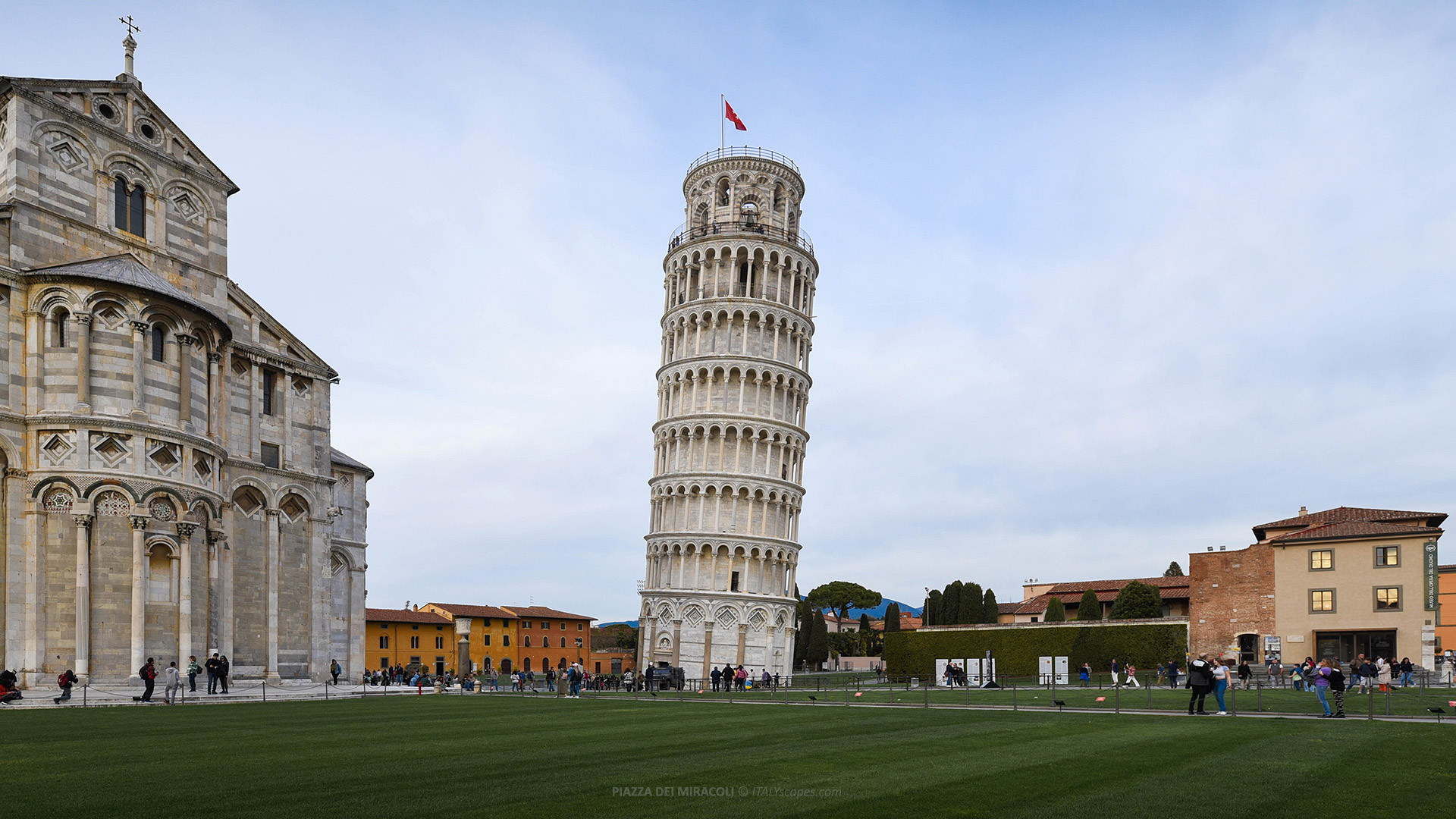
Buy tickets & tours:GetYourGuidePiazza dei Miracoli, officially known as Piazza del Duomo, is the most important artistic and religious space in Pisa. Located in the north-western part of the historic city, the square brings together the Cathedral of Santa Maria Assunta, the Baptistery of San Giovanni, the Leaning Tower, the Camposanto, and two major museums.
The popular name “Square of Miracles” comes from the admiration inspired by the complex. Gabriele d’Annunzio famously described the area as the “Prato dei Miracoli” in his 1910 novel Forse che sì forse che no. The expression later spread widely, especially after the Second World War and during mass tourism.
Since 1987, Piazza dei Miracoli in Pisa has been listed as a UNESCO World Heritage Site. The recognition is based on the exceptional artistic value of the complex, its influence on medieval architecture, and the way its monuments express the religious, civic, and cultural identity of medieval Pisa.
Piazza dei Miracoli is mostly pedestrian and covered by a large lawn, which gives the marble buildings a striking visual unity. Its current open appearance is not entirely medieval. It was shaped especially in the 19th century, when several later constructions were removed and the monuments were restored.
Unlike many Italian cathedral squares, Pisa’s main religious complex is not in the very center of the medieval town. It stands in a more peripheral north-western area, near the archbishop’s seat and close to the old city walls, emphasizing the city’s power, independence, and maritime ambition.
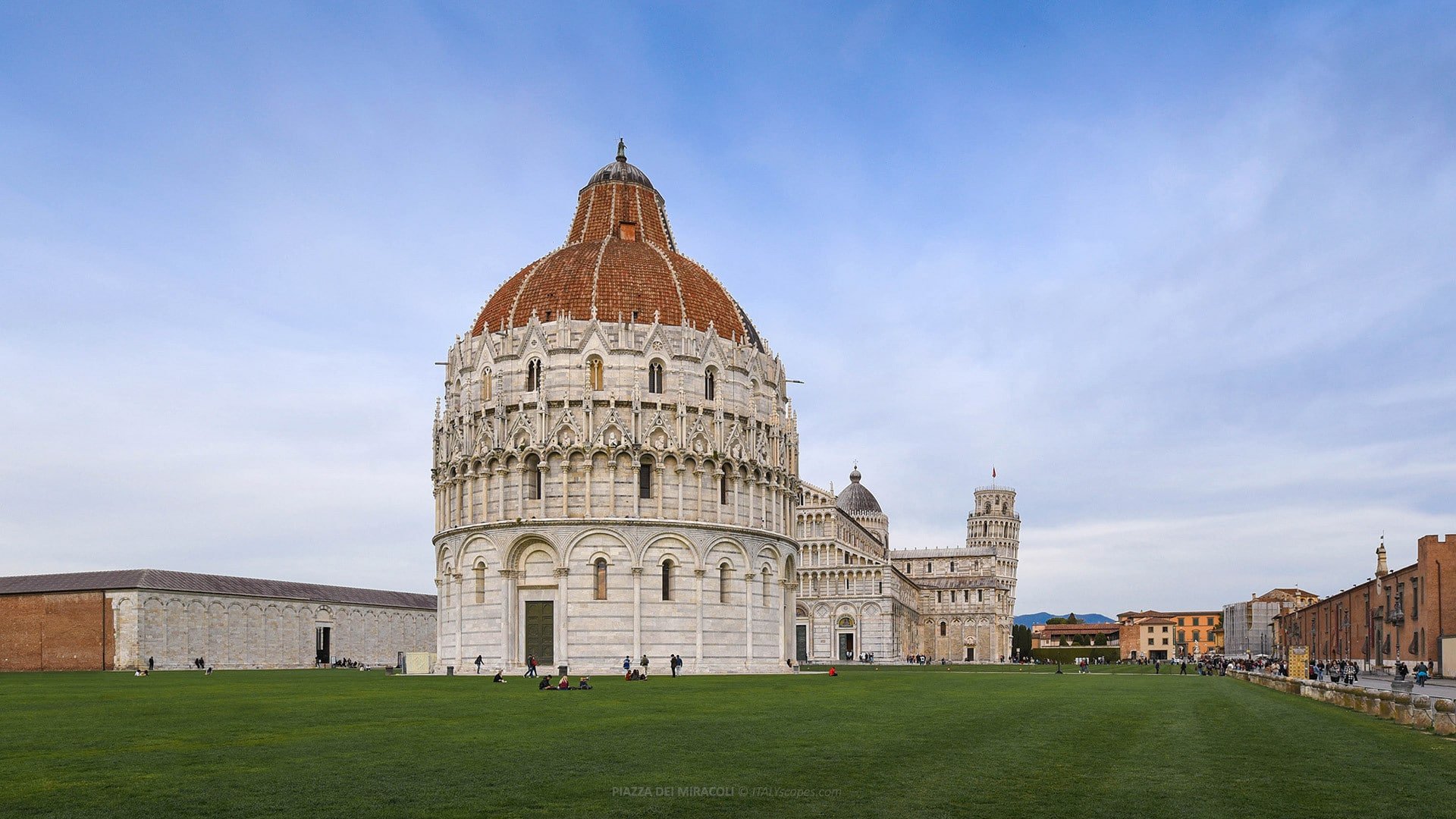
Piazza dei Miracoli, with the the Leaning Tower in the background
Short History of Piazza dei Miracoli
Ancient and Early Medieval Origins
The area occupied by today’s Piazza dei Miracoli was used before the Middle Ages. Archaeological evidence shows activity from the Etruscan and Roman periods. In Roman times, the area was connected to the urban landscape by nearby waterways and probably by a river-port zone located to the east.
Roman remains, including foundations and floor mosaics from two domus, were found between the Cathedral and the Camposanto. Later, after the contraction of the ancient city, the area gradually changed from a civil zone into a sacred one. Lombard-period burials were also found across the square.
By the early Middle Ages, a church probably dedicated to Santa Maria existed in this area. Archaeological excavations confirmed the presence of an earlier religious building, although it appears never to have been fully completed. This phase prepared the ground for the monumental transformation that began in the 11th century.
The Birth of the Cathedral Complex
Piazza dei Miracoli began to take its recognizable form in 1063, or 1064 according to the Pisan calendar then in use, when construction started on the new cathedral dedicated to Santa Maria Maggiore, later Santa Maria Assunta. The project was connected to Pisa’s maritime strength and political ambitions.
At that time, the site still stood outside the city walls. The area was included within the defensive system only in 1156, when the walls were expanded under the consul Cocco Griffi. This enlargement turned the cathedral zone into a monumental entrance to the city’s religious and civic image.
Three years before that expansion, in 1152, construction began on the new Baptistery of San Giovanni. Unlike the earlier baptistery, the new building was placed directly in front of the Cathedral’s western façade. Its diameter corresponded symbolically and visually to the width of the Cathedral façade.
In 1173, construction began on the bell tower, today known worldwide as the Leaning Tower of Pisa. The tower was not designed as a defensive structure. It was the Cathedral’s campanile, built to house bells and to mark sacred and civic time within the religious complex.
Completing the Medieval Frame
Towards the end of the 12th century, the residence of the canons was built south of the bell tower. This construction helped close the eastern side of Piazza dei Miracoli. The medieval complex was therefore not created all at once, but through a long sequence of coordinated architectural additions.
In 1257, the southern side of Piazza dei Miracoli was marked by the Spedale Nuovo di Santo Spirito, a hospital complex. The building later changed functions and today is connected with the Museo delle Sinopie, which preserves the preparatory drawings removed from the frescoes of the Camposanto.
The northern side was defined by the Camposanto, begun in 1277. This monumental cemetery was intended to gather the tombs that had previously been scattered around the Cathedral. Its long marble wall completed the sacred frame of the square and gave the complex a more enclosed, ceremonial form.
The arrangement of the Cathedral, Baptistery, and Tower has often been interpreted as part of a precise plan. Some studies have connected their alignment to symbolic, geometric, or astronomical principles. What is certain is that the three buildings create a powerful architectural dialogue across the lawn.
Medici, Lorraine, and 19th-Century Transformations
The appearance of Piazza dei Miracoli changed significantly during the Medici period. The old Porta del Leone was closed, and a new entrance, Porta Nuova, was opened on the western side. The hospital was also modified in a Florentine style, losing much of its original Gothic character.
During the Medici and Lorraine periods, several additional buildings appeared in the open spaces of Piazza dei Miracoli. These included residences, service buildings, enclosures, and structures near the bell tower, the Baptistery, and the city walls. The medieval openness of the complex was therefore gradually reduced.
In the 19th century, the architect Alessandro Gherardesca played a decisive role in restoring the square’s monumental appearance. Many later constructions were demolished in an attempt to recover what was understood as the original visual order of the medieval complex.
By the end of the 19th century, most of the buildings added during the Medici-Lorraine period had been removed. This intervention created the wide lawn and open perspectives that visitors recognize today. The present image of Piazza dei Miracoli is therefore partly medieval and partly modern restoration.
20th-Century Changes and Modern Context
At the beginning of the 20th century, new symbolic elements were added. A monument of the Roman she-wolf was placed near the bell tower, and seventeen cypresses were planted along the eastern side of Piazza dei Miracoli in memory of seventeen deceased Fascist militants.
Between 1912 and 1952, Piazza dei Miracoli was also affected by the presence of tram tracks and a dedicated stop belonging to Pisa’s tram network. This detail is striking today, because the modern visitor experiences the square as a pedestrian monumental area rather than a transport corridor.
In the 21st century, the area around the former Santa Chiara hospital has remained part of broader urban and cultural planning. The historic core of Piazza dei Miracoli, however, continues to be managed by the Opera della Primaziale Pisana, the institution responsible for preserving and promoting its religious and artistic heritage.
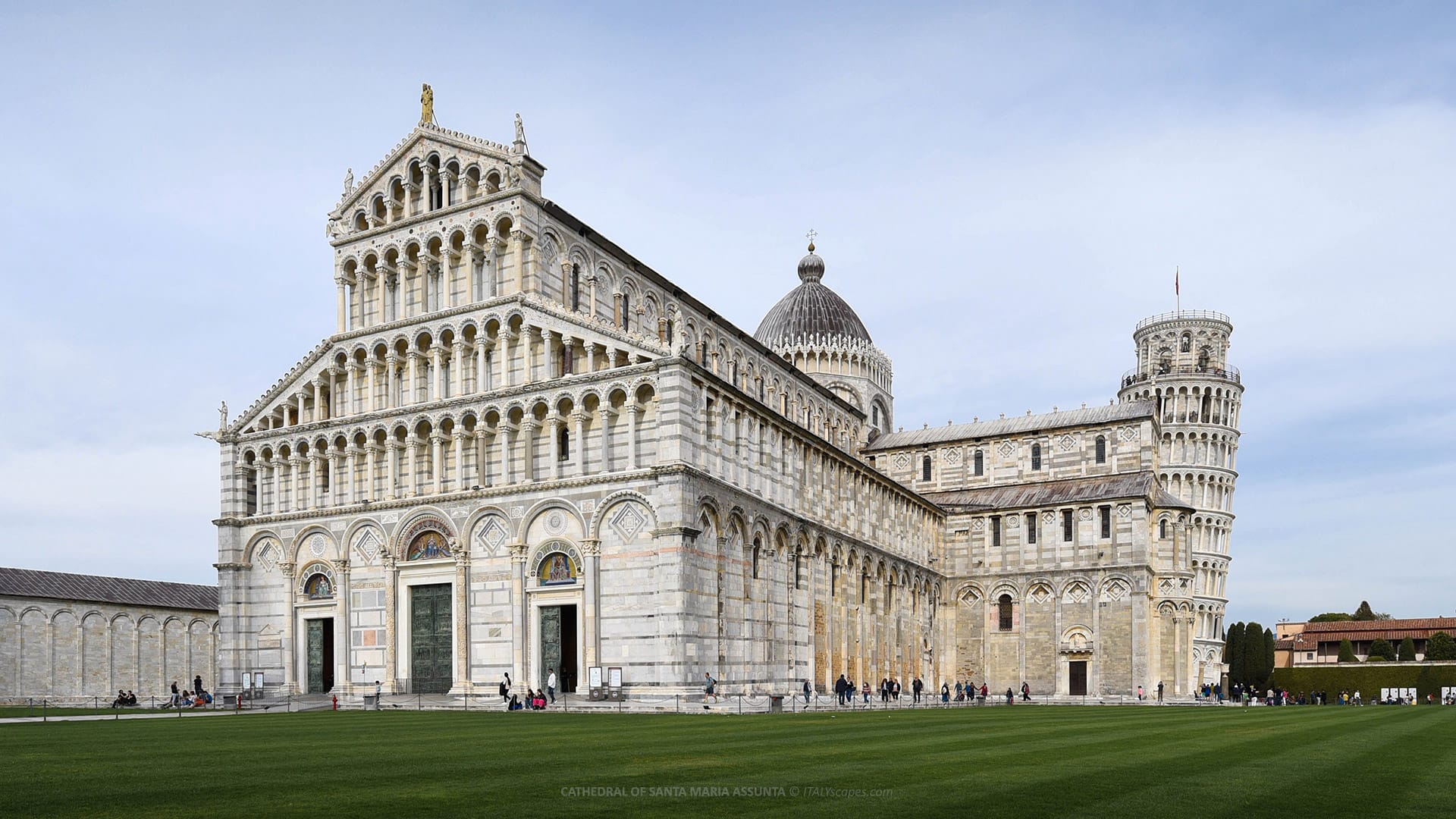
Cathedral of Santa Maria Assunta
Architecture of Piazza dei Miracoli
The Architectural Unity of Piazza dei Miracoli
Piazza dei Miracoli is one of the clearest expressions of Pisan Romanesque architecture, a style that combines classical, early Christian, Lombard, Islamic, and Mediterranean influences. White marble, blind arcades, galleries, columns, and alternating decorative rhythms create a strong unity between buildings built in different centuries.
The four main monuments can also be read as an allegory of human life. The Baptistery represents birth through baptism, the Cathedral represents Christian worship and community, the Tower marks time through its bells, and the Camposanto represents death, memory, and the hope of salvation.
The lawn is not a secondary element. It gives visual space to the monuments and separates them from the surrounding city. The green surface makes the white and grey marble more visible, while the open arrangement allows visitors to understand the relationship between the buildings at a glance.
Cathedral of Santa Maria Assunta
The Cathedral of Santa Maria Assunta is the heart of the complex. Founded in 1064 and solemnly consecrated on 26 September 1118, it was built in two major phases. The first is linked to Buscheto, and the second to Rainaldo, who extended the building and completed the façade.
The Cathedral has a five-nave basilican body, a three-nave transept, and a dome over the crossing. Its plan is unusually complex, almost like three basilicas joined together: the central body and the two arms of the transept. It is Pisa’s cathedral and archiepiscopal seat.
The exterior uses white and dark marble contrasts, with decorative elements of Mediterranean and Islamic inspiration. Reused Roman materials were incorporated to underline Pisa’s prestige. The façade, arcades, lozenges, bronze ornaments, and sculptural details announce a maritime republic open to artistic influences from many regions.
Inside, the central nave is separated by granite columns, with smaller colonnades dividing the side aisles. Above them extend broad galleries. The wooden coffered ceiling, added in the 17th century, replaced the original visible roof trusses and contributes to the rich post-medieval interior appearance.
The Cathedral was severely damaged by the fire of 1595, which destroyed many medieval works. The apse mosaic survived, including the figure of Saint John the Evangelist attributed to Cimabue. Giovanni Pisano’s pulpit, made between 1302 and 1310, also survived but was later dismantled and reassembled.
Baptistery of San Giovanni
The Baptistery of San Giovanni stands directly in front of the Cathedral façade. It was founded on 15 August 1152 as a monumental complement to the Cathedral. Its position, scale, material, and style were carefully chosen to correspond to the older church and complete the liturgical sequence.
The essential structure of the Baptistery is attributed to Diotisalvi, who directed the works from 1152 until about 1180. An inscription inside the building identifies him as the master of the work. By 1185, solemn ceremonies were already being held inside the building.
The Baptistery was later transformed by Nicola Pisano and Giovanni Pisano. Around the mid-13th century, Guido Bigarelli da Como created the octagonal baptismal font. Nicola Pisano made the celebrated pulpit in 1260, an important work that helped mark the rebirth of monumental sculpture in Italy.
The building is exceptionally large. Its circumference measures 107.24 meters, and the wall at the base is 2.63 meters thick. It reaches a height of 54.86 meters, making it the largest baptistery in Italy. The interior remains sober, spacious, and strongly geometric.
The roof structure explains the Baptistery’s famous acoustics. It has a double cupola: an internal truncated-cone dome and an external hemispherical shell. This system creates a powerful reverberation, turning the interior into a natural resonating chamber often described as a kind of architectural musical instrument.
Leaning Tower of Pisa
The Leaning Tower is the bell tower of the Cathedral, not a defensive tower. Construction began in 1173, and the building started to lean before the third order was completed. The cause was the unstable sandy and silty soil beneath shallow foundations, only about 3 meters deep.
The tower’s function was liturgical and civic. Its seven bells marked sacred time, religious ceremonies, and the rhythm of the city. The largest bell, cast in 1655, weighs about 3.5 tons. The number of bells corresponds to the seven musical notes.
Official technical data gives the tower a height of 58.36 meters, an external diameter of about 15 meters, and a weight of 14,453 tons. It contains 29,424 stone blocks, 7,735 square meters of stone surfaces, 207 capitals, and 273 steps.
Architecturally, the Tower repeats motifs found in the Cathedral façade. Six of its levels are surrounded by loggias with round arches. The repeated columns, arcades, and marble surfaces connect it visually with the rest of Piazza dei Miracoli, even though its tilt has made it uniquely famous.
The Tower was stabilized through major modern restoration works and later reopened to visitors with controlled access. Its lean remains essential to its identity, but today it is also valued as part of a larger religious and architectural composition, not merely as an isolated curiosity.
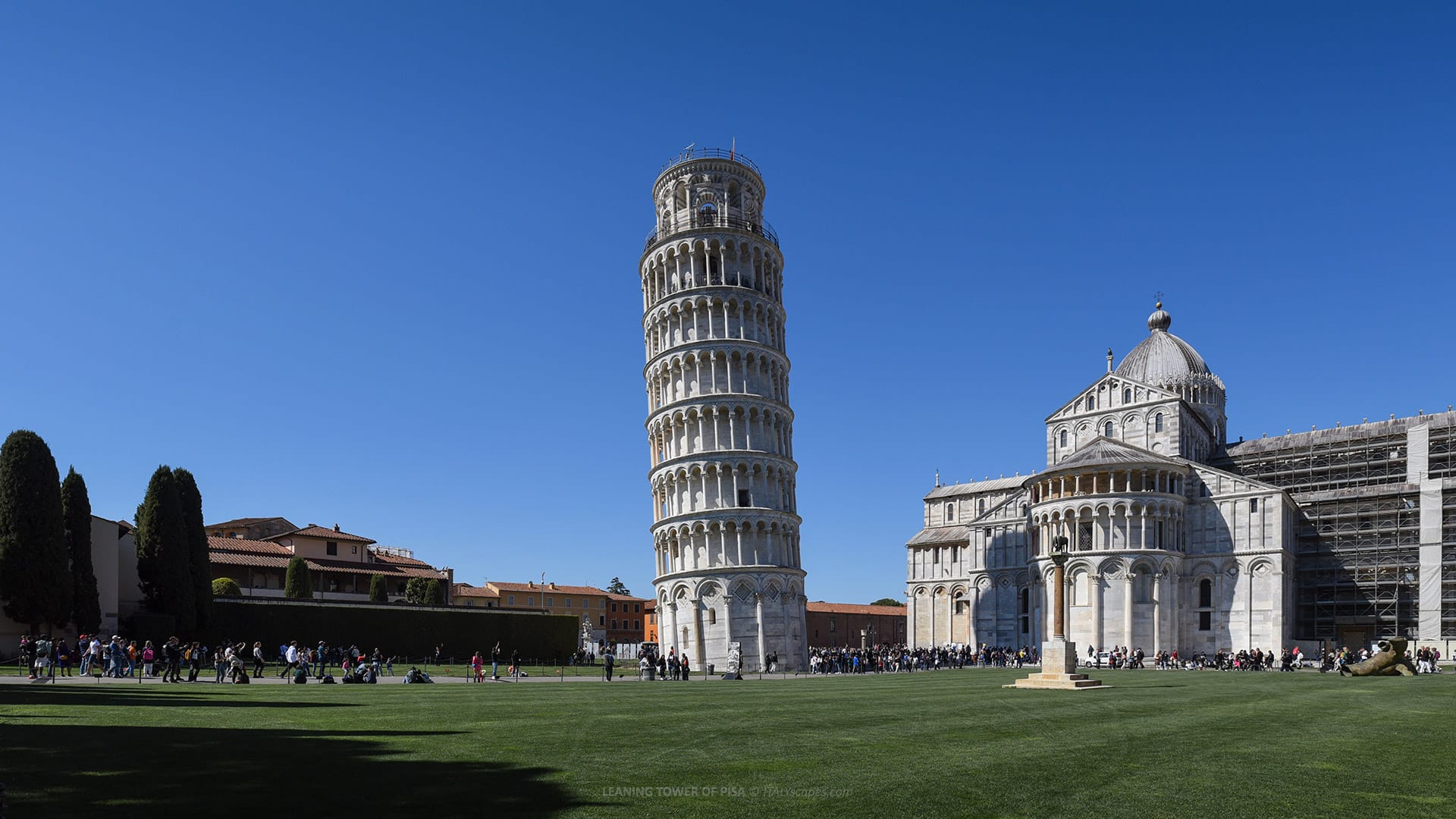
Camposanto
The Camposanto stands along the northern edge of the square and completes the monumental frame of Piazza del Duomo. It was founded in 1277 to receive the tombs that had previously been placed around the Cathedral. It is one of the most important medieval Christian cemeteries in Europe.
The building was planned as a dignified, enclosed, and separate place for the dead. According to tradition, the central ground contained holy earth brought from Palestine during the time of the Crusades. Initially, sarcophagi were placed in the open central area, while humbler burials occupied the side corridors.
The structure is an elongated cloister with a long marble exterior wall. Construction began under Giovanni di Simone and continued for centuries, with completion only in the 15th century. The exterior wall includes 43 blind arches and gives the northern side of Piazza dei Miracoli its austere rhythm.
During the 14th century, the inner walls were decorated with large fresco cycles dedicated to life, death, judgment, biblical history, and the saints of Pisa. Artists connected with these works include Francesco Traini, Bonamico Buffalmacco, Taddeo Gaddi, Piero di Puccio, and Benozzo Gozzoli.
The Camposanto later became a kind of local pantheon. From the 16th century onward, it housed the tombs of distinguished professors from the University of Pisa and members of important families. In the early 19th century, it also developed into one of Europe’s early public museums.
Museo delle Sinopie
The Museo delle Sinopie is housed in the former hospital building on the southern side of Piazza dei Miracoli. The structure originated in the area of a medieval hospital and was connected with the Spedale Nuovo di Santo Spirito, begun in 1257 and associated with care for pilgrims, the poor, and the sick.
The museum preserves the sinopie removed from the walls of the Camposanto. A sinopia is the preparatory drawing made on the first layer of plaster before the final fresco was painted. It was usually hidden beneath the finished image, making these works rare witnesses to medieval artistic process.
The sinopie came to light after the disastrous fire that damaged the Camposanto during the Second World War. The frescoes had to be detached for restoration, and this process revealed the underlying red preparatory drawings. Since 1979, they have been displayed in the present museum.
The collection allows visitors to compare the working methods of artists such as Bonamico Buffalmacco, Taddeo Gaddi, Pietro di Puccio, and Benozzo Gozzoli. It preserves one of the most extensive known groups of 14th- and 15th-century graphic works connected with monumental fresco painting.
Museo dell’Opera del Duomo
The Museo dell’Opera del Duomo is located near the Tower and preserves works originally connected with the Cathedral, Baptistery, Tower, and other monuments of the square. A first small collection was displayed in 1935, but the museum as a major institution opened in 1986.
The museum was created to protect and present sculptures, fragments, liturgical objects, and works removed from the monuments for conservation reasons. Its collections help visitors understand how the square developed artistically over time and how medieval sculpture, metalwork, painting, and liturgical art shaped its identity.
The modern museum route includes the Porta di Bonanno, Romanesque sculpture from the Cathedral, works connected with the Baptistery, and major pieces related to Nicola and Giovanni Pisano. The display also includes sacred furnishings, textiles, goldsmith work, reliquaries, books, and objects used in religious ceremonies.
The museum was reorganized with a new display completed in 2019. This renewed arrangement gives priority to the original relationship between the works and the monuments. From parts of the museum, visitors can also enjoy important views toward the Tower and the marble buildings of the square.
Other Architectural Elements in the Square
Piazza dei Miracoli is also defined by the medieval walls to the north and west. Important surviving elements include Porta Nuova, Porta del Leone, the Tower of Santa Maria, and the Tower of Catallo. These structures remind visitors that the sacred complex was also tied to Pisa’s defensive perimeter.
On the southern side, the long former hospital structure contributes to the architectural boundary of the square. Today, part of this historic building is connected with the Museo delle Sinopie.
Near the entrance from Via Santa Maria stands the Fontana dei Putti. Its base and fountain were made by Giuseppe Vaccà, while the marble group of putti holding the coats of arms of Pisa and the Opera was made by Giovanni Antonio Cybei.
Other features include the Roman she-wolf monument near the Tower and the column connected with the so-called “vase of talent” tradition near Porta di San Ranieri. These objects are less famous than the main monuments, but they add layers of civic memory to the square.
How to Get to Piazza dei Miracoli
Getting to Piazza dei Miracoli on foot
Pisa Centrale railway station is about 2 kilometers from Piazza dei Miracoli. The walk usually takes around 25 to 30 minutes, depending on pace and stops. A common route leads through the historic center, crossing the Arno and continuing toward Via Santa Maria.
Walking from Pisa Centrale is a good option for visitors who want to see more of the city before reaching the monumental square. The route is mostly urban and straightforward, and the first view of the Cathedral, Baptistery, and Tower through the western approach is memorable.
Pisa San Rossore station is much closer, located only a few hundred meters from Piazza dei Miracoli. This can be the most convenient rail option for visitors arriving from certain regional routes. From there, the monuments can be reached on foot in a short and simple walk.
Getting to Piazza dei Miracoli by bus
From Pisa Centrale, the official visitor route includes several bus options. Line 1+ runs from Stazione 1 toward Park Pietrasantina and stops at Torre 1. Line 4 runs from Stazione 8 to Del Parlascio, while Line 21 operates at night from Stazione 5 to Torre 1.
Visitors can also use buses departing from the Sesta Porta bus station in Via Battisti. Lines 60, 70, 80, 120, and 130 stop at Torre 1. These options are useful for travelers who prefer not to walk the full distance from Pisa Centrale.
From Pisa Airport, the practical route is to take the PisaMover to Pisa Centrale and then continue by bus or on foot. This keeps the journey simple and connects the airport with the main rail and urban transport network before reaching the monumental area.
Getting to Piazza dei Miracoli by taxi
Taxi is a practical option for visitors arriving with luggage, traveling in a group, or coming directly from Pisa Centrale or Pisa Airport. Since Piazza dei Miracoli itself is pedestrianized, taxis normally drop visitors near the access points around the monumental area rather than directly on the lawn.
A taxi from Pisa Centrale is usually the simplest choice for a short transfer when time is limited. From the airport, taxi can also be convenient because the distance across Pisa is not large. Visitors should always confirm the fare or meter use before starting the ride.

Baptistery of San Giovanni
Frequently Asked Questions about Piazza dei Miracoli
What is Piazza dei Miracoli?
Piazza dei Miracoli is the famous monumental square of Pisa, officially called Piazza del Duomo. It includes the Cathedral, Baptistery, Leaning Tower, Camposanto, and two important museums.
Why is it called Piazza dei Miracoli?
The name comes from Gabriele d’Annunzio, who described the square as a “prato dei Miracoli” because of the beauty and harmony of its white marble monuments.
What monuments are in Piazza dei Miracoli?
The main monuments are Pisa Cathedral, the Baptistery of San Giovanni, the Leaning Tower of Pisa, and the Camposanto. The square also includes the Opera del Duomo Museum and Sinopie Museum.
How much does it cost to visit Piazza dei Miracoli?
Walking around the square is free. Current tickets include Tower + Cathedral for €20, Complete Visit without Tower for €11, Complete Visit + Tower for €27, and Cathedral + one monument for €8.
Is Pisa Cathedral free to visit?
Yes, Pisa Cathedral can be visited with a free pass. Visitors who buy any monument ticket receive Cathedral access, while Cathedral-only passes are available from the ticket offices on site.
Can you climb the Leaning Tower of Pisa?
Yes, visitors can climb the Leaning Tower with a timed ticket. Access is limited, the staircase has 273 steps, and children under 8 are not allowed for safety reasons.
How do you get to Piazza dei Miracoli?
From Pisa Centrale, the square is about 2 kilometers away and can be reached on foot in 25-30 minutes. Pisa San Rossore station is much closer.
Sources:Buy tickets & tours:GetYourGuide -
Photos
-
Map
-
Reviews