-
About
Table of Contents
Palio di Siena 2027 will take place twice during the summer, on Friday, July 2, and Monday, August 16, following the traditional calendar established for Siena‘s two ordinary annual Palii. Both horse races are held in Piazza del Campo, at the center of Siena’s UNESCO-listed historic district.
The July race is the Palio di Provenzano, dedicated to the Madonna of Provenzano, whose image is venerated in the Basilica of Santa Maria in Provenzano. The August race is the Palio dell’Assunta, associated with the Assumption of the Virgin Mary, historically central to Siena’s religious identity.
Only ten of Siena’s seventeen Contrade compete in each race. The horses are assigned by lot three days beforehand, while every Contrada independently chooses its jockey. The race itself consists of three circuits of Piazza del Campo, covering approximately one kilometer on a specially prepared track.
The Palio is organized by the Municipality of Siena, but its meaning extends far beyond race day. Contrade function throughout the year as territorial communities with elected institutions, museums, oratories, meeting places, ceremonies, celebrations, rivalries, and social activities that remain integral to everyday Sienese life.
When Will Palio di Siena 2027 Take Place?
The first race of 2027, the Palio di Provenzano, is scheduled for Friday, July 2. The second, the Palio dell’Assunta, takes place on Monday, August 16. These are the regular dates fixed for Siena’s two annual Palii and remain the same from year to year.
Each Palio develops over four principal days. For the July race, the horse assignment takes place on June 29, followed by trials through July 2. The equivalent August sequence begins with the Tratta on August 13 and concludes with the race on August 16.
The festivities culminate on race day, but many important ceremonies occur beforehand. Visitors arriving several days early can see the horse selection, assignment ceremony, six trial races, Contrada gatherings, and Prova Generale, providing a more complete understanding of the Palio than the final race alone.
What Is the Calendar of Palio di Siena 2027?
For the July Palio, June 29 begins with the veterinary examination and selection of horses, followed by La Tratta, when ten horses are randomly assigned to the participating Contrade. The first trial is held that evening, beginning a sequence of six official trials.
On June 30 and July 1, morning and evening trials continue. The fifth trial, held on the evening before the Palio, is the Prova Generale. Afterward, each participating Contrada traditionally holds a large dinner bringing together residents, members, guests, the jockey, and the community surrounding the assigned horse.
On July 2, the Mass of the Jockeys is traditionally celebrated at around 8:00 AM, followed by the Provaccia at 9:00 AM. Horse blessings take place around mid-afternoon. The Historical Parade normally enters Piazza del Campo around 5:20 PM, with the horses emerging for the race at approximately 7:30 PM.
The August schedule follows the same structure beginning on August 13. The Provaccia is held at 9:00 AM on August 16, followed by the afternoon blessings and procession. Because sunset arrives earlier, the Historical Parade traditionally enters the Campo around 4:50 PM and the horses emerge at approximately 7:00 PM.
Where Will Palio di Siena 2027 Take Place?
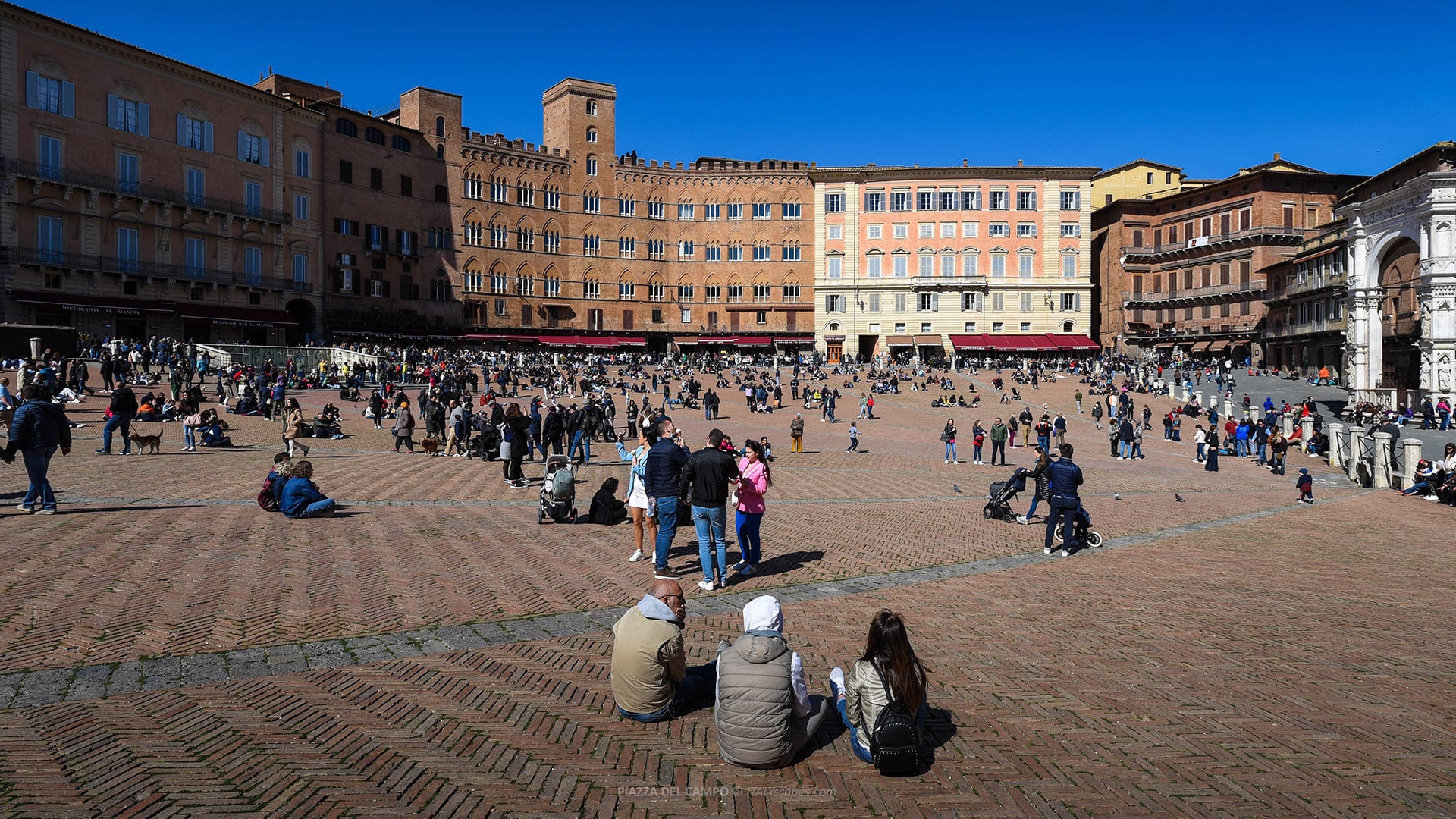
Both races take place in Piazza del Campo, the civic center of medieval Siena. The square becomes a temporary racecourse when its outer perimeter is covered with a specially prepared mixture containing tuff and sand, creating the track used by the ten participating horses.
The Palio also extends through the surrounding city. Contrada oratories host horse blessings, processions move along historic streets, the participants assemble around Piazza del Duomo, and celebrations after the race continue in the territory of the winning Contrada and at the church associated with the respective July or August dedication.
About Siena
Siena lies in central Tuscany, approximately 50 kilometers south of Florence. The historic city developed across three hills in a landscape of rolling ridges and valleys, while its three principal medieval urban axes converge near Piazza del Campo, creating the distinctive Y-shaped structure of the old city.
The walled historic center occupies an elevated position amid the Tuscan countryside, surrounded by agricultural land, vineyards, olive groves, wooded areas, and clay hills. The wider province extends toward Chianti in the north, Val d’Orcia in the southeast, Val di Chiana in the east, and the Maremma toward the southwest.
Siena retains an unusually coherent medieval and Gothic urban landscape. Its approximately seven kilometers of historic walls follow the contours of the hills, enclosing streets, tower houses, palaces, churches, gardens, fountains, and the territories traditionally belonging to the seventeen Contrade.
The Historic Centre of Siena became a UNESCO World Heritage Site in 1995. Its international significance is based on its preserved medieval urban form, Gothic architecture, relationship with the surrounding landscape, and the influence of Sienese artists including Duccio, Simone Martini, and Ambrogio and Pietro Lorenzetti.
What Is the Venue of Palio di Siena 2027?
Piazza del Campo developed where Siena’s three hills converge and gradually became the city’s principal civic space. Its characteristic shell-like form descends toward Palazzo Pubblico and is divided by paving lines into nine sectors traditionally associated with the Government of the Nine, which governed Siena during an important period of medieval prosperity.
The Palazzo Pubblico dominates the lower side of the square. Construction began in 1297, while the adjoining Torre del Mangia was built during the following century. Inside the palace, the Museo Civico preserves major works including Simone Martini’s Maestà and Ambrogio Lorenzetti’s Allegory and Effects of Good and Bad Government.
On the opposite side stands Fonte Gaia, represented today by a nineteenth-century reconstruction of Jacopo della Quercia’s fifteenth-century fountain. The original sculptural elements were moved for conservation and can be seen within the Santa Maria della Scala museum complex near Siena Cathedral.
For the Palio, the outer circumference of the Campo becomes a three-lap racecourse measuring approximately one kilometer in total. The route includes the demanding San Martino bend, approached downhill, and the Casato curve before the horses return toward the finishing area.
Spectators can watch from the interior of Piazza del Campo free of charge, subject to capacity and access restrictions. Paid viewing is available from temporary grandstands, windows, and balconies around the square, which are managed individually rather than through one centralized municipal ticket office.

Piazza del Campo
A Short History of Palio di Siena
Horse racing in Siena predates the modern Palio. Medieval competitions included palii alla lunga, races following routes through the city and usually finishing near the Cathedral. The prize was a valuable cloth known as a pallium, the term from which the modern name “Palio” ultimately derives.
During the Renaissance and early seventeenth century, Siena also staged bull hunts, buffalo races, donkey races, tournaments, and other public competitions. Piazza del Campo increasingly became the setting for civic spectacle, and in 1605 a formal proposal was submitted to the municipal authorities to hold the horse race inside the square.
The first documented Palio run “alla tonda” around Piazza del Campo appears to date from 1633. The decisive development came in 1656, when the circular Palio acquired a regular structure and became associated with the cult of the Madonna of Provenzano.
Several defining rules emerged during the seventeenth century. Jockeys were required to ride bareback from 1657, while systems for selecting and randomly assigning horses developed during the following decades. The principle that the horse itself could win even after losing its jockey also became established.
In 1721, the Collegio di Balìa issued regulations that formed an important basis for the modern Palio rules. The following decades consolidated the structure of the races, the institutions of the Contrade, the ceremonies surrounding the competition, and the relationship between civic authorities and participating neighborhoods.
When Was the Second Palio Added?
The July Palio originally became the principal regular circular race. A second race in August developed gradually. In 1689, the victorious Istrice organized a Palio on August 16, providing an important precedent for what later became the regular Assumption race.
The decisive initiative came from Contrada dell’Oca in 1701. After winning the July race, Oca proposed using its prize to finance another Palio on August 16 for the Assumption festivities. The August race subsequently developed into a regular tradition, and in 1774 the municipality standardized the organization of both Palii.
How Many Contrade Exist Today?
Medieval Siena contained many more neighborhood divisions than the present city. During the fourteenth century, sources record 42 Contrade, a number that declined considerably after the Black Death of 1348 and through the gradual transformation of Siena’s military, civic, and social organizations.
The boundaries of the seventeen surviving Contrade were formally established in 1729 under Violante Beatrice of Bavaria, Governor of Siena. Those seventeen remain unchanged: Aquila, Bruco, Chiocciola, Civetta, Drago, Giraffa, Istrice, Leocorno, Lupa, Nicchio, Oca, Onda, Pantera, Selva, Tartuca, Torre, and Valdimontone.
Every Contrada represents a specific territory inside Siena’s walls and maintains its own symbols, colors, governing institutions, patronal celebrations, oratory, fountain, museum collections, social facilities, alliances, and rivalries. Membership can remain a defining element of personal and family identity throughout a Sienese resident’s life.
How Are the Participants Selected?
Only ten Contrade participate in each Palio. Seven enter automatically because they did not race in the corresponding Palio during the previous year. Three additional Contrade are selected by lottery from among the ten that participated in that race one year earlier.
For the July Palio, the draw traditionally occurs on the last Sunday in May. For the August race, the three additional participating Contrade are drawn on the first Sunday after the July Palio. This rotation guarantees opportunities to participate while preserving an unpredictable element.
The horses are selected separately. Before La Tratta, candidate horses undergo veterinary assessments and regulated trials designed to evaluate their health and suitability for Piazza del Campo. Ten are eventually chosen and assigned randomly to the ten Contrade, meaning no neighborhood can simply acquire its preferred racehorse.

Cathedral of Santa Maria Assunta
Palio di Siena Today
The contemporary Palio continues to operate according to detailed municipal regulations while remaining closely connected with Contrada life. The race is only the visible conclusion of months of organizational activity involving historical groups, musicians, flag-bearers, officials, jockey negotiations, ceremonial planning, costume maintenance, dinners, and community events.
Contrade participate in the Palio as living institutions rather than temporary festival teams. Their activities continue throughout the entire year, and victory is celebrated collectively within the neighborhood, while defeats and rivalries become part of an ongoing historical record remembered across generations.
Months of Preparation
Preparations extend well beyond the four official days. Contrade organize finances, maintain ceremonial costumes, train drummers and flag-bearers, prepare their historical procession groups, hold assemblies, follow the available jockeys, and plan the social activities surrounding both the July and August races.
Horse preparation is managed through a municipal system rather than by each Contrada months in advance. Candidate animals participate in a training and selection protocol, including veterinary pre-visits and regulated practice sessions before being admitted to La Tratta and becoming eligible for random assignment.
The Assignment of the Horses – La Tratta
La Tratta takes place on June 29 and August 13, three days before the respective races. Horse owners present eligible animals at the Cortile del Podestà, where veterinary professionals assess them before they are divided into groups and tested for three circuits of the Campo.
The captains of the participating Contrade select ten suitable horses from the approved group. A public draw then pairs each horse with a Contrada. The Barbaresco, responsible for caring for the animal, takes possession of the assigned horse and accompanies it to the Contrada stable with residents of the neighborhood.
Test Races
There are six official trials between La Tratta and the Palio. They begin on the afternoon when the horses are assigned and continue each morning and evening. The trials allow jockeys to learn the characteristics of their randomly assigned horses and evaluate their behavior on the unusual Piazza del Campo track.
The fifth trial is the Prova Generale, held on the evening before the race and followed by traditional dinners in the participating neighborhoods. The final trial, the Provaccia, takes place on race morning and is normally approached cautiously because the principal competition follows later that day.
The Historical Parade – Corteo Storico
Before the race, the Corteo Storico moves through central Siena and enters Piazza del Campo. Its modern form commemorates the institutions and civic culture of the former Republic of Siena, with the seventeen Contrade providing the principal groups of costumed participants.
The procession comprises almost 700 participants organized into fourteen groups. It includes drummers, flag-bearers, representatives of the Contrade, civic and military figures, historic institutions, musicians, and the Carroccio carrying the Drappellone. A mounted Carabinieri detachment also performs its traditional passage before the main procession enters the Campo.
The Race – 90 Seconds of Chaos and Passion
The ten jockeys ride without saddles. Nine horses line up between two starting ropes, known as the canapi, in an order established by lot. The tenth Contrada remains outside as the rincorsa and enters when its jockey chooses, triggering the starting procedure controlled by the Mossiere.
Each jockey receives a nerbo, traditionally made from ox sinew, which may be used after the permitted starting point both to encourage the horse and to hinder rival jockeys and horses. The official regulations govern its use, making direct tactical confrontation an established component of the race.
The horses complete three laps for approximately 1,000 meters. San Martino, approached downhill, is one of the most technically difficult points, while the Casato corner creates another major change of direction. The entire race commonly lasts only around a minute and a half.
The horse, not the jockey, is the decisive competitor. A horse that loses its rider can continue racing and can legally win if it completes the course first. Such a horse is called scosso, and victories without a jockey form part of Palio history.
The Prize – The Drappellone
The winning Contrada receives the Drappellone, also called the Palio or, colloquially in Siena, the Cencio. It is an original work created on an elongated piece of silk and becomes the permanent property of the victorious Contrada, where it is preserved among previous trophies.
Each Drappellone must follow an established iconographic framework. The July banner includes the image of the Madonna of Provenzano, while the August banner represents the Virgin of the Assumption. Municipal and Contrada symbols are incorporated into an original composition created specifically for that race.
After victory, the Contradaioli take the Drappellone to Santa Maria in Provenzano in July or Siena Cathedral in August for the Te Deum. Celebrations continue through the summer and culminate in the autumn victory dinner, at which the victorious horse traditionally occupies a place of honor.
Piazza del Campo
Beyond Palio di Siena 2027
The days surrounding the races offer opportunities to explore Siena’s medieval architecture and art, although the historic center becomes exceptionally busy. Many of the city’s major monuments lie only a few minutes apart on foot, particularly between Piazza del Campo and Piazza del Duomo.
What to Visit in Siena
The Siena Cathedral is one of Tuscany’s major Gothic churches, distinguished by its striped marble architecture, sculptural decoration, library, chapels, and extraordinary inlaid marble floor. The surrounding complex includes the Baptistery, Crypt, Museo dell’Opera, and panoramic structures associated with the unfinished expansion of the cathedral.
Opposite the Cathedral, Santa Maria della Scala occupies a former hospital complex that served pilgrims travelling along the Via Francigena. Its extensive interiors contain archaeological collections, medieval spaces, chapels, fresco cycles, underground passages, and material documenting centuries of Sienese civic and charitable history.
The Palazzo Pubblico and Museo Civico provide direct access to Siena’s political and artistic history. The museum contains celebrated medieval frescoes, while the adjoining Torre del Mangia rises above Piazza del Campo and provides extensive views across the roofs, hills, and countryside surrounding the city.
The Basilica of San Domenico stands on a separate hill overlooking parts of the old center. Closely associated with Saint Catherine of Siena, the large Gothic church contains important relics and artworks connected with the saint, whose family home and sanctuary are located nearby.
Visitors interested in Sienese painting can explore the Pinacoteca Nazionale, whose collections include works by Duccio, Simone Martini, the Lorenzetti brothers, Sano di Pietro, Giovanni di Paolo, Il Sodoma, and Domenico Beccafumi, documenting the distinctive development of the Sienese school from the Middle Ages onward.
Nearby Cities and Day Trips
Monteriggioni is one of the closest excursions from Siena. The small fortified settlement was founded by the Sienese in the thirteenth century and retains a nearly complete ring of defensive walls and towers around its compact center, historically positioned to control routes toward Florence.
Farther northwest, San Gimignano is known for the medieval towers that dominate its skyline. Its UNESCO-listed center, civic palaces, churches, museums, and position amid the Val d’Elsa countryside make it one of the most practical full-day destinations from Siena.
South of Siena, the Val d’Orcia contains Pienza, San Quirico d’Orcia, Montalcino, and landscapes of cultivated hills, cypress-lined roads, vineyards, and historic settlements. Montalcino is particularly associated with Brunello wine, while Pienza is renowned for its Renaissance urban design and pecorino cheese.
Travelers interested in wine can instead explore Chianti, north of Siena, or visit Montepulciano between Val d’Orcia and Val di Chiana. A car offers the greatest flexibility for rural excursions because many villages and wine estates are not connected by frequent public transport.
What to Eat
Siena’s most characteristic pasta is pici, thick strands traditionally rolled by hand. Common preparations include pici all’aglione with garlic and tomato, pici with breadcrumbs, meat ragù, or sauces incorporating local ingredients. The simplicity of the pasta reflects the agricultural origins of much Tuscan cuisine.
Local savory products include Cinta Senese cured meats, pecorino cheese, crostini with chicken-liver pâté, wild boar dishes, grilled meats, and soups based on bread, vegetables, and legumes. Cinta Senese is a traditional Tuscan pig breed closely associated with the countryside around Siena.
Siena has an especially important tradition of spiced and almond-based sweets. Panforte combines dried and candied fruit, honey, nuts, and spices, while ricciarelli are soft almond pastries traditionally covered with powdered sugar. Other local sweets include cavallucci, panpepato, copate, and pan co’ santi.
The surrounding province also produces major Tuscan wines, including Chianti Classico, Brunello di Montalcino, Vino Nobile di Montepulciano, and Vernaccia di San Gimignano. Their production areas can be explored independently as day trips from Siena.

Frequently Asked Questions about Palio di Siena 2027
When will Palio di Siena 2027 take place?
The two regular races are scheduled for July 2 and August 16, 2027, the traditional dates of the Palio di Provenzano and Palio dell’Assunta.
Where is Palio di Siena 2027 held?
Both races take place in Piazza del Campo, Siena’s shell-shaped medieval civic square, which is temporarily transformed into a three-lap horse-racing track.
How many Contrade participate in each Palio?
Exactly ten of Siena’s seventeen Contrade compete in each race: seven qualify automatically and another three are chosen by lottery.
How are the horses assigned to the Contrade?
During La Tratta, ten suitable horses are selected after veterinary checks and testing, then randomly assigned to the participating Contrade three days before the race.
Can a horse win without its jockey?
Yes. A scosso horse that has lost its jockey can still win for its Contrada if it completes the three laps and reaches the finish first.
How long does the Palio race last?
The horses complete approximately one kilometer over three laps, and the actual race generally lasts around 90 seconds, although the starting procedure can take considerably longer.
Is it free to watch the Palio di Siena 2027?
Watching from the interior of Piazza del Campo is free, subject to capacity restrictions. Grandstands, windows, terraces, and balconies overlooking the track require payment.
What is the Drappellone?
The Drappellone is the painted silk banner awarded to the winning Contrada. A different artist creates an original design for each July and August race.
-
Photos
-
Video
Table of Contents
-
Map
-
Reviews
2 July 2027