


-
About
Table of Contents
At the heart of Siena – a city perched among the hills of Tuscany – lies the magnificent shell-shaped square known as Piazza del Campo.
This medieval piazza is not only the symbolic and civic center of the city, but also one of the most beautiful and architecturally coherent urban spaces in Europe.
With its distinctive downward slope, brick pavement, surrounding historic buildings, and the soaring bell-tower that watches over it all, Piazza del Campo offers a unique blend of history, design, urban poetry, and vibrant living tradition.
Over centuries, it has borne witness to markets, civic gatherings, dramatic events, and – twice each year – the incomparable spectacle of the Palio.
Whether you stroll its bricks in the soft glow of dawn, sip a drink beside the fountain at dusk, or feel the thunder of horses under the stars, the square remains a living, breathing center of community and memory.

Short History of Piazza del Campo
Origins and Medieval Transformation
The open area that would become Piazza del Campo existed well before the 13th century, on a sloping site where the three hill-communities that formed early Siena converged. It served informally as a gathering ground for local people.
By 1169, the square (“Campo”) is already mentioned in documents as property of the city; over time, its civic importance grew as Siena solidified as a self-governing commune.
Around the late 13th and early 14th centuries, under the government of the ruling oligarchy known as the “Nine” (the Noveschi), the transformation became intentional: the square was formalized as the civic and social heart of Siena.
The construction of the adjoining civic palace, Palazzo Pubblico, began; narrow alleys and uphill streets converged toward the piazza; and a sense of collective urban identity started to crystallize.
By 1349, the brick paving that we still see today was completed. The surface was divided into nine sections – separated by travertine lines over red bricks – symbolically honoring the Nine governors who had shaped the city.
The square’s dimensions and layout were generous: at the time it was built, its capacity was sufficient to accommodate the entire population of medieval Siena – a testament to its role as a communal gathering place for markets, celebrations, political assemblies, and public life in general.
Over centuries, Piazza del Campo became the stage of Siena’s public life: markets, ceremonies, festivals, civic announcements – the square was more than a marketplace; it was the city’s living room, its theatre, its communal soul.
Palio di Siena – Tradition, Passion, IdentityNo account of Piazza del Campo can omit the Palio di Siena, the legendary horse race held here twice a year, on 2 July and 16 August.
During the Palio, the square is transformed: the bricks are covered with a layer of tuff (a mixture of vulcanic sand and earth), grandstands and barriers are erected, and the entire community converges to watch the riders represent their contrade (city districts) in a bareback sprint that combines tradition, rivalry and raw excitement.
The Palio is not a modern invention – its roots go back centuries, though the current format stabilised in the 17th century.
Once the race ends, and the city returns to its usual rhythm, the square remains the same shell-shaped theatre it always was – but resonating with the memory of cheers, colors, and thunderous hooves.
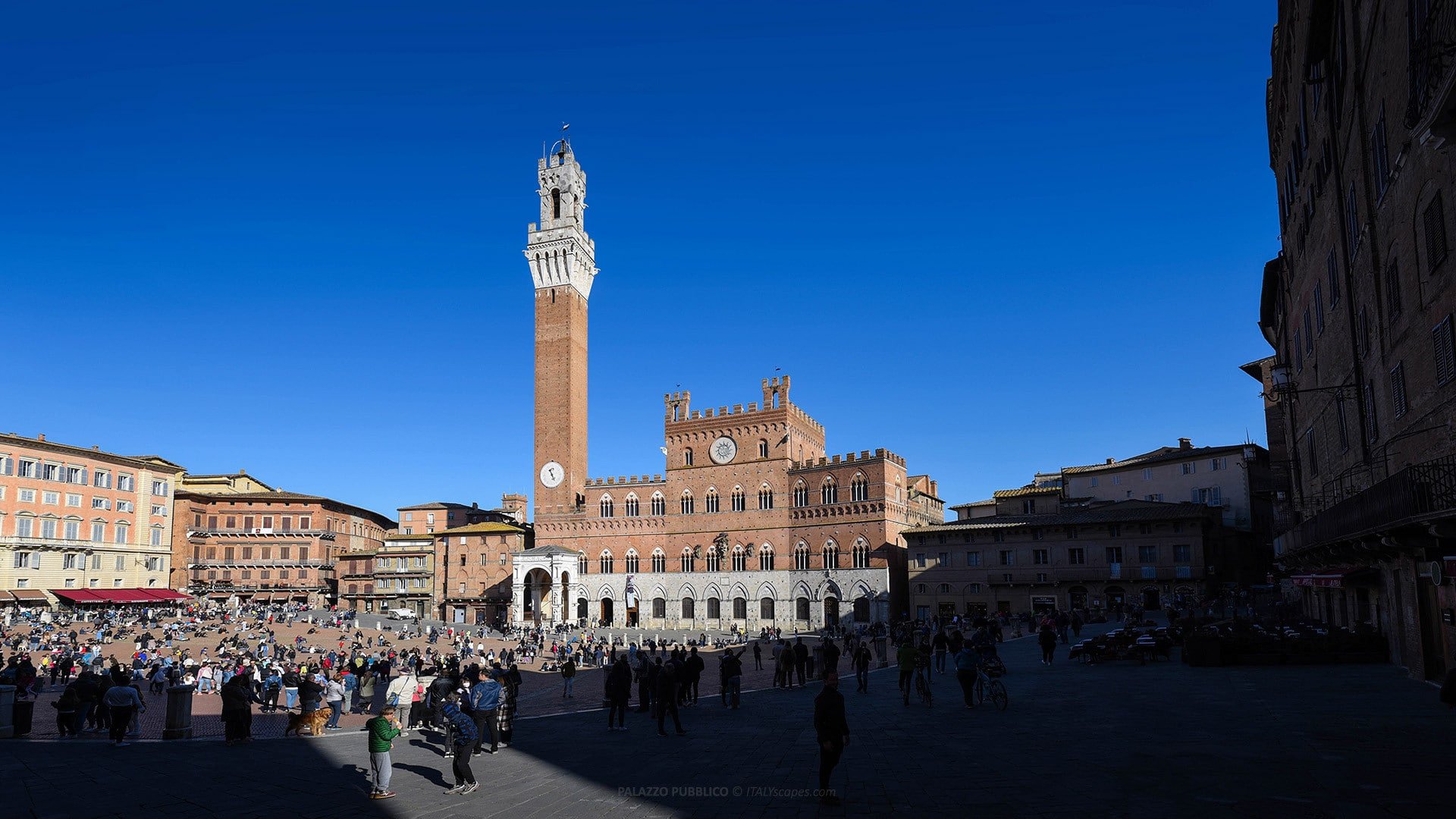
Architecture of Piazza del Campo
Shape, Pavement and Urban Layout
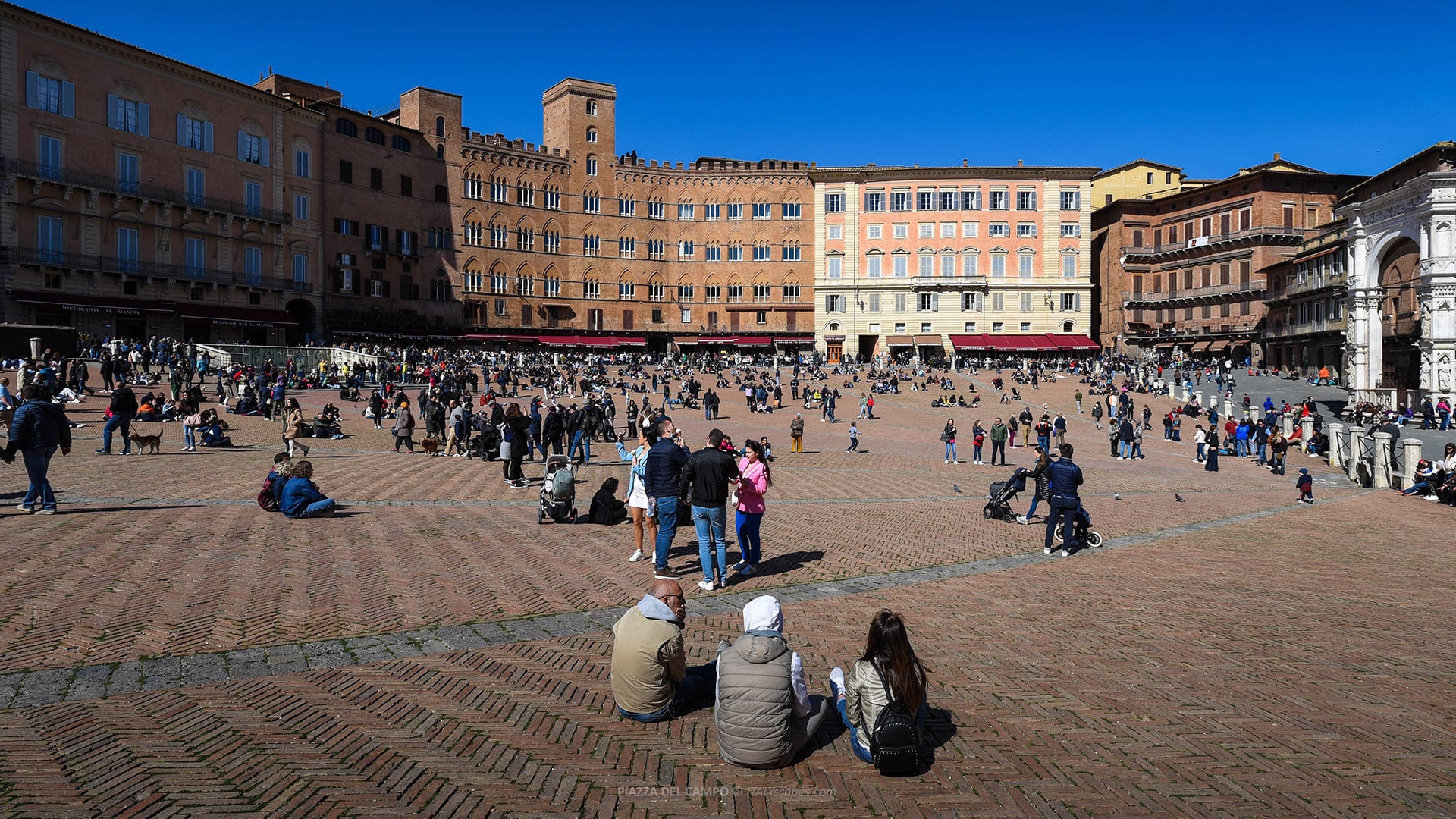
What makes Piazza del Campo instantly recognizable is its shell or scallop-shell shape, a form both elegant and functional, shaped by the natural topography of the hillside and refined by urban vision.
The entire surface is paved in red bricks laid in a distinctive herringbone or “fishbone” pattern (spina di pesce).
Radiating from the central drain (the gavinone) are nine wedge-shaped sections, each separated by lighter travertine lines; together they echo the symbolic political divisions of Siena under the Nine.
This careful design combines artistry with practicality: the gentle slope (about 15 feet from one end of Piazza del Campo to the other) facilitates drainage, while the color and texture of the bricks create an inviting warm ambiance, especially at sunrise or sunset.
Surrounding Buildings – Civic, Gothic, BaroqueEncircling Piazza del Campo is a nearly continuous ring of buildings: noble palazzi, townhouses, public buildings – all aligned in harmonious proportions.
Eleven main access points (once twelve) lead from narrow alleys and streets into the open square, giving the piazza a sense of surprise when one arrives – the full vista only reveals itself at the threshold.
The dominant building is the Palazzo Pubblico – begun in the late 13th century, it served as Siena’s city hall, seat of civic government, and remains a central architectural anchor of the piazza.
Rising next to the Palazzo is the Torre del Mangia, the civic bell tower erected between 1325 and 1348.
At 102 meters tall, it dramatically punctuates the skyline and serves as a visual counterpoint to Siena’s cathedral on the opposite hill – a medieval statement of civic pride and balance of powers.
Also notable is Fonte Gaia, standing at the elevated edge of Piazza del Campo – a marble fountain originally designed in the early 15th century by sculptor Jacopo della Quercia, representing joy and prosperity when clean water first arrived to the city center.
The fountain visible today is a 19th-century copy, while the original sculptures are preserved in a museum for conservation.
Together, the shell-shaped square, the uniformly aligned buildings, the civic palace and tower, the fountain and the paving form a comprehensive medieval urban design – a rare surviving example of city planning where form, function, symbolism and beauty blend in perfect balance.
Urban Experience – Stage, Gathering Place, Living ForumArchitecturally, the piazza functions almost like an open-air amphitheatre: buildings curve to embrace it, façades seem to converge toward the Palazzo Pubblico and tower; the incline and the division into nine sectors draw the eye toward the center.
Given the multiplicity of functions – marketplace, political forum, civic arena, festive ground – the design had to be flexible.
The brick surface endures centuries of use, while the surrounding buildings frame the square with intimacy: when you walk through one of the alleys, you don’t see the whole – the full spectacle reveals itself only when you step into the open.
How to Get to Piazza del Campo
On foot: If you arrive at Siena railway station, the historic center and the main square Piazza del Campo lie about 2.1–2.2 km away.
Walking from the station to the Campo typically takes about 20–25 minutes, but most of the route involves going uphill – so if you have luggage or mobility issues it may be a bit strenuous.
To reach the square, exit the railway station and follow signs toward the historic center. You’ll pass through streets that ascend toward the old town.
By bus: If you prefer not to walk up the hill, Siena has a reliable local bus network that connects the station with points near the old town.
From Siena railway station, take any of the urban buses operated by Autolinee Toscane that head toward the city center. Buses leave frequently – about every 15–30 minutes.
The nearest bus stop is Angolo Via delle Terme, situated on Via di Città, approximately 90 meters from the square. You can reach this stop using bus Line 590.
Taxi or private transfer: If you have heavy luggage, are in a group, or prefer convenience, a taxi from Siena railway station directly to Piazza del Campo is a fast option. The distance is short, so the ride takes approximately 3-5 minutes.
Taxi fares are usually reasonable – often around €6–8 – but can rise if traffic is heavy or if you travel very late/early.
Sources: -
Photos
-
Map
-
Reviews


