-
About
Table of Contents
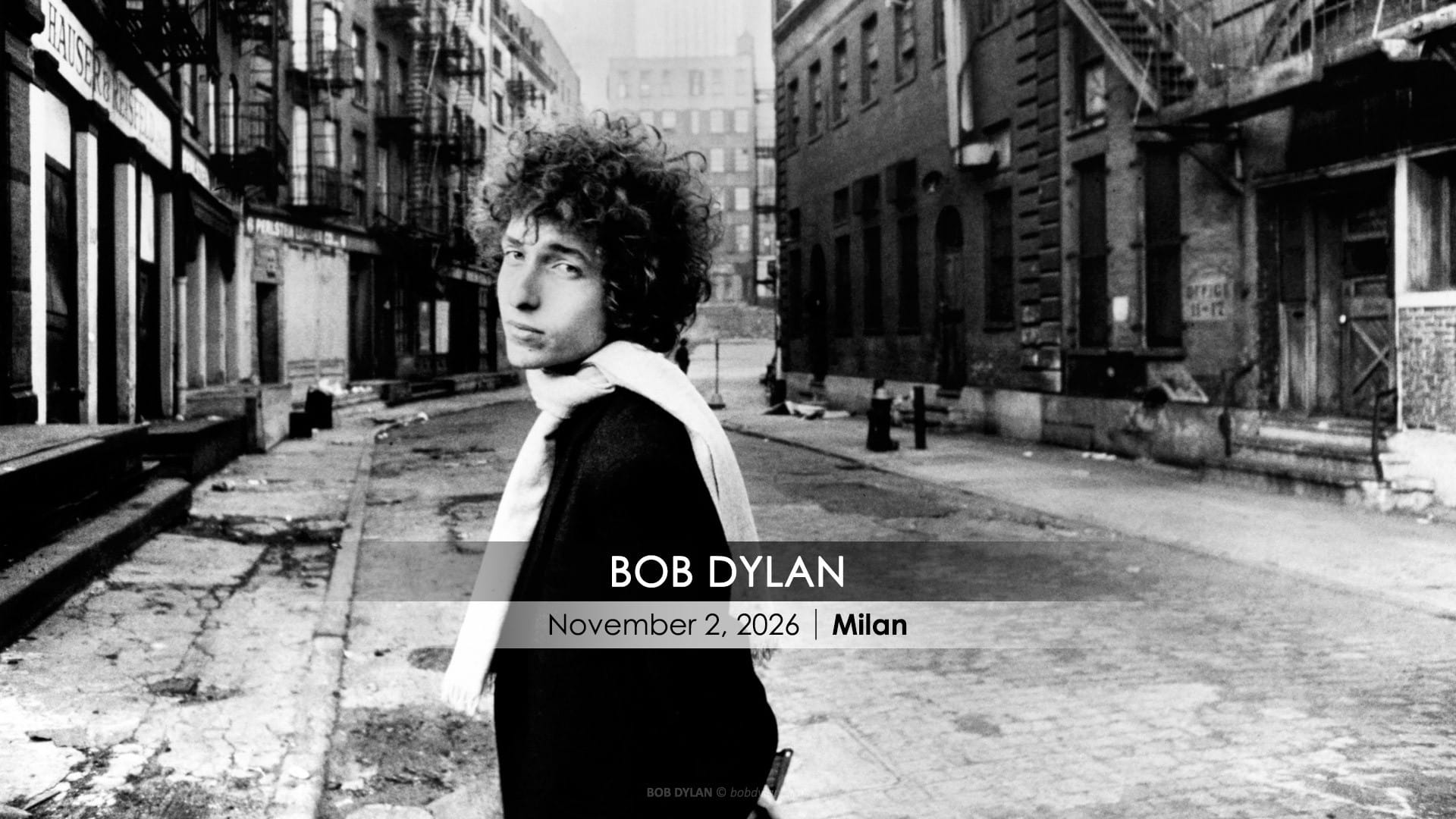
Buy tickets:TicketOneBob Dylan will perform in Milan on Monday, November 2, 2026, at Unipol Dome in the Milano Santa Giulia district. The concert is scheduled to begin at 9:00 pm and is one of three exclusive Italian performances announced for autumn 2026, alongside shows in Rome and Bologna.
The Milan concert follows the international success of the Rough and Rowdy Ways Tour, created around Bob Dylan’s 2020 studio album. His live performances emphasize musical interpretation, with songs regularly presented through arrangements, tempos, vocal approaches, and instrumental structures that differ substantially from their original studio versions.
The event will be a phone-free show organized in collaboration with Yondr. Mobile phones must be placed inside sealed pouches upon entry and kept by their owners throughout the concert. Photography and audio or video recording are prohibited, allowing the audience to experience the performance without illuminated screens or recording devices.
About Bob Dylan
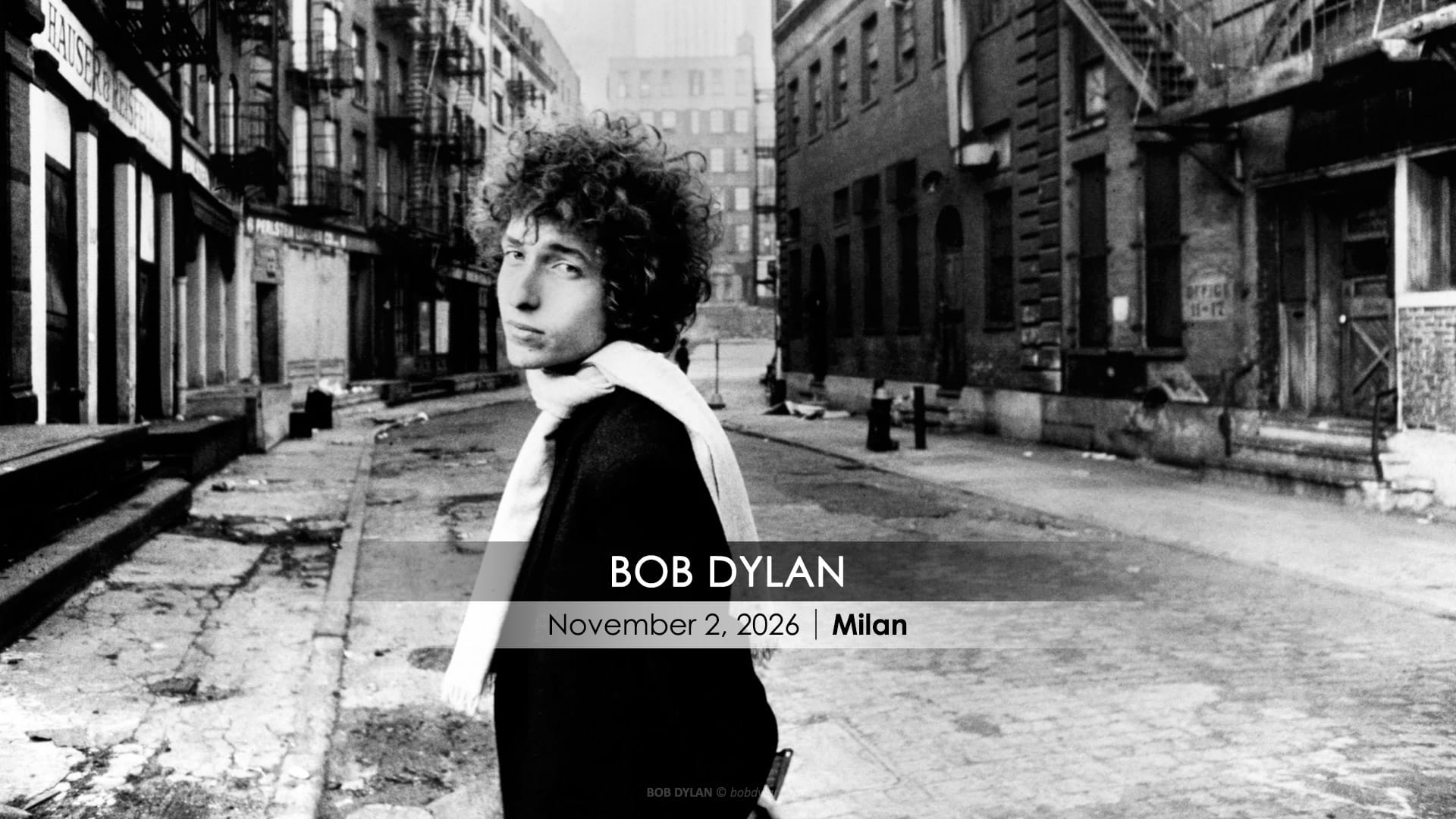
Bob Dylan was born Robert Allen Zimmerman on May 24, 1941, in Duluth, Minnesota. He grew up primarily in Hibbing, where he listened to blues and country radio before becoming interested in early rock and roll. During high school, he performed with several local bands and began developing his identity as a musician.
He briefly attended the University of Minnesota in Minneapolis, where he became involved in the folk-music community around the Dinkytown district. During this period, he began performing under the name Bob Dylan and increasingly focused on traditional American folk, blues, country, and songs associated with Woody Guthrie.
Bob Dylan moved to New York City in 1961 to pursue a professional career and meet Woody Guthrie, who was hospitalized in New Jersey. He performed in Greenwich Village clubs, gained attention within the local folk scene, and signed a recording contract with Columbia Records after producer John Hammond saw him perform.
His self-titled debut album appeared in 1962, but his major breakthrough came with The Freewheelin’ Bob Dylan in 1963. Songs such as Blowin’ in the Wind and A Hard Rain’s a-Gonna Fall demonstrated his ability to combine traditional musical forms with political, social, literary, and philosophical themes.
Blowin’ in the Wind and The Times They Are a-Changin’ became closely associated with the American civil rights and anti-war movements. However, Dylan resisted being limited to the role of a protest singer and gradually introduced more personal, surreal, symbolic, and literary forms of songwriting into his work.
In 1965, he began using electrically amplified rock instrumentation, a transition documented on Bringing It All Back Home and completed through Highway 61 Revisited. The single Like a Rolling Stone expanded conventional song length and lyrical complexity, while his electric performances generated controversy among sections of the folk audience.
After a motorcycle accident in 1966, Dylan withdrew from regular touring for several years. His subsequent work explored country, rural American music, gospel, blues, traditional standards, and rock. This continuous stylistic movement became a defining feature of a career built on reinvention rather than repetition.
Dylan resumed regular touring and launched what became known as the Never Ending Tour in 1988. Since then, his concerts have frequently transformed familiar material through new arrangements. His performances generally use restrained staging and place the emphasis on the interaction between his voice, piano, harmonica, and touring band.
Bob Dylan Discography
The Bob Dylan discography contains 40 studio albums, together with numerous live recordings, soundtracks, compilations, singles, and archival releases. Most of his catalogue was issued through Columbia Records, while Planet Waves and the live album Before the Flood were originally released by Asylum Records before later Columbia reissues.
His debut album, Bob Dylan, was released in March 1962 and consisted mainly of traditional folk and blues material. The Freewheelin’ Bob Dylan followed in 1963 and contained a much larger proportion of original compositions, including Girl from the North Country, Don’t Think Twice, It’s All Right, and Masters of War.
The Times They Are a-Changin’ and Another Side of Bob Dylan appeared in 1964, before the decisive electric period represented by Bringing It All Back Home, Highway 61 Revisited, and Blonde on Blonde. These three releases combined folk-based songwriting with blues and rock instrumentation, creating a major influence on contemporary popular music.
Bob Dylan explored country and rural musical traditions on John Wesley Harding, Nashville Skyline, and New Morning. His 1970s catalogue also included Pat Garrett & Billy the Kid, featuring Knockin’ on Heaven’s Door, followed by the commercially successful albums Planet Waves, Blood on the Tracks, and Desire.
Blood on the Tracks reached number one in the United States and included Tangled Up in Blue, Simple Twist of Fate, and Shelter from the Storm. Desire also topped the American chart and featured Hurricane, Isis, and Sara, supported by violin-led arrangements and narrative songwriting.
The albums Slow Train Coming, Saved, and Shot of Love reflected Dylan’s Christian period between 1979 and 1981. His later 1980s releases included Infidels, Empire Burlesque, and Oh Mercy, while he also recorded as a member of the Traveling Wilburys with George Harrison, Roy Orbison, Tom Petty, and Jeff Lynne.
A major critical resurgence arrived with Time Out of Mind in 1997. It was followed by Love and Theft, Modern Times, Together Through Life, and Tempest. Modern Times reached number one in the United States, making Dylan, then aged 65, the oldest living artist at that time to top the Billboard 200.
After three albums devoted largely to traditional American standards, Dylan released Rough and Rowdy Ways in 2020. The album included I Contain Multitudes, False Prophet, and the 17-minute Murder Most Foul. His archival catalogue continued in 2025 with The Bootleg Series Vol. 18: Through the Open Window, 1956-1963.
Bob Dylan Awards and Sales
Bob Dylan has sold an estimated 125 million records worldwide, placing him among the most commercially successful recording artists in history. His influence extends beyond sales figures because many of his compositions became widely known through recordings by other performers, including Peter, Paul and Mary, the Byrds, Jimi Hendrix, and Adele.
His musical honours include ten Grammy Awards, together with the Grammy Lifetime Achievement Award received in 1991. Time Out of Mind won Album of the Year in 1998, while Cold Irons Bound and Someday Baby received awards in rock performance categories during later stages of his career.
Bob Dylan won both the Academy Award and Golden Globe Award for Things Have Changed, written for the 2000 film Wonder Boys. He was inducted into the Rock and Roll Hall of Fame in 1988 and has also entered the Songwriters Hall of Fame and the Nashville Songwriters Hall of Fame.
He received Kennedy Center Honors in 1997, a Pulitzer Prize special citation in 2008, and the Presidential Medal of Freedom in 2012. In 2016, he became the first songwriter awarded the Nobel Prize in Literature, recognized for creating new poetic expressions within the American song tradition.
Venue – Unipol Dome
Unipol Dome is a multipurpose indoor arena in the Milano Santa Giulia district. The venue can accommodate up to 16,000 visitors, using a concert configuration of approximately 12,000 seats and 4,000 standing places. Its interior arrangement can be adapted to the technical and audience requirements of individual events.
The arena originated as a central component of Milan’s preparations for the 2026 Winter Olympic and Paralympic Games. Construction began in 2023, although planning started earlier within the broader redevelopment of the Santa Giulia area in southeastern Milan.
Unipol Dome was designed through a collaboration between David Chipperfield Architects and Arup. Its elliptical shape reinterprets the form of a classical amphitheatre, while the exterior consists of three stacked aluminium rings separated by transparent glass bands that create horizontal divisions around the structure.
The external media façade contains more than 2.4 million LEDs across an area exceeding 7,000 square meters. It can display large-scale visual content and programmed lighting sequences, transforming the exterior into an active presentation surface during concerts, sporting competitions, and other major events.
Inside, the arena contains two covered seating tiers above the parterre, together with lounges, restaurants, hospitality areas, and skyboxes. Its bowl was digitally modelled to improve audience sightlines, acoustics, circulation, and crowd movement, while accommodating the staging and equipment used by international touring productions.
A raised podium surrounds the building and connects it with a public piazza measuring more than 10,000 square meters. Wide stairways lead from the plaza to the main entrances, while the external space supports audience distribution, security procedures, waiting areas, and selected outdoor event formats.
How to Get to the Unipol Dome
The principal public-transport route uses Metro Line M3, Milan’s yellow line, to Milano Rogoredo. During major events, a dedicated shuttle operates between the station and Unipol Dome. The official arena access plan also provides extended M3 operating hours until approximately 1:00 am on event nights.
Passengers arriving at Milano Centrale can take M3 directly toward San Donato and leave the train at Rogoredo FS. This journey requires no metro transfer. Regional, suburban, national, and high-speed trains also stop at the railway platforms of Milano Rogoredo.
Unipol Dome can be reached on foot from Milano Rogoredo in approximately 25 minutes. Walking may be practical before the concert, although the event shuttle generally provides a more direct option for visitors unfamiliar with the streets and pedestrian routes of the Santa Giulia district.
Tram Line 27 serves the Viale Ungheria area, approximately five minutes on foot from the arena. The tram connects with Metro Line M4 at Repetti, allowing passengers arriving from Linate Airport or neighbourhoods along the blue metro line to continue toward the venue.
Bus lines 45, 66, 77, 88, and 95 serve the surrounding area. Bus 88 connects Rogoredo FS with stops near Viale Ungheria, while stops around Via Manzù–Via Cascella are also within walking distance of Unipol Dome.
Visitors travelling by car should follow the designated access routes for Milano Santa Giulia and reserve parking in advance when required. Traffic restrictions, shuttle schedules, pedestrian routes, and extended metro services may be adjusted for major concerts, so event-specific instructions should be checked before departure.
Frequently Asked Questions about the Bob Dylan Concert in Milan
When is the Bob Dylan concert in Milan?
The concert takes place on Monday, November 2, 2026. It is the first of three exclusive Italian performances scheduled in Milan, Rome, and Bologna during November.
Where will Bob Dylan perform in Milan?
The concert will be held at Unipol Dome, a multipurpose indoor arena located in the Milano Santa Giulia district, southeast of Milan’s historic city centre.
Is the Milan concert a phone-free event?
Yes. The concert is a mandatory phone-free show. Mobile devices must be placed inside sealed Yondr pouches and remain secured while visitors are inside the performance area.
Which metro station is closest to Unipol Dome?
The main metro and railway interchange is Rogoredo FS on Metro Line M3. Event shuttles connect the station area with Unipol Dome during major performances.
Can Unipol Dome be reached directly from Milano Centrale?
Yes. Take Metro Line M3 toward San Donato from Milano Centrale and exit at Rogoredo FS. The journey does not require changing metro lines.
Is parking available at Unipol Dome?
Designated parking is available according to the arrangements established for each event. Drivers should book parking in advance when reservations are required and check temporary traffic restrictions before travelling.
Buy tickets:TicketOne -
Photos
-
Video
Table of Contents
-
Map
-
Reviews
2 November 2026 9:00 pm
2 November 2026 11:45 pm