-
About
Table of Contents
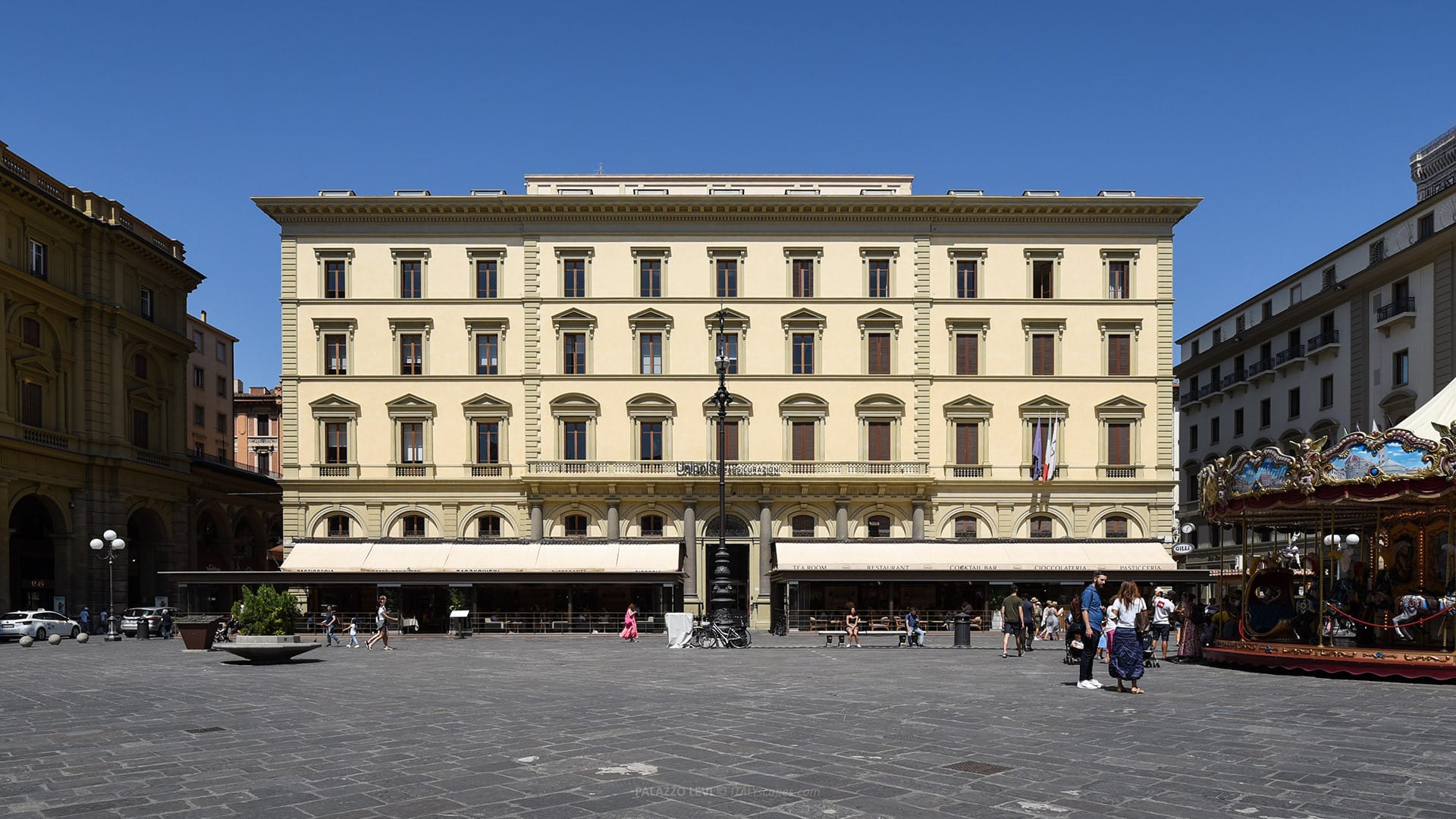
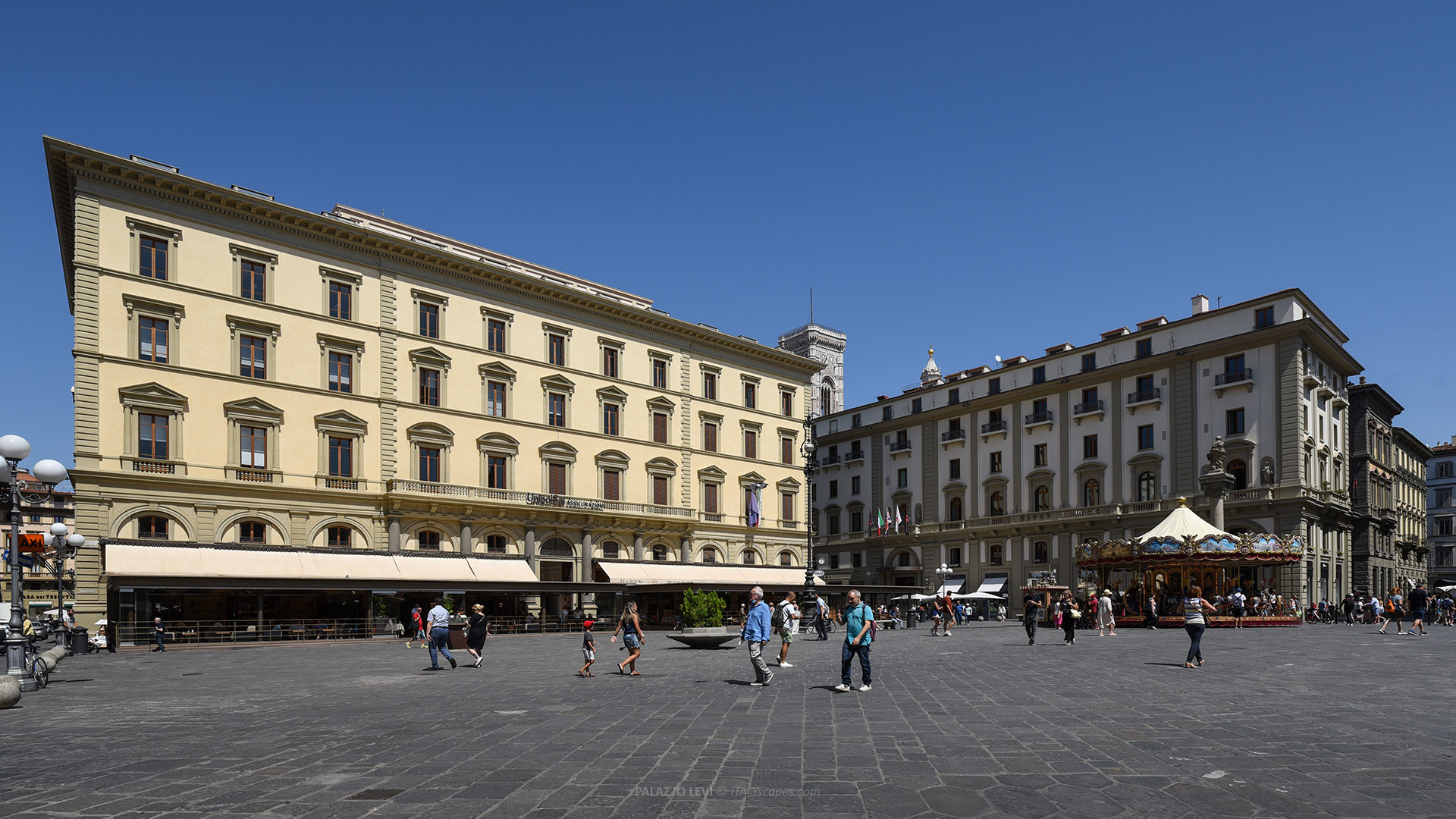
Palazzo Levi is a large civil building in the historic center of Florence, located in Piazza della Repubblica. It stands at the corner of Via de’ Brunelleschi, Via de’ Tosinghi, and Via Roma, one of the most central urban areas in Florence, Tuscany, Italy.
The palace is also known as Palazzo della Fondiaria Assicurazioni, because from 1893 it became connected with Fondiaria Assicurazioni. It was built between 1890 and 1893, during the major redevelopment of the old central district around today’s Piazza della Repubblica.
Palazzo Levi is important because it occupies the site of the former Jewish Ghetto of Florence. Its history connects the medieval city, the nineteenth-century transformation of Florence, the rise of bourgeois architecture, and the modern commercial life of Piazza della Repubblica.
The building is not a Renaissance palace in the historical sense. It is a Neo-Renaissance palace, designed in the late nineteenth century by the architect Giuseppe Boccini. Its monumental façade, large scale, and central position make it a visible landmark in the urban fabric of central Florence.
Today, Palazzo Levi forms an entire block and includes important commercial and institutional spaces. On the ground floor are the historic cafés Gilli and Paszkowski, two well-known addresses in Piazza della Repubblica, while other parts of the palace have been used for offices, apartments, and representative functions.
Short History of Palazzo Levi
From the Old Ghetto to the New Piazza
The area where Palazzo Levi stands belonged to one of the most densely built parts of old Florence. Before the nineteenth-century redevelopment, this zone included the Mercato Vecchio, medieval streets, old houses, churches, shops, and the Jewish Ghetto, established in the sixteenth century.
The transformation of the area was part of the so-called Risanamento, the urban renewal that reshaped the center of Florence after the city had served as capital of the Kingdom of Italy between 1865 and 1871. The redevelopment removed much of the old medieval fabric around the former market.
The project was officially justified by hygiene, modernization, and urban order, but it also produced a large real-estate operation. The old market district was demolished, Piazza della Repubblica was enlarged, and new monumental buildings were erected around the rectangular square.
The Levi Family and Fondiaria Assicurazioni
The palace was commissioned by the brothers Ottavio Levi and Enrico Levi, sons of Salvatore Levi. They owned part of the former Ghetto properties and invested in the new building during the redevelopment of central Florence. The large palace was reportedly sold before the works were fully completed.
Construction took place between 1890 and 1893, under the design of Giuseppe Boccini. The same year the works were completed, the building became the seat of Fondiaria Assicurazioni, which explains the alternative name Palazzo della Fondiaria Assicurazioni.
The building also preserves a memorial element linked to the insurance company. At the end of the entrance hall from Piazza della Repubblica, there is a bronze-framed plaque commemorating Fondiaria employees who died in the wars of 1915-1918 and 1940-1945.
Between August 2005 and June 2008, Palazzo Levi underwent important restoration works. These works involved the external wall surfaces and the roofing, restoring the building’s sober bourgeois appearance. Later, in 2011, internal spaces of more than 6,000 square meters were reorganized by architect Massimo Pierattelli.
Architecture of Palazzo Levi
Neo-Renaissance Exterior
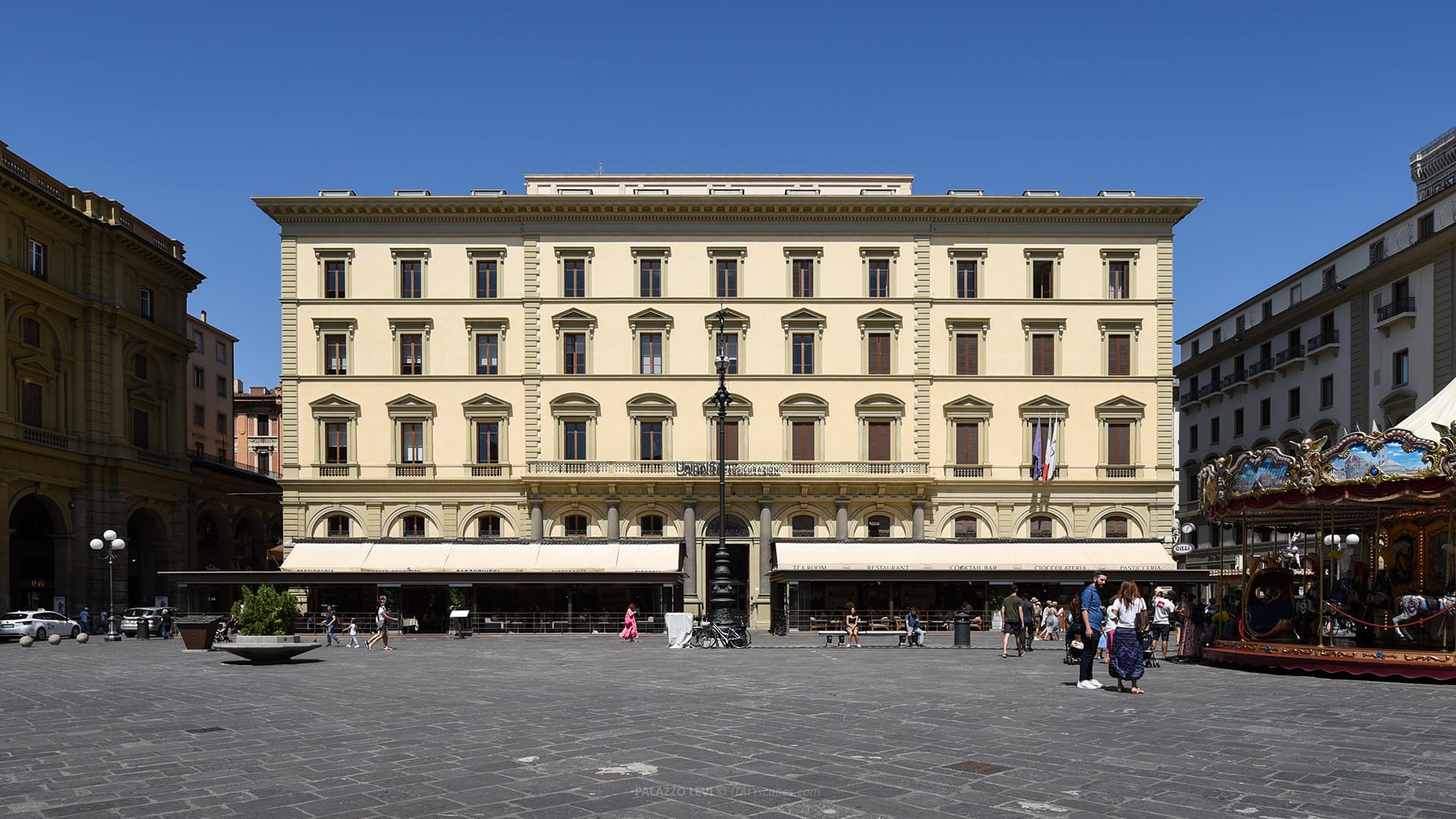
Palazzo Levi is a Neo-Renaissance building, a style frequently used in nineteenth-century Florence to give new constructions a historical and respectable appearance.
The palace is large enough to define an entire urban block. Its main façade faces Piazza della Repubblica and is organized on four levels. The façade has eleven axes, giving the building a regular, monumental, and balanced appearance.
A notable feature is the long balcony on the piano nobile, the main noble floor. This balcony extends across five of the eleven façade axes, emphasizing the central part of the building and creating a horizontal architectural line above the commercial ground-floor level.
Ground Floor, Uses, and Interior Spaces
The ground floor of Palazzo Levi is closely linked to the public life of Piazza della Repubblica. The historic cafés Gilli and Paszkowski occupy spaces within the building, connecting the palace with Florence’s café culture, literary history, and central commercial activity.
Other parts of the palace have hosted institutional and private functions. The building has included offices of the Amministrazione Autonoma dei Monopoli di Stato, the Consulate of the Principality of Monaco, and residential spaces, including apartments connected with modern hospitality use.
The interior reorganization completed after the exterior restoration involved more than 6,000 square meters. The project focused on global restructuring and a new functional distribution of the interior spaces.
The palace also includes attic spaces that have been converted into high-end accommodation units.
How to Get to Palazzo Levi
Palazzo Levi is located in the pedestrian and commercial heart of Florence, very close to the city’s main historic attractions. The building stands on Piazza della Repubblica, between the Cathedral area, Via Roma, Via de’ Brunelleschi, and the shopping streets leading toward Piazza della Signoria.
Because of its central position, Palazzo Levi is easiest to reach on foot from many places in Florence.
Getting to Palazzo Levi on foot
Palazzo Levi is located about 900 meters away from the Santa Maria Novella railway station. The walk usually takes around 10 to 12 minutes, depending on pace, luggage, and crowd levels in the historic center.
A practical walking route from the station follows the central streets toward Piazza della Repubblica. Visitors can pass through the area of Via de’ Panzani, Via de’ Cerretani, and the Cathedral zone before continuing toward the square. The route is mostly urban, central, and suitable for first-time visitors.
From the Cathedral of Santa Maria del Fiore, Palazzo Levi is only a short walk away. The distance is roughly 250 to 300 meters, depending on the exact route. Visitors can continue along Via Roma or nearby streets until they reach the corner of Piazza della Repubblica.
From Piazza della Signoria, the walk is also short, about 450 to 500 meters.
Getting to Palazzo Levi by bus
The closest useful bus stop is Vecchietti, located about 140 meters away in Via de’ Vecchietti. This stop is close to the northwestern side of Piazza della Repubblica and is practical for reaching Palazzo Levi without walking from the railway station.
Bus lines 6 and 11 serve the central Florence area and can be useful depending on the visitor’s starting point.
From the Vecchietti stop, the route to Palazzo Levi is short. Walk toward Piazza della Repubblica, then continue to the side of the square where Via Roma, Via de’ Brunelleschi, and Via de’ Tosinghi meet.
Getting to Palazzo Levi by taxi
A taxi is useful for visitors carrying luggage, arriving at Santa Maria Novella railway station, or travelling from accommodation outside the historic center. From Firenze Santa Maria Novella to Piazza della Repubblica, the ride is short and usually takes about 5 minutes, depending on traffic.
The taxi distance from the station is small, but traffic restrictions, pedestrian zones, and one-way streets can affect the exact route. Taxis usually stop at accessible points near Piazza della Repubblica, from where Palazzo Levi is only a very short walk away.
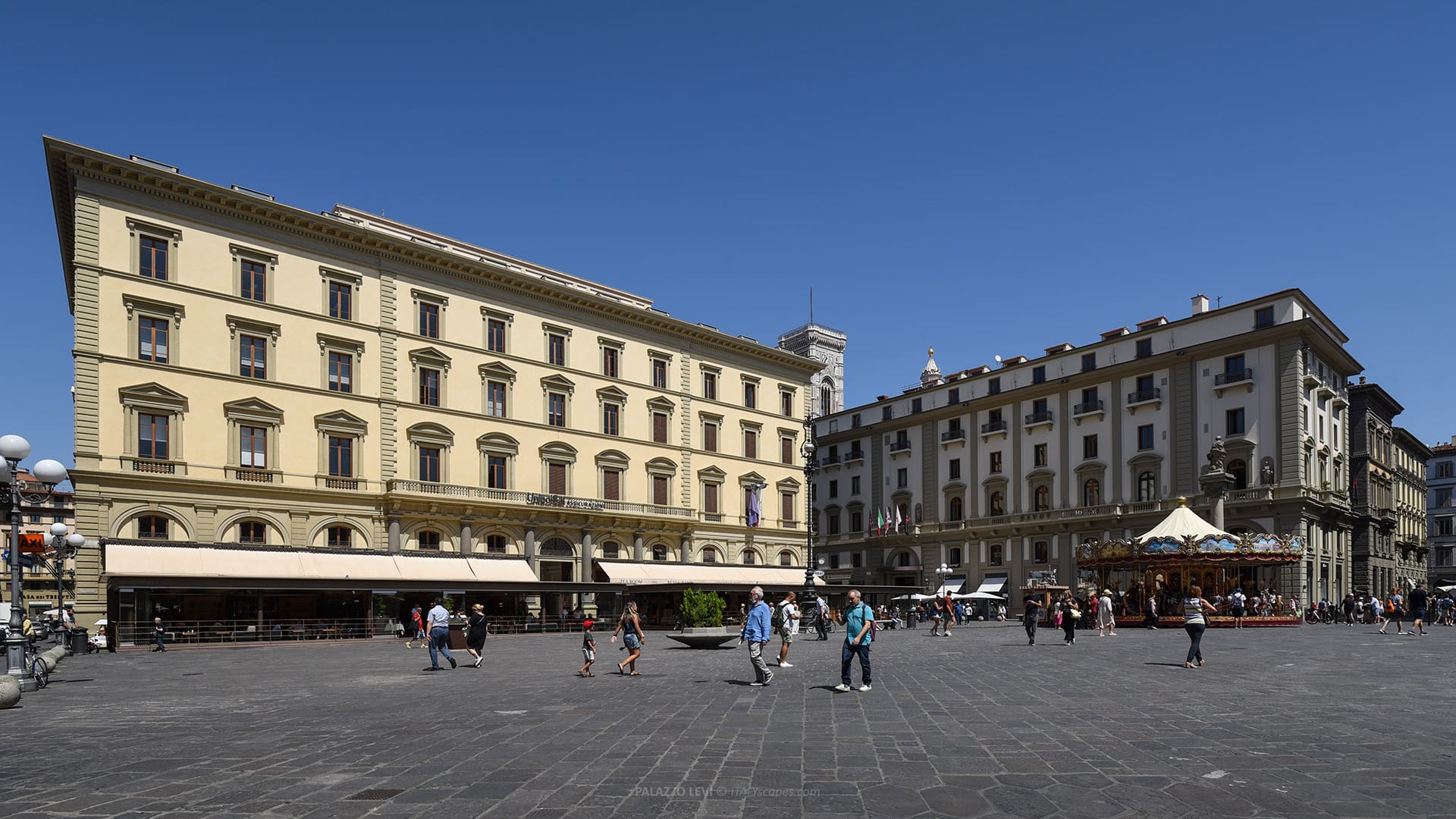
Piazza della Repubblica, with Palazzo Levi on the left.
Frequently Asked Questions about Palazzo Levi
Where is Palazzo Levi located?
Palazzo Levi is located at Piazza della Repubblica 6, in central Florence. It stands at the corner of Via Roma, Via de’ Brunelleschi, and Via de’ Tosinghi.
When was Palazzo Levi built?
Palazzo Levi was built between 1890 and 1893. Its construction belongs to the redevelopment of Florence’s old central market and Ghetto area.
Who designed Palazzo Levi?
The palace was designed by the architect Giuseppe Boccini, one of the architects active in the transformation of Piazza della Repubblica during the late nineteenth century.
What architectural style is Palazzo Levi?
Palazzo Levi is a Neo-Renaissance building. Its façade uses symmetry, regular axes, and monumental proportions inspired by Renaissance architectural language.
Can Palazzo Levi be visited inside?
Palazzo Levi is not a public museum. Visitors can see the exterior from Piazza della Repubblica and enter ground-floor businesses such as historic cafés.
How far is Palazzo Levi from Santa Maria Novella station?
Palazzo Levi is about 900 meters from Santa Maria Novella railway station. The walk usually takes around 10 to 12 minutes through central Florence.
Sources: -
Photos
-
Map
-
Reviews