-
About
Table of Contents
Buy tickets & tours:GetYourGuidePalazzo Vecchio is the monumental town hall of Florence, located in Piazza della Signoria, one of the most important civic spaces in the historic center. The palace stands beside the Uffizi Gallery, about 50 meters from its northern side, and about 300 meters from Ponte Vecchio.
Known in English as the “Old Palace”, Palazzo Vecchio has been connected with Florentine government for more than seven centuries. It was built as a fortified seat for the city’s magistrates, later became a Medici residence, and still houses the Municipality of Florence, the Mayor’s offices, and the city council.
The building is one of the clearest symbols of Florence’s political history. Its massive stone facade, high battlements, and 95-meter Torre di Arnolfo dominate Piazza della Signoria. Inside, the museum preserves medieval rooms, Renaissance halls, Medici apartments, archaeological remains, monumental frescoes, sculptures, maps, and civic artworks.
Palazzo Vecchio is also one of the best places to understand Florence as a city-state. The building connects the Roman city of Florentia, the medieval republic, the Medici duchy, the short period when Florence was capital of Italy, and the modern civic administration of the city.
Short History of Palazzo Vecchio
Roman and Medieval Foundations
Before Palazzo Vecchio existed, the area was part of ancient Roman Florence. Archaeological excavations beneath the palace revealed remains of the Roman Theatre of Florentia, whose cavea faced today’s Piazza della Signoria and whose stage area extended toward Via dei Leoni.
The Roman theatre probably reached its greatest size between the late 1st century and early 2nd century AD. Its capacity has been estimated at 8,000 to 10,000 spectators, a significant figure that reflects the urban development of Roman Florentia during the imperial period.
After late antiquity, the theatre gradually lost its original function. Its stone corridors, known as burelle, were reused during the medieval period for practical purposes, including storage, animal shelters, dumping areas, and even prisons. Later medieval buildings rose above these Roman structures.
By the 13th century, the site was occupied by buildings connected with powerful Florentine families and civic functions. The new public palace was later built over the remains of the Palazzo dei Fanti and the Palazzo dell’Esecutore di Giustizia, previously linked to the Ghibelline Uberti family.
Palazzo dei Priori and the Florentine Republic
At the end of the 13th century, Florence decided to build a secure palace for its magistrates. The project is traditionally attributed to Arnolfo di Cambio, the architect also associated with the Cathedral of Santa Maria del Fiore and the Basilica of Santa Croce.
Construction began in 1299, when the palace was known as the Palazzo dei Priori. The building incorporated the pre-existing Torre della Vacca, which explains why the main tower is not centered on the facade. Arnolfo died in 1302, and the palace was completed by other masters.
On March 26, 1302, the palace became the seat of the Signoria, the governing council of Florence, led by the Priors and the Gonfaloniere of Justice. The first major construction phase was completed in the early 14th century, around 1314-1315.
The palace was designed both as an administrative center and as a defensive structure. Its thick masonry, high tower, battlements, and protected internal spaces reflected the political instability of medieval Florence, where government officials needed protection from noble families and factional violence.
Enlargements from the 14th to 15th Century
Between 1342 and 1343, Gualtieri VI of Brienne, known as the Duke of Athens, began the first important enlargements. He extended the palace toward Via della Ninna and strengthened its fortress-like appearance, adapting the building to his short and unpopular rule in Florence.
Further changes took place between 1440 and 1460, under Cosimo de’ Medici. During this phase, Renaissance decoration was introduced into the Sala dei Duecento, and the first courtyard was redesigned by Michelozzo, giving the medieval palace a more refined internal appearance.
The Salone dei Cinquecento was built in 1494, during the republican period associated with Girolamo Savonarola. It was designed by Simone del Pollaiolo, known as Il Cronaca, as a large hall for the expanded governing assembly of the Florentine Republic.
The original function of the hall was political, not princely. It was created for the Great Council, which included more than one thousand citizens meeting in rotating groups. Its later Medici decoration changed its meaning, transforming a republican assembly space into a ducal ceremonial hall.
Cosimo I de’ Medici and the Ducal Residence
Between 1540 and 1550, Palazzo Vecchio became the residence of Cosimo I de’ Medici. The old republican palace was transformed into a ducal residence, and Cosimo commissioned first Battista del Tasso and then Giorgio Vasari to enlarge and reorganize the building.
The Medici court required reception rooms, private apartments, service areas, ceremonial halls, and decorated spaces suitable for dynastic display. The palace doubled its volume through additions at the back, and the last major 16th-century works were completed under architects such as Bernardo Buontalenti.
In 1565, Cosimo I moved his residence to Palazzo Pitti, across the Arno River. From that moment, the former ducal residence became officially known as “Palazzo Vecchio”, while Piazza della Signoria kept its traditional name and civic role.
Also in 1565, Giorgio Vasari built the Vasari Corridor, an elevated passage connecting Palazzo Vecchio with Palazzo Pitti. The route passes through the Uffizi, crosses the Arno on Ponte Vecchio, and allowed the Medici court to move privately between their political and residential centers.
Florence Capital of Italy and the Modern Palace
Between 1865 and 1871, Florence served as the capital of the Kingdom of Italy. During this period, Palazzo Vecchio gained new national importance and was used by the Chamber of Deputies, while the city was adapted to its temporary role as the Italian capital.
After Rome became the capital of Italy in 1871, Palazzo Vecchio returned fully to its civic function. The Sala dei Duecento became again the meeting place of the Florentine municipal council, and the building remained the historic center of local government.
Today, most of Palazzo Vecchio functions as the Museo di Palazzo Vecchio, while important rooms still serve public institutions. The palace is not only a museum of Florence’s past, but also an active seat of government in the contemporary city.
Architecture of Palazzo Vecchio
Fortress Facade and Medieval Exterior
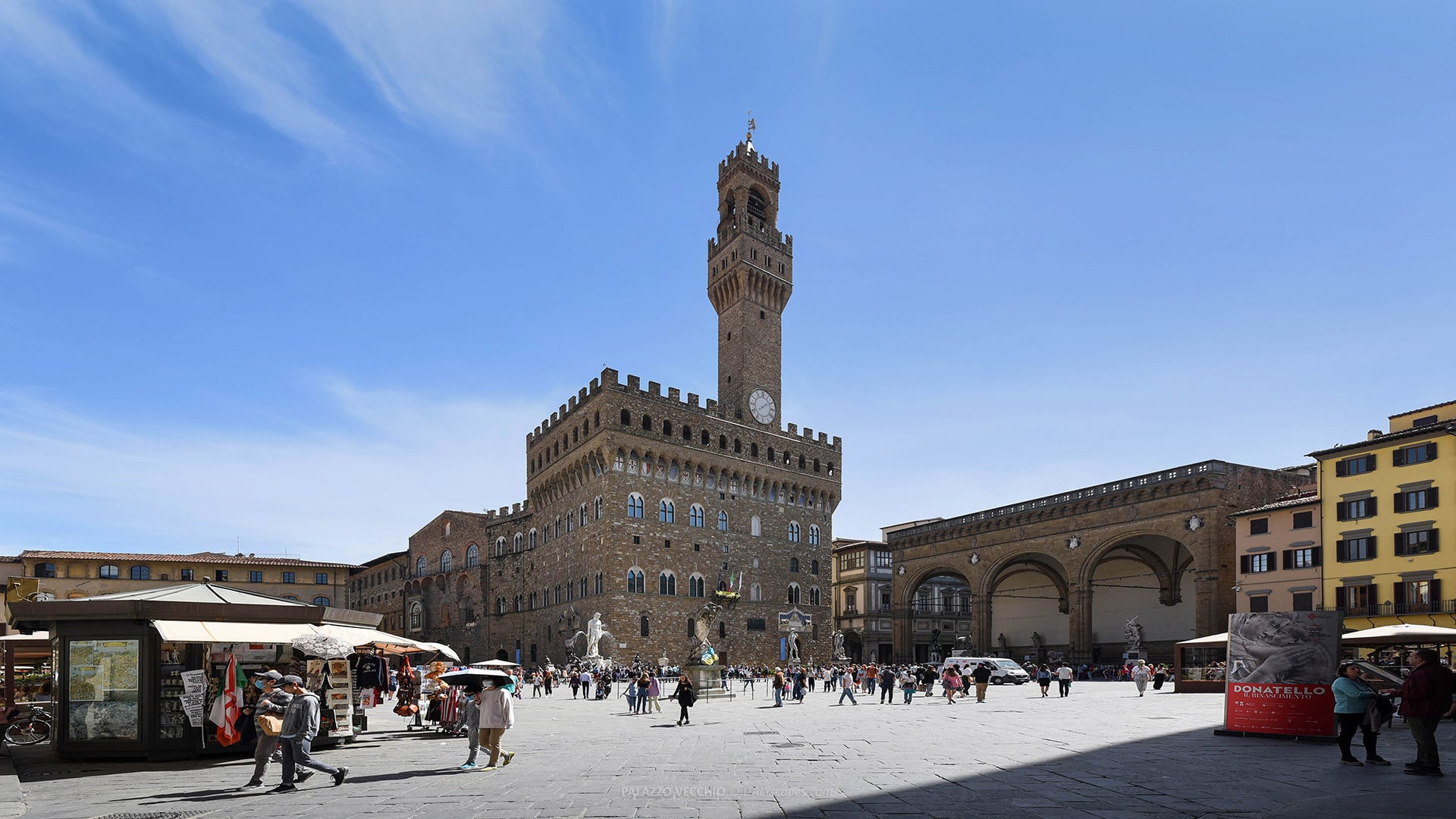
The main facade of Palazzo Vecchio faces Piazza della Signoria and is covered in rusticated pietraforte stone, giving the building a strong defensive appearance. The facade is divided into three main levels by horizontal string courses and pierced by two rows of mullioned windows.
The windows visible today include Neo-Gothic marble mullioned windows with trefoil arches, added in the 18th century in place of earlier openings. The upper part of the older palace is crowned by an overhanging gallery supported by corbels and round arches.
The battlements of the palace and tower have different forms. The palace gallery has Guelph-style battlements, with squared tops, while the tower has Ghibelline swallow-tail battlements. These architectural details visually connect the building with medieval political and military symbolism.
The upper gallery also had a defensive purpose. Some of its arches included machicolations, openings through which defenders could drop stones or other materials on attackers. The building was designed to protect the magistrates who lived and worked inside the palace.
Torre di Arnolfo
The tower of Palazzo Vecchio, commonly known as Torre di Arnolfo, rises about 95 meters above Florence. The tower is not centered on the facade because it rests partly on an older tower-house, the Torre della Vacca, connected with the Foraboschi family.
Inside the tower, a stone staircase of 223 steps leads to the final crenellated lookout level. The route offers panoramic views over the historic center, including the Cathedral dome, Piazza della Signoria, the Uffizi, the Arno River, and the surrounding hills.
One of the most historically important spaces inside the tower is the Alberghetto, a small cell. Cosimo the Elder was imprisoned there in 1433 before his exile, and Girolamo Savonarola was held there in 1498 before his execution in Piazza della Signoria.
The great clock on the tower was originally built by the Florentine Nicolò Bernardo. It was replaced in 1667 with a mechanism made by Giorgio Lederle of Augsburg and installed by Vincenzo Viviani. The clock remains one of the most visible details of the tower facade.
Arengario
The raised platform in front of the palace is the Arengario, also known historically as the ringhiera. It was the place from which the Priors watched civic ceremonies in Piazza della Signoria, making it an important threshold between government and public space.
The First Courtyard
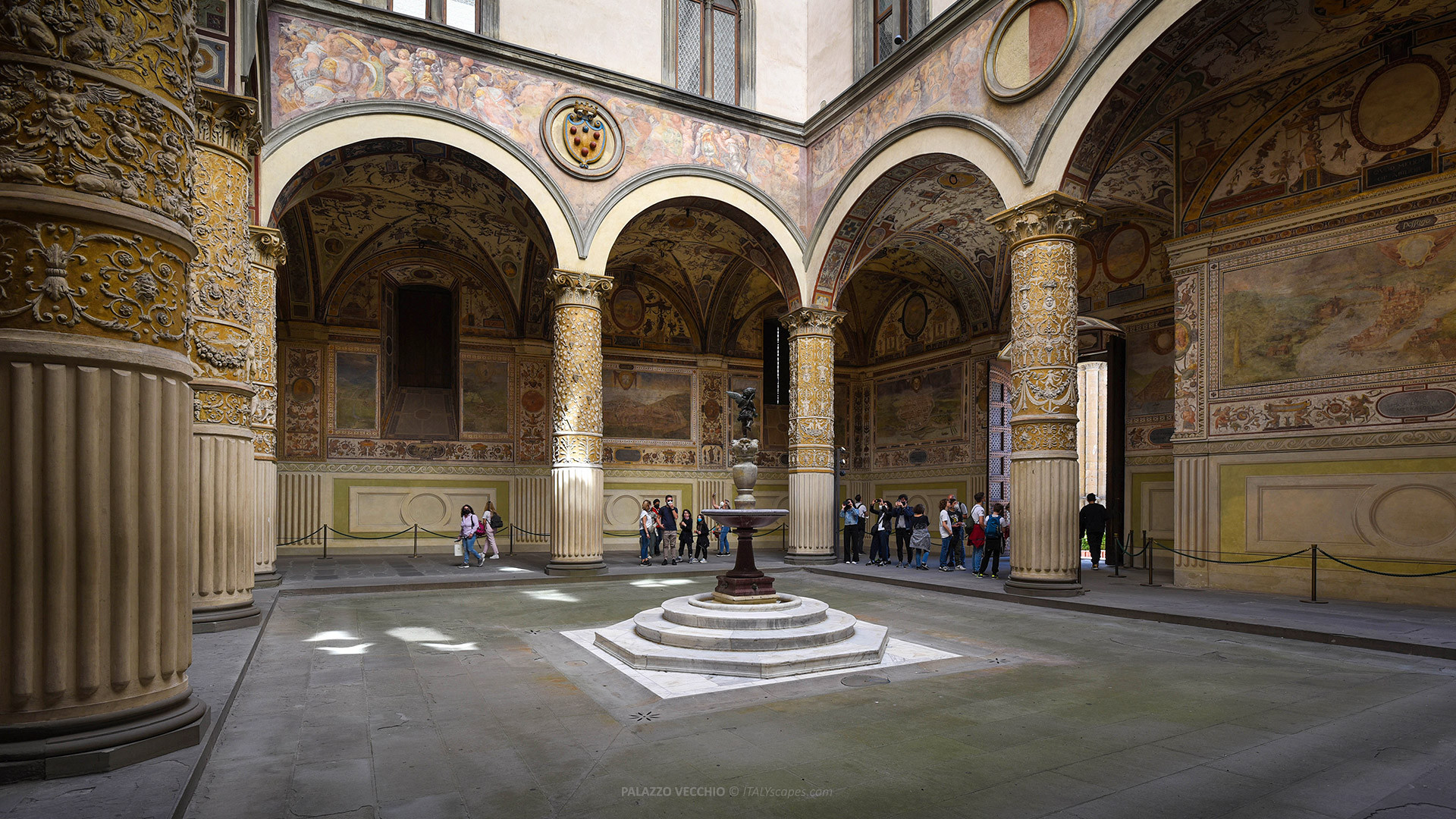
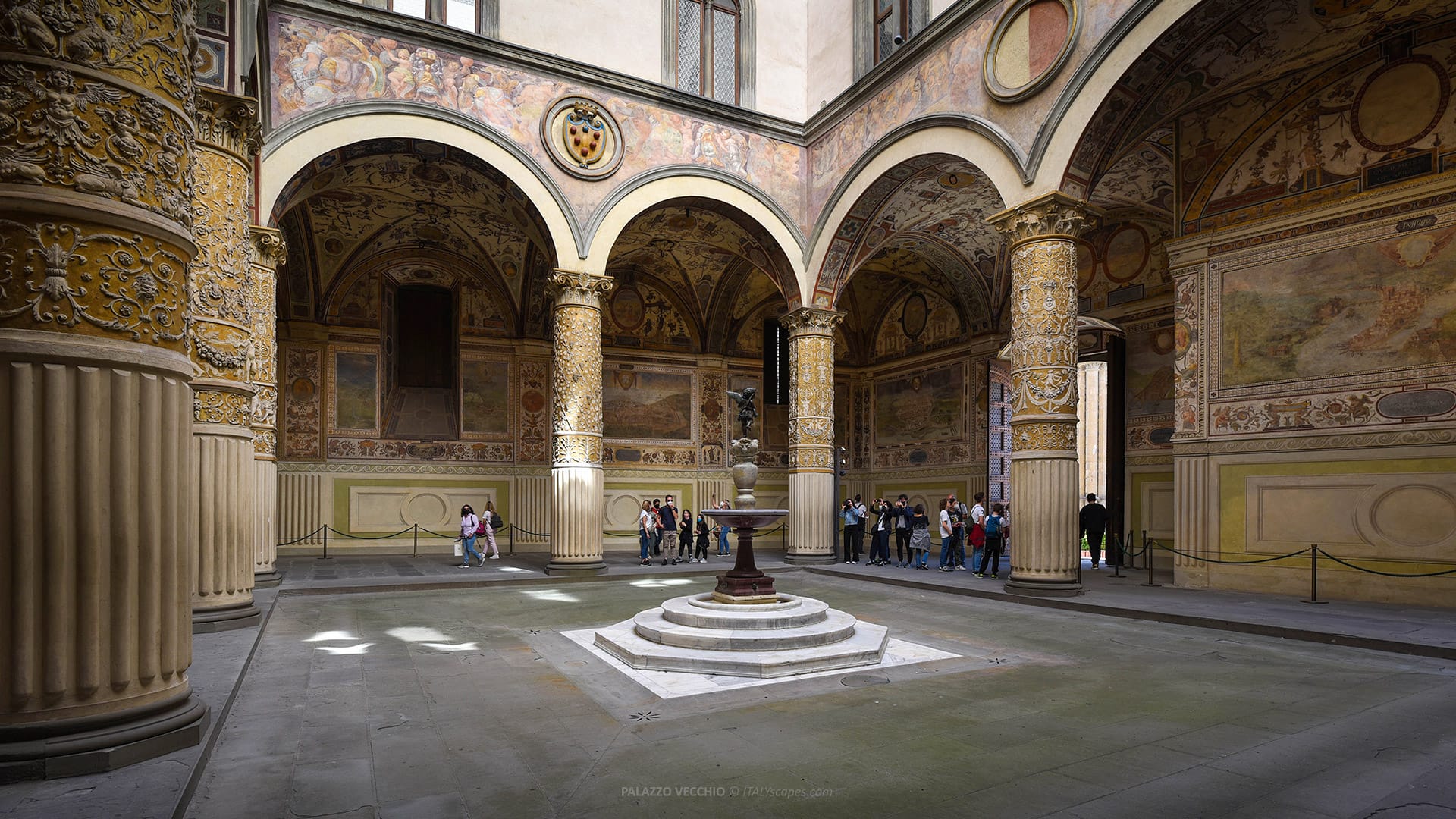
The first courtyard, entered from Piazza della Signoria, was designed by Michelozzo in 1453. Its architecture softened the fortress character of the exterior, creating a more elegant internal space with columns, arches, decorated vaults, and a central fountain.
In 1565, the courtyard was transformed for the wedding of Francesco I de’ Medici and Joanna of Austria. Giorgio Vasari directed the decorative program, which celebrated the Habsburg connection through views of cities from the Austrian and imperial territories.
The frescoes include cities such as Vienna, Innsbruck, Prague, Linz, Graz, Bratislava, and Freiburg im Breisgau. They were painted by artists including Bastiano Lombardi, Cesare Baglioni, and Turino Piemontese.
At the center of the courtyard is a fountain with a porphyry basin and a small bronze putto attributed to Andrea del Verrocchio, represented today by a copy.
The Second and Third Courtyards
The second courtyard is also known as the Customs Courtyard. It contains massive pillars built in 1494 by Il Cronaca to support the Salone dei Cinquecento above. The name comes from the customs offices once located in this part of the palace.
Today, the second courtyard is connected with the visitor route and museum services. It also preserves stone coats of arms from the 14th and 15th centuries. Between the first and second courtyards stands the monumental Vasari staircase leading toward the Salone dei Cinquecento.
The third courtyard, known as the New Courtyard, was planned by Vasari and completed by Bartolomeo Ammannati and Bernardo Buontalenti. It belongs to the later expansion toward Via dei Gondi and Via dei Leoni, and is now linked mainly with municipal offices.
Salone dei Cinquecento
The Salone dei Cinquecento is the largest and most imposing room in Palazzo Vecchio. It measures about 54 meters long and 23 meters wide, with a height of about 18 meters after the 16th-century transformations directed under Giorgio Vasari.
The hall was built in 1494 for the Great Council of the Florentine Republic. Under Cosimo I de’ Medici, it was enlarged and transformed into one of the most impressive ceremonial halls of the late Renaissance, used to receive ambassadors and display ducal authority.
Monumental Apartments and Upper Rooms
The first and second floors preserve several monumental rooms connected with the Medici court and the older republican government. The Studiolo of Francesco I was built between 1570 and 1575 as a secret study and cabinet for precious objects from the Medici collection.
The Apartments of Eleonora of Toledo, wife of Cosimo I, occupy part of the oldest core of the palace. Her private chapel, decorated by Agnolo Bronzino between 1540 and 1565, is considered one of the great masterpieces of Florentine Mannerism.
The Apartments of the Priors preserve the memory of republican Florence. The Priors of the Guilds and the Gonfaloniere of Justice lived inside the palace during their terms, which lasted only two months, because civic officials were required to remain permanently on site.
Another important room is the Hall of Geographical Maps, created by Vasari between 1561 and 1565 as part of the Medici Wardrobe. Its painted map panels, cabinets, and globe reflected Cosimo I’s interest in geography, science, commerce, and global representation.
Art of Palazzo Vecchio
The Facade and the Entrance
The art of Palazzo Vecchio begins before entering the museum. The front of the palace is surrounded by sculpture, inscriptions, coats of arms, and civic symbols. Together, these elements present Florence as a republic, a Medici capital, and a city with a strong public identity.
The Marzocco, the lion symbol of Florence, represented civic power and republican freedom. Donatello’s original Marzocco is preserved in the Bargello, while a copy stands near the palace. Donatello’s Judith and Holofernes is preserved inside Palazzo Vecchio for conservation reasons.
Michelangelo’s David, now in the Accademia Gallery, originally stood outside Palazzo Vecchio as a political symbol of Florentine liberty. Its current copy marks the original position, while Bandinelli’s Hercules and Cacus reflects the later Medici taste for monumental dynastic sculpture.
Salone dei Cinquecento
The Salone dei Cinquecento contains one of the most ambitious decorative programs in Florence. The wall frescoes depict military victories over Siena, Pisa, Porto Ercole, Marciano in Val di Chiana, and Livorno, transforming the room into a visual history of Florentine conquest.
The ceiling paintings were designed to celebrate Cosimo I as ruler of Florence and Tuscany. At the center is the glorification of Cosimo, surrounded by the insignia of Florence and the guilds. The cycle presents the duke as the political and territorial unifier of Tuscany.
The hall also has an important connection with Leonardo da Vinci and Michelangelo. In the early 16th century, Leonardo was commissioned to paint the Battle of Anghiari, and Michelangelo the Battle of Cascina. Neither project was completed in its intended final form.
Michelangelo’s Genius of Victory gives the hall another direct connection with the artist. The marble group, executed around 1533-1534, was originally intended for the tomb of Pope Julius II. It remained incomplete and was later incorporated into the artistic program of the palace.
The Studiolo of Francesco I
The Studiolo of Francesco I is one of the most refined interiors in Palazzo Vecchio. Designed by Giorgio Vasari and Vincenzo Borghini, it was conceived as a private cabinet where Francesco de’ Medici could keep rare, precious, scientific, artistic, and natural objects.
The room was accessible only from the duke’s private apartment in the 16th century. Its cabinets were hidden behind painted panels, and the decoration was created by more than 30 artists, with subjects connected to the objects once stored inside the secret compartments.
The iconographic system organized the contents according to the four elements: earth, water, air, and fire. Gemstones, metals, glass, crystal, pearls, and other materials were classified through symbolic associations.
The Chapel of Eleonora and Medici Rooms
The private chapel of Eleonora of Toledo was created by closing off part of a pre-existing room between 1539 and 1540. Agnolo Bronzino decorated it in stages between 1540 and 1565, creating one of the most important Mannerist interiors in Florence.
The chapel’s decoration focuses on religious themes centered on the Eucharist and salvation. The vault includes scenes from the Apocalypse, while the walls present stories of Moses that prefigure Christ’s sacrifice. The space also served as a private devotional room for the duchess.
Maps, Civic Memory, and Archaeology
The Hall of Geographical Maps represents the world known in the mid-16th century. Of the 53 geographical panels completed, 30 were painted by Egnazio Danti and 23 by Stefano Bonsignori. The room also includes a large terrestrial globe created by Danti.
The maps were not decorative objects only. They expressed Cosimo I’s interest in geography, trade, natural science, and dynastic power. The Medici court used world knowledge as a form of political representation, presenting the ruler as master of an ordered and knowable universe.
The museum also includes the underground remains of the Roman Theatre of Florentia. Excavations carried out between 2004 and 2010 revealed parts of the theatre’s radial corridors, access passages, and other structures later covered by medieval and Renaissance construction.
The inner courtyard of Palazzo Vecchio
How to Get to Palazzo Vecchio
Getting on foot to Palazzo Vecchio
Palazzo Vecchio is located in Piazza della Signoria, in the pedestrian heart of Florence’s historic center. From Santa Maria Novella railway station, the walking distance is about 1.1 to 1.3 kilometers, depending on the exact route through the city center.
A common walking route from Santa Maria Novella passes through Via Panzani, Via de’ Cerretani, Piazza del Duomo, and Via dei Calzaiuoli. The walk usually takes about 15 to 20 minutes, with the Cathedral and Piazza della Repubblica nearby along the route.
From the Cathedral of Santa Maria del Fiore, Palazzo Vecchio is about 550 meters away. The simplest route follows Via dei Calzaiuoli directly south to Piazza della Signoria. From Ponte Vecchio, the palace is about 300 meters away through the Uffizi area.
Getting to Palazzo Vecchio by bus
The closest useful bus stop is Galleria degli Uffizi, located near Piazza del Grano and the Uffizi area, about 100 meters from Palazzo Vecchio. Small central bus lines, including C1, serve the historic center and stop near the museum area.
Getting to Palazzo Vecchio by taxi
A taxi is useful for visitors arriving with luggage, limited time, or mobility needs. From Santa Maria Novella railway station, the ride to the Palazzo Vecchio area normally takes about 10 minutes, depending on traffic, access restrictions, and the exact drop-off point.
Because the historic center includes restricted traffic areas, taxis may use authorized routes and drop passengers near Piazza della Signoria, Via dei Gondi, or the Uffizi area.
Frequently Asked Questions about Palazzo Vecchio
Where is Palazzo Vecchio located?
Palazzo Vecchio is located in Piazza della Signoria, in the historic center of Florence. It stands next to the Uffizi Gallery and about 300 meters from Ponte Vecchio.
When was Palazzo Vecchio built?
Construction of Palazzo Vecchio began in 1299. The project is traditionally attributed to Arnolfo di Cambio, and the palace became the seat of the Florentine Signoria in 1302.
Why is Palazzo Vecchio important?
Palazzo Vecchio is important because it served as Florence’s political center for centuries. It was the seat of the Republic, a Medici residence, and remains the city’s town hall.
How much does it cost to visit Palazzo Vecchio?
A standard ticket to the Palazzo Vecchio Museum costs €18. Reduced tickets cost €12, while access to the Torre di Arnolfo costs €20. Prices may change, so check before visiting.
Can you climb the tower of Palazzo Vecchio?
Yes, visitors can climb the Torre di Arnolfo, which rises about 95 meters above Florence. The route includes 223 steps and offers panoramic views over the historic center.
What can you see inside Palazzo Vecchio?
Inside Palazzo Vecchio, visitors can see the Salone dei Cinquecento, Medici apartments, frescoed rooms, Renaissance sculptures, the Hall of Geographical Maps, archaeological remains, and the tower route.
How far is Palazzo Vecchio from Florence train station?
Palazzo Vecchio is about 1.1 to 1.3 kilometers from Santa Maria Novella railway station. The walk usually takes 15 to 20 minutes through Florence’s historic center.
Sources:Buy tickets & tours:GetYourGuide -
Photos
-
Map
-
Reviews