


-
About
Table of Contents
Buy tickets & tours:GetYourGuideThe Basilica of Saint John Lateran, also known as Basilica di San Giovanni in Laterano and Lateran Basilica, is the cathedral of Rome and the official ecclesiastical seat of the Bishop of Rome, the Pope. The basilica is located in Piazza San Giovanni in Laterano, near the Caelian Hill.
Although many visitors associate the Pope mainly with Saint Peter’s Basilica, the Basilica of Saint John Lateran has a higher ecclesiastical rank. It is the cathedral of the Diocese of Rome and the mother and head of all Catholic churches in Rome and throughout the world.
The full official name of the church is the Papal Archbasilica Cathedral of the Most Holy Savior and of Saints John the Baptist and John the Evangelist in the Lateran. In Italian, it is known as Arcibasilica Papale del Santissimo Salvatore e dei Santi Giovanni Battista ed Evangelista in Laterano.
The basilica is the highest-ranking of the four papal major basilicas of Rome. Its special title of Archbasilica reflects its unique importance in Catholic tradition. The other papal major basilicas are Saint Peter’s Basilica, Saint Paul Outside the Walls, and Saint Mary Major.
The Basilica di San Giovanni in Laterano stands in an area closely connected with early Christianity in Rome. Around it are the Lateran Palace, the Lateran Baptistery, the Holy Stairs, Porta San Giovanni, and the Lateran Obelisk, one of the most important ancient obelisks in the city.

Short History of Basilica of Saint John Lateran (Basilica di San Giovanni in Laterano)
The history of the Basilica of Saint John Lateran begins in the early 4th century, after Christianity was legally tolerated in the Roman Empire. The land belonged to the Laterani family, a wealthy Roman family whose properties were confiscated under Emperor Nero after accusations of conspiracy.
At the beginning of the 4th century, Emperor Constantine the Great gave the Lateran estate to the Bishop of Rome. This donation allowed the construction of a monumental Christian basilica in the capital of the empire. The new church became one of the first great public Christian places of worship in Rome.
The basilica was completed in the first decades of the 4th century and was consecrated in 324 by Pope Sylvester I. Its original dedication was to the Most Holy Savior, which remains the primary dedication of the church, even though the name Saint John Lateran became more common later.
From the 4th century onward, the Basilica di San Giovanni in Laterano became the religious heart of the Roman Church. The adjacent Lateran Palace served as the papal residence for many centuries. For a long time, the Lateran complex was the real center of papal life and government.
The Early Medieval Basilica
The Lateran Basilica suffered damage during the turbulent centuries that followed the decline of imperial Rome. In 410, Rome was sacked by the Visigoths led by Alaric. In 455, the Vandals led by Genseric also attacked the city and removed treasures from churches and important Roman buildings.
After these events, the Basilica of Saint John Lateran was restored and enriched by several popes. Pope Leo the Great, in the 5th century, played an important role in restoring the church’s prestige. The basilica continued to function as the cathedral of Rome and as the principal church of the papacy.
In the late 9th century, the structure was damaged by an earthquake. Restoration and rebuilding works followed, and in the early 10th century Pope Sergius III renewed the basilica. He also added the dedication to Saint John the Baptist, strengthening the church’s connection with baptismal tradition.
In the 12th century, Pope Lucius II added the dedication to Saint John the Evangelist. From this period onward, the church became closely associated with both John the Baptist and John the Evangelist, although its oldest dedication to Christ the Savior remained fundamental.
Powered by GetYourGuideThe Medieval Papal Center
During the Middle Ages, the Basilica di San Giovanni in Laterano was the main church of the papacy and the center of Western Christianity. The popes lived in the Lateran Palace, next to their cathedral, and the complex hosted ceremonies, councils, diplomatic meetings, and administrative activity.
Several important church assemblies, known as the Lateran Councils, were held in this area. These councils underlined the basilica’s central role in the institutional history of the Catholic Church.
The basilica was enriched with mosaics, frescoes, liturgical furnishings, and architectural additions. At the end of the 13th century, Pope Boniface VIII promoted important works in the Lateran complex. Medieval artistic decorations traditionally associated with great masters such as Giotto and Cimabue were later lost.
The Basilica of Saint John Lateran and the Lateran Palace formed a vast religious and political complex. Before the Vatican became the main papal residence, the Lateran was the true headquarters of the papacy. Its importance was both spiritual and administrative.
Decline, Fires, and the Avignon Period
In the 14th century, the position of the Lateran Basilica changed dramatically. The papacy moved to Avignon in 1309, and Rome lost much of its religious and political centrality. During this period, the Lateran complex suffered from neglect, structural decline, and damaging fires.
Two major fires in the 14th century caused serious destruction to the basilica and the adjacent palace. Restoration works followed, but the condition of the complex remained problematic. When the popes returned to Rome, the Lateran no longer offered the same security, prestige, or architectural stability.
After the papacy returned to Rome, the popes increasingly preferred the Vatican area. Saint Peter’s Basilica and the Vatican Palace gradually became the practical center of papal life. However, the Basilica di San Giovanni in Laterano never lost its formal status as the cathedral of Rome.
The distinction is important: Saint Peter’s Basilica became the most famous papal church, but the Basilica of Saint John Lateran remained the cathedral of the Pope as Bishop of Rome. This status explains why the basilica still holds the highest rank among Catholic churches.
Renaissance and Baroque Transformations
Major changes occurred in the late 16th century under Pope Sixtus V. The old Lateran Palace was demolished and replaced by a new palace designed by Domenico Fontana. The pope also reorganized the surrounding urban area and moved the ancient Lateran Obelisk to the square.
The basilica itself received its most important interior transformation in the 17th century. Pope Innocent X commissioned Francesco Borromini to remodel the interior for the Jubilee of 1650. Borromini preserved the ancient five-nave plan but gave the church its powerful Baroque appearance.
In the 18th century, the monumental main façade was completed under Pope Clement XII. The architect Alessandro Galilei designed the façade, finished in 1735. This façade gave the Basilica of Saint John Lateran the grand external image it still has today.
Further works were carried out in the 19th century, especially in the apse area. The apse was rebuilt and moved under Pope Leo XIII, while preserving the important medieval mosaic. These interventions shaped the balance between ancient, medieval, Baroque, and modern elements inside the basilica.
Architecture of Basilica of Saint John Lateran (Basilica di San Giovanni in Laterano)
The architecture of the Basilica of Saint John Lateran is the result of many centuries of construction, destruction, restoration, and transformation. The church preserves the basic layout of an ancient Christian basilica, with five naves, a transept, an apse, and a long central axis.
The building is about 140 meters long and approximately 73 meters wide, depending on the areas included in the measurement. The scale of the Basilica di San Giovanni in Laterano reflects its role as a major public church designed for papal ceremonies, large liturgies, and pilgrim gatherings.
The earliest Constantinian basilica followed the model of large Roman public halls. It had a central nave, side aisles, colonnades, and an apse. This type of plan was suitable for Christian worship because it allowed processions, large congregations, and a clear focus on the altar.
The Main Façade
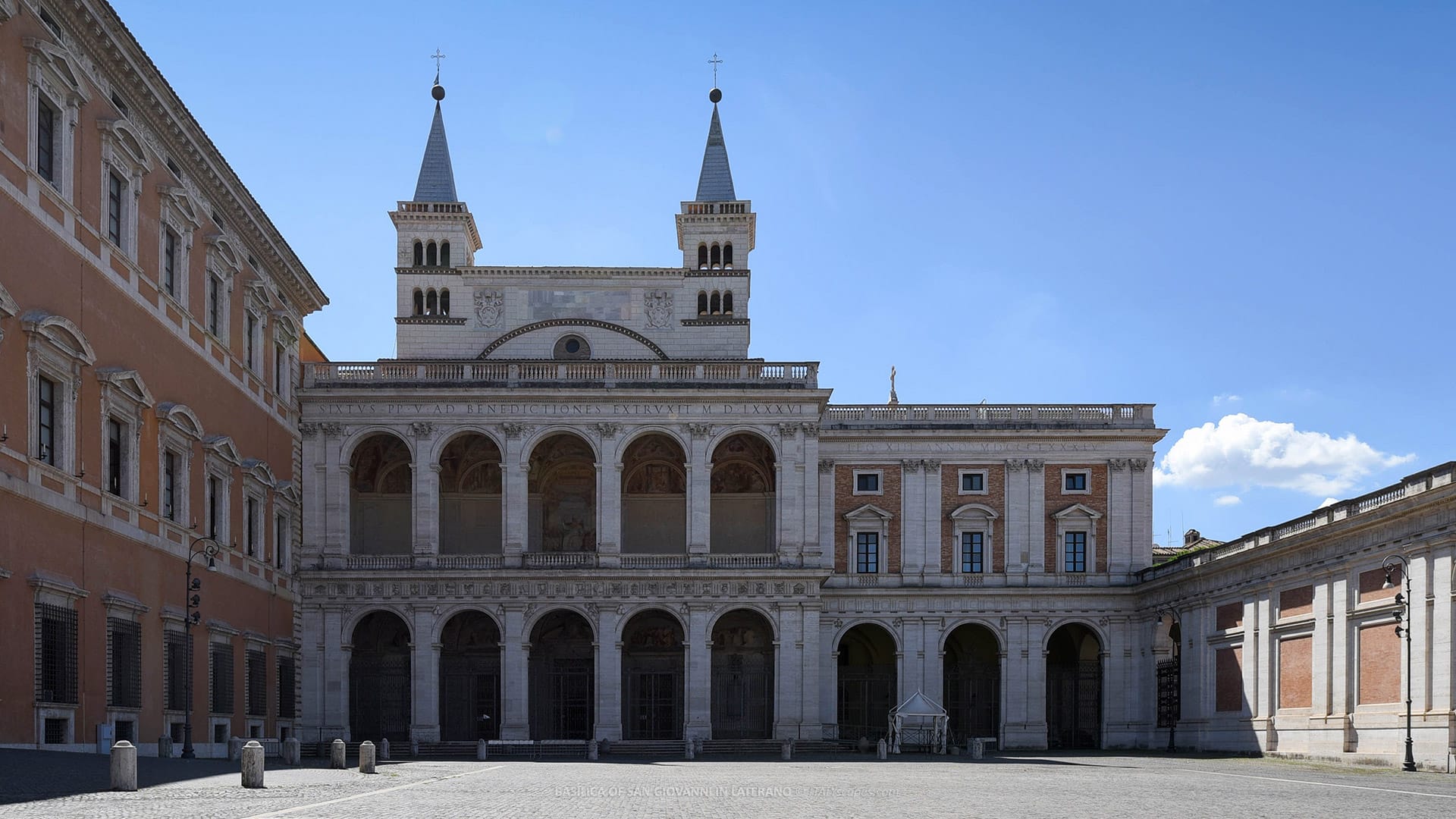
The main façade of the Basilica of Saint John Lateran is one of the most recognizable elements of the church. Designed by Alessandro Galilei and completed in 1735, it has a monumental classical structure, with large pilasters, a central balcony, and a powerful ceremonial rhythm.
At the top of the façade stand 15 colossal statues. The central figure represents Christ, while the others include Saint John the Baptist, Saint John the Evangelist, and Doctors of the Church. These statues emphasize the theological and institutional importance of the basilica.
The façade includes a large portico at ground level and a loggia above it. The central balcony is used for solemn papal ceremonies connected with the basilica.
Inside the portico are important historical elements. The large central bronze doors originally came from the Curia Julia, the ancient Roman Senate house in the Roman Forum. They were adapted for the basilica, creating a direct material connection between Christian Rome and ancient imperial Rome.
Powered by GetYourGuideThe North Transept and Lateran Square
The north transept has a separate monumental façade designed by Domenico Fontana during the pontificate of Pope Sixtus V. This side of the church faces the Lateran Palace and the square dominated by the ancient Egyptian obelisk. It became an important ceremonial entrance.
The Lateran Obelisk is the tallest standing ancient Egyptian obelisk in the world. It was originally brought to Rome in antiquity and stood in the Circus Maximus. In 1588, Pope Sixtus V had it moved to Piazza San Giovanni in Laterano.
The area around the Basilica of Saint John Lateran also includes the Lateran Baptistery, traditionally associated with the age of Constantine, and the Holy Stairs nearby. Together, these monuments make the Lateran complex one of the most important Christian areas in Rome.
The square itself is an important urban space. It connects the basilica with Porta San Giovanni, the Aurelian Walls, the Lateran Palace, and the surrounding streets. For pilgrims and visitors, the exterior setting helps explain the basilica’s role in the religious geography of Rome.
The Interior Layout
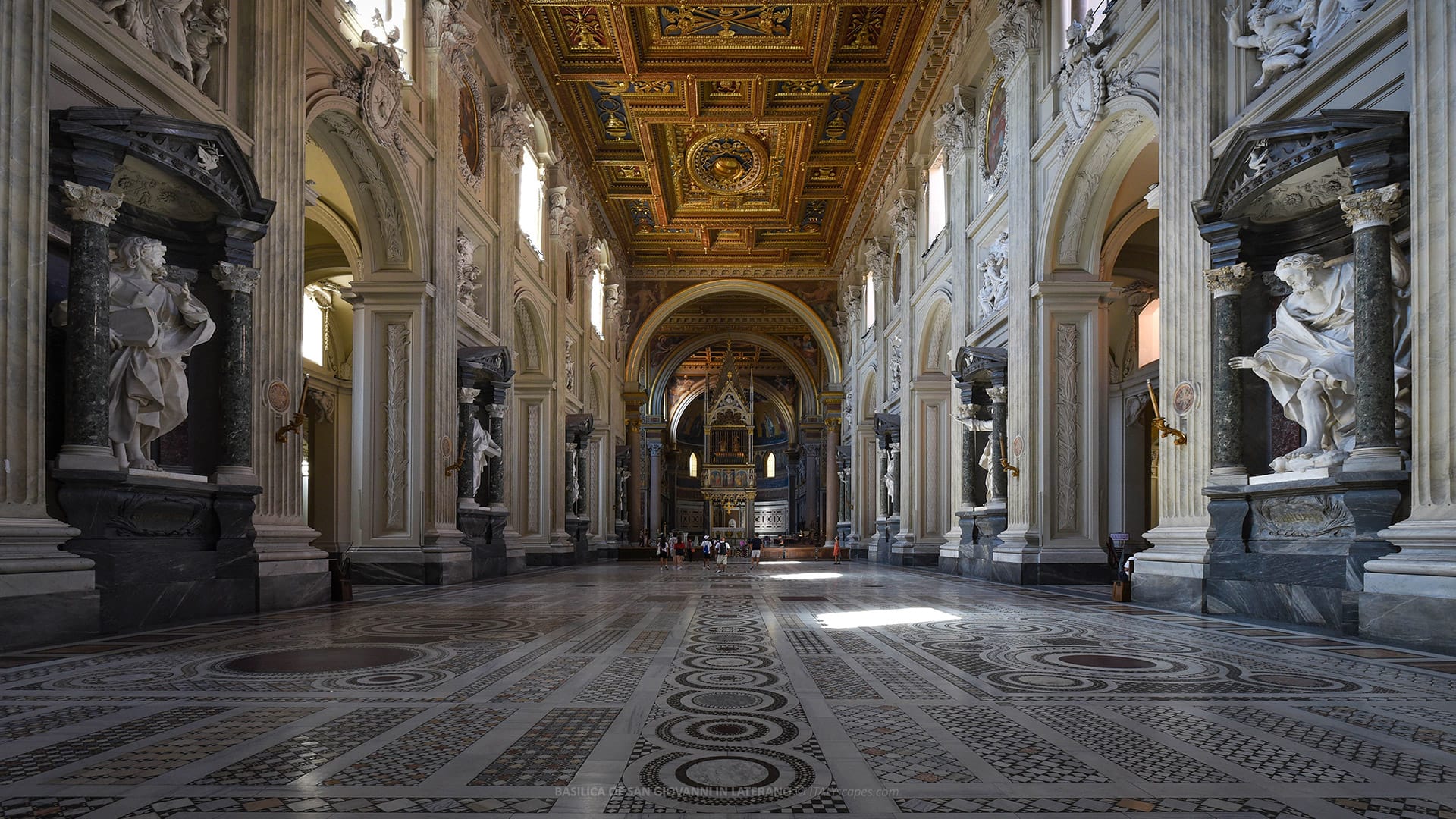
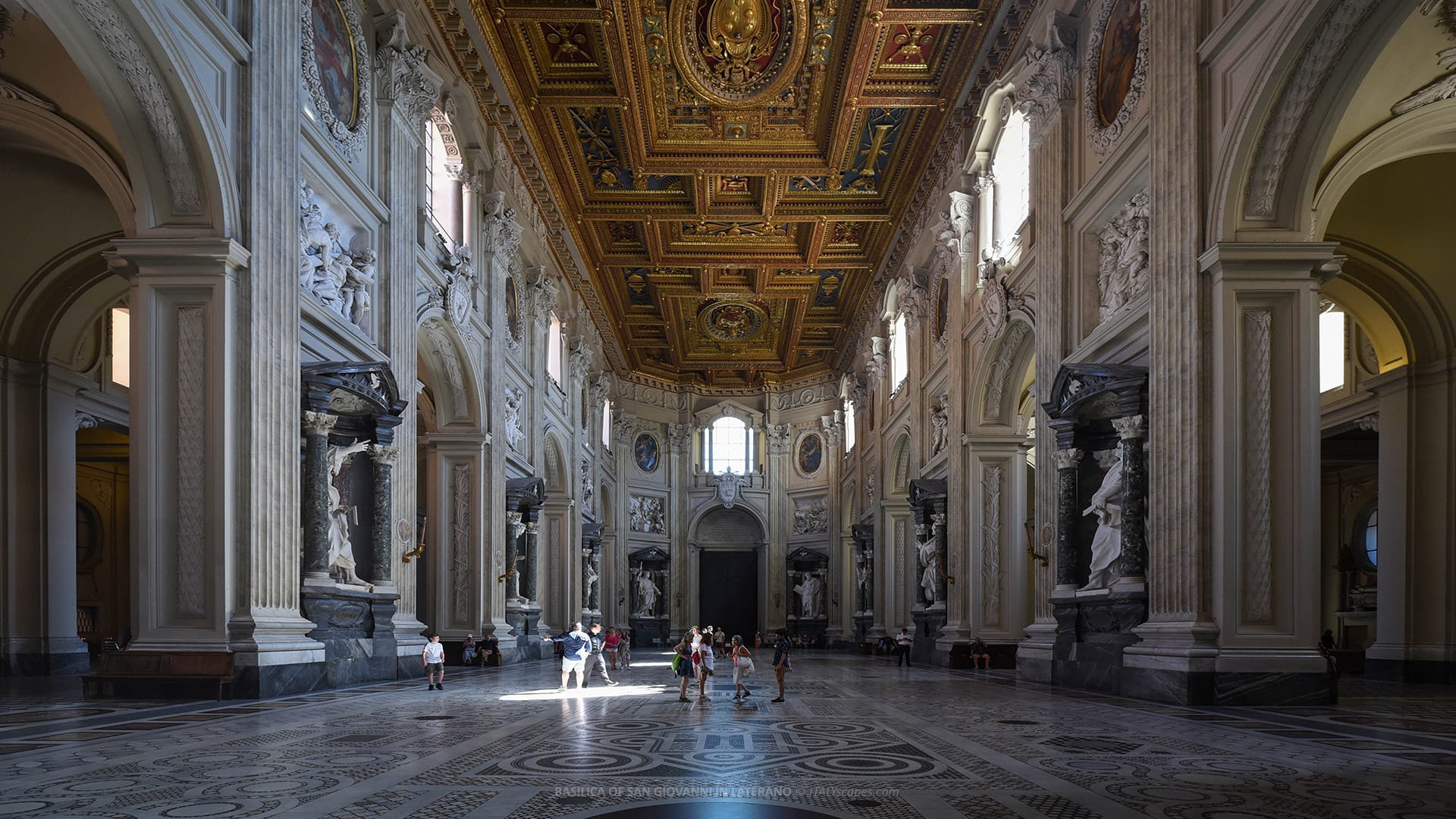
The interior of the Basilica di San Giovanni in Laterano has five naves divided by massive pillars. Borromini’s 17th-century intervention transformed the ancient colonnaded structure into a dramatic Baroque space. The central nave is high, solemn, and organized by large niches and pilasters.
The ceiling of the central nave is richly decorated and coffered. It creates a strong horizontal line above the nave and adds ceremonial grandeur to the interior. The side aisles are lower and more intimate, helping to emphasize the height and importance of the main nave.
Borromini’s design respected the ancient spatial logic of the basilica while giving it a new architectural language. The result is not a complete replacement of the early Christian plan, but a powerful reinterpretation. The Lateran Basilica still feels ancient, but its visible interior is strongly Baroque.
The transept, papal altar, apse, and nave create a clear liturgical hierarchy. The visitor’s eye is drawn from the entrance toward the altar and the apse mosaic. This visual direction reinforces the role of the Basilica of Saint John Lateran as a place of worship and papal authority.
Art of Basilica of Saint John Lateran (Basilica di San Giovanni in Laterano)
The art of the Basilica of Saint John Lateran reflects many periods of Christian history in Rome. Ancient fragments, medieval mosaics, Gothic architecture, Baroque interiors, and 18th-century sculpture coexist in the same building.
One of the most striking artistic programs is found in the central nave. The large niches in the pillars contain monumental statues of the Twelve Apostles. These sculptures were created by leading artists of the late Baroque and early 18th century.
Above the nave, painted decorations include prophets and biblical themes. These images form a theological sequence linking the Old and New Testaments. The result is a visual program centered on revelation, apostolic continuity, and the authority of the Roman Church.
The Papal Altar and Gothic Ciborium
The papal altar stands at the crossing of the transept, one of the most important points inside the Basilica of Saint John Lateran. Traditionally, only the Pope, or a priest specifically authorized by him, celebrates Mass at this altar, reflecting the basilica’s status as the cathedral of Rome.
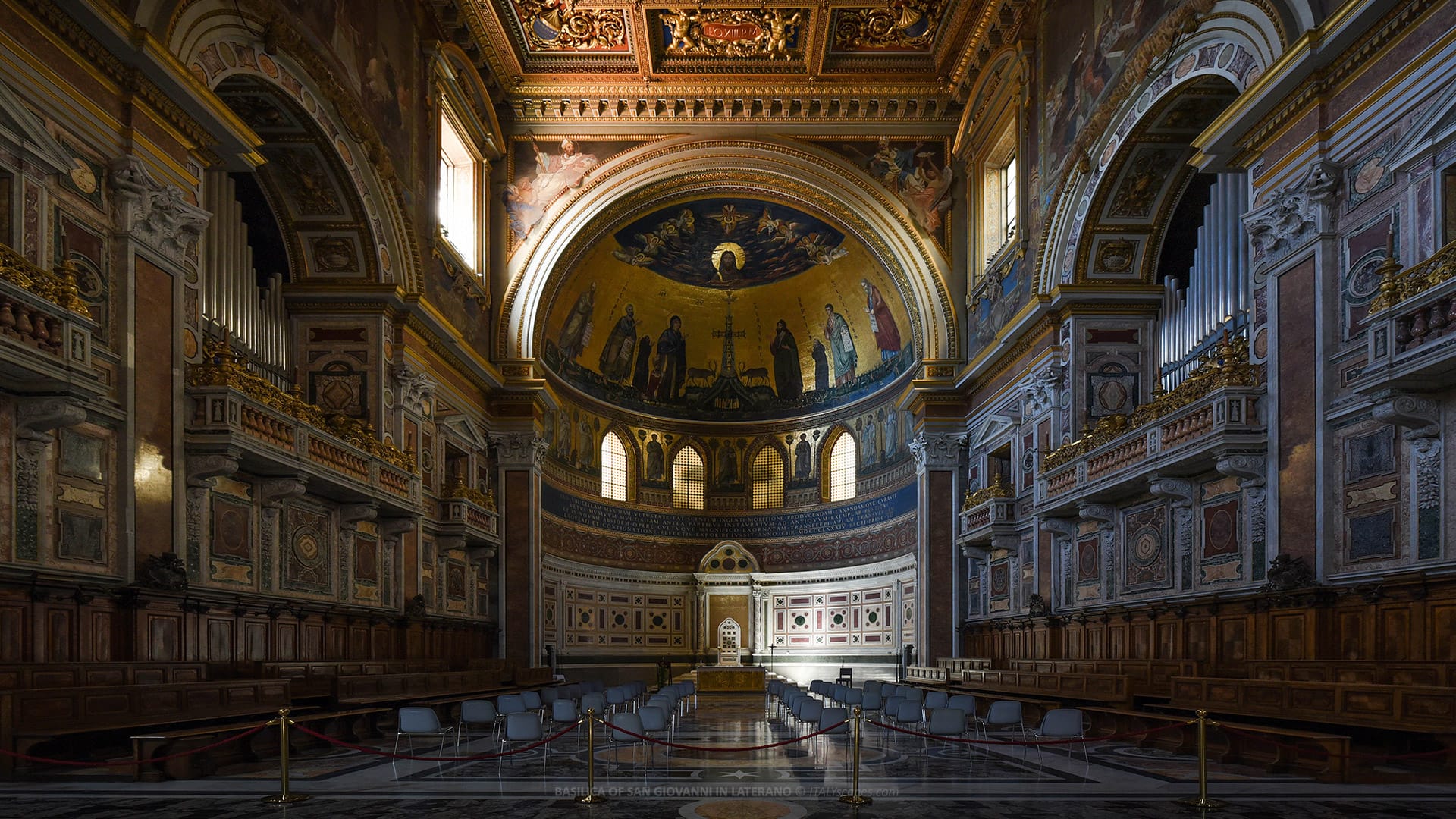
Above the altar rises a monumental Gothic ciborium, created in the 14th century and attributed to Giovanni di Stefano. This richly decorated structure is one of the most important medieval elements preserved inside the basilica. It contrasts strongly with the later Baroque interior.
The ciborium is decorated with delicate Gothic forms and sculptural details. It also marks the sacred focus of the church. In a basilica transformed many times, the ciborium remains a visible reminder of the medieval Lateran Basilica and of the continuity of papal liturgy.
Powered by GetYourGuideThe Apse Mosaic
The apse mosaic is one of the most important works of art in the Basilica of Saint John Lateran. Its medieval composition was restored and reinstalled after the 19th-century rebuilding of the apse. The mosaic presents a theological image centered on Christ, the Cross, saints, and salvation.
At the center of the composition is the Cross, above which appears Christ. The Holy Spirit is represented through the dove. Around the scene are figures including the Virgin Mary, Saint Peter, Saint Paul, Saint John the Baptist, Saint John the Evangelist, Saint Andrew, Saint Francis of Assisi, and Saint Anthony of Padua.
The mosaic combines ancient Christian symbolism with medieval artistic language. The flowing waters below the Cross refer to baptism and spiritual renewal. This is especially meaningful in the Lateran complex, because the nearby baptistery was one of the most important baptismal sites in Christian Rome.
Chapels and Sacred Spaces
The basilica contains several important chapels, each with its own artistic and historical value. Among the most notable is the Corsini Chapel, built in the 18th century for Pope Clement XII. It is one of the richest chapel interiors in the Basilica of Saint John Lateran.
The Blessed Sacrament Chapel and other side chapels preserve paintings, sculptures, altars, and funerary monuments. These spaces show how the basilica continued to receive artistic additions long after its original construction.
The cloister, located beside the basilica, is another significant artistic space. It dates mainly from the medieval period and is known for its elegant columns, Cosmatesque decoration, and quiet architectural rhythm. The cloister preserves a more intimate side of the Lateran complex.
How to Get to Basilica of Saint John Lateran (Basilica di San Giovanni in Laterano)
The Basilica of Saint John Lateran is located in Piazza San Giovanni in Laterano, southeast of Rome’s historic center. It is easy to reach by metro, bus, tram, or on foot from several major landmarks. The area is well connected because San Giovanni is an important transport hub.
Visitors often combine the Basilica di San Giovanni in Laterano with nearby monuments such as the Holy Stairs, the Lateran Baptistery, Porta San Giovanni, Porta Asinaria, and the Basilica of Santa Croce in Gerusalemme. The Colosseum is also within walking distance.
Getting to Basilica of Saint John Lateran on foot
Walking to the Basilica of Saint John Lateran is possible from several parts of central Rome. From the Colosseum, the distance is about 1.5 kilometers, depending on the route. The walk usually takes around 20 minutes and passes through historic streets near the Caelian Hill.
From the Basilica of Santa Croce in Gerusalemme, the Lateran Basilica is about 600 to 700 meters away. This short walk is useful for visitors following pilgrimage routes in Rome.
From Roma Termini station, the basilica is around 2 kilometers away. The walk usually takes 25 to 30 minutes, depending on pace and route.
Getting to Basilica of Saint John Lateran by metro
The nearest metro station is San Giovanni, served by Metro Line A and Metro Line C. The station is located near Piazzale Appio and is only a short walk from the basilica. For most visitors, this is the fastest and simplest public transport option.
From Termini station, take Metro Line A toward Anagnina and get off at San Giovanni. From the Vatican area, travelers can also use Line A, connecting stations such as Ottaviano or Cipro with San Giovanni.
Metro Line C also serves San Giovanni, connecting the area with eastern districts of Rome. The station became an interchange between Line A and Line C in 2018.
Getting to Basilica of Saint John Lateran by bus
The closest bus stops are around Porta San Giovanni, Piazza San Giovanni in Laterano, and nearby streets. Several ATAC bus lines serve the area, including routes commonly listed for San Giovanni such as 16, 51, 81, 85, 87, 218, 360, 665, and 792.
Bus line 85 is useful for connections with central Rome, including areas near the Colosseum and Via del Corso. Bus line 87 also connects important historic zones. Routes can change, so visitors should always check current local transport information before traveling.
Getting to Basilica of Saint John Lateran by tram
The area of San Giovanni is also served by tram connections. Tram line 3 is particularly useful because it links different historic and residential areas of Rome. It can be a convenient option for visitors coming from districts not directly connected by Metro Line A.
The tram stop is not far from the Basilica di San Giovanni in Laterano, and the walk from the stop to the church is short. This option is useful for travelers who want to combine the basilica with other sites outside the most crowded tourist routes.
Frequently Asked Questions about Basilica of Saint John Lateran (Basilica di San Giovanni in Laterano)
What is the Basilica of Saint John Lateran?
The Basilica of Saint John Lateran is the cathedral of Rome and the official church of the Pope as Bishop of Rome. Its Italian name is Basilica di San Giovanni in Laterano.
Is Basilica of Saint John Lateran more important than Saint Peter’s Basilica?
In ecclesiastical rank, yes. Basilica of Saint John Lateran is the cathedral of Rome and the mother church of all Catholic churches, while Saint Peter’s Basilica is the most famous papal basilica.
Where is Basilica di San Giovanni in Laterano located?
Basilica di San Giovanni in Laterano is located in Piazza San Giovanni in Laterano, southeast of central Rome, near the Caelian Hill, Porta San Giovanni, and the Aurelian Walls.
When was Basilica of Saint John Lateran built?
The basilica was built in the early 4th century, after Emperor Constantine gave the Lateran estate to the Bishop of Rome. It was consecrated in 324 by Pope Sylvester I.
Why is it called Lateran Basilica?
The name Lateran Basilica comes from the Laterani family, whose estate once occupied the area. The land later became imperial property before being given to the Church by Constantine.
What can you see inside Basilica di San Giovanni in Laterano?
Inside the basilica, visitors can see the Twelve Apostles statues, the Gothic ciborium, the papal altar, the apse mosaic, Baroque architecture by Borromini, chapels, and medieval artistic elements.
How do you get to Basilica of Saint John Lateran by metro?
The nearest metro station is San Giovanni, served by Metro Line A and Metro Line C. From the station, the basilica is only a short walk away.
Is Basilica of Saint John Lateran free to visit?
The main basilica is generally free to enter, although some connected areas, such as the cloister or special sections, may require a ticket. Opening conditions can change during religious events.
Sources:Buy tickets & tours:GetYourGuidePowered by GetYourGuide -
Photos
-
Map
-
Reviews


