-
About
Table of Contents
Rising at the entrance to the Grand Canal, the Basilica di Santa Maria della Salute is one of the defining monuments of Venice. Its great dome dominates the view from the Bacino di San Marco, while its marble mass marks the tip of Dorsoduro beside Punta della Dogana.
Commonly called La Salute, the church stands between the Grand Canal and the Giudecca Canal, directly across the water from Piazza San Marco. From the square, La Salute appears as a theatrical counterpoint to the Doge’s Palace, San Giorgio Maggiore and the long waterfront of the city.
The church was built as an ex voto after the plague of 1630-1631, when Venice suffered one of the most destructive epidemics in its history. The Republic promised a sanctuary to the Virgin Mary, under the title of Santa Maria della Salute, meaning Saint Mary of Health or Salvation.
Designed by Baldassare Longhena, the church combines religious symbolism, difficult lagoon engineering and Venetian Baroque architecture. The building is not a longitudinal church with a traditional nave. Its main space is centralized, octagonal and luminous, organized around a massive dome and a sequence of Marian altars.
Inside, visitors find works by Titian, Luca Giordano, Tintoretto, Pietro Liberi and other Venetian masters. The main altar contains the revered Byzantine icon known as the Madonna della Salute or Mesopanditissa, while the sacristy preserves some of the most important paintings associated with the basilica.
Today, La Salute remains a place of worship, a major artistic monument and a powerful civic symbol. Every year, on 21 November, the Festa della Madonna della Salute brings thousands of Venetians to the church, continuing a tradition born from the city’s vow during the plague.
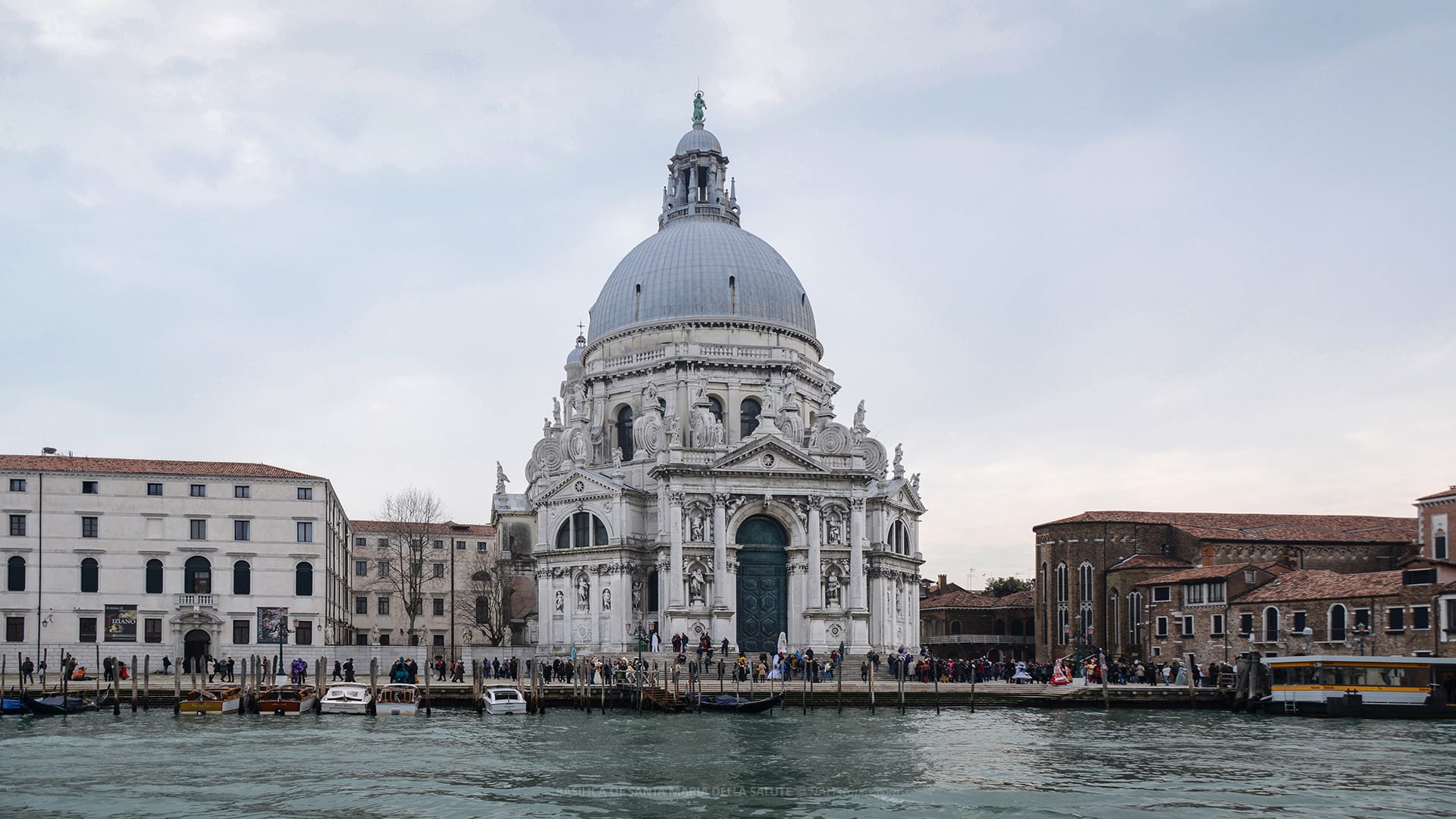
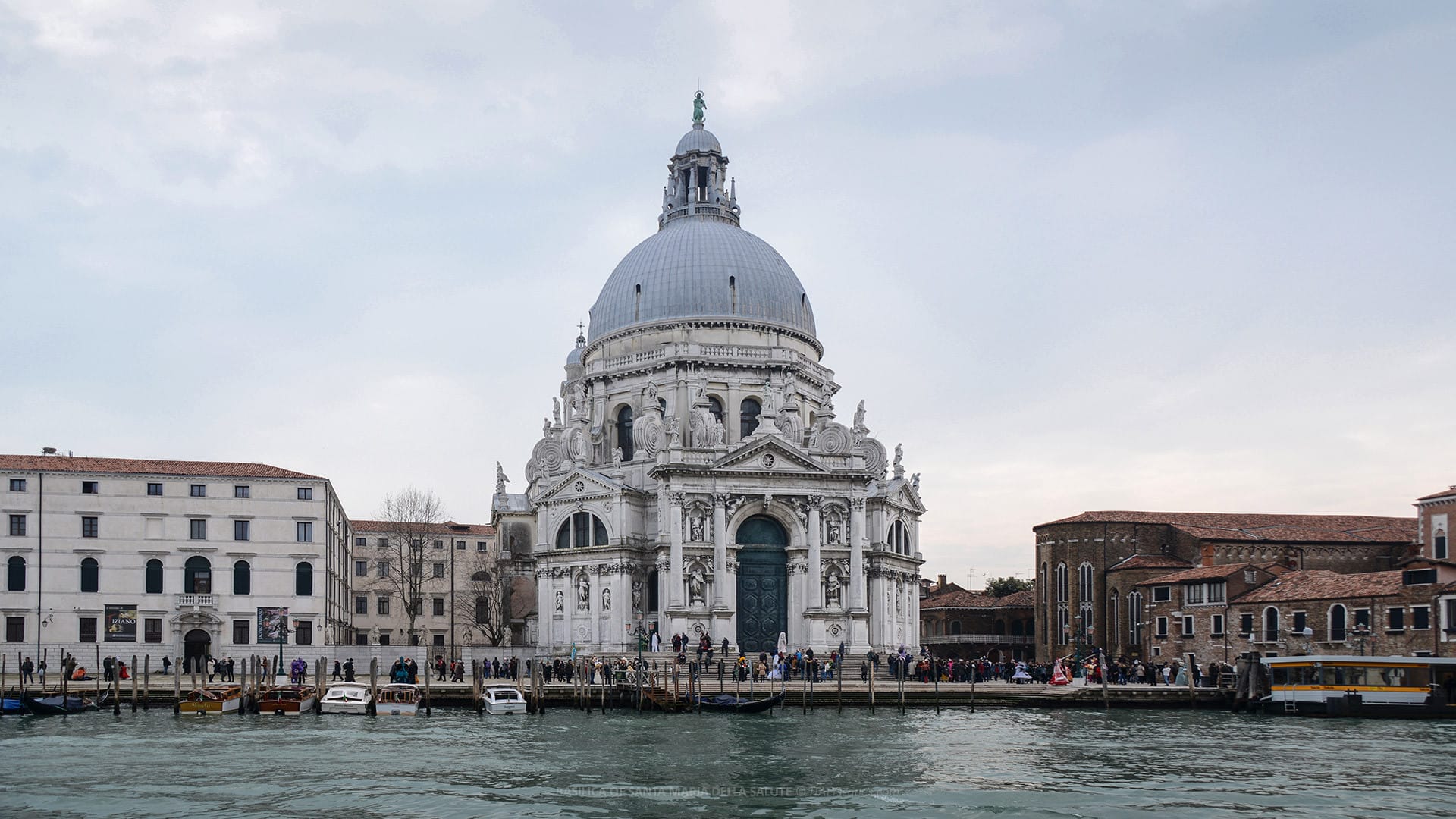
Basilica di Santa Maria della Salute overlooking the Grand Canal
Short History of the Basilica di Santa Maria della Salute
The plague and the public vow
The history of the Basilica di Santa Maria della Salute begins during the plague of 1630-1631. The disease entered a city already weakened by political and military pressure, then spread rapidly through dense neighborhoods, trade routes and lagoon communities. Venice lost tens of thousands of inhabitants during the epidemic.
On 22 October 1630, Patriarch Giovanni Tiepolo made a solemn vow to build a new church dedicated to the Virgin Mary if the city were freed from the plague. A few days later, Doge Nicolò Contarini, the clergy and the people gathered in Piazza San Marco for public prayer.
The vow gave the church a double identity from the beginning. It was not only a religious sanctuary, but also a state monument. The Senate wanted a permanent architectural sign of gratitude, visible from the water and linked to the ceremonial life of the Republic.
Choosing the site and the architect
The Republic selected a dramatic site near Punta della Dogana, where the Grand Canal opens into the Bacino di San Marco and meets the Giudecca Canal. To build there, an older religious complex dedicated to the Santissima Trinità had to be demolished, and the unstable ground had to be reinforced.
The position gave the Basilica di Santa Maria della Salute an exceptional visual role. It could be seen from the water approach to San Marco, from the Doge’s Palace, from San Giorgio Maggiore and from the Grand Canal.
A design competition was organized, and Longhena, still a relatively young architect, won the commission. His proposal described the church as a form of crown for the Virgin. This idea explains the symbolic force of the great dome, which still reads as a monumental crown above the lagoon.
Construction began in 1631, and the first stone was laid on 1 April of that year. The work lasted for decades, passing through complex foundation works, masonry, sculpture and interior decoration. Longhena died in 1682, before all details were finished, but his design remained the guiding plan.
The church was solemnly consecrated by Patriarch Alvise Sagredo on 9 November 1687. The long construction period explains why the Basilica di Santa Maria della Salute belongs fully to the 17th century, yet also shows continuity with earlier Venetian models, including Palladian centralized architecture.
A living vow – Festa della Salute
The vow did not end when the building was completed. Every year, on 21 November, Venice celebrates the Festa della Madonna della Salute, linked to the Presentation of the Blessed Virgin Mary. The ceremony renews the city’s gratitude for deliverance from the epidemic and keeps the old promise alive.
For the feast, a temporary bridge is built across the Grand Canal, traditionally allowing people to walk from the San Marco area toward La Salute. Earlier versions used boats; today the bridge is a floating structure fixed for the pilgrimage. The crossing gives the ritual a strong civic and physical meaning.
La Salute becomes the focus of prayer, candles and family devotion during the celebration. Venetians come to the sanctuary, attend Mass, light candles and often eat castradina, a traditional dish based on mutton, historically associated with the feast.
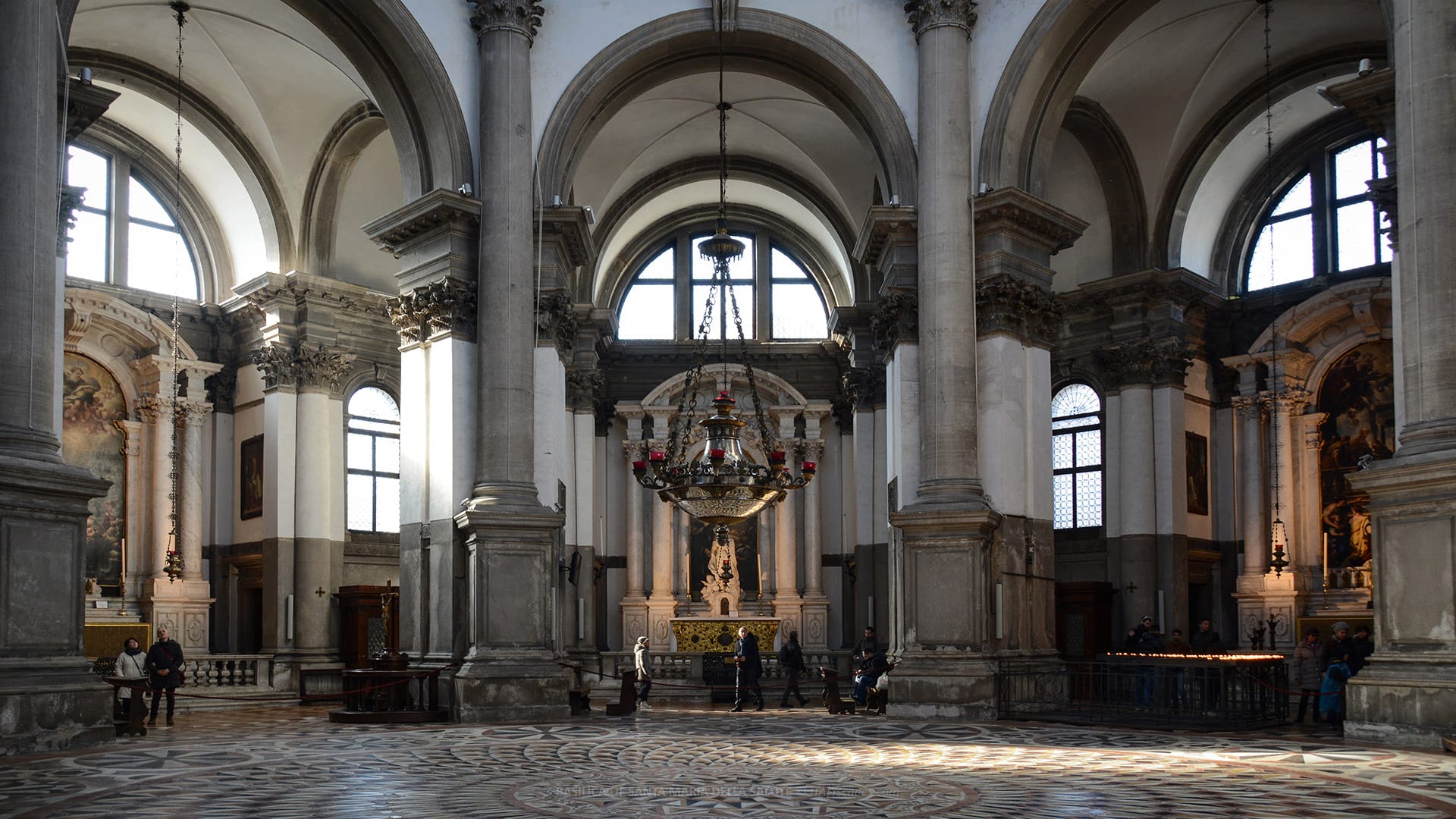
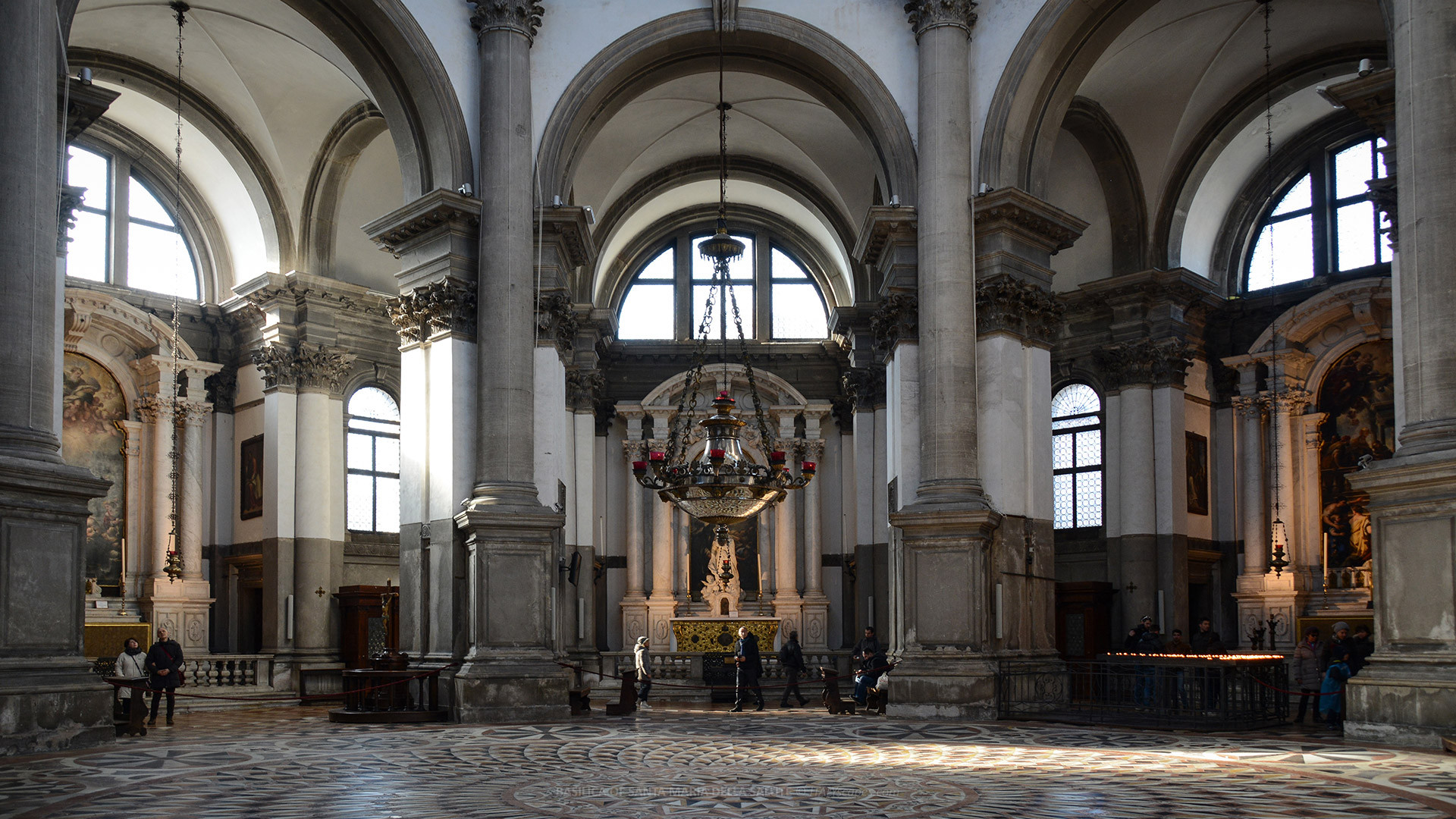
Interior of the Basilica di Santa Maria della Salute
Architecture of the Basilica di Santa Maria della Salute
Foundations and overall form
The architecture of La Salute had to solve a severe technical problem: how to place a large stone church on soft lagoon ground at the edge of Venice. The solution involved deep timber piling, land consolidation and a broad platform able to distribute the weight of the structure.
Older descriptions often repeat the figure of one million wooden piles, but modern studies treat that number as exaggerated. A safer estimate is around 100,000 wooden piles, driven into the ground to support the platform. This hidden forest of timber made Longhena’s ambitious centralized church possible.
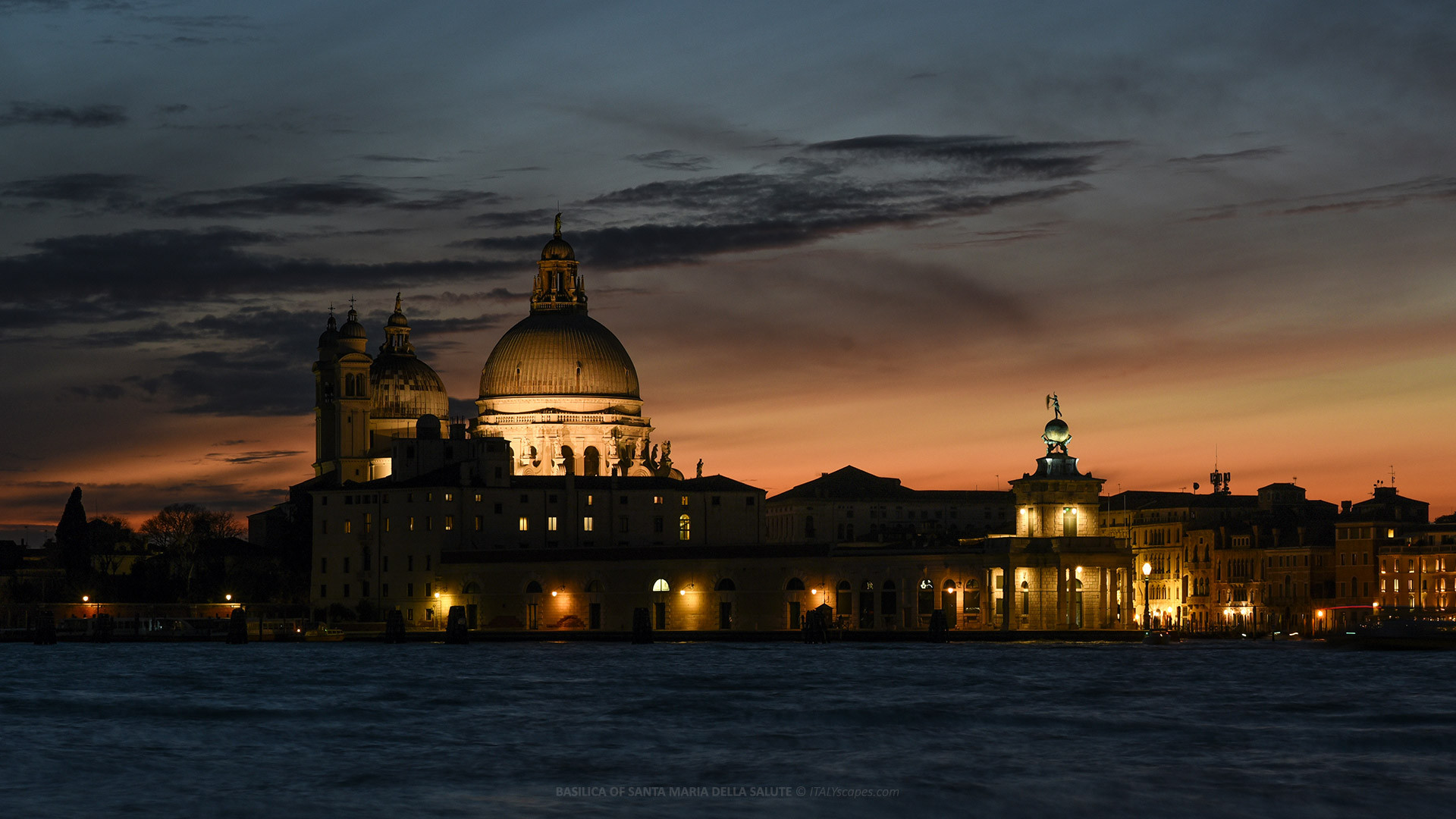
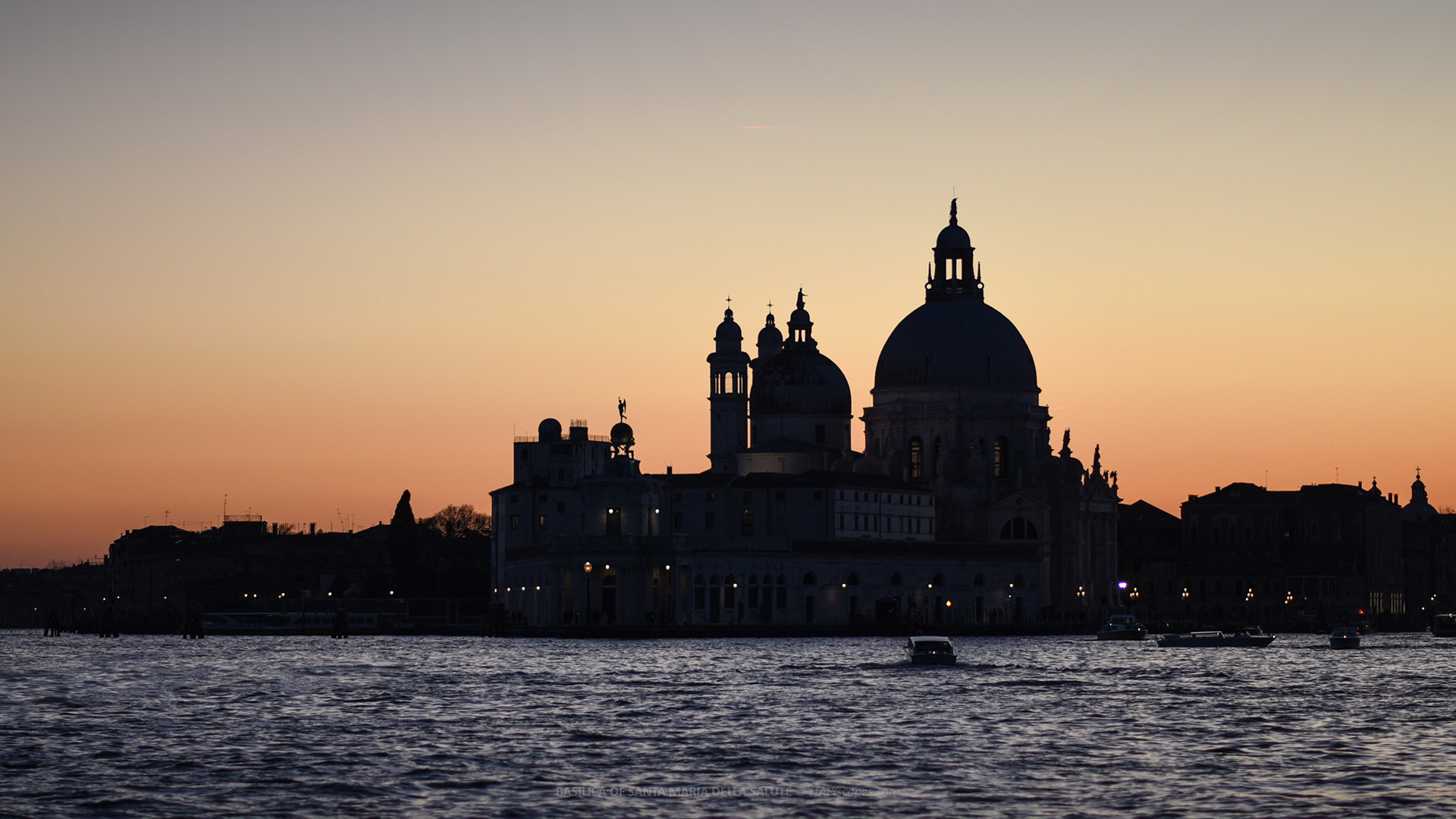
The main body of the basilica is octagonal, covered by a hemispherical dome. Behind it, toward the south, Longhena placed a smaller volume for the presbytery, with lateral apses, a lower dome and two bell towers. This creates the famous layered silhouette seen from the lagoon and Grand Canal.
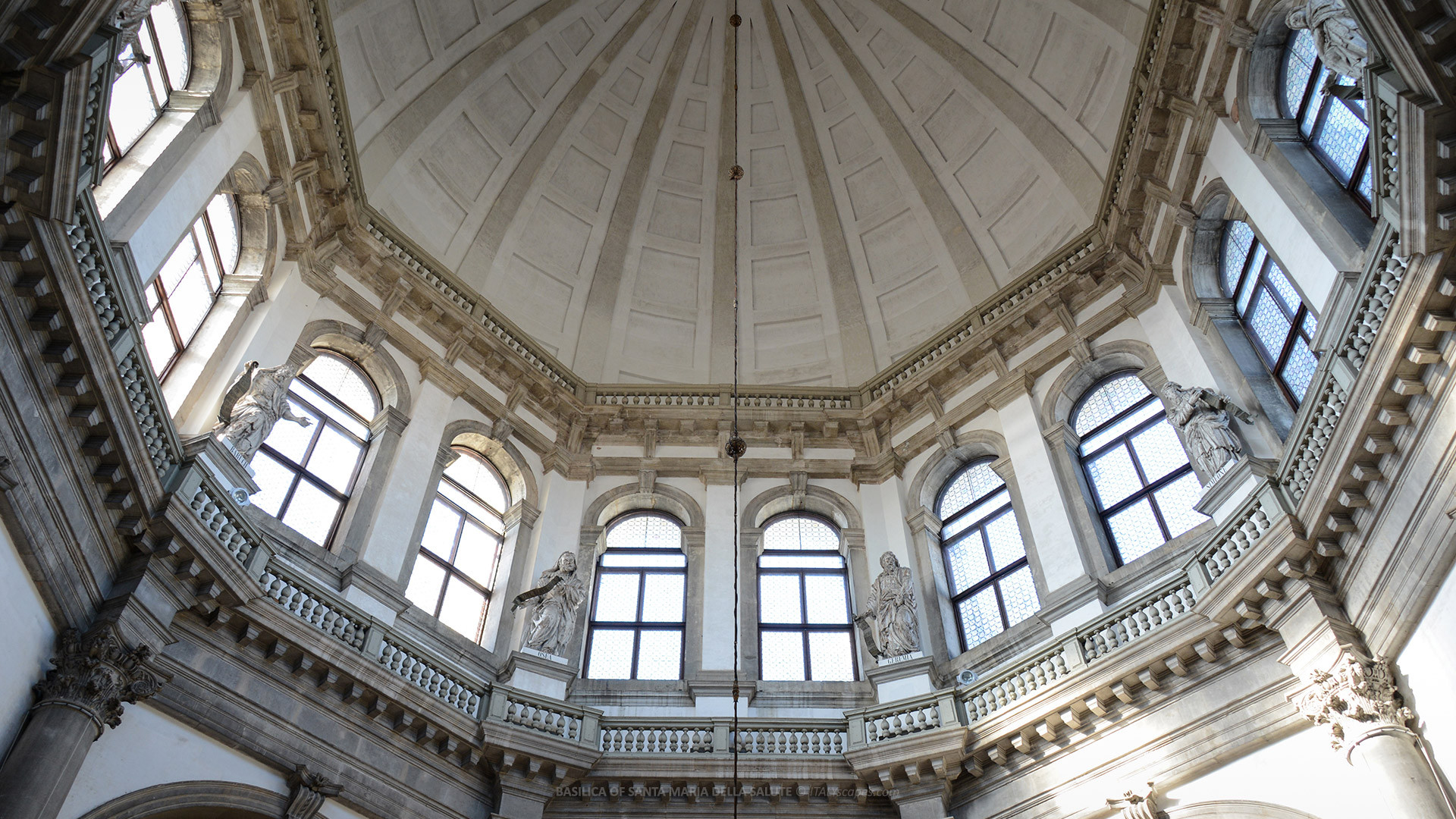
The basilica measures about 70 meters in length and 47 meters in width. The interior drum of the main dome has a diameter of 21.55 meters, a figure that helps explain the impressive scale of the central space when seen from below.
The main materials are Istrian stone and marmorino. Istrian stone was widely used in Venice because it resisted salt and moisture better than many other stones. Marmorino, a finish made with lime and marble dust over masonry, gave large surfaces a pale, unified and luminous appearance.
Façade and exterior sculpture
The façade faces the water with a wide stairway that appears to rise directly from the Grand Canal. This approach is essential to the monument’s theatrical effect. The visitor climbs from the level of the lagoon toward the entrance of the sanctuary.
The main façade uses columns, pediments, niches and sculpture in a rich Baroque composition. Above the central pediment stands the Virgin with the Child, while statues of prophets and Marian figures develop the theme of the church’s dedication.
The sculptural program continues on the sides and upper parts of the building. The four Evangelists on the main façade are associated with Tommaso Rues, one of the sculptors active in the decorative campaign. Other statues animate the buttresses, chapels and pediments around the central body.
Large spiral volutes help buttress the dome and also give the exterior its movement. These stone scrolls are among the most recognizable features of La Salute.
At the top of the great dome stands the statue of the Virgin, shown with the staff of Capitana da Mar. This detail links Marian devotion with Venice’s maritime identity. The smaller dome and two bell towers behind the main body complete the skyline when viewed from the Bacino di San Marco.
Interior space and symbolic design
The interior is spacious, bright and centralized. The main rotunda opens under the great dome, with six side chapels around the octagonal body and a smaller rotunda functioning as the presbytery and sanctuary. The arrangement focuses attention on the high altar.
Light enters through the thermal windows of the side chapels and the windows of the dome drum. It falls across the colored marble pavement and the gray stone architectural elements, producing a calm, measured interior very different from the more crowded decoration of many Baroque churches.
The floor uses polychrome marble patterns arranged in geometric designs. These patterns reinforce the central plan and guide the eye toward the middle of the rotunda.
The symbolic meaning of the plan is closely tied to Marian devotion. The octagon recalls the number eight, associated with salvation, hope and the eight-pointed star of Mary as Stella Maris. The great dome was also read as the crown of the Virgin, matching Longhena’s original idea.
The presbytery is more theatrical than the central rotunda. Longhena designed the high altar as the spiritual climax of the building. The smaller rear space works almost like a stage, where sculpture, architecture and the revered icon create a concentrated devotional image for pilgrims and visitors.
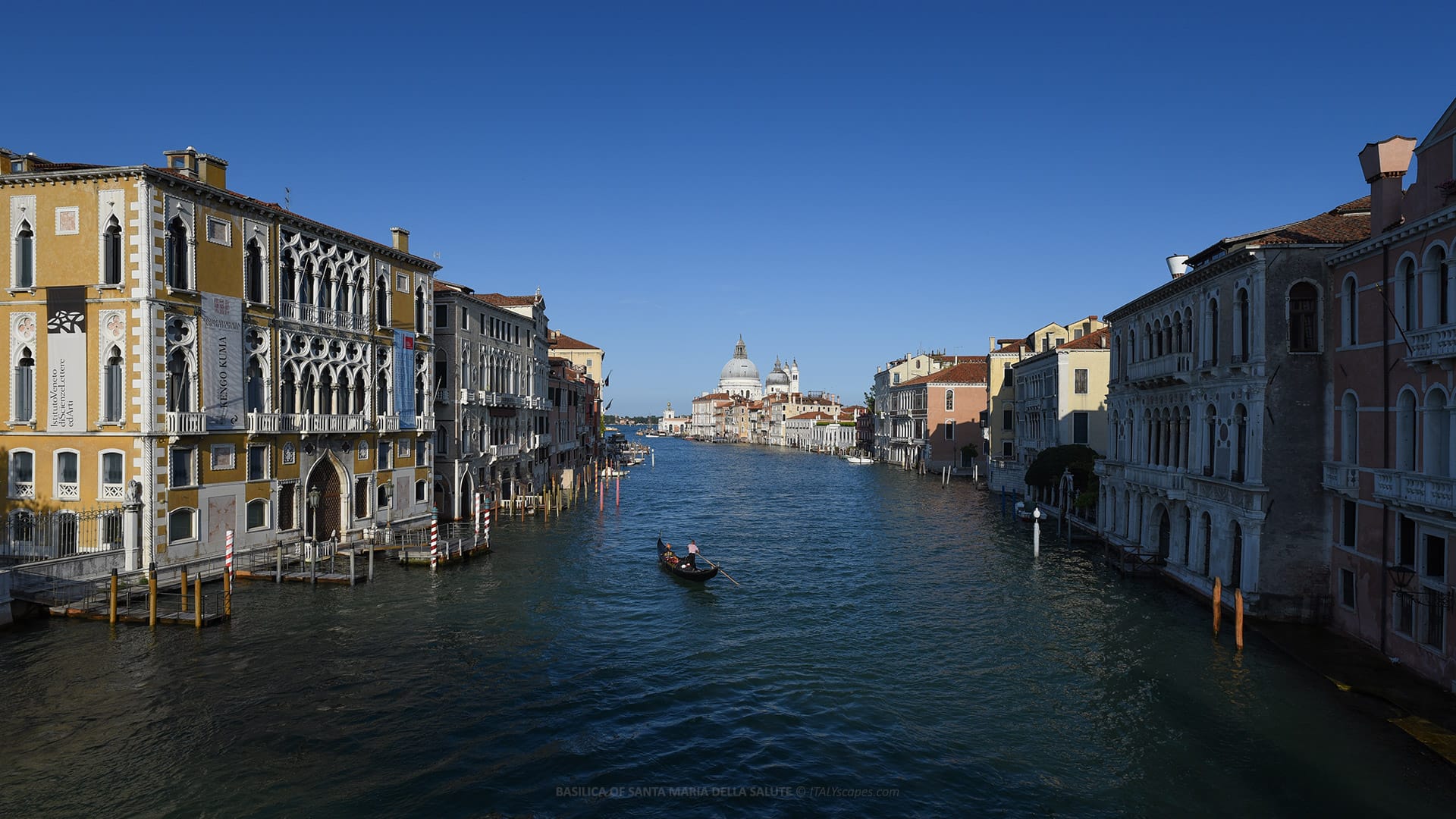
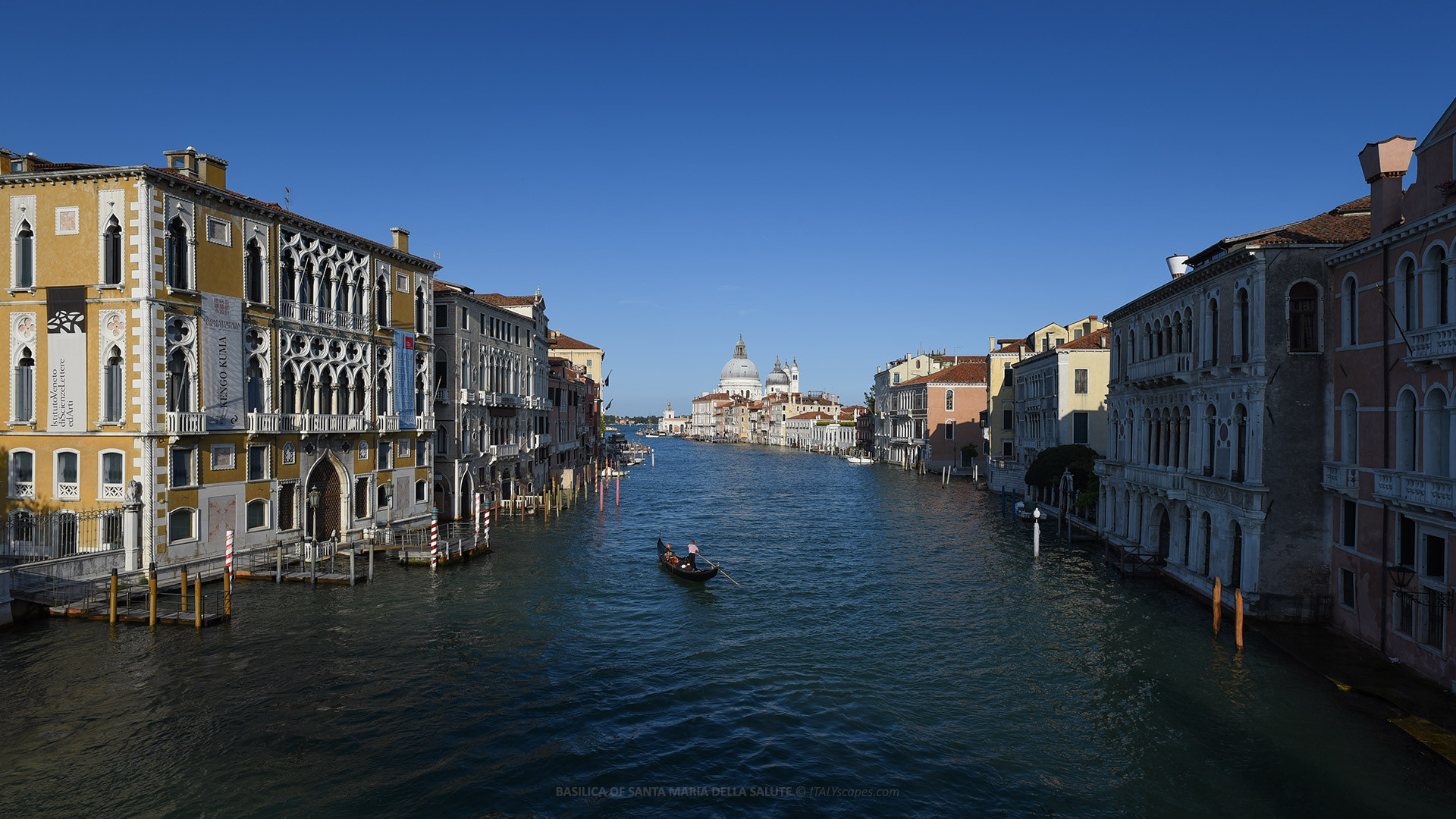
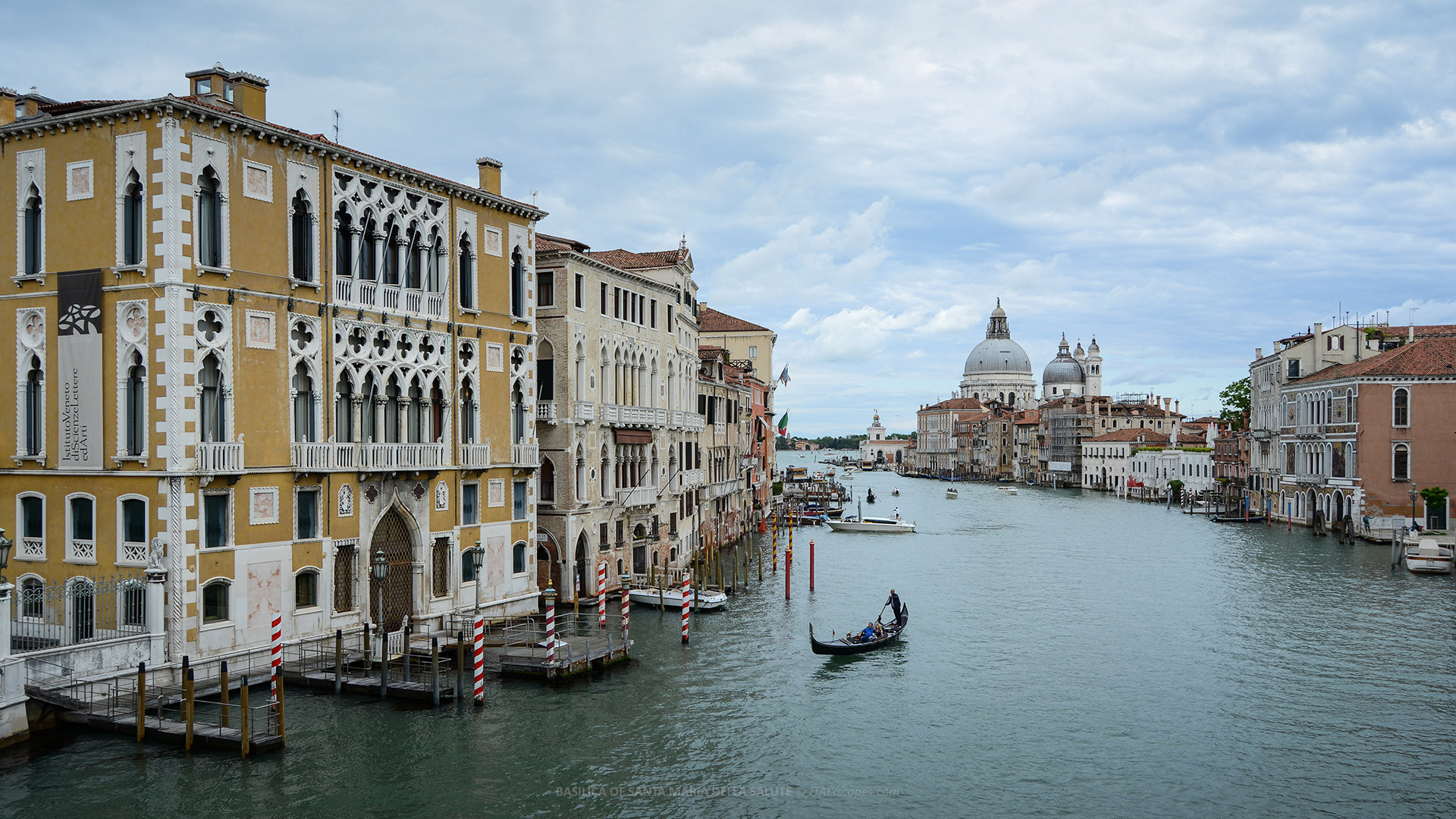
Basilica di Santa Maria della Salute seen from the Ponte dell’Accademia
Art of the Basilica di Santa Maria della Salute
Major artworks inside La Salute
The chapels of the Basilica di Santa Maria della Salute are closely connected to the life of the Virgin Mary. Starting from the right of the entrance, visitors encounter three altars with paintings by Luca Giordano: the Presentation of Mary in the Temple, the Assumption of the Virgin and the Nativity of Mary.
On the left side, the altar of the Descent of the Holy Spirit contains Titian’s Pentecost, one of the key paintings in the main body of the basilica. Nearby are altars dedicated to Saint Anthony and to the Annunciation, with works connected to Pietro Liberi.
The high altar is one of the greatest artistic focal points of the church. It was designed by Longhena and enriched with a sculptural group by Giusto Le Court. The composition shows the Virgin and Child, Venice kneeling in supplication and the personification of the Plague being driven away.
At the center of the altar is the Byzantine icon of the Madonna della Salute, also called Mesopanditissa, meaning mediator of peace. The icon came from Candia, today Heraklion in Crete, and was brought to Venice by Francesco Morosini in 1670 after the end of the War of Candia.
The sacristy and its masterpieces
The sacristy is one of the richest art spaces in the church. It requires a separate visit ticket, but it contains a concentrated group of paintings by Titian, Tintoretto and other important artists from the Venetian school.
Titian’s Saint Mark Enthroned with Saints Cosmas, Damian, Sebastian and Roch was painted in 1511-1512 and later placed in the sacristy. The choice of saints is significant, because Sebastian and Roch were especially associated with protection from plague, making the altarpiece meaningful in this setting.
The ceiling includes later works by Titian: Cain and Abel, the Sacrifice of Abraham and Isaac, and David and Goliath.
The sacristy also preserves Tintoretto’s Marriage at Cana, painted in 1561. It stands near works by Alessandro Varotari, called Il Padovanino, Giuseppe Porta, called Il Salviati, Sassoferrato, Palma il Giovane and Marco d’Oggiono.
La Salute in painting and the Venetian imagination
The dome quickly became one of the great visual symbols of Venice. Its position at the mouth of the Grand Canal made it ideal for vedute, because it anchors the meeting point between the canal, the lagoon and the ceremonial city.
Canaletto and Francesco Guardi used La Salute in views of the Bacino di San Marco and the Grand Canal. In their paintings, the basilica often balances the Doge’s Palace or appears beyond boats, sunlight and water traffic, giving the composition a strong architectural center.
In the 19th century, J. M. W. Turner transformed the church into a study of light, mist and reflection. Later, John Singer Sargent painted Venetian scenes in which La Salute appears through changing atmosphere, showing how the white surfaces of the building respond to water and sky.
Powered by GetYourGuideHow to Get to the Basilica di Santa Maria della Salute
Getting to the Basilica di Santa Maria della Salute on foot
Walking to La Salute is one of the most rewarding approaches, especially from Santa Lucia railway station or Piazzale Roma. The route takes you through Dorsoduro and lets you connect the church with bridges, canals and quieter streets away from the busiest San Marco flow.
From Venezia Santa Lucia, allow about 35-45 minutes on foot, depending on pace and route. A practical route crosses the Ponte degli Scalzi, continues toward Campo Santa Margherita, reaches the Accademia Bridge, then follows the final stretch toward Campo della Salute and the basilica.
From the Accademia Bridge, the walk is much shorter, around 8-10 minutes. This last section is especially beautiful because it keeps you close to the Grand Canal. The Basilica di Santa Maria della Salute appears gradually, with its staircase, dome and façade framed by water.
Getting to the Basilica di Santa Maria della Salute by vaporetto
The easiest public transport option is the vaporetto. The closest stop is Salute, served by ACTV Line 1 on the Grand Canal. This makes the Basilica di Santa Maria della Salute simple to reach from Ferrovia, Rialto, Accademia, San Marco Vallaresso and other central stops.
Line 1 is slower than some routes because it stops frequently, but it offers one of the best views of Venice from the water. Arriving at Salute by vaporetto is especially effective because the façade, stairway and dome appear as the boat approaches the entrance to the Grand Canal.
From Santa Lucia station, board at the Ferrovia stops and check the direction before entering the pier. For a faster mixed route, take a vaporetto to Accademia and continue on foot.
For visitors staying near San Marco, Salute can be reached by Line 1 from San Marco Vallaresso, or by walking through the city and crossing at Accademia. During the annual feast in November, the temporary bridge changes pedestrian movement and makes the pilgrimage route much more direct.
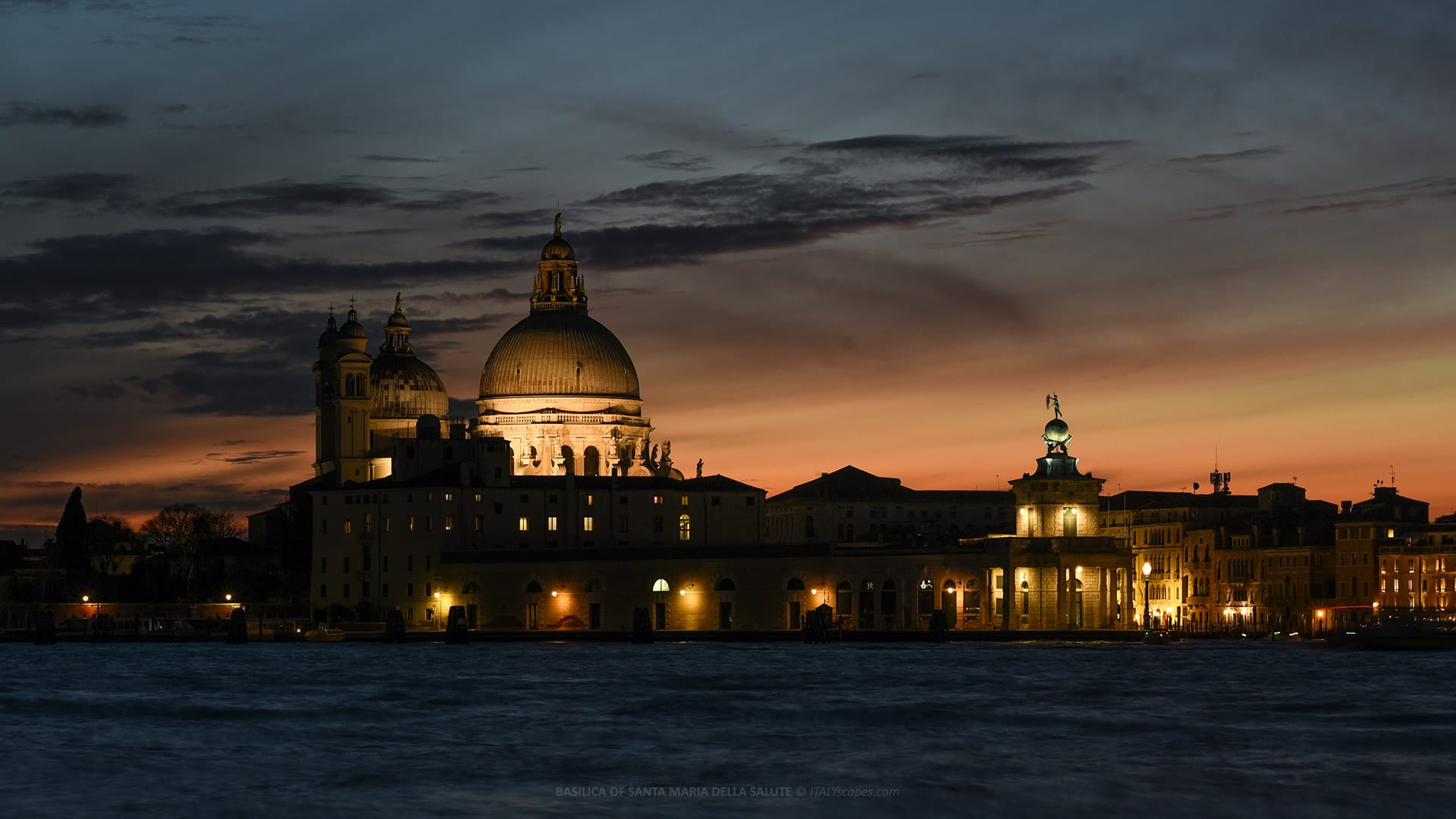
Basilica di Santa Maria della Salute at sunset
Frequently Asked Questions about the Basilica di Santa Maria della Salute
What is the Basilica di Santa Maria della Salute famous for?
The basilica is famous for its huge dome, Baroque architecture, plague-vow history, Marian symbolism, Titian paintings, Tintoretto’s Marriage at Cana and its spectacular position at the entrance to the Grand Canal.
Why was the Basilica di Santa Maria della Salute built?
The Basilica di Santa Maria della Salute was built after the plague of 1630-1631 as a votive offering to the Virgin Mary. Venice promised the church in gratitude for deliverance from the devastating epidemic.
Who designed the Basilica di Santa Maria della Salute?
The Basilica di Santa Maria della Salute was designed by Baldassare Longhena, one of the most important architects of Venetian Baroque. He won the commission after a competition and shaped the building as a Marian crown.
When was the Basilica di Santa Maria della Salute completed?
Construction began in 1631 and continued for decades. The basilica was solemnly consecrated on 9 November 1687, after Longhena’s death, when the main architectural work was complete.
Where is the Basilica di Santa Maria della Salute located?
It stands in Dorsoduro, near Punta della Dogana, between the Grand Canal and the Giudecca Canal. Its position faces the Bacino di San Marco and Piazza San Marco.
Is the Basilica di Santa Maria della Salute free to visit?
The main rotunda is normally free to enter. The sacristy, dome and other special visit areas require tickets, with prices depending on the selected route or guided access.
What artworks can you see inside La Salute?
Important works include Titian’s Pentecost, Luca Giordano’s Marian altarpieces, the Byzantine Mesopanditissa icon, Giusto Le Court’s high altar sculpture and paintings by Titian and Tintoretto in the sacristy.
How do you get to the Basilica di Santa Maria della Salute?
The easiest route is ACTV vaporetto Line 1 to Salute. On foot, the most practical route usually crosses the Accademia Bridge and continues through Dorsoduro to Campo della Salute.
Sources:Powered by GetYourGuide -
Photos
-
Map
-
Reviews