-
About
Table of Contents
Buy tickets & tours:GetYourGuideThe Scrovegni Chapel in Padua, also known as the Cappella degli Scrovegni or Arena Chapel, is one of the greatest monuments of Western art. Dedicated to Santa Maria della Carità, it is famous for the fresco cycle painted by Giotto di Bondone between 1303 and 1305.
The chapel stands in Piazza Eremitani, close to the remains of the ancient Roman arena of Padua. Its name comes from Enrico degli Scrovegni, the wealthy Paduan banker who commissioned the building, the private oratory, and the decoration that made it world-famous.
Since 2021, the chapel has been part of the UNESCO World Heritage Site called Padua’s Fourteenth-Century Fresco Cycles. The site includes eight frescoed complexes in Padua, created between 1302 and 1397, and the Scrovegni Chapel is its most famous component.
Giotto’s work inside the chapel changed the language of painting. His figures show weight, space, emotion, human gestures, grief, tenderness, fear, and hope. For this reason, the frescoes are considered a decisive step toward the artistic innovations that later shaped the Italian Renaissance.
The chapel is not large, but its artistic importance is enormous. The interior is a single rectangular nave with a barrel vault, almost entirely covered by paintings. The frescoed surface is about 700 square meters, including the blue starry vault above the main space.
Short History of the Scrovegni Chapel
Enrico Scrovegni and the Roman Arena
At the beginning of the 14th century, Enrico degli Scrovegni bought land in Padua in the area of the ancient Roman arena. The site was important, visible, and connected with the city’s past. On this land, he built a palace and a private chapel.
The chapel was intended as a family oratory and probably also as a funerary space. It was dedicated to the Virgin Mary, under the title Santa Maria della Carità.
Enrico Scrovegni’s father, Reginaldo, was remembered by Dante in the Inferno, among the usurers. This connection has often been linked to the chapel’s religious meaning. The building can be understood as a public act of devotion, prestige, memory, and spiritual concern.
The Scrovegni palace once stood beside the chapel. The chapel was therefore not an isolated monument at first, but part of a larger private residence. Today, the palace no longer exists, while the chapel survived and became part of Padua’s civic museum system.
Giotto’s Commission
For the decoration of the chapel, Enrico Scrovegni called Giotto di Bondone, the Florentine painter who had already become one of the leading artists of his time. Giotto worked in Padua with an organized team, completing the fresco cycle in a remarkably short period.
The paintings were created between 1303 and 1305. The chapel was consecrated on March 25, 1305, the Feast of the Annunciation, a date perfectly connected with the Marian dedication and with the importance of the Virgin in the iconographic program.
Giotto painted almost the entire inner surface of the chapel. His cycle includes scenes from the lives of Joachim and Anna, the Virgin Mary, and Christ, together with the allegories of Vices and Virtues and the monumental Last Judgment on the entrance wall.
From Private Chapel to Civic Monument
The Scrovegni family palace was demolished in the 19th century. In 1827, it was taken down to reuse materials and make space for new residential buildings. The chapel survived, but its situation became fragile and required protection from further urban changes.
The Municipality of Padua purchased the chapel in the late 19th century, after decisions made to preserve and restore the monument. The buildings that had replaced the palace were later demolished, allowing the chapel to stand in a clearer setting near the Eremitani complex.
From that moment, the chapel gradually became a public monument rather than a private family oratory. It entered the care of the city and became one of the most important cultural sites in Padua, together with the nearby Civic Museums of the Eremitani.
The chapel’s conservation required continuous attention. The frescoes are extremely sensitive to humidity, dust, pollution, and visitor pressure. For this reason, modern access is strictly controlled, and visitors enter through a technological waiting area designed to protect the painted surfaces.
Restoration and Conservation
The frescoes of the Scrovegni Chapel have been studied and monitored for decades. The main modern restoration campaign was carried out after long research into the structure, the painted surfaces, the microclimate, and the effects of visitor presence inside the chapel.
A major restoration of Giotto’s frescoes began in 2001 under the direction of Giuseppe Basile and the Istituto Centrale per il Restauro, in collaboration with the Municipality of Padua. The intervention followed more than twenty years of studies and diagnostic investigations.
The restoration was completed in March 2002, when the chapel was presented again to the public. The work focused on the conservation of the frescoes, the recovery of visual unity, and the reduction of degradation caused by environmental factors.
Today, visits are organized in small groups and timed entries. Before entering the chapel, visitors wait in a controlled access area. This system helps reduce humidity, dust, and pollution brought inside by people, protecting one of the most delicate fresco cycles in Europe.
Architecture of the Scrovegni Chapel
A Simple Exterior
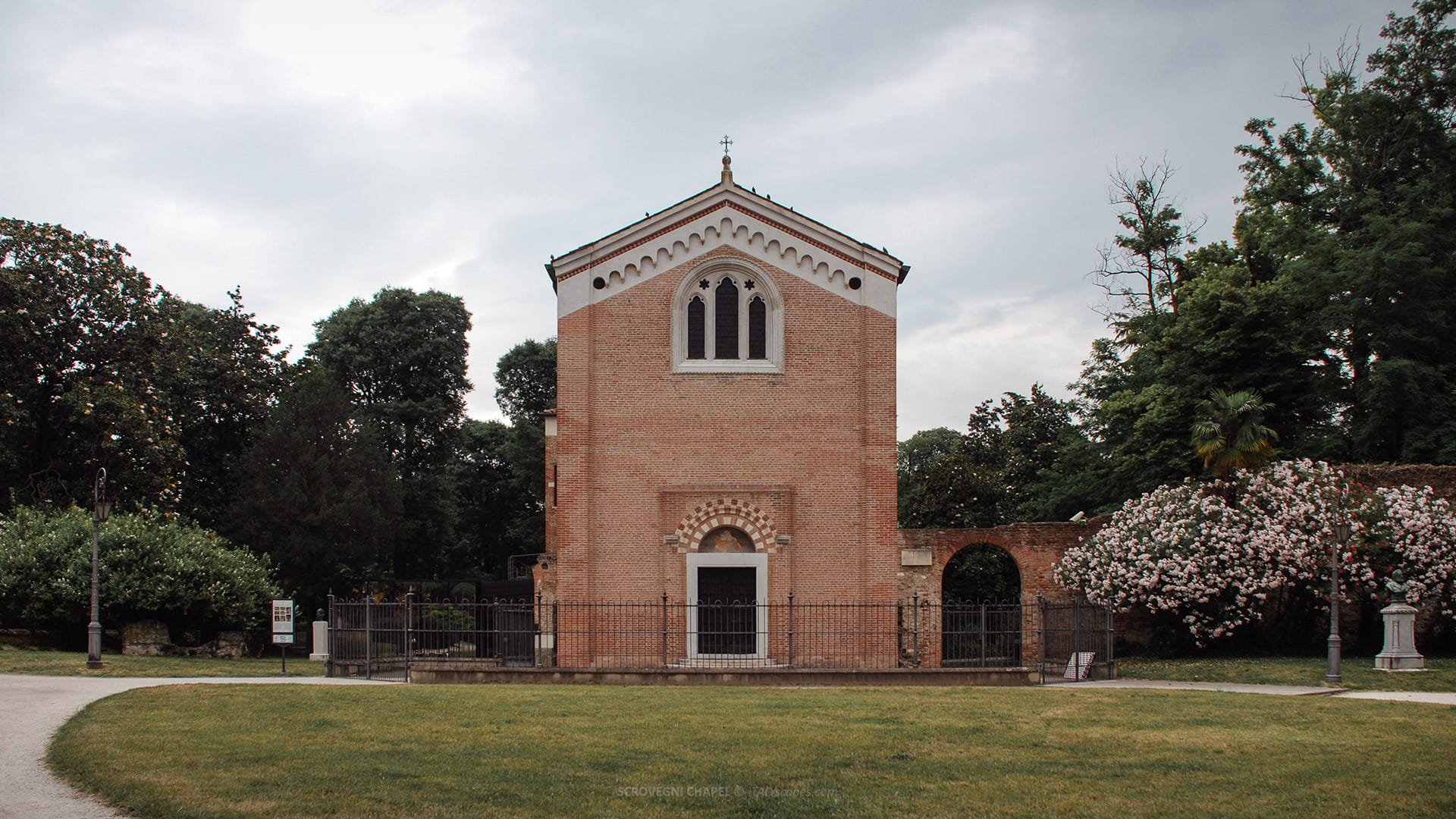
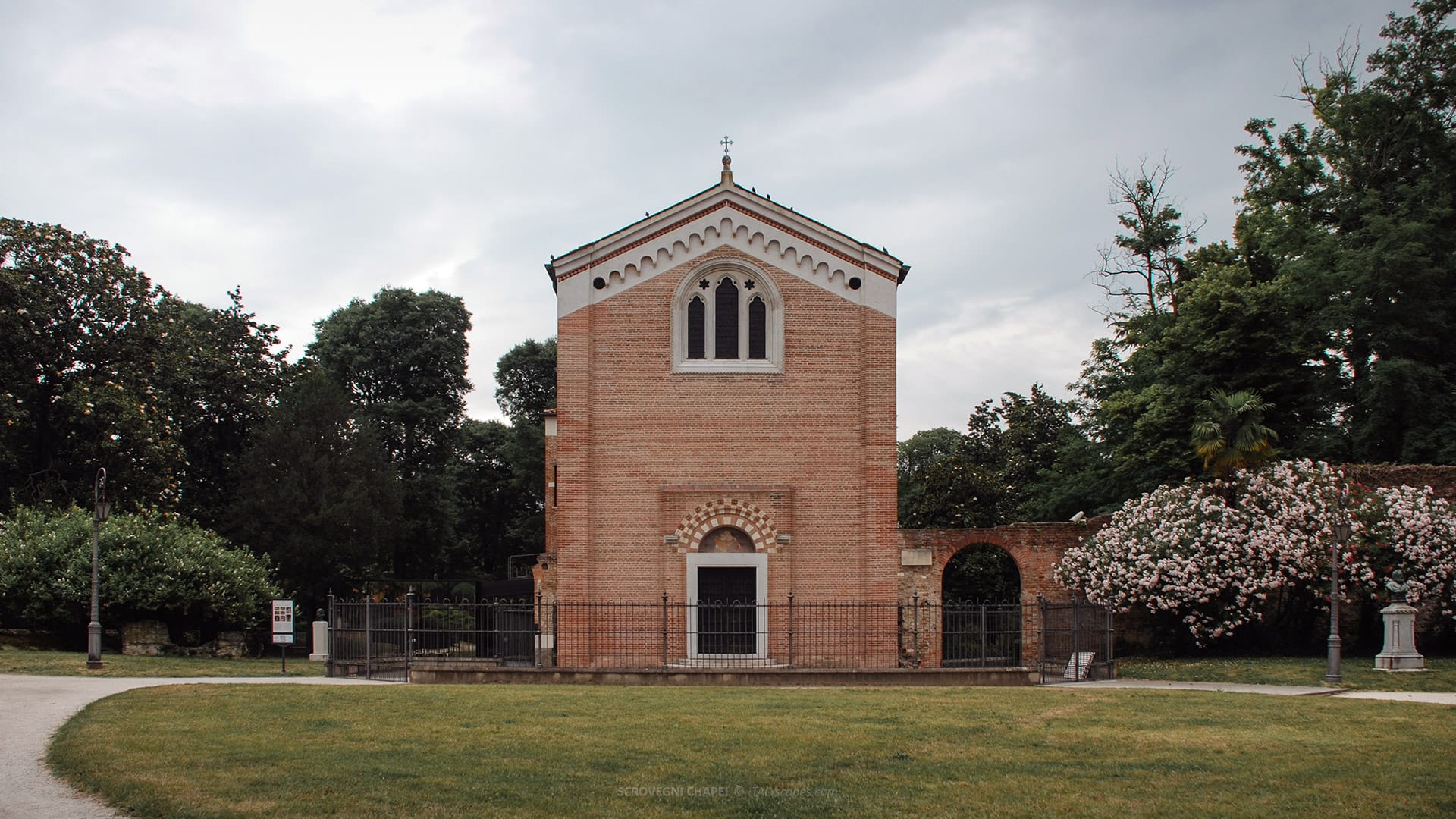
The architecture of the Scrovegni Chapel is simple, clear, and modest compared with the richness of its interior. The building has a rectangular plan, a single nave, a barrel vault, and a presbytery at the eastern end. Its exterior does not prepare visitors for the painted world inside.
The chapel was built in brick and has a sober medieval appearance. The façade includes a Gothic window, while the side walls are plain and functional. The southern wall has tall, narrow windows, which influenced the way Giotto organized the fresco scenes inside.
Dimensions and Interior Space
The chapel is relatively small. The main interior space is about 20.5 meters long and 8.5 meters wide, and 12.65 meters high, with a barrel-vaulted roof.
The modest dimensions intensify the effect of Giotto’s painting. The visitor stands very close to the frescoes, surrounded by scenes placed on the walls, the triumphal arch, the counter-façade, and the vault. The chapel works as a complete painted environment.
The interior ends in a presbytery, where the sarcophagus of Enrico Scrovegni is kept. The sarcophagus is attributed to Andriolo de Santi. On the altar, the chapel preserves a sculptural group of the Madonna and Child with two angels by Giovanni Pisano.
Art of the Scrovegni Chapel
The Narrative Program
The fresco cycle follows the Story of Salvation through a carefully ordered sequence. The main scenes begin with the lives of Joachim and Anna, continue with the life of the Virgin Mary, and then move to the life, Passion, death, and Resurrection of Christ.
The cycle includes 39 narrative scenes. These are arranged across the walls in horizontal bands, guiding the viewer through sacred history. The sequence begins with Joachim expelled from the Temple and ends with Pentecost, when the Holy Spirit descends upon the Apostles.
The lower part of the walls contains 14 monochrome allegories of Vices and Virtues. These figures are painted like stone statues, creating a moral path beneath the sacred narratives.
The counter-façade is occupied by the monumental Last Judgment. This large scene presents Christ as judge, with the blessed on one side and the damned on the other. It is the visual conclusion of the chapel’s religious and moral program.
Stories of Joachim and Anna
The first part of the cycle focuses on Joachim and Anna, the parents of the Virgin Mary. These scenes are important because they prepare the birth of Mary and the beginning of the events that lead to the Incarnation.
One of the most famous episodes is the Meeting at the Golden Gate, where Joachim and Anna embrace after their separation. Giotto gives the scene strong emotional intensity through the direct contact of the figures, the closeness of their faces, and the simplicity of the composition.
Stories of the Virgin Mary
The life of the Virgin occupies a central place in the chapel’s iconographic program. This is natural because the chapel is dedicated to Santa Maria della Carità, and the date of consecration, March 25, is connected with the Annunciation.
The scenes show the Virgin’s childhood, presentation, marriage, and role in the divine plan. Giotto presents Mary not only as a sacred figure but also as a human presence within a sequence of events that unfold with clarity and emotional force.
Stories of Christ
The life of Christ forms the largest and most dramatic part of the fresco cycle. The scenes include episodes from the Nativity, public life, Passion, Crucifixion, Resurrection, and Pentecost. Together, they create a complete visual account of Christian salvation history.
Among the most famous scenes is the Lamentation over the Dead Christ. Giotto arranges the mourners around Christ’s body with extraordinary emotional power. The angels in the sky, the grieving figures, and the diagonal rocky landscape intensify the tragedy.
The Kiss of Judas is another central scene. Giotto places Christ and Judas face to face, surrounded by soldiers and witnesses. The emotional confrontation is concentrated in the meeting of their eyes and in the yellow cloak that envelops Judas.
Vices, Virtues, and the Last Judgment
The lower walls contain the allegories of Vices and Virtues, painted in monochrome. These figures are arranged opposite each other, creating a moral dialogue. They represent the choices that lead either toward salvation or toward damnation.
The Virtues include positive qualities such as Prudence, Fortitude, Temperance, Justice, Faith, Charity, and Hope. The Vices present their opposites, including Folly, Inconstancy, Anger, Injustice, Infidelity, Envy, and Despair. The arrangement creates a visual lesson in moral conduct.
The Last Judgment on the entrance wall completes the program. Christ appears in majesty, surrounded by angels and apostles. The blessed are welcomed into paradise, while the damned are shown in the terrifying disorder of hell.
Enrico Scrovegni himself appears in the Last Judgment, offering a model of the chapel to the Virgin.
How to Get to the Scrovegni Chapel
Getting to the Scrovegni Chapel on foot
The Scrovegni Chapel is located in Piazza Eremitani 8, near the Civic Museums of the Eremitani. From Padua railway station, the walk is short and direct. The distance is approximately 700-800 meters, depending on the exact route.
On foot, the journey usually takes around 10 minutes. The route follows the central axis from the station toward the historic center, passing near Corso del Popolo and the Eremitani area. It is one of the easiest ways to reach the chapel.
Walking is also practical because the chapel is close to other important attractions. The Church of the Eremitani is nearby, and the historic center begins just beyond the area. Piazza dei Signori and Palazzo della Ragione are within a longer but manageable walk.
Getting to the Scrovegni Chapel by tram or bus
Public transport is useful for visitors arriving from the railway station or from other parts of Padua. The tram line that crosses the city stops close to the Eremitani area, making it convenient for those who do not want to walk.
From the railway station, the tram journey toward the center takes only a few minutes. Visitors can get off near the Eremitani or Garibaldi area, then walk a short distance to the museum entrance and the chapel access point.
Several bus lines also stop near the chapel. The area around Piazza Eremitani, Corso del Popolo, Giardini dell’Arena, and Garibaldi is well served by urban transport.
Getting to the Scrovegni Chapel by taxi
A taxi from Padua railway station to the Scrovegni Chapel is very quick. The driving distance is short, usually around 2 kilometers depending on traffic and the exact route. The ride normally takes only a few minutes.
Taxi access is useful for visitors with luggage, reduced mobility, or a very tight schedule. However, the chapel and the Eremitani Museums are in a central area, and parts of Padua’s historic center are pedestrian or traffic-restricted zones.
Visitors arriving by taxi should ask to be dropped near Piazza Eremitani or the Civic Museums entrance.
Frequently Asked Questions about the Scrovegni Chapel
What is the Scrovegni Chapel famous for?
The Scrovegni Chapel is famous for Giotto’s fresco cycle, painted between 1303 and 1305. The paintings cover almost the entire interior and represent a turning point in Western art.
Where is the Scrovegni Chapel located?
The chapel is in Piazza Eremitani 8, Padua, in the Veneto region of northern Italy. It stands near the Civic Museums of the Eremitani and the ancient Roman arena area.
Who commissioned the Scrovegni Chapel?
The chapel was commissioned by Enrico degli Scrovegni, a wealthy Paduan banker. He built it beside his family palace as a private oratory and probably also as a funerary chapel.
When did Giotto paint the Scrovegni Chapel?
Giotto painted the chapel between 1303 and 1305, with the help of his workshop. The chapel was consecrated on March 25, 1305, the Feast of the Annunciation.
Is the Scrovegni Chapel a UNESCO World Heritage Site?
Yes. Since 2021, the Scrovegni Chapel has been part of the UNESCO World Heritage Site Padua’s Fourteenth-Century Fresco Cycles, together with other frescoed monuments in Padua.
How large is the Scrovegni Chapel?
The chapel is small but completely frescoed. The main space is about 20.5 meters long and 8.5 meters wide, with a barrel vault above the single nave.
Can visitors enter the Scrovegni Chapel without booking?
No. Visits normally require advance booking because entry is strictly controlled. Timed access protects the frescoes from humidity, dust, pollution, and excessive visitor pressure.
How much does it cost to visit the Scrovegni Chapel?
A standard daytime ticket for the Scrovegni Chapel costs €15 + €1 booking fee, so €16 total. Reduced tickets are available, and the Urbs Picta Card costs €28 for 48 hours or €35 for 72 hours.
How far is the Scrovegni Chapel from Padua railway station?
The chapel is about 700-800 meters from Padua railway station. On foot, the walk usually takes around 10 minutes, making it easy to visit after arriving by train.
Sources:Buy tickets & tours:GetYourGuide -
Photos
-
Map
-
Reviews