


-
About
Table of Contents
Buy tickets & tours:GetYourGuideThe Cathedral of Santa Maria Assunta, also known as Padua Cathedral or Duomo di Padova, is the main Catholic church of Padua and the seat of the Diocese of Padua. Dedicated to the Assumption of Mary, it stands in Piazza Duomo, in the historical center of the city, beside the Bishop’s Palace and the Padua Baptistery.
The Cathedral of Santa Maria Assunta is one of the most important religious buildings in Padua, although its exterior is sober and unfinished. Its history includes early Christian origins, medieval destruction, a Renaissance presbytery connected with Michelangelo Buonarroti, Baroque completion, modern liturgical changes, and restorations after natural and wartime damage.
Unlike the Basilica of Saint Anthony, which dominates Padua with its domes and rich exterior, the city’s cathedral has a more austere appearance. Its importance lies in its role as the episcopal seat, its ancient religious continuity, its relics, and the artistic works preserved inside its chapels, crypt, and sacristies.
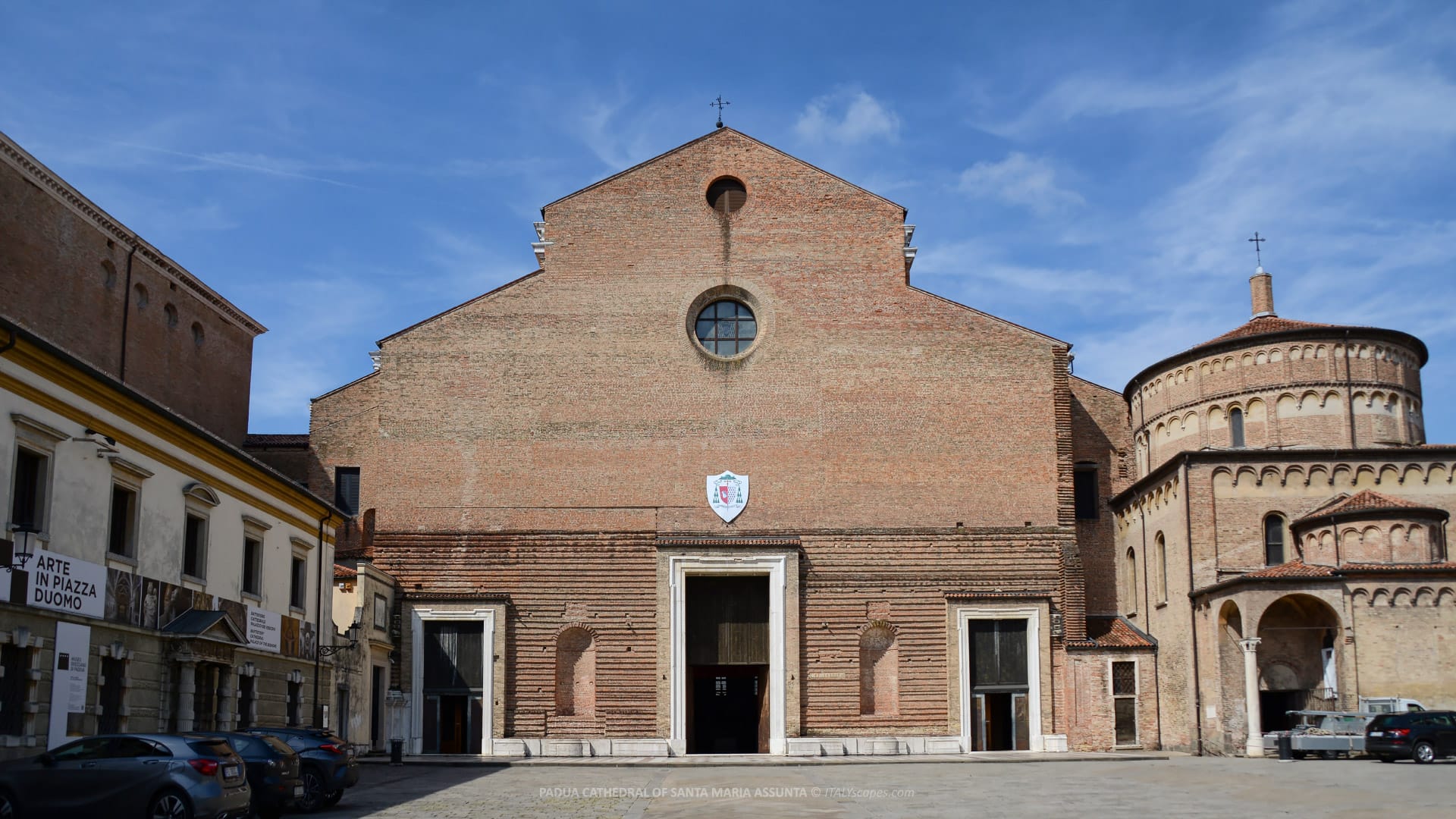
The facade of the Cathedral of Santa Maria Assunta
Short History of the Cathedral of Santa Maria Assunta (Padua Cathedral)
Early Christian Origins
According to tradition, the first cathedral of Padua was built after the Edict of Milan of 313, when Christianity was legally recognized in the Roman Empire. This tradition places the religious origin of the site in the earliest phase of public Christian worship in the city.
The first church was originally connected with Saint Justina, one of the most important early Christian figures of Padua. After one of its later reconstructions, traditionally dated to 462 or 602, the cathedral was dedicated to Saint Mary, reflecting the growth of Marian devotion.
The area around Piazza Duomo has major archaeological importance. Excavations near the baptistery revealed mosaic floors, burials, liturgical fragments, and architectural remains. Some traces are dated to the 4th and 5th centuries, confirming that this part of Padua was an ancient Christian center.
A later rebuilding phase is traditionally associated with Bishop Tricidius, around 620. Between 899 and 900, the cathedral area was damaged during the Hungarian raids, which affected many settlements in northern Italy. These attacks probably caused serious destruction to the early episcopal complex.
Archaeological investigations also identified burials belonging to 56 individuals and remains of medieval structures. In the north-eastern area of the churchyard, the base of a large square tower, measuring about 10 meters per side, was discovered and dated between the 10th and 12th centuries.
The Medieval Cathedral
In 1075, Bishop Olderico consecrated a new cathedral built on the remains of previous sacred buildings. This medieval church became the main episcopal church of Padua, but it did not survive intact for long because a powerful earthquake struck northern Italy in the early 12th century.
On January 3, 1117, a major earthquake damaged or destroyed the medieval cathedral. This event is one of the most important seismic disasters recorded in medieval northern Italy. After the destruction, the church had to be rebuilt again on the ancient religious site.
The new medieval cathedral was built according to a project traditionally attributed to the architect Macillo. The reconstructed building was consecrated on April 24, 1180. It had three naves, a transept, and a structure supported by alternating columns and pillars.
In 1227, the bell tower was rebuilt. Between 1399 and 1400, Bishop Stefano da Carrara promoted restoration works and the construction of cross vaults. These interventions show that the medieval church remained active and was repeatedly adapted before the great Renaissance rebuilding campaign.
Renaissance Rebuilding and Michelangelo’s Project
The present Cathedral of Santa Maria Assunta began to take shape in the 16th century. On May 6, 1522, Cardinal Francesco Pisani blessed and placed the first stone for the new presbytery. This marked the beginning of a long construction campaign that continued for more than two centuries.
On January 2, 1551, the Chapter of Canons approved a model for the new presbytery by Michelangelo Buonarroti. This project replaced an earlier design by Jacopo Sansovino. Although Michelangelo’s original idea was changed, the connection remains one of the cathedral’s most important historical facts.
The works were carried out by Andrea da Valle and Agostino Righetto, who interpreted and modified Michelangelo’s model. The new presbytery was completed and inaugurated on April 14, 1582, under Bishop Federico Cornaro, becoming the symbolic center of the Renaissance transformation.
During the same period, parts of the old medieval structure were gradually removed. The ancient bell tower that once stood on the left side of the façade was demolished, while the present bell tower was developed in another position, closer to the right transept and sacristy area.
Completion, Damage, and Restorations
The rebuilding of the cathedral continued slowly after the presbytery was completed. Around 1635, the right arm of the transept was finished. In 1693, the left arm was completed. The older medieval parts were progressively replaced, creating the large Latin-cross structure visible today.
The new cathedral was solemnly consecrated on August 25, 1754, by Cardinal Carlo Rezzonico. In 1756, the construction of the main dome began, following a project connected with Giovanni Gloria and Giorgio Massari, two important figures in the final architectural phase.
In 1797, French troops entered the church and removed silver and other precious objects from its treasury. Many of these items had been donated by bishops, cardinals, and benefactors. This loss explains why the present cathedral is historically important but not as richly furnished as it once was.
In 1822, the covering of the main dome burned after being struck by lightning. The structure was restored under engineer Giuseppe Bissacco. The building was damaged again during the First World War, when bombardments in 1917 and 1918 affected both the façade and the dome.
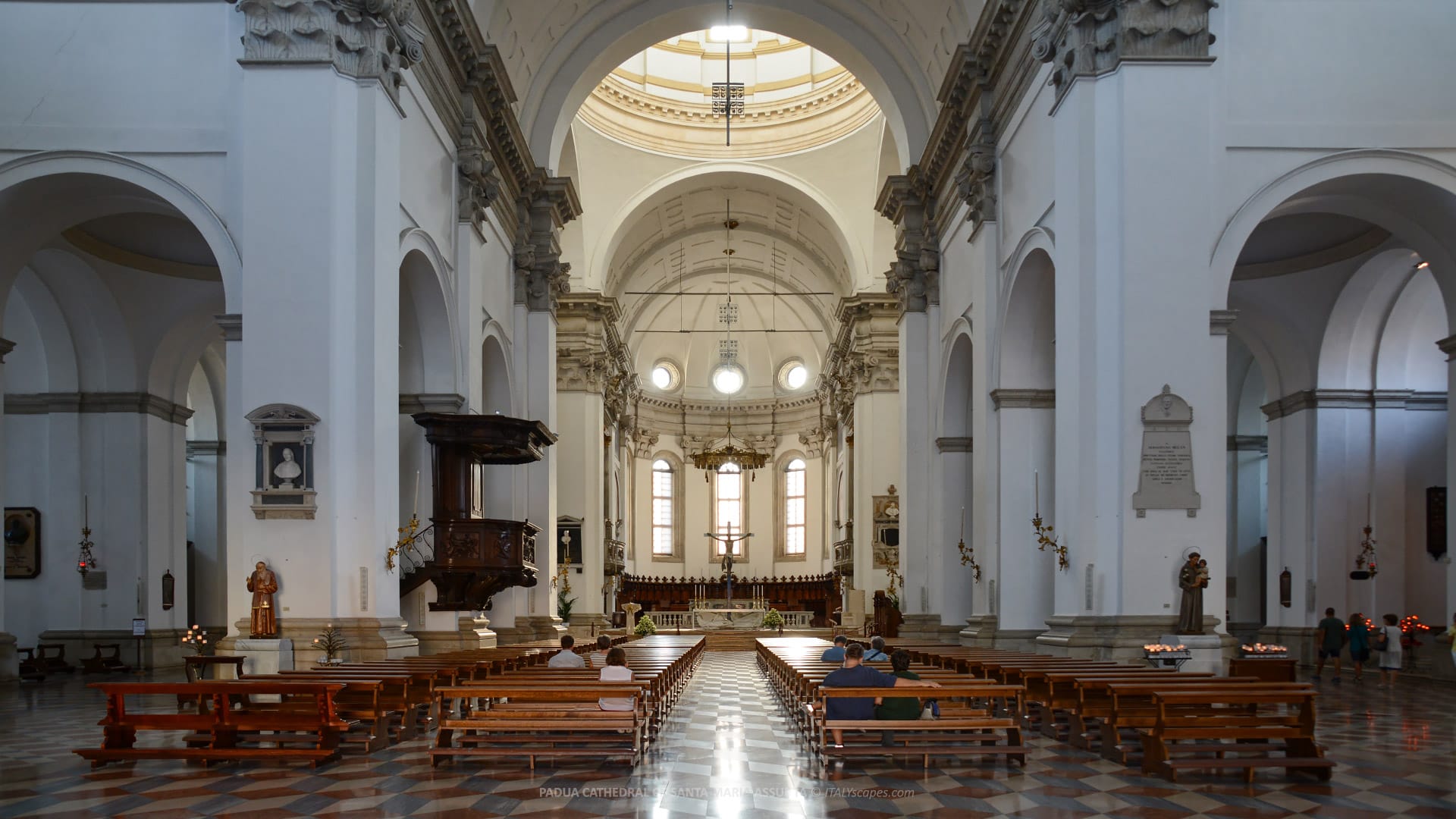
The interior of the Cathedral of Santa Maria Assunta
Architecture of Padua Cathedral
Exterior and Unfinished Façade
The façade of the Cathedral of Santa Maria Assunta remains unfinished, which gives the exterior a plain and austere appearance. It has three portals, two empty niches, and a small rose window above the main entrance. Its simplicity contrasts with the scale, history, and importance of the interior.
A more monumental façade had been planned but was never completed. The architect Gerolamo Frigimelica designed a project with an entrance atrium, an upper loggia, a classical pediment, and six Corinthian semi-columns. This design would have given the church a much grander external appearance.
The façade was also affected by wartime damage in the 20th century. During restoration works after the First World War, the small rose window was opened in the upper section. The present façade is therefore the result of unfinished historical planning and later repair.
Plan and Interior Structure
The church has a Latin cross plan with three naves. The central nave is broad and luminous, while the side aisles lead toward chapels and devotional areas. The interior is more monumental than the unfinished façade suggests, with a strong sense of depth and symmetry.
The plan includes a transept, a raised presbytery, two sacristies, a crypt, and the Chapel of the Holy Cross. The raised presbytery stands above older sacred areas connected with relics, burials, and episcopal memory.
Two domes define the interior space. One dome corresponds to the area of the chapels dedicated to Saint Gregory Barbarigo and Saint Lorenzo Giustiniani. The larger dome rises above the crossing and marks the most important liturgical zone of the church.
The presbytery is one of the key architectural elements of the cathedral. Its development is connected with the 1551 Michelangelo project, although the final result was modified by other architects.
Sacristies, Crypt, and Bell Tower
On the sides of the presbytery are two sacristies: the Sacristy of the Canons and the Sacristy of the Prebendati. These rooms were used for liturgical preparation, the storage of sacred objects, and the preservation of artworks connected with the clergy and benefactors.
Below the presbytery are the crypt and the Chapel of the Holy Cross. This lower sacred area has special importance because it is linked to relics, episcopal burials, and older devotional traditions. Its position beneath the presbytery reflects an ancient Christian architectural arrangement.
The bell tower rises between the Sacristy of the Prebendati and the right arm of the transept. It contains seven bells, cast in 1923 by the Pontifical Foundry Daciano Colbachini and Sons of Padua. The bells belong to the Veronese ringing system.
A mutilated Roman inscription is embedded in the bell tower. It mentions the Gens Fabia of Veii, a title associated with the people of Padua from the period of the Roman municipium, established in 49 BC.
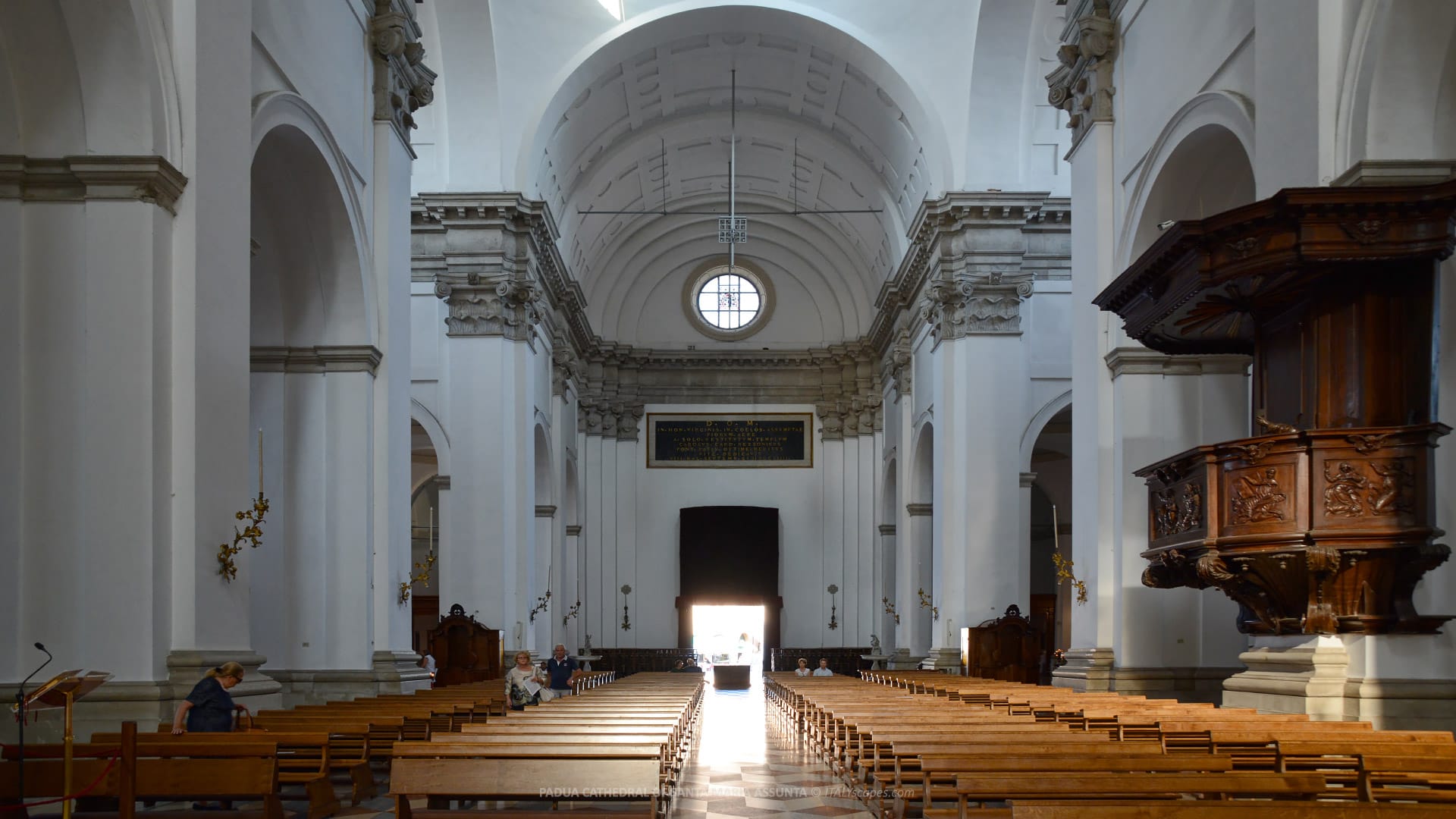
The interior of the Cathedral of Santa Maria Assunta
Art of the Cathedral of Santa Maria Assunta (Padua Cathedral)
Chapels of the Right Nave
The first chapel on the right nave has an altar donated in 1760 by the shoemakers’ guild. It now houses a painting of Saint Pius X by Dionisio Gardini. The saint had a connection with Padua because he studied at the diocesan seminary.
The second chapel on the right contains an altar with the Martyrdom of Saint Lawrence by Alessandro Galvano. The right nave also includes the Chapel of Saint Lorenzo Giustiniani, commissioned by Bishop Nicolò Antonio Giustiniani in honor of his saintly ancestor.
The Chapel of Saint Lorenzo Giustiniani contains a Carrara marble statue by Felice Chiereghin, dated 1788. Behind the statue is a painting of the Virgin and saints attributed to Alessandro Varotari, known as il Padovanino, an important Venetian painter.
Since 1809, the body of Saint Leoninus, bishop of Padua, has been kept behind an altar in the Cathedral of Santa Maria Assunta. Near the entrance to the rectory are two funerary monuments by Girolamo Campagna, dedicated to Sperone Speroni and Giulia Speroni.
The Madonna dei Miracoli
One of the most important devotional images in the Cathedral of Santa Maria Assunta is the Madonna dei Miracoli. In the 13th century, a canon left the church an ancient Byzantine-style icon showing the Virgin Mary with the Child Jesus wrapped in swaddling clothes.
The icon became a major object of Marian devotion in Padua. It was used in solemn ceremonies and carried in processions. Because of its liturgical importance, copies were made in the 14th century, including works connected with Guariento di Arpo and Giusto de’ Menabuoi.
From the 17th century, the image was placed on a special altar in the right transept. After an accident in 1647, it was replaced by an identical copy. The substitution was identified only in 1974, after closer examination of the painted image.
The altar of the Madonna dei Miracoli was designed in 1647 by Mattia Carneri. The image was once believed to be by Giotto, but it is older in origin. Its present surface also reflects later restoration and repainting.
The same altar includes statues of Saint Peter and Saint Paul by Bernardo Falconi. Nearby are bronze gates by Angelo Scarabello and paintings by Francesco Zanella and Gregorio Lazzarini. This chapel is one of the richest artistic and devotional spaces inside the cathedral.
Presbytery and Choir
The old high altar was created by Daniele Danieletti and consecrated on December 2, 1770, by Bishop Antonio Marino Priuli. Above it stands a baldachin by Cesare Bovo, with a representation of the Eternal Father painted by Francesco Zanella.
The choir is an important wooden work by Filippo Parodi. A floor inscription recalls 1698, the year in which the seats and pavement were completed. These works were financed through the bequest of Canon Pietro Labia, who had died in 1692.
The current presbytery was inaugurated in 1997 and is the work of the Tuscan sculptor Giuliano Vangi. It was created after the liturgical reforms and for the third centenary of the death of Saint Gregory Barbarigo, one of Padua’s most important bishops.
Vangi’s modern liturgical works include the altar in Carrara marble, the ambo shaped as an announcing angel, the bishop’s chair, the crucifix, and a statue of Saint Anthony of Padua preaching to the fish.
On the access steps to the modern presbytery are figures of Padua’s patron saints. Saint Prosdocimus and Saint Justina recall the first millennium of the local Church, while Saint Gregory Barbarigo and Saint Anthony represent the second millennium of Christian history in Padua.
Crypt and Chapel of the Holy Cross
The crypt preserves the body of Saint Daniel the Martyr, transferred from the Basilica of Saint Justina in 1076. His body is kept in a Roman urn under the altar table. Saint Daniel is one of the patron saints of Padua and an important local martyr.
The Chapel of the Holy Cross was decorated in 1676 for Canon Giambattista Vero. Its altar is a late-Mannerist work using black and white marble with polychrome inserts. The chapel also served as a burial space for several bishops of Padua.
This chapel once preserved a precious relic of the Cross in a gilded silver and enamel reliquary. The reliquary was made by Bartolomeo da Bologna, measures 35 centimeters in height, and is now kept in the Bishop’s Palace as part of the cathedral treasure.
Sacristies and Paintings
The Sacristy of the Canons contains a historical picture gallery created from canonical bequests. It preserves works connected with Bassano, Liberi, Forabosco, Brusasorci, and Sassoferrato. It also contains portraits of illustrious canons, including an important portrait of Francesco Petrarch.
The Sacristy of the Prebendati includes 17th-century paintings, a copy after Caravaggio, works by Francesco Lopez, and ceiling decoration with an Assumption by Niccolò Bambini. Frescoes by Francesco Zanella also contribute to the artistic value of this liturgical room.
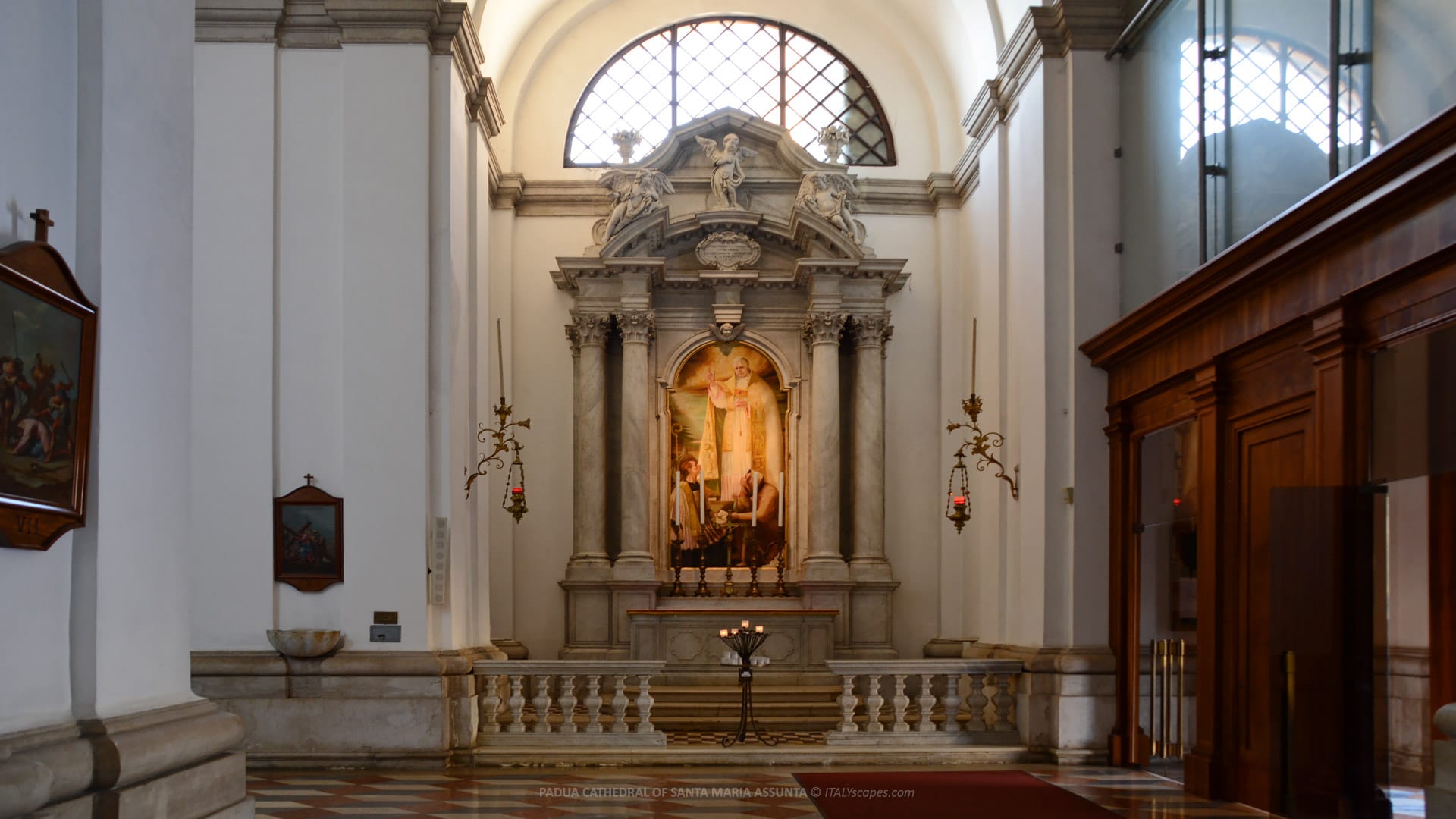
The Chapel of Saint Pius X
How to Get to the Cathedral of Santa Maria Assunta (Padua Cathedral)
Getting to the Cathedral of Santa Maria Assunta on foot
The Cathedral of Santa Maria Assunta is located in Piazza Duomo, in the historical center of Padua. From Padova railway station, the walking distance is about 1.8 to 3 kilometers, depending on the exact route. The walk usually takes around 20 to 30 minutes.
A convenient pedestrian route leads from the station toward the central streets of Padua, passing near the historic market area and Piazza dei Signori. The cathedral is easy to include in an itinerary with Palazzo della Ragione, Piazza delle Erbe, Piazza dei Frutti, and the Baptistery.
Getting to the Cathedral of Santa Maria Assunta by tram or bus
Public transport can be useful for visitors arriving from the railway station or from other parts of Padua. Urban buses stop near Piazza Duomo and nearby streets. Local routes may change, so visitors should check current timetables before planning the exact journey.
The closest stops are in the Piazza Duomo and Arco Vallaresso area. Some routes stop only a short walk from the cathedral. From the railway station, buses generally offer a faster option than walking, especially for visitors with luggage or limited time.
The tram can also help visitors reach the central area of Padua, although a final walk may still be necessary.
Getting to the Cathedral of Santa Maria Assunta by taxi
A taxi from Padova railway station to Piazza Duomo is usually the fastest option. The distance is short, and the ride normally takes only a few minutes in regular traffic. This is convenient for visitors with luggage, mobility issues, or a very limited schedule.
Visitors arriving by car should remember that the cathedral is inside the old center of Padua. Access restrictions, limited parking, and pedestrian areas may apply.
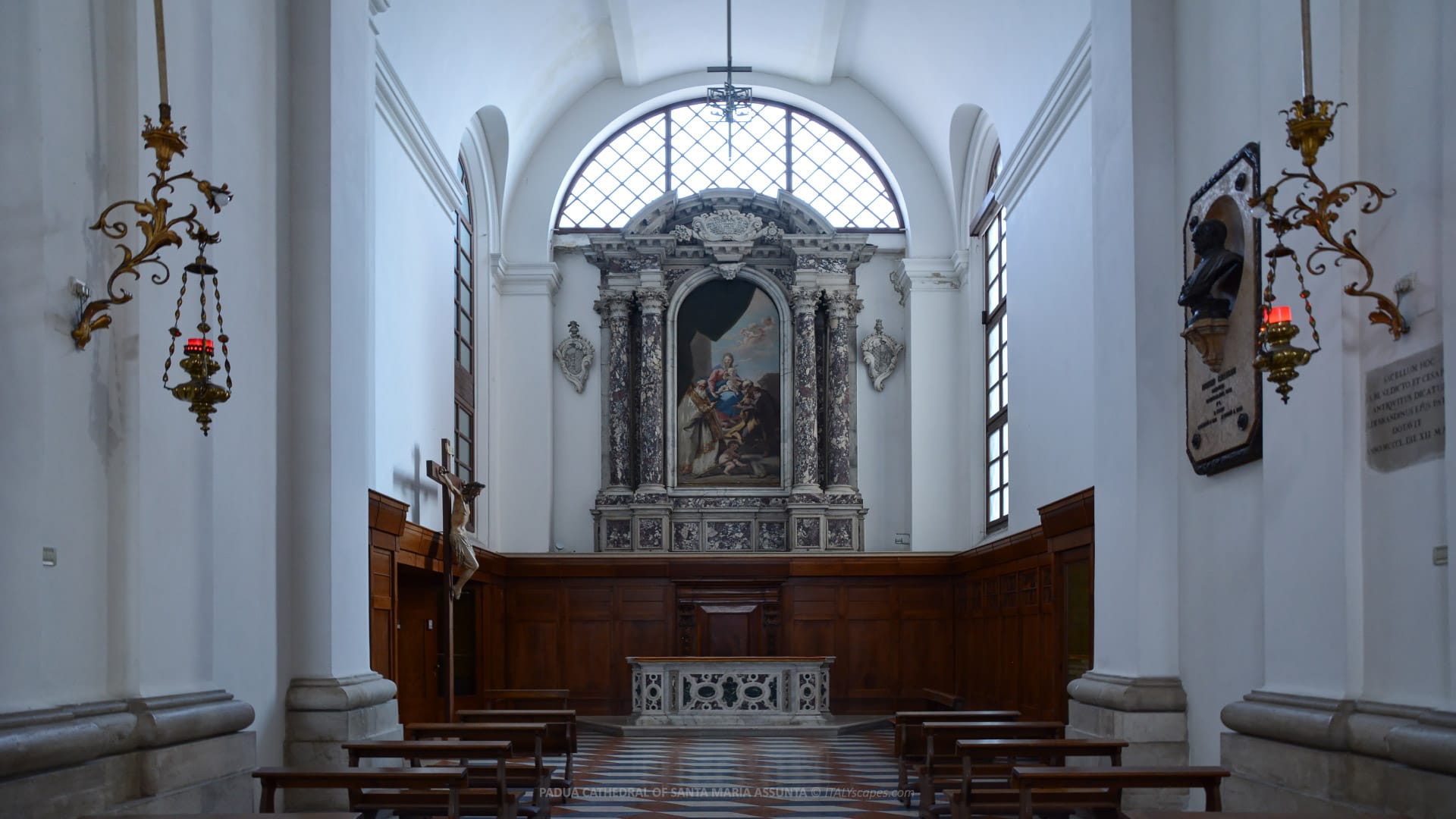
The Chapel of Saint Joseph
Frequently Asked Questions about the Cathedral of Santa Maria Assunta (Padua Cathedral)
Where is Padua Cathedral located?
Padua Cathedral is located in Piazza Duomo, in the historical center of Padua. It stands beside the Bishop’s Palace and the Padua Baptistery, close to Piazza dei Signori.
Is the Cathedral of Santa Maria Assunta the same as the Duomo di Padova?
Yes. The Padua Cathedral is commonly called Duomo di Padova in Italian. The names refer to the same episcopal church dedicated to Saint Mary of the Assumption.
When was the first cathedral built?
Tradition dates the first cathedral to the period after the Edict of Milan in 313. The present building mainly belongs to the 16th, 17th, and 18th centuries.
Why is the façade of the Cathedral of Santa Maria Assunta unfinished?
The monumental façade planned for the church was never completed. The present façade remains simple, with three portals, empty niches, and a small rose window above the main entrance.
What important relics are inside?
The Padua Cathedral preserves the bodies of Saint Daniel, Saint Leoninus, and Saint Gregory Barbarigo. Saint Daniel’s body is kept in the crypt, inside a Roman urn under the altar.
What is the Madonna dei Miracoli?
The Madonna dei Miracoli is an important Marian image connected with medieval devotion in Padua. Its chapel became one of the main devotional spaces in the cathedral.
Is the Padua Cathedral free to visit?
Entrance to the Cathedral of Santa Maria Assunta is generally free. The nearby Baptistery and Diocesan Museum usually have separate visiting conditions and may require tickets, depending on the chosen visit.
Sources:Buy tickets & tours:GetYourGuide -
Photos
-
Map
-
Reviews


