-
About
Table of Contents
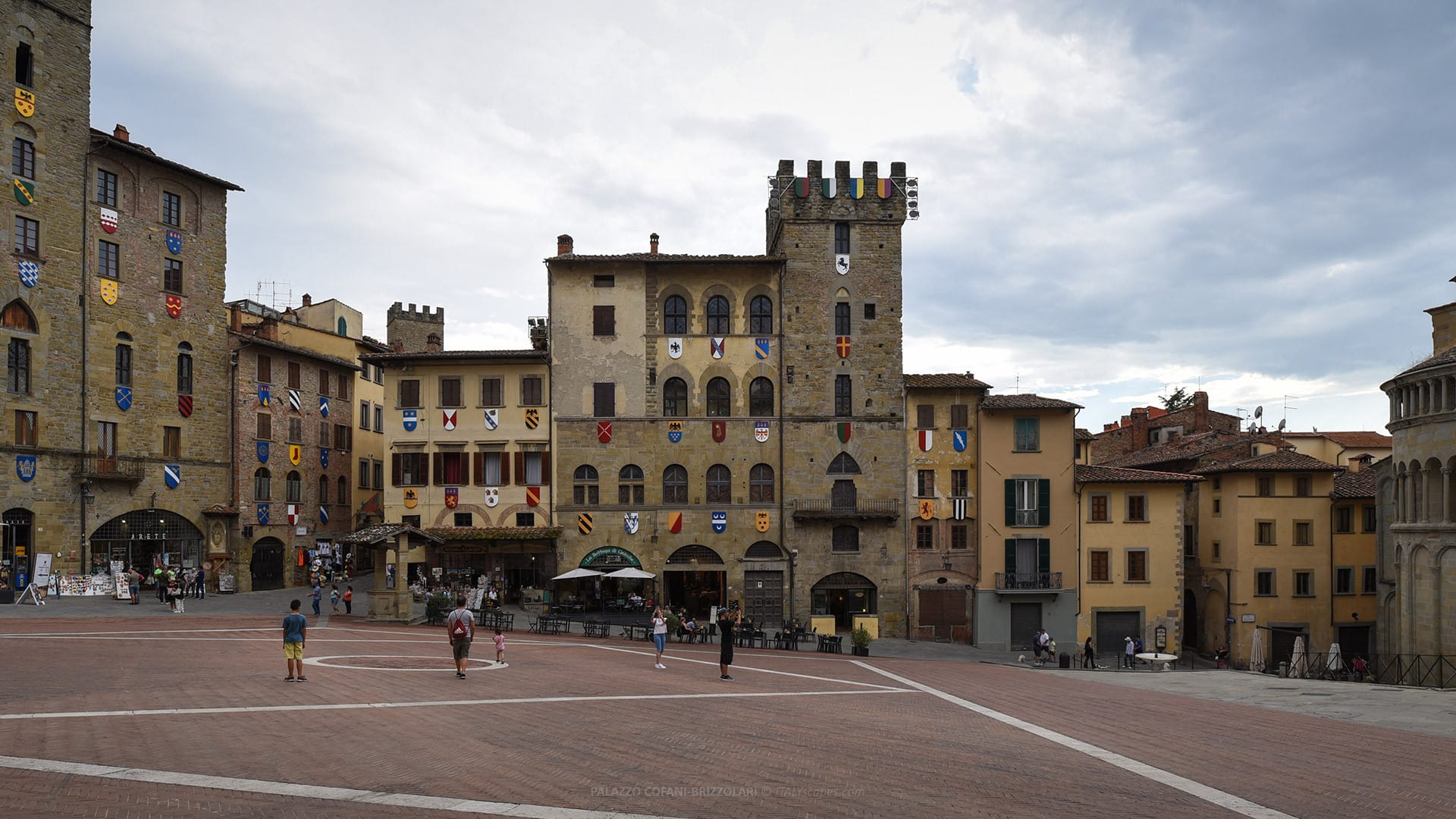
Palazzo Cofani-Brizzolari occupies the southwestern side of Piazza Grande, in the historic centre of Arezzo. The monument is a medieval residential complex formed by the union of the thirteenth-century Torre Faggiolana and an adjoining fourteenth-century tower house. Its stone frontage and crenellated tower overlook Arezzo’s principal historic square.
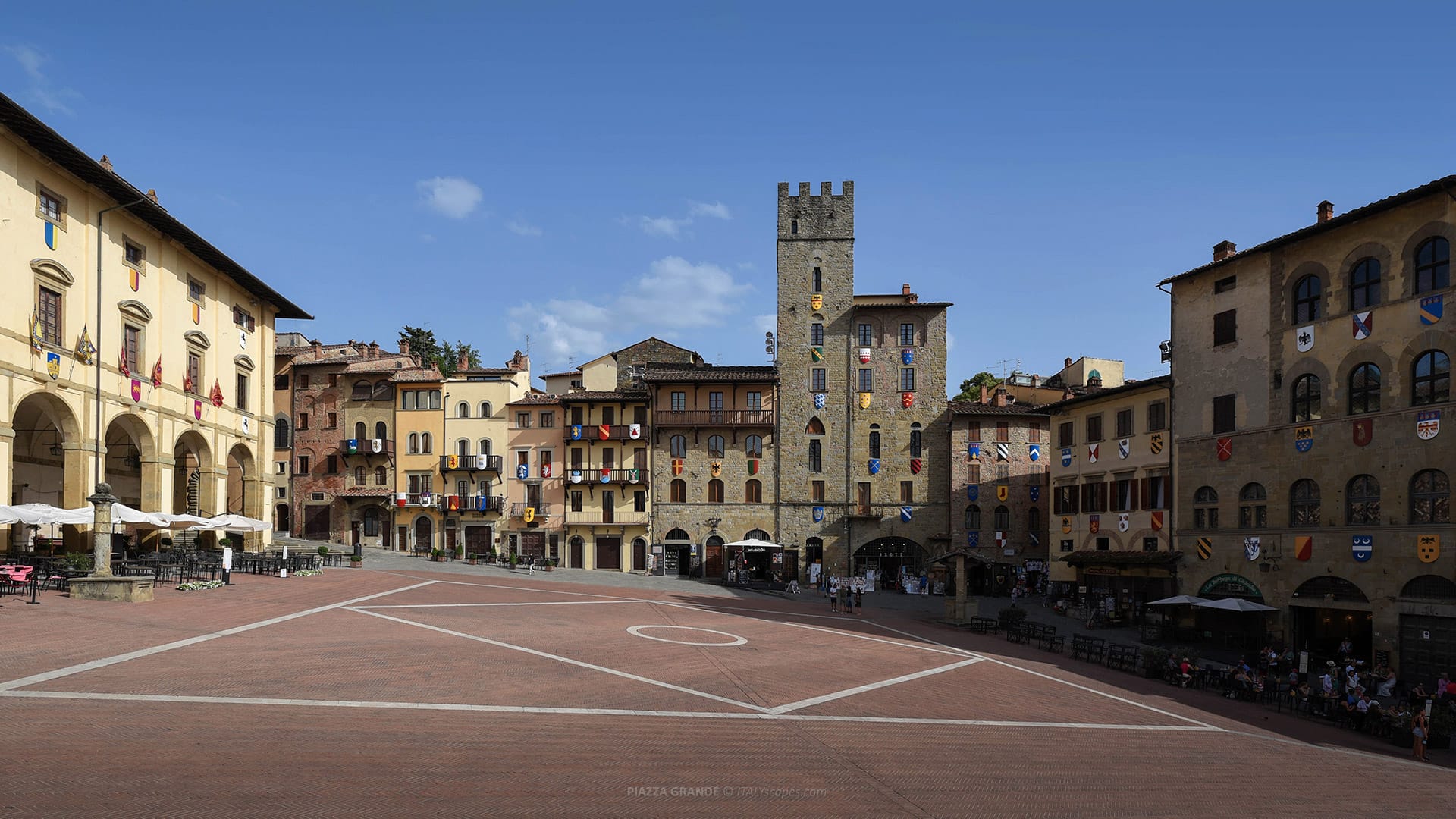
The building stands among the medieval, Renaissance, and later structures that define Piazza Grande. The square has an irregular trapezoidal plan and a strongly sloping surface, while Palazzo Cofani-Brizzolari belongs to the group of medieval buildings lining its lower side.
Unlike a palace conceived as a single architectural project, the complex developed through successive construction phases. Its medieval core, later additions, centuries of alteration, and twentieth-century restoration are all relevant to its present appearance.
Short History of Palazzo Cofani-Brizzolari
The earliest component is Torre Faggiolana, built during the thirteenth century. It predates the adjoining residence and originally rose higher than it does today. The tower’s early date is supported by its narrow pointed openings near the upper section.
The tower is known as Torre Faggiolana because it probably belonged during the thirteenth century to the family of Uguccione della Faggiola. Uguccione was a prominent Ghibelline captain, but historical descriptions remain cautious about the ownership.
During the fourteenth century, a separate building was constructed beside the tower. This adjoining structure was a casa-torre, or tower house, combining residential functions with the vertical and fortified character of medieval urban architecture. Its large openings at the lower level remain among the elements attributed to this construction phase.
The house and tower belonged during the fifteenth and sixteenth centuries to the Cofani, described in local historical documentation as a bourgeois family. Their ownership gave the residence its established Cofani identity.
The upper floors were expanded and remodelled from the fifteenth century onward. These interventions enlarged the residential portion and modified its exterior without eliminating the medieval masonry at the lower level.
Over the centuries, Palazzo Cofani-Brizzolari was damaged and repeatedly altered. By the early twentieth century, its appearance no longer corresponded completely to the medieval character now associated with the building. Its condition led to a substantial restoration campaign intended to recover and emphasize the historic image of Piazza Grande’s medieval side.
Architect Giuseppe Castellucci began extensive work in late 1927. Records describe the 1927-1929 restoration of the palace and the raising of the tower of Uguccione della Faggiola, undertaken with Umberto Tavanti and A. Aretini. Other local accounts date the final phase to 1929-1930, when the complex regained its strongly medieval appearance.
Architecture of Palazzo Cofani-Brizzolari
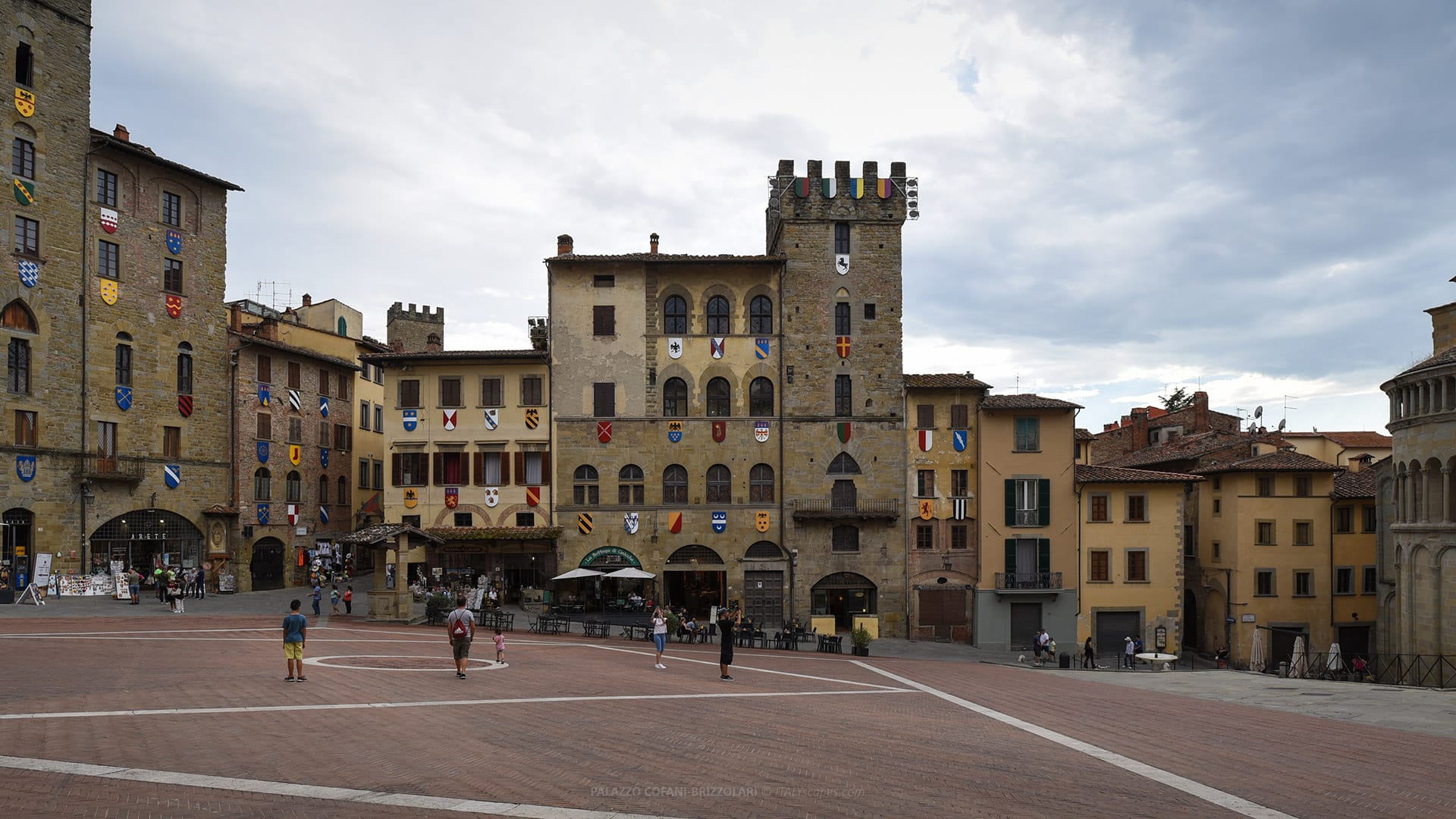
The defining architectural feature is the physical union of two originally distinct components: Torre Faggiolana and the adjacent Cofani tower house. This composite structure explains the irregular massing of Palazzo Cofani-Brizzolari. The tower forms the taller vertical element, while the broader residential building extends beside it along the edge of the square.
At the lower level, the palace displays carefully cut stone blocks that reveal its medieval origin. The masonry gives the base a heavy, compact appearance suited to the sloping setting of Piazza Grande. The large lower openings belong to the fourteenth-century phase and distinguish the residence from the narrower openings of the older tower.
The upper two floors of the palace were remodelled during the fifteenth century and altered again later. The contrast between the lower masonry and the later upper levels provides visible evidence of the building’s gradual enlargement and adaptation.
Torre Faggiolana is the oldest and most strongly vertical part of the complex. Near its upper section are narrow pointed-arch openings characteristic of thirteenth-century construction.
The tower ends in a crenellated crown, one of the most recognizable elements of Palazzo Cofani-Brizzolari. The merlons reinforce its fortified appearance and make the tower prominent within the skyline of Piazza Grande. The crown visible today is also connected to the twentieth-century restoration, which raised and reconstructed parts of the tower.
Although the tower no longer preserves its complete original height, it retains a massive and defensive visual character. Its narrow openings, solid stone walls, and vertical proportions create the impression of a medieval stronghold on a reduced urban scale.
The palace forms part of the medieval architectural group on the lower side of Piazza Grande, facing the later Renaissance organization of the square. Its stone surfaces and crenellated profile contrast with the long Vasari loggia above.
Powered by GetYourGuideHow to Get to Palazzo Cofani-Brizzolari
Getting to Palazzo Cofani-Brizzolari on foot
Palazzo Cofani-Brizzolari is located about 950 metres from Arezzo railway station. The walk generally takes around fifteen minutes, depending on pace and stops. From the station area, visitors can proceed toward Piazza Guido Monaco and then follow pedestrian signs for Piazza Grande and the upper historic centre.
The final part of the route enters older streets before reaching the sloping square. Some sections are uphill, and the historic paving may be uneven, so comfortable footwear is useful. The palace stands on the southwestern side of Piazza Grande, beside the crenellated Torre Faggiolana, which provides the clearest visual landmark.
Getting to Palazzo Cofani-Brizzolari by bus
The closest bus stop is Viale Buozzi Opp 5 – Prato, approximately 250 metres from the palace. It is served by Line C of Arezzo’s urban bus network. After leaving the bus, passengers continue on foot toward Piazza Grande, following the signs into the historic centre and the nearby square.
Getting to Palazzo Cofani-Brizzolari by taxi
Arezzo’s official taxi service operates a fixed rank outside Arezzo railway station in Piazza della Repubblica. The service is available 24 hours a day, and taxis can also be requested by telephone at +39 0575 382626. The journey to Piazza Grande area is short under normal traffic conditions.
Piazza Grande
Frequently Asked Questions about Palazzo Cofani-Brizzolari
What is Palazzo Cofani-Brizzolari?
It is a medieval residential complex created by joining Torre Faggiolana to an adjoining tower house. The surviving structure contains thirteenth-, fourteenth-, fifteenth-, and twentieth-century elements.
Where is Palazzo Cofani-Brizzolari located?
The building stands on the southwestern side of Piazza Grande in Arezzo’s historic centre, beside Torre Faggiolana and among the square’s principal medieval structures.
When was Palazzo Cofani-Brizzolari built?
There is no single construction date. The tower dates from the thirteenth century, the adjoining house from the fourteenth, and the upper floors from later phases.
What is Torre Faggiolana?
Torre Faggiolana is the oldest component of the complex. It is a thirteenth-century stone tower with narrow pointed openings and a crenellated upper section.
Sources:Powered by GetYourGuide -
Photos
-
Map
-
Reviews