-
About
Table of Contents
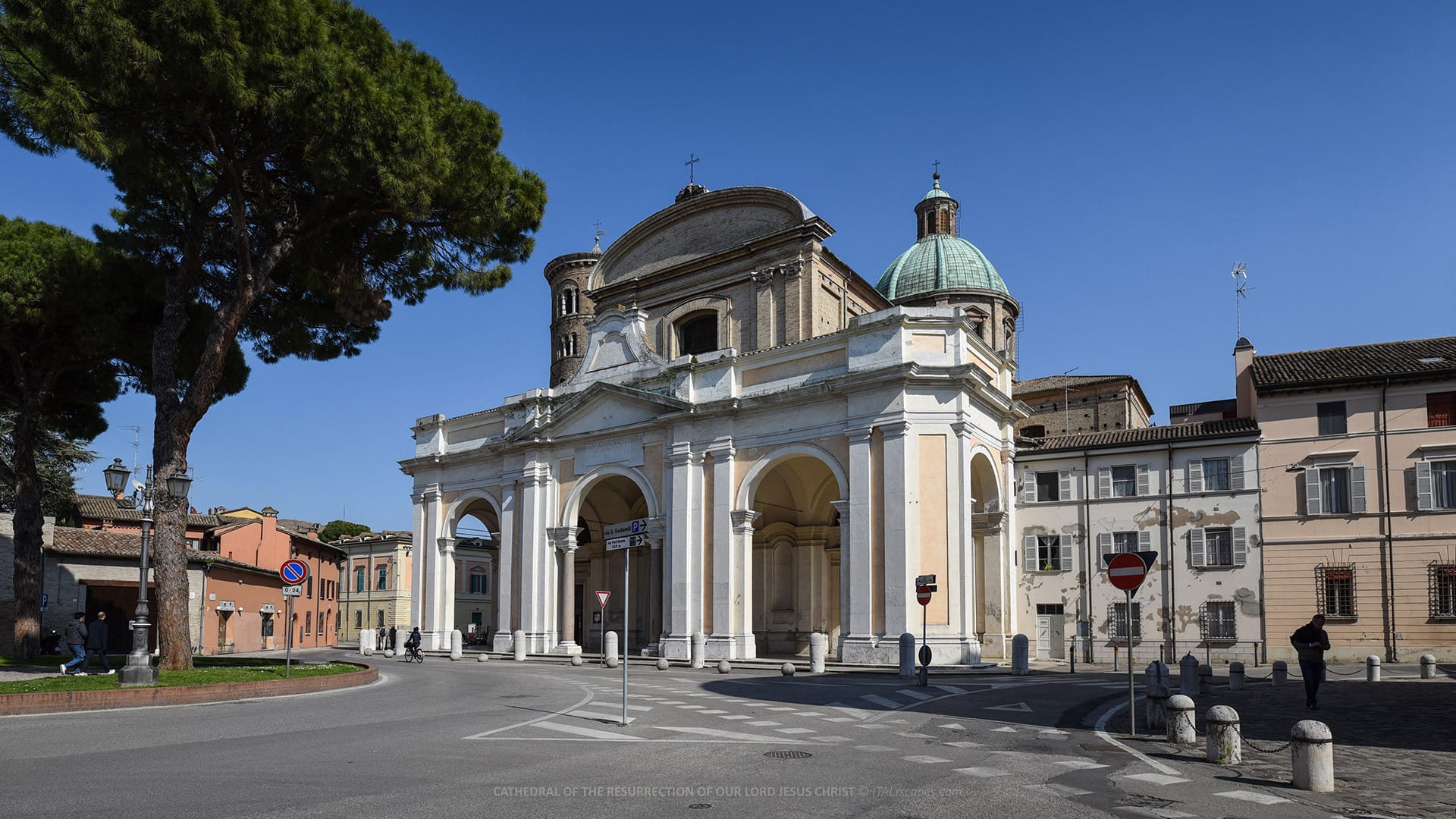
The Ravenna Cathedral, officially known as the Metropolitan Cathedral of the Resurrection of Our Lord Jesus Christ, is the principal Catholic church in Ravenna, and one of the city’s most historically significant religious buildings.
Commonly referred to as the Duomo di Ravenna, it hosts centuries of Christian devotion, architectural transformation, and artistic heritage.
Situated in the heart of Ravenna near Piazza Duomo and adjacent to other landmark sites such as the Neonian Baptistery and the Archiepiscopal Museum, the Ravenna Cathedral stands as a testament to the city’s long role as a spiritual and cultural center in Emilia-Romagna.
Originally founded in the early 5th century, the cathedral has undergone major reconstructions and stylistic evolutions, culminating in the Baroque-Neoclassical structure seen today.
Short History of the Ravenna Cathedral
The history of Ravenna Cathedral begins with the establishment of Ravenna as the capital of the Western Roman Empire in the early 5th century.
Around this time, the episcopal seat was transferred from the ancient port city of Classe to Ravenna, prompting the construction of a new cathedral under Bishop Ursus (Orso).
This early structure, consecrated on April 3, 407 AD, was dedicated to the Resurrection of Jesus Christ, or Hagìa Anástasis in ancient Greek. Due to its founder’s name, it became known as the Basilica Ursiana.
The original church was built in the early Christian architectural tradition with a basilica plan featuring five naves divided by rows of marble columns and round arches, and ending in a semicircular apse, externally polygonal – elements typical of early ecclesiastical architecture.
Over time, the Ravenna Cathedral became richly adorned with mosaics and decorative elements, particularly after the 11th century when substantial restoration work was done, including the addition of mosaics in the apse and on the triumphal arch.
In the 10th century, a cylindrical bell tower was constructed and still remains as one of the few remnants of the early structure.
By 1112 AD, significant mosaic decoration was commissioned for the interior – on the triumphal arch, Christ the Risen is depicted among the apostles, and the apse mosaics showed scenes like the Resurrection of Christ itself, with figures such as Saints Peter and Apollinaris framed by early Christian iconography.
Today, fragments of these mosaics survive in the Archiepiscopal Museum of Ravenna.
Despite its historical richness, the ancient Ravenna Cathedral deteriorated over the centuries. By the 18th century, it was considered in need of complete renewal.
Archbishop Maffeo Nicolò Farsetti initiated an ambitious project to rebuild the cathedral in a modern style, commissioning architect Giovan Francesco Buonamici to design a new church in the prevailing Baroque-Neoclassical style.
Demolition of most of the old structure began in 1734, although the bell tower and crypt were preserved, and construction continued until the mid-18th century.
The newly reconstructed Ravenna Cathedral was opened for worship in 1745, with a grand portico and Classical façade. However, it was not consecrated until April 13, 1749, under Archbishop Ferdinando Romualdo Guiccioli.
Over the following decades, adjustments and restorations took place, including work by architects such as Cosimo Morelli and later modifications in the late 18th century under Giuseppe Pistocchi, who redesigned the original octagonal dome into its present elliptical Neoclassical form.
Today the Ravenna Cathedral functions as the seat of the Archdiocese of Ravenna-Cervia and holds the title of minor basilica, granted by Pope John XXIII in 1960, continuing a tradition of worship that spans more than 1,600 years.
Architecture of the Ravenna Cathedral
The cathedral’s architecture reflects a blend of ancient legacy and 18th-century reinterpretation.
Although much of the early Christian structure was replaced during the comprehensive Baroque-Neoclassical rebuild, certain elements like the bell tower survived, creating a dialogue between old and new architectural languages.
Exterior and PlanThe current Ravenna Cathedral has a Latin-cross plan with a dominant central nave flanked by two side aisles that extend toward the transept.
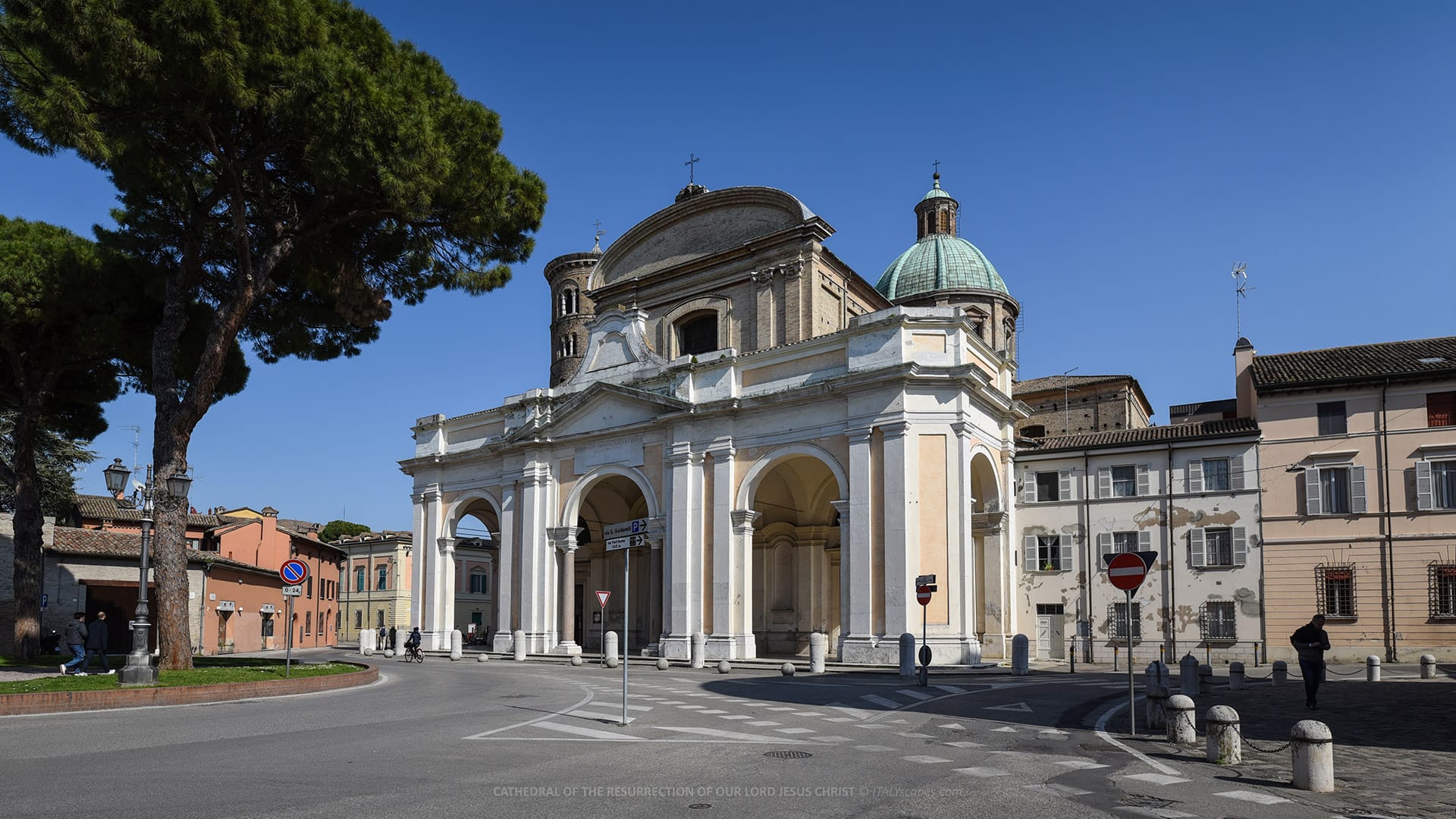
The façade and portico, completed in the mid-18th century, display Classical architectural references with clean lines and balanced proportions typical of Baroque-inspired design transitioning into Neoclassical restraint.
One of the most striking external features is the bell tower, whose cylindrical form was added to the original cathedral in the 10th century.
Its layered series of openings – monofore, bifore, and trifore windows – mark it as a Romanesque element in contrast to the later styles of the main body of the cathedral. This juxtaposition gives the cathedral’s exterior a unique architectural layering visible from Piazza Duomo.
The dome is another key architectural highlight. Originally planned with an octagonal base, it was later redesigned with an elliptical base by Giuseppe Pistocchi between 1780 and 1782.
Rising above the crossing of the nave and transept, the dome’s lantern and windows flood the interior with natural light, enhancing the spiritual atmosphere and emphasizing height and openness – central themes of Neoclassical church architecture.
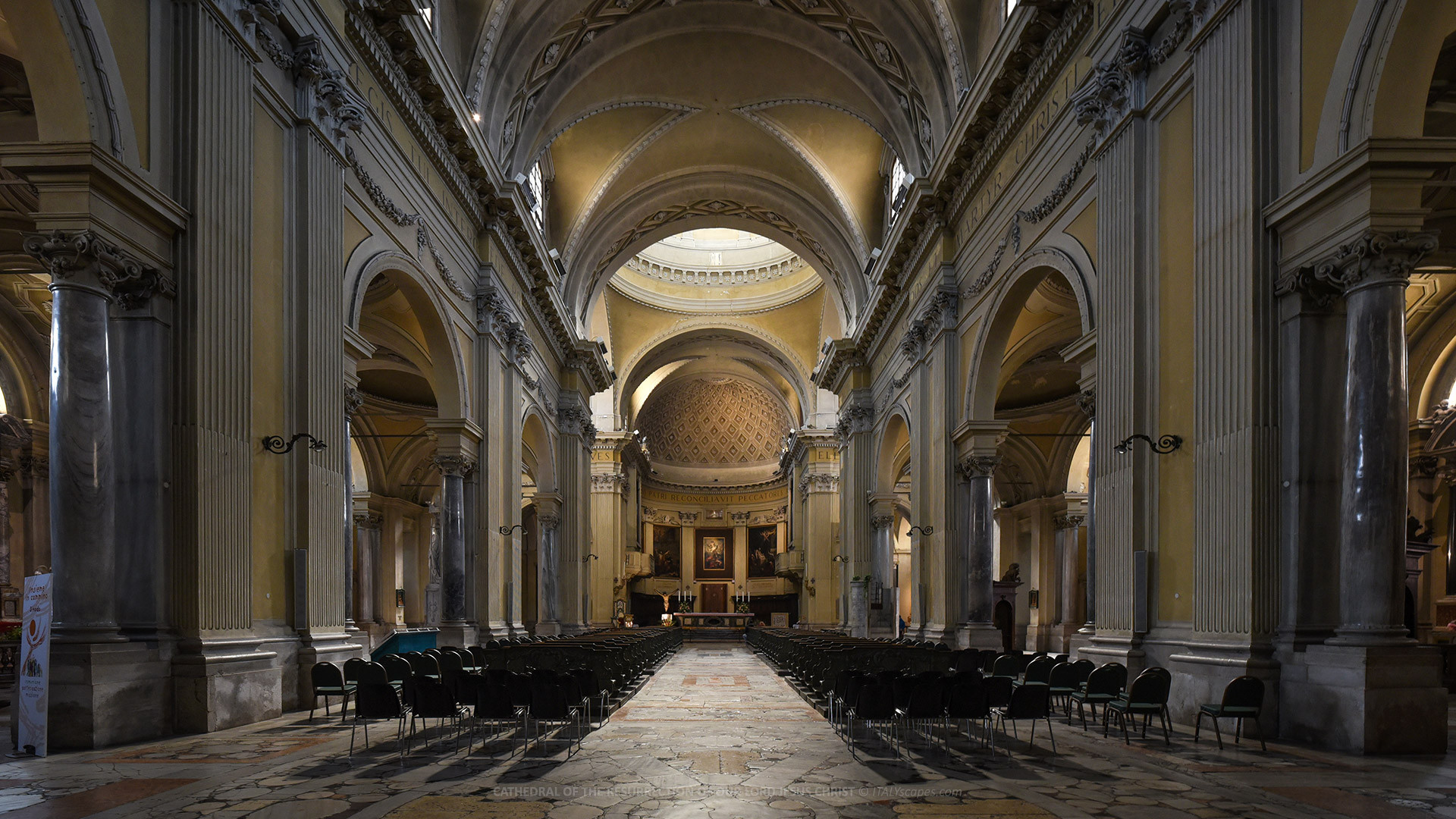
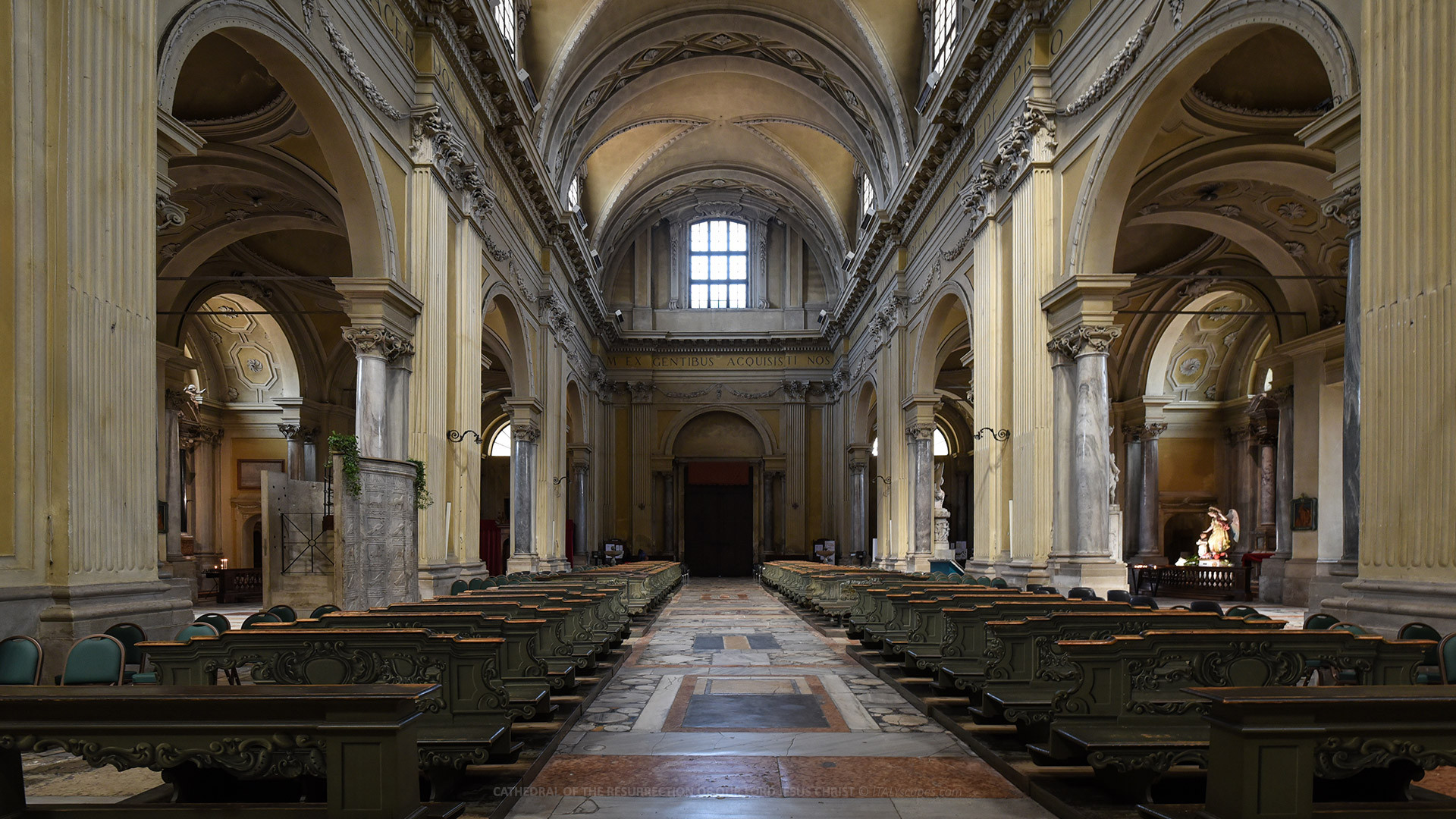
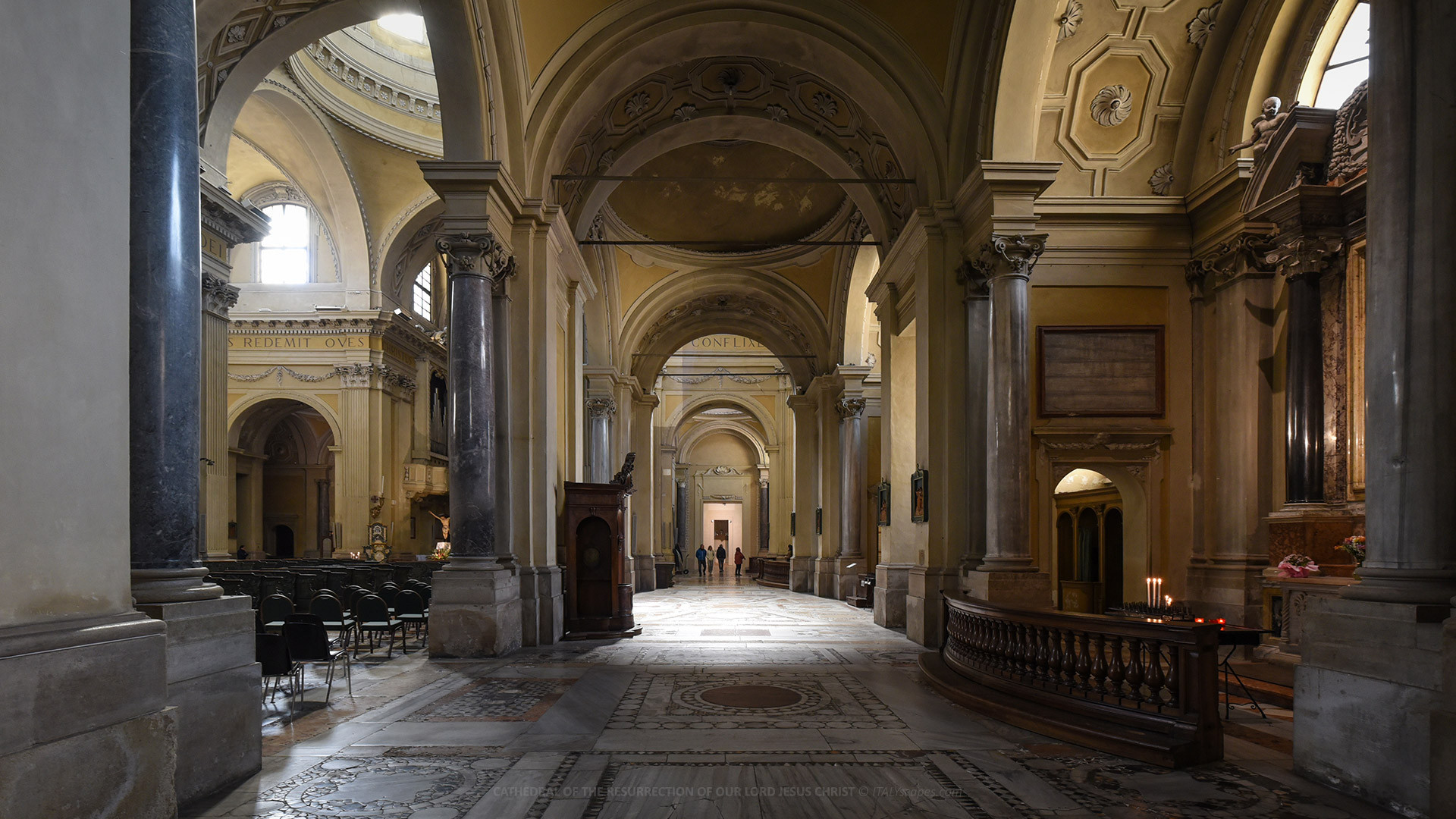
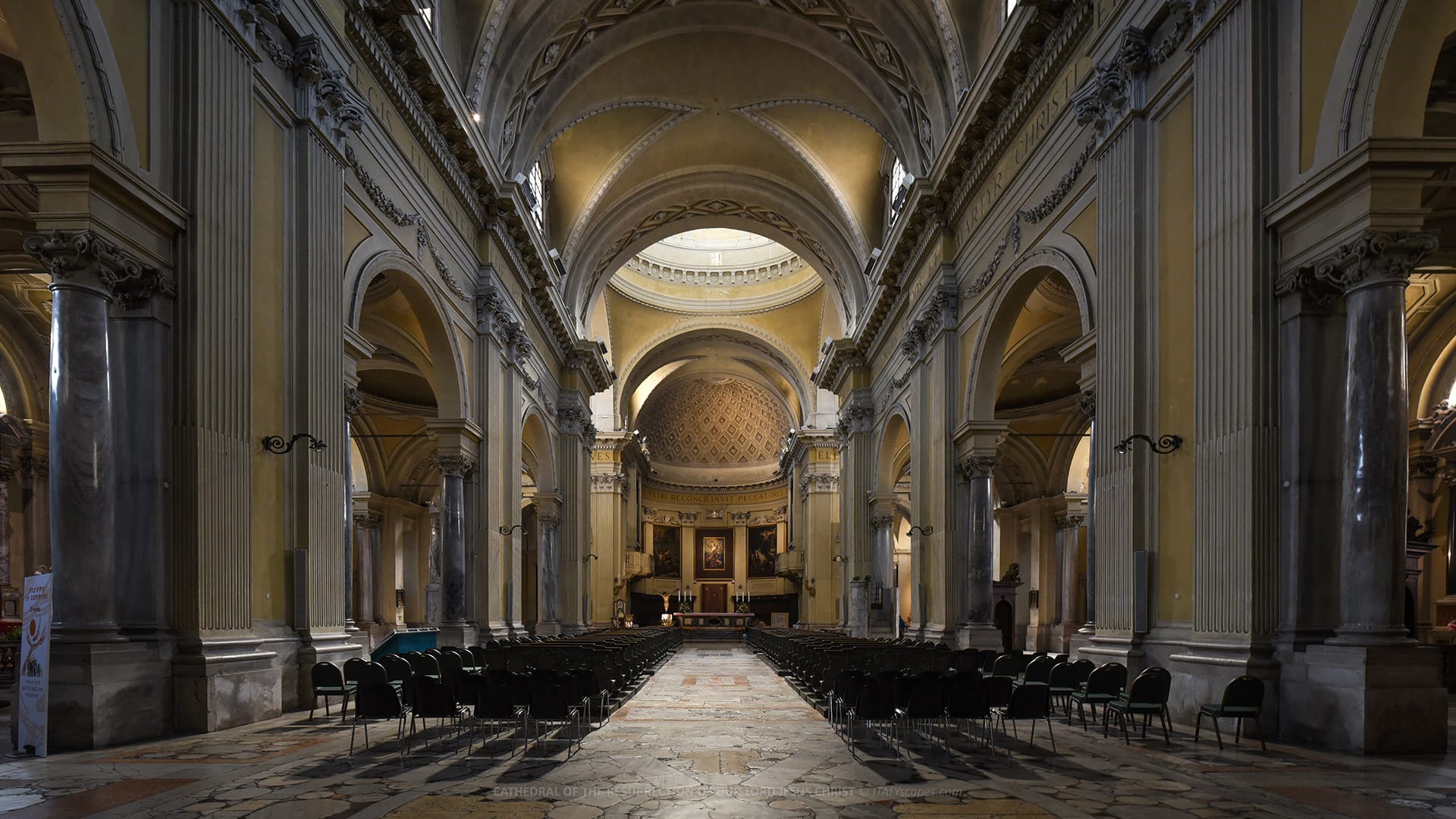
Interior Structure and Spatial OrganizationInside, the cathedral’s nave is elevated above the level of the ancient Basilica Ursiana, with a richly patterned opus sectile marble floor that underscores its historical layers.
The interior elevation, supported by two rows of columns, helps define the central space and reinforces a sense of sacred procession toward the apse.
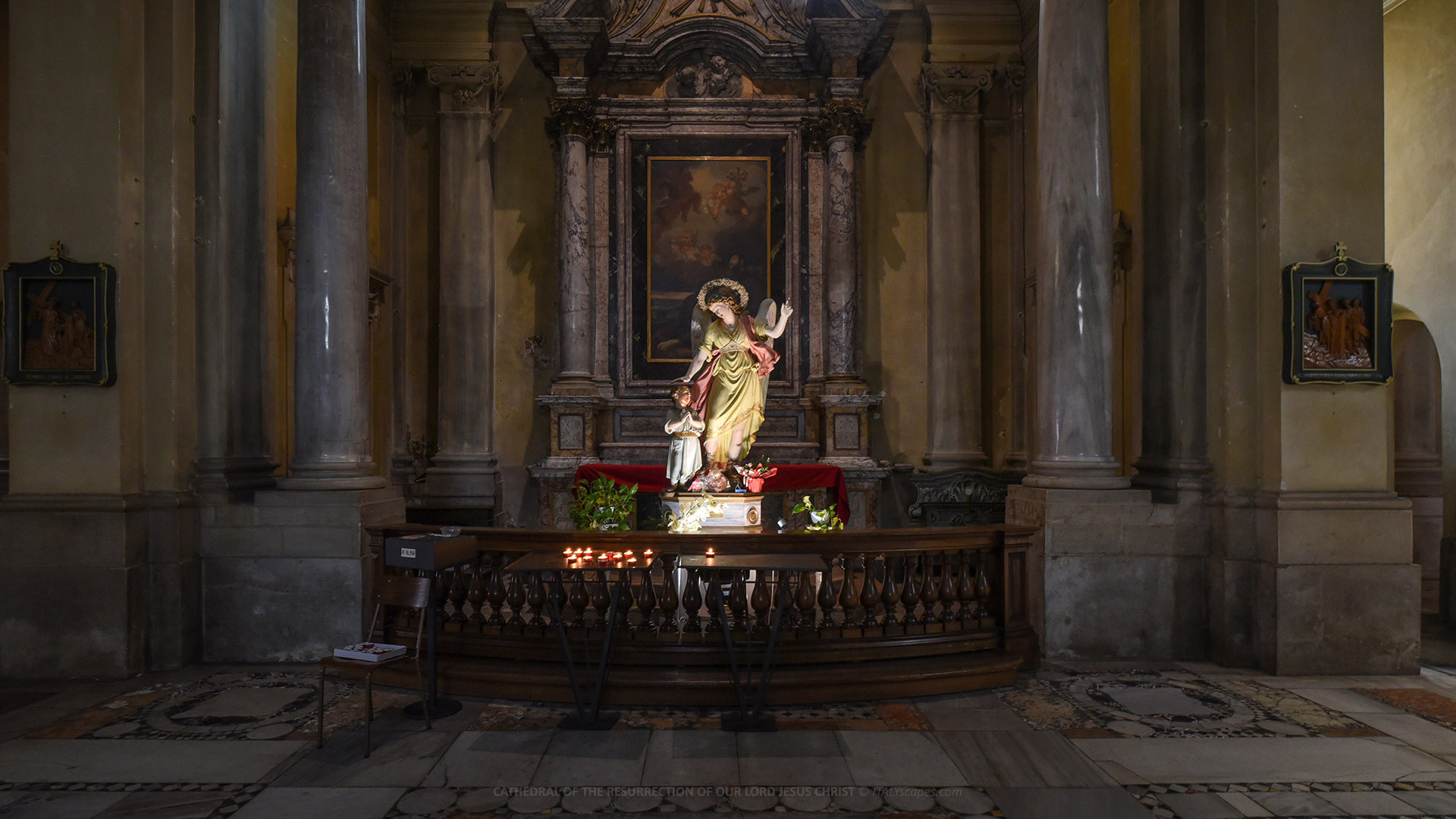
The side aisles lead to symmetrical chapels, many with ornate Baroque altars and decorative elements that reflect the artistic tastes of the 17th and 18th centuries.
Among these is the Chapel of the Blessed Sacrament and the Chapel of Our Lady of Sweat (Madonna del Sudore), a devotional site focused on an image believed by local tradition to have miraculously “sweated”.
Art of the Ravenna Cathedral
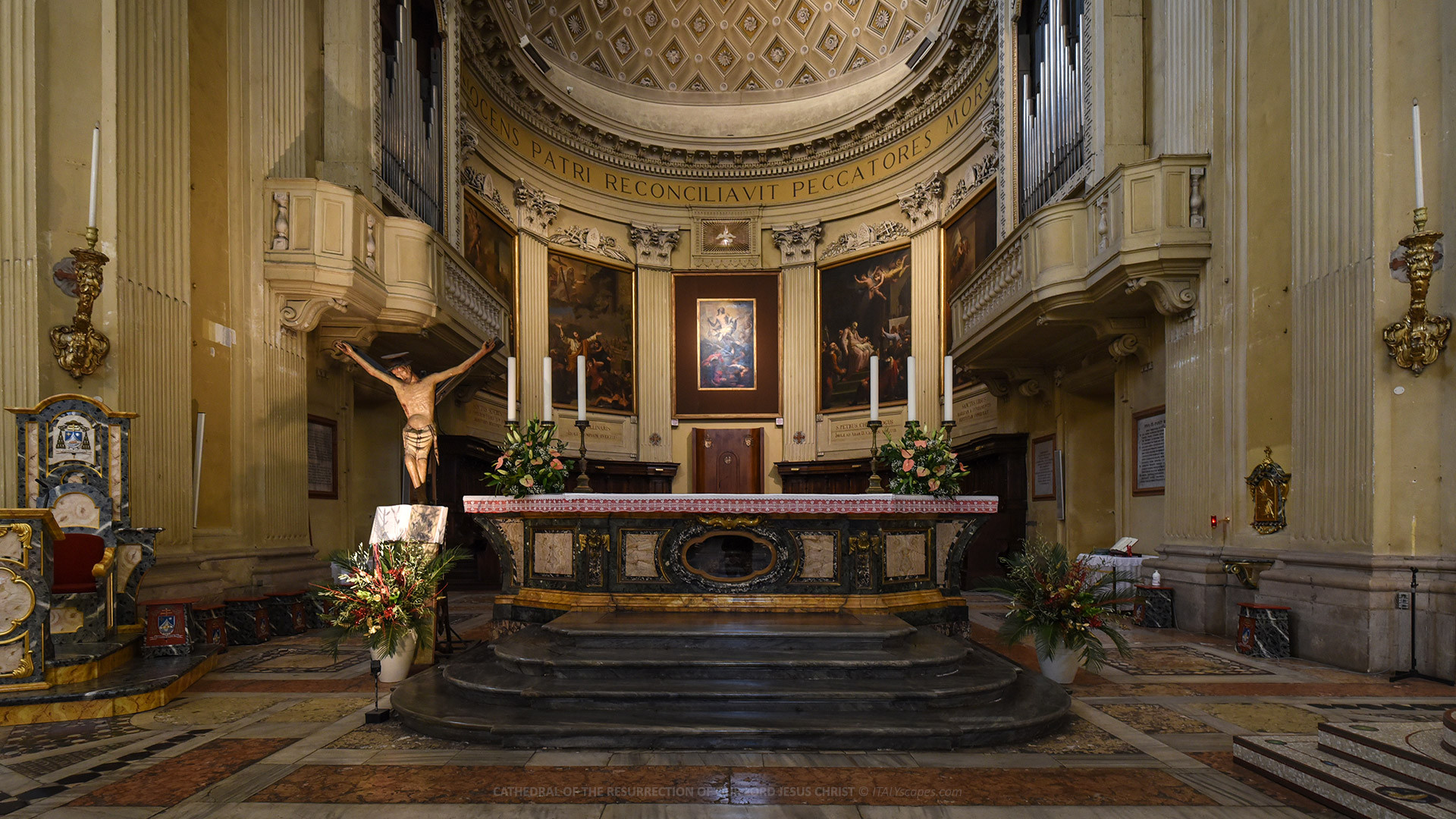
Although the present cathedral interior is dominated by Baroque and Neoclassical decorative schemes, a number of significant works of religious art and historic artifacts are preserved within its walls.
Among the noteworthy ancient elements that can be connected to earlier phases of the cathedral’s history are sarcophagi of local saints and bishops, such as Saint Exuperantius of Ravenna and Maximianus of Ravenna.
Inside the cathedral, visitors can also appreciate paintings and altarpieces from various periods. These include pieces attributed to prominent artists such as Guido Reni, whose work in the Chapel of the Blessed Sacrament illustrates biblical themes.
How to Get to the Ravenna Cathedral
The Ravenna Cathedral (Cathedral of the Resurrection of Our Lord Jesus Christ) is located in the historic center of Ravenna, making it easily accessible from the city’s primary transport hub, the Ravenna railway station.
- On Foot: The distance from Ravenna railway station to the cathedral is approximately 1 km – a walk of about 12-15 minutes. This route is mostly flat and leads directly into the heart of Ravenna’s pedestrian-friendly historic core, passing other key attractions such as the Neonian Baptistery and Piazza Duomo before reaching the cathedral.
- By bus: Public buses in Ravenna serve stops near Piazza Duomo and the cathedral. A number of local lines operate within the city center, connecting the railway station with the vicinity of the cathedral. The nearest bus stop is on Via de Gaspari/ Largo Chartres, about 290 meters from the cathedral, and is served by Bus Lines 1, 3, 4, 5, 8, 18, 70, 80, 145, and 158.
- Taxi or Ride Service: Taxis and ride-hailing services are available outside the Ravenna railway station and offer a direct and comfortable option for visitors who prefer not to walk or use public transportation. The ride to the cathedral typically takes only a few minutes, depending on traffic conditions.
Sources: -
Photos
-
Map
-
Reviews