-
About
Table of Contents
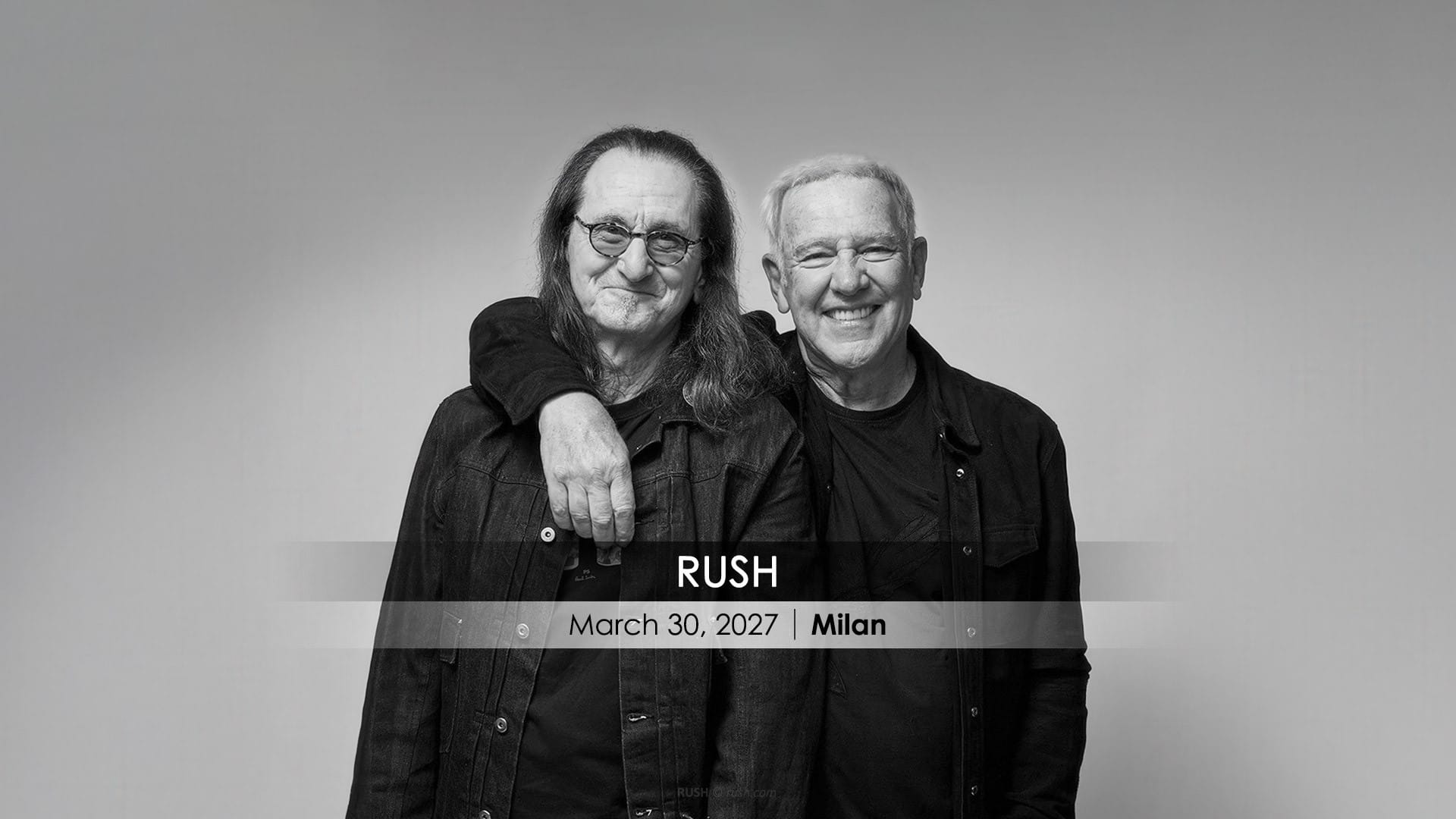
Rush will perform at the Unipol Dome in Milan on Tuesday, March 30, 2027. The concert is scheduled to begin at 8:00 pm and is the only Italian date announced for the European section of the Fifty Something Tour, the group’s first European tour since 2013.
The Milan performance is presented as an evening with Rush. Each concert contains two full sets, while the musicians select the programme from a rotating catalogue of more than 40 songs covering the principal periods of their recorded career. Consequently, the exact setlist can differ from one city to another.
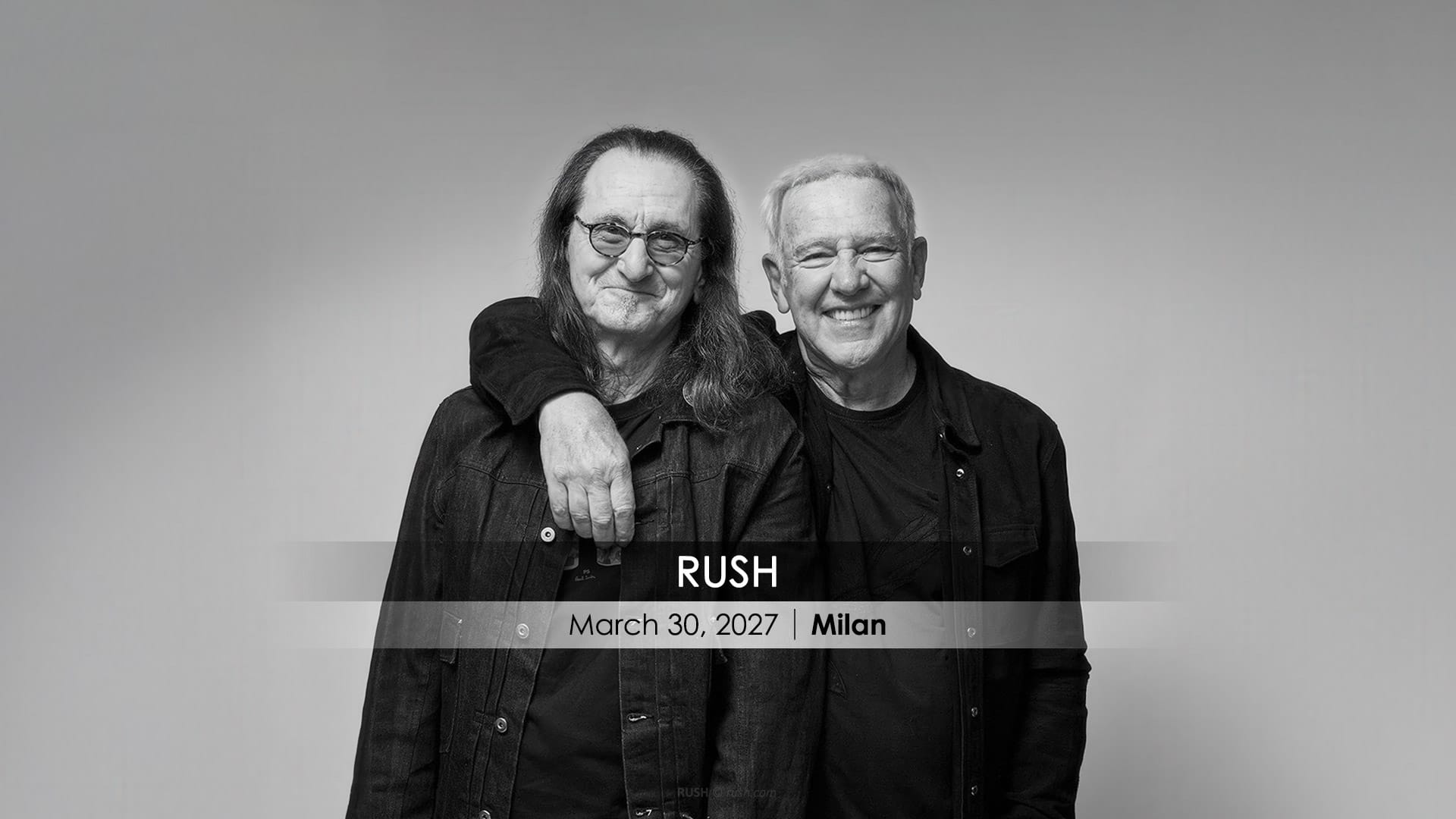
The touring lineup features Geddy Lee on vocals, bass, and keyboards, Alex Lifeson on guitars and vocals, Anika Nilles on drums and percussion, and Loren Gold on keyboards and backing vocals. The production celebrates more than five decades of music while paying a central tribute to Neil Peart.
About Rush
Rush was formed in Willowdale, Toronto, in August 1968 by guitarist Alex Lifeson, drummer John Rutsey, and bassist and vocalist Jeff Jones. Geddy Lee replaced Jones shortly after the group’s formation, establishing the musical partnership with Lifeson that would remain at the centre of the band for more than five decades.
The musicians initially performed blues-rock and hard-rock material in clubs and other small venues around Toronto. After releasing an unsuccessful cover of Buddy Holly’s Not Fade Away, Rush established Moon Records and independently issued its self-titled debut album in 1974, supported by growing radio exposure for Working Man.
John Rutsey left after the first album, and Neil Peart joined in July 1974, shortly before the first United States tour. Peart became both drummer and principal lyricist, while Lee and Lifeson concentrated primarily on composing the music. This lineup remained unchanged throughout the group’s original touring history.
Peart’s arrival accelerated the transition from blues-based hard rock toward progressive rock. Albums released during the second half of the 1970s introduced longer compositions, shifting time signatures, conceptual narratives, fantasy imagery, science-fiction themes, and increasingly complex instrumental passages built around the distinct abilities of all three musicians.
The commercial breakthrough came with 2112 in 1976. Its title suite occupied an entire side of the original LP and demonstrated that Rush could maintain its progressive approach while building a substantial audience. The album’s success gave the musicians greater creative control and established their long-term recording direction.
By the beginning of the 1980s, the group had condensed its progressive structures into shorter and more accessible songs. Permanent Waves and Moving Pictures combined technical arrangements with direct melodies, producing enduring recordings such as The Spirit of Radio, Freewill, Tom Sawyer, Limelight, and the instrumental YYZ.
During the remainder of the 1980s, synthesizers, sequencers, and electronic percussion became increasingly important to the sound. The arrangements absorbed elements of new wave, reggae, and pop rock without abandoning progressive structures. Geddy Lee often divided his live role between bass, keyboards, pedals, and vocals.
The 1990s brought a stronger guitar presence on albums including Counterparts and Test for Echo. Touring stopped after personal tragedies in Neil Peart’s family, and Rush remained inactive for several years. The musicians reunited for Vapor Trails in 2002 and subsequently resumed extensive international touring.
The band released its final studio album with Peart, Clockwork Angels, in 2012. The R40 Tour concluded in Los Angeles on August 1, 2015, becoming the classic trio’s final concert. Peart retired from professional touring and died in January 2020 after a private illness with glioblastoma.
Geddy Lee and Alex Lifeson announced the Fifty Something Tour in October 2025. German drummer Anika Nilles joined the live lineup, while keyboard player Loren Gold was added for the 2027 international dates. The concerts open a new performing chapter while preserving Peart’s historic creative role within the group’s legacy.
Rush Discography
The Rush discography contains 19 studio albums, beginning with Rush in 1974 and ending with Clockwork Angels in 2012. It also includes numerous live albums, compilations, box sets, videos, and two extended plays, documenting several distinct musical periods across nearly four decades of studio recording.
The self-titled debut was followed by Fly by Night and Caress of Steel in 1975. Fly by Night was the first studio recording with Peart and introduced more elaborate compositions, while Caress of Steel expanded the concept through extended pieces including The Necromancer and The Fountain of Lamneth.
2112 arrived in 1976 and became the decisive early breakthrough. Rush then released A Farewell to Kings in 1977 and Hemispheres in 1978. These albums contained ambitious works such as Xanadu, Cygnus X-1, Closer to the Heart, The Trees, and the instrumental La Villa Strangiato.
The release of Permanent Waves in 1980 marked a successful balance between progressive composition and concise songwriting. One year later, Moving Pictures became the group’s most commercially successful studio album, driven by Tom Sawyer, Limelight, Red Barchetta, YYZ, The Camera Eye, Witch Hunt, and Vital Signs.
Signals, released in 1982, placed synthesizers more prominently within the arrangements and included Subdivisions and New World Man. Grace Under Pressure followed in 1984, combining electronic textures with darker lyrical subjects on songs including Distant Early Warning, Afterimage, and Red Sector A.
The synthesizer-oriented period continued with Power Windows in 1985 and Hold Your Fire in 1987. Both albums used layered keyboards and detailed production, while The Big Money, Marathon, Force Ten, and Time Stand Still demonstrated an increasing interest in compact, rhythmically structured compositions.
Presto appeared in 1989 with a lighter production style, while Roll the Bones followed in 1991 with Dreamline, Bravado, and its title track. The heavier Counterparts arrived in 1993, and Test for Echo in 1996 became the final studio album before the interruption.
Vapor Trails marked the studio comeback in 2002 after a six-year gap between albums. The covers EP Feedback appeared in 2004, followed by Snakes & Arrows in 2007. That album included Far Cry, The Larger Bowl, and the Grammy-nominated instrumental Malignant Narcissism.
Clockwork Angels completed the studio catalogue in 2012. Produced by Nick Raskulinecz, it became the group’s first full concept album and followed a young protagonist through a world governed by the Watchmaker. The record included Caravan, BU2B, The Wreckers, Headlong Flight, and its title composition.
The live discography begins with All the World’s a Stage and includes Exit… Stage Left, A Show of Hands, Different Stages, Rush in Rio, and R40 Live. The 2025 anthology Rush 50 surveyed the catalogue from the earliest single to the final classic-lineup performance.
Rush Awards and Sales
Rush has sold more than 40 million records worldwide, including over 26 million album units in the United States. The band accumulated 24 gold records and 14 platinum records, three of them multi-platinum, reflecting unusually consistent commercial results across successive phases of its career.
The group ranks behind only the Beatles and the Rolling Stones for the most consecutive gold or platinum studio albums by a rock band in the United States. Moving Pictures is its highest-selling album, with an RIAA certification of five-times platinum representing more than five million American units.
Rush received 10 Juno Awards from 41 nominations and entered the Canadian Music Hall of Fame in 1994. Its Juno victories include awards connected with Presto, Roll the Bones, Rush in Rio, Beyond the Lighted Stage, and Clockwork Angels, together with earlier Group of the Year honours.
The musicians were inducted into the Rock and Roll Hall of Fame in 2013 and received the Allan Waters Humanitarian Award in 2015. The latter recognized sustained charitable work and support for organizations addressing education, healthcare, disaster relief, human rights, and other social causes.
The band received seven Grammy nominations but did not win the award. Several recognized instrumental performances, while the documentary Rush: Beyond the Lighted Stage was nominated for Best Music Film. Its long-term reputation rests on both commercial results and the technical influence of its musicianship.
Venue – Unipol Dome
Unipol Dome is a multipurpose indoor arena in the Milano Santa Giulia district, in southeastern Milan. The venue accommodates up to 16,000 visitors, using approximately 12,000 seats and 4,000 standing places for concerts. Its interior configuration can be modified for different productions, sporting competitions, and audience layouts.
The arena originated as a central component of Milan’s preparations for the 2026 Winter Olympic and Paralympic Games. Construction began in 2023, following earlier planning connected with the wider redevelopment of Santa Giulia. The building hosted Olympic ice hockey before beginning its long-term programme of concerts and major events.
Unipol Dome was designed by David Chipperfield Architects in collaboration with Arup. Its elliptical form reinterprets the geometry of a classical amphitheatre, while the exterior consists of three stacked aluminium rings separated by transparent glazed bands that reveal parts of the circulation and public areas.
The media façade covers more than 7,000 square metres and contains over 2.4 million LEDs. It can display large-scale visual material and coordinated lighting sequences, making the exterior an active presentation surface during concerts, sporting events, and commercial productions rather than a conventional static façade.
Inside, the arena contains two covered seating tiers above the parterre, together with lounges, restaurants, hospitality areas, and skyboxes. Digital modelling optimized sightlines, circulation, crowd movement, acoustics, and technical installation. A raised podium connects the building with a public piazza exceeding 10,000 square metres.
How to Get to the Unipol Dome
The principal public-transport route uses Metro Line M3, the yellow line, to Milano Rogoredo. Dedicated shuttle buses operate between the station and Unipol Dome during major events. The official access plan also provides extended M3 operating hours until approximately 1:00 am on event nights.
Passengers travelling from Milano Centrale can take M3 directly toward San Donato and leave the train at Rogoredo FS. No metro change is required. Visitors using regional, suburban, national, or high-speed trains can also arrive through the railway platforms at Milano Rogoredo.
The arena is approximately a 25-minute walk from Milano Rogoredo. Walking may be practical before the concert, although the dedicated shuttle provides a more direct connection for visitors unfamiliar with Santa Giulia or for passengers arriving close to the scheduled starting time.
Tram Line 27 serves the Viale Ungheria area, around five minutes on foot from the venue. It connects with Metro Line M4 at Repetti, providing a useful route for passengers travelling from Linate Airport or from districts located along Milan’s blue metro line.
Bus routes 45, 66, 77, 88, and 95 serve the surrounding area. Bus 88 connects with Rogoredo FS, while stops near Via Manzù-Via Cascella and Viale Ungheria are within walking distance. Service patterns may be adjusted when the arena hosts high-attendance events.
Drivers should use the designated access routes for Milano Santa Giulia and reserve parking in advance whenever required. Event-specific traffic restrictions, parking rules, shuttle timetables, metro extensions, and pedestrian routes should be checked before departure because the transport plan can change according to attendance and production requirements.
Frequently Asked Questions about the Rush Concert in Milan
When will Rush perform in Milan?
Rush will perform at the Unipol Dome in Milan on Tuesday, March 30, 2027. The concert is scheduled to begin at 8:00 pm.
Where will the Rush concert take place?
The concert will be held at Unipol Dome, a multipurpose indoor arena in Milan’s Santa Giulia district with a maximum capacity of approximately 16,000 visitors.
What tour includes the Rush concert in Milan?
The Milan performance forms part of the Fifty Something Tour, which marks the return of Rush to international touring following the death of Neil Peart.
How can I reach Unipol Dome by public transport?
Take Metro Line M3 to Milano Rogoredo and continue with the dedicated event shuttle. The venue can also be reached on foot in approximately 25 minutes.
Can I travel directly from Milano Centrale?
Yes. Take Metro Line M3 toward San Donato and leave at Rogoredo FS. The journey from Milano Centrale does not require a metro transfer.
-
Photos
-
Video
Table of Contents
-
Map
-
Reviews
30 March 2027 8:00 pm
30 March 2027 11:45 pm