-
About
Table of Contents
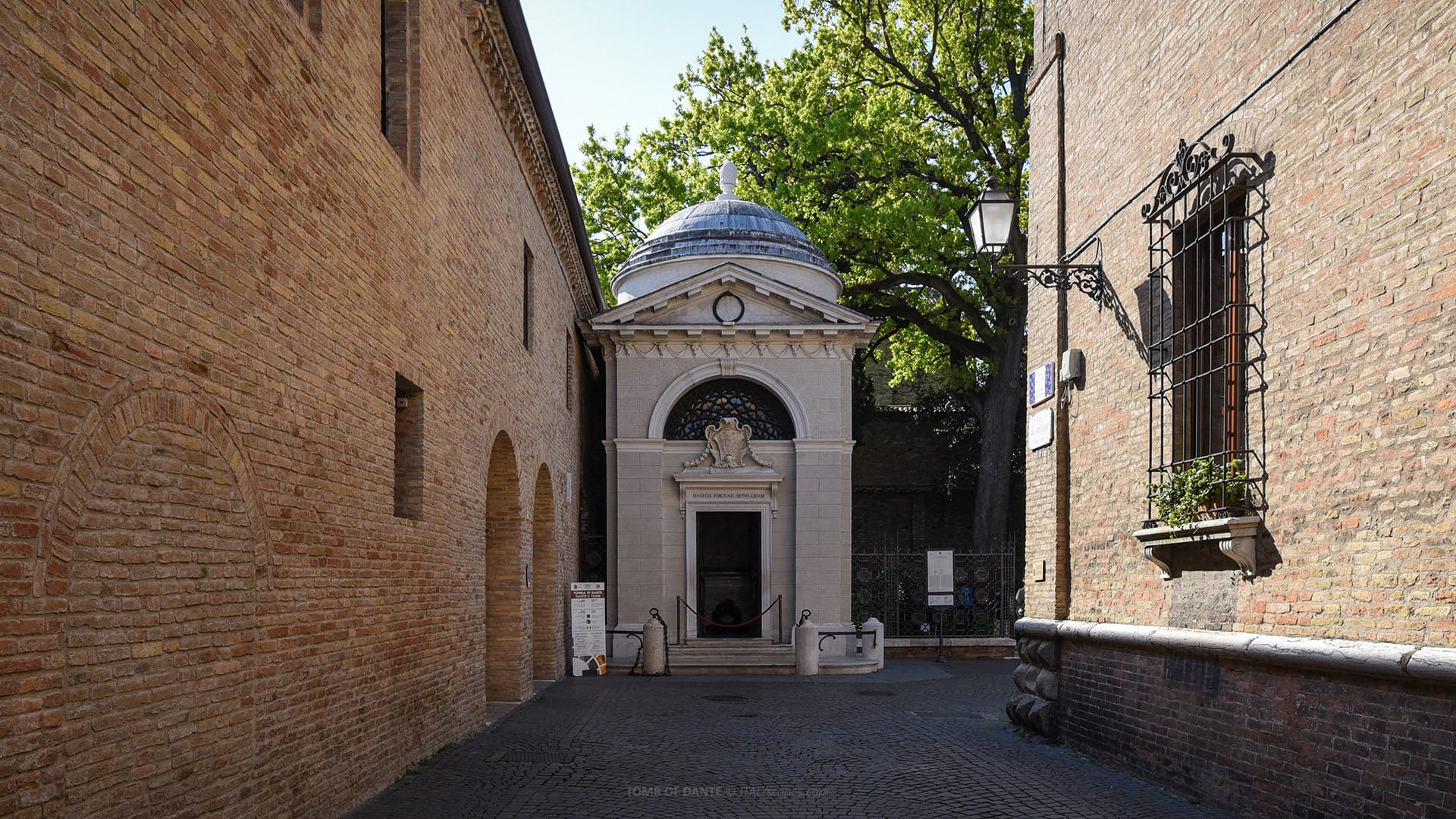
Buy tickets & tours:VivaTicketThe Tomb of Dante in Ravenna is the Neoclassical mausoleum that houses the mortal remains of Dante Alighieri (1265-1321), one of the most influential poets in world literature and author of The Divine Comedy.
Built in 1780-1781 next to the Basilica of San Francesco, this national monument stands at the heart of Ravenna’s historic center, forming part of a larger memorial area dedicated to Dante’s life and work.
The burial site sits within a quiet, pedestrianized area known as the “Zone of Silence” (zona dantesca), where visitors are encouraged to observe silence and respect, reflecting the solemn legacy of the Supreme Poet.
Although Dante was born in Florence, he died in exile in Ravenna on September 13-14, 1321, and was buried there the day after his death.
Over the centuries, numerous efforts were made to relocate his remains to his native city, but they never succeeded. Today, the Tomb of Dante remains in Ravenna as a powerful symbol of literary history and cultural memory, drawing visitors from around the world.
Short History of the Tomb of Dante
Dante Alighieri spent the last years of his life in Ravenna under the patronage of Guido Novello da Polenta, the city’s ruler.
After his death in 1321, his funeral took place at the Basilica of San Francesco (then known as San Pier Maggiore), and he was initially buried outside the cloister in an ancient Roman sarcophagus. This sarcophagus, containing his remains, is still preserved beneath the current monument.
In the late 15th century, the Venetian governor Bernardo Bembo moved Dante’s sarcophagus to the west side of the cloister.
At that time, Dante’s hometown of Florence began requesting the return of his remains, efforts that continued for centuries.
The Florentine popes Leo X and Clement VII supported these moves, and in 1519 Florence received permission to bring the remains back. However, the Franciscans cleverly hid the bones inside a wall before the delegation arrived, leaving the sarcophagus empty.
During the 17th century, the bones were placed in a new box by the prior of the monastery, Antonio Sarti, and were restored under guard.
By 1781, a new mausoleum was constructed over the site under the commission of Cardinal Luigi Valenti Gonzaga, who engaged local architect Camillo Morigia to design what became the present Neoclassical tomb.
In the 19th century, the location of Dante’s bones was forgotten after the Franciscan monastery was suppressed.
The bones were rediscovered only in 1865 by a worker restoring the site, and the almost complete skeleton was briefly displayed before being reinterred in a lead-covered chest beneath the monument.
The monument saw further additions in 1921, including a bronze garland at the foot of the sarcophagus in memory of the fallen of World War I, a marble plaque detailing restorations, and a wrought-iron gate to the adjacent garden designed by Venetian artist Umberto Bellotto.
During World War II, the remains were hidden once more to protect them from bombing, only to be returned after the conflict.
The Tomb of Dante remains one of Italy’s most valued national monuments, drawing historians, literary scholars, and visitors from around the world who pay homage to the poet’s legacy.
Architecture of the Tomb of Dante
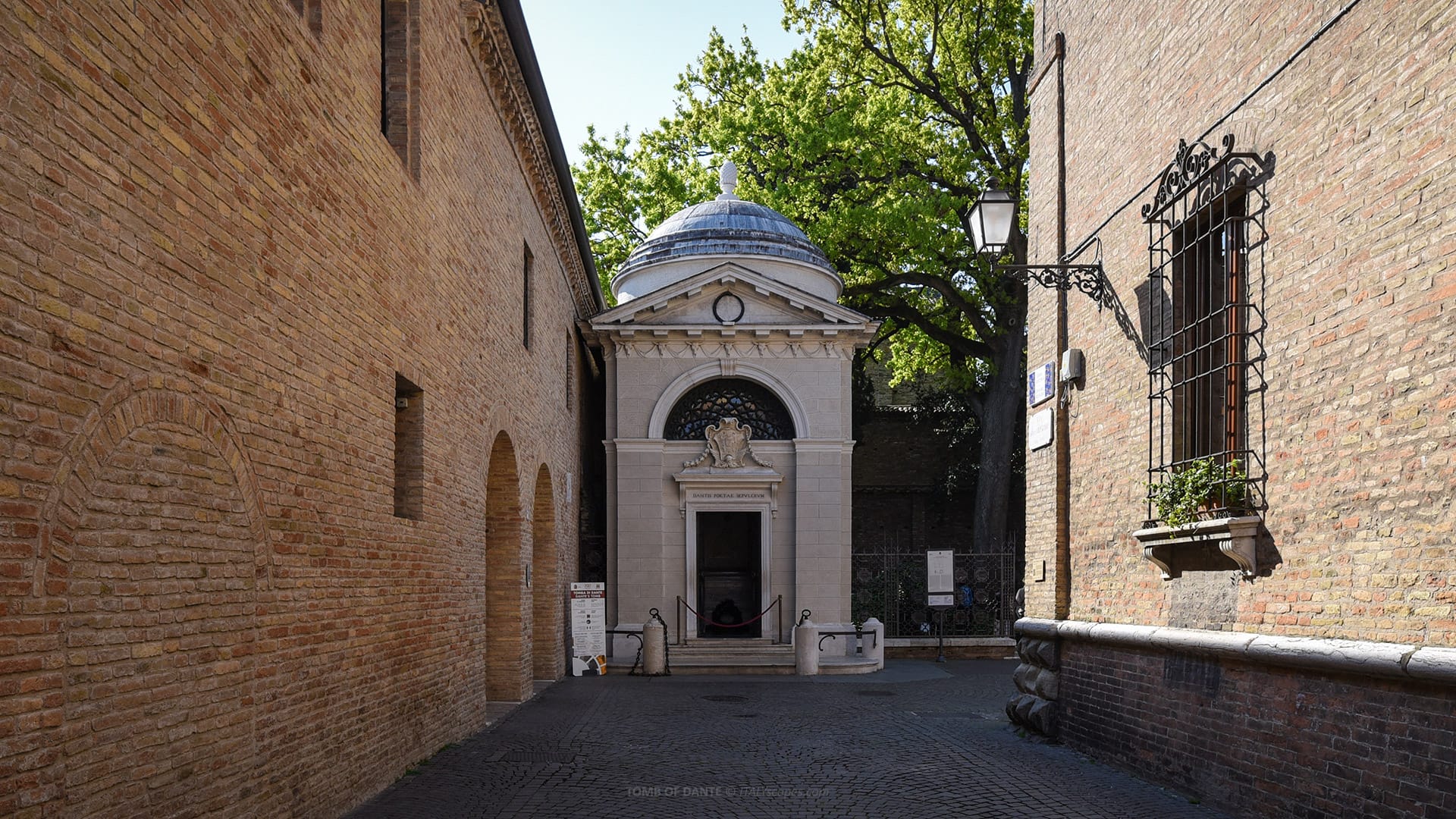
The Tomb of Dante as seen today is a product of 18th-century Neoclassical architecture, reflecting the period’s emphasis on simplicity, symmetry, and solemn dignity – befitting the final resting place of a figure of Dante’s stature.
Commissioned by Cardinal Luigi Valenti Gonzaga, the tomb was designed by Camillo Morigia, an architect active in Ravenna during the late Baroque and early neoclassical period.
Its design is square in plan, surmounted by a small dome, and finished with an exterior that is elegantly austere, emphasizing the sacred function of the space rather than ornate decoration.
On the façade, a simple gate is topped by the archiepiscopal coat of arms of Cardinal Gonzaga and the inscription “DANTIS POETAE SEPULCRUM” – Latin for “Tomb of Dante the Poet”.
The mausoleum remains small and intimate, creating an immediate sense of proximity to the historical figure it commemorates.
Adjacent to the tomb is a small garden area containing the Quadrarco di Braccioforte, an ancient oratory and tranquil space within the “Zone of Silence” that enhances the contemplative atmosphere of the site.
The garden was enclosed by a wrought-iron fence in 1921, and the area continues to reflect a historic sense of reverence and calm.
Art of the Tomb of Dante
While the architectural form of the Tomb of Dante is intentionally restrained, the artistic elements within and around the monument deepen its cultural significance.
Inside the mausoleum, the sarcophagus – originally a Roman relic – serves as the container for Dante’s remains.
It bears inscriptions in Latin and is a focal point of reverence. Above it stands the 15th-century bas-relief by Pietro Lombardo, which depicts Dante reading at a lectern, highlighting his role as thinker and poet.
The sarcophagus itself contains a Latin epitaph believed to have been composed by a contemporary of the poet. This inscription, preserved through centuries, captures both Dante’s sense of exile and his poetic identity.
The votive lamp suspended from the ceiling is more than a decorative element: it is part of a living tradition.
Olive oil from Tuscany is donated every year by Florence to keep this lamp burning on September 14th, the anniversary of Dante’s death, symbolizing an enduring connection between the poet’s birthplace and his final resting place.
Visitors to the tomb often pair their visit with the adjacent Museo Dante and Casa Dante, where more extensive exhibitions on Dante’s life and influence are displayed, including relics related to his remains and the enduring impact of his literary works.
How to Get to the Tomb of Dante
The Tomb of Dante is situated in the historic center of Ravenna, making it accessible by foot, public bus, or taxi from major transport hubs – particularly the Ravenna train station (Ravenna FS).
The tomb is approximately 800 meters (about 0.5 miles) from the Ravenna railway station. A pleasant 12-15-minute walk through the city center takes visitors past streets filled with historic charm and points of interest.
The route typically leads south into the pedestrian area around Piazza San Francesco and the “Zone of Silence”, where the tomb is located.
- On Foot: Walking is the most straightforward way to reach the tomb. From the station, head along Via di Roma and follow signs into the historic centre. The pedestrianized area around the tomb ensures that visitors can enjoy the surroundings safely and without traffic.
- By Bus: Public buses in Ravenna stop near Piazza Caduti della Libertà, which is only about 20 meters (a short stroll) from the Tomb of Dante. The closest bus stop is Piazza Caduti, located about 180 meters from the site, and served by Bus Lines 1, 3, 4, 5, 8, 18, 70, 80, 145, 147, 149, 154, 155, 156, 157, 158, and 159.
- Taxi or Ride Service: Taxis are available outside the train station for a direct and comfortable ride to the historic center. The journey takes just a few minutes, depending on traffic, and drops you near Piazza San Francesco. From there, the tomb is only a short walk away.
Sources:Buy tickets & tours:VivaTicket -
Photos
-
Video
Table of Contents
-
Map
-
Reviews