-
About
Table of Contents
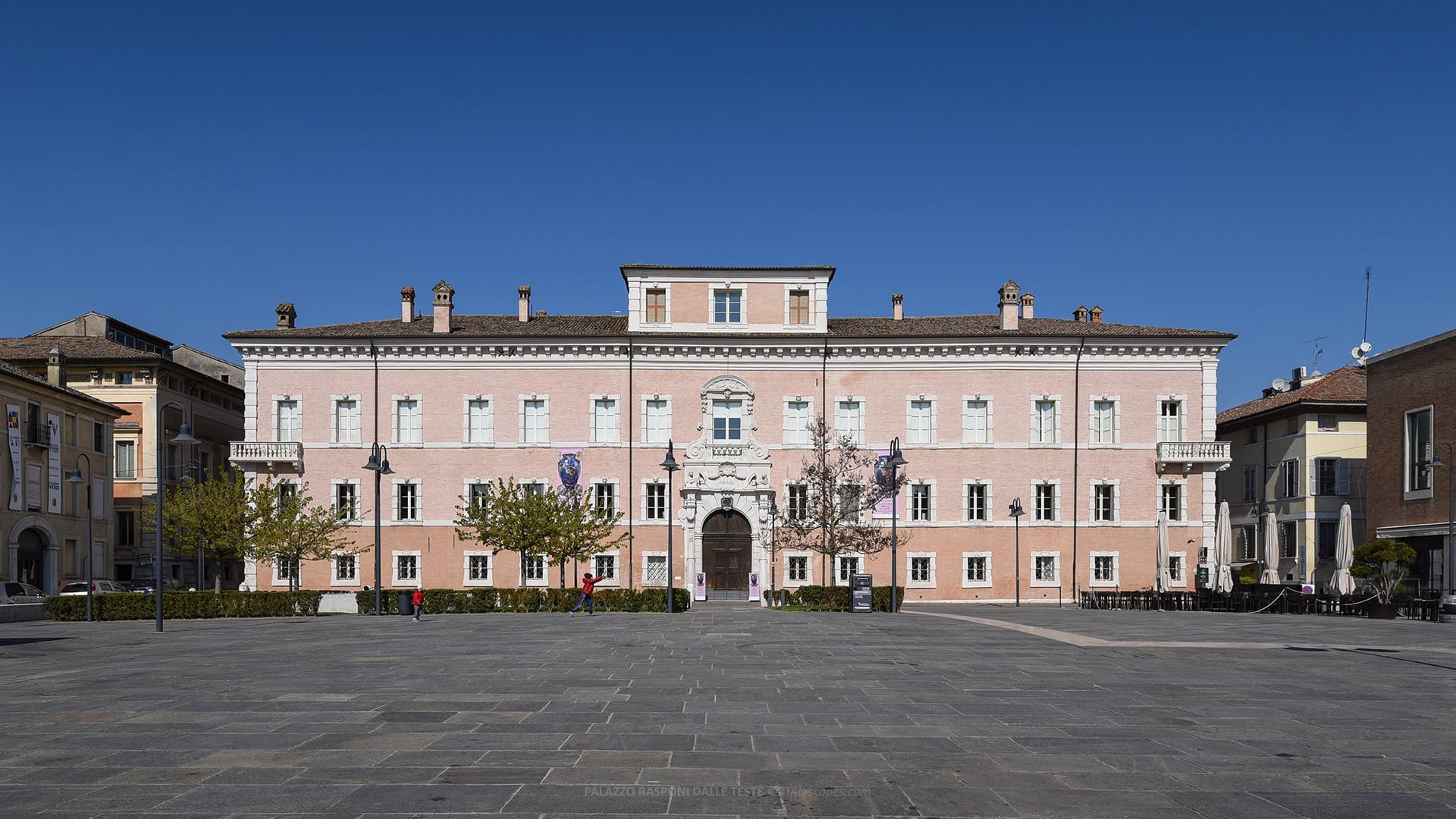
Palazzo Rasponi dalle Teste is one of Ravenna’s most impressive historic buildings, renowned for its monumental Baroque architecture and rich connection to one of Romagna’s most influential noble families.
Standing proudly in Piazza Kennedy, the palace occupies over 5,000 square meters and is widely regarded as one of the most beautiful palaces in the city.
Originally constructed between the late 17th and early 18th centuries, the palace today houses cultural events, exhibitions, and institutional functions, contributing to Ravenna’s vibrant cultural life.
Its façade, grand internal spaces, and historic symbolism reflect both the aspirations and the complex fortunes of the Rasponi family, whose influence shaped the city’s political and social fabric for centuries.
Short History of Palazzo Rasponi dalle Teste
Palazzo Rasponi dalle Teste was commissioned in the late 1600s by Giovanni Rasponi, who served as Bishop of Forlì from 1689 until his death in 1714, together with his brother Count Giuseppe Rasponi.
The palace was built on a site already owned by the Rasponi family since at least the 15th century, reflecting their long-standing prominence in Ravenna.
The family’s name, “dalle Teste”, literally means “of the Heads” – a moniker derived from the distinctive sculpted heads featured on the palace façade. These include alternating Moorish figures with blindfolds and leonine heads, symbols of the family’s identity and heraldic tradition.
Construction spanned several decades because of the scale of the project and the complicated family politics surrounding its site.
Historical documents tell us that Giuseppe Rasponi resolved legal disputes with relatives over the plot of land designated for the palace, avoiding obstacles that might have halted construction.
The palace’s erection coincided with the end of the Rasponi family’s apex of power in Ravenna. What was intended as a grand statement of wealth and cultural leadership paradoxically mirrored the slow decline of the dynasty’s influence in local affairs by the early 18th century.
Over time, the building underwent several modifications. It was completed only in 1738 under Ippolito Rasponi, whose name appears on later additions and decorative elements.
The palace remained a central part of Ravenna’s urban fabric throughout the 19th and 20th centuries, though its appearance and setting changed significantly due to urban redevelopment and damage sustained during World War II.
In the 20th century, part of the surrounding medieval neighborhood was demolished to create Piazza Kennedy, altering the palace’s historical context. Damage from wartime bombings affected the piano nobile (main floor) and decorative details, which have since been the subject of restoration efforts.
The Rasponi family eventually handed the palace over to the Municipality of Ravenna in 1977, triggering a new phase of restoration and reintegration into civic life.
Since 2014, the building has undergone careful restoration financed by foundations and civic authorities, transforming many of its spaces into venues for cultural events, exhibitions, and public functions.
Architecture of Palazzo Rasponi dalle Teste
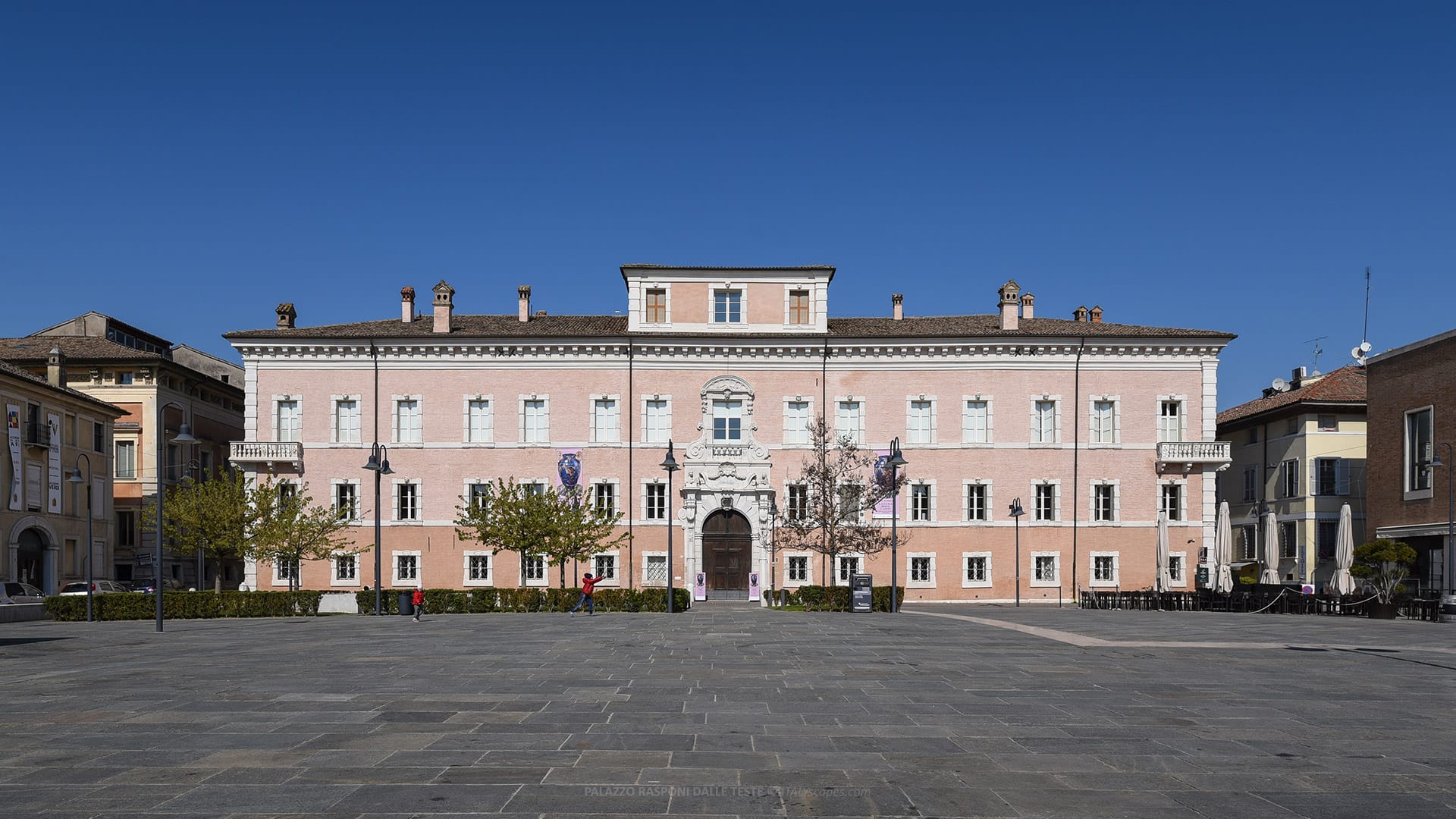
Architecturally, Palazzo Rasponi dalle Teste is a masterful example of late Baroque and proto-Rococo style, synthesizing grandiosity and intricate detail. The palace’s elegance and technical complexity mark it as a landmark of 18th-century urban architecture in Ravenna.
Façade and External FeaturesThe front façade of Palazzo Rasponi dalle Teste extends approximately 70 meters and is perfectly symmetrical, a hallmark of Baroque spatial organization. At its center stands a large portal, framed in a scenographic manner that emphasizes the visual depth of the entrance and contributes to the palace’s monumental effect.
Above the entrance, a series of balconies and a central lantern tower punctuate the design, while sculptural elements recall both classical and late-mannerist traditions. This gliding formal language signals a transition from Baroque to Rococo styles.
Interior Layout and DecorationInside, the palace unfolds into a sequence of richly decorated spaces.
A tripartite androne (central hall) reminiscent of a three-nave church leads visitors toward the grand staircase of honor. This monumental staircase provides access to the piano nobile, which was historically the main residence and representation space for the Rasponi family.
The double-volume hall once served as the Count’s primary reception area and features stucco decorations and busts of ancestors or mythological figures, consistent with noble self-representation in the Baroque age.
Several historic interior elements have survived or been rediscovered through recent restorations: coffered ceilings decorated in the 18th century, painted stuccoes in window jambs, and fragments of earlier frescoes that recall the palace’s decorative program.
Materials and Structural FeaturesAlthough the palace originally included Istrian stone as a primary material, later financial constraints led successive generations to replace it with alternative materials such as San Leo stone, terracotta, or even cement of varying quality.
Beyond architectural elements, historic gardens once extended behind the palace, creating a buffer between the building and neighboring structures.
Though much of the original garden was lost due to later urban changes, the palace’s architectural footprint continues to reflect a blend of Renaissance planning ideas with Baroque theatricality.
Today, the palace’s monumental spaces are used not only for municipal offices but also as exhibition venues and cultural platforms, enhancing Ravenna’s artistic and social engagement.
How to Get to Palazzo Rasponi dalle Teste
Palazzo Rasponi dalle Teste is centrally located in historic Ravenna, making it accessible by various modes of transport from the city’s main arrival point, Ravenna train station.
The distance from the Ravenna railway station to Palazzo Rasponi dalle Teste is approximately 1.2 kilometers (about 0.75 miles).
- On Foot: The most straightforward way for visitors staying in the city center to reach Palazzo Rasponi dalle Teste is to walk. A pleasant 10-15-minute walk leads from the station into the heart of Ravenna’s historic streets and squares, including Piazza Kennedy where the palace stands.
- By Bus: Local buses provide convenient access as well. Buses such as Line 149 depart regularly from Ravenna FS and travel toward the city center. The bus ride is quick – usually around 5 minutes – and drops passengers near central stops within walking distance of Piazza Kennedy. The closest bus stop to Palazzo Rasponi dalle Teste is Piazza Kennedy, which is served by Bus Line 70.
- By Taxi or Ride Service: Taxis are available outside Ravenna train station and offer a direct and comfortable option for visitors who prefer not to walk or wait for public transport. The ride to Piazza Kennedy typically takes only a few minutes.
Sources: -
Photos
-
Map
-
Reviews