


-
About
Table of Contents
Palazzo dei Capitani is an historic palace located in the centre of Malcesine, on the eastern shore of Lake Garda.
Built originally between the 13th and 14th centuries on older Roman and Romanesque remains, the palace has undergone several transformations across centuries and today stands as a protected national monument.
It occupies a prominent position near the lakefront and the port, making it an emblematic building that reflects the layered political and architectural history of the region.
With its Venetian-Gothic style facade, frescoed interior, elegant halls, and tranquil lakeside garden, Palazzo dei Capitani offers a fascinating glimpse of the past: from feudal lords to Venetian magistrates, from private noble residence to modern civic building.
Short History of Palazzo dei Capitani
The site of Palazzo dei Capitani in Malcesine traces back to ancient times: the building was erected over Roman and early medieval (Romanesque) remains.
The first version of the palace was constructed by the ruling family of Verona, the Scaligeri (also known as the della Scala), sometime between the late 13th and early 14th centuries.
At some point, the original structure was reduced to simple walls – likely as a result of a disaster such as a fire or an earthquake.
Later, it became the property of a Veronese citizen, Francesco Mercanti, and was inherited by his descendants. On 18 December 1473, the heirs sold the palace to Alessandro Miniscalchi.
Under Miniscalchi ownership, the building was reconstructed and redecorated: by 1477, documents show it had assumed a refined Venetian-Gothic appearance.
In 1618, at the request of the authorities of the Republic of Venice, the building was purchased by the city of Verona to serve as residence of the “Captain of the Lake” (Capitano del Lago), the Venetian magistrate in charge of supervising the Garda region.
For centuries, Palazzo dei Capitani remained under Venetian authority. After the fall of the Republic, the property gradually passed to local civil authorities.
On 20 March 1854, the city of Verona leased it to the municipality of Malcesine; by 1897, Malcesine became the full owner.
In 1902, the palace was officially declared a national monument – a recognition of its historical, architectural, and cultural significance.
Over the centuries, the palace underwent various restorations. A major one began in 1985, which included recovery of upper floors, structural renovation and rebuilding of the roof.
Further restoration, begun in 2007, refurbished the ground and first floors: murals were restored, static consolidation was done, and the interior infrastructure (plumbing, electricity) was modernized.
Today, Palazzo dei Capitani serves a civic and cultural role: it houses municipal offices and the public library of Malcesine. In addition, it hosts exhibitions, concerts, conferences, and private events such as weddings.
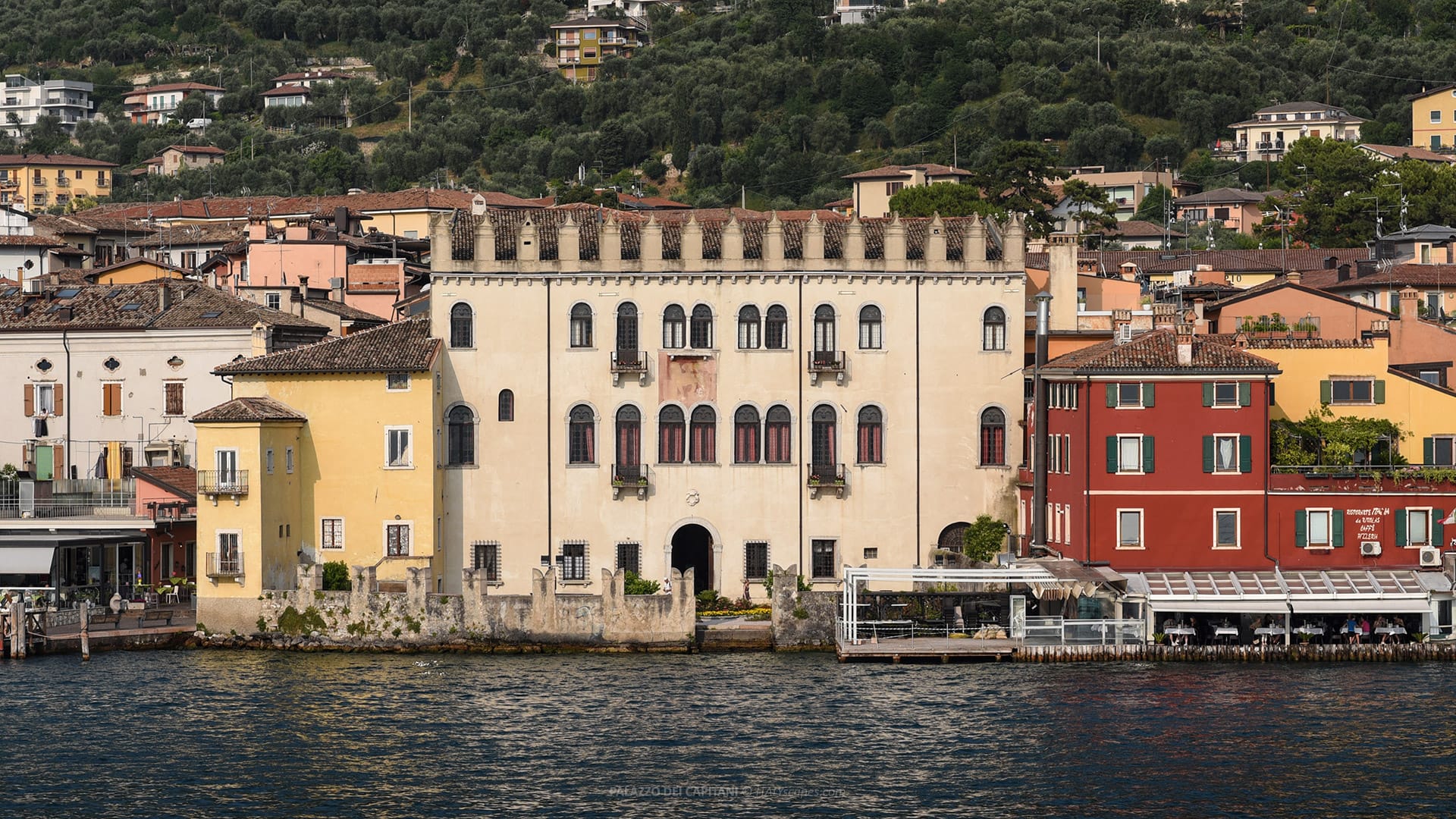
Palazzo dei Capitani, seen from the water
Architecture of Palazzo dei Capitani
Architecturally, Palazzo dei Capitani is a fine example of the evolution from medieval power residence to refined Venetian-Gothic palace, combining historical layers with later stylistic and functional adaptations.
Layout and ExteriorThe palace stands along Via Capitanato, near the port of Malcesine and just steps from the shore of Lake Garda. Its lakeside orientation and proximity to the harbor once allowed boats to moor directly to the building – a clear sign of its former administrative and strategic function.
The main facade, facing the lake, exhibits characteristic Venetian-Gothic elements resulting from the 15th-century reconstruction by the Miniscalchi family. The overall style emphasizes elegance and authority rather than pure fortification.
Interior Decoration and HallsAt the ground floor lies a large hall whose ceiling is adorned with frescoes.
These frescoes display emblems relevant to the region: the “Gardesana dell’Acqua” (the historic community around Lake Garda), the castle of Malcesine, the lion of Saint Mark (symbol of Venice), the coat of arms of Verona, and the coat of arms of the Lake Captain at the time – Lodovico Giusti.
On the walls, additional heraldic symbols can be found: those of the Miniscalchi family, original owners after 1473, and – following a 1488 marriage between Alessandro Miniscalchi and Ginevra Lodron – also the coat of arms of the Lodron family from Trentino.
The first floor (piano nobile) was traditionally the main floor for representation and residence. Its rooms feature ornate decorative elements: sculpted floral and leaf motifs, a decorated cornice with cherubs, seahorses, birds – combining Venetian elegance with local craftsmanship.
Above the main entrance, inscriptions in Latin remain: on the architrave, “Stat sine morte decus” (“Magnificence never lacks death”) and above the arch, an inscription commemorating the 1618 acquisition by Verona and its assignment to the Lake Captain.
The upper floor once housed servants’ quarters and the chapel for the house’s chaplain – reflecting the hierarchical residential layout typical of noble dwellings of that era.
Garden and WaterfrontBehind the palace lies a garden, planted with palm trees, that faces the lake. This garden originally served as the docking area for boats of the Captain of the Lake. Through a portico and small quay, the Capitano could reach his residence directly from the lake.
Today, the garden remains accessible to visitors and offers a peaceful space with views of Lake Garda – a picturesque contrast to the rich history and ornamented halls inside the palace.
Preservation and UseThanks to restoration campaigns – especially those begun in 1985 and continued from 2007 – both the structural stability and aesthetic quality of Palazzo dei Capitani have been recovered.
How to Get to Palazzo dei Capitani
Reaching Palazzo dei Capitani is easy, especially given its central location in the charming village of Malcesine. The palace sits on Via Capitanato, just a few steps from the harbour and the lakefront – so once you arrive in town, you are already virtually at its doorstep.
- By Car: If you arrive by car, follow the scenic Gardesana road that skirts the shores of Lake Garda; once you enter Malcesine, you’ll find local parking areas nearby – then it’s a short walk through the narrow historic streets to reach Via Capitanato and the palace. Local signage will guide you to the old town and the lakefront.
- By Public Transport / Ferry: Given Malcesine’s position on Lake Garda, many visitors combine boat travel with their visit. Ferries from other lakeside towns often dock near the port – from there, the palace is immediately visible and just a few steps away. If arriving by bus, local lines serving Malcesine drop you close to the historic center; from the bus stop, a short walk brings you to the palace.
- On Foot (within Malcesine): Once in Malcesine, the historic center is compact and walkable. From almost any point near the lakefront or old town, you can find narrow cobblestone alleys leading you to the palace. The signage for “Palazzo dei Capitani” or “Porto” will help.
Sources: -
Photos
-
Map
-
Reviews

