Table of Contents
If you’re planning an architectural road trip through Italy, few themes are more rewarding than exploring the Baroque churches in Sicily.
After the devastating earthquake of 1693, many towns in the southeast of the island were rebuilt almost from scratch, giving rise to a flamboyant, theatrical style now known as Sicilian Baroque.
Today, these churches form the heart of several UNESCO World Heritage sites, especially in the Val di Noto region.
Below you’ll find a top 12 of Baroque churches in Sicily. For each one, you’ll get a short guide to its location, history, architecture and art, so you can plan your own itinerary around these masterpieces.
12. Church of San Giovanni Evangelista – Scicli
The Church of San Giovanni Evangelista lies in central Scicli, on the right side of the Town Hall, within the historic core that forms part of the UNESCO Val di Noto listing.
Its discreet position, just off the main square, makes it easy to combine with a wider walk through this small Baroque town.
The church was built between about 1760 and 1765, though interior decoration continued into the mid-19th century.
It replaced earlier religious structures and was originally attached to a Benedictine monastery that was demolished in the early 20th century to make way for the present Town Hall.
San Giovanni Evangelista is described as a precious example of Scicli’s Baroque. The church has a bright, oval internal space organised with pilasters and Ionic columns, which support a large vault.
The façade, though less theatrical than others in the Val di Noto, still displays the plasticity and vertical energy typical of the local Baroque idiom.
Inside, the cathedral preserves important Baroque frescoes and decorations, supported by white marble columns that contribute to the luminous atmosphere.
One of its most distinctive works is the image of the “Cristo di Burgos” (Christ in a skirt), a copy of a Spanish devotional image that gives the church a unique iconographic focus.
11. Collegiate Basilica of San Sebastiano – Acireale

The Collegiata di San Sebastiano is located in central Acireale, a coastal town north of Catania known for its elegant Baroque architecture.
The basilica stands on Piazza San Sebastiano, close to the town’s main cathedral and within walking distance of Piazza Duomo. Its commanding position and ornate façade make it one of the most prominent landmarks in the city, especially during religious festivals.
The origins of San Sebastiano trace back to a small 15th-century oratory built in devotion to Saint Sebastian, who was believed to have protected Acireale from a plague outbreak.
After the 1693 earthquake devastated much of the region, the church underwent a complete Baroque reconstruction.
Work on the new building began in 1699 and continued well into the 18th century under several local architects, reflecting Acireale’s broader architectural renaissance during this period.
In 1924, it received the title of Basilica Minor, acknowledging its historical and artistic significance.
San Sebastiano is considered one of the finest examples of Acireale’s Baroque style.
The façade, attributed primarily to architect Angelo Bellofiore, features a two-tiered structure with paired columns, elaborate volutes, and a richly decorated portal framed by sculptural elements.
The staircase leading to the entrance enhances the theatrical impact typical of Sicilian Baroque. The basilica’s interior has a Latin cross plan with side chapels, barrel vaults, and a spacious transept crowned by a dome.
Stucco decorations, Corinthian pilasters, and polychrome marble surfaces contribute to its refined decorative harmony.
The interior is decorated with cycles of 18th-century frescoes by artists such as Pietro Paolo Vasta, one of Acireale’s most important painters.
Vasta’s works depict episodes from the life of Saint Sebastian and other biblical scenes, showcasing dramatic lighting and vivid color typical of late Baroque painting.
Additional artworks include sculpted altarpieces, wooden statues used in processions, and richly decorated chapels.
The basilica is also known for its role in Acireale’s annual Carnival, during which it serves as a cultural and spiritual landmark.
10. Cathedral of San Pietro – Modica

The Cathedral of San Pietro stands in Modica Bassa, directly on Corso Umberto I. Its monumental staircase rises above the main street, making the church one of the most recognisable landmarks in this UNESCO-listed Baroque town.
San Pietro’s origins date back to the medieval period, but the church was heavily rebuilt after the 1693 earthquake. Construction continued well into the 19th century, with the monumental staircase only completed in 1876.
Today it is recognised as a co-cathedral of the Diocese of Noto and an integral part of Modica’s Baroque ensemble.
The façade is a classic display of Sicilian Baroque: tiered elevation, sculpted stonework and a wrought-iron balcony that runs along the front. The staircase is lined with twelve statues of the Apostles – the famous “Santoni” – carved from local stone, giving a theatrical approach to the church.
Inside, three aisles are divided by fourteen Corinthian columns, and the floor is paved with richly inlaid marble.
San Pietro preserves frescoes, sculptures and liturgical furnishings commissioned over the 18th and 19th centuries, including decorated chapels and an elaborate high altar.
Much of the interior decoration reflects the taste of late Baroque and Neoclassicism, blending stucco, polychrome marble and painted cycles.
9. Church of Santa Lucia alla Badia – Syracuse (Ortigia)

Santa Lucia alla Badia stands on the southern side of Piazza Duomo in Ortigia, the historic centre of Syracuse. It faces the cathedral square, making it one of the most photographed Baroque churches in Sicily and a key stop on any walk through Ortigia’s urban stage.
A church and Benedictine convent already existed here by the 15th century, but the current Baroque building was completed in 1703 after an earlier structure was damaged.
Dedicated to Syracuse’s patron saint, Lucy, the complex later lost its religious function and is now deconsecrated, used for exhibitions and cultural events.
The façade, overlooking the square, is a compact Baroque composition with pilasters, curved gables and a central doorway, all built in the honey-coloured stone typical of Syracuse.
The church’s position, closing one side of the piazza, is as important as its details: together with the cathedral and palaces it creates a unified Baroque scenography.
Santa Lucia alla Badia is strongly associated with Caravaggio’s Burial of Saint Lucy, painted in 1608 for Syracuse.
The original work has had a complex history and is now housed in the Church of Santa Lucia al Sepolcro; Santa Lucia alla Badia displays a copy, along with other Baroque paintings and a notable painted ceramic floor.
8. Church of San Bartolomeo – Scicli
The Church of San Bartolomeo sits just outside Scicli’s central core, in a rocky valley carved by the river. Its slightly isolated position, framed by cliffs, gives it one of the most dramatic settings among the Baroque churches in Sicily.
A church existed here by the 15th century, but repeated earthquakes – especially in 1693 – led to major rebuilding.
The present structure largely dates from works begun around 1752, with different architects contributing up to the early 19th century. The façade was completed in 1815, and an ornate iron gate was added in 1822.
San Bartolomeo’s façade shows a transition from late Baroque to early Neoclassicism. Rising through superimposed orders of Doric, Ionic and Corinthian columns, it culminates in a belfry with a ribbed dome.
Statues of the Madonna and Child and saints including Peter, Paul, Bartholomew and William animate the roofline, while the interior plan follows a Latin cross with a single nave.
The church houses a rich collection of sacred art, including altarpieces, sculpted decorations and devotional objects that reflect the religious life of Scicli over several centuries.
Among the highlights are works associated with local confraternities and processions, emphasising the church’s role in community celebrations.
7. Basilica della Collegiata – Catania

The Basilica della Collegiata, dedicated to Our Lady of the Alms, rises directly on Via Etnea, the main axis of Catania’s historic centre. Its position on this broad, volcano-view boulevard makes it one of the easiest Baroque churches in Sicily for visitors to encounter during a stroll.
An earlier medieval church once stood here, but it was destroyed in the 1693 earthquake. The present basilica was rebuilt in the early 18th century, following Catania’s new urban plan.
Completed in 1794, it became an important collegiate church and a focal point for religious life in the rebuilt city.
Angelo Italia reoriented the building so that its façade would face the new street grid, while the front elevation was designed by Polish architect Stefano Ittar.
The two-tier façade, in pale Syracuse stone, displays a bold concave-convex pattern punctuated by columns and pilasters. Statues of saints, including Catania’s patron St Agatha, stand on podiums at the upper corners.
An elegant staircase and wrought-iron parapet lead up from the street.
Inside, the church follows a basilican plan with three apses and side altars. Though much of the decoration reflects the taste of the 18th and 19th centuries, visitors can admire frescoed vaults, sculpted altarpieces and liturgical furnishings that echo the exuberance of the façade.
6. Cathedral of Saint Agatha – Catania

The Cathedral of Saint Agatha (Cattedrale di Sant’Agata) stands in Piazza Duomo, the monumental heart of Catania’s historic center.
Directly facing the iconic Elephant Fountain (Fontana dell’Elefante) and framed by elegant Baroque palazzi, the cathedral occupies the site of the ancient Roman baths of Achilleo.
Its proximity to Via Etnea, Catania’s main thoroughfare, makes it one of the most visited religious monuments in eastern Sicily.
The cathedral also serves as the focal point of the Feast of Saint Agatha, one of the largest religious processions in the world.
The first cathedral built on this site dates back to 1078–1093, commissioned under Roger I of Sicily after the Norman conquest. It was originally designed as a fortified basilica integrated into the city’s defensive walls.
Over the centuries, the cathedral suffered repeated damage from earthquakes, including the catastrophic 1693 earthquake, which prompted a near-complete Baroque rebuilding.
Much of the reconstruction took place in the early 18th century under architect Giovanni Battista Vaccarini, who reshaped the cathedral’s external appearance. Today, it stands as both a spiritual center and a historical record of Catania’s endurance.
The cathedral’s façade is a hallmark of Sicilian Baroque, built almost entirely in Carrara marble. Vaccarini’s design features superimposed orders, broken pediments, volutes, and statues of saints set within niches.
Three monumental bronze doors lead into the interior, with the central door decorated with reliefs depicting scenes from the life of Saint Agatha. The cathedral incorporates earlier Norman structural elements, particularly in its transept and apse.
The bell tower and dome were reconstructed multiple times due to seismic activity, resulting in an architectural blend that is both Baroque in ornamentation and medieval in structure.
Inside, the cathedral houses the Chapel of Saint Agatha, containing the silver reliquary chest and bust of the patron saint, used during annual processions.
The interior features marble floors, Corinthian columns, and late Baroque altarpieces.
Several notable sepulchres are found here, including the tomb of the Aragonese king Frederick III of Sicily and, more unexpectedly, the tomb of the composer Vincenzo Bellini, one of Catania’s most celebrated historical figures.
Frescoes, sculpted altars, and devotional artworks enrich the cathedral, blending post-1693 Baroque commissions with earlier medieval liturgical elements.
5. Cathedral of the Nativity of the Blessed Virgin Mary – Syracuse

The Cathedral of Syracuse (Duomo di Siracusa) stands in Piazza Duomo on the island of Ortigia, the oldest part of Syracuse.
Surrounded by Baroque palaces and overlooking one of Italy’s most beautiful squares, the cathedral occupies the site of the ancient Temple of Athena.
Its location at the heart of Ortigia makes it a highlight of any visit to Syracuse and a key monument within the UNESCO World Heritage listing for the ancient city.
The Duomo has an extraordinary historical continuum. Its core structure incorporates the 5th-century BC Doric columns of the Temple of Athena, converted into a Christian basilica in the 7th century.
Over time, the church underwent numerous reconstructions, particularly after earthquakes.
Following the 1693 earthquake, major Baroque renovations reshaped the façade and parts of the interior, led by architect Andrea Palma, whose work between 1728 and 1753 gave the cathedral its celebrated Baroque identity.
The building remains a living synthesis of Greek, Byzantine, Norman, and Baroque heritage.
The façade is a magnificent example of High Sicilian Baroque, with two tiers of columns in Corinthian style, dynamic volutes, and large sculpted statues of saints.
The rhythm of concave and convex surfaces and the richly decorated pediments highlight Baroque theatricality, while the flanking twin bell towers balance the structure.
Inside, the Doric columns of the ancient temple remain visible along the nave walls, creating a unique overlap of classical antiquity and Baroque design. Norman additions, such as the apse and parts of the transept, integrate medieval elements into the architectural ensemble.
The cathedral contains important artworks spanning many centuries. The silver statue of Saint Lucy, Syracuse’s patron saint, is kept here and displayed during major religious feasts.
The interior preserves Byzantine-era mosaics, Norman stonework, Baroque altarpieces, and Neoclassical elements added during later restorations.
The Chapel of the Blessed Sacrament features 18th-century stucco decorations, while various chapels contain paintings by Sicilian masters. The layering of artistic styles – Classical, Renaissance and Baroque – renders the cathedral one of the most culturally stratified churches in Sicily.
4. Church of San Domenico – Noto
The Church of San Domenico stands on Via Matteo Raeli in Noto, facing Piazza XVI Maggio. Across a small park with the Fountain of Hercules and the town’s theatre, it forms part of a carefully choreographed Baroque urban landscape.
Built between 1703 and 1727 as the church of a Dominican convent, San Domenico is one of the earliest major works of architect Rosario Gagliardi in the rebuilt Noto.
In 2002 it was included in the UNESCO World Heritage listing for the Late Baroque Towns of the Val di Noto.
San Domenico is often cited as one of Gagliardi’s masterpieces. The concave façade rises above street level, articulated by projecting columns – Doric on the lower level and Ionic above – and richly carved cornices.
The plan is an elongated Greek cross with a dome over the crossing, while the convex–concave rhythms of the exterior embody the theatrical energy of Sicilian Baroque.
Inside, San Domenico has three naves and polychrome marble altars. Rich stucco work decorates the walls and vaults, and side altars host paintings such as a Madonna of the Rosary (1712) by Vito D’Anna and a sculpted Crucifixion with scenes of the Passion.
The main altar holds an image of the Madonna of the Rosary within a gilded ciborium by Antonio Basile.
3. Cathedral of San Nicolò – Noto

Noto Cathedral crowns the upper end of Corso Vittorio Emanuele, directly opposite the Palazzo Ducezio, dominating the town’s main square. Its wide staircase and pale façade are among the most iconic images of Baroque churches in Sicily.
Construction of the cathedral began in the early 18th century as part of Noto’s post-1693 reconstruction.
Over the 19th and 20th centuries the building underwent repairs and alterations, but on 13 March 1996 a large part of it dramatically collapsed, including sections of the nave and dome.
After extensive studies and conservation work, the reconstructed cathedral was reconsecrated in 2007, with new artworks installed in the dome and high altar area.
The exterior, in pale yellow limestone, is a textbook example of Sicilian Baroque: a three-bay façade flanked by towers, with statues of saints on pillars and a central dome over the crossing.
The collapse destroyed much of the historic interior decoration, so today the interior appears largely white, emphasising the structure of piers and arches.
New artworks were commissioned for the restored cathedral, including a silvered-bronze altar, lectern and crucifix by Giuseppe Ducrot, as well as frescoes in the dome and pendentives by Russian painter Oleg Supereko and stained-glass windows by Francesco Mori.
The cathedral also preserves the silver urn with relics of Saint Corrado Confalonieri, Noto’s patron.
2. Cathedral of San Giorgio – Modica
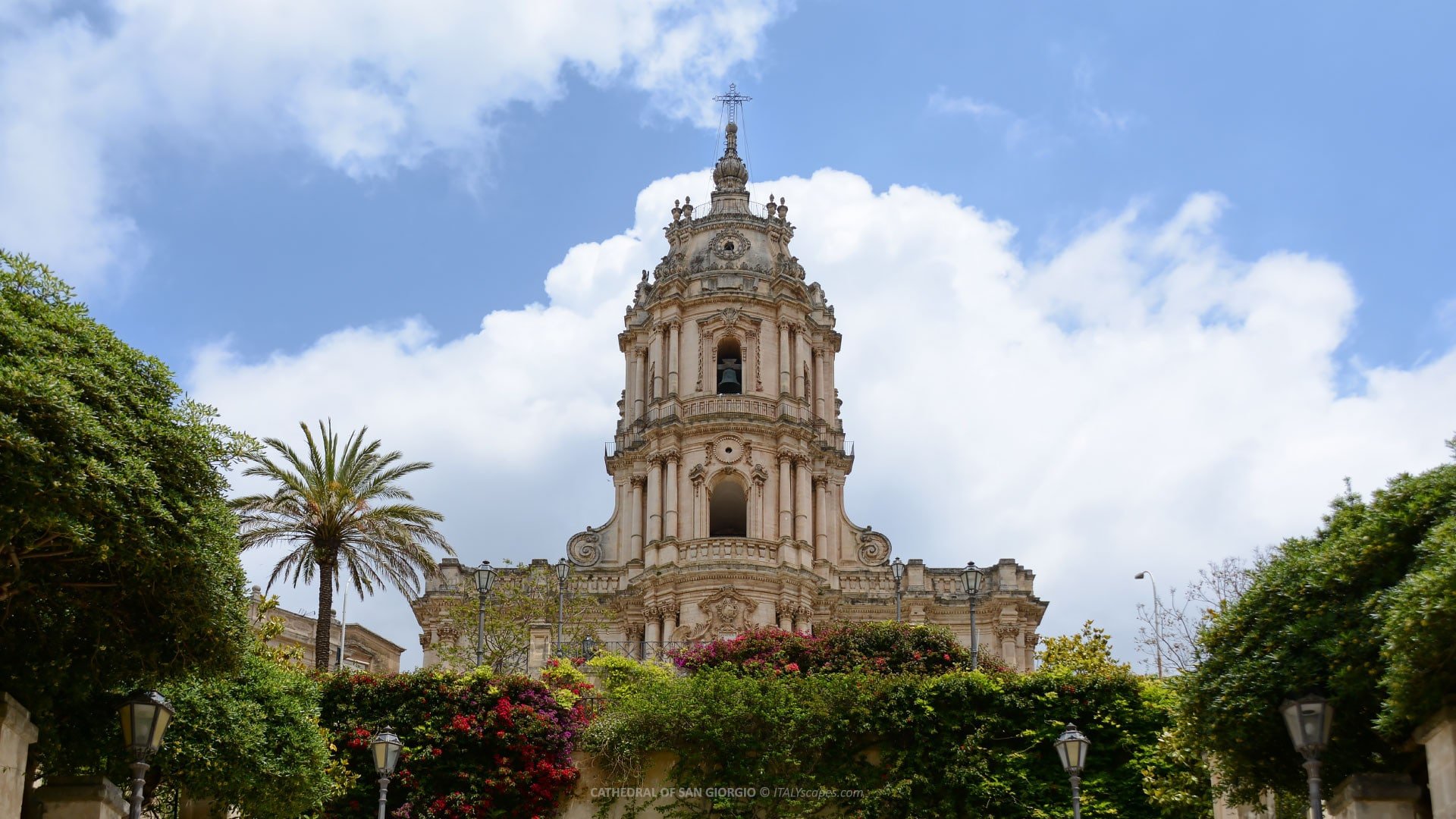
The Cathedral of San Giorgio rises above Modica Alta, the upper part of the town, accessed by a dramatic staircase of around 250 steps.
Its towering position, visible from across the valley, makes it one of the emblematic Baroque churches in Sicily and a symbol of Modica’s skyline.
Like much of Modica, the original church was badly damaged in the 1693 earthquake. The current structure was rebuilt during the 18th century, with significant work by architect Rosario Gagliardi, and further modifications continuing into the 19th century.
The cathedral forms part of the Val di Noto UNESCO site as a key monument of Sicilian Baroque.
San Giorgio’s 62-metre tower-façade, designed by Gagliardi, is one of the most spectacular Baroque fronts in Sicily. Five entrance portals correspond to five naves inside, which terminate in three apses.
The façade’s vertical sweep and sculpted details, combined with the monumental staircase, create an almost theatrical approach to the church.
The interior contains numerous artworks, including paintings, sculptures and liturgical furnishings.
Among the highlights are the Santa Arca, a silver reliquary, and a meridian line set into the pavement that once functioned as a solar clock. Decorative cycles of stucco and painting add to the richness of this UNESCO-listed monument.
1. Duomo of San Giorgio – Ragusa Ibla
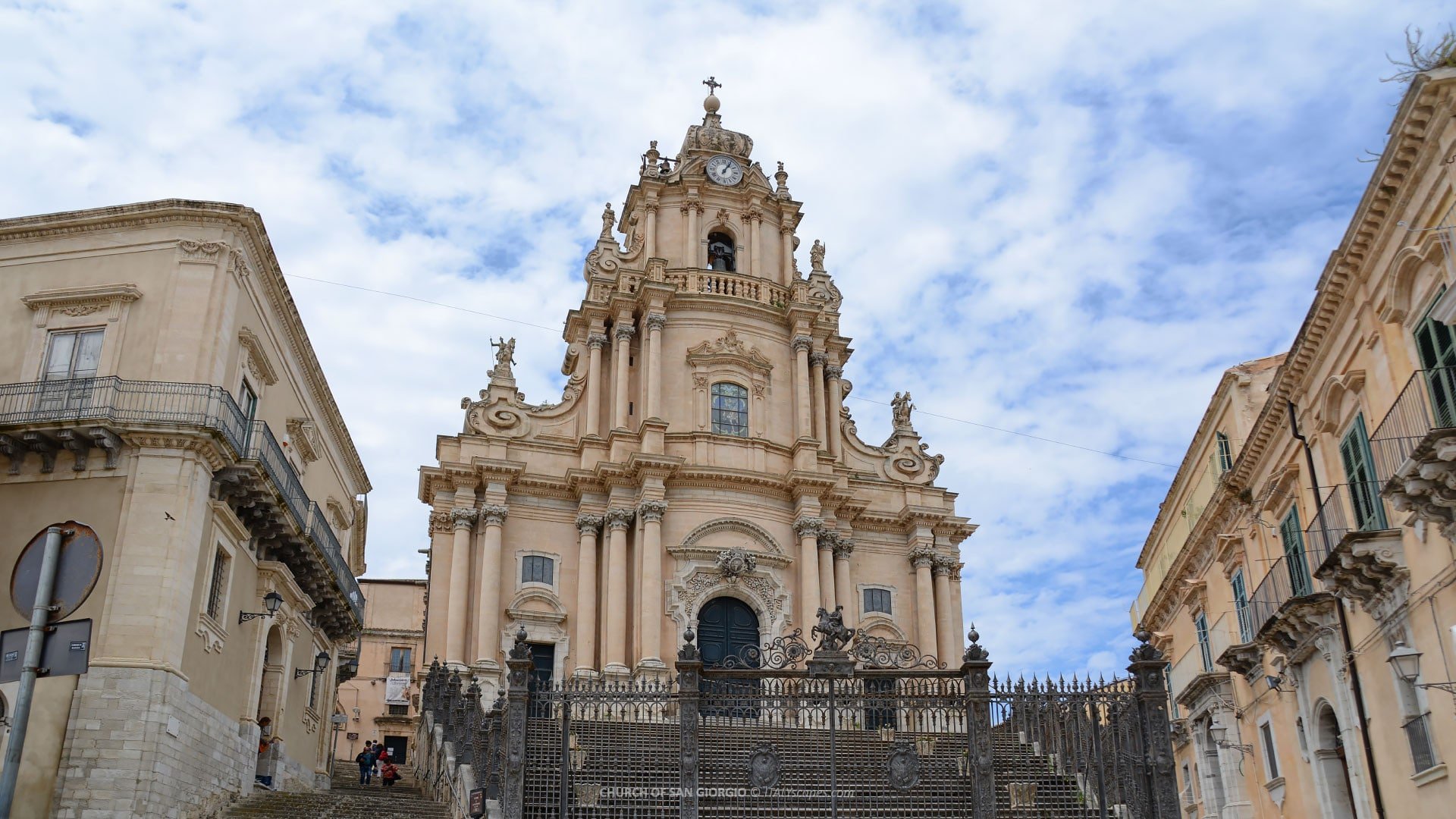
The Duomo of San Giorgio dominates Ragusa Ibla, rising above Piazza Duomo at the top of a grand staircase.
Its elevated position and iron railings frame one of the most memorable views in the Val di Noto, frequently featured in the opening credits of the TV series Inspector Montalbano.
After the 1693 earthquake destroyed Ragusa’s old mother church of St George, a new cathedral was planned for Ibla.
The commission went to Rosario Gagliardi in 1738; foundation work started around 1739, and the church was substantially complete by 1775.
Its construction coincided with Ragusa’s social and political reorganisation after the disaster.
The Duomo is a masterpiece of Sicilian Baroque. Gagliardi designed a majestic, slightly curved façade that rises in three tiers, topped by an elegant dome set back from the front, increasing the sense of height.
The church is preceded by a wide staircase and enclosed by a wrought-iron fence. Inside, a Latin-cross plan with three naves is supported by massive pillars and crowned by the dome, which soars above the crossing.
The interior houses important works linked to Ragusa’s devotion to St George, including altarpieces, silver reliquaries and sculpted decorations.
Stained glass and painted cycles enrich the chapels, while the overall decorative programme reinforces the cathedral’s status as the spiritual and visual centre of Ragusa Ibla.
Final Thoughts – Planning Your Route Around the Baroque Churches in Sicily
From the theatrical staircases of Modica and Ragusa to the luminous interiors of Scicli and the lavish stuccoes of Catania, these twelve Baroque churches in Sicily offer an extraordinary concentration of architecture and art.
Many stand within the UNESCO-listed towns of the Val di Noto, while others, like those in Catania, Ragusa and Syracuse, reveal how the Baroque style transformed Sicily’s major cities as well.