-
About
Table of Contents
Buy tickets & tours:GetYourGuideThe Basilica of San Vitale in Ravenna is one of the most extraordinary monuments of early Byzantine architecture and art in Europe.
Located in Via San Vitale, just a few meters from the Mausoleum of Galla Placidia, the Basilica of San Vitale represents the artistic, political, and religious transformation of Ravenna during the 6th century, when the city stood at the crossroads between the Roman world and the Byzantine Empire.
Constructed between 532 and 547, the Basilica of San Vitale is celebrated above all for its magnificent mosaic decoration, considered among the finest surviving examples of Byzantine art outside Constantinople.
Its interior combines architectural innovation, rich symbolism, and imperial ideology, creating a space that communicates theological meaning through geometry, light, and color.
In 1996, the basilica was included in the UNESCO World Heritage Site Early Christian Monuments of Ravenna, recognizing its outstanding universal value and its exceptional state of preservation.
Despite its relatively modest exterior, the Basilica of San Vitale reveals a breathtaking interior where mosaics, marbles, stuccoes, and architectural forms work together to convey a vision of divine authority and cosmic order.

Short History of the Basilica of San Vitale
The Basilica of San Vitale was commissioned by Bishop Ecclesius (Ecclesio) shortly after his return from Constantinople, where he had been exposed to the latest developments in Byzantine architecture and religious art.
Construction began in 532, during a period of profound political change, as Ravenna transitioned from Ostrogothic rule to Byzantine control.
The Basilica of San Vitale was completed in 547 under Archbishop Maximian, one of the most influential ecclesiastical figures in Ravenna’s history. By that time, Ravenna was firmly under the authority of Emperor Justinian, whose ambition was to restore Roman imperial power in the West.
Although Justinian never visited Ravenna, his presence is powerfully asserted through the basilica’s artistic program, particularly in the famous imperial mosaics.
Dedicated to Saint Vitale, a Christian martyr from Ravenna, the church was intended to serve both as a place of worship and as a symbol of orthodox Christianity aligned with imperial authority.
Unlike earlier basilicas in Ravenna, San Vitale did not follow the traditional longitudinal basilica plan; instead, it adopted a centralized design that reflected Eastern architectural influences and emphasized spiritual transcendence over processional movement.
Throughout the Middle Ages, the basilica remained in continuous use and avoided major structural alterations. This continuity helped preserve its original mosaics and architectural features. Over the centuries, it became a reference point for scholars, artists, and travelers fascinated by its unique synthesis of Roman and Byzantine traditions.
In the modern era, systematic conservation efforts ensured the stability of the structure and the preservation of its decorative elements.
The basilica’s inclusion on the UNESCO World Heritage list in 1996 confirmed its role as one of the most important monuments of early Christian and Byzantine civilization.

Architecture of the Basilica of San Vitale
The architecture of the Basilica of San Vitale is both innovative and complex, reflecting a deliberate fusion of Roman construction techniques and Byzantine spatial concepts.
Unlike traditional basilican churches, San Vitale is based on a centralized octagonal plan, a form that emphasizes unity, balance, and symbolic geometry.
The exterior is built primarily of brick, with limited decorative elements, creating a restrained and almost austere appearance.
From the compact main nucleus rise clearly articulated volumes, including the octagonal tiburium (lantern tower) that conceals the dome, and the polygonal apse, which is polygonal on the outside and semicircular on the inside.
The apse is flanked by two small rectangular rooms that served liturgical functions.
One of the basilica’s most distinctive architectural features is its oblique narthex. Instead of aligning parallel to the main axis of the building, the narthex is set at an angle, likely due to pre-existing urban constraints.
This obliqueness continues inside, influencing the orientation of one of the two portals: one aligned with the apse and the other set diagonally, creating a dynamic and unexpected spatial experience upon entry.
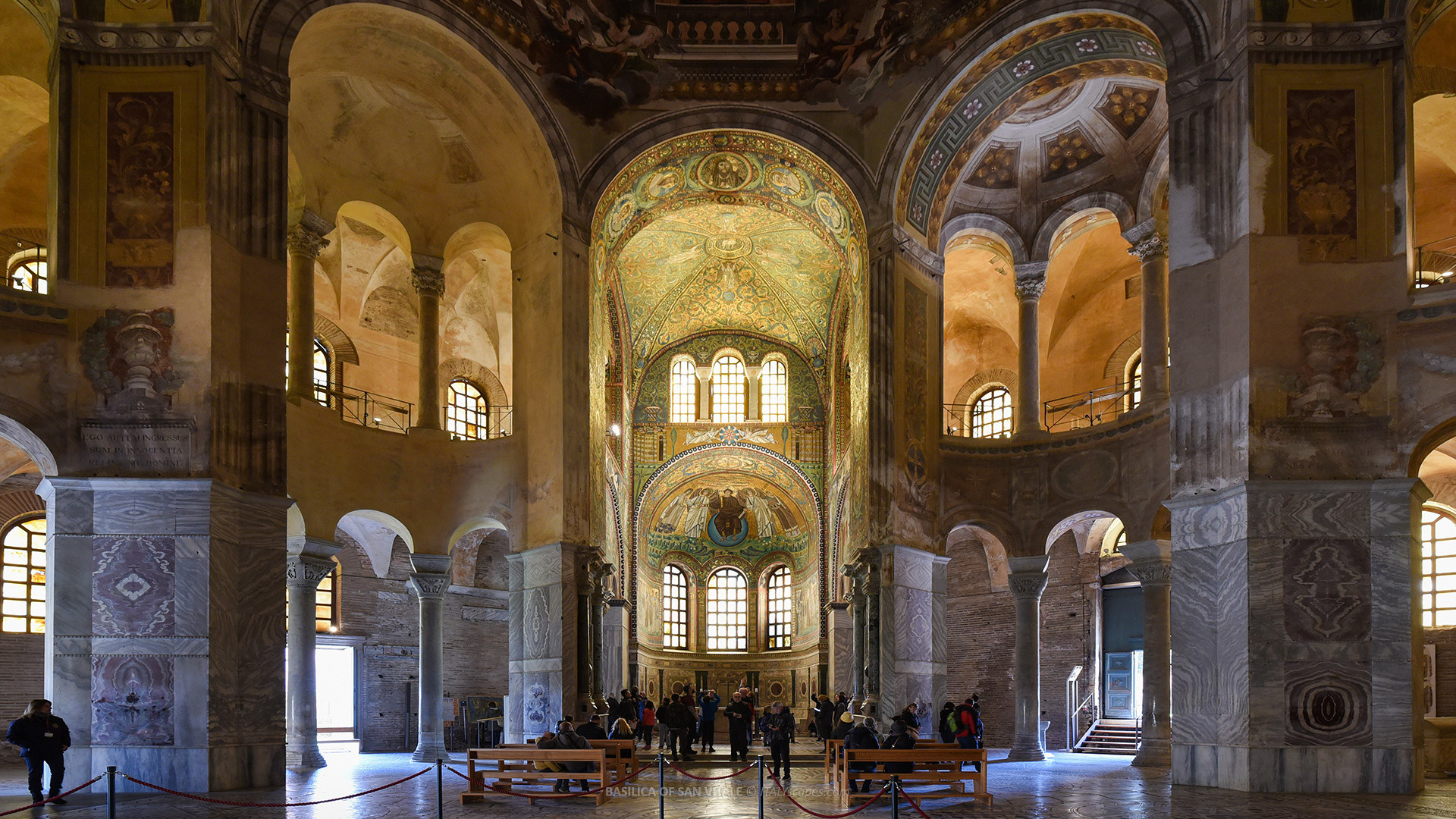
The interior space unfolds vertically and horizontally through a sophisticated system of exedras – semi-circular recesses that open around the central octagon.
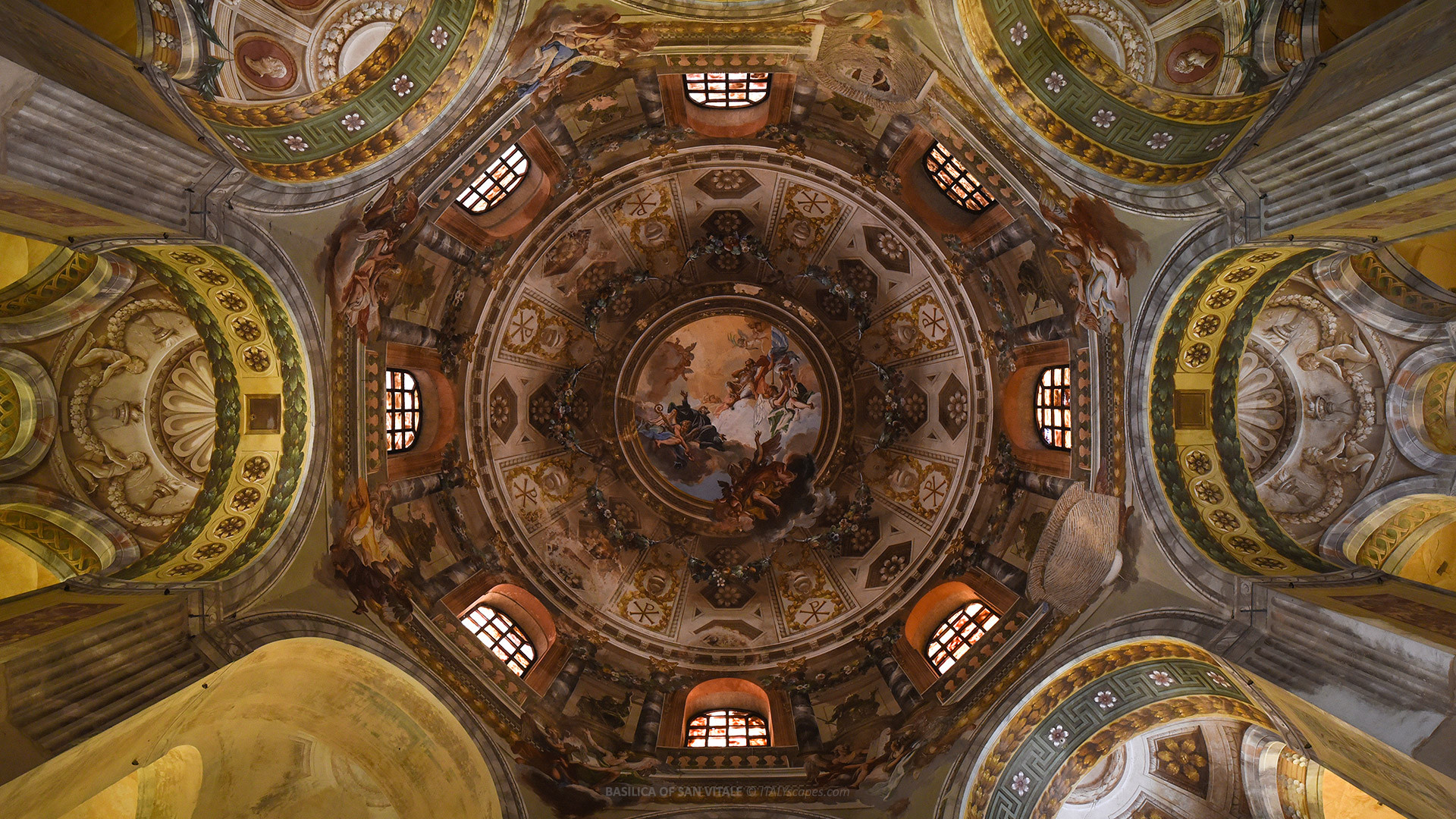
These exedras are defined by a double order of arches: smaller arches enclosed within larger ones, all supported by massive corner pillars. Above this structural framework rises the dome, which appears light and elevated despite its substantial mass.
The capitals of the columns are finely carved with Byzantine decorative motifs, distinct from classical Corinthian models. The use of polychrome marble revetments, combined with stucco decoration and pierced stone screens, further enhances the richness of the interior.
A women’s gallery, or matroneum, runs above the ambulatory, enclosed by finely perforated balustrades. This upper level not only provided space for female worshippers but also contributed to the layered spatial rhythm that characterizes the basilica.
Overall, the architecture of San Vitale creates a sense of vertical ascent and centralized focus, guiding the viewer’s gaze upward toward the dome and the sacred imagery of the presbytery.
Art of the Basilica of San Vitale
The artistic heart of the Basilica of San Vitale lies in its mosaic decoration, concentrated primarily in the presbytery and apse, and dating to the mid-6th century.
These mosaics represent one of the highest achievements of Byzantine art, combining theological symbolism, imperial iconography, and extraordinary technical refinement.
Above the apse arch, two flying angels hold a jeweled disc, flanked by personifications of Jerusalem and Bethlehem, symbolizing the spiritual origins of Christianity. This composition introduces the sacred space of the apse, framing it as a vision of the heavenly realm.
In the apse conch itself, Christ Pantocrator is depicted seated on a blue globe, symbol of cosmic dominion. He is flanked by two archangels, while Saint Vitale receives a martyr’s crown from Christ’s hand, and Bishop Ecclesius presents a model of the church.
The cross vault of the presbytery features four angels supporting a circular medallion containing the Lamb of God, surrounded by spirals, foliage, and stylized flowers.
On the interior face of the presbytery arch, a series of medallions portrays Christ and the Apostles, forming a visual bridge between the narrative scenes below and the cosmic imagery above.
The side walls of the presbytery contain three-mullioned windows, each surmounted by a lunette decorated with Old Testament scenes that prefigure Christ’s sacrifice.
On the right, the Sacrifices of Abel and Melchisedec are depicted, while on the left, the Hospitality of Abraham and the Sacrifice of Isaac unfold. These scenes establish a theological continuity between the Old and New Testaments.
Among the most famous mosaics in the Basilica of San Vitale are those depicting Emperor Justinian and Empress Theodora with their respective entourages.
Justinian is shown carrying a paten, accompanied by clergy and soldiers, while Theodora carries a chalice, surrounded by court attendants.
Beyond the mosaics, the interior decoration is enriched by polychrome marbles, stucco reliefs, and the delicate stonework of the matroneum balustrades. Together, these elements create a unified artistic environment where architecture and decoration are inseparable.

How to Get to the Basilica of San Vitale
The Basilica of San Vitale is located within the historic center of Ravenna and is easily accessible from the city’s main transportation hub.
- On foot: From Ravenna railway station, the basilica is approximately 1 kilometer away, making it reachable on foot in about 12-15 minutes. Walking is often the most enjoyable option, as it allows visitors to experience the city’s historic streets and nearby monuments.
- By bus: For those using public transport, the closest bus stop is located on Via Maggiore, about 400 meters from the basilica, and is served by Bus Line 70. From the stop, a short walk leads directly to the monument.
- Taxi or Ride Share: Taxis are available outside the railway station and provide a quick and comfortable alternative, especially for visitors with limited time or mobility. The journey to the historic center typically takes only a few minutes.
Thanks to its proximity to other UNESCO-listed monuments, including the Mausoleum of Galla Placidia, the Basilica of San Vitale is ideally situated for a combined visit, offering an unparalleled immersion into Ravenna’s early Christian and Byzantine heritage.
Sources:Buy tickets & tours:GetYourGuide -
Photos
-
Video
Table of Contents
-
Map
-
Reviews