


-
About
Table of Contents
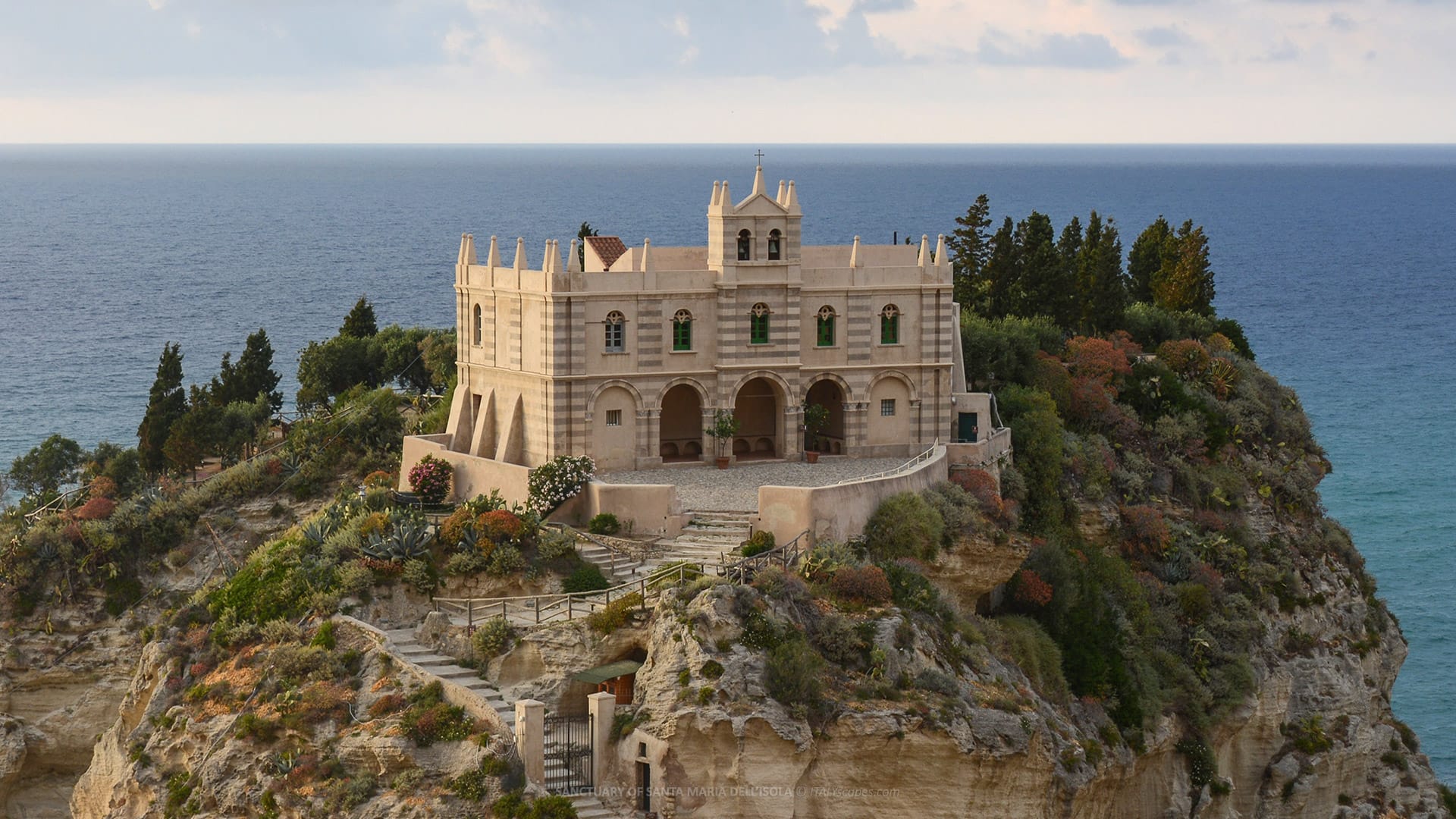
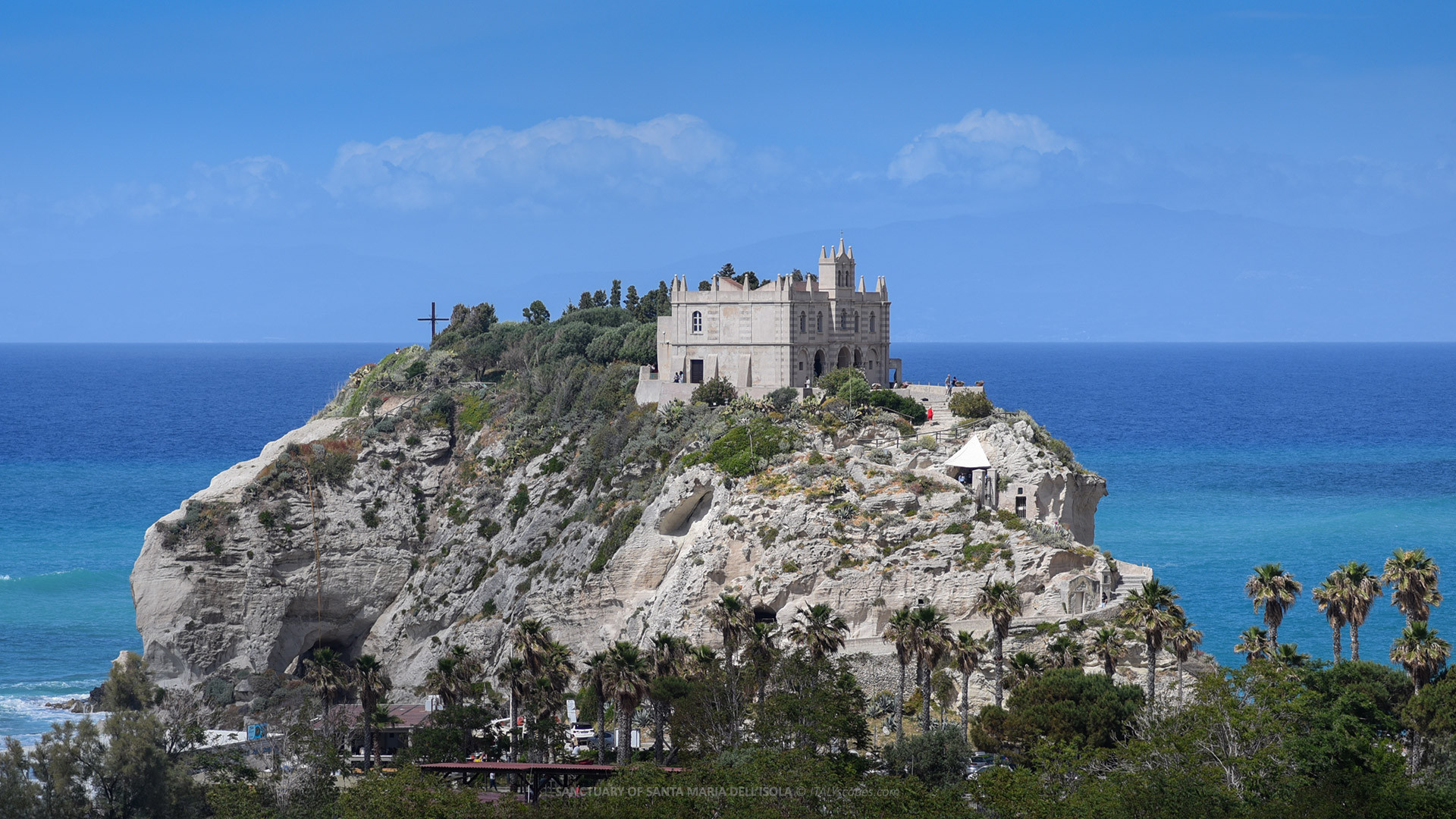
The Sanctuary of Santa Maria dell’Isola is a small historic church standing on the homonymous sandstone rock in Tropea, on the Tyrrhenian coast of Calabria. Together with the cliff, the sea, and the beach below, it forms one of the most recognizable views of the town.
The Sanctuary of Santa Maria dell’Isola rises in front of Tropea’s historic center, on a rock once completely surrounded by the sea. This detail explains the name “dell’Isola”, meaning “of the island”. Today, the rock is connected to the mainland, but its isolated position still defines the identity of the monument.
Seen from the beaches of Tropea, the church appears above the coastline like a small fortified religious complex. Its position makes it not only a place of worship, but also one of the most photographed landmarks in Calabria. For many visitors, it is the visual symbol of Tropea and the Costa degli Dei.
The Legend of the Sanctuary of Santa Maria dell’Isola
The history of the Sanctuary of Santa Maria dell’Isola is accompanied by a local legend connected to a statue of the Virgin Mary. According to tradition, during the period of Byzantine iconoclasm, a wooden statue of the Madonna arrived in Tropea from the East, carried by the sea to the shore.
The people of Tropea, together with the bishop and the mayor, went down to the beach to welcome the statue. They decided to place it inside a natural grotto in the rock of the island. The chosen niche, however, was too small for the statue.
To solve the problem, they called a carpenter and asked him to shorten the statue by cutting its legs. According to the legend, when the carpenter placed the saw on the statue, his arms became paralyzed. At the same moment, the bishop and the mayor died suddenly.
After this event, the statue became associated with miraculous protection. The faithful began to bring sick people to the place where the Madonna had been placed, hoping for healing or grace.
Powered by GetYourGuideShort History of the Sanctuary of Santa Maria dell’Isola
Greek Monks and Byzantine Origins
The rock on which the Sanctuary of Santa Maria dell’Isola stands was probably inhabited around the 7th or 8th century by Greek or Byzantine hermit monks. Its isolation made it suitable for a contemplative life, far from the inhabited town and close to the sea, silence, and prayer.
These early monks were connected to the Greek religious tradition of southern Italy. At the time, Calabria was culturally and ecclesiastically influenced by Byzantium. The isolated rock of Tropea offered a natural refuge for ascetic life, similar to other hermit settlements in the Mediterranean world.
Built before the 9th century, the church belonged at first to the Basilian monks. These monks followed the eastern monastic tradition and were present in many areas of Calabria during the Middle Ages.
From the Normans to Montecassino
In the 11th century, after the arrival of the Normans, the sanctuary passed to the Benedictine monks. This change was part of a broader transformation in Calabria, where the Greek rite gradually gave way to the Latin rite under Norman rule and under the influence of the Roman Church.
Tropea, like much of Calabria, remained under Byzantine ecclesiastical influence until the Normans imposed a process of latinization. Around 1060, Robert Guiscard supported the transition from the Greek rite to the Latin rite, reinforcing the religious and political links with Rome.
Around 1066, the Sanctuary of Santa Maria dell’Isola and some surrounding territories were donated by the Normans to the Abbot of Montecassino, Desiderius, who later became Pope Victor III. This donation connected the sanctuary directly with one of the most important Benedictine abbeys in Europe.
The link with Montecassino is confirmed by historical references to Sancta Maria de Tropea cum omnibus pertinentiis suis, meaning Santa Maria of Tropea with all its belongings. The sanctuary still belongs to the Abbey of Montecassino, preserving a medieval institutional connection that has lasted for centuries.
Earthquakes, Restorations and the Modern Sanctuary
During its long history, the church was repeatedly modified. The medieval building did not remain unchanged, because earthquakes, restorations, and architectural additions altered its appearance. As a result, only limited parts of the earliest structure have survived in visible form.
The violent earthquakes of 1783 and 1905 caused serious damage in Calabria and also affected the sanctuary. After these events, the complex required major restoration works. The current appearance is therefore the result of medieval origins, later transformations, and modern reconstruction.
The staircase leading to the Sanctuary of Santa Maria dell’Isola was built around 1810, allowing easier access to the top of the rock. Before this intervention, reaching the church was more difficult, because the site was naturally steep and separated from the surrounding urban fabric.
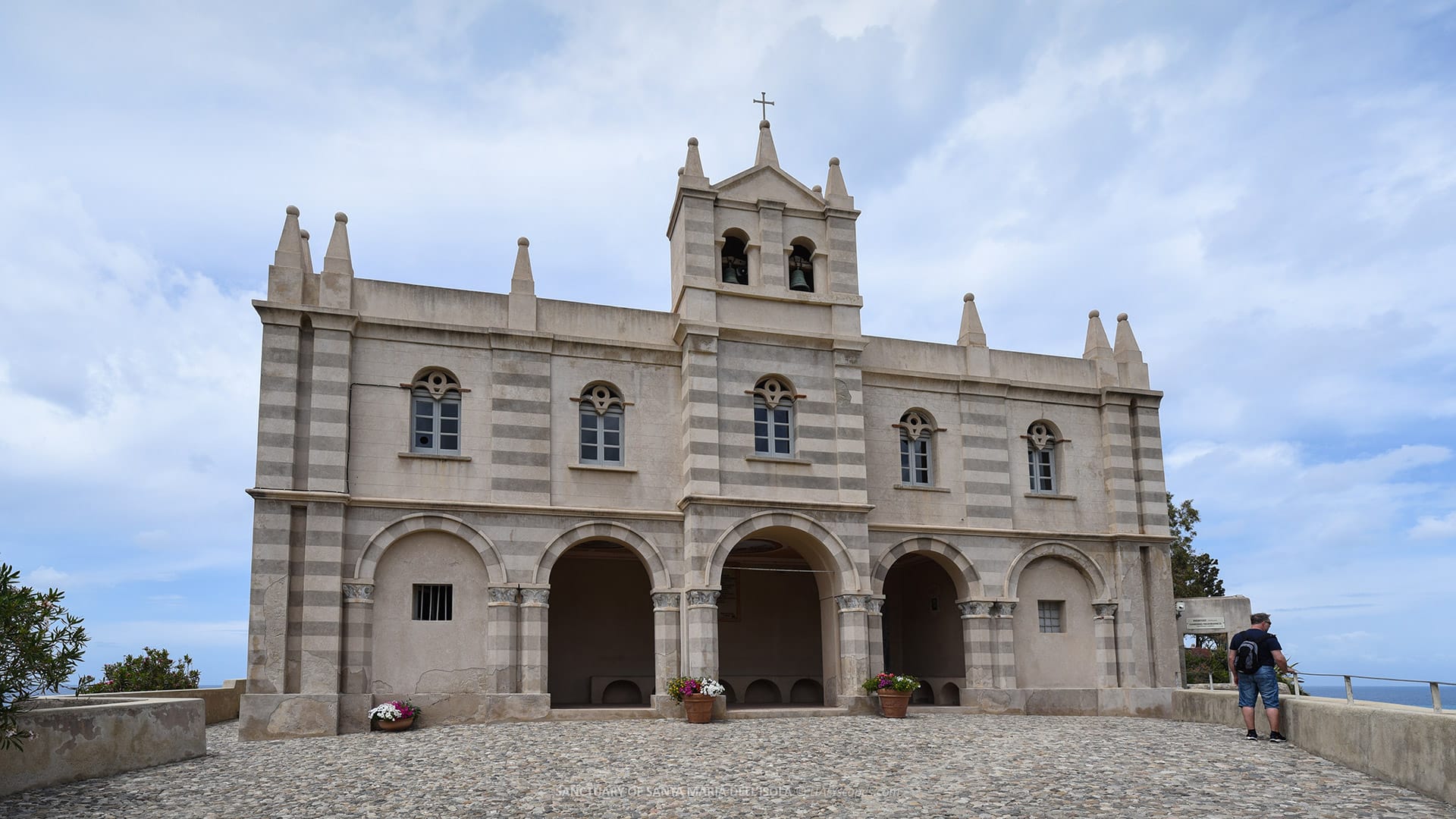
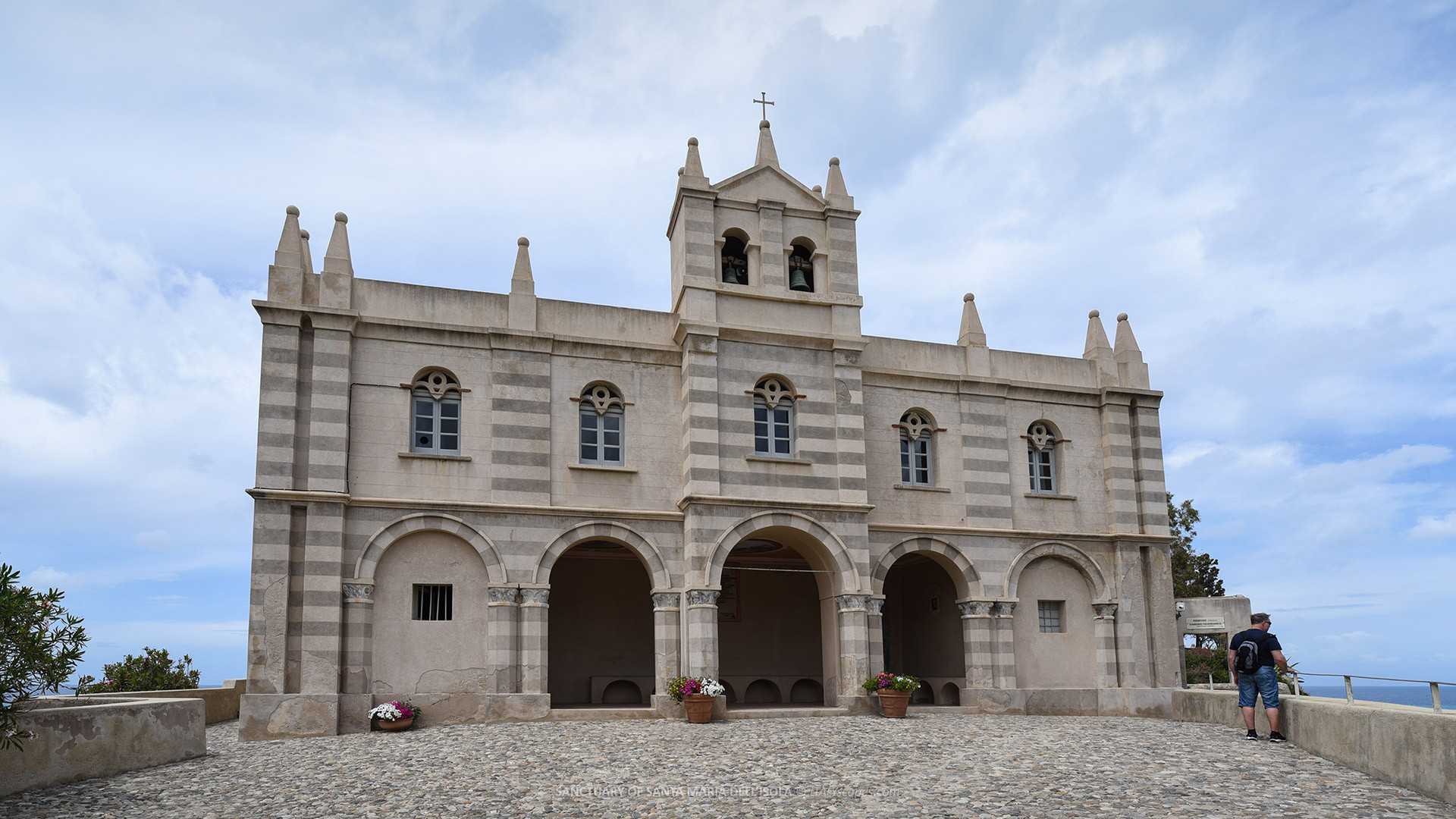
After the 1905 earthquake, part of the structure collapsed and the facade was rebuilt. The portico was made more symmetrical, the bell tower was placed in the center, and decorative pinnacles were added.
A long restoration campaign was carried out in the early 21st century. After several years of work, the sanctuary was reopened for worship on 14 August 2014. This reopening restored the religious function of the church and renewed its role as a major landmark of Tropea.
Facade of the Sanctuary of Santa Maria dell’Isola
Architecture of the Sanctuary of Santa Maria dell’Isola
Medieval Layout and Structural Changes
The architecture of the Sanctuary of Santa Maria dell’Isola reflects many centuries of changes. The original structure was probably much simpler than the church visible today. Over time, new spaces were added to the early medieval core, creating an irregular but historically significant building.
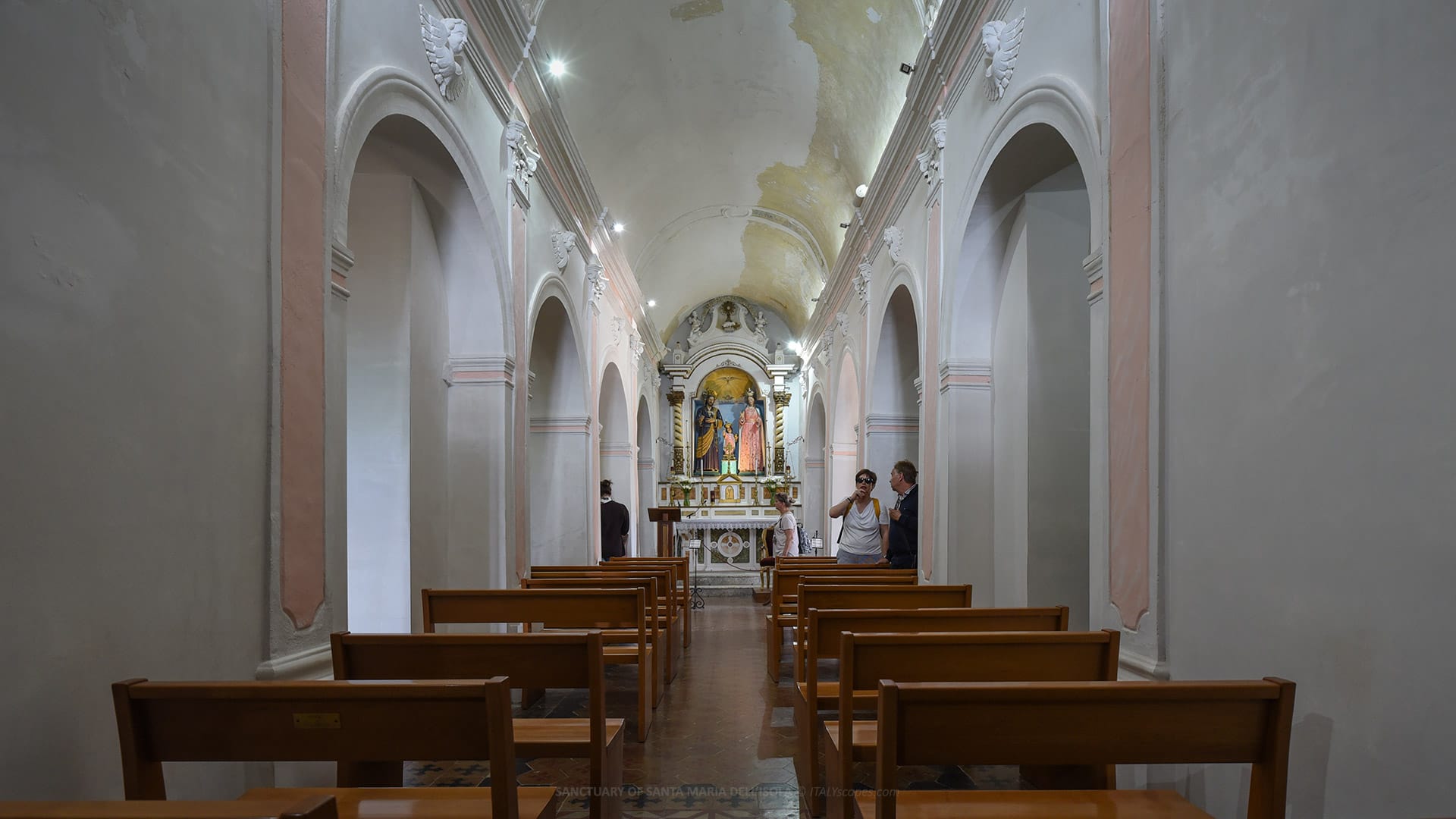
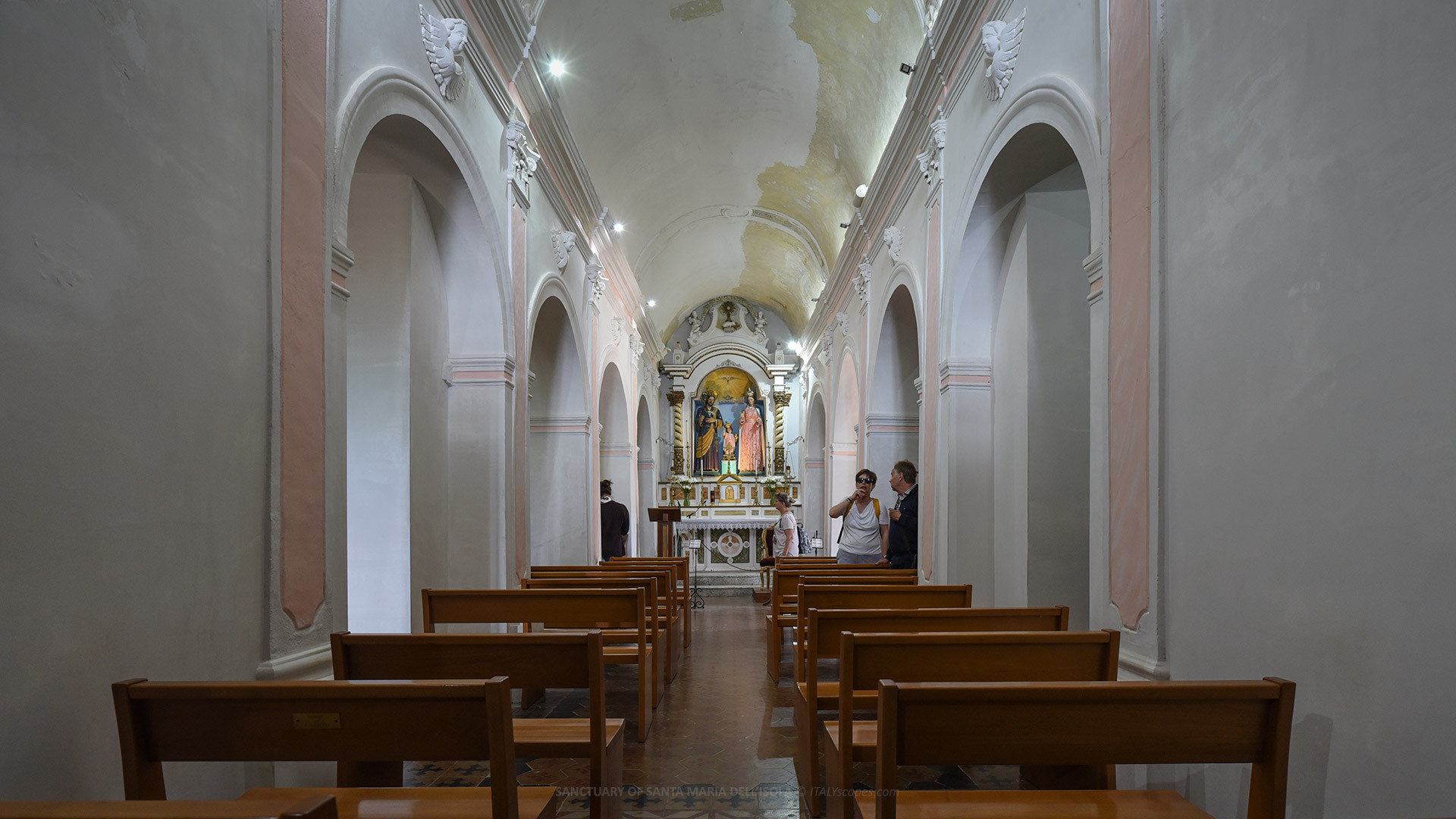
The earliest layout is described as a central square space surrounded by a vaulted ambulatory. Later, a basilica-type plan with three naves and barrel vaults was added to the older construction. This explains why the sanctuary does not have a perfectly regular or uniform plan.
Some ancient portions of the building are made of tuff and belong to the older perimeter structure. These parts contribute to the irregular organization of the interior. In one area, they form what has been interpreted as a fourth nave, where fragments of funerary inscriptions are preserved.
Facade, Portico and Benedictine Identity
The facade seen today was created after the earthquake of 1905. Before the latest restoration, it was characterized by a two-tone horizontal pattern, with alternating light and dark bands, recalling the symmetry and visual language of Tuscan Romanesque architecture.
The last restoration unified the exterior colors closer to the natural tone of the rock. This intervention reduced the contrast of the previous facade and made the church appear more visually connected to the sandstone cliff on which it stands.
The portico is another important architectural element. It supports spaces historically connected to monastic use, including cells for monks. After the 1905 earthquake, this area was reworked and decorated with painted scenes recalling the history of the sanctuary and its transformations.
The entrance also preserves the symbolic presence of Montecassino. Above the door is the coat of arms of the abbey, with references to Benedictine tradition. The motto “Dio sia glorificato in tutte le cose” expresses the spiritual identity of the place.
The Rock and the Landscape
Because of the rock, the Sanctuary of Santa Maria dell’Isola is inseparable from its natural setting. The architecture was adapted to the shape of the cliff, not imposed on a flat surface. This makes the building irregular, compact, and strongly connected to the landscape of Tropea.
From below, the sanctuary appears almost suspended above the shoreline. From above, the same site becomes a panoramic terrace over the Tyrrhenian Sea. This dual perspective explains why the monument is central to both religious devotion and tourism in Tropea.
The Gardens
The gardens of the Sanctuary of Santa Maria dell’Isola are located behind and around the sanctuary, on the upper part of the rock. They are one of the main reasons visitors climb to the church, because they offer some of the best panoramic views over Tropea, the sea, and the coastline.
The gardens are arranged on the rock and include paths, viewpoints, and Mediterranean vegetation. Their position allows visitors to observe the historic center of Tropea, the beaches below, and the clear Tyrrhenian Sea from above. On clear days, the view can extend toward the Aeolian Islands.
Powered by GetYourGuideArt of the Sanctuary of Santa Maria dell’Isola
The Holy Family and Devotional Art
Inside the Sanctuary of Santa Maria dell’Isola, the most important devotional work is the sculptural group of the Holy Family. The group, preserved in the altar niche, includes the Virgin Mary, Saint Joseph, and the Child Jesus, and is traditionally connected to the religious life of Tropea.
The statues are generally dated to the 18th century and are made of mixed materials. They are not only works of religious art, but also objects of popular devotion. Their importance becomes especially visible during the celebrations of the Assumption of the Virgin.
Every year, on 15 August, the Holy Family is carried in procession and taken to the sea. The statues are placed on a decorated fishing boat, followed by other boats and faithful.
Paintings, Inscriptions and Historical Memory
The Sanctuary of Santa Maria dell’Isola also preserves artistic traces connected to its architectural history. The portico ceiling contains painted scenes that reproduce the church as it appeared in older images, including views related to the years 1780 and 1905, before and after earthquake damage.
Fragments of funerary inscriptions are also walled into the older parts of the church. These elements show that the Sanctuary of Santa Maria dell’Isola was not only a place of prayer, but also a site connected to memory, burial, and the long religious history of the community.
Interior of the Sanctuary of Santa Maria dell’Isola
How to Get to the Sanctuary of Santa Maria dell’Isola
Getting to the Sanctuary of Santa Maria dell’Isola on foot
The Sanctuary of Santa Maria dell’Isola is located about 1.3 kilometers from Tropea railway station, or around 15-20 minutes on foot. The walking route passes through the town and leads toward the historic center and the seafront area below the sanctuary.
The sanctuary is also about 400 meters from Piazza Cannone, the panoramic square located at the edge of Tropea’s historic center. From this area, visitors can easily reach the access point to the staircase that climbs up the rock.
The final approach requires climbing a long staircase. The path is scenic but steep, so comfortable shoes are recommended. The climb is not very long, but it may be difficult for visitors with reduced mobility, especially in hot weather or during crowded periods.
Getting to the Sanctuary of Santa Maria dell’Isola by car
Visitors arriving by car should know that the historic center of Tropea has limited access and parking can be difficult in high season. It is usually better to leave the car in one of the parking areas outside the most central streets and continue on foot.
The Sanctuary of Santa Maria dell’Isola is close to the main beaches of Tropea, so it can be visited together with the seafront, the historic center, and the viewpoints overlooking the Tyrrhenian Sea. Its location makes it one of the easiest and most important stops on a walking itinerary through Tropea.
Frequently Asked Questions about the Sanctuary of Santa Maria dell’Isola
Where is the Sanctuary of Santa Maria dell’Isola located?
The Sanctuary of Santa Maria dell’Isola stands on a sandstone rock before Tropea’s historic center, overlooking the Tyrrhenian Sea, the beach below, and Calabria’s iconic coastline.
Why is it called Santa Maria dell’Isola?
Its name means Saint Mary of the Island because the rock was once separated from the mainland by the sea, creating an island-like religious retreat in Tropea.
How old is the Sanctuary of Santa Maria dell’Isola?
The sanctuary has early medieval origins, probably connected to Byzantine or Greek hermit monks, while its documented history becomes clearer from the 11th century onward.
Can you visit the church and gardens?
Yes, visitors can usually access the church, garden, panoramic terraces, and upper rock area during opening hours, after climbing the staircase from the seafront.
Is the climb to the sanctuary difficult?
The final approach includes a steep staircase, so comfortable shoes are recommended. Visitors with reduced mobility may find the climb difficult, especially in summer.
How much does it cost to visit Santa Maria dell’Isola?
A visit usually costs €3, covering access to the sanctuary complex, including the church area, garden, and panoramic terrace. Children under 10 usually enter free. Check seasonal opening times.
Sources:Powered by GetYourGuide -
Photos
-
Map
-
Reviews

1 Review on “Sanctuary of Santa Maria dell’Isola”
Leave a Review

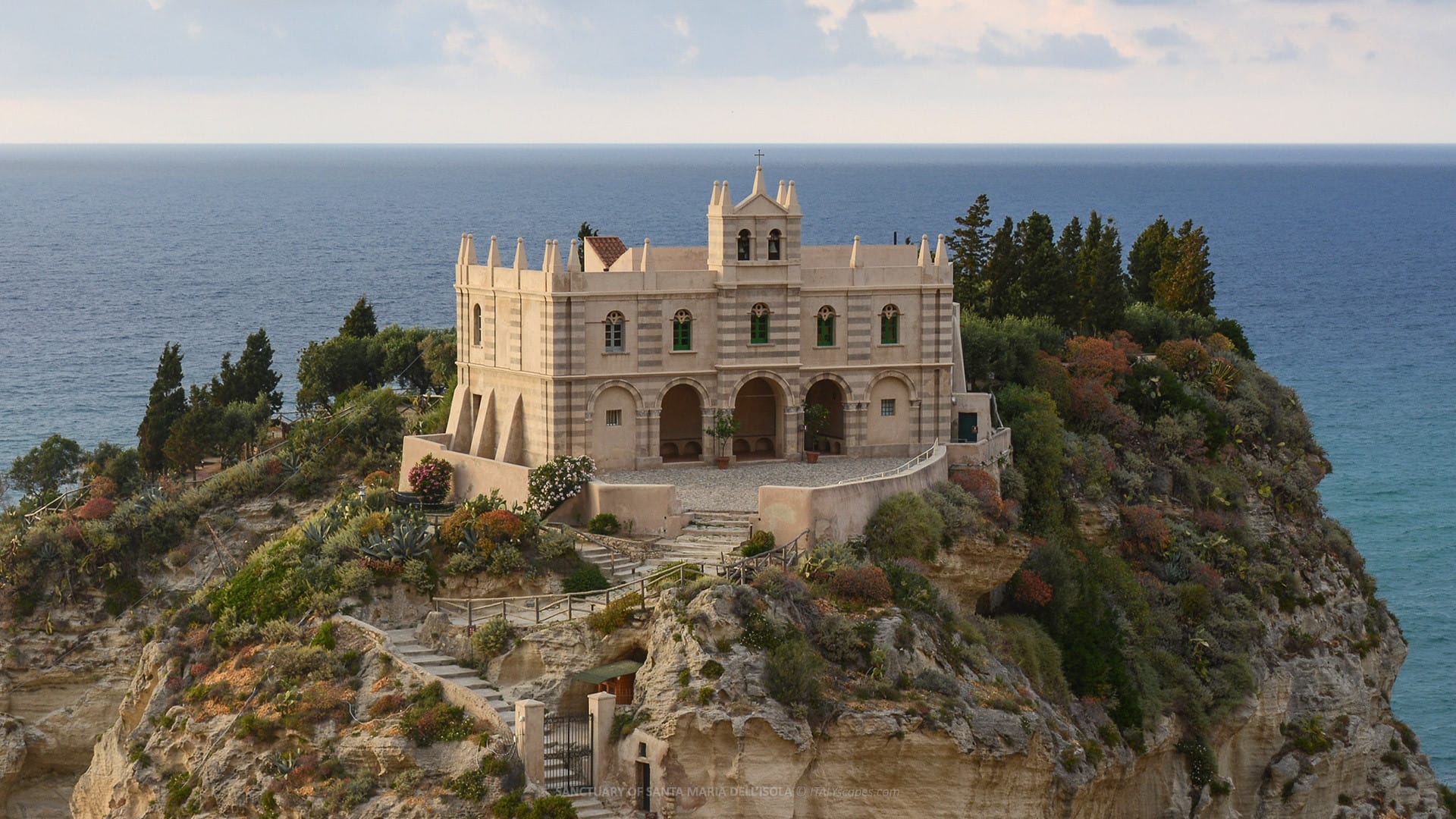
The entire setting is fantastic… the small island, the church, the sea in the background. Beautiful!