Table of Contents
The 1000 Miglia, historically known as the Mille Miglia, is one of the most celebrated automobile competitions in the history of motorsport. Founded in Brescia, the race originally connected Brescia with Rome and back, covering approximately 1,600 kilometers on public roads and attracting leading drivers and automobile manufacturers.
The original Mille Miglia took place between 1927 and 1957, producing 24 editions marked by extraordinary sporting achievements, technological developments, and serious accidents. Its winners included Tazio Nuvolari, Rudolf Caracciola, Clemente Biondetti, Stirling Moss, and Piero Taruffi, while manufacturers such as Alfa Romeo, Ferrari, Mercedes-Benz, and BMW competed for victory.
Following the cancellation of the original speed race, the 1000 Miglia was revived as a competition for historic automobiles. Today, the event preserves the connection between Brescia and Rome while celebrating the vehicles that participated in the original editions. The competition’s centenary in 2027 marks one hundred years since its inaugural race.
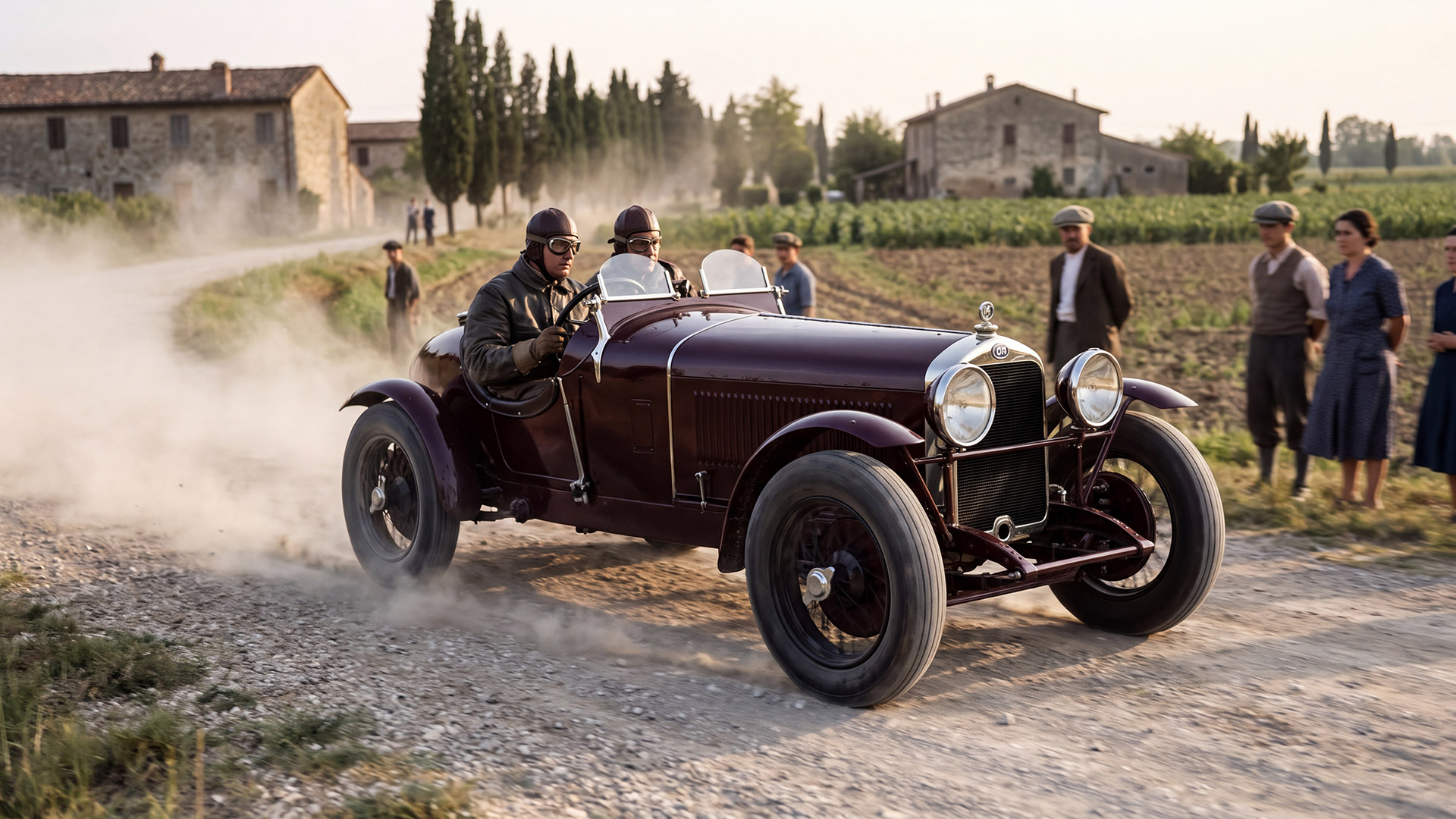
Reconstruction of an OM 665 Sport during the 1927 Mille Miglia.
Brescia Before the Mille Miglia
Brescia had an established tradition of automobile competitions long before the creation of the Mille Miglia. On March 14, 1899, a motor race following the Verona-Mantua-Brescia-Verona route passed through the area. The competition was won by Ettore Bugatti, driving a Prinetti & Stucchi motorized three-wheeler.
On September 10, 1899, Brescia organized its first automobile speed competition on a six-kilometer circuit around the city. The following day, another competition covered approximately 223 kilometers between Brescia, Mantua, Verona, and Brescia, establishing the city among the earliest Italian centers involved in organized motor racing.
During the early twentieth century, the region hosted additional competitions, including the Brescia Circuit, established in 1904. The circuit followed roads connecting Brescia, Cremona, and Mantua, covering approximately 185 kilometers per lap. Automobile manufacturers and professional drivers participated in these events, which attracted increasing public attention.
On September 4, 1921, Brescia hosted the first Italian Grand Prix at the Circuito della Fascia d’Oro, near Montichiari. The competition was won by Jules Goux in a Ballot. However, the Grand Prix moved to the newly constructed Monza circuit in 1922, encouraging local enthusiasts to develop another major automobile event.
The Four Founders of the 1000 Miglia
The idea for the Mille Miglia emerged in 1926 through the collaboration of four automobile enthusiasts: Franco Mazzotti, Aymo Maggi, Renzo Castagneto, and Giovanni Canestrini. They subsequently became known as the Four Musketeers, a nickname reflecting their shared responsibility for establishing the competition.
On December 2, 1926, Mazzotti, Maggi, and Castagneto visited Canestrini at his residence in Milan, accompanied by Flaminio Monti. During their discussions, they developed the concept of a long-distance automobile race connecting Brescia with Rome and returning to the original starting point.
Franco Mazzotti, a nobleman, automobile enthusiast, and journalist, is credited with proposing the name Mille Miglia. The term means One Thousand Miles, referring to the approximate length of the route. Mazzotti had recently returned from the United States, where distances were commonly expressed in miles rather than kilometers.
Aymo Maggi contributed his experience as a driver and financial supporter, while Giovanni Canestrini provided journalistic expertise and helped promote the competition. Renzo Castagneto became its principal organizer, coordinating manufacturers, competitors, and local authorities. His administrative involvement continued throughout much of the original race’s history.
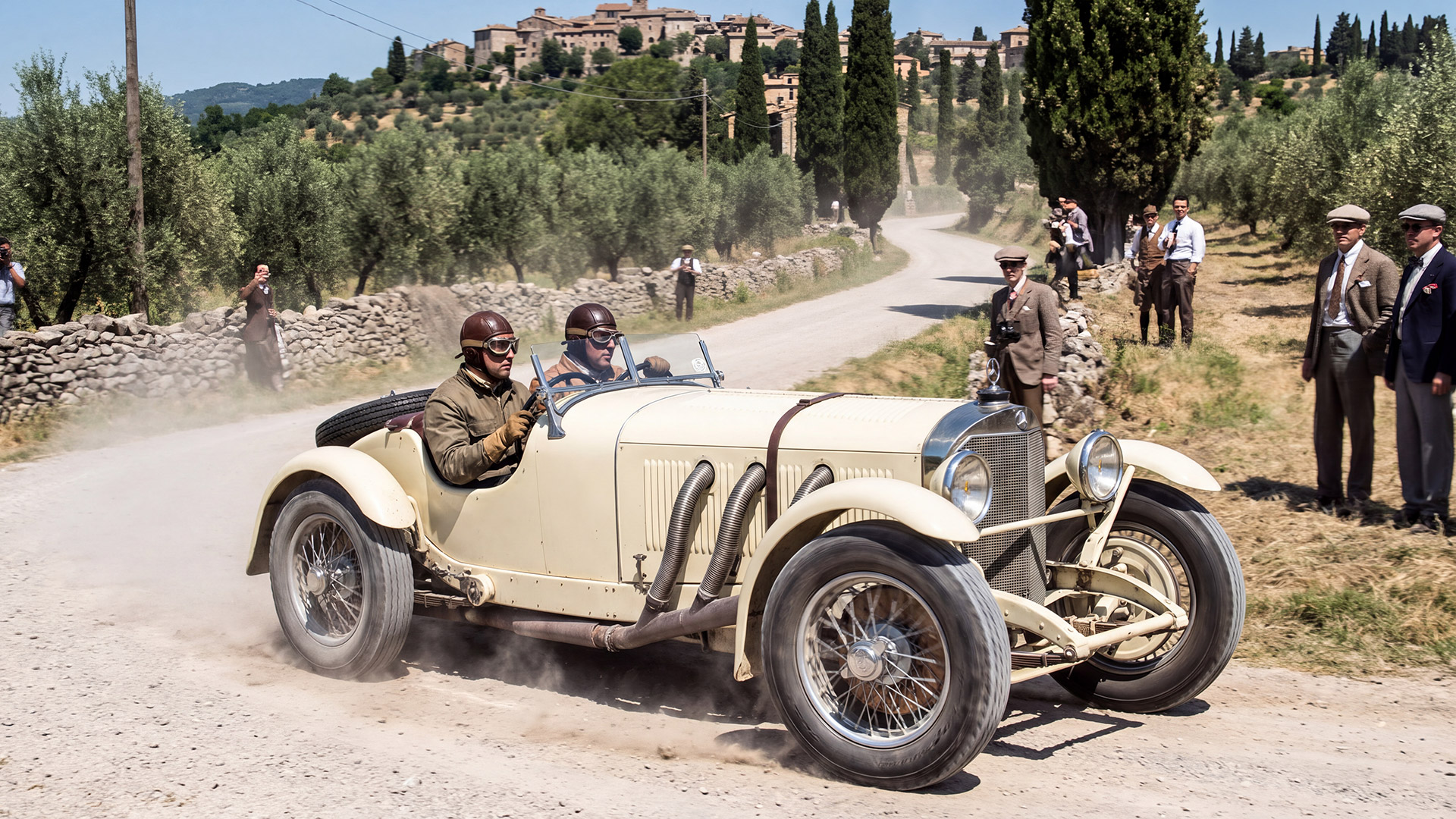
Reconstruction of a Mercedes-Benz SSKL during the 1931 Mille Miglia.
The First 1000 Miglia Race in 1927
The first Mille Miglia began on March 26, 1927, with 77 participating crews. The route formed a large circuit through central and northern Italy, traveling from Brescia toward Rome before returning north through the Adriatic regions and the Veneto to the original starting point.
The inaugural course measured approximately 1,628 kilometers and included cities such as Bologna, Florence, Siena, Rome, Perugia, Ancona, Ferrara, Padua, and Verona. Drivers also crossed mountain passes, encountered unpaved roads, and negotiated difficult sections where weather conditions and road surfaces presented significant challenges.
Unlike modern stage-based automobile competitions, the original 1000 Miglia was essentially a continuous road race. Competitors attempted to complete the entire distance as quickly as possible, with individual starting times. The format tested mechanical reliability, navigation, driving ability, and the endurance of both drivers and passengers.
The inaugural edition was won by Ferdinando Minoia and Giuseppe Morandi, driving an OM 665 Sport manufactured in Brescia. They completed the course in 21 hours, 4 minutes, and 48 seconds, achieving an average speed of approximately 77.24 kilometers per hour, a remarkable performance considering contemporary road conditions.
The first three places were occupied by OM automobiles, providing an important achievement for the Brescia-based manufacturer. Of the 77 participating crews, 55 completed the competition. The event’s success encouraged organizers to repeat the race, establishing an annual tradition that attracted increasing international participation.
The Golden Age of the Mille Miglia
During the late 1920s and 1930s, the Mille Miglia became an important competition for European automobile manufacturers. Success demonstrated the performance and reliability of their vehicles over considerable distances. Different categories allowed both powerful racing machines and smaller production-based automobiles to participate.
Alfa Romeo dominated much of the period before the Second World War, achieving eleven victories across the original editions. Its successful models included the 6C and 8C series, driven by leading competitors such as Giuseppe Campari, Tazio Nuvolari, Achille Varzi, and Clemente Biondetti.
In 1931, Rudolf Caracciola became the first non-Italian driver to win the race. Accompanied by Wilhelm Sebastian, he drove a Mercedes-Benz SSKL to victory, completing the course in 16 hours, 10 minutes, and 10 seconds. The achievement demonstrated that German manufacturers could challenge the established Italian competitors.
The competition’s development was interrupted following a serious accident during the 1938 edition, when a Lancia Aprilia struck spectators near Bologna, killing ten people. The race was not held in 1939. In 1940, it returned in a different format, using a closed circuit connecting Brescia, Cremona, and Mantua.
The Second World War prevented further editions between 1941 and 1946. Racing resumed in 1947, when Clemente Biondetti won in an Alfa Romeo 8C 2900B. During the following decade, Ferrari became the dominant manufacturer, while automobile performance and average race speeds increased considerably.
Tazio Nuvolari and the Legendary Races of the 1930s
Tazio Nuvolari, born in Castel d’Ario near Mantua in 1892, became one of the most celebrated racing drivers of the twentieth century. He competed in motorcycle and automobile racing, establishing a reputation for exceptional car control and competitive driving during the formative decades of international motorsport.
Nuvolari achieved his first Mille Miglia victory in 1930, driving an Alfa Romeo 6C 1750 Gran Sport with navigator Giovanni Battista Guidotti. The crew completed the course in 16 hours, 18 minutes, and 59 seconds, recording an average speed of 100.45 kilometers per hour.
The 1930 competition also featured a celebrated rivalry between Nuvolari and Achille Varzi, another leading Italian racing driver. Nuvolari overtook Varzi during the final stages and became the first winner to complete the event at an average speed exceeding 100 kilometers per hour.
Nuvolari achieved a second victory in 1933, accompanied by Decimo Compagnoni in an Alfa Romeo 8C 2300 Spider. His continued success established him among the leading competitors of the prewar period. He subsequently participated in additional editions, including the closely contested postwar race of 1947.
Stirling Moss and the Unbeaten Record of 1955
One of the most extraordinary performances in Mille Miglia history occurred on May 1, 1955, when British driver Stirling Moss and navigator Denis Jenkinson competed in a Mercedes-Benz 300 SLR. Their victory established the fastest average speed ever recorded in the original Brescia-Rome-Brescia competition.
Moss drove a silver Mercedes-Benz carrying the racing number 722, indicating the vehicle’s scheduled departure time of 7:22 am. The car featured a three-liter, eight-cylinder engine and had been prepared by Mercedes-Benz for endurance competitions involving public roads and racing circuits.
An important element of their preparation was the navigation system developed by Denis Jenkinson, an experienced motoring journalist. During reconnaissance journeys, he recorded detailed information about corners, road surfaces, and other characteristics of the course, which he transferred to a continuous paper roll.
During the race, Jenkinson communicated the approaching road conditions to Moss through a system of hand signals. These preparations helped the crew navigate unfamiliar or particularly demanding sections at high speed, reducing their dependence on visual judgments made only after approaching individual corners.
Moss and Jenkinson completed approximately 1,592 kilometers in 10 hours, 7 minutes, and 48 seconds, achieving an average speed of 157.65 kilometers per hour. Juan Manuel Fangio, also driving a Mercedes-Benz 300 SLR, finished second. The record remained unbeaten throughout the remaining history of the original speed race.
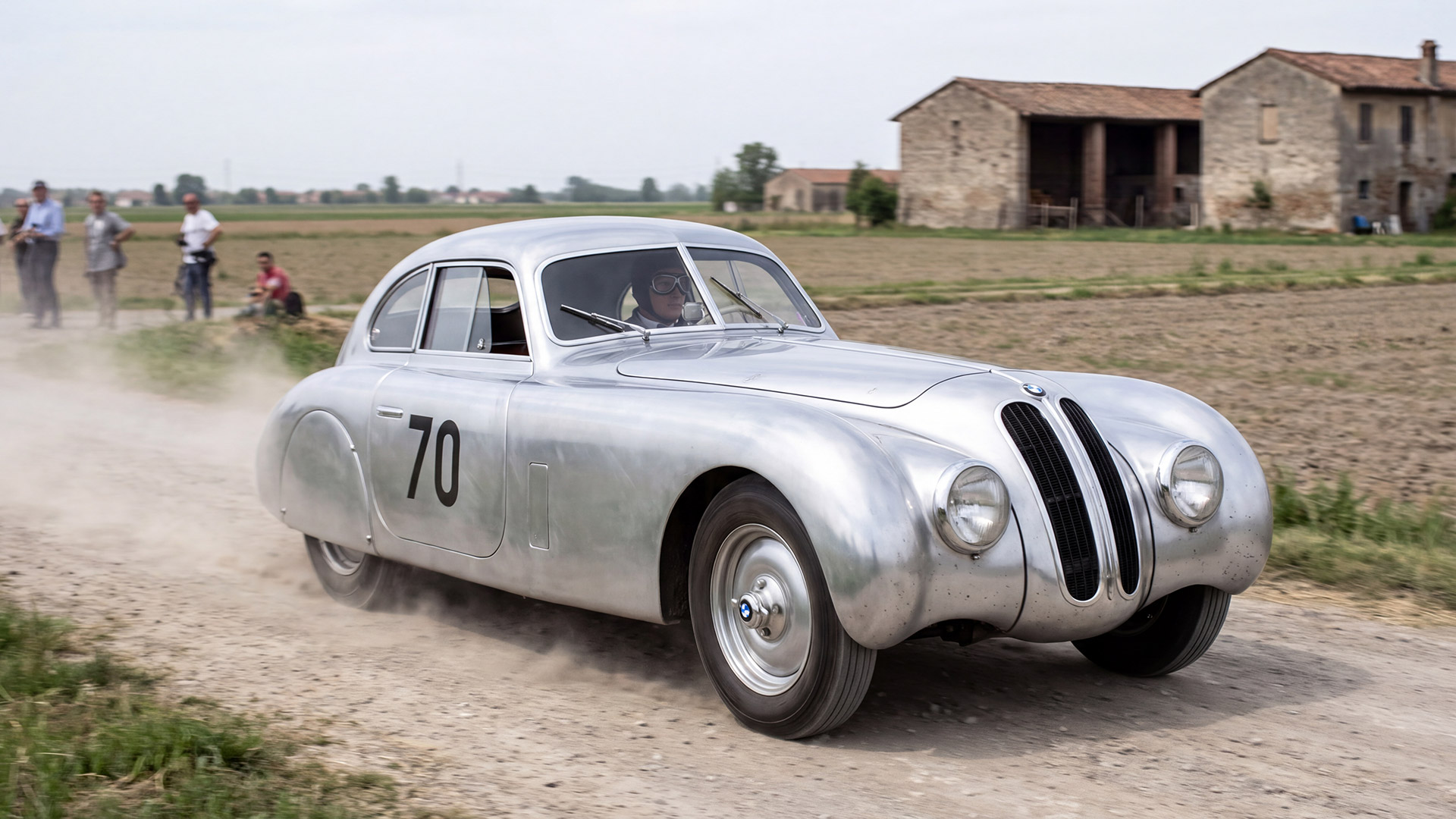
Reconstruction of the BMW 328 Touring Coupé during the 1940 Mille Miglia.
The 1957 Tragedy and the End of the Original Race
The final traditional Mille Miglia took place on May 11-12, 1957, with leading Italian and international drivers competing for victory. The race was won by Piero Taruffi in a Ferrari 315 S, which completed the course in 10 hours, 27 minutes, and 47 seconds.
However, the sporting result was overshadowed by a devastating accident involving Alfonso de Portago, a Spanish driver competing in a Ferrari 335 S. Near Guidizzolo, in the province of Mantua, his automobile suffered a tire failure and left the road at high speed.
The crash killed de Portago and his American navigator Edmund Nelson, together with nine spectators, five of whom were children. The accident occurred during the final portion of the competition and became one of the most consequential tragedies in the history of Italian automobile racing.
The deaths prompted widespread public criticism of high-speed competitions on ordinary roads. Italian authorities subsequently prohibited the traditional Mille Miglia format, ending the event as a continuous long-distance speed race. The decision reflected growing concerns about spectator protection and the dangers associated with increasingly powerful racing automobiles.
Organizers attempted to preserve the event in 1958, 1959, and 1961 through a modified competition combining short timed speed sections with longer regularity stages. However, the revised format did not restore the original event, and the competition disappeared from the international racing calendar for several years.
The Rebirth of the 1000 Miglia in 1977
The Mille Miglia returned in 1977 as a historical commemoration marking the fiftieth anniversary of its foundation. The initiative was organized through the collaboration of local automobile enthusiasts, the Musical Watch Veteran Car Club, and the Automobile Club of Brescia.
Unlike the original competition, the revived event followed a regularity format, emphasizing precision rather than maximum speed. Participants drove historic automobiles while attempting to respect prescribed times over designated sections. The change allowed the organizers to commemorate the original race without recreating its unrestricted high-speed competition.
Further historical editions followed in 1982, 1984, and 1986, supported by organizers including Beppe Lucchini, Costantino Franchi, Gino Danieli, Enzo Ziletti, and Manuel Vigliani. Their efforts established a framework for a recurring event centered on eligible classic automobiles and the preservation of the race’s traditions.
In 1987, the 1000 Miglia became an annual event, establishing the format that continues today. The renewed competition attracted collectors, enthusiasts, and internationally recognized participants. Its identity remained closely associated with Brescia, preserving the city’s historic role as the starting and finishing point.
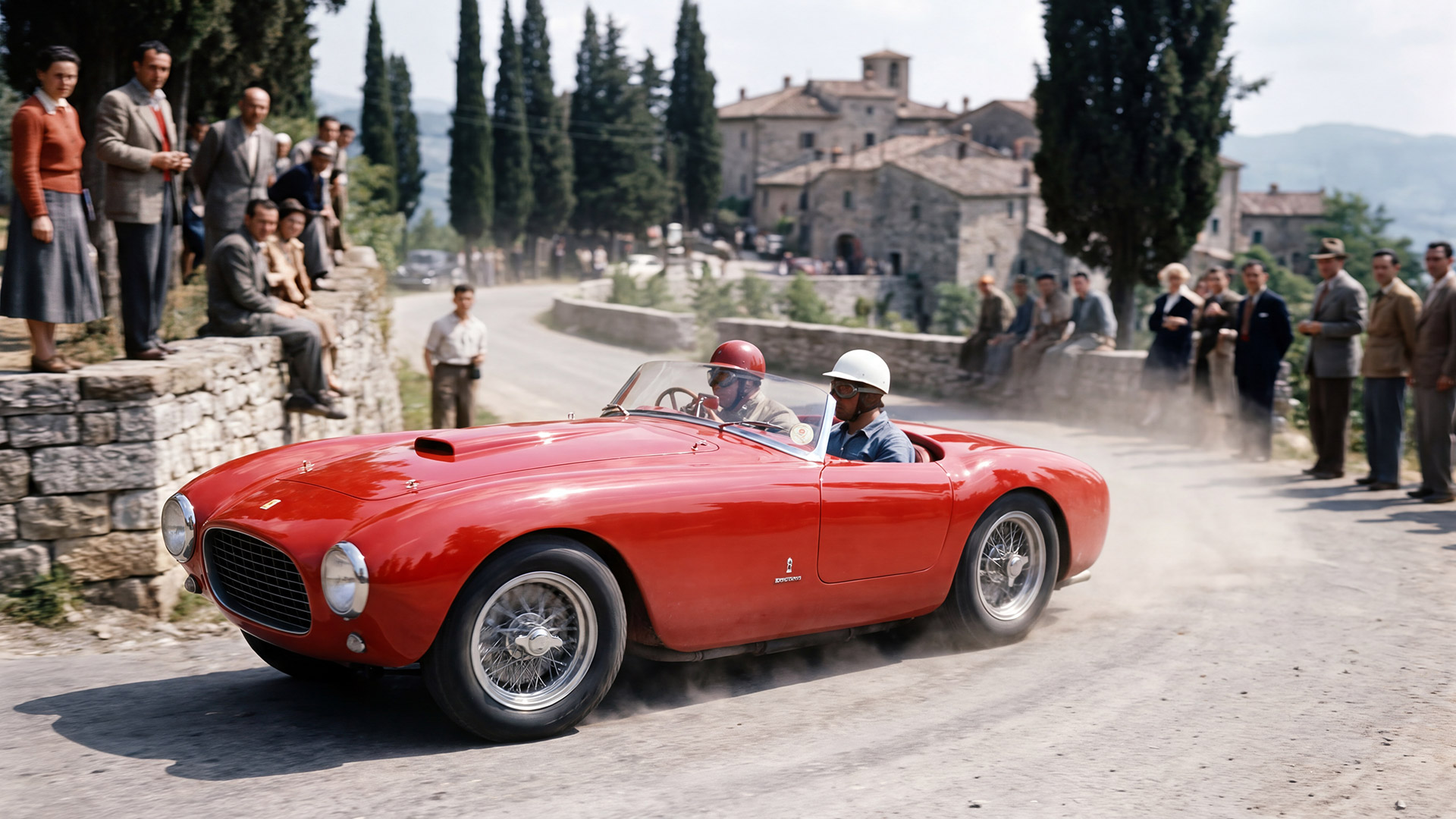
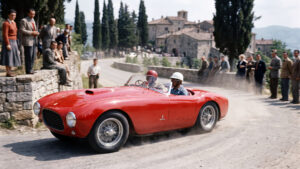
Reconstruction of a Ferrari 340 MM Spider during the 1953 Mille Miglia.
The 1000 Miglia Today
Today, the 1000 Miglia is a regularity competition for historic automobiles, organized around a multi-day journey through Italy. The principal event generally follows the traditional Brescia-Rome-Brescia concept, although intermediate destinations, individual stages, and the precise route change between editions.
Eligibility is restricted to automobiles belonging to models that participated in, or were officially entered for, at least one original edition between 1927 and 1957. The vehicles must satisfy the requirements of the Registro 1000 Miglia, which maintains documentation concerning eligible models.
The modern Mille Miglia is not won by the crew that completes the route in the shortest possible time. Competitors participate in precision time trials and regularity tests, where the objective is to maintain assigned times. Penalties are applied according to the specific regulations governing each edition.
The event is organized by 1000 Miglia Srl, a company associated with the Automobile Club of Brescia. Participating automobiles represent numerous historic manufacturers, including Alfa Romeo, Fiat, Ferrari, Mercedes-Benz, BMW, Lancia, Porsche, and other marques associated with the original competition.
The famous Red Arrow remains the event’s principal symbol, appearing on participating vehicles and official materials. Its visual identity connects the contemporary regularity competition with the historic speed race, while the convoy travels through Italian cities, villages, and landscapes associated with different periods of automobile history.
The 2027 centenary edition is scheduled for May 24-29, celebrating one hundred years since the inaugural competition. The announced six-day route begins and ends in Brescia, with intermediate destinations including Parma, Florence, Rome, Cervia, and Verona, and a return to an anticlockwise circuit inspired by the original route.
Museo Mille Miglia in Brescia
The Museo Mille Miglia is located at Viale della Bornata 123, in Sant’Eufemia della Fonte, an eastern district of Brescia. The museum occupies a historic monastic complex that was restored and adapted for exhibitions dedicated to the competition and its relationship with Italian automobile history.
The museum opened on November 10, 2004, following an initiative launched by the Associazione Museo della Mille Miglia Città di Brescia. Founded in December 1996, the association brought together local entrepreneurs and enthusiasts interested in preserving documents, vehicles, and other historical materials associated with the race.
Its exhibitions include historic automobiles, photographs, period clothing, documents, and memorabilia. The displays illustrate different stages of the competition, from the inaugural edition through the postwar period and the revival as a regularity event. Many exhibited vehicles are provided through collaborations with private collectors.
The museum also preserves an important historical archive containing approximately 130,000 documents, including entry forms, correspondence, and newspaper materials associated with Renzo Castagneto and the original organizers. The collection has been digitized, allowing researchers and enthusiasts to examine records concerning the competition’s development.
The museum is generally open daily from 10:00 am to 6:00 pm, with admission tickets required. Visitors traveling by public transport can use urban bus Line 3 toward Sant’Eufemia. A typical visit takes approximately one to two hours, depending on individual interest in the vehicles and historical exhibitions.
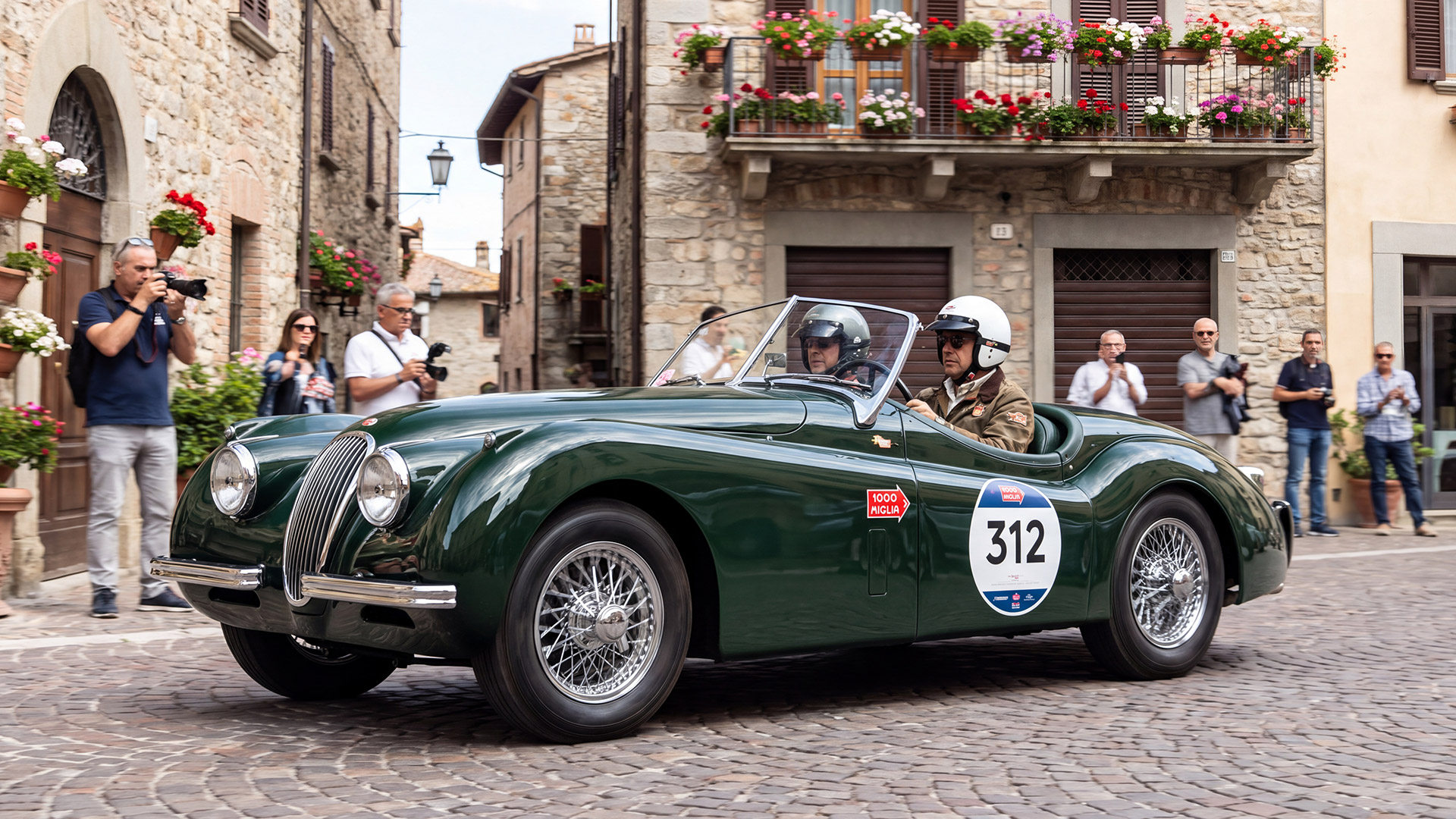
Jaguar XK120 Roadster participating in the modern 1000 Miglia.
Frequently Asked Questions About the 1000 Miglia
What is the 1000 Miglia?
The 1000 Miglia is an Italian automobile competition founded in Brescia in 1927. Originally a speed race, it is now a regularity event for historic cars.
Why is the race called Mille Miglia?
The Italian name means One Thousand Miles, referring to the original route’s approximate length of 1,600 kilometers between Brescia, Rome, and Brescia.
When was the first Mille Miglia held?
The inaugural race took place on March 26-27, 1927. Ferdinando Minoia and Giuseppe Morandi won the competition driving an OM 665 Sport.
Who founded the 1000 Miglia?
The four founders were Franco Mazzotti, Aymo Maggi, Renzo Castagneto, and Giovanni Canestrini, who developed the competition during the final months of 1926.
Who won the most original Mille Miglia races?
Clemente Biondetti holds the record with four victories, achieved in 1938, 1947, 1948, and 1949, driving automobiles manufactured by Alfa Romeo and Ferrari.
What is the fastest Mille Miglia record?
Stirling Moss and Denis Jenkinson established the record in 1955, completing approximately 1,592 kilometers in 10 hours, 7 minutes, and 48 seconds.
Why was the original Mille Miglia cancelled?
The traditional speed race was discontinued following a fatal accident in 1957 that killed eleven people, including driver Alfonso de Portago and nine spectators.
When was the 1000 Miglia revived?
The event returned as a historic automobile commemoration in 1977. Further editions followed during the 1980s, and the competition became annual in 1987.
Can anyone participate in the modern 1000 Miglia?
Participation requires an eligible historic automobile and compliance with registration requirements, including certification through the Registro 1000 Miglia and acceptance by the organizers.
Images generated with Nano Banana Pro / Google AI Studio