-
About
Table of Contents
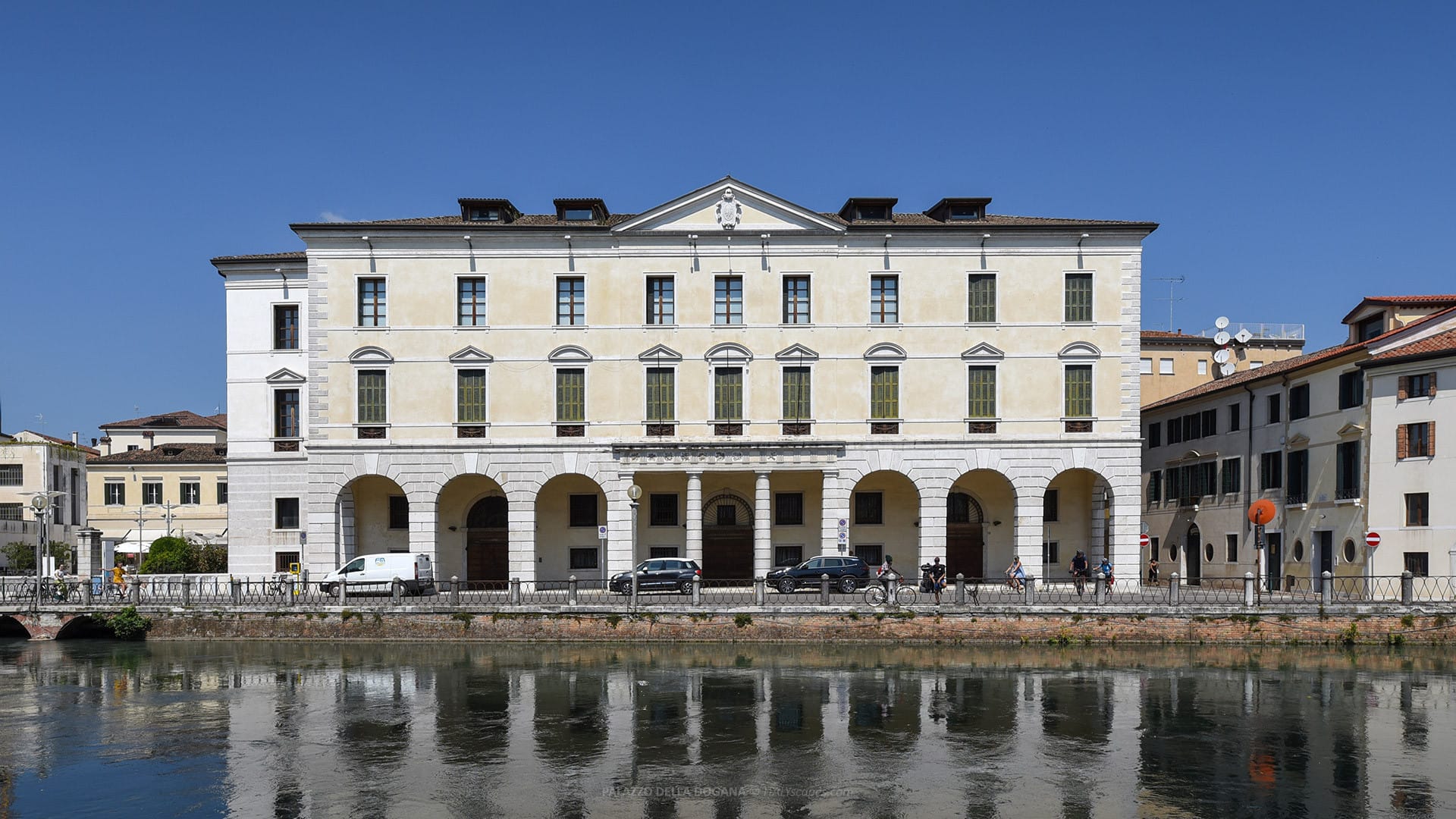
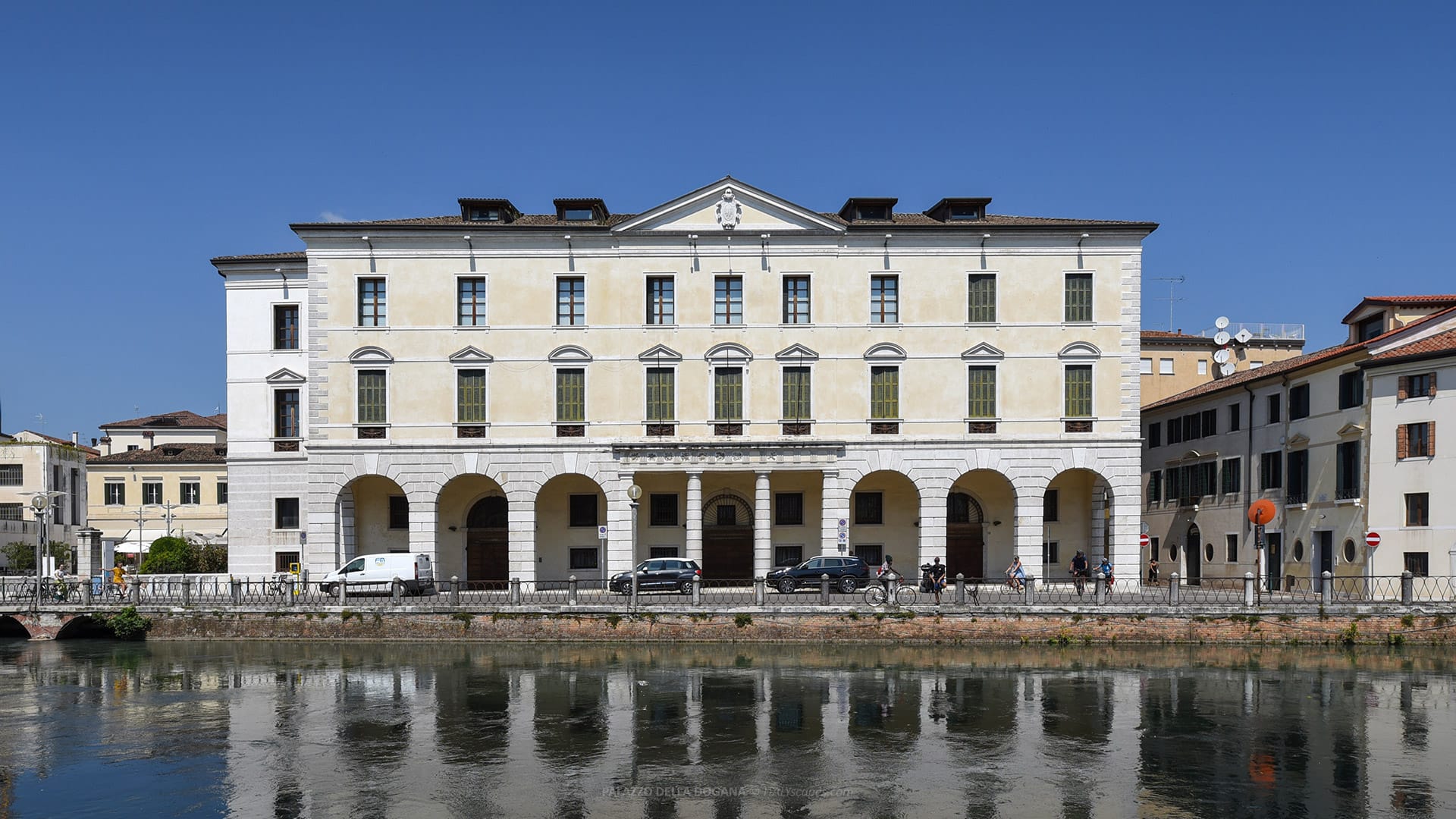
Palazzo della Dogana is one of the historic buildings of the former San Leonardo Civil Hospital complex in Treviso. It stands in the city’s historic center, along the Sile riverfront, within the area now known as the Quartiere Latino, close to Piazza Santa Maria dei Battuti.
Today, the former hospital area includes university spaces, residential units, commercial areas, open courtyards, and pedestrian connections along the Sile and Cagnan waterways.
The broader university area covers about 9,617 square meters, including about 5,965 square meters of covered space. These figures refer to the restored San Leonardo university complex, not only to the rooms once used by customs officials.
The name “Palazzo della Dogana” should be understood with precision. The building belonged to the former hospital complex, and only some rooms housed the customs office between 1834 and 1866.
Short History of Palazzo della Dogana
From Medieval Charity to the San Leonardo Hospital
The history of Palazzo della Dogana is connected to the old hospital complex of Santa Maria dei Battuti, also known as San Leonardo. This charitable institution was linked to the Scuola di Santa Maria dei Battuti, a confraternity active in Treviso between the 13th and 14th centuries.
The first hospital stood near the area of today’s Via Roma and Lungosile Mattei. In 1332, after that older site was affected by the fortification works ordered by Mastino della Scala, the confraternity acquired a new plot near the Sile, in the district of San Pancrazio, also known as San Leonardo.
For more than 600 years, this area functioned as one of Treviso’s most important hospital zones. Its position was practical and strategic, because it stood in the historic center, close to the Sile River, and near routes used for movement, trade, and communication inside the city.
The 18th and 19th-Century Transformation
At the end of the 18th century, the river-facing part of the hospital complex changed significantly. In 1795, the old Gothic façade facing the Sile was demolished and replaced by a new Neoclassical façade designed by Daniele Danieletti.
The works on this façade were completed in 1832, with important modifications by Gaspare Petrovich. This transformation gave the building a more regular and modern appearance, in line with the architectural taste of the period and with the civic importance of the hospital complex.
Between 1834 and 1866, some rooms of the former hospital hosted the customs office. The customs function was linked to the building’s position near the Sile and the old port area of Treviso.
Decline of the Hospital and Modern Recovery
In 1852, the Dorothean Sisters entered the hospital, marking another phase in the charitable and religious history of the complex. The hospital continued to serve Treviso for decades, but its original function gradually declined during the 20th century, especially after the Second World War.
After the war, the former hospital area went through a long period of abandonment and underuse. Many parts of the complex lost their original function, although the site remained important because of its central position, historical value, and relationship with the Sile riverfront.
A decisive change came when Fondazione Cassamarca acquired the former hospital complex from the local health authority. The foundation promoted a large restoration project designed to transform the abandoned area into a university district while preserving its historical and architectural identity.
The first important result came in October 1999, when university courses were inaugurated and the first restored part, Palazzo della Dogana, was delivered. The wider area later reopened to the city as the Quartiere Latino on 30 September 2006, reconnecting the former hospital with Treviso’s public life.
Architecture of Palazzo della Dogana
Historical Structure and Urban Position
Palazzo della Dogana is not an isolated monument but part of a complex urban organism. It belongs to the former San Leonardo hospital area, placed between the historic streets of Treviso and the Sile river.
The building faces the riverfront along Riviera Garibaldi and is connected to a broader group of spaces around the Quartiere Latino.
Restoration and Interior Spaces
The restoration of Palazzo della Dogana was part of the wider transformation of the former hospital into a university district. The project began around 2000, and the first restored part was completed after about 13 months of work, a rapid intervention for a complex historical site.
One of the most important interior spaces is the Aula Magna, positioned on the river-facing side of Palazzo della Dogana. It was designed as a central teaching and conference room and includes a large mezzanine, allowing it to host up to 400 seats.
The Aula Magna is also notable for its oak furnishings and its exedra-like arrangement, with the speakers’ area at the center.
The restoration also introduced symbolic elements linked to water and navigation. In the entrance area, a wooden form recalls an overturned boat, an architectural reference to Treviso’s river setting and to the historic relationship between the complex, the Sile, and commercial traffic.
Materials and Architectural Details
The modern interiors use oak wood, glass, and durable floor finishes. In several parts of the project, Murano glass appears in lighting elements and decorative features, creating a connection with Venetian craft traditions and the broader cultural geography of the Veneto region.
The building’s restored educational spaces balance practical needs with architectural memory. Upper-floor classrooms and frequently used areas were designed with sober materials, suitable for continuous student use. Porcelain stoneware was chosen for durability, especially where floors had to resist heavy circulation.
The outdoor spaces are equally important. Portoghesi’s intervention created new pedestrian passages, courtyards, and the Piazza dell’Umanesimo Latino. These spaces made the former hospital area part of the city again, rather than an enclosed institution separated from daily urban movement.
How to Get to Palazzo della Dogana
Palazzo della Dogana is located in central Treviso, in the Quartiere Latino area, along Riviera Garibaldi, close to Piazza San Leonardo and the Sile river. From Treviso Centrale railway station, it is close enough to reach on foot, by urban bus, or by taxi.
Getting to Palazzo della Dogana on foot
From Treviso Centrale railway station, the walk to Palazzo della Dogana is about 800-900 meters, depending on the exact route. It usually takes around 10-12 minutes at a normal pace, making walking the simplest option for most visitors without heavy luggage.
Exit the railway station toward Piazzale Duca d’Aosta and continue toward Via Roma. Cross the Sile and enter the historic center. From there, continue toward Corso del Popolo and the central streets leading toward Piazza Borsa, Piazza San Leonardo, and Riviera Garibaldi.
Once near Piazza San Leonardo, follow the signs or local directions toward the Quartiere Latino and Riviera Garibaldi.
Getting to Palazzo della Dogana by bus
From Treviso Centrale, taking the bus is possible, although walking is often faster for this short distance. The most straightforward urban option is MOM line 1, because its route includes the railway station stops and Piazza San Leonardo, which is close to Palazzo della Dogana.
The useful station-side stops are generally FS Via Roma or FS Viale Bandiera. After boarding line 1 in the correct direction toward the city center, get off at Piazza San Leonardo. From there, Palazzo della Dogana is roughly 250-300 meters away, about 3-4 minutes on foot.
Other bus lines also serve stops around Piazza San Leonardo or Riviera Garibaldi, including lines such as 4, 7, 61, 104, 120, and 8E, depending on schedules and direction.
Getting to Palazzo della Dogana by taxi
A taxi from Treviso Centrale railway station to Palazzo della Dogana is the easiest option for visitors with luggage, reduced mobility, or very limited time. The driving distance is approximately 1-1.3 kilometers, depending on the exact route and traffic restrictions in the historic center.
The ride usually takes around 3–5 minutes in normal traffic. Ask the driver for Palazzo della Dogana, Quartiere Latino, Riviera Garibaldi, or Piazza San Leonardo.
Frequently Asked Questions About Palazzo della Dogana
Where is Palazzo della Dogana located?
Palazzo della Dogana is located in Treviso’s historic center, near Riviera Garibaldi, Piazza San Leonardo, and the Sile River, inside the restored area known as the Quartiere Latino.
What was Palazzo della Dogana originally?
Palazzo della Dogana was part of the former San Leonardo Civil Hospital complex. It was not originally built as a customs palace, although some rooms later housed customs offices.
Why is it called Palazzo della Dogana?
The name comes from the building’s 19th-century use. Between 1834 and 1866, some rooms of the former hospital complex were used as a customs office.
Can visitors enter Palazzo della Dogana?
Visitors can see the exterior and surrounding Quartiere Latino area. Interior access may depend on university functions, events, or institutional use, because it is not a standard museum.
How far is Palazzo della Dogana from Treviso Centrale?
Palazzo della Dogana is about 800-900 meters from Treviso Centrale railway station. The walk usually takes around 10-12 minutes, depending on the exact route and pace.
Sources: -
Photos
-
Map
-
Reviews