-
About
Table of Contents
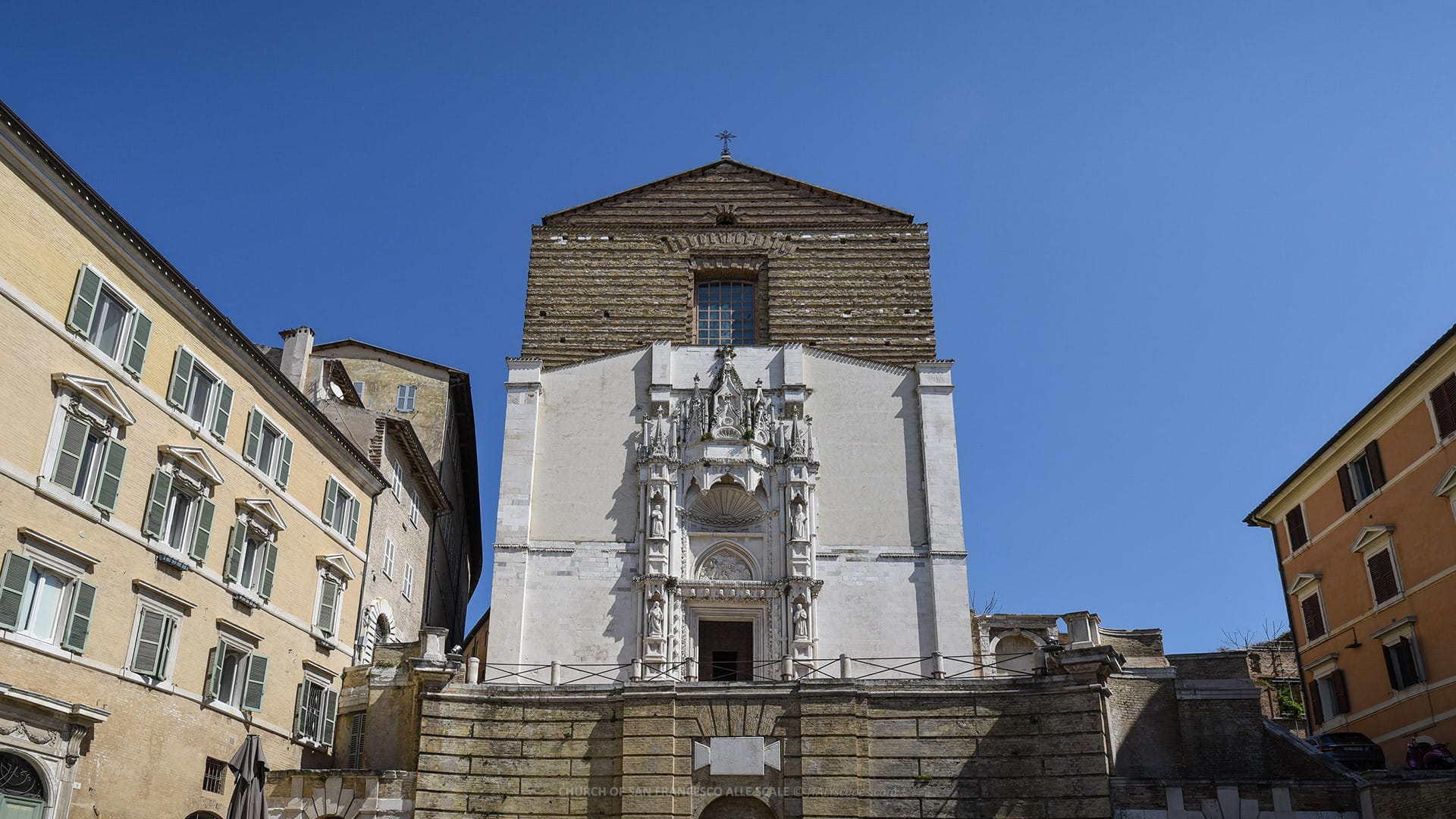
The Church of San Francesco alle Scale stands as one of the most important and visually striking churches in the city of Ancona.
Its name – San Francesco alle Scale – reflects the monumental staircase that once connected it with the surrounding area, a defining element of its urban presence.
Today, the Church of San Francesco alle Scale occupies a revered place in Ancona’s architectural landscape, admired both for its stylistic evolution through centuries and for the remarkable artworks it houses.
Originally founded by Franciscan friars in the early 14th century, the Church of San Francesco alle Scale has witnessed centuries of transformation – from medieval origins to Renaissance enrichment and later Baroque modifications.
Its rich history mirrors Ancona’s own cultural shifts, as the church has alternated between sacred and secular functions, been repurposed through political upheavals, and ultimately restored to its role as a place of worship.
Its striking exterior and layered interior design make it not only a spiritual destination but also an architectural and artistic landmark that draws scholars, pilgrims, and travelers alike.
Short History of the Church of San Francesco alle Scale
The history of the Church of San Francesco alle Scale begins in the early 14th century. It was founded on August 14, 1323, by the Franciscan order in collaboration with Bishop Nicolò degli Ungari, a native nobleman devoted to the Franciscan cause.
At the time of its foundation, the church was known as Santa Maria Maggiore, and it was the largest church in Ancona dedicated to the Virgin Mary, reflecting the importance of Marian devotion in the medieval city.
In the mid-15th century, the remarkable monumental staircase that gave the church its name was constructed.
Designed by the Dalmatian master Giorgio Orsini – also known as Giorgio da Sebenico – this extensive flight of stairs occupied the entire area of what is now Piazza San Francesco, connecting the lower streets with the church entrance and creating a dramatic urban approach that became emblematic of the building itself.
Orsini’s contribution did more than provide access: it transformed the Church of San Francesco alle Scale into a visual landmark within the urban fabric.
The sculpted portal and decorative elements he created during this period reflect a blend of Gothic and early Renaissance influences, demonstrating a stylistic transition that was taking shape across the Adriatic and Italian cultural sphere.
The staircase and ornate facade became inseparable from the church’s identity, leading locals to refer to it as San Francesco alle Scale – Saint Francis of the Stairs.
The late 18th century brought further change as the Church of San Francesco alle Scale was substantially remodeled and enlarged between 1777 and 1790 by Francesco Maria Ciaraffoni.
This intervention raised the overall structure and altered the interior, integrating Baroque and later stylistic elements while preserving its medieval and Renaissance core. Alongside the church, the monastery and cloisters were also rebuilt, reinforcing the complex’s status as a major religious institution in Ancona.
However, the political upheavals of the Napoleonic era interrupted its religious function. After the French occupation, the church and adjacent monastery were deconsecrated and repurposed, serving as a hospital in the 19th century and later housing civic institutions such as a museum, library, and civic art gallery.
These secular uses continued until the mid-20th century, leaving physical traces and architectural imprints that attest to its varied past.
In the course of the Second World War, the Church of San Francesco alle Scale suffered significant damage, including the destruction of its bell tower in 1944. After the war, extensive restoration efforts were undertaken to repair the damage, rebuild key structural elements, and return the building to its original religious function.
By 1953, the church was reconsecrated and once again dedicated to the spiritual life of the community. The Franciscan presence remained central for decades thereafter, and the church became the parish church of the San Pietro neighborhood.
Architecture of the Church of San Francesco alle Scale
The architecture of the Church of San Francesco alle Scale is a compelling visual narrative of centuries of stylistic evolution. The building’s exterior and interior structure reflect a complex synthesis of medieval origins, Renaissance refinement, and later architectural additions that together create a unique and layered aesthetic.
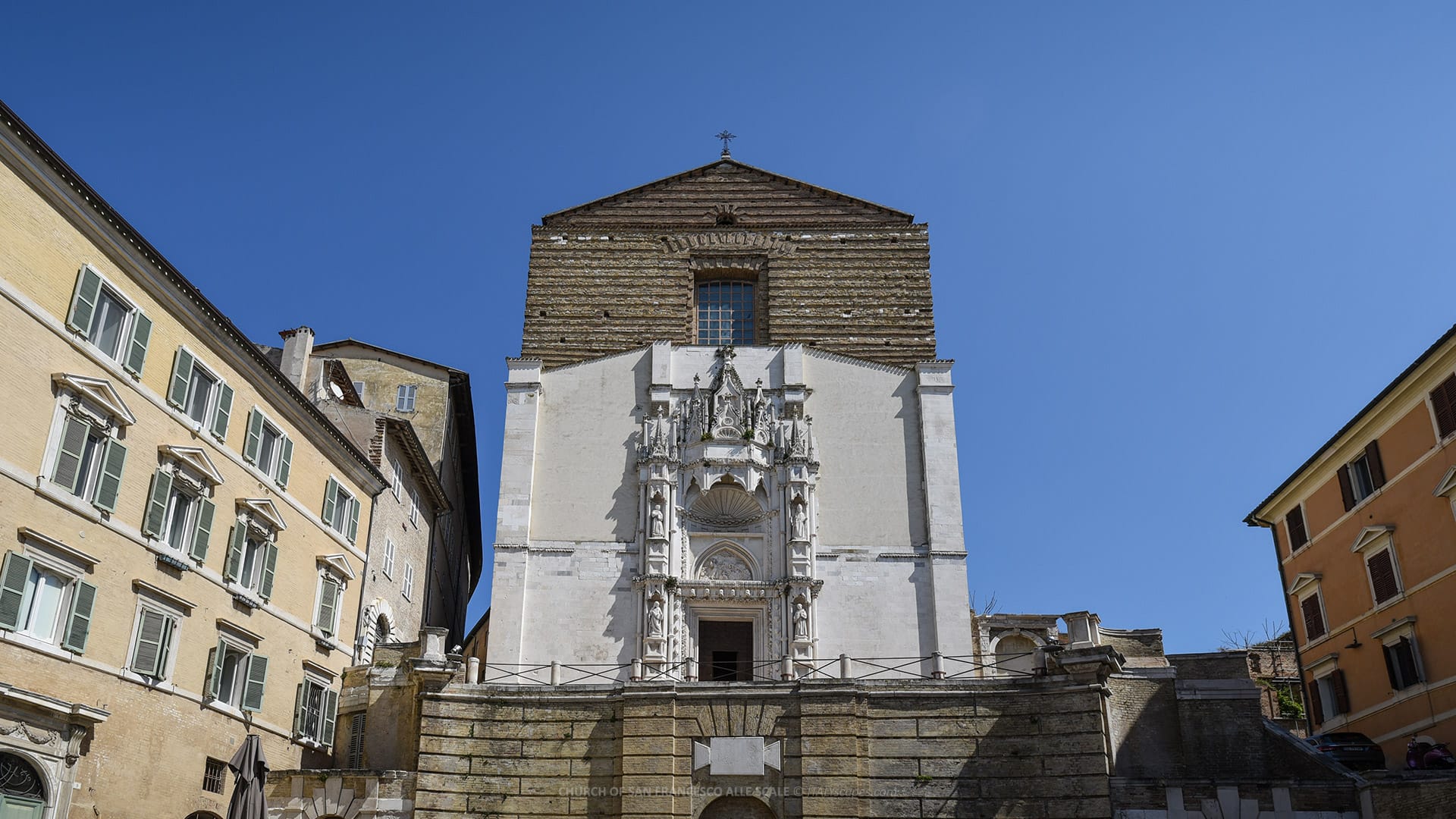
Approaching the church, one is first struck by its imposing facade, which stands prominently above the street and overlooks Piazza San Francesco. The lower portion of the building retains elements of the original medieval structure, while the upper sections represent later renovations.
The most remarkable feature of the facade is the portal, executed in the mid-15th century by Giorgio Orsini. This ornate entrance is framed by exquisite stone carvings and sculptural details typical of the transition from Gothic to early Renaissance.
The portal’s elaborate composition includes a finely articulated frame and a series of sculpted heads and figures that enliven the stone surface, elevating the entrance from a simple doorway to a work of art in its own right.
Above the portal, intricate bas-reliefs depict key religious scenes and serve as visual focal points that draw both the eye and the spirit upward. Niches on either side of the entrance once held statues of saints associated with the Franciscan order, adding a sculptural dimension to the architectural design.
The interior of the Church of San Francesco alle Scale evolved significantly during the 18th-century renovations. The space is organized around a single nave, characterized by its clarity of form and the sense of expansiveness created by unifying elements such as continuous vaulting and simplified wall surfaces.
Art of the Church of San Francesco alle Scale
Inside the Church of San Francesco alle Scale, visitors encounter an extraordinary array of artworks that speak to the church’s importance as a center of artistic patronage through the Renaissance and beyond.
One of the most celebrated works within the church is the Assumption of the Virgin by Lorenzo Lotto, a monumental altarpiece that dominates the high altar.
Painted around the mid-16th century, this remarkable piece captures the dramatic ascent of the Virgin Mary into heaven, surrounded by a host of apostles and angels.
Lotto’s mastery of composition, color, and emotional expression is evident in the swirling clouds, dynamic figures, and luminous palette that characterize this work.
Another significant painting is the Baptism of Christ by Pellegrino Tibaldi, located within the nave. This work depicts the moment when Jesus is baptized by John the Baptist, a foundational scene in Christian iconography.
Tibaldi’s treatment of the subject underscores his command of human anatomy, spatial depth, and narrative clarity, hallmarks of his mature artistic style.
In addition to these major altarpieces, the church contains a series of sculptural and decorative elements that enrich its artistic program. Among these is a chalk Glory by Gioacchino Varlè, which adorns the apse area.
Other artistically significant pieces include works by Andrea Lillio, whose depiction of angels – Angels Carrying the Holy House of Loreto – integrates religious narrative with delicate color and movement.
How to Get to the Church of San Francesco alle Scale
The Church of San Francesco alle Scale is located approximately 2.2 kilometers from the Ancona railway station, making it easily reachable for visitors arriving by train.
One of the most rewarding ways to reach the church is on foot, as the path from the station weaves through the historic heart of Ancona, allowing visitors to experience the city’s traditional architecture and vibrant urban life. The walk typically takes around 25 to 30 minutes, depending on your pace.
For those who prefer to use public transport, the closest bus stop to the church is Fermata Banchine, approximately 300 meters away. This stop is served by Bus Line 10, which connects key parts of the city and provides convenient access to the area around Piazza San Francesco.
From the bus stop, a short walk through charming streets will lead you directly to the entrance of the church.
Taxis are another practical option, with services available outside the railway station that can deliver you close to the church entrance in a matter of minutes.
Sources: -
Photos
-
Map
-
Reviews