-
About
Table of Contents
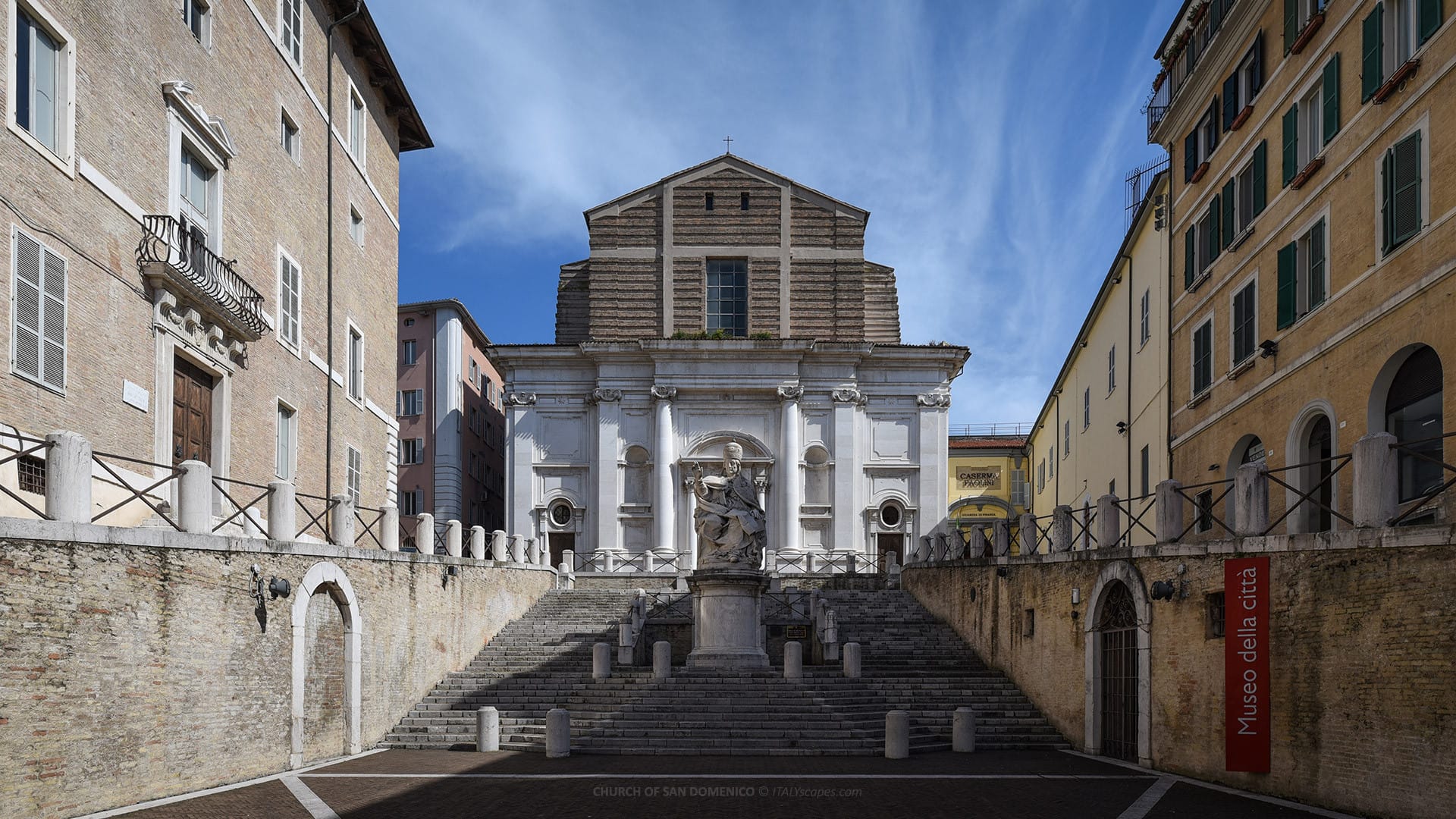
The Church of San Domenico is one of the most important religious and artistic landmarks in the historic center of Ancona.
It is located in Piazza del Plebiscito, the city’s main historical square, and occupies a dominant position that immediately draws the attention of visitors.
Rising at the top of a wide monumental staircase, the church visually closes one of the two short sides of the square and plays a fundamental role in defining its architectural identity.
More than just a place of worship, the Church of San Domenico represents centuries of religious devotion, political change, and artistic patronage. Its imposing scale, refined architectural language, and remarkable collection of artworks make it one of the most significant churches in Ancona.
Today, the Church of San Domenico continues to serve both spiritual and cultural functions. It is an active church, open to worshippers, while also attracting art lovers and history enthusiasts who come to admire its interior and understand its role in the broader urban context of Piazza del Plebiscito.
Short History of the Church of San Domenico
The current Church of San Domenico stands on the site of a much older religious building.
Before its construction, a church dedicated to the same saint had existed here since the 13th century. That medieval structure served the Dominican order for centuries but had become inadequate by the 18th century, both in terms of size and architectural ambition.
As Ancona grew and modernized, the decision was made to demolish the old church and replace it with a new, more monumental building.
The design of the new Church of San Domenico was entrusted to the renowned architect Carlo Marchionni in 1763. Marchionni was a prominent figure in late Baroque architecture, and his project for San Domenico reflected the stylistic transition toward a more sober and monumental classicism.
The laying of the first stone took place in 1771, marking the official beginning of construction. The main structure was completed by 1778, although the church was left without a finished facade, a condition that would remain unresolved for decades.
The late 18th century brought dramatic political changes to Ancona, and these events directly affected the Church of San Domenico. In 1798, during the French occupation and the establishment of the Republic of Ancona, the church was requisitioned and used as a military barracks.
This change of function interrupted religious activities and caused further delays in completing the building. The upper part of the facade remained unfinished, a visible sign of the turbulent period the city was experiencing.
The 20th century brought new challenges. During the bombings of the Second World War, the Church of San Domenico suffered significant damage. The roof partially collapsed, and the interior was heavily affected.
Among the most painful losses was the destruction of the venerated image of the Incoronata, or the Crowned Madonna, which had been transferred from the earlier medieval church and placed in a side chapel. Two statues by Gioacchino Varlè and several important paintings were also destroyed during the bombardments.
After the war, the city undertook a careful restoration of the church. Structural repairs were carried out, and efforts were made to restore the building’s artistic and liturgical function. The destroyed artworks were replaced with new pieces, allowing the church to recover its role as a center of worship and culture.
In 1948, the Church of San Domenico was officially reopened to the public, marking the beginning of a new chapter in its long and complex history.
Architecture of the Church of San Domenico
The architecture of the Church of San Domenico is one of its most striking features and reflects the artistic ideals of the late 18th century.
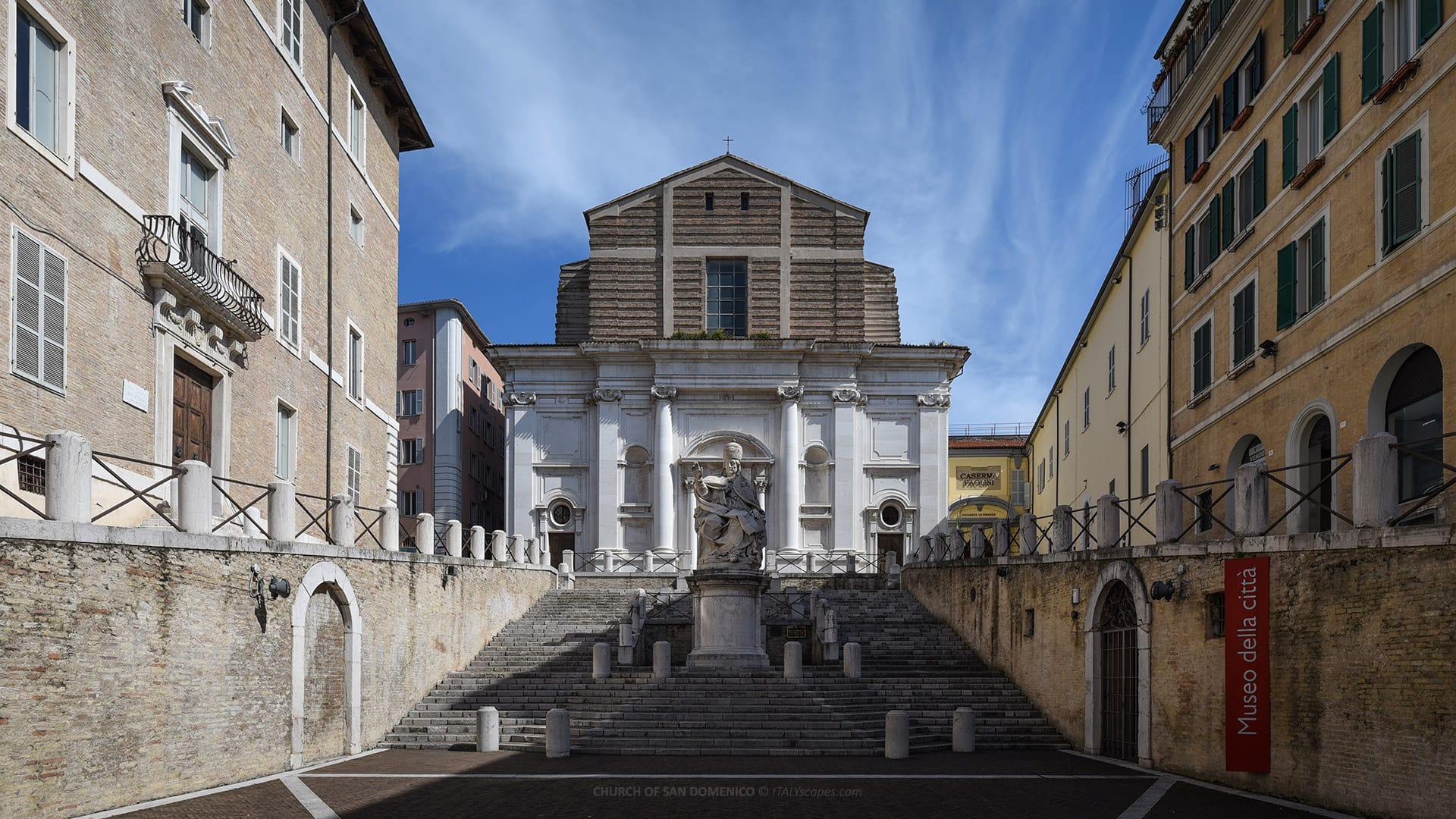
The church is built primarily in Istrian stone, a material widely used in Adriatic architecture for its durability and luminous appearance. The facade, although unfinished in its upper section, conveys a strong sense of monumentality and balance.
The facade is divided into five vertical sectors, articulated by pilasters and semi-columns with Ionic capitals. This rhythmic division gives the structure a sense of order and harmony, emphasizing its width and reinforcing its presence at the head of Piazza del Plebiscito.
The facade is organized into two architectural orders, but only the lower order was fully completed. Despite this, the overall composition remains coherent and visually powerful.
At the center of the facade is the main portal, which serves as the symbolic and physical entrance to the church. It is framed by Corinthian columns that support a thin architrave, above which rises a round broken tympanum.
This classical vocabulary reflects Marchionni’s refined approach, combining decorative elegance with structural clarity.
The side portals are smaller and are surmounted by oculi, circular openings that allow light to enter the interior. Between the central portal and the side entrances are two empty niches, originally intended to house statues that were never installed.
The interior of the Church of San Domenico is equally impressive. The space is organized around a single wide nave, a design choice that enhances the sense of openness and grandeur. The nave is covered by a barrel vault with lunettes, creating a continuous and unified spatial experience.
This architectural solution allows light to filter softly into the interior, highlighting the proportions of the church and guiding the eye toward the altar.
The scale of the interior reflects the ambition of the project. The height and width of the nave were designed to accommodate large congregations and to emphasize the importance of the Dominican order within the city.
The architectural language is restrained but solemn, avoiding excessive ornamentation while maintaining a strong visual impact. The result is an interior that feels both monumental and contemplative, perfectly suited to its religious function.
Art of the Church of San Domenico
The Church of San Domenico is also renowned for the exceptional quality of the artworks preserved inside. Among the most important paintings housed in the church are two masterpieces that place it among the key artistic sites of Ancona.
One of these is the Annunciation by Guercino, a work celebrated for its dramatic use of light, expressive figures, and emotional intensity. The painting exemplifies Guercino’s mature style and represents a highlight of Baroque art within the church.
Equally significant is the Crucifixion by Titian, one of the greatest masters of the Italian Renaissance. This painting stands out for its powerful composition and profound emotional depth.
The presence of a work by Titian in the Church of San Domenico underscores the cultural importance of the building and the historical connections between Ancona and the broader artistic currents of Italy.
In addition to these paintings, the church contains numerous sculptures by Gioacchino Varlè. His works contribute significantly to the artistic character of the interior, adding sculptural richness and reinforcing the religious themes expressed throughout the space.
How to Get to the Church of San Domenico
The Church of San Domenico is located approximately 2.1 kilometers from the Ancona railway station, making it easily accessible for visitors arriving by train.
Walking to the church is a popular option, as the route passes through parts of the historic center and allows visitors to experience the city’s atmosphere at a relaxed pace. The walk typically takes around twenty-five minutes.
Public transportation offers a convenient alternative. The closest bus stop is located on Via Pizzecolli, about 200 meters from the church, and is served by Bus Line 11. From the bus stop, the church can be reached in just a few minutes on foot.
Taxis are also readily available at the railway station and provide a quick and comfortable way to reach Piazza del Plebiscito and the Church of San Domenico.
Sources: -
Photos
-
Map
-
Reviews