


-
About
Table of Contents
The Galleria Vittorio Emanuele II is a monumental covered shopping arcade located in the historic center of Milan. Connecting Piazza del Duomo with Piazza della Scala, it is one of Europe’s most remarkable examples of nineteenth-century commercial architecture and one of Milan’s most recognizable landmarks.
Designed by architect Giuseppe Mengoni, Galleria Vittorio Emanuele II was constructed between 1865 and 1877, with its formal completion in 1878. The arcade combines Neo-Renaissance architectural decoration with innovative iron-and-glass construction. Its defining feature is a monumental glass dome rising approximately 47 meters above the central octagonal intersection.
Named after Victor Emmanuel II, the first king of unified Italy, Galleria Vittorio Emanuele II has been an important gathering place since its inauguration. Its elegant boutiques, historic cafés, restaurants, marble floors, and elaborate decorations have earned it the nickname Il Salotto di Milano, meaning Milan’s Drawing Room.
Today, Galleria Vittorio Emanuele II remains a public pedestrian passage containing luxury boutiques, restaurants, and historic commercial establishments. Visitors can admire its architecture without paying an admission fee. The arcade also provides direct pedestrian connections between Milan Cathedral, Palazzo Marino, Teatro alla Scala, and several important streets in central Milan.

The monumental entrance to Galleria Vittorio Emanuele II in Piazza del Duomo
Short History of the Galleria Vittorio Emanuele II
The Origins of the Project
During the first half of the nineteenth century, the area surrounding Milan Cathedral was characterized by narrow medieval streets and irregularly arranged buildings. Increasing traffic and commercial activity encouraged municipal authorities to consider reorganizing Piazza del Duomo and improving access to nearby neighborhoods, including the area surrounding Teatro alla Scala.
Discussions concerning the redevelopment of the square intensified in 1839, when the writer and political thinker Carlo Cattaneo promoted proposals for improving central Milan. The project gained greater importance after Lombardy joined the Kingdom of Sardinia in 1859 and the Kingdom of Italy was proclaimed in 1861.
In 1860, Milan’s municipal administration organized an architectural competition for a new street connecting the cathedral square with Piazza della Scala. Two competitions failed to produce an accepted design. A third competition, held in 1863, selected Giuseppe Mengoni, whose proposal incorporated a monumental covered arcade.
Construction and the First Inauguration
Construction of Galleria Vittorio Emanuele II officially began on March 7, 1865, when King Victor Emmanuel II laid the foundation stone. The ceremony was attended by important political and municipal representatives, including Milan’s mayor, Antonio Beretta, and the Italian prime minister, Alfonso La Marmora.
The construction contract was awarded to the City of Milan Improvements Company Limited, a British company responsible for organizing and financing the works. The project required the demolition of existing buildings, including structures belonging to the historic urban fabric surrounding Piazza del Duomo, followed by extensive masonry and metal construction.
On September 15, 1867, Galleria Vittorio Emanuele II was officially inaugurated, although several architectural elements remained unfinished. The opening established a new connection between two of Milan’s most important public squares. The completed sections already accommodated commercial premises, pedestrian circulation, and spaces intended for social gatherings.
Completion and the Death of Giuseppe Mengoni
The final stages of construction encountered considerable financial difficulties. In 1869, the British company responsible for the works went bankrupt, forcing the Municipality of Milan to assume control of the project. Construction subsequently continued under municipal supervision, with particular attention devoted to the monumental southern entrance.
One of the most tragic events in the history of Galleria Vittorio Emanuele II occurred on December 30, 1877, when Giuseppe Mengoni died after falling from scaffolding during an inspection. His death occurred shortly before the completion of the architectural complex he had designed.
The monumental entrance arch facing Piazza del Duomo was formally inaugurated on February 24, 1878, completing the principal architectural composition. During the following decades, the arcade became an important center of Milanese social life, attracting businessmen, writers, intellectuals, and members of the city’s increasingly prosperous bourgeoisie.
The Twentieth Century and Restoration Works
Galleria Vittorio Emanuele II suffered considerable damage during the Allied bombing of Milan in August 1943. Several sections of the glass roof and interior decorations were damaged or destroyed. The surrounding city center also experienced extensive destruction, requiring substantial reconstruction during the years following the Second World War.
The principal postwar restoration was completed in 1955, with a ceremonial reopening on December 7, the feast day of Saint Ambrose, Milan’s patron saint. Additional conservation works were undertaken in 1967, coinciding with the centenary of the arcade’s original inauguration, particularly affecting its historic flooring.
Between March 2014 and April 2015, Galleria Vittorio Emanuele II underwent another major conservation campaign in preparation for Expo Milano 2015. The restoration involved approximately 14,000 square meters of architectural surfaces and included cleaning, repairs, and the recovery of historical colors through extensive analysis of surviving materials.
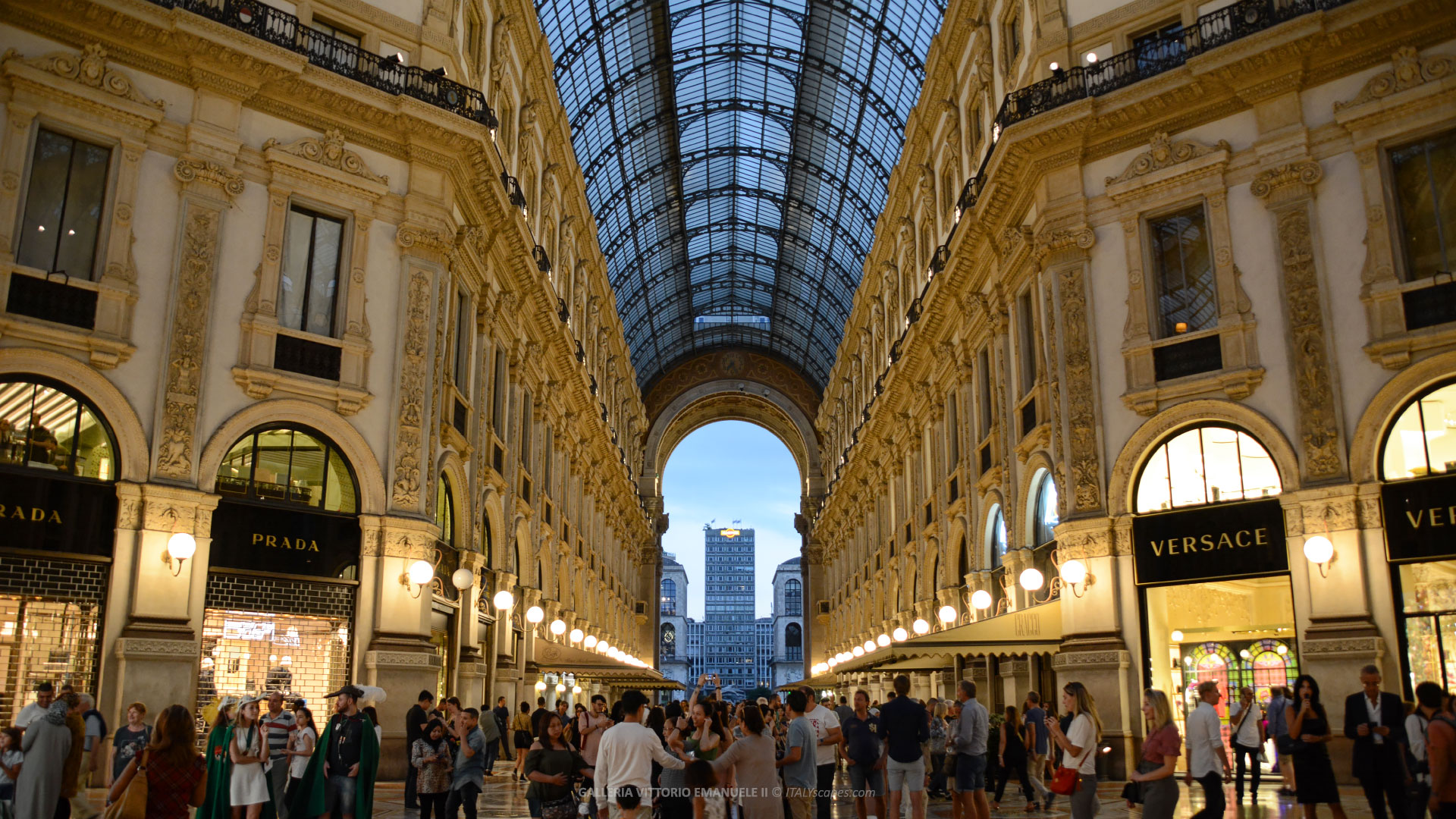
Luxury boutiques line the historic shopping arcade of Galleria Vittorio Emanuele II.
Architecture of the Galleria Vittorio Emanuele II
Architectural Style and General Layout
The architecture of Galleria Vittorio Emanuele II combines Neo-Renaissance decoration with nineteenth-century engineering. Its design belongs to the broader tradition of eclectic architecture, incorporating historical artistic references alongside modern construction techniques. The building represents an important stage in the development of monumental covered commercial passages in Europe.
Galleria Vittorio Emanuele II has a cruciform plan, formed by two intersecting covered passages. The longer passage, connecting Piazza del Duomo with Piazza della Scala, measures approximately 196.6 meters. The shorter passage measures approximately 105.1 meters and connects Via Ugo Foscolo with Via Silvio Pellico.
Both passages are approximately 14.5 meters wide, providing substantial space for pedestrian circulation. At their intersection, the building opens into an octagonal hall measuring approximately 36.6 meters between opposite sides. The total pedestrian floor area of the arcade is approximately 4,165 square meters, excluding the adjoining commercial buildings.
The Glass Roof and Central Dome
The most innovative structural feature of Galleria Vittorio Emanuele II is its monumental iron-and-glass roof. The vaulted covering extends over both principal passages, allowing natural light to illuminate the interior. Its construction reflects technological developments that transformed European architecture during the Industrial Revolution.
The vaulted roof rises approximately 29.2 meters above the floor. At the central intersection, the structure expands into an impressive glass dome approximately 39 meters in diameter. The dome reaches approximately 47 meters in height, including its upper lantern, making it the tallest part of the covered arcade.
The roof of Galleria Vittorio Emanuele II incorporates approximately 7,800 square meters of glass supported by a complex network of metal elements. Historical construction records indicate approximately 353 tonnes of steel in the covering. The arrangement combines structural strength with relatively slender supporting members, maximizing daylight within the passage.
The Monumental Entrances
The principal entrance to Galleria Vittorio Emanuele II, facing Piazza del Duomo, resembles a monumental triumphal arch. Its composition includes a large central opening flanked by two smaller architectural sections. Corinthian columns, sculpted decorations, ornamental moldings, and upper windows establish a formal relationship with the surrounding nineteenth-century buildings.
The upper part of the entrance arch reaches approximately 32 meters above the square. Its façade contains a monumental inscription dedicated to Victor Emmanuel II by the people of Milan. The architectural composition emphasizes the role of the gallery as both an urban passage and a commemorative monument.
The entrance facing Piazza della Scala follows a similar architectural arrangement, although its decoration is less elaborate. Mengoni incorporated a semicircular architectural space, known as an exedra, to compensate for the imperfect alignment between the gallery’s central axis and the surrounding square. This arrangement creates a balanced transition between the two spaces.
The Interior Façades and Decorative Architecture
The interior façades of Galleria Vittorio Emanuele II are organized across three principal levels and a mezzanine. The ground floor contains commercial premises with large glazed entrances. Above them, decorative architectural elements divide the elevations into regular sections, creating a continuous arrangement along both covered passages.
The façades incorporate ornamental pilasters, carved capitals, stucco decorations, projecting cornices, and sculpted human figures. Several architectural details draw inspiration from Lombard Renaissance buildings. The combination of decorative elements and symmetrical window arrangements creates a consistent architectural composition throughout the interior.
The upper levels of Galleria Vittorio Emanuele II also contain residential and commercial spaces. Their façades are integrated into the architectural design through balconies, balustrades, and elaborate window frames. The lower shopfronts maintain a coordinated appearance, including the characteristic gold lettering displayed against black backgrounds.
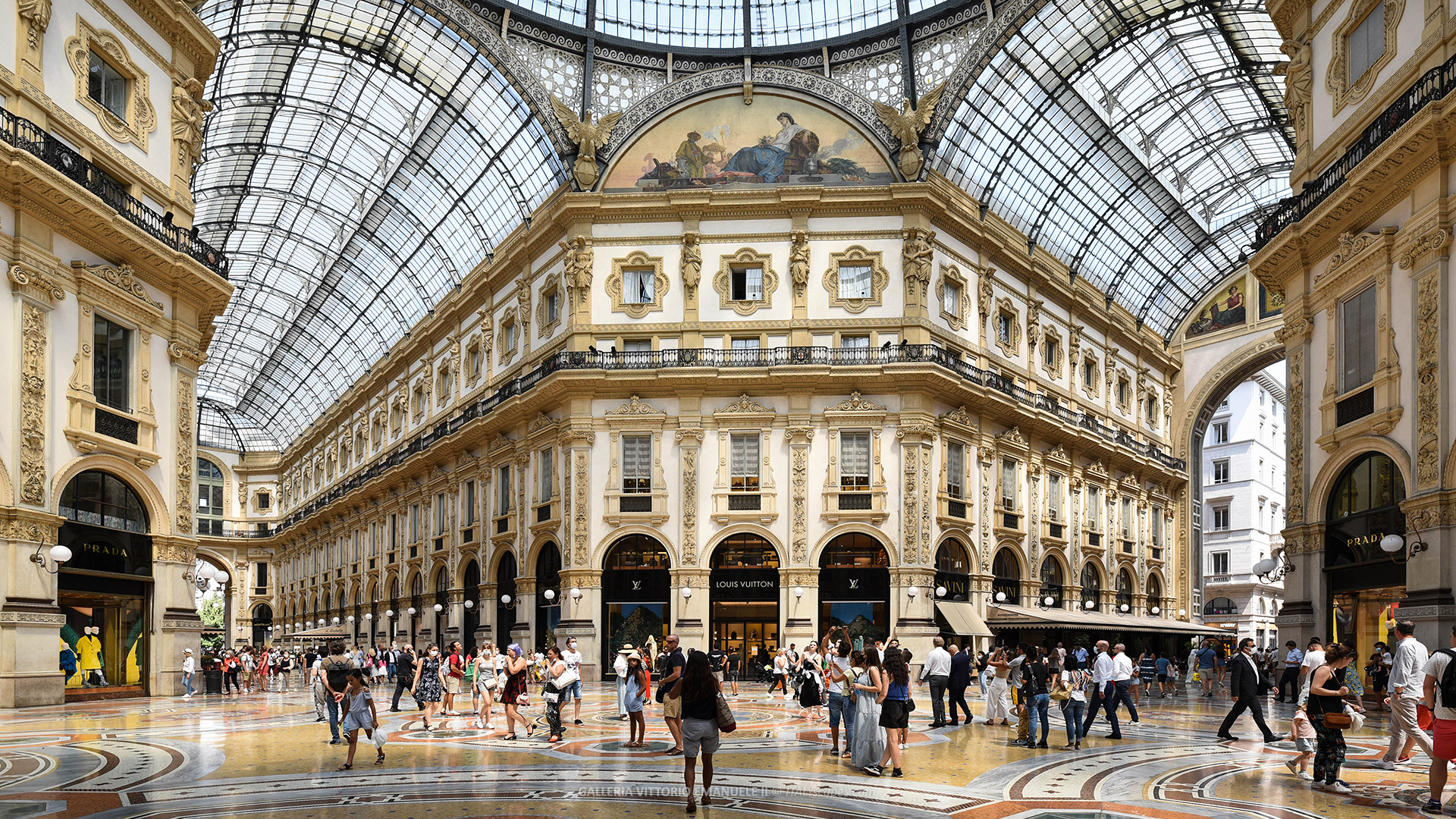
The impressive architecture of Galleria Vittorio Emanuele II with elaborate nineteenth-century decorations.
Art of the Galleria Vittorio Emanuele II
The Allegories of the Four Continents
Among the principal artistic decorations of Galleria Vittorio Emanuele II are four large painted allegories of the continents, positioned in lunettes beneath the central dome. Created during the nineteenth century, these compositions represent Europe, Asia, Africa, and America through female personifications accompanied by symbolic figures and objects.
The allegory of Europe was painted by Angelo Pietrasanta and depicts a female figure in classical clothing accompanied by a winged figure holding a laurel branch. The representation of Asia was created by Bartolomeo Giuliano and includes a seated female figure receiving offerings from surrounding attendants.
The allegory of Africa, painted by Eleuterio Pagliano, depicts a woman wearing ancient Egyptian-inspired clothing, accompanied by a lion and additional figures. America was represented by Raffaele Casnedi, who incorporated figures intended to symbolize the continent’s inhabitants. These compositions reflect nineteenth-century European approaches to geographical allegory.
The Allegories of Human Activities
Galleria Vittorio Emanuele II also contains four allegorical paintings representing important human activities. These decorations occupy semicircular spaces associated with the lateral entrances. Their subjects are Science, Industry, Art, and Agriculture, reflecting the intellectual, economic, and cultural values emphasized during Italy’s nineteenth-century modernization.
The allegory of Science was painted by Bartolomeo Giuliano, while Industry was created by Angelo Pietrasanta. The two compositions belong to a coordinated decorative program designed to complement the architectural setting. Their subjects emphasize scientific knowledge and industrial production as important aspects of contemporary society.
The remaining paintings represent Art, created by Raffaele Casnedi, and Agriculture, painted by Eleuterio Pagliano. Together, the four compositions establish a relationship between artistic creativity, scientific development, industrial activity, and agricultural production. Their placement integrates these themes into the broader symbolic decoration of the arcade.
The Floor Mosaics and the Bull of Turin
The floors of Galleria Vittorio Emanuele II feature extensive polychrome marble mosaics incorporating geometrical patterns, heraldic symbols, and ornamental compositions. The decoration of the central octagon includes the coat of arms of the House of Savoy, accompanied by its traditional dynastic motto, FERT.
Additional mosaics represent the coats of arms of Milan, Turin, Florence, and Rome, cities associated with the political history of Italy. The most famous is the bull of Turin, depicted as a heraldic animal. This particular mosaic has become one of the most visited decorative elements in the gallery.
According to a popular Milanese tradition, placing the right heel on the bull’s genitals and turning three times counterclockwise brings good luck. The repeated movement has caused considerable wear to the marble surface. The bull mosaic underwent another restoration in 2026, with the repaired pavement reopened to visitors in June.
Historical Sculptures and Artistic Representations
The original decorative program of Galleria Vittorio Emanuele II included 25 plaster statues representing important Italian historical figures, including Dante Alighieri, Leonardo da Vinci, and Camillo Benso, Count of Cavour. Several prominent nineteenth-century sculptors participated, including Odoardo Tabacchi, Antonio Tantardini, and Pietro Magni.
The statues were progressively removed beginning in 1891, following concerns about their deterioration. Their disappearance altered the original artistic composition of the central hall. Other decorative elements, including painted figures, ornamental reliefs, and architectural sculpture, remained part of the gallery’s historic interior.
Galleria Vittorio Emanuele II also became a subject of modern Italian painting. Umberto Boccioni depicted a violent street confrontation in Rissa in Galleria in 1910, while Carlo Carrà represented the arcade in Galleria di Milano. Both paintings are associated with the artistic experimentation of Italian Futurism.
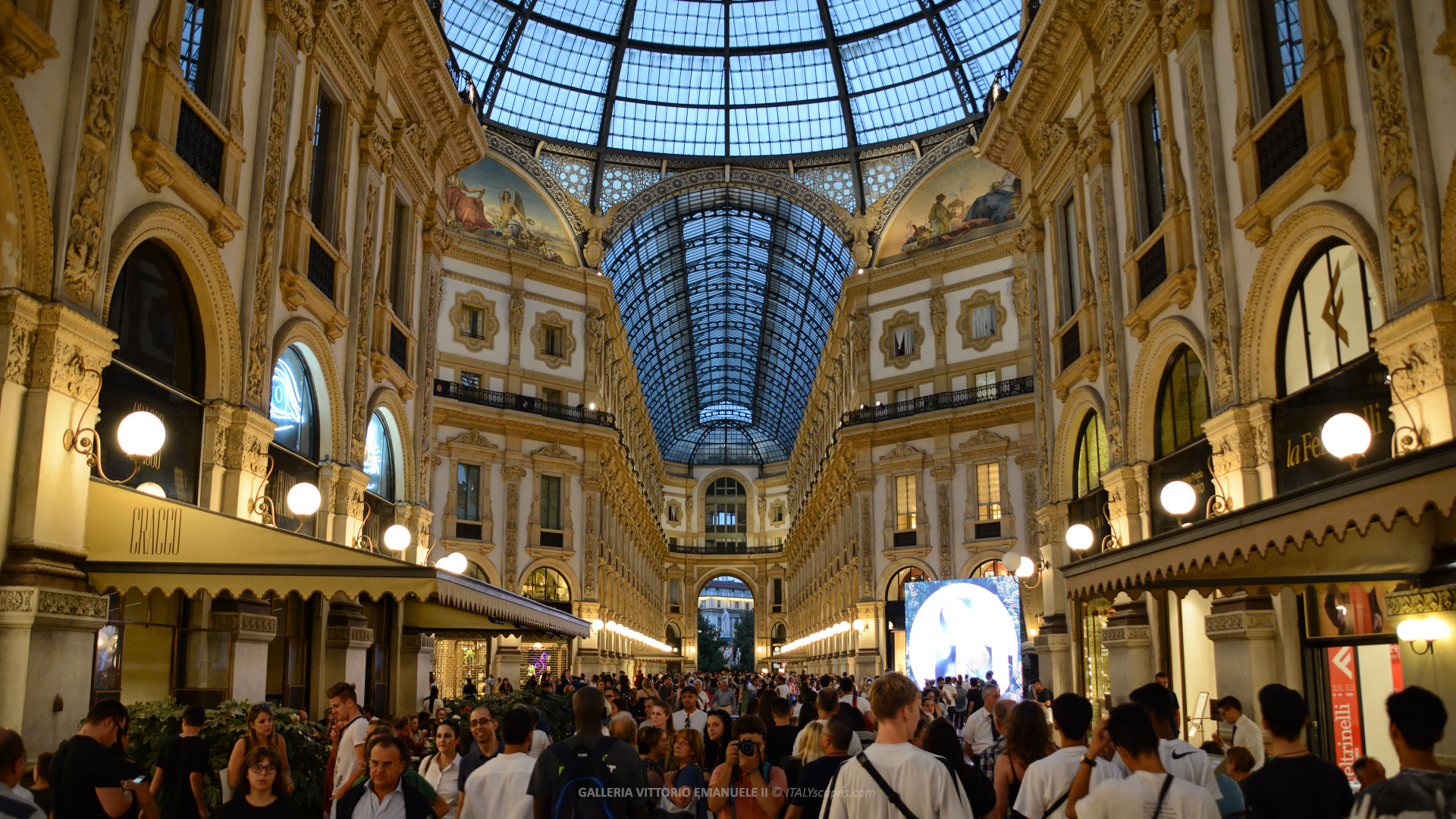
The magnificent interior of Galleria Vittorio Emanuele II in Milan, illuminated in the evening.
How to Get to the Galleria Vittorio Emanuele II
Galleria Vittorio Emanuele II is situated in central Milan, approximately three kilometers from Milano Centrale, the city’s principal railway station. The arcade has entrances facing Piazza del Duomo, Piazza della Scala, Via Ugo Foscolo, and Via Silvio Pellico. Visitors can reach the monument on foot, by metro, by bus, or by taxi.
Getting to the Galleria Vittorio Emanuele II on foot
Walking from Milano Centrale to Galleria Vittorio Emanuele II generally takes approximately 35-45 minutes, depending on the selected route and walking speed. The journey covers around three kilometers and crosses several central Milanese streets, including areas containing important nineteenth-century buildings and historical monuments.
Leave Milano Centrale through its main entrance and proceed along Via Vittor Pisani toward Piazza della Repubblica. Continue along Via Filippo Turati, passing Piazza Cavour, then follow Via Alessandro Manzoni in the direction of Teatro alla Scala, one of Milan’s most important cultural institutions.
At Piazza della Scala, walk toward the entrance of Galleria Vittorio Emanuele II, located opposite Teatro alla Scala. This entrance provides direct access to the covered arcade. The route also passes Palazzo Marino, the historical palace that serves as the seat of Milan’s municipal government.
Getting to the Galleria Vittorio Emanuele II by metro
The closest metro station to the southern entrance of Galleria Vittorio Emanuele II is Duomo, served by the M1 red line and M3 yellow line. The station has exits directly into Piazza del Duomo, only a short walk from the monumental entrance arch.
From Centrale FS, take the M3 yellow line toward San Donato. Travel four stops, passing Repubblica, Turati, and Montenapoleone, before disembarking at Duomo. The underground journey takes approximately six to eight minutes and requires no transfers between different metro lines.
After leaving Duomo, follow the signs toward Piazza del Duomo. The entrance to Galleria Vittorio Emanuele II is located on the northern side of the square, facing the cathedral. The entire journey generally takes approximately 10-15 minutes, including the final walk.
Getting to the Galleria Vittorio Emanuele II by bus
Visitors traveling from Milano Centrale by bus can use ATM line 60, which connects the railway station area with Piazza del Duomo through several central Milanese neighborhoods. The journey is considerably longer than the metro connection because the bus follows an indirect route through the city.
Board bus 60 at Stazione Centrale P.za Duca d’Aosta M2 M3, located outside the main railway station. Select the service traveling toward Duomo M1 M3 and remain on the bus until its final stop. The route passes through residential and commercial areas east of the historic center.
From Duomo M1 M3, continue on foot across Piazza del Duomo toward Galleria Vittorio Emanuele II. The entrance is only a short walk from the bus stop. Journey times depend on traffic conditions, and visitors should verify the current timetable before traveling.
Getting to the Galleria Vittorio Emanuele II by taxi
Official taxis are available outside Milano Centrale, particularly at the designated ranks in Piazza Duca d’Aosta. Traveling by taxi to Galleria Vittorio Emanuele II generally involves a road distance of approximately four kilometers, depending on traffic restrictions and the selected approach to the historic center.
Under normal conditions, the taxi journey generally takes approximately 10-20 minutes, although travel times can increase during peak commuting periods. Fares depend on the taximeter, journey duration, and applicable supplements. Licensed taxis can be recognized by their official markings and identification numbers.
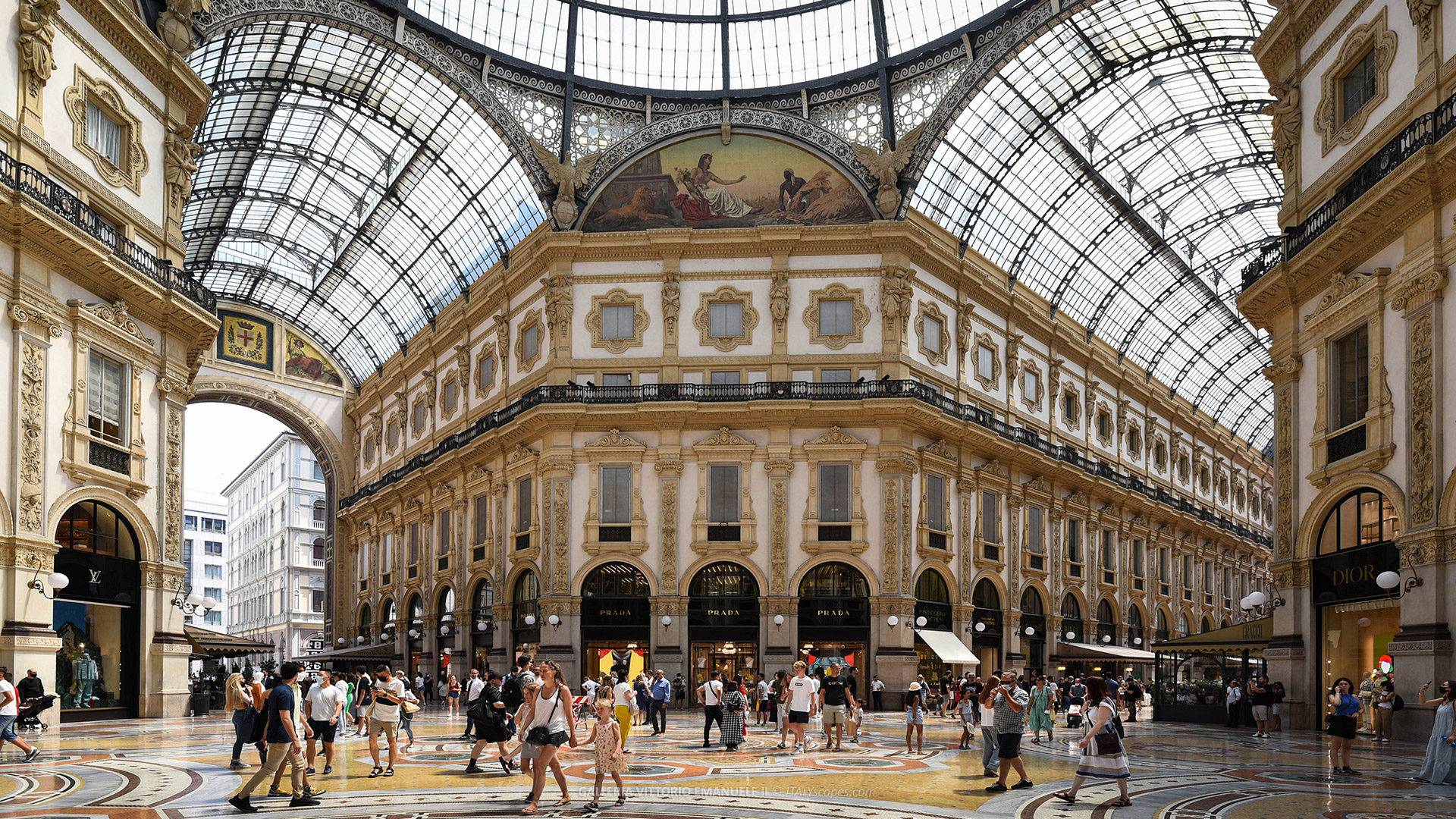
The central octagon of Galleria Vittorio Emanuele II, with the monumental glass dome.
Frequently Asked Questions about the Galleria Vittorio Emanuele II
Is Galleria Vittorio Emanuele II free to visit?
Yes. Access to the public pedestrian passages is free. Visitors can admire the architecture, glass dome, mosaics, and decorative elements without purchasing an admission ticket.
What are the opening hours of Galleria Vittorio Emanuele II?
The public arcade is generally accessible 24 hours a day. Shops, restaurants, and cafés maintain their own opening hours, while temporary restrictions may apply during special events.
How long does it take to visit Galleria Vittorio Emanuele II?
A general architectural visit takes approximately 15-30 minutes. Visitors planning to explore the boutiques, take photographs, or stop at a café should allow additional time.
Why is Galleria Vittorio Emanuele II called Milan’s Drawing Room?
The nickname Il Salotto di Milano reflects its historical role as a gathering place for Milan’s bourgeoisie, intellectuals, businessmen, and visitors during the late nineteenth century.
What is the significance of the bull mosaic inside the gallery?
The bull represents Turin’s coat of arms. According to local tradition, rotating three times on the mosaic while resting the right heel on the bull brings good luck.
When did Prada open its first shop in Galleria Vittorio Emanuele II?
Prada opened its original boutique in the gallery in 1913, founded by Mario Prada. The historic location remains closely associated with the company’s origins in luxury leather goods.
Are there historic cafés inside Galleria Vittorio Emanuele II?
Yes. Historic establishments include Camparino in Galleria, associated with the Campari family, and Caffè Biffi. Their presence reflects the arcade’s longstanding commercial and social traditions.
Can visitors access the glass roof of Galleria Vittorio Emanuele II?
The glass roof is not part of the ordinary public pedestrian route. Access to elevated areas depends on specific visitor arrangements and is not guaranteed.
Is Galleria Vittorio Emanuele II accessible to wheelchair users?
The main pedestrian passages are at street level and generally accessible to wheelchair users. Accessibility arrangements for individual shops, restaurants, and upper floors vary.
-
Photos
-
Map
-
Reviews


