Table of Contents
Lucca is compact enough to explore in one full day, but its churches, towers, palaces, Roman remains, and Renaissance walls require a carefully ordered route. This Lucca itinerary connects the city’s essential monuments while limiting unnecessary backtracking and reserving enough time for several meaningful interior visits.
The Lucca itinerary begins at Lucca railway station, immediately south of the historic centre. It enters through Porta San Pietro, reaches the Cathedral of San Martino, crosses the principal civic squares, follows Via Fillungo, and continues toward Torre Guinigi, Piazza dell’Anfiteatro, Basilica di San Frediano, Palazzo Pfanner, and the city walls.
This Lucca itinerary is designed for approximately ten hours in Lucca, from 8:30 am until around 6:30 pm. It includes a proper lunch, a short coffee break, one tower climb, and time inside the cathedral, the Puccini Museum, San Frediano, and Palazzo Pfanner, although some entries can be removed for a slower visit.
Lucca contains far more monuments than anyone can study properly in a single day. The National Museums of Villa Guinigi and Palazzo Mansi, the archaeological complex of Santi Giovanni e Reparata, additional churches, and the full circuit of the walls all deserve more time. The Lucca itinerary therefore prioritises a balanced first visit rather than an impossible checklist.
Why This One-Day Lucca Itinerary Works
Lucca’s historic centre is completely enclosed by an intact Renaissance fortification measuring approximately 4,223 metres. Most major attractions stand within a relatively small area, and the flat urban terrain makes walking straightforward. The only strenuous sections of this Lucca itinerary are the tower stairs and any extended walk on the walls.
The Lucca itinerary follows the city’s geography and historical development. It begins with the Renaissance gate and defensive circuit, moves to the religious centre around San Martino, crosses the Napoleonic and medieval civic spaces, reaches the Roman forum, and then continues through the merchant streets toward Lucca’s medieval towers and ancient amphitheatre.
The programme also avoids climbing both civic towers. Torre delle Ore is the tallest tower in Lucca, while Torre Guinigi is the city’s most recognisable tower because of the holm oaks growing on its summit. This Lucca itinerary selects Torre Guinigi for the climb and treats Torre delle Ore as an architectural stop.
A realistic day should not depend on every attraction being open at the same time. Religious services, seasonal schedules, restoration work, and special events can affect access. Before travelling, check the official timetables for the cathedral complex, civic towers, Puccini Museum, Basilica di San Frediano, and Palazzo Pfanner, especially during winter months.

8:30 am – Start at Lucca Railway Station
Begin at Lucca railway station, which stands directly opposite the southern side of the walls. The closest pedestrian access through the San Colombano bastion is about 200 metres away, while Porta San Pietro is approximately 300 metres from the station. This unusually short approach makes the historic centre immediately accessible.
Do not enter the city through the first available opening without looking at the fortifications from outside. The grassy glacis, brick walls, projecting bastions, and tree-lined upper promenade reveal the scale of Lucca’s final defensive circuit more clearly from ground level than from the streets inside the centre.
From the station forecourt, walk left toward Porta San Pietro. This short approach provides a clear view of the southern curtain and allows the Lucca itinerary to begin at one of the three original gates created during the construction of the present walls. The gate was opened in 1565.
8:40 am – Porta San Pietro and the Southern Fortifications
Porta San Pietro was the principal southern entrance through the Renaissance walls and remains the most convenient gateway for travellers arriving by train. Its position connected the city with roads leading toward Pisa, while its controlled passages formed part of the defensive system completed between the 16th and 17th centuries.
The present walls were Lucca’s third major defensive circuit. Their formal planning began in 1513, construction started in 1544, and the work was completed in 1650. They were designed for artillery warfare, with broad earth-filled structures, curtains, bastions, underground spaces, and protected routes rather than the thin vertical walls of a medieval fortress.
Lucca’s fortifications were never subjected to a major military siege after completion. During the 19th century, the upper circuit was transformed into a public promenade with regular avenues of trees. This peaceful conversion preserved the walls while giving them a new civic function that remains central to daily life in Lucca.
At this point in the Lucca itinerary, pass through Porta San Pietro and continue toward Piazza San Martino. Resist the temptation to begin a complete wall circuit immediately. The cathedral and other ticketed monuments are better visited during their opening hours, while the walls remain freely accessible and can be explored later in the afternoon light.
9:00 am – A Short Walk on the Walls at San Colombano
Before reaching the cathedral, take a short introductory walk on the southern section of the walls near the San Colombano bastion. Ramps and passages provide access to the broad upper promenade, where the defensive structure becomes a raised, tree-lined avenue overlooking both the historic centre and the land outside the fortified perimeter.
The complete circuit includes ten bastions and one platform. Their projecting forms allowed defenders to cover adjoining walls with artillery fire, while the massive earth-filled construction absorbed cannon impacts more effectively than earlier stone fortifications. These features explain why the walls are not merely ornamental landscaping but a Renaissance military system.
Keep this morning walk to approximately 20 minutes. The purpose is to understand the walls before entering the dense centre, not to complete the entire 4.2-kilometre circuit. From the elevated promenade, church towers and tiled roofs provide an immediate visual introduction to Lucca’s traditional description as the “City of a Hundred Churches”.
Descend near the southern centre and continue to Piazza San Martino. The transition is short, but it moves from the city’s defensive boundary to its religious heart. Arriving before the busiest part of the morning also gives you time to study the cathedral façade before entering the monumental complex.
9:30 am – Cathedral of San Martino and Piazza San Martino
The Cathedral of San Martino is the principal religious monument in Lucca and the most important interior visit in this Lucca itinerary. The church was consecrated in 1070 by Pope Alexander II, who had previously served as Bishop of Lucca, but repeated rebuilding campaigns produced the complex structure visible today.
The façade is deliberately asymmetrical because the existing bell tower restricted its right side. Its lower portico and upper galleries contain numerous columns with different decorative patterns, creating one of the most distinctive examples of Lucchese Romanesque architecture. The sculptural decoration includes work connected with the workshop of Guidetto.
Before entering, examine the small carved labyrinth on a pier of the portico. Its accompanying Latin inscription refers to the Cretan labyrinth associated with Daedalus and Theseus. The motif predates the famous labyrinth at Chartres Cathedral and forms one of the most discussed details of the façade.
Inside, the most important devotional object is the Volto Santo, a large wooden crucifix preserved in a polygonal chapel built in 1484 by Matteo Civitali. The crucifix has been central to Lucca’s religious identity and to the annual Luminara di Santa Croce procession held on the evening of September 13.
The cathedral also contains the funerary monument Ilaria del Carretto, carved by Jacopo della Quercia after the death of Paolo Guinigi’s young wife in 1405. The recumbent figure, elegant drapery, and small dog at her feet make the work one of the most celebrated examples of early Renaissance sculpture.
Allow approximately 60 minutes for the cathedral. Focus on the architecture, the Volto Santo, Ilaria del Carretto, Matteo Civitali’s works, and selected paintings rather than trying to study every chapel. The associated museum, bell tower, and archaeological area require additional time and are better reserved for a second visit.

The façade of the Cathedral of San Martino
10:35 am – Piazza Napoleone and Palazzo Ducale
From Piazza San Martino, walk west toward Piazza Napoleone, Lucca’s largest central square. The space was created in 1806 by order of Elisa Bonaparte Baciocchi, Napoleon’s sister and ruler of Lucca and Piombino. Houses, shops, warehouses, a tower, and the church of San Pietro Maggiore were demolished for the new urban project.
Despite its name and Napoleonic origins, the monument in the centre does not represent Napoleon. The statue honours Maria Luisa of Bourbon, Duchess of Lucca, and was created by Lorenzo Bartolini. The square therefore records two successive political periods through its name, planning, and central monument.
Palazzo Ducale occupies the western side of the square. The site had been associated with political power since the fortifications of Castruccio Castracani and the residence of Paolo Guinigi. Later phases involved architects including Bartolomeo Ammannati, Filippo Juvarra, and Lorenzo Nottolini, producing a multi-period palace.
Today, Palazzo Ducale houses public institutions, including the prefecture and provincial administration, so it should be treated mainly as an exterior architectural stop unless a temporary exhibition or accessible area is specifically open. Spend time in the courtyards only where public access is clearly permitted.
Allow approximately 25 minutes for the square, the palace façade, and the nearby Piazza del Giglio. The latter is dominated by Teatro del Giglio, Lucca’s historic theatre. The Lucca itinerary does not include a theatre visit, because the next stages contain the city’s principal civic and musical landmarks.
11:10 am – Piazza San Michele and San Michele in Foro
Continue north to Piazza San Michele, the historical civic centre of Lucca. The square occupies the site of the Roman forum, where the main streets of the ancient settlement intersected. Its continuing role as a meeting and commercial space demonstrates the urban continuity between Roman Lucca and the medieval city.
San Michele in Foro was first documented in 795, while construction of the present church began in 1070 under Pope Alexander II. The long building history produced a structure that combines Romanesque elements with later Gothic features, although the ornate façade remains its most immediately recognisable component.
The upper façade rises above the roofline in multiple tiers of open loggias. Each column differs in material or decoration, and the summit carries a large statue of Saint Michael defeating the dragon, accompanied by two angels. The composition gives the church a strong vertical profile despite the relatively low nave behind it.
Enter briefly if the church is open and no service is taking place. The interior is more restrained than the façade and preserves works from different periods, including a glazed terracotta Madonna and Child from the Della Robbia workshop and a panel of Four Saints by Filippino Lippi.
Spend approximately 35 minutes in the square and church. Notice Palazzo Pretorio on the southern side, traditionally associated with Matteo Civitali, but do not repeat the longer palace visit planned elsewhere. This stop is primarily about Lucca’s Roman forum, communal centre, and monumental Romanesque church.

Piazza San Michele
11:50 am – Piazza Cittadella and the Puccini Museum
Walk a few minutes west to Piazza Cittadella and Corte San Lorenzo. Giacomo Puccini was born here on December 22, 1858, in an apartment on the second floor of a historic building. The house now contains the Puccini Museum – Birthplace, one of Lucca’s most important cultural museums.
In Piazza Cittadella, the bronze Monument to Giacomo Puccini by Vito Tongiani depicts the composer seated in an informal pose. The sculpture was installed in 1994 and identifies the small square immediately with the musician whose operas brought Lucca’s name into theatres around the world.
The museum rooms are arranged to evoke the home during Puccini’s early life and present documents, letters, portraits, furniture, costumes, and personal possessions. The collection explains the composer’s family background, musical education, private interests, and the creation of operas such as La Bohème, Tosca, Madama Butterfly, and Turandot.
One of the most important objects is the Steinway piano connected with Puccini’s final creative period. It came from his villa in Viareggio, where he worked on Turandot. The museum therefore combines the authentic birthplace with materials from later stages of the composer’s life and career.
Allow 35 to 45 minutes for the museum. Visitors with no interest in opera can treat the birthplace as an optional stop and use the time for the cathedral museum or a longer wall walk. For music lovers, however, removing Puccini from a Lucca itinerary would leave out a fundamental part of the city’s identity.
12:35 pm – Coffee Break, Via Fillungo, and Torre delle Ore
After the museum, take a 15-minute coffee or water break before joining Via Fillungo. This narrow medieval street is the main commercial axis of the historic centre and follows part of the ancient north-south route through Lucca. Its shops occupy buildings that preserve a dense historic streetscape.
Via Fillungo is not a single monument, so its value lies in movement and observation. Look for medieval façades, projecting upper floors, old shopfronts, side alleys, and views toward towers and churches. Walk at a normal pace rather than treating the street as a shopping detour that consumes the entire midday period.
At the corner with Via dell’Arancio stands Torre delle Ore. At 50 metres, it is the tallest surviving tower in Lucca. Originally associated with the Quartigiani family, it was acquired by the General Council in 1490 and became the city’s civic clock tower.
The tower’s present clock mechanism was made in 1752 by Louis Simon of Geneva. A new dial was installed two years later by the Lucchese clockmaker Sigismondo Caturegli, while Stefano Filippi cast three new bells. The mechanism still marks hours and quarter-hours as part of Lucca’s secular timekeeping tradition.
Do not climb Torre delle Ore during this route unless Torre Guinigi is closed. Reaching the top requires approximately 290 wooden steps, and climbing both towers would duplicate the panoramic experience while using valuable time. Study the exterior, listen for the bells, and continue toward lunch.
1:10 pm – Lunch in the Historic Centre
Take lunch near Via Fillungo, Piazza San Michele, Piazza dell’Anfiteatro, or the streets between them. Reserve approximately 60 minutes, including ordering and a short rest. By this stage, the Lucca itinerary has already covered the walls, cathedral, two major squares, San Michele, Puccini’s birthplace, and the civic clock tower.
A practical lunch should be substantial without becoming a long formal meal. Traditional local choices can include tordelli lucchesi, garmugia, frantoiana soup, or other seasonal dishes. Buccellato, a sweet bread containing raisins and aniseed, is a characteristic Luccan speciality suitable for dessert or a later snack.
Avoid eating a large meal immediately before the tower climb. Torre Guinigi requires more than 200 steps, and the final sections become narrower. Use the lunch break to drink water, check admission availability, and decide whether the afternoon should include both Palazzo Pfanner and a long section of the walls.
2:15 pm – Torre Guinigi and the Hanging Garden
After lunch, walk east toward Torre Guinigi, which rises at the corner of Via Sant’Andrea and Via delle Chiavi d’Oro. The tower belonged to the powerful Guinigi family and forms part of a medieval residential complex. At 45 metres high, it is slightly lower than Torre delle Ore but far more visually distinctive.
Lucca once contained more than one hundred towers, and medieval merchant families used them as signs of wealth, prestige, defence, and political competition. Most were demolished, lowered, or lost. Torre Guinigi survives as the clearest monument to the period when Lucca was known as the “City of a Hundred Towers”.
The defining feature is the small hanging garden at the summit, where mature holm oaks grow above the brick structure. The trees create an unmistakable silhouette and distinguish Torre Guinigi from the conventional stone or brick towers found in many other Italian cities.
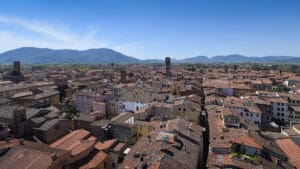
Climb slowly and allow other visitors to pass where the stairway narrows. The route includes more than 200 steps, but the summit offers wide views over red-tiled roofs, church façades, bell towers, the complete line of the walls, and the hills surrounding the Lucca plain.
Allow approximately 45 minutes for entry, ascent, photographs, and descent. In high summer, carry water and avoid the hottest part of the afternoon where possible. If the tower is closed, use Torre delle Ore as the alternative panoramic climb and keep the rest of the Lucca itinerary unchanged.
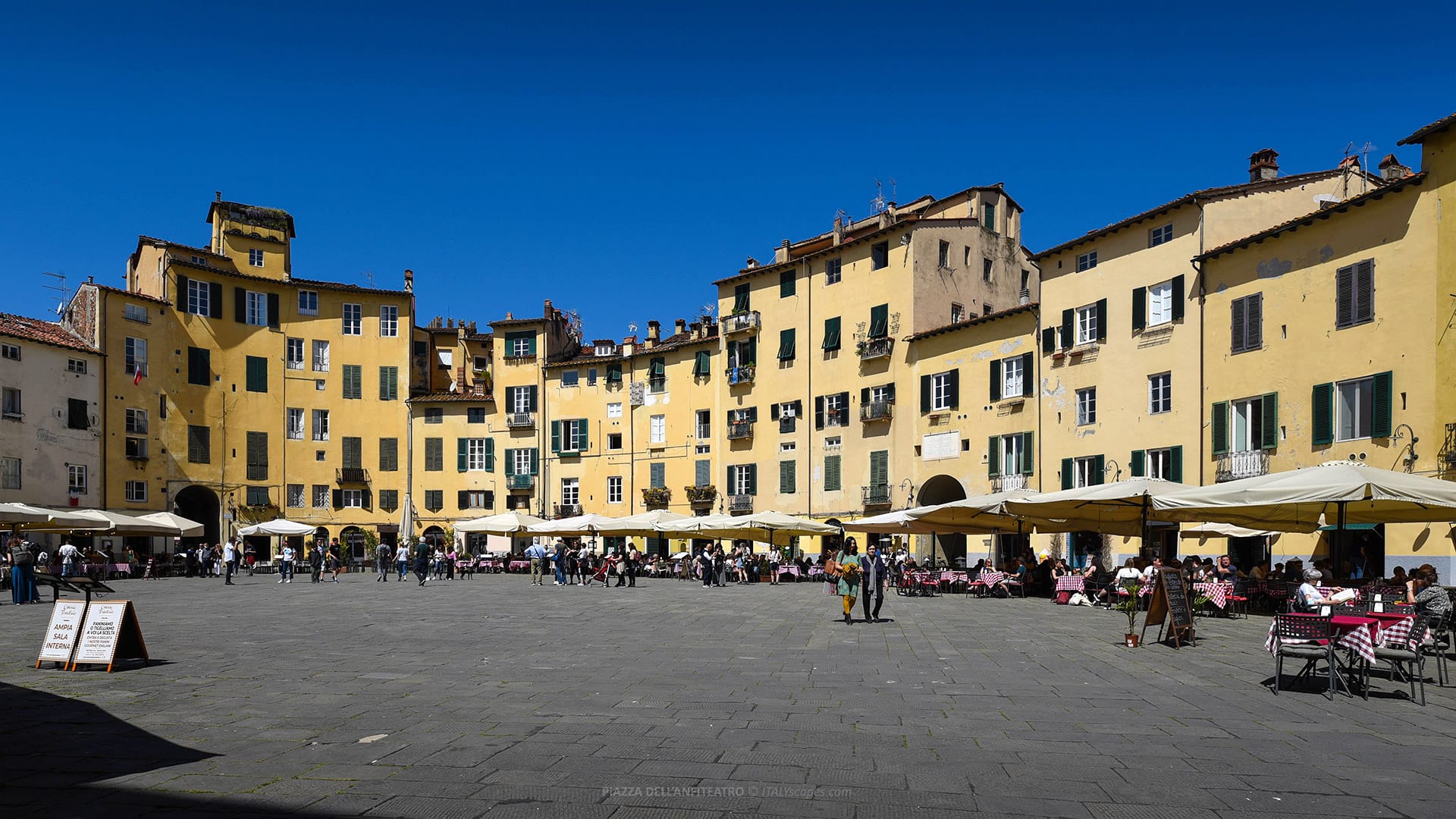
Piazza dell’Anfiteatro
3:05 pm – Piazza dell’Anfiteatro
From Torre Guinigi, continue north toward Piazza dell’Anfiteatro. The present square preserves the elliptical outline of Lucca’s Roman amphitheatre, which was built outside the earliest city walls in the 1st or 2nd century AD. The ancient structure now lies approximately three metres below ground.
The Roman amphitheatre had two external orders of 55 arches and a cavea of about twenty seating rows, with an estimated capacity of approximately 10,000 spectators. After antiquity, houses, workshops, storage spaces, and other buildings gradually occupied its surviving walls and internal area.
Beginning in 1830, architect Lorenzo Nottolini reorganised the site. Buildings that had filled the central space were removed, and a ring street was created around the perimeter. The intervention transformed the crowded remains into the open elliptical square recognised today while retaining the ancient footprint.
Enter through one of the four vaulted passages rather than approaching only from the busiest opening. The enclosed oval, curved façades, irregular roofline, and narrow entrances make the original amphitheatre’s geometry visible without exposing large archaeological ruins.
Allow approximately 25 minutes for a complete circuit of the square. Cafés and restaurants occupy much of the ground level, but the stop should focus on the relationship between Roman structure and later housing. This is not a reconstructed arena; it is a living urban space formed by continuous reuse.
3:40 pm – Basilica di San Frediano
Walk west from Piazza dell’Anfiteatro to the Basilica di San Frediano. The church is one of the oldest religious sites in Lucca and is traditionally connected with Bishop Fridianus, who led the local church during the 6th century. The present building largely reflects its medieval reconstruction.
Unlike San Michele and San Martino, San Frediano has a comparatively restrained lower façade. Its dominant feature is the large 13th-century mosaic in the upper section, representing the Ascension of Christ. The brilliant gold background introduces a visual element associated with Byzantine artistic traditions.
Inside, the nave is divided by ancient columns and supports a timber roof. One of the most important objects is the 12th-century baptismal font, whose sculpted scenes are arranged around a large circular basin. The work combines biblical imagery with the ceremonial function of Christian baptism.
The basilica contains the preserved body of Saint Zita, who died in 1278 and became one of Lucca’s most venerated saints. Her feast is celebrated on April 27, when Piazza San Frediano and nearby streets are traditionally filled with flowers and plants.
Important chapels include the Chapel of Saint Augustine, decorated with frescoes by Amico Aspertini, and the Trenta Chapel, which contains works associated with Jacopo della Quercia. These additions demonstrate how family patronage transformed the early basilica into a layered artistic complex.
Allow approximately 40 minutes inside. The church is also linked to the Volto Santo: according to local tradition, the crucifix was first kept at San Frediano before being transferred to the cathedral. The annual September procession begins here and retraces that symbolic transfer through the city.
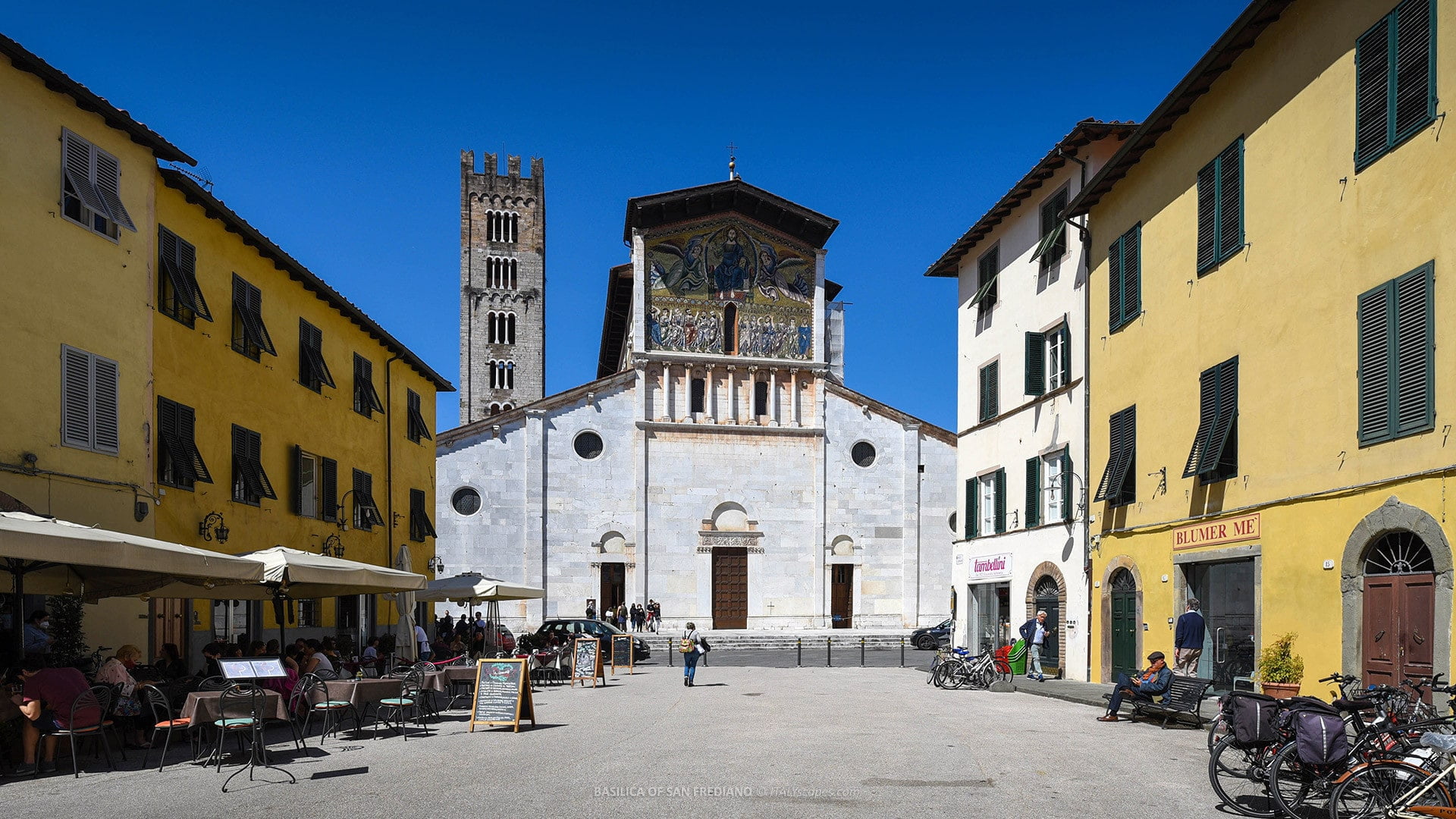
Basilica of San Frediano
4:30 pm – Palazzo Pfanner and Its Baroque Garden
From San Frediano, walk a short distance west to Palazzo Pfanner, positioned near the inner side of the walls. The palace was begun for the Moriconi family, wealthy silk merchants, during the 17th century. Financial difficulties forced them to sell the property to the Controni family in 1680.
The Controni expanded and decorated the residence. The monumental external staircase is traditionally attributed to the Lucchese architect Domenico Martinelli, while the early 18th-century redesign of the garden is attributed to Filippo Juvarra. Together, these elements created one of Lucca’s most recognisable Baroque ensembles.
The formal garden contains a central avenue, clipped vegetation, lemon trees, statues representing mythological figures and seasonal themes, and a large fountain added during a later phase. The palace façade and open staircase form the architectural backdrop, while the nearby walls rise directly beyond the garden.
Felix Pfanner, an Austrian brewer, arrived in Lucca in 1846 and established a brewery on the property. The business became closely associated with the palace and operated until 1929. The Pfanner family gradually acquired the residence, which still carries their name.
Allow 40 to 50 minutes for the garden and accessible museum rooms. Palazzo Pfanner is seasonal and can close for private events or extraordinary circumstances, so verify access in advance. If it is unavailable, use the time for a longer section of the walls or the National Museum of Palazzo Mansi.
5:20 pm – Walk the Renaissance Walls
After Palazzo Pfanner, reach the walls on the northern or northwestern side of the centre and begin the final major section of the Lucca itinerary. The upper promenade is broad, level, and lined with trees, making it fundamentally different from narrow wall walks built on battlements in other fortified cities.
A complete circuit measures approximately 4.2 kilometres and usually requires about one hour at a steady pace without long stops. After a full day of sightseeing, a partial circuit of two to three kilometres is more realistic. Continue south and east toward Porta San Pietro and the San Colombano bastion.
From the walls, identify landmarks already visited rather than introducing new detours: the cathedral bell tower, San Michele, Torre delle Ore, Torre Guinigi, San Frediano, and the roofs surrounding Piazza dell’Anfiteatro. Their relative positions become clear from the elevated circular route.
The walls contain curtains, bastions, ramps, sorties, interior chambers, and underground passages. Some spaces are accessible only through specific entrances or attractions, while the upper promenade is generally open and free. Respect barriers around grassy slopes and areas closed for maintenance.
The tree planting and public promenade belong mainly to the 19th-century transformation of the fortifications. Before that conversion, the walls had remained a strategic military structure. Their survival was aided by Lucca’s political history and by the absence of destructive modern expansion through the Renaissance circuit.
Take approximately 60 minutes for this final walk, including short rests and photographs. Cyclists, runners, families, and local residents use the same route, so keep to a predictable line and avoid blocking the avenue. The walls are both a monument and an active public park.
6:30 pm – Return to Porta San Pietro and Lucca Station
Descend near Porta San Pietro or the San Colombano bastion. From Porta San Pietro, Lucca railway station is only about 300 metres away. Travellers with an early evening train can reach the platforms quickly, but they should still allow time for ticket validation, platform changes, and possible queues.
If you are staying overnight, return to the historic centre for dinner. Piazza San Michele, the streets near Via Fillungo, and quieter areas south of Piazza Napoleone provide many options without requiring another long walk.
Evening concerts connected with Puccini are regularly organised in Lucca, although programmes and venues vary by season. A concert can extend the cultural theme of the route, but it should be booked separately and should not determine the daytime schedule unless the performance has a fixed admission time.
By the end of the day, the Lucca itinerary has connected the Renaissance walls, the cathedral, Napoleonic urban planning, the Roman forum, Puccini’s birthplace, medieval merchant streets, surviving towers, the Roman amphitheatre, a major basilica, and a Baroque palace without leaving the historic centre.
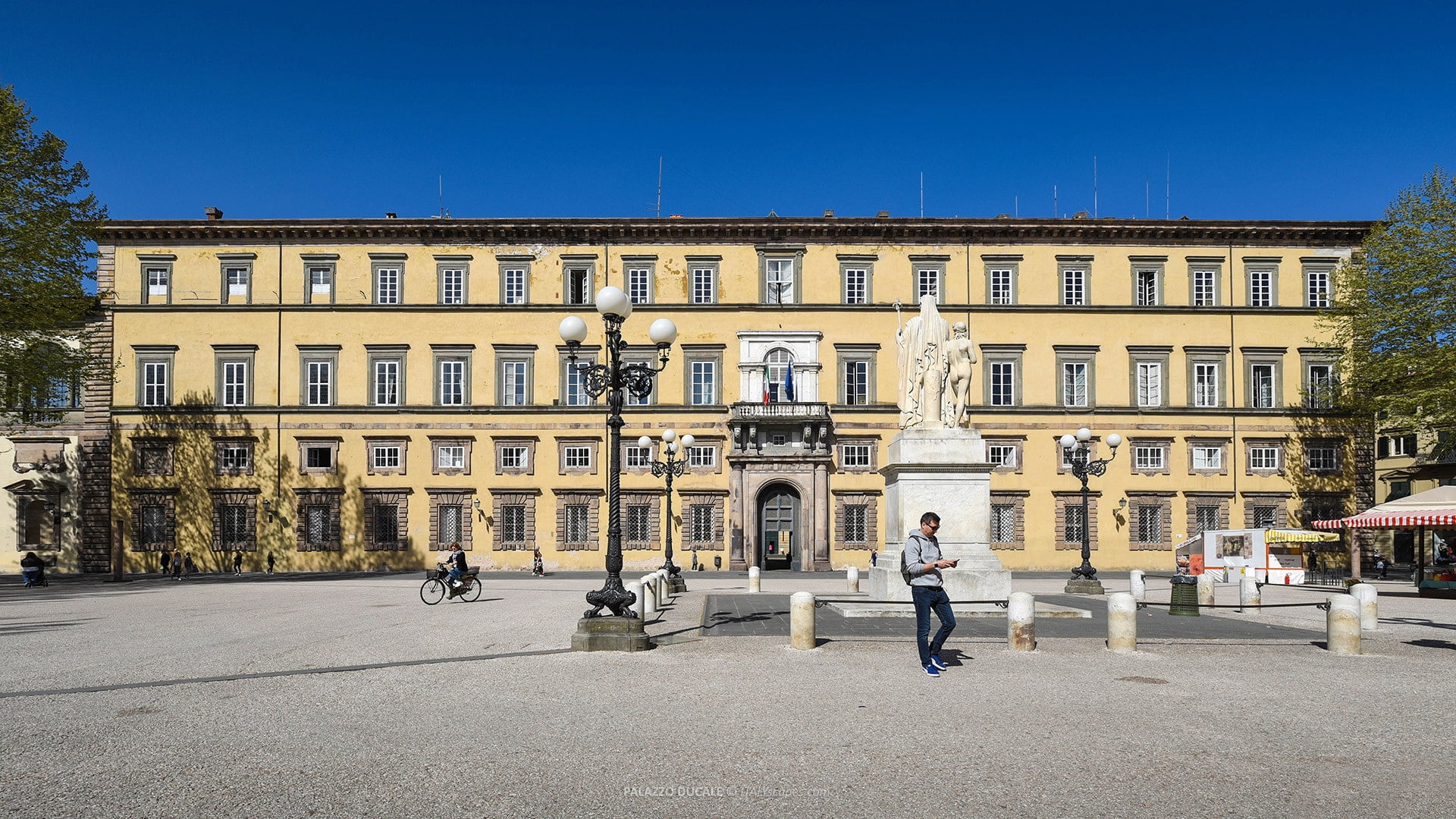
Palazzo Ducale
Practical Walking Summary
The complete route covers approximately six to eight kilometres, depending on the wall section, museum circulation, and small detours. Completing the entire 4.2-kilometre wall circuit can increase the total. The terrain is mostly flat, but tower stairs substantially increase the physical effort.
The most demanding activity is the ascent of Torre Guinigi. Torre delle Ore should remain an exterior stop unless Torre Guinigi is unavailable. Visitors with limited mobility can remove both climbs and still experience the city’s principal churches, squares, museum, amphitheatre, palace, and walls at ground level.
The most efficient paid-entry combination is the Cathedral of San Martino, Puccini Museum, Torre Guinigi, Basilica di San Frediano, and Palazzo Pfanner. Travellers who prefer art museums should replace Puccini or Pfanner with Villa Guinigi or Palazzo Mansi rather than adding another long interior visit.
Carry water in warm weather, particularly before the tower and wall sections. Lucca’s centre contains many cafés and fountains, but opening conditions and water availability can vary. Churches require respectful clothing and may restrict tourist access during services, funerals, weddings, or religious celebrations.
Best Adjustments for Sundays, Winter, and Shorter Visits
On Sundays and major religious holidays, tourist access to churches can begin later or pause during services. Start with the walls, Piazza Napoleone, Piazza San Michele, Puccini Museum, or the external monuments, then move the cathedral and San Frediano to confirmed visitor periods.
During winter, Palazzo Pfanner and the civic towers may operate on reduced or seasonal schedules. Build the Lucca itinerary around attractions with confirmed opening times and use closed periods for the walls, Piazza dell’Anfiteatro, Via Fillungo, Piazza San Michele, and the external architecture of the churches.
For a shorter six-hour route, remove Palazzo Pfanner and the Puccini Museum. Keep Porta San Pietro, San Martino, Piazza Napoleone, San Michele, Via Fillungo, Torre Guinigi, Piazza dell’Anfiteatro, San Frediano, and a short wall walk. This version preserves Lucca’s essential historical layers.
For a slower Lucca itinerary, choose only one major church interior in addition to the cathedral, one tower, and one museum. Lucca rewards careful observation of façades, street alignments, courtyards, and reused Roman structures. Removing stops can therefore improve the visit rather than reduce its historical value.
Final Route Overview
Lucca railway station → Porta San Pietro → San Colombano bastion → Cathedral of San Martino → Piazza Napoleone → Palazzo Ducale → Piazza San Michele → San Michele in Foro → Piazza Cittadella → Puccini Museum → Via Fillungo → Torre delle Ore → Torre Guinigi → Piazza dell’Anfiteatro → Basilica di San Frediano → Palazzo Pfanner → Walls → Porta San Pietro.
This Lucca itinerary works because it forms a continuous route through the centre and reserves the walls for the final section. It limits major climbs to one tower and combines exterior stops with carefully selected interiors. The programme is full, but it does not require constant rushing between distant neighbourhoods.
The route deliberately excludes several important sites, including the National Museum of Villa Guinigi, National Museum of Palazzo Mansi, the Cathedral Museum, Santi Giovanni e Reparata, San Francesco, the Botanical Garden, and a complete study of the walls. Each omission protects the realistic timing of one day.
Used as planned, this one-day Lucca itinerary provides a coherent introduction to the city: Roman Lucca in the forum and amphitheatre, medieval Lucca in its churches and towers, Renaissance Lucca in its walls and palaces, Napoleonic Lucca in Piazza Napoleone, and musical Lucca in the birthplace of Giacomo Puccini.
Frequently Asked Questions about a Lucca Itinerary
Can you see Lucca in one day?
Yes. Lucca’s compact historic centre makes a one-day visit realistic. A well-planned route can include major churches, squares, towers, museums, Roman remains, palaces, and sections of the city walls.
How long does this Lucca itinerary take?
The complete itinerary takes approximately ten hours, from around 8:30 am to 6:30 pm. It includes sightseeing, several interior visits, one tower climb, lunch, and a short coffee break.
How much walking is involved in this Lucca itinerary?
Expect approximately six to eight kilometres of walking, depending on detours and how much of the walls you cover. Completing the entire 4.2-kilometre wall circuit increases the total distance.
Where should I start a one-day visit to Lucca?
Lucca railway station is an excellent starting point because it lies immediately south of the historic centre. Porta San Pietro, one of the main entrances through the walls, is about 300 metres away.
Which tower should I climb in Lucca?
Torre Guinigi is the recommended climb because its rooftop garden with holm oaks makes it Lucca’s most distinctive tower. Torre delle Ore can be used as an alternative if Guinigi is closed.
Can you walk all the way around Lucca’s walls?
Yes. The complete Renaissance wall circuit measures approximately 4.2 kilometres and usually takes about one hour at a steady pace. After a full sightseeing day, a shorter section may be more practical.
What are the essential attractions on a one-day Lucca itinerary?
Essential stops include San Martino Cathedral, Piazza Napoleone, San Michele in Foro, Torre Guinigi, Piazza dell’Anfiteatro, Basilica di San Frediano, the Renaissance walls, and central medieval streets.