-
About
Table of Contents
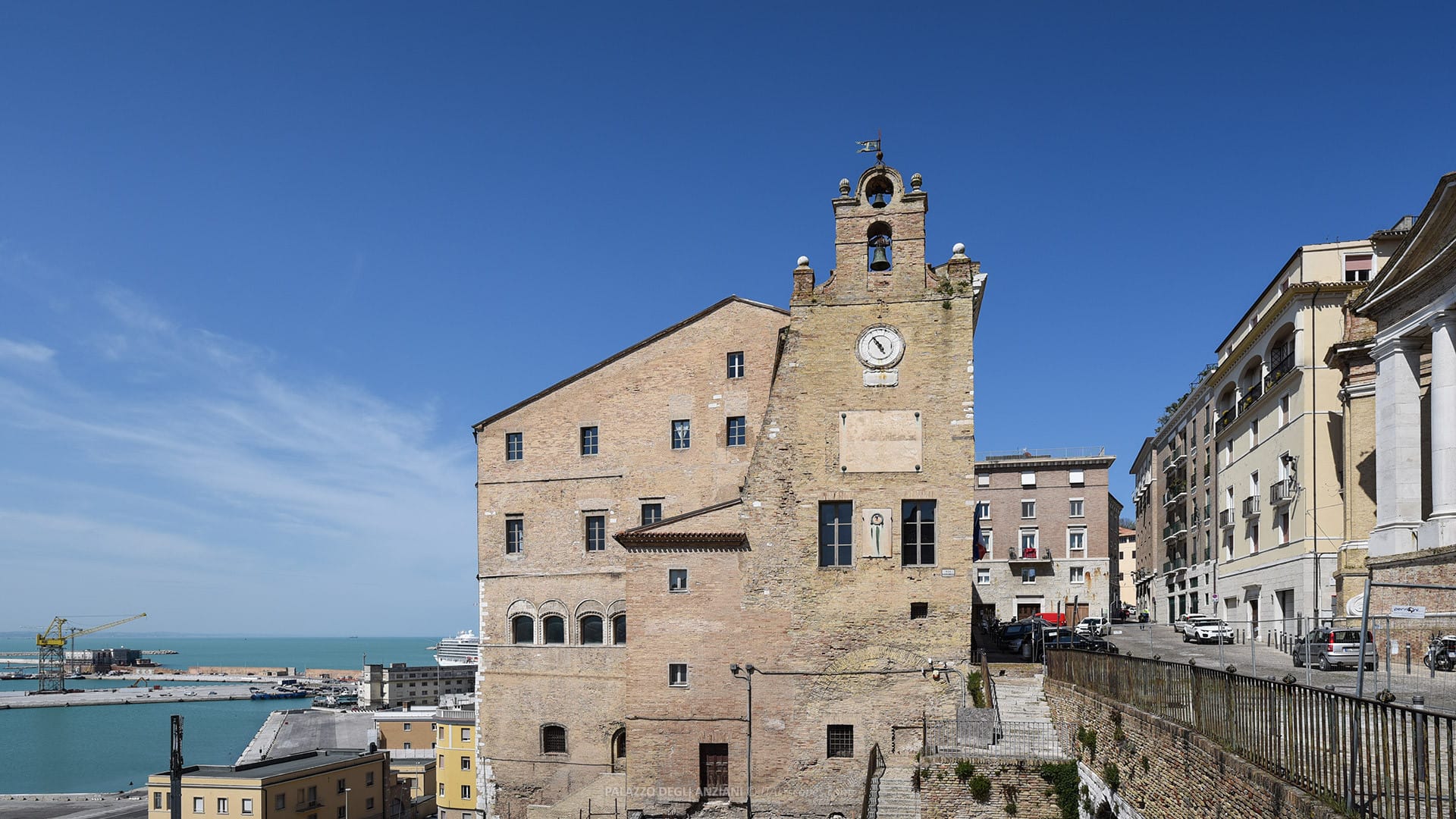
Palazzo degli Anziani is one of the most important historic civic buildings in the city of Ancona. Located in the upper part of the historic center, the palace has represented political authority and municipal identity for many centuries.
This imposing structure dominates its surroundings through scale, position, and architectural complexity. Palazzo degli Anziani rises near the waterfront, forming a symbolic connection between Ancona’s maritime vocation and its long tradition of self-government and civic autonomy.
For generations, the palace served as the institutional core of the city, hosting the governing magistrates of the medieval Republic of Ancona. Its name, meaning Palace of the Elders, reflects its role as the seat of the city’s highest civic authority.
Today, Palazzo degli Anziani continues to embody Ancona’s historical continuity. Restored and reused as a civic building, it stands as a tangible reminder of the city’s medieval independence, political resilience, and architectural evolution across more than a millennium.
Short History of Palazzo degli Anziani
The origins of Palazzo degli Anziani are traditionally traced back to the early 5th century AD. According to historical accounts, the first structure on this site was erected in 425 AD during the reign of Emperor Valentinian III.
This early building functioned as an administrative residence and symbolized imperial authority within the city. Its strategic location allowed direct control over the harbor and the upper urban areas, reinforcing Ancona’s importance within the regional power structure of the time.
In 839 AD, the building suffered severe destruction during a Saracen invasion that devastated much of the Adriatic coast. The palace was heavily damaged, marking the beginning of a long cycle of destruction, rebuilding, and transformation.
Over the following centuries, the site gradually regained importance. With the rise of Ancona as an autonomous maritime republic in the Middle Ages, the palace assumed a new and decisive role in the political life of the city.
By the 11th century, Palazzo degli Anziani had become the official seat of Consiglio degli Anziani, the governing council of the republic. From here, magistrates oversaw diplomacy, trade, justice, and military defense.
During the 13th century, the palace underwent a major reconstruction that reshaped its appearance. Romanesque and Gothic elements were introduced, creating a fortified and monumental structure suitable for a powerful civic institution.
The palace was constructed on a steep slope, a feature that strongly influenced its form. Facing the harbor, it rose to six levels, while the side oriented toward the city square consisted of only three floors.
In 1348, a devastating fire swept through Ancona, severely damaging Palazzo degli Anziani. The city council was temporarily forced to relocate while extensive repairs and structural reinforcements were carried out.
Under papal rule, beginning in the 16th century, the palace underwent further transformations. Architect Pellegrino Tibaldi redesigned the upper sections, closing open loggias and introducing Renaissance architectural elements.
Additional modifications followed in the 17th century, including the construction of a grand internal staircase and the raising of the central roof to form a monumental Hall of Honour for official ceremonies.
A bell tower with a distinctive six-hour clock was added during this period. This feature reinforced the palace’s role as the civic timekeeper and a visible symbol of public authority.
The palace continued to serve as Ancona’s municipal headquarters until 1947. Damage sustained during the Second World War made the building temporarily unsuitable for official use.
After decades of restoration work, Palazzo degli Anziani regained its institutional function. In 2011, the city council officially returned to the palace, restoring its historic role at the heart of Ancona’s civic life.
Architecture of Palazzo degli Anziani
The architecture of Palazzo degli Anziani reflects centuries of adaptation and stylistic layering. Romanesque solidity, Gothic verticality, and Renaissance refinement coexist within a single structure shaped by political ambition and challenging topography.
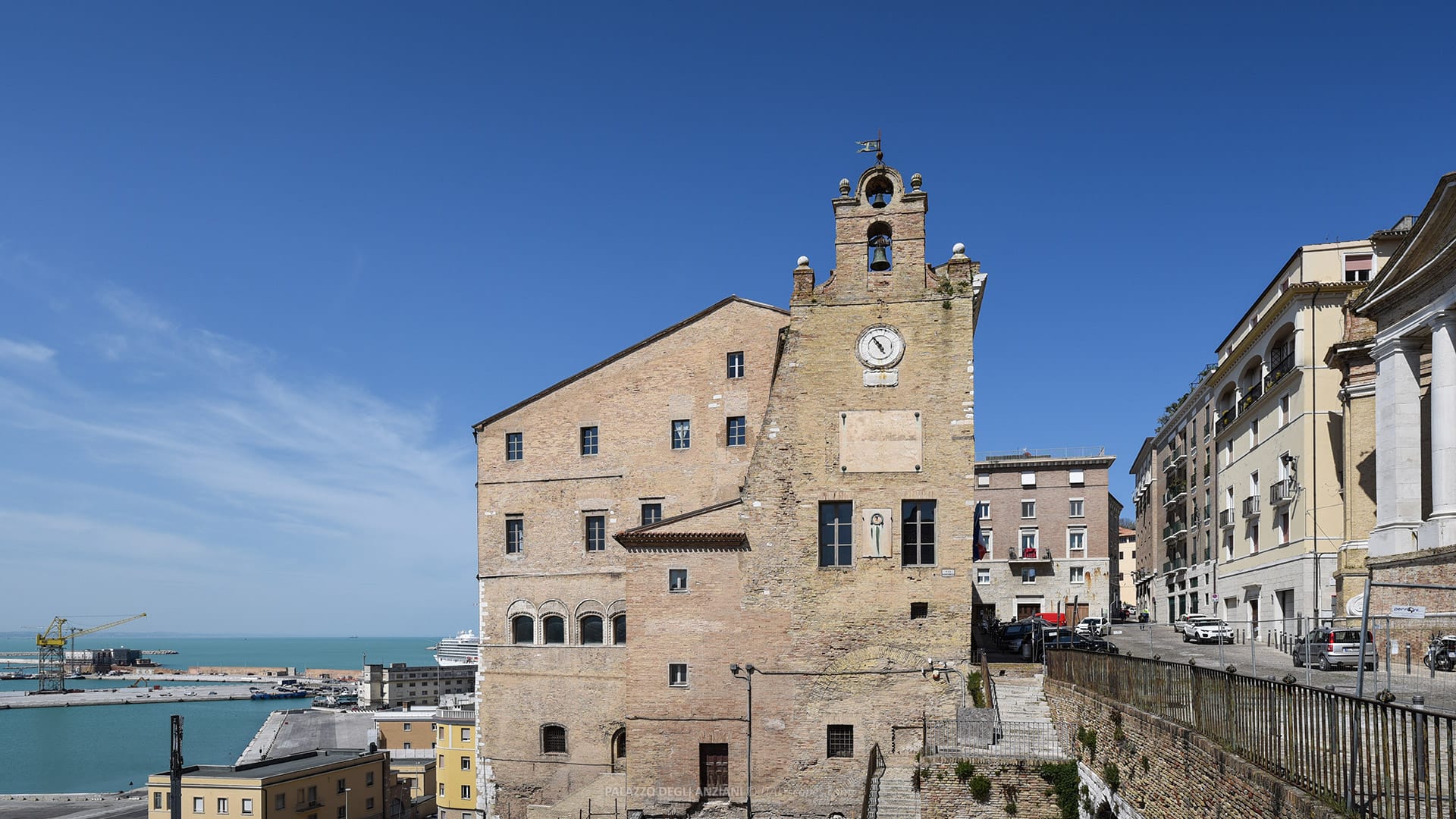
One of the most distinctive features of the palace is its dramatic vertical development. Built on the steep slopes of Monte Guasco, the building presents markedly different elevations depending on the viewing angle.
The lower facade, facing the harbor, is characterized by a powerful arcade made of white Conero stone. These arches once formed part of the city’s defensive system and supported the upper levels of the palace.
Above the arcade, multiple tiers of windows punctuate the brick facade. Their varying sizes and shapes reveal the different construction phases and architectural influences accumulated over the centuries.
The upper facade, overlooking Piazza Benvenuto Stracca, displays a more orderly and ceremonial appearance. Stone and brick elements are carefully balanced, projecting dignity, authority, and institutional stability.
The palace’s bell tower stands adjacent to the main structure and remains one of its most recognizable elements. The six-hour clock once regulated daily civic life and reinforced the building’s administrative function.
Internally, Palazzo degli Anziani was originally divided into functional spaces for governance, defense, and administration. Council chambers, guard rooms, and storage areas reflected the complex needs of a medieval republic.
The Hall of Honour, created by elevating the central roof, became the symbolic heart of the palace. This grand space hosted assemblies, official receptions, and moments of political decision-making.
Although many interior decorations were lost due to war damage, modern restorations have preserved the palace’s spatial organization and structural integrity, allowing visitors to appreciate its monumental character.
Architectural fragments and carved stone elements from different periods remain visible throughout the building. These details offer valuable insight into the evolving construction techniques and aesthetic preferences of successive eras.
How to Get to Palazzo degli Anziani
Palazzo degli Anziani is located approximately 2.3 kilometers from the Ancona railway station, making it easily accessible for visitors arriving by train.
Walking to the palace is a rewarding option. The route through the historic center takes about twenty-five to thirty minutes and offers views of the harbor, medieval streets, and the city’s layered urban fabric.
Public transportation provides a convenient alternative. The closest bus stop is Via Birarelli/ Parco Del Cardeto, located about 270 meters from the palace and served by Bus Line 11.
From the bus stop, a short walk leads uphill toward Piazza Benvenuto Stracca, where Palazzo degli Anziani stands prominently among historic buildings.
Taxis are readily available at the railway station and offer a direct and comfortable way to reach the palace in just a few minutes.
Sources: -
Photos
-
Map
-
Reviews