
Table of Contents
When people imagine the Carnival of Venice, they picture misty canals, decorated costumes and, above all, mysterious masks.
Venetian masks are not just pretty accessories – they are the core of the festival’s identity and have a long, complex history rooted in politics, theatre, secrecy and social rules.
In the run-up to Venice Carnival 2026 (scheduled from 31 January to 17 February 2026 according to the official programme, knowing the main Venetian mask types is the best way to understand what you’re seeing in the streets – or to choose the right mask for yourself.
Below is a list of the most important traditional Venetian masks. These are the core mask types you’ll encounter in authentic workshops and in the historical iconography of the Carnival of Venice.
9. Zanni – The Prototype Servant Mask
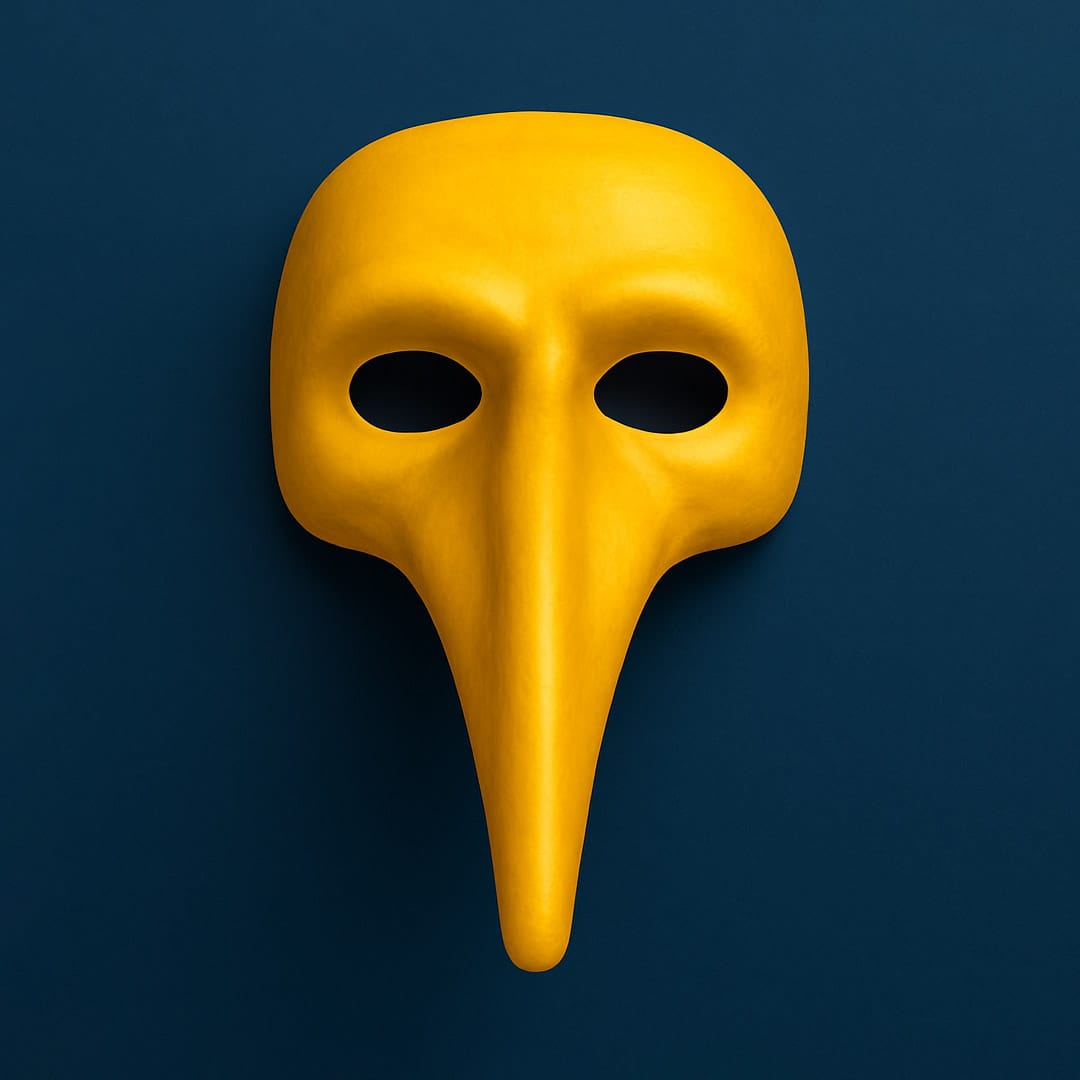
The term Zanni refers not to a single character but to a whole class of servant figures in commedia dell’arte.
Their masks are half-masks with a low forehead, bulging eyebrows and a long, downward-curving nose. The longer the nose, the more foolish the character was considered.
Zanni masks represent peasants, porters and low-status servants – the roots from which characters like Arlecchino developed.
In Carnival context, Zanni masks add a rough, earthy comic tone that contrasts with the refined elegance of bauta and volto.
Though not as frequently worn during the Carnival of Venice as some other types, Zanni masks still appear in historical re-enactments and in mask-making workshops that focus on the theatrical tradition behind modern Carnival.
8. Pantalone – The Venetian Merchant Mask

Another classic commedia dell’arte figure who became part of Venice’s mask tradition is Pantalone.
His name may derive from “pianta il leone” (“plant the lion”), a reference to Venetian expansion, or from the common Venetian name Pantaleone.
Pantalone is usually portrayed as an elderly, miserly Venetian merchant. His mask is a half-mask with a long, hooked nose (a bit like a crow’s beak), high eyebrows and a wrinkled forehead, all meant to suggest age and cunning.
Though less common today than bauta or volto, Pantalone’s mask still appears in parades, performances and traditional workshops.
He embodies the mercantile spirit of old Venice – rich, shrewd, sometimes ridiculous, but always influential.
If you’re interested in the link between masks and social satire, Pantalone is one of the best examples: a walking caricature of Venetian wealth.
7. Arlecchino – The Colourful Servant of Commedia dell’Arte
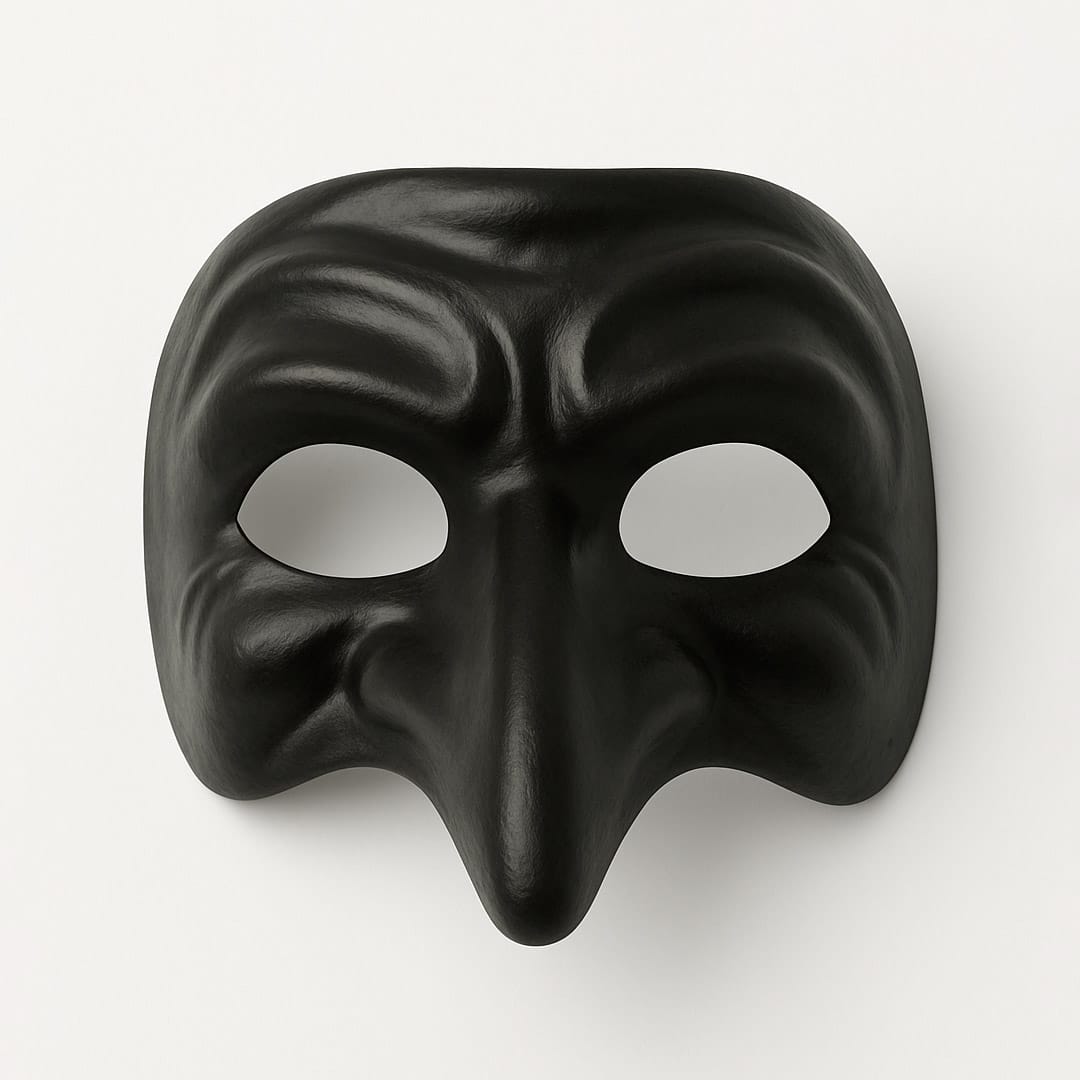
Arlecchino (Harlequin) comes directly from commedia dell’arte, the popular improvised theatre that influenced much of Europe. He is a servant character: agile, emotional, cunning and often foolish.
His mask is a black half-mask with small, lively eyes, a short broad nose and sometimes a bump on his forehead suggesting devilish energy. He is traditionally dressed in a patchwork or diamond-pattern costume in bright colours.
While Arlecchino is more strongly associated with theatre than with street Carnival, his mask and costume migrated into the Carnival of Venice over time, especially as theatrical characters mixed with traditional Venetian disguises.
During the Venice Carnival, you’ll see Arlecchino mainly in performances, children’s costumes and themed events. He represents the playful, chaotic side of Venetian culture – a reminder that Carnival is as much about theatre as it is about fashion.
6. Gnaga – The Subversive Cat Mask
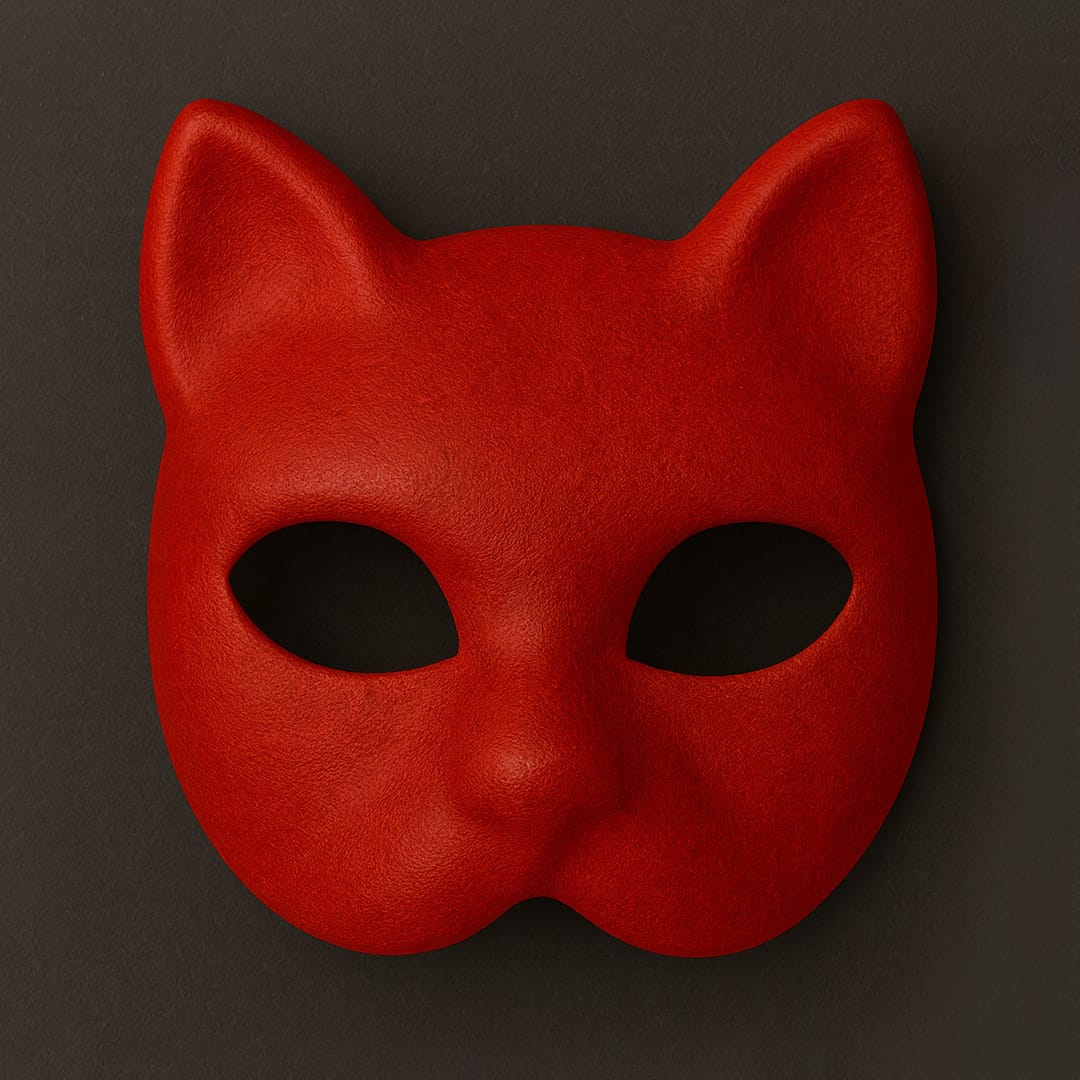
The gnaga is one of the lesser-known but historically important Venetian masks. It’s a small cat mask, usually worn by men dressed as women.
During the Renaissance and Baroque periods, male homosexual prostitutes used the gnaga to cross-dress and perform as women during Carnival, protected by the anonymity of the mask.
Venetian law once prescribed harsh penalties for homosexual acts, but the legal use of masks during Carnival created a kind of “suspension zone” where people in disguise could not easily be prosecuted.
The gnaga – sometimes accompanied by a basket of kittens and exaggeratedly feminine behaviour – became a symbol of transgression and role-reversal.
Today, the gnaga remains part of the Carnival of Venice tradition as a playful, provocative costume. Men wearing the mask often meow at passers-by and parody stereotypical female gestures, echoing centuries-old subcultural history.
At Venice Carnival 2026, spotting a gnaga is like glimpsing the rebellious side of Venice – the part that used Carnival not only for fun, but as a space to challenge social norms.
5. Colombina – The Half Mask of the Flirtatious Servant
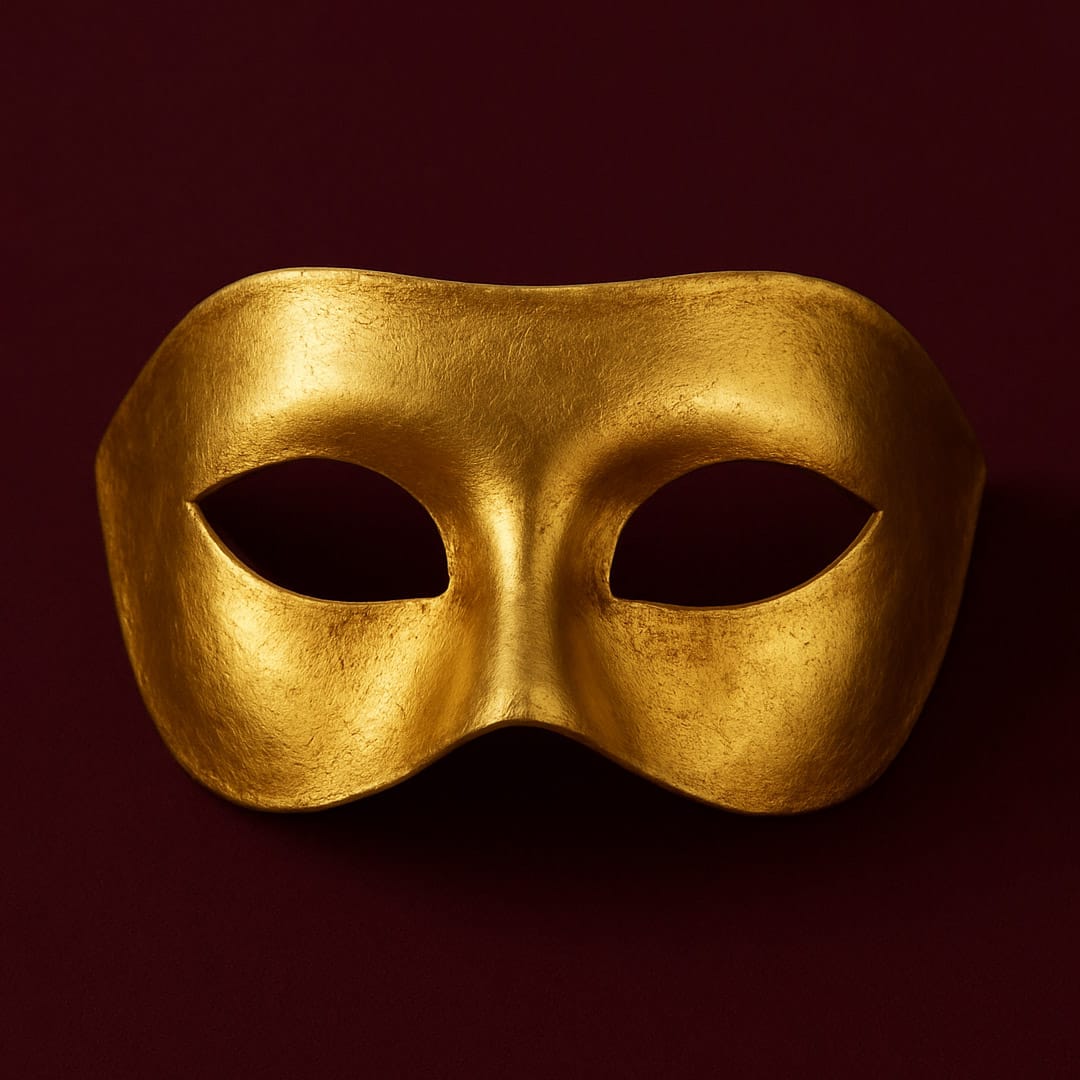
The Colombina mask is a half-mask that covers only the eyes, nose and upper cheeks, leaving the mouth and lower face visible.
It is often richly decorated with gold, silver, crystals or feathers and tied with ribbons or held on a stick.
The name comes from Colombina, a witty maidservant character in commedia dell’arte – playful, clever and flirtatious.
Although many modern legends claim that the mask was invented for an actress who didn’t want to hide her whole face, its use is mostly modern; there are no firm historical sources showing it on the stage in the 17th–18th centuries.
Today, the Colombina is among the most popular choices at the Carnival of Venice because it’s light, comfortable and allows the wearer to eat, drink and smile freely.
During the Carnival of Venice, you’ll see hundreds of versions: from simple metallic designs to extremely elaborate, feathered creations paired with giant ball gowns.
If you’re looking for an elegant mask that feels glamorous without being overwhelming, Colombina is the perfect compromise between tradition and practicality.
4. Medico della Peste – The Plague Doctor Mask
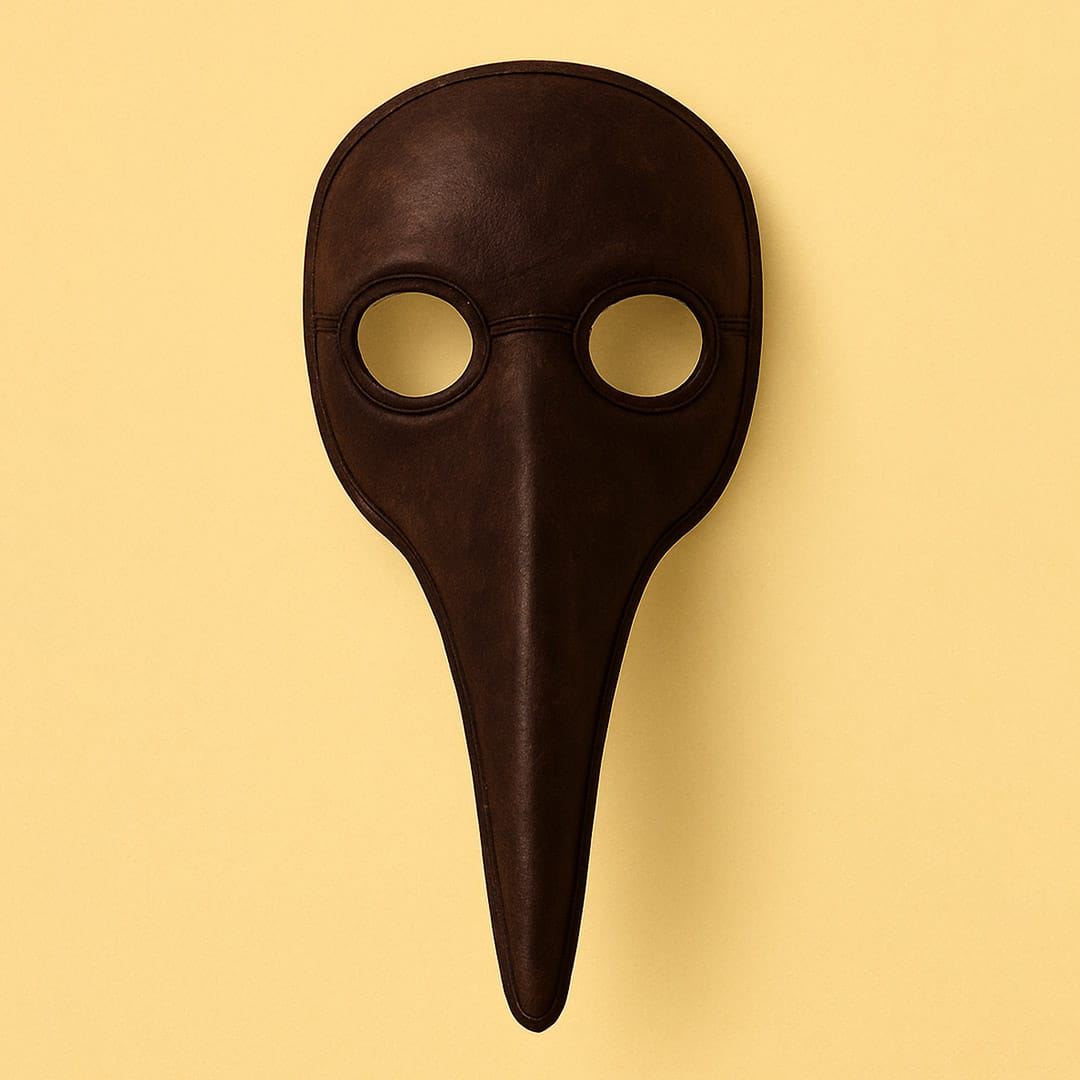
The Medico della Peste (“Plague Doctor”) is perhaps the most instantly recognisable Venetian mask for visitors, with its long, curved beak and round eyeholes. But unlike most Carnival masks, it did not start as a festive accessory.
The design goes back to 17th-century plague doctors, who wore a beaked mask filled with aromatic herbs and flowers, based on the old miasma theory that bad smells spread disease. The outfit included a long black coat, gloves and a staff to avoid touching patients.
Only much later did this terrifying medical uniform become part of the Carnival of Venice, reinterpreted in a more decorative, theatrical way.
Today, the Medico della Peste mask is often white or elaborately decorated and is usually worn with the full doctor costume – hat, cloak and staff – like a walking memento mori during celebrations.
At the Venice Carnival, expect to see many plague doctor figures roaming the calle and piazzas: they symbolise both the city’s dark history and its ability to transform fear into art.
3. Moretta (Servetta Muta) – The Silent Lady’s Mask
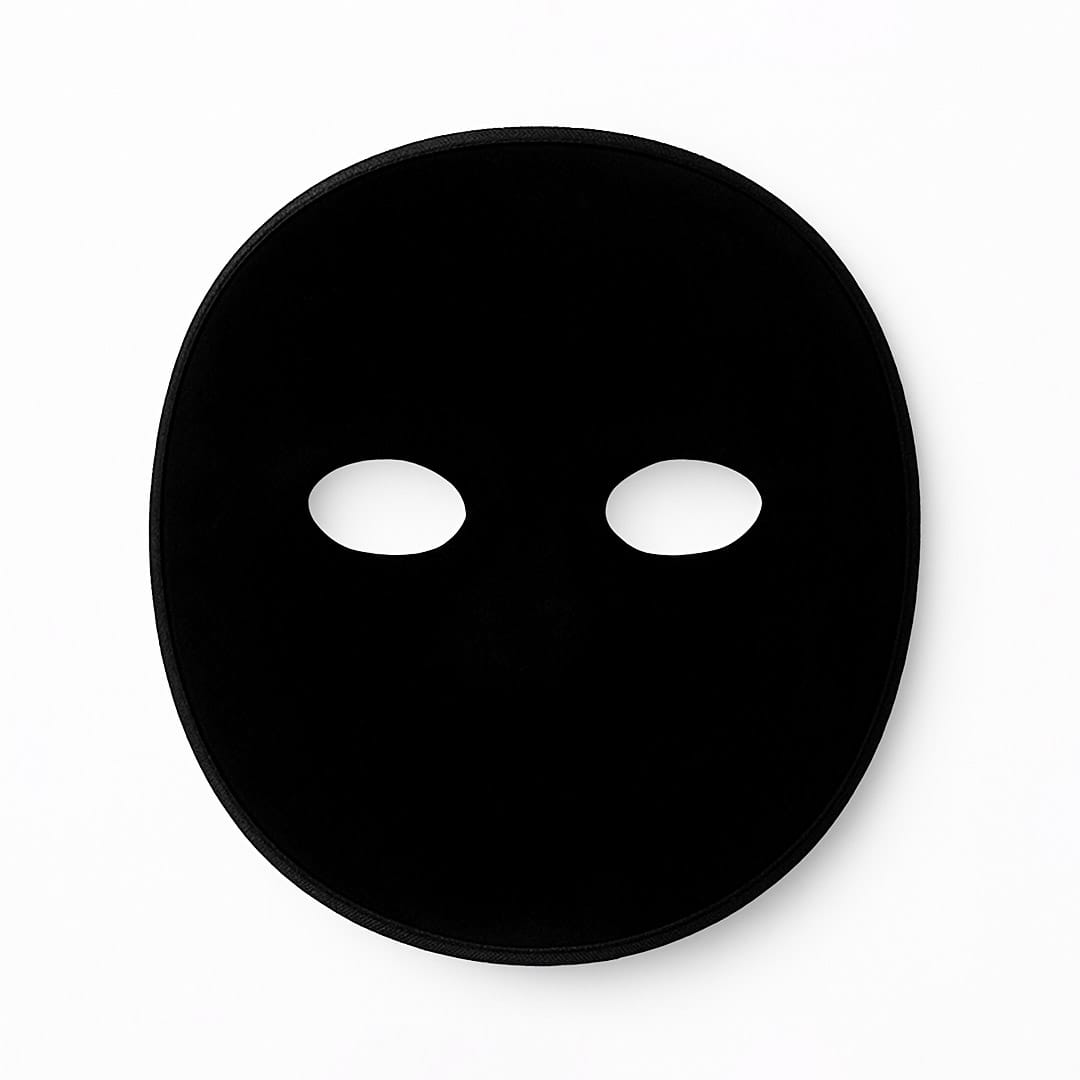
The moretta (“little dark one”) or servetta muta (“mute maidservant”) is one of the most intriguing Venetian masks, because it literally takes away the wearer’s voice.
It is a small, oval black velvet mask, without mouth opening, worn by upper-class women.
Instead of straps, the moretta was held in place by biting a button on the inside. As long as the woman wore it, she could not speak – hence the name “mute servant”.
Often combined with a veil, it allowed noblewomen to move through the city, observe others and flirt with their eyes while remaining unrecognisable and silent.
The mask fell out of fashion around the mid-18th century, but it’s still recreated today by traditional artisans and occasionally worn during the Carnival of Venice as a nod to historic aristocratic customs.
If you see a woman in black velvet, veiled and silent, holding a small dark mask tight to her face, you are looking at one of Venice’s most sophisticated and symbolic disguises.
2. Volto (Larva) – The Classic White “Face” of Carnival
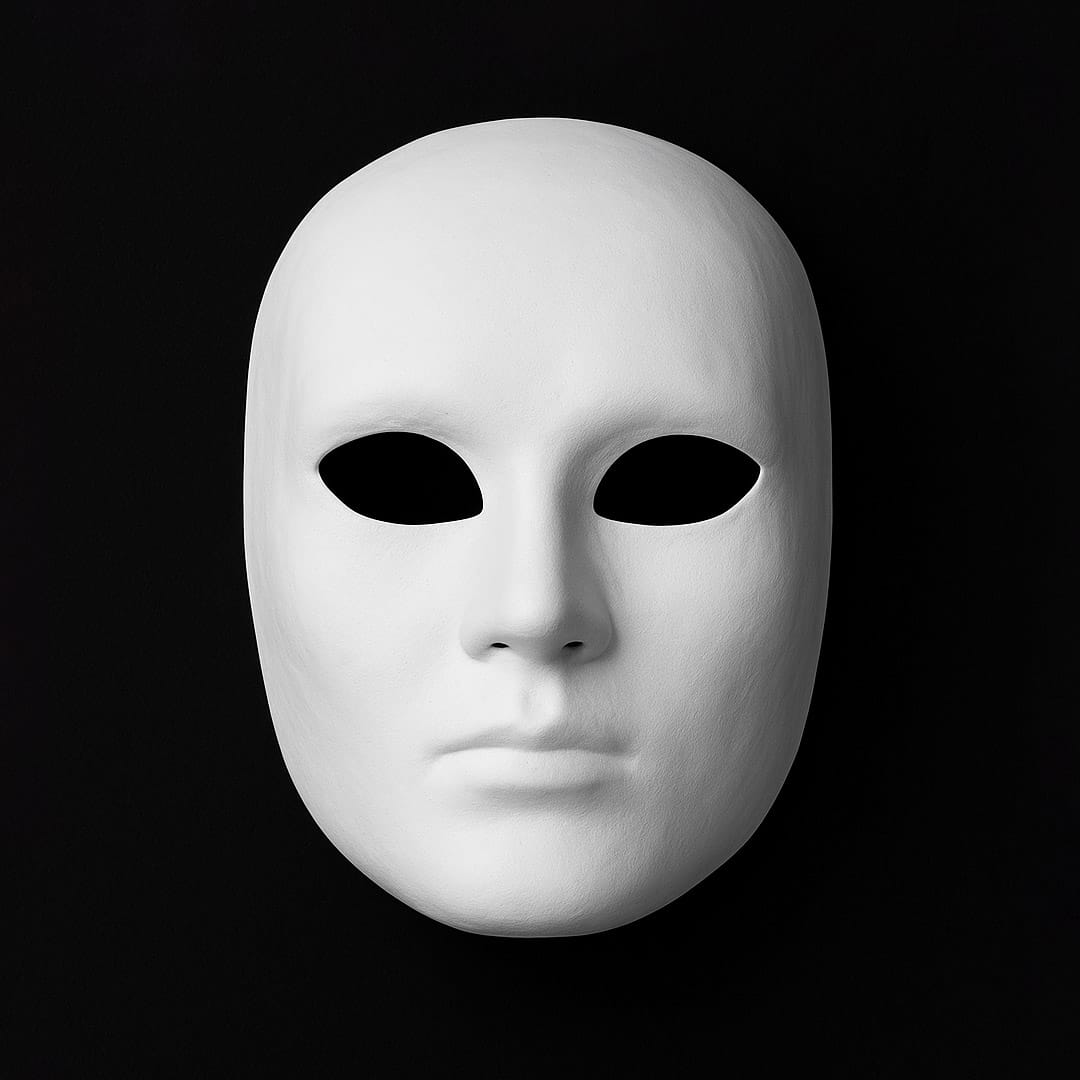
The volto (“face”) or larva (“ghost”) is the simple, full-face white mask most visitors instinctively associate with the Carnival of Venice.
Traditionally made of waxed cloth and later of porcelain or modern materials, it covers the entire face – including chin and forehead – and is usually worn with a tricorne hat and cloak.
Compared to the bauta, the volto is smoother and more neutral. It hides all facial expression, turning the wearer into an anonymous “ghost” drifting through the crowd. Because it fits closely to the face, it’s less practical for eating or talking, but visually very striking.
During the Carnival of Venice, the volto is often used as a “blank canvas” for decoration: gold leaf, painted tears, floral motifs or baroque designs. It’s particularly popular with costumers who want a timeless, androgynous, almost supernatural look – perfect for the dreamlike atmosphere of the Venice Carnival.
1. Bauta – The Political and Social Mask of Venice
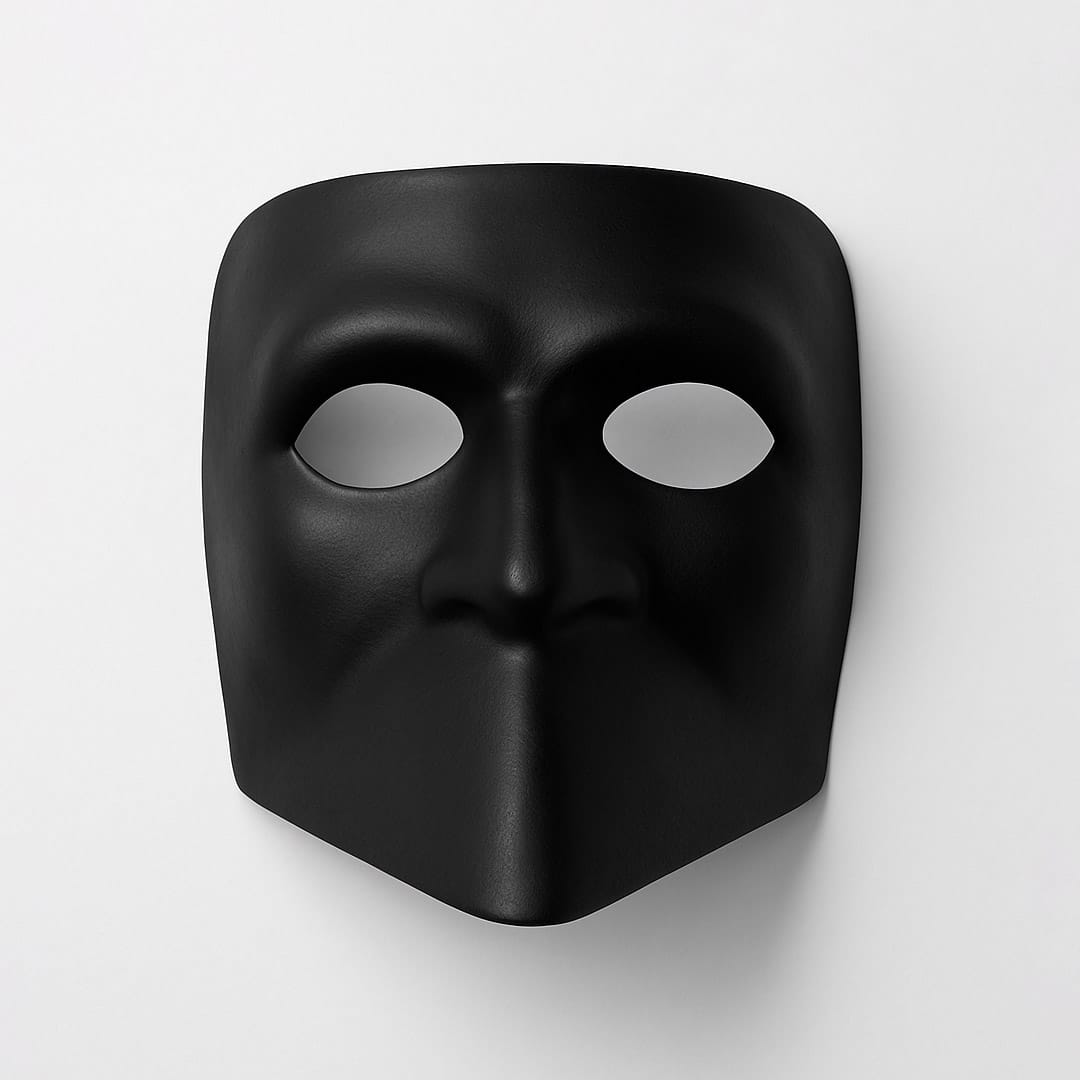
The bauta (often written baùtta) is the queen of Venetian masks and the most closely linked to the historic Carnival of Venice. It covers the whole face with a strong, slightly grotesque shape: deep eye sockets, a heavy brow and a pronounced, beak-like jaw line.
Historically, the mask was usually plain white, worn together with a black cloak (tabarro) and a three-cornered hat (tricorne).
The genius of the design lies in the jutting chin: it allows the wearer to speak, eat and drink without removing the mask, making it perfect for long evenings in casinos, theatres and political meetings while remaining anonymous.
By the 18th century, the bauta had become an official society uniform, regulated by the Venetian government. At some political decision-making events, male citizens were required to wear it so that everyone could act as equal, anonymous participants – an early form of secret ballot.
Today, during the Venice Carnival, you can expect to see countless modern variations: gilded, hand-painted or combined with rich fabrics. But the symbolic power remains the same – the bauta still represents freedom, secrecy and equality in Venice.
Choosing Your Mask for Venice Carnival 2026
Whether you’re planning to attend Venice Carnival 2026 in person or simply want to understand the photos flooding the internet each February, knowing these mask types helps you see more than just decoration. Each mask carries a story:
- Bauta – anonymity and political equality
- Volto – the blank, ghostly face of Carnival
- Moretta – silent noblewomen and controlled desire
- Medico della Peste – fear, medicine and memory
- Colombina – flirtation and elegance
- Gnaga – subversion and gender play
- Arlecchino, Pantalone, Zanni – theatre and social satire
Sources:
- Images – ChatGPT
- Wikipedia.it


