


-
About
Table of Contents
Buy tickets & tours:GetYourGuideBasilica of San Zeno Maggiore is one of the most important churches in Verona, dedicated to Saint Zeno, the city’s patron saint and an early Christian bishop. The basilica stands in Piazza San Zeno, west of the historic center, and is among the clearest examples of Romanesque architecture in northern Italy.
The church develops on three main levels: the crypt, the plebeian nave, and the raised presbytery. The present structure preserves several medieval phases, especially from the 10th, 11th, 12th, and 14th centuries. Basilica of San Zeno Maggiore is also connected with the former Benedictine abbey that once stood beside it.
Basilica of San Zeno Maggiore is known for its tuff and brick exterior, sculpted porch, bronze doors, large rose window, crypt, medieval frescoes, and the celebrated altarpiece by Andrea Mantegna. The church combines religious importance, local identity, architectural clarity, and major works of medieval and Renaissance art.
In 1973, the church was elevated to the dignity of a minor basilica by Pope Paul VI. Today, Basilica of San Zeno Maggiore remains a parish church, a major monument, and one of the most meaningful religious sites in Verona, because it preserves the memory and cult of the city’s patron saint.

The facade of the Basilica di San Zeno Maggiore
Short History of the Basilica of San Zeno Maggiore
Early Christian Origins and the Tomb of Saint Zeno
Saint Zeno of Verona is believed to have died between 372 and 380. Tradition says that he was buried outside the Roman city, near the route of the ancient Via Gallica. A first Christian building was later raised above or near his tomb, creating the earliest sacred nucleus of the site.
By the late 6th century, the cult of Saint Zeno was already important in Verona. According to early medieval tradition, the church was restored and enlarged around 589, after a major flooding of the Adige River. The episode strengthened the religious prestige of the place and the devotion to the bishop.
Fragments and reused architectural elements suggest that the area had an early sacred history before the great medieval basilica. Some sculpted pieces, including Byzantine-style elements, are connected with buildings from the 5th or 6th century, although the surviving structure is the result of later medieval construction.
The Carolingian Basilica and the Translation of the Relics
At the beginning of the 9th century, the old church was considered too poor for the relics of the city’s patron saint. Pepin of Italy, together with Bishop Ratoldo, promoted the construction of a larger and more dignified church, suitable for the body of Saint Zeno.
The new building was consecrated on December 8, 806. On May 21, 807, the body of Saint Zeno was solemnly moved into the crypt. The ceremony was remembered as an exceptional religious event, because it renewed the public cult of Verona’s patron saint.
Medieval tradition also mentions the role of Archdeacon Pacifico, associated with several church works in Verona. The Carolingian church had a crypt, a raised liturgical area, and probably a simpler structure than the current basilica. Very little of that 9th-century phase survives in visible form.
Basilica of San Zeno Maggiore was also linked to a Benedictine monastery. The first known abbot mentioned in the sources is Leone, recorded in 833. From this period onward, the basilica and the abbey formed one of the most influential religious complexes in the Verona area.
Reconstruction after the Hungarian Invasions
Between 899 and 933, Hungarian raids caused damage to churches and monastic sites outside Verona’s walls. San Zeno was still located outside the protected urban core, and the church and monastery were probably seriously damaged during this period of insecurity.
After the raids ended, Bishop Raterio promoted a new reconstruction. In 967, he obtained financial support from the German Emperor Otto I, who had been hosted in Verona. The new project followed the early development of the Veronese Romanesque style.
The 10th-century church had three naves, a raised central nave, a crypt, and a presbytery above it. The building was about the same width as the present basilica, but probably only around three quarters of its current length and about half of its later height.
Some traces of this phase remain visible, especially near the eastern side and around the crypt. A diploma issued by Emperor Henry II in 1014 indicates that the relics of Saint Zeno were already again in the basilica by that date.
The Romanesque Renewal and the Earthquake of 1117
By the early 11th century, the first Romanesque phase of Basilica of San Zeno Maggiore was complete. The church was then strengthened and raised. In 1045, Abbot Alberico began the construction of the bell tower, as recorded by an inscription on the tower itself.
Around the end of the 11th century and the beginning of the 12th, a major renewal project enlarged the church. The plan included a westward extension, renewed perimeter walls, new stonework, sculpted decoration, and the development of the Romanesque structure visible today.
The earthquake of 1117 damaged many buildings in Verona, including parts of San Zeno. Work continued after the disaster, using both new material and reused elements. The rebuilding and enlargement were largely completed in 1138, a key date for the present appearance of the church.
During the same period, the porch, façade sculpture, and architectural language of Basilica of San Zeno Maggiore became central examples of Veronese Romanesque art. The basilica’s combination of tuff, brick, sculpted marble, and balanced proportions belongs to this major medieval reconstruction.
Gothic and Later Transformations
At the end of the 14th century, the basilica underwent important Gothic modifications. The architect Giovanni da Ferrara was commissioned by Abbot Ottonello Pasti to complete the enlargement and make further changes. Work began on March 24, 1386, and was completed in July 1398.
The most important Gothic intervention was the reconstruction of the main apse. Giovanni da Ferrara worked with his son Nicolò da Ferrara, and the new apse gave the eastern end of Basilica of San Zeno Maggiore a taller and more updated late medieval form.
The wooden ceiling of the nave was also created during the late 14th-century phase, between 1385 and 1389. Its shape resembles an inverted ship’s hull, a type of ceiling also found in other important Veronese churches, including San Fermo Maggiore.
Further changes occurred in later centuries. In 1870, the central staircase was removed and the old side stairways were recovered. Between 1927 and 1931, restoration works helped return Mantegna’s altarpiece to the basilica and reorganize the high altar area.
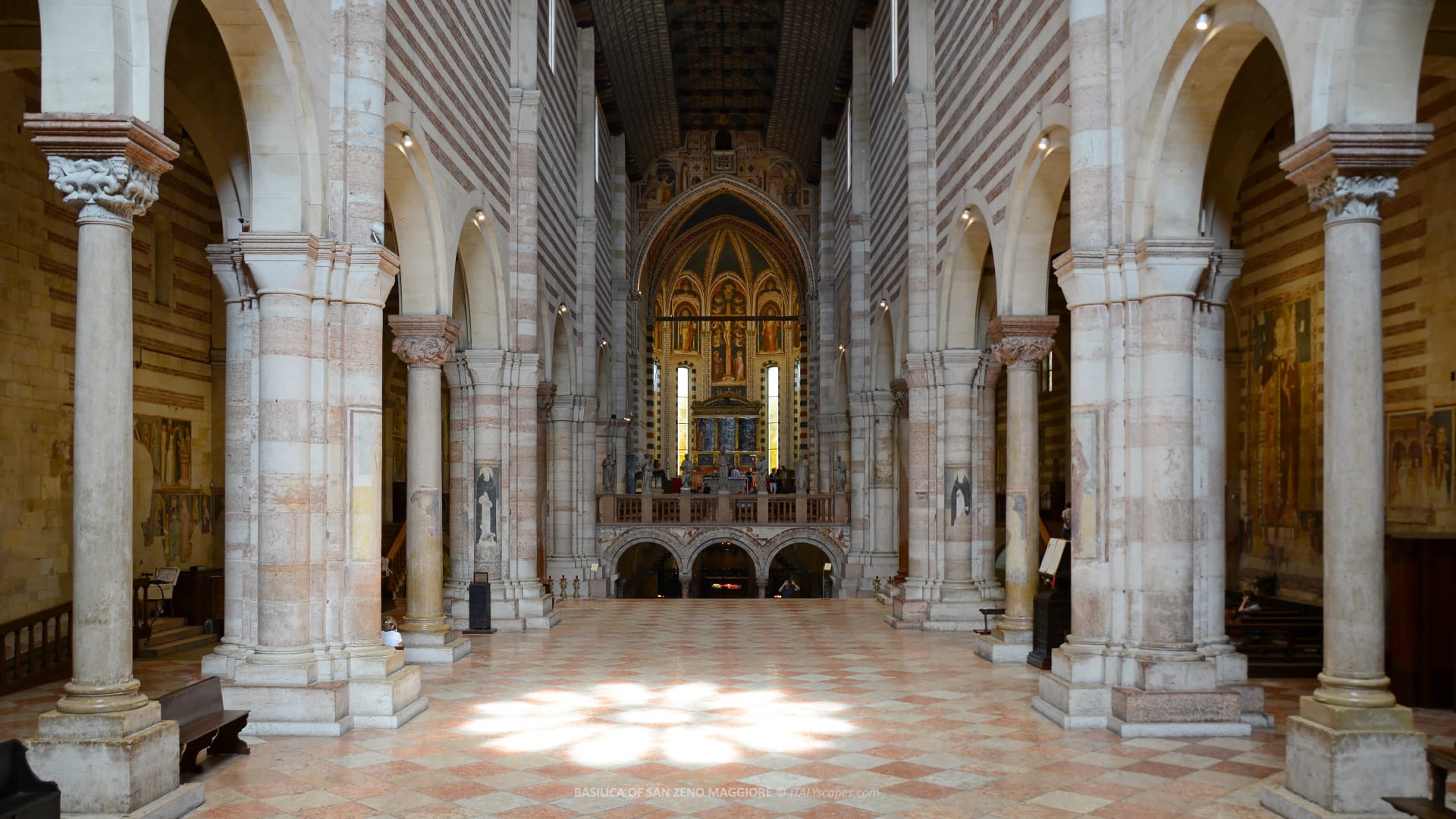
The interior of the Basilica of San Zeno Maggiore
Architecture of the Basilica of San Zeno Maggiore
The Facade and the Romanesque Exterior
The façade of Basilica of San Zeno Maggiore is built mainly of tuff, with marble and stone elements used for details and sculptural decoration. Its tripartite composition reflects the internal division into three naves: a taller central nave and two lower side aisles.
The façade is divided by strong vertical pilasters and crowned by sloping rooflines. The central upper section includes a white marble triangular pediment, contrasting with the warmer tuff surface. This balance of color, geometry, and structure is one of the basilica’s clearest Romanesque features.
The lateral parts are simpler and lower, with blind arcades and sculpted decorative bands beneath the roofline. The central part contains the main portal, porch, and rose window.
The southern side shows several construction phases. Some sections are built in brick, others alternate brick and tuff in the typical red-and-white rhythm of Veronese Romanesque masonry. These visible changes help identify medieval building campaigns from the 11th, 12th, and 13th centuries.
The Porch of Nicholaus and the Main Portal
The porch of Basilica of San Zeno Maggiore was made by the master Nicholaus in the 12th century. The structure projects over the main entrance and rests on columns supported by two crouching lions, traditional guardians of sacred space in medieval church sculpture.
The porch includes sacred, civic, and seasonal imagery. The lunette shows Saint Zeno at the center, connected with the symbolic consecration of the medieval Commune of Verona. This scene is important not only artistically, but also historically, because it reflects civic identity in 1138.
The porch is supported by crouching telamons, while the roof area includes reliefs of Saint John the Baptist and Saint John the Evangelist. Other sculptures show the Lamb of God, the blessing hand of God, and episodes from the life and miracles of Saint Zeno.
Beside the porch and portal are 18 high reliefs from the 12th century. The left group is generally attributed to Master Guglielmo, while the right group is connected with Nicholaus and his workshop. Their subjects include scenes from the Old Testament, New Testament, and the legend of Theodoric.
The Bronze Doors
The main portal of Basilica of San Zeno Maggiore is famous for its bronze doors, one of the most remarkable medieval works of this type in Italy. The doors include 48 bronze panels, arranged on wooden leaves that measure about 3.95 by 4.81 meters.
The panels were not all made by one artist or in one single campaign. Scholars generally identify different hands and phases, from the 11th to the 13th century. This explains the variety of styles, subjects, and visual rhythm across the two leaves.
The bronze panels include biblical scenes, episodes from the life of Saint Zeno, symbolic figures, and decorative motifs. Some panels are more dramatic and expressive, while others are more schematic. Their irregular arrangement shows that older elements were probably reused in later, larger doors.
The Rose Window and the Fronton
The rose window is known as the Wheel of Fortune and was created by Brioloto de Balneo. It is one of the most recognizable elements of the façade. The wheel is decorated with six figures representing the changing phases of human life and destiny.
The structure is divided into twelve sectors by paired small columns in red marble. At the center is an open circular hub, while larger lobes connect the surrounding architectural parts. The design combines geometry, symbolism, sculpture, and the medieval idea of Fortune as unstable destiny.
The upper fronton once contained a representation of the Last Judgment, now preserved only through traces and documentation. The subject included Christ, angels, the Virgin Mary, Saint John, the Apostles, the saved, and the damned, following a common medieval theological program.
Together, the porch, rose window, bronze doors, and façade reliefs make Basilica of San Zeno Maggiore a complete medieval visual system. The exterior teaches biblical history, civic identity, moral order, and the instability of human life before the visitor even enters the church.
The Interior, Nave, and Presbytery
The interior of Basilica of San Zeno Maggiore has a basilical plan, divided into three longitudinal naves. The nave is organized by massive cross-shaped pillars alternating with columns. There are ten supports per side, with capitals showing zoomorphic, Corinthian, and reused Roman elements.
The wooden ceiling dates from the late 14th century and has the form of an inverted ship’s hull. It was made during the Gothic restructuring of the church. The nave is also marked by two large transverse arches that give rhythm to the long interior space.
The church is arranged vertically on three levels. The lower level is the crypt, the central level is the plebeian church, and the upper level is the presbytery. This arrangement gives Basilica of San Zeno Maggiore a strong spatial contrast between public nave, relic crypt, and liturgical high altar.
The raised presbytery is reached by two stairways from the side aisles. It is separated from the nave by a medieval rood screen with a balustrade. On it are placed 13 medieval statues, including Christ, the Apostles, and the Evangelists.
The Crypt of the Basilica
The crypt of Basilica of San Zeno Maggiore dates mainly from the 10th century, but it was damaged by the 1117 earthquake and later restored. It was completed and adjusted through several medieval interventions, especially between the 12th and early 13th centuries.
The crypt is divided into galleries that create a complex lower space. It has 49 columns supporting arches and 54 cross vaults. The columns have sculpted capitals, each different from the others, with floral motifs, animals, monsters, human heads, leaves, and hunting scenes.
Most capitals date from the 10th century, although three are reused Roman elements. Byzantine influence can be seen in several carvings. The irregular rhythm of the crypt reflects its long construction history, structural changes, and adaptation to the liturgical role of the relics.
The body of Saint Zeno is preserved in the crypt, in a visible sarcophagus consecrated in 1939. The saint’s face is covered by a silver mask, and the body is dressed in episcopal vestments. This makes the crypt the devotional heart of Basilica of San Zeno Maggiore.
INTERESTING FACT: According to local tradition, the crypt is associated with the secret marriage of Romeo and Juliet in William Shakespeare’s tragedy. This is a literary and popular tradition, not a documented historical event.
The Bell Tower and Abbey Buildings
The bell tower stands detached from the church and reaches about 62 meters in height. It was begun in 1045 under Abbot Alberico. By 1067, it had probably reached more than half its present height, and later work continued through the 12th century.
The base of the tower is rectangular, with sides of about 8.25 meters and 8.23 meters, and a base height of roughly 7 meters. The masonry uses stone, tuff, and brick, creating the chromatic effect typical of Romanesque Verona.
The upper bell chamber has two levels of triple windows on each side. By 1498, the bell chamber already housed six bells. One of the bells, cast in 1423, has a diameter of over 1 meter and weighs close to one ton.
The basilica complex also preserves elements of the former abbey, including the cloister, the Abbey Tower, and the Chapel of San Benedetto.
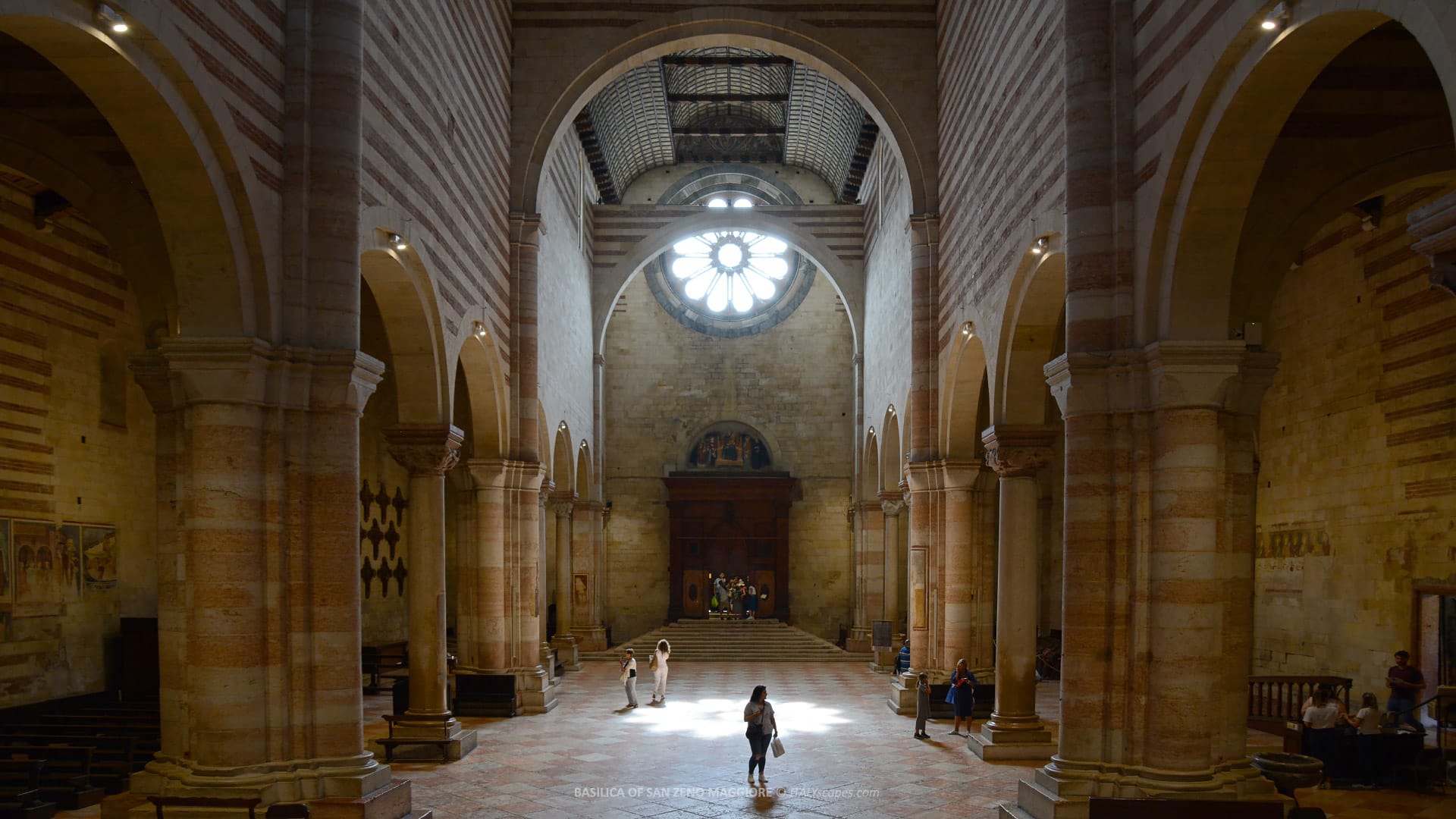
The interior of the Basilica of San Zeno Maggiore
Art of the Basilica of San Zeno Maggiore
Medieval Sculpture and Exterior Reliefs
The exterior sculpture of Basilica of San Zeno Maggiore is one of the strongest parts of its artistic identity. The porch, reliefs, lions, telamons, lunette, biblical scenes, and civic imagery form a dense program created mainly during the 12th-century Romanesque phase.
The reliefs beside the portal include both sacred and profane subjects. On one side, scenes from Genesis and the story of Theodoric appear. On the other, New Testament scenes are represented. This mixture is typical of medieval churches, where history, morality, legend, and faith meet.
The sculptors Nicholaus and Guglielmo were among the most important figures connected with the portal decoration. Their work helped define the visual language of Romanesque Verona. The sculptures are not merely ornamental, because they communicate religious teaching and local political identity.
Basilica of San Zeno Maggiore also preserves sculptural decoration inside the church, including the famous red marble statue known as San Zeno Laughing. This 12th-century sculpture is one of Verona’s most beloved images of its patron saint.
Frescoes and Interior Painting
The interior walls are covered with many frescoes, often fragmentary, damaged, or superimposed. They date from different centuries, especially between the 13th and 15th centuries.
Many frescoes are associated with groups conventionally known as the first and second masters of San Zeno. These are not necessarily single artists, but stylistic groups of painters active in Verona. Their work shows the spread of Giottesque influence and later Lombard pictorial culture.
Among the visible subjects are Madonnas with Child, Crucifixions, saints, scenes from the life of Saint Nicholas, Saint George and the Dragon, the Baptism of Christ, and the transport of Saint Zeno’s body by Saints Benigno and Caro.
The presbytery also contains important late medieval frescoes. The triumphal arch includes an Annunciation attributed to Martino da Verona and his circle, made between the late 14th and early 15th centuries.
The Pala di San Zeno by Andrea Mantegna
The most important artwork in Basilica of San Zeno Maggiore is the Pala di San Zeno, painted by Andrea Mantegna between 1457 and 1459. It was commissioned by Abbot Gregorio Correr and is considered a masterpiece of Italian Renaissance painting in northern Italy.
The altarpiece consists of three main painted panels showing the Madonna and Child with angels and saints. The represented saints include Peter, Paul, John the Evangelist, Zeno, Benedict, Lawrence, Gregory, and John the Baptist. The original wooden frame was also designed as an architectural structure.
The predella originally included three scenes from the life of Christ: the Agony in the Garden, the Crucifixion, and the Resurrection. During the Napoleonic requisitions of 1797, the altarpiece was taken to France. The upper panels returned to Verona in 1817, but the original predella remained in France.
Today, the Crucifixion is in the Louvre, while the Agony in the Garden and the Resurrection are in Tours. The predella visible in Basilica of San Zeno Maggiore is a copy. Even so, the altarpiece remains in its original liturgical location above the high altar.
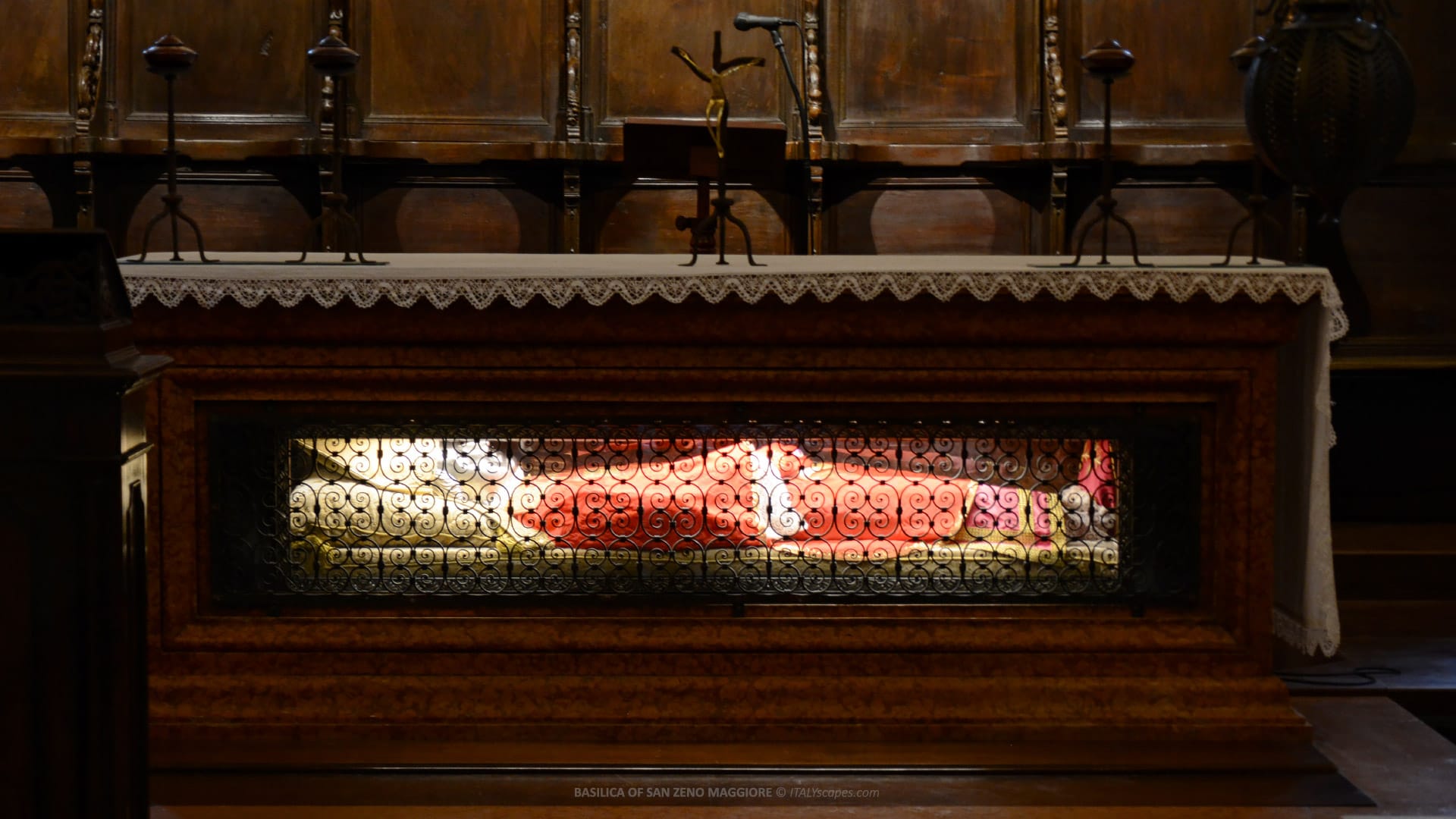
The tomb of Saint Zeno
How to Get to the Basilica of San Zeno Maggiore
Basilica of San Zeno Maggiore is located in Piazza San Zeno, west of Verona’s ancient center. It is about 2.2 kilometers from Verona Porta Nuova railway station on foot, depending on the exact route. The walk usually takes around 30 minutes.
From Piazza Bra and the Verona Arena, the basilica is closer, about 1.3 to 1.5 kilometers away. Visitors can reach the church by walking through the western part of the historic center, passing near Castelvecchio or continuing along streets leading toward the San Zeno district.
Getting to the Basilica of San Zeno Maggiore on foot
The walk from Verona Porta Nuova to Basilica of San Zeno Maggiore is straightforward and mostly urban. A practical route passes from the station area toward Porta Palio, then continues through the streets leading to Piazza San Zeno. The route takes about 25 to 35 minutes.
Walking from the Arena is often more pleasant for visitors already in the historic center. From Piazza Bra, continue toward Castelvecchio, cross the area near Corso Cavour, then proceed toward the San Zeno district. This route usually takes about 18 to 22 minutes.
Getting to the Basilica of San Zeno Maggiore by bus
The closest useful bus stops are near Via Da Vico, Piazza Pozza, and Piazza Corrubio, all a short walk from the church. The stop commonly indicated for the basilica is Via Da Vico / San Zeno, only a few minutes from Piazza San Zeno.
Lines such as 31 and 91 are commonly associated with the San Zeno area, but visitors should check the current ATV Verona timetable before traveling.
From Verona Porta Nuova, the bus journey to the San Zeno area usually takes about 8 to 15 minutes, depending on the line and traffic. After getting off near Via Da Vico or Piazza Pozza, the basilica is reached on foot in about 2 to 4 minutes.
Getting to the Basilica of San Zeno Maggiore by taxi
A taxi from Verona Porta Nuova to Basilica of San Zeno Maggiore is the easiest option for visitors with luggage, limited time, or reduced mobility. The distance by road is short, and the journey normally takes about 7 to 10 minutes, depending on traffic.
From the Arena or Piazza Bra, a taxi ride is even shorter, usually around 5 to 8 minutes. Taxis can drop visitors near Piazza San Zeno or on nearby streets, but access may vary because of pedestrian areas, events, markets, or local traffic restrictions.
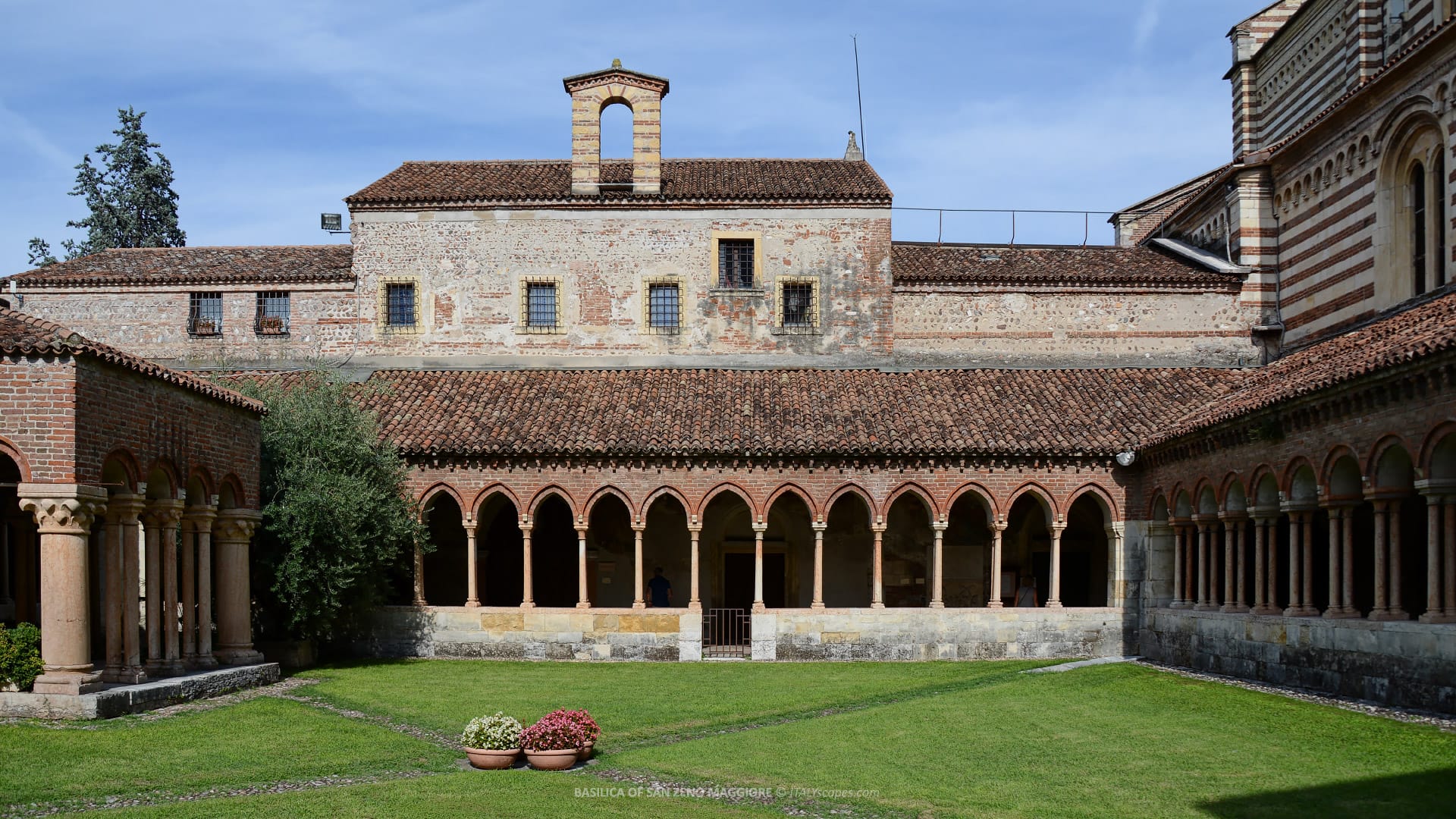
The cloister of the Basilica of San Zeno Maggiore
Frequently Asked Questions about the Basilica of San Zeno Maggiore
What is Basilica of San Zeno Maggiore famous for?
Basilica of San Zeno Maggiore is famous for its Romanesque architecture, bronze doors, Wheel of Fortune rose window, crypt of Saint Zeno, medieval frescoes, and Mantegna’s Renaissance altarpiece.
Where is Basilica of San Zeno Maggiore located?
Basilica of San Zeno Maggiore is located in Piazza San Zeno, in the San Zeno district of Verona, west of the historic center and near the former abbey complex.
Who was Saint Zeno?
Saint Zeno was an early Christian bishop of Verona, believed to have died between 372 and 380. He became the city’s patron saint and was buried near the basilica.
When was the present basilica built?
The present Basilica of San Zeno Maggiore mainly took shape between the 10th and 12th centuries. Major Romanesque rebuilding was completed around 1138, with Gothic changes finished in 1398.
What is inside the crypt?
The crypt contains the body of Saint Zeno in a visible sarcophagus. It also has 49 columns, sculpted capitals, 54 cross vaults, and surviving medieval fresco fragments.
What is the most important artwork in the basilica?
The most important artwork is Mantegna’s Pala di San Zeno, painted between 1457 and 1459. It is one of the key Renaissance masterpieces in northern Italy.
How far is the basilica from Verona Porta Nuova?
Basilica of San Zeno Maggiore is about 2.2 kilometers from Verona Porta Nuova on foot. The walk usually takes about 30 minutes, depending on the chosen route.
How much does it cost to visit Basilica of San Zeno Maggiore?
A single ticket costs €4.00 and is valid for Basilica of San Zeno Maggiore only. Reduced tickets are available for groups and schools, while children under 12 and disabled visitors enter free.
Sources:Buy tickets & tours:GetYourGuide -
Photos
-
Map
-
Reviews


