


-
About
Table of Contents
The Cathedral of San Nicolò, often referred to simply as Noto Cathedral, stands at the heart of the Sicilian baroque city of Noto, in the province of Syracuse.
As a masterpiece of Sicilian Baroque architecture, the Cathedral of San Nicolò dominates the town’s skyline, rising at the top of a grand triple staircase – a vision in honey-colored limestone that glows in the warm southern sunlight.
Despite dramatic events – including a disastrous collapse in 1996 – the cathedral has been restored and today continues to welcome visitors and worshippers alike, inviting them to explore the history, art, and spirituality embedded within its walls.

Short History of the Cathedral of San Nicolò
The story of Noto Cathedral begins with tragedy and rises into grandeur.
In 1693, a catastrophic earthquake struck southeastern Sicily, leveling entire towns, including the original medieval city of Noto (now known as Noto Antica). The devastation was total: many buildings were destroyed or severely damaged.
In the period following the earthquake, a decision was made not simply to repair the old city, but to rebuild the city of Noto entirely on a new site. This ambitious reconstruction would shape what we now know as Noto and its surrounding towns, in a unified Baroque style.
Amid this effort, the Cathedral of San Nicolò was planned as the spiritual and architectural focal point of the new city.
Construction began around 1694 (some sources place the start in early 18th century) with early works, and over decades the cathedral gradually took shape. Construction was completed in 1776.
Originally, the Cathedral of San Nicolò was richly decorated inside and outside with the Baroque style of the time. Its design was influenced by leading architects and sculptors of Sicily.
Over time, modifications and reconstructions altered parts of the structure, including work on the roof and dome.
Tragically, on March 13, 1996, the cathedral suffered a catastrophic collapse. The collapse destroyed large parts of the nave: four piers on the southern side, the nave roof and vault, the transept roof, the dome and its lantern, and the roof of the right aisle.
The collapse was partly due to structural weaknesses accumulated over decades – including ill-advised renovations in the 1950s, which had replaced the original pitched roof with a heavy loft of brick and concrete, greatly increasing stress on the supports.
After years of careful study, reconstruction began. The community and authorities, recognizing the cathedral’s importance, mobilized to rebuild it. After nearly a decade of restoration, the cathedral was reopened on June 15, 2007.
Since reopening, restoration and decoration efforts have continued inside; a new high altar, lectern, crucifix and organ were consecrated in 2011, and the dome and cupola were painted and fitted with new windows.
In recognition of its significance, the cathedral – already part of the broader UNESCO listing for the Late Baroque Towns of the Val di Noto – carries on as both a functioning church and a major cultural landmark.
Architecture of the Noto Cathedral
Exterior & Structure
Noto Cathedral stands on one side of Noto’s central square, accessible by a broad monumental staircase composed of three flights.
This elevated position not only gives it commanding views over the city but also enhances its visual prominence – the Cathedral of San Nicolò appears to tower above Noto’s baroque streets and low rooftops.
The exterior is composed of warm Iblean limestone, giving the building a honey-toned glow typical of Sicilian Baroque architecture.
The façade itself is richly detailed: twin bell towers flank the main structure, and the central entrance is framed by Corinthian columns and crowned by a tympanum.
Above the entrance lies a large window that brings light into the interior, while the overall symmetry and composition evoke grand European Baroque churches – yet with a local Sicilian character.
The DomeThe cathedral dome – long one of Noto’s architectural landmarks – collapsed in 1996 along with significant structural elements, threatening the survival of the entire monument.
The collapse exposed multiple structural vulnerabilities: the addition of heavy concrete roofing in the 1950s had placed excessive load on the original supports, and seismic damage from previous earthquakes had weakened key foundations.
Repairing the cathedral was a massive undertaking. Reconstruction from 1999 to 2007 involved careful analysis of debris, restoration or replacement of damaged elements, and reconstruction of the dome with more appropriate materials and modern safety standards.
Today, the new dome – finished by the early 2000s – restores the silhouette of Noto’s skyline.
The dome is topped with a lantern and eight windows that allow light to flood the interior. Since the reopening, the cathedral’s external appearance once again reflects the Baroque grandeur intended by its original designers.
Art of the Cathedral of San Nicolò
The cathedral’s artistic aspects – though altered significantly over time – still reveal a mixture of historical legacy and modern restoration.
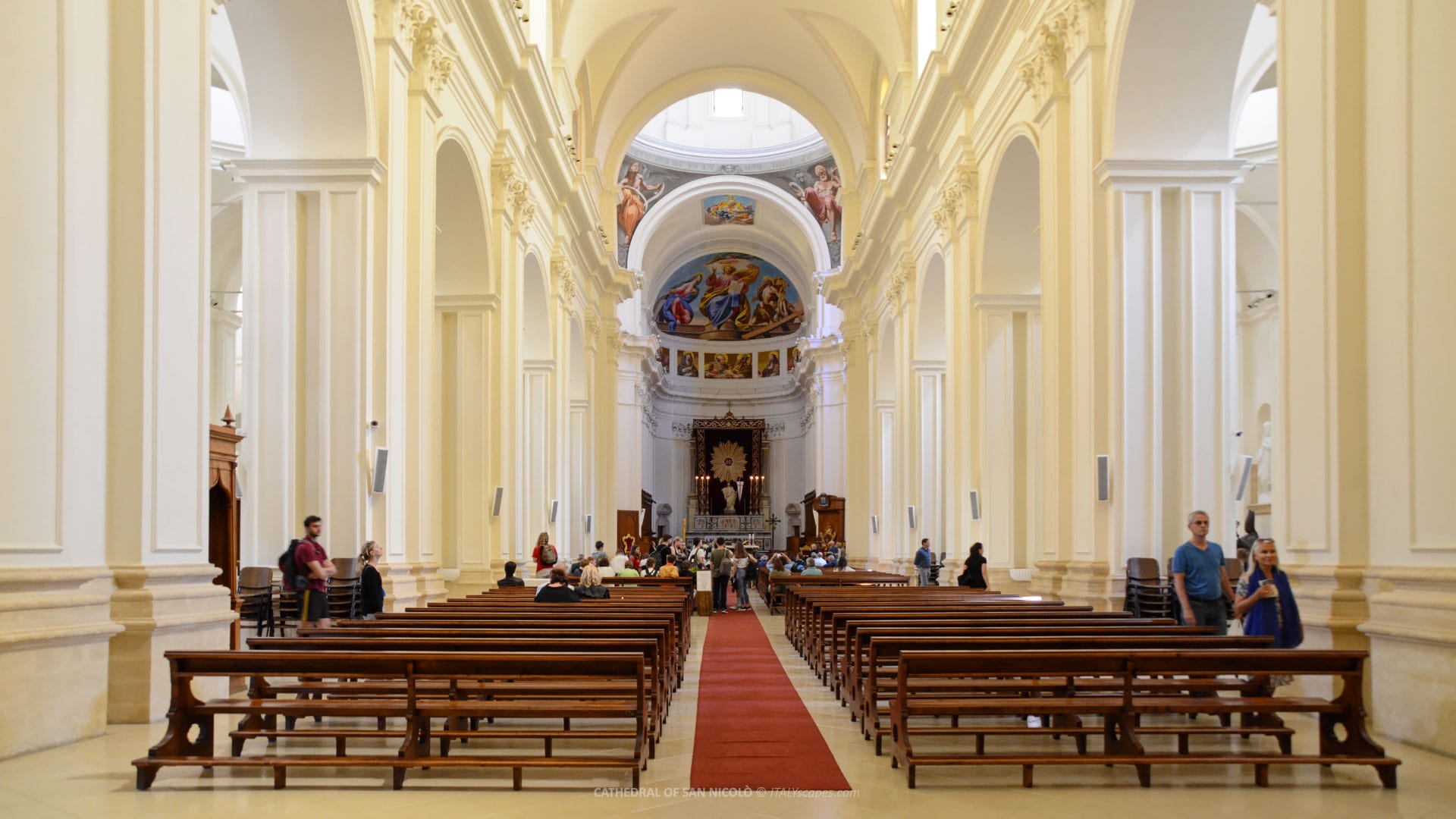
The collapse in 1996 destroyed much of the original Baroque decoration. The current interior, while simpler than in the 18th century, merges restored elements, newly commissioned works, and preserved relics and artworks.
Interior Layout & Surviving HeritageInside, the cathedral retains its Latin-cross plan with a central nave and side aisles. Originally richly decorated, much of the ornate plasterwork and stucco decoration were lost – yet several significant pieces survived or have been restored. These include:
- An ancient silver urn containing the relics of Saint Corrado Confalonieri, the patron saint of Noto and the diocese. The urn dates back to the period of Noto Antica (the city before the 1693 earthquake).
- A polychrome marble funerary monument of Giovanni di Lorenzo, Marquess of Castelluccio, notable for its craftsmanship and historical value.
- Some 18th and 19th-century paintings that survived or were restored after the collapse.
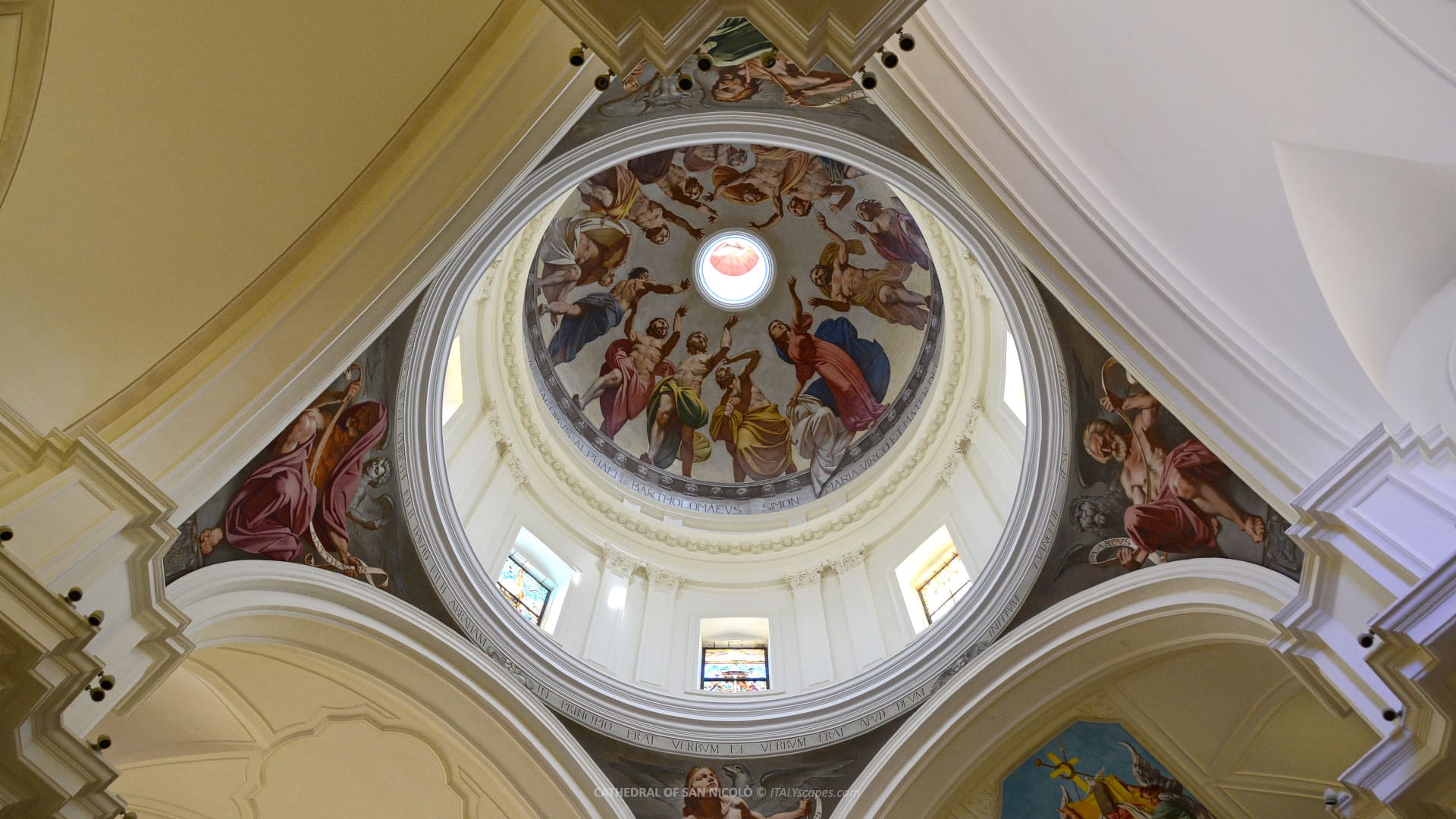
Modern Frescoes and Re-decorationAfter its reopening in 2007, the Cathedral of San Nicolò underwent significant re-decoration.
The dome and pendentives were painted by Russian painter Oleg Supereko, giving new life to the central space.
Additionally, eight new windows in the dome were installed (designed by artist Francesco Mori), flooding the interior with natural light and creating a bright, contemplative atmosphere.
The high altar, lectern, crucifix, and organ – consecrated in 2011 – were crafted in silvered bronze and Sicilian jasper by sculptor Giuseppe Ducrot, combining classic reverence with contemporary artistry.
While the interior no longer displays the lavish 18th-century stucco Baroque flourishes, the present decor is sober, elegant, and respectful of both the building’s history and its renewed life.
How to Get to Noto Cathedral
If you arrive in Noto by train or bus, reaching the Cathedral of San Nicolò is straightforward. From the Noto railway station, you can either walk or take a local bus.
On foot: The journey from the railway station to the Noto Cathedral is pleasant and takes about 15-20 minutes: simply follow the main road towards the historic center, continue along Corso Vittorio Emanuele, and you will eventually reach the monumental staircase that leads directly to the cathedral.
By bus: Take a bus heading toward the city center and get off near Corso Vittorio Emanuele, just a short distance from the Cathedral of San Nicolò.
From the bus stop, follow the pedestrian streets uphill until you reach the large square in front of the Cathedral of San Nicolò. The final approach is always on foot, as the cathedral sits within a pedestrian-only zone.
Sources: -
Photos
-
Map
-
Reviews


