


-
About
Table of Contents
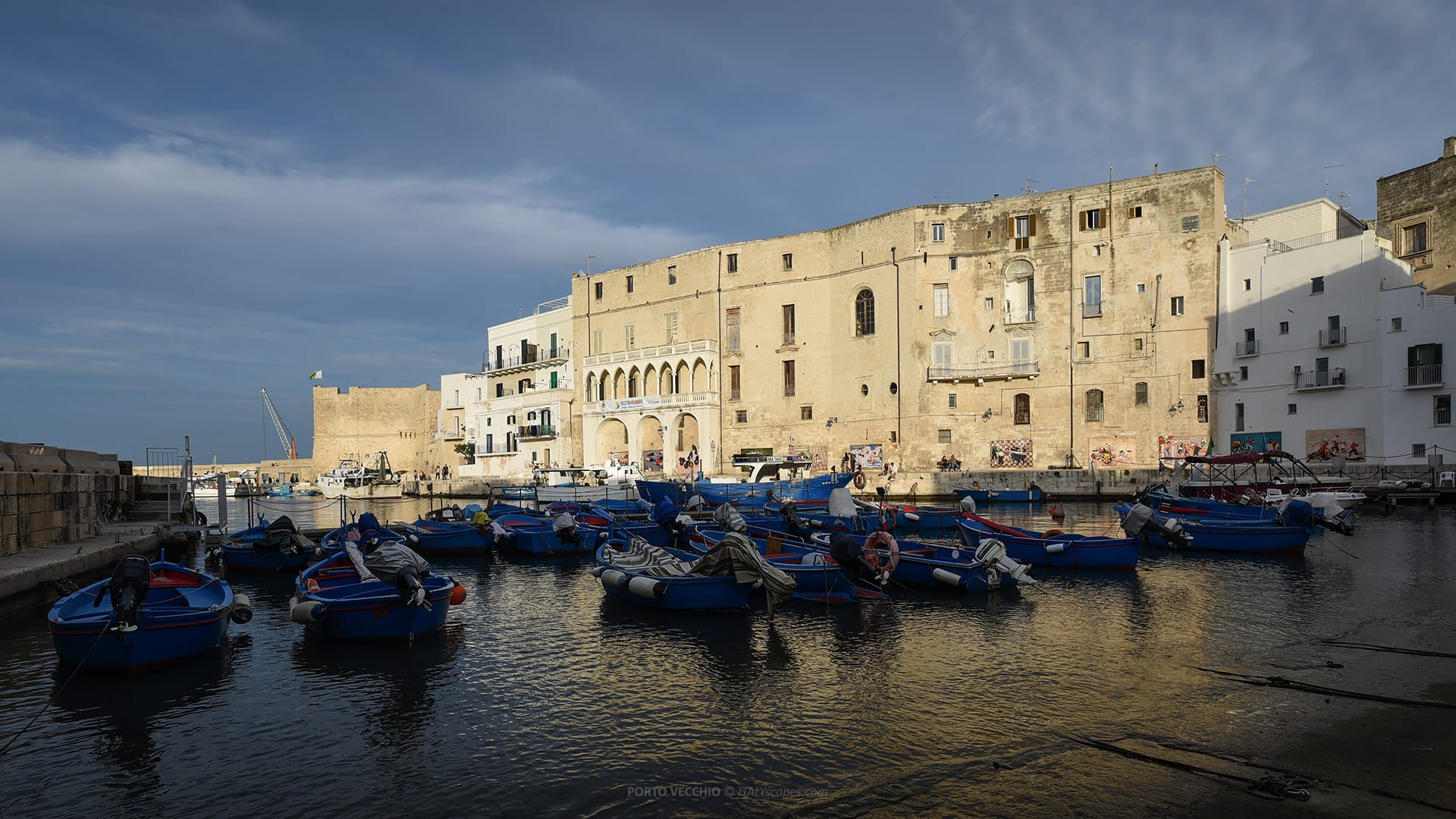
Palazzo Martinelli-Meo Evoli is a historic aristocratic palace located in Monopoli, built along the line of the ancient city walls, overlooking Porto Vecchio.
Its position places it in close proximity to two of Monopoli’s most important landmarks: the historic harbor and the Castle of Charles V, forming a continuous architectural and historical ensemble that defines the northeastern edge of the old town.
Palazzo Martinelli-Meo Evoli represents one of the most significant examples of eighteenth and nineteenth-century noble architecture in Monopoli, combining elements from different stylistic phases while maintaining a strong relationship with the surrounding urban fabric.
Today, the palace is recognized for its architectural complexity, its layered historical development, and its prominent visual presence along the waterfront.
Its façade overlooking Porto Vecchio contributes significantly to the scenic character of the Old Port area, where civic, military, and residential architectures converge.

Palazzo Martinelli-Meo Evoli
Short History of Palazzo Martinelli-Meo Evoli
The origins of Palazzo Martinelli-Meo Evoli are closely linked to the succession of noble families who owned the property over several centuries.
The earliest documented owners were the Bandino family, followed by the Carbonelli and Lentini families. Each phase of ownership corresponds to periods of architectural adaptation and functional use, reflecting broader social and economic changes within the city of Monopoli.
At the end of the eighteenth century, the palace was acquired by the Martinelli family, whose name remains permanently associated with the building. The Martinellis were a wealthy family originally from Mola, who relocated to Monopoli during the second half of the eighteenth century.
Their move was motivated primarily by the commercial and economic opportunities offered by Monopoli, which at the time was an important Adriatic port with active maritime trade connections.
During this period, Monopoli experienced significant urban and economic development. The city’s port played a key role in regional trade, particularly in agricultural products, and attracted merchant families seeking strategic locations along the coast.
Under the Martinelli ownership, the palace underwent important transformations that defined its current appearance. While the core structure retains eighteenth-century characteristics, the family introduced architectural updates in the nineteenth century, aligning the building with contemporary tastes.
These interventions included the redesign of the main entrance portal and the addition of Neo-Gothic decorative elements, which distinguished the palace from other noble residences in Monopoli.
The addition of the Meo Evoli name is linked to later familial connections, reflecting the common practice of merging surnames associated with inheritance or marital alliances among noble families.
Architecture of Palazzo Martinelli-Meo Evoli
Palazzo Martinelli-Meo Evoli is a multi-level building developed over three main floors and directly facing Porto Vecchio.
The long façade overlooking the Old Port is characterized by a sequence of eighteenth-century windows, whose regular rhythm emphasizes the horizontal development of the building along the city walls.
These openings belong to the original phase of the palace and reflect the sober elegance typical of late Baroque noble architecture in southern Italy.
In contrast, the monumental entrance portal and the balconies on the first floor were added or reworked around the mid-nineteenth century.
These elements are executed in Neo-Gothic style, a deliberate aesthetic choice that introduced pointed arches and decorative motifs inspired by medieval architecture.
This stylistic intervention created a visual dialogue between the palace and the nearby Castle of Charles V, reinforcing the historical continuity of the area.
One of the most distinctive features of Palazzo Martinelli-Meo Evoli is its loggia. Built on a portico supported by three arches, the loggia produces a strong scenographic effect when viewed from Porto Vecchio.
Above the portico, the loggia opens onto the sea through eight ogival arches, also in Neo-Gothic style, and is completed by a balcony with balustrade.
The loggia serves both aesthetic and functional purposes. Architecturally, it lightens the mass of the building and creates depth through the play of shadows and openings. Functionally, it offers panoramic views of the port, historically allowing residents to observe maritime activity directly from their residence.
Internally, the palace is organized around a wide entrance hall that leads to an internal courtyard. This courtyard represents one of the most refined architectural spaces within the building.
It features a large open staircase, which serves as the main vertical circulation element and contributes to the ceremonial character of the interior.
Overlooking the courtyard is an eighteenth-century loggia developed on three levels. This internal loggia reflects the original phase of the palace and preserves the architectural language of the period, with balanced proportions and restrained decorative elements.
The internal arrangement of the palace follows the traditional layout of noble residences, with representative rooms facing the port and more private or service spaces oriented toward the interior.
How to Get to Palazzo Martinelli-Meo Evoli
Palazzo Martinelli-Meo Evoli is located approximately 1.3 kilometers from the Monopoli railway station, making it easily accessible on foot. The walk from the station to the palace takes about 15 to 20 minutes and passes through the modern city before entering the historic center.
Once inside the old town, the palace can be reached by following the perimeter of the ancient walls toward Porto Vecchio. Its position overlooking the Old Port and near the Castle of Charles V makes it a recognizable landmark within the historic urban landscape.
Due to traffic restrictions in the old town, access by car is limited in the immediate vicinity of the palace. Visitors arriving by vehicle can park in designated areas outside the historic center and continue on foot.
Sources: -
Photos
-
Map
-
Reviews

