-
About
Table of Contents
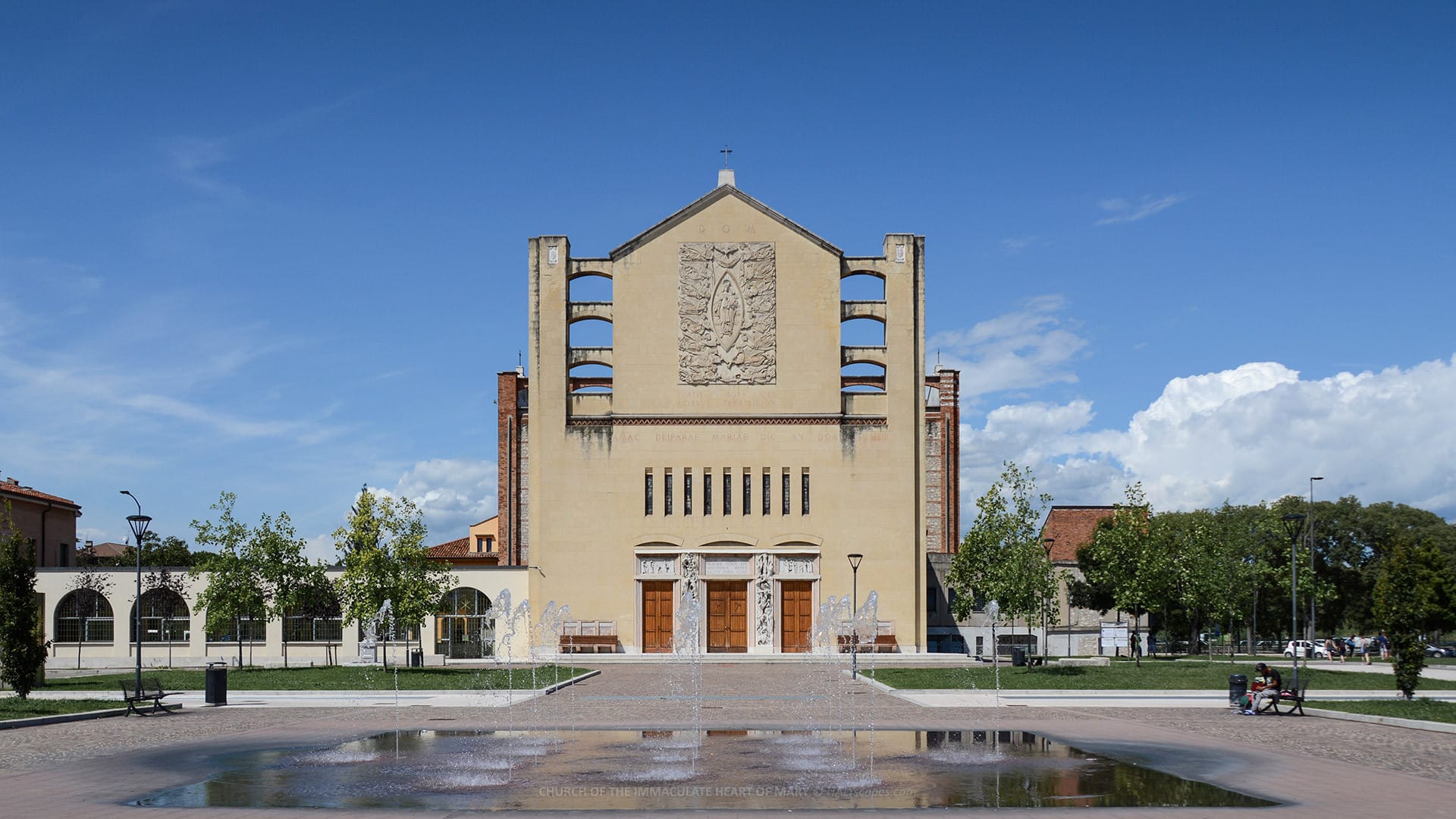
The Church of the Immaculate Heart of Mary is a Catholic parish church in Verona, officially called Chiesa del Cuore Immacolato di Maria in Italian. In the city, it is also widely known as the Votive Temple, because it was built after a solemn wartime vow.
The dedication to the Immaculate Heart of Mary connects the church with Marian devotion. Its religious identity is closely linked to the dramatic years of the Second World War, when Verona suffered bombing, fear, and uncertainty, and the local Church asked for protection through a public vow.
The Church of the Immaculate Heart of Mary stands at Piazzale XXV Aprile 8, directly in front of Verona Porta Nuova railway station. Its position makes it one of the easiest churches to reach in Verona, especially for visitors arriving by train, airport shuttle, regional bus, urban bus, or taxi.
The Church of the Immaculate Heart of Mary was designed by Paolo Rossi De Paoli and constructed between 1950 and 1952. It opened for worship on 8 December 1952, became a parish on 25 December 1953, and was consecrated in May 1958 by Bishop Giovanni Urbani.
The church belongs to the Diocese of Verona and the Vicariate of Verona Centro. On 8 December 2002, on the fiftieth anniversary of its opening, Bishop Flavio Roberto Carraro declared it a Santuario cittadino, or civic sanctuary.
Short History of the Church of the Immaculate Heart of Mary
The Wartime Vow of 1943 and the Construction
The history of the Church of the Immaculate Heart of Mary begins during the Second World War. On 8 September 1943, Bishop Girolamo Cardinale made a vow in the name of Verona and the diocese, asking that the city be spared from destruction. This vow explains the name Tempio Votivo, meaning Votive Temple.
Construction began on 8 December 1950, seven years after the vow. The date was symbolically important, because 8 December is the Catholic feast of the Immaculate Conception. The project was entrusted to the architect Paolo Rossi De Paoli.
The Church of the Immaculate Heart of Mary was completed in 1952 and opened for worship on 8 December 1952. This created a direct connection between the vow, the dedication to Mary, and the liturgical calendar. The new building immediately became one of Verona’s most visible modern churches.
Parish Life and Later Changes
The Church of the Immaculate Heart of Mary became a parish on 25 December 1953. In 1965, it passed to the Friars Minor Conventual, who administered it for several decades. During that same year, important liturgical and internal changes were made inside the building.
The four side altars were removed, the high altar was moved to the center of the nave crossing, and the Madonna Pellegrina statue was placed in its chapel.
On 8 December 2002, the church received the title of civic sanctuary. The date marked the fiftieth anniversary of its opening and confirmed the building’s special role in Verona’s religious memory, especially as a church connected with wartime protection and thanksgiving.
Since 1 September 2013, the Parish of the Tempio Votivo has been officiated and administered by the diocesan clergy. This means that its pastoral care returned to the direct responsibility of the Diocese of Verona after the period of Franciscan administration.
Architecture of the Church of the Immaculate Heart of Mary
Exterior Setting and the Façade
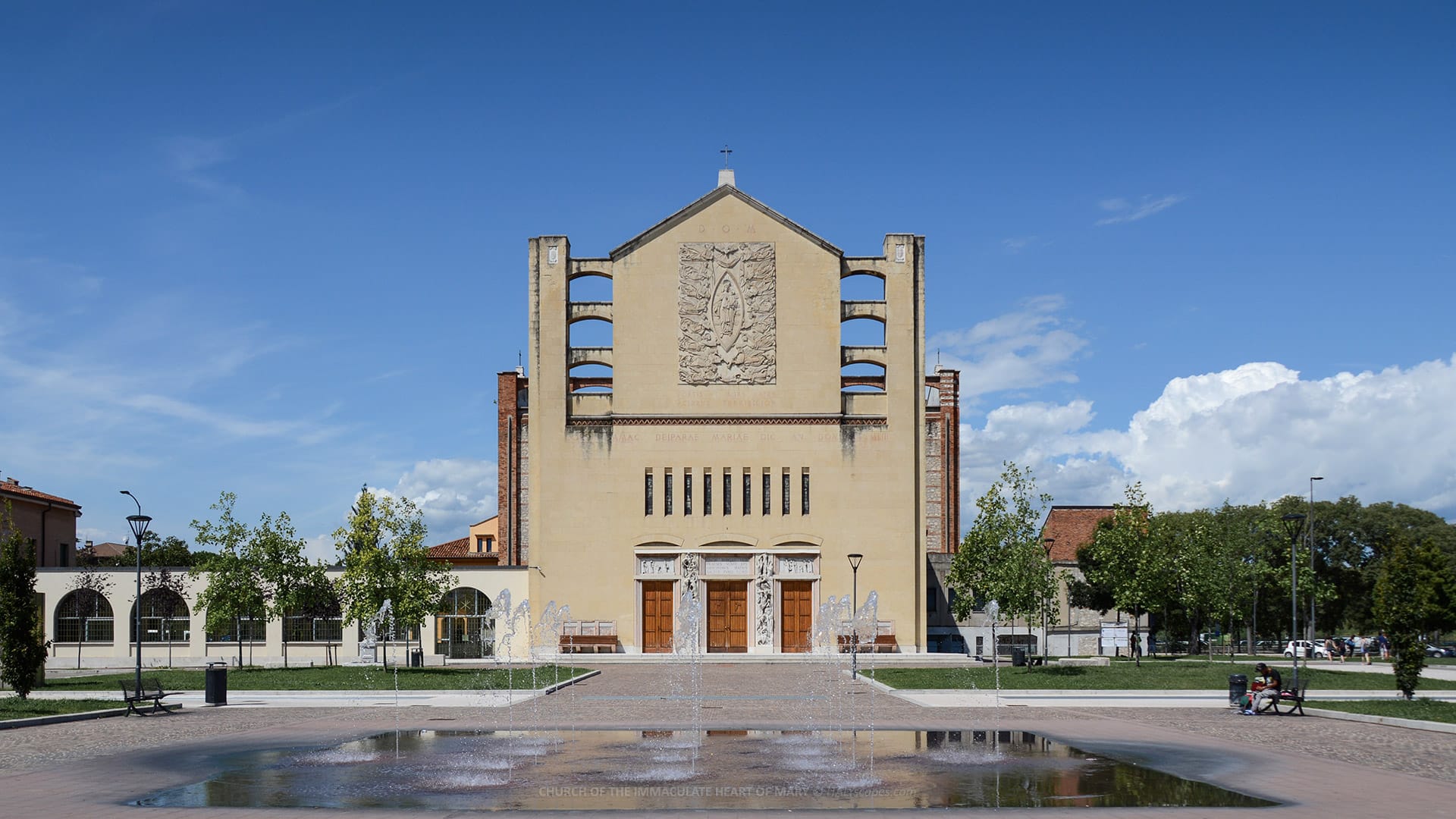
The Church of the Immaculate Heart of Mary stands isolated on the northern side of Piazzale XXV Aprile, directly facing Verona Porta Nuova station. This setting gives the building a strong visual role in the station area, where traffic, buses, taxis, pedestrians, and travelers constantly pass through.
The building develops along a south-north axis. The façade faces south, toward the station square, while the apse is positioned to the north, near the area connected with Verona’s historical defensive system and the canal derived from the Adige.
The façade is simple, vertical, and monumental. It is built with squared blocks of soft stone and has three entrance portals at ground level. Above them, narrow slit-like windows bring light into the upper part of the interior.
The central portal is decorated with high reliefs by Vittorio di Colbertaldo, showing scenes from the life of the Virgin and Christ. The upper sides of the façade are marked by strong buttress-like structures connected to the wall by arched openings.
Plan and Spatial Layout
The interior follows a Latin-cross plan, with one large nave, a transept, a deep presbytery, a semicircular apse, and an ambulatory around the apse. The plan is traditional, but the architectural language belongs to the 20th century.
The transept is raised by six steps above the nave. The presbytery is raised by two additional steps, while the side chapels are raised by one step from the nave floor. These level changes create a clear hierarchy inside the Church of the Immaculate Heart of Mary.
The nave and presbytery are slightly flared toward the crossing. The walls do not run in a perfectly parallel line, because the nave widens toward the transept, while the presbytery narrows along the main axis, directing attention toward the altar and apse.
Along the sides of the nave, two large lowered arches open toward the side chapels. Above the chapels are matronei, or gallery spaces, built as stepped balconies. These galleries also continue along the counter-façade, above the entrance area.
Materials, Structure, Flooring and Interior Finish
The structural system uses reinforced concrete, with wall infill made of rough limestone and tuff blocks, horizontal brick courses, and brick masonry in the upper nave. The external walls are not plastered, so the masonry texture remains clearly visible.
The nave, presbytery, and transept arms are covered by very low barrel vaults in latero-cement. At the crossing, where nave and transept meet, there is a large cross vault. The church does not have a bell tower.
The floor uses Rosso Verona marble and pink nembro stone. The main nave, crossing, and presbytery contain Rosso Verona marble slabs, while the transept arms and steps use nembro rosato. These materials connect the modern building with local Veronese stone tradition.
The interior is broad and sober, with the strongest visual emphasis placed on the presbytery and apse. The architectural design avoids excessive decoration in the nave, allowing the frescoes, altar area, and Marian dedication to dominate the visitor’s attention.
Art of the Church of the Immaculate Heart of Mary
Frescoes by Pino Casarini
The most important artistic feature of the church is the fresco cycle by Pino Casarini, completed in 1954 in the presbytery and apse. The central theme is the Assumption of Mary, represented as the main spiritual and visual focus of the sanctuary.
At the center of the apse appears the Madonna Assunta tra gli angeli, or the Assumed Madonna among the angels. Below this Marian image, the fresco includes Pope Pius XII proclaiming the dogma of the Assumption of Mary.
The apse decoration also includes the Twelve Apostles in the upper register. In the lower register, Casarini painted bishops in council, including the Bishop of Verona. This connects universal Catholic doctrine with the local Church of Verona.
The presbytery walls are arranged with slightly overlapping oblique sections. This creates an effect similar to theatrical scenery, guiding the eye toward the apse. The architecture and painting work together, making the sanctuary the strongest artistic point of the church.
Frescoes by Carlo Bonacina
The side chapels were decorated by Carlo Bonacina between 1954 and 1959. His frescoes represent important saints connected with Catholic devotion, charity, education, and religious life, creating a devotional program around the central Marian theme of the church.
On the left side, the subjects include Saint Maria Maddalena di Canossa and Saint Joseph with the adolescent Jesus. On the right side, the subjects include Saint Vincent de Paul and Saint John Bosco.
The Madonna Pellegrina
Another important devotional object is the Madonna Pellegrina statue. It is a wooden statue made by an artisan from Ortisei and donated to the Diocese of Verona by the Sovereign Military Order of Malta.
The statue was received in Verona in September 1949, taken to Castel Gandolfo to be blessed by Pope Pius XII, and then welcomed at Porta Nuova. It later became closely connected with the new church and its Marian identity.
Stained Glass and Portal Reliefs
The church also contains artistic stained-glass windows. The large windows in the transept include scenes from the Old and New Testament, while narrow rectangular windows appear along the upper nave, galleries, and ambulatory.
The exterior portal reliefs by Vittorio di Colbertaldo add an important sculptural element to the façade. Together with the stained glass, frescoes, and devotional statue, they complete the church’s 20th-century artistic program.
How to Get to the Church of the Immaculate Heart of Mary
The Church of the Immaculate Heart of Mary is one of the simplest religious landmarks to reach in Verona because it stands directly beside the city’s main railway and bus hub. The practical destination to use is Piazzale XXV Aprile 8, or simply Verona Porta Nuova station.
Visitors arriving by train do not need to enter the historic center first. The church is immediately outside the station area, on the opposite side of the square.
Getting to the Church of the Immaculate Heart of Mary on foot
From Verona Porta Nuova railway station, the walk is extremely short. Leave the main station building toward Piazzale XXV Aprile, face the open square and bus area, and walk north toward the church façade.
The distance from the station entrance to the church is about 200-250 meters, depending on the exact exit and crossing point. The walking time is usually 3 to 5 minutes, even with light luggage. The route is flat and direct.
For visitors coming from Piazza Bra or the Arena di Verona, the simplest walking route follows Corso Porta Nuova south toward the station. The distance is about 1.5 kilometers, and the walk normally takes around 20 minutes.
Getting to the Church of the Immaculate Heart of Mary by bus
By bus, the destination is Verona Porta Nuova or one of the station-area stops in Piazzale XXV Aprile. The church stands beside the transport terminal, so once you get off, the final walk is normally only a few minutes.
Getting to the Church of the Immaculate Heart of Mary by taxi
From the historic center, a taxi to Piazzale XXV Aprile usually takes about 5 to 10 minutes, depending on traffic and the departure point. Ask for Tempio Votivo, Piazzale XXV Aprile 8, opposite Verona Porta Nuova station.
Frequently Asked Questions about the Church of the Immaculate Heart of Mary
What is the Church of the Immaculate Heart of Mary in Verona?
It is a Catholic parish church and civic sanctuary in Verona, officially named Chiesa del Cuore Immacolato di Maria and commonly known as Tempio Votivo.
Why is it called the Votive Temple?
It is called Votive Temple because it was built after a 1943 vow made by Bishop Girolamo Cardinale, asking that Verona and its diocese be spared during the war.
Where is the Church of the Immaculate Heart of Mary located?
The church is located at Piazzale XXV Aprile 8, directly in front of Verona Porta Nuova railway station, the main transport hub of Verona.
When was the church built?
The church was built between 1950 and 1952. It opened for worship on 8 December 1952 and became a parish on 25 December 1953.
What are the main artworks inside the church?
The main artworks are the frescoes by Pino Casarini in the apse and presbytery, and the chapel frescoes painted by Carlo Bonacina between 1954 and 1959.
How far is the church from Verona Porta Nuova station?
The church is about 200-250 meters from the station entrance. The walk usually takes 3 to 5 minutes across Piazzale XXV Aprile.
Is the Church of the Immaculate Heart of Mary worth visiting?
Yes, especially for visitors interested in modern religious architecture, Marian devotion, post-war Verona, and 20th-century frescoes by Pino Casarini and Carlo Bonacina.
Sources: -
Photos
-
Map
-
Reviews