-
About
Table of Contents
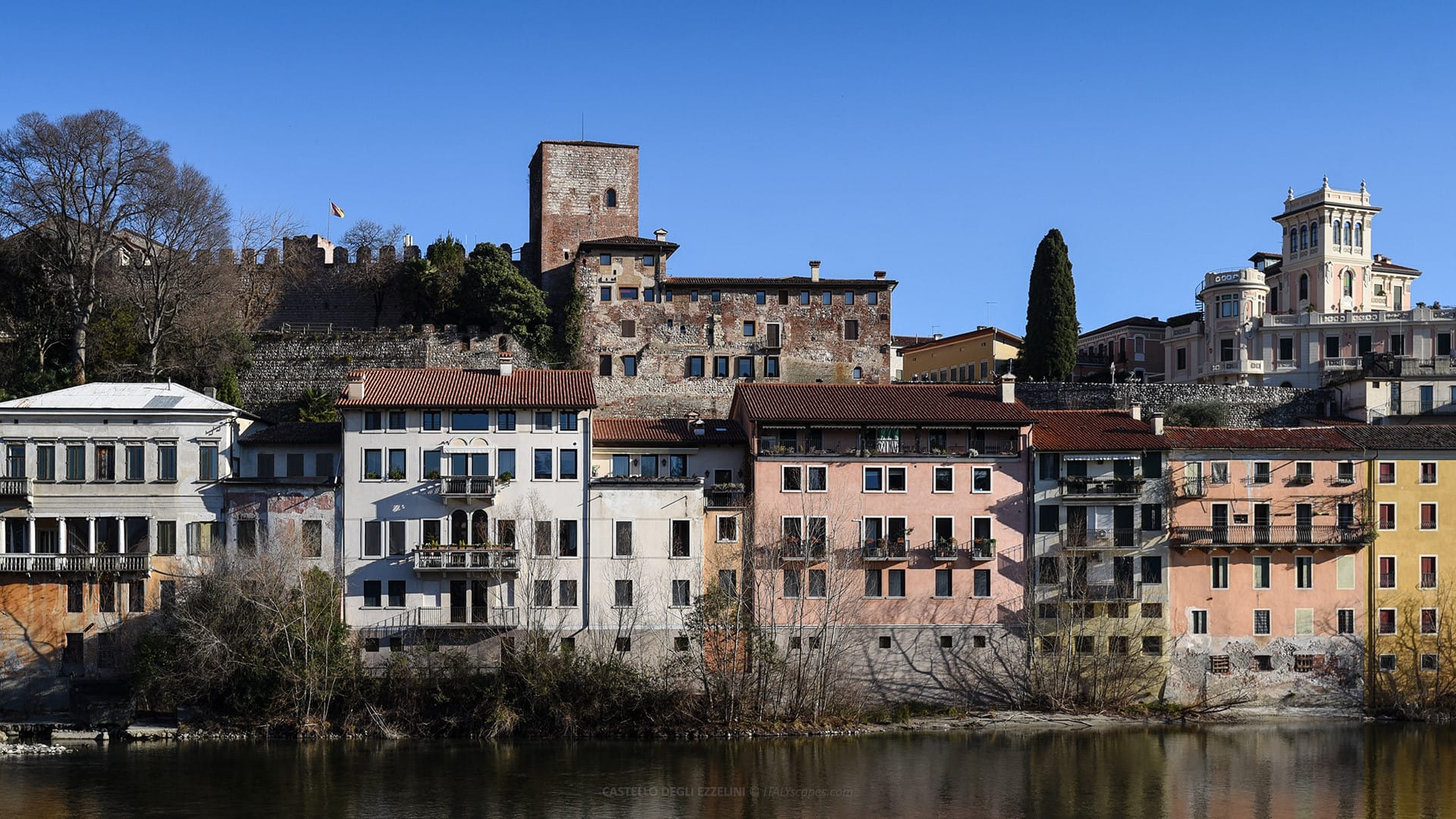
Castello degli Ezzelini is a medieval fortress situated at the highest point of Bassano del Grappa, dominating the landscape with its medieval silhouette.
Its strategic location underscores its importance: from here, one could oversee the Brenta Valley, monitor enemy movements, and control trade routes that connected the Venetian plain to the Alpine passes.
Today, Castello degli Ezzelini continues to fascinate visitors not only with its formidable walls and towers but also with the legends, conflicts, and dramatic historical events associated with the Ezzelini family, one of the most feared dynasties in northern Italy during the Middle Ages.

Short History of Castello Degli Ezzelini
A defensive structure already existed around the ancient Church of Santa Maria in Colle, and a record from the year 998 confirms fortifications on this elevated site.
In the second half of the 12th century, the castle’s destiny changed forever. The Bishop of Vicenza, who owned the complex, granted the castle to Ezzelino I da Romano, the patriarch of what would become the Ezzelini dynasty.
Ezzelino I and his descendants did not simply occupy the castle – they turned it into the seat of their power, strengthening existing fortifications and using it as an administrative, military, and symbolic center.
The Ezzelini family soon became one of the most formidable dynastic forces in northern Italy. Their control extended through territories in Veneto, especially around Bassano, Treviso, and Vicenza.
The most notorious member of the family, Ezzelino III da Romano, ruled the region with unmatched brutality.
His reputation spread beyond the borders of the Veneto and into European chronicles, where he was portrayed as a tyrant feared for his cruelty, political ruthlessness, and relentless ambition.
Even Dante Alighieri mentioned Ezzelino III in Inferno (Canto XII), associating him with violence and tyranny.
In 1229, Bassano del Grappa attempted to reclaim its autonomy from Ezzelino rule in what is historically known as the Rivolta dei liberi di Bassano. The rebellion was crushed, and the castle remained in the hands of the Ezzelini.
Their political power continued until the late 13th century, when the dynasty fell dramatically after the death of Ezzelino III in 1259 and the subsequent annihilation of the family.
With their downfall, the Castello degli Ezzelini passed from ruler to ruler, mirroring the shifting political landscape of northern Italy.
In 1311, the castle came under the control of the Scaligeri of Verona. Later, in 1387, it passed to the Visconti of Milan, who pursued ambitions of territorial expansion into Veneto.The castle’s strategic role remained paramount until 1404, when it was absorbed into the Republic of Venice, marking a new chapter in its history. Under Venetian rule, Castello degli Ezzelini continued to play a defensive role.
In 1411, during the war between Venice and the Kingdom of Hungary, the fortress famously resisted bombardments by Emperor Sigismund of Luxembourg’s troops – an event that proves the fortress was capable of withstanding early gunpowder artillery, a rarity for medieval defensive structures.
This feat highlights both the castle’s structural solidity and the ingenuity of Venetian military architecture.
In 1508, the castle and the entire town of Bassano fell to the armies of Emperor Maximilian I during the War of the League of Cambrai. The fall did not destroy the castle, but it marked the beginning of its decline as a military installation.
By the 16th century, the fortification was officially decommissioned. The fortress, stripped of its military relevance, gradually became part of the everyday town fabric.
Its interior spaces were occupied by artisanal workshops, warehouses, and commercial activities, demonstrating a shift from warfare to commerce – a transformation typical of many former medieval strongholds across Europe.
Over the centuries, the castle witnessed further transformations, collapses, restorations, and reinterpretations.
The structure partially crumbled in 1928 due to a collapse involving a section of walls. Later restoration works recovered sections of the patrol walkways, towers, and outer fortifications.
Today, Castello degli Ezzelini stands not as a ruin of forgotten times but as a dynamic historical organism – one that encapsulates the sweeping changes of northern Italian history from the Middle Ages to the modern era.
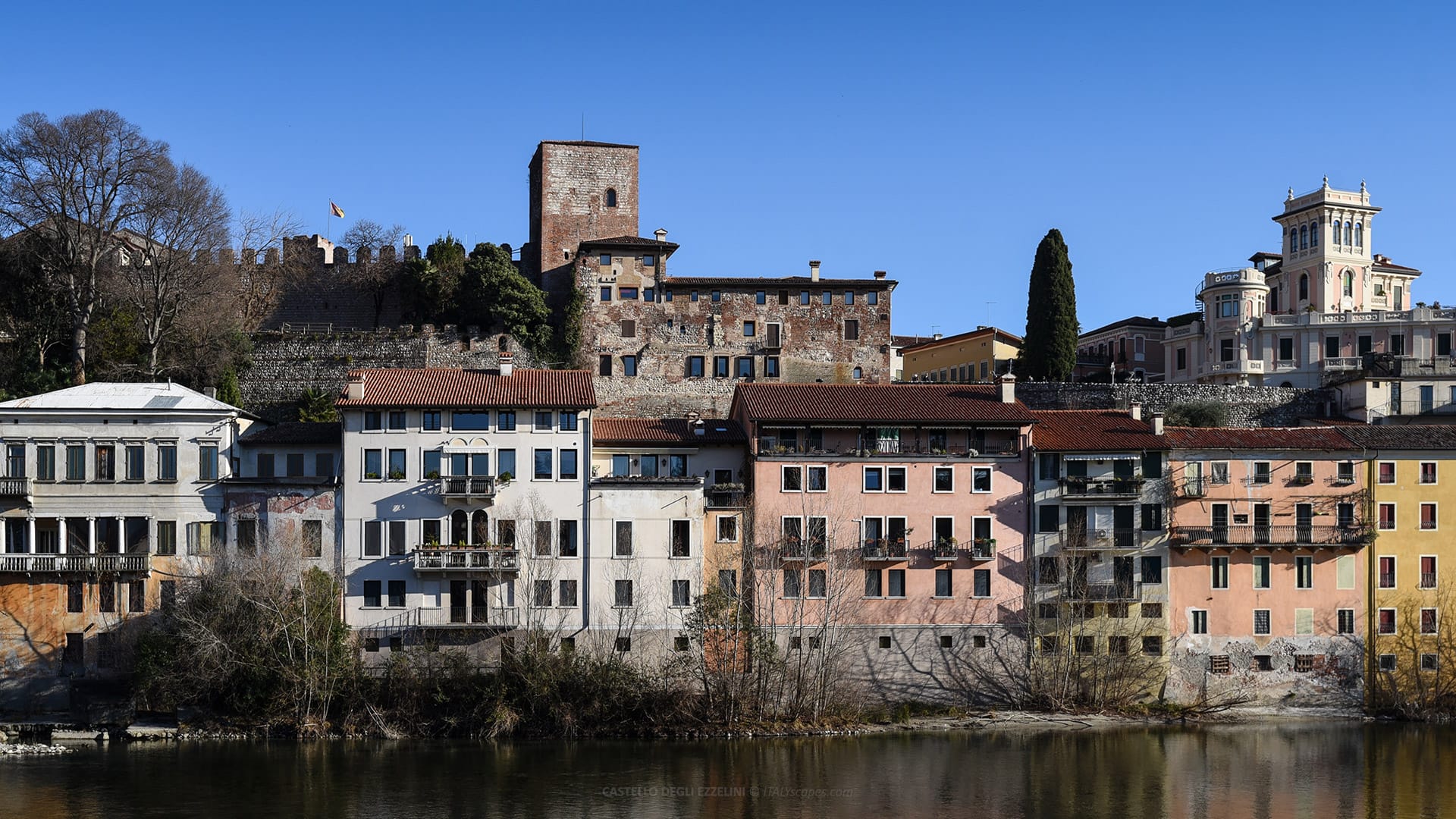
Castello degli Ezzelini, seen from the opposite bank of the Brenta river
Architecture of Castello Degli Ezzelini
The architectural identity of Castello degli Ezzelini reflects centuries of stratification, military adaptation, and stylistic evolution.
The dominant features include two concentric walls circling the hilltop, battlements, sighting points, a patrol walkway, and defensive towers – all crafted to maximize strategic control of the surrounding territory.
The outer enclosure is the oldest section, dating mainly from the early medieval period and built to protect the first settlement and its church.
The inner enclosure, developed later, exhibits clearer medieval military logic, featuring more complex ramparts associated with increased threats and new warfare technologies introduced between the 13th and 14th centuries.
The fortress employs a distinctive building technique: alternating rows of brick and smooth river stones. These stones were collected from the nearby Brenta River, offering both convenience and visual uniqueness.
The fortification is quadrangular, with walls ranging from 7.50 to 13.50 meters in height and designed to make direct assaults nearly impossible.
Two towers define the identity of the Castello degli Ezzelini: Torre Bolzonella and Torre dell’Ortazzo.
Torre BolzonellaAlso known as Torre di Ser Ivano, this watchtower rises to about 30 meters. Its vertical mass dominates the castle entrance and historically functioned as an autonomous defensive outpost.
Torre dell’OrtazzoPositioned on the southwestern side, this tower is square-based and more squat, measuring around 8.40 meters per side and reaching 22.64 meters in height. Its location near a historic burial area known as Ortazzo lends the tower a somewhat somber aura.
Historically, the adjacent field was used to bury those considered unworthy of consecrated ground – often the drowned or suicides.
Between the two defensive perimeters lies a patrol walkway (camminamento di ronda), restored and accessible to visitors. From this vantage point, one can admire captivating views of Bassano del Grappa, the Brenta River, and the surrounding hills.
How to Get to Castello Degli Ezzelini
Accessing the Castello degli Ezzelini is remarkably simple. The castle sits about 900 meters from the Bassano del Grappa railway station, making it easily reachable on foot in approximately 10-15 minutes.
The walk ascends gently through historical alleys and stone-paved streets, giving visitors the chance to enjoy the medieval atmosphere of the town before reaching the fortress.
Once visitors enter the historic center, clear signage guides them toward the castle. The route culminates at Piazza Castello, where the imposing walls and the unmistakable profile of the Torre Bolzonella signal arrival at one of Bassano’s most historically charged locations.
Sources: -
Photos
-
Map
-
Reviews