-
About
Table of Contents
Palazzo della Fraternita dei Laici is a historic palace overlooking Piazza Grande, the monumental heart of Arezzo. Construction began during the fourteenth century, but the building developed through several distinct phases, combining medieval stonework, Renaissance sculpture and sixteenth-century architectural additions within a single façade.
Palazzo della Fraternita dei Laici occupies a prestigious position between the apse of the Church of Santa Maria della Pieve and the Logge Vasari. Its location reflects the importance acquired by the Fraternita dei Laici, an institution established in Arezzo in 1262 and closely connected with the city’s social, charitable and cultural development.
Originally known as the Fraternita di Santa Maria della Misericordia, the organization assisted poor residents, transported and buried the dead and administered donations received from local benefactors. It gradually accumulated enough property and financial resources to support hospitals, schools, public infrastructure, artistic commissions and cultural institutions.
Palazzo della Fraternita dei Laici is especially recognizable for its façade, where the Gothic lower level is joined to a Renaissance upper section and a bell gable designed by Giorgio Vasari. The latter contains an astronomical clock constructed in 1552 and still operated through its historic mechanical system.
The building now accommodates the Fraternita dei Laici Museum, administrative and cultural spaces and the institution’s important historical archive. Visitors can examine artworks connected with Arezzo’s history, enter the clock mechanism room and reach the upper terrace overlooking Piazza Grande and the surrounding historic center.

Short History of Palazzo della Fraternita dei Laici
The Foundation of the Fraternity
The Fraternita dei Laici was established in 1262 by a group of citizens and received formal recognition from Guglielmino degli Ubertini, Bishop and Lord of Arezzo, in 1263. Its earliest activities focused on charitable assistance, the burial of the dead and support for residents living in poverty.
The institution was initially called the Fraternita di Santa Maria della Misericordia. Its current name was later adopted to emphasize its lay character and distinguish it from other religious or charitable organizations bearing similar titles. Its activities nevertheless remained strongly connected with civic solidarity and public welfare.
As donations and testamentary bequests increased, the Fraternity accumulated agricultural land, houses, workshops, mills and other properties. This expanding patrimony allowed it to become an important participant in the administration of Arezzo and created the financial conditions necessary for constructing a representative headquarters in the city’s principal square.
The Fourteenth-Century Construction
Work on Palazzo della Fraternita dei Laici began in 1375. The first phase was entrusted to the Florentine masters Baldino di Cino and Niccolò di Francesco, who designed the lower portion of the façade according to the Gothic architectural language still dominant during the late fourteenth century.
By 1377, the first level had become usable, although the wider building project remained incomplete. Construction then slowed amid the political instability surrounding Arezzo and the city’s gradual passage under Florentine control. The unfinished structure nevertheless provided the Fraternity with premises in the most important public space of Arezzo.
The original façade included a deeply recessed stone portal framed by carefully cut architectural elements. Two narrow pointed windows were positioned beside the entrance, creating the balanced medieval composition that still defines the lower register of Palazzo della Fraternita dei Laici.
Between 1395 and 1396, Spinello Aretino decorated the lunette above the entrance with a mural representing Christ in Pietà between the grieving Virgin Mary and Saint John.
Powered by GetYourGuideLazzaro Bracci and the Renaissance Phase
A decisive moment arrived after the death of the wealthy Arezzo merchant Lazzaro di Giovanni di Feo Bracci. Having no direct heirs, he left his assets to the Fraternita dei Laici, providing the institution with resources that enabled it to resume and expand construction.
In 1433, Bernardo Rossellino was commissioned to design the upper portion of Palazzo della Fraternita dei Laici. His intervention introduced the forms of the early Renaissance while respecting the existing Gothic structure, producing one of the clearest examples of stylistic continuity visible in Piazza Grande.
Rossellino also designed the sculptural decoration installed on the façade during the following years. The principal group represents the Madonna della Misericordia with the Child and the young martyrs Lorentino and Pergentino. Statues of Saint Donatus and Blessed Gregory X were placed in separate niches beside it.
The sculptural group was substantially completed between 1434 and 1435. Its subjects were selected carefully: Lorentino and Pergentino were associated with the Fraternity, while Saint Donatus and Gregory X were honored as important protectors of Arezzo and its religious identity.
Work on the upper level continued during the following decades. Between the late 1450s and 1461, Giuliano da Settignano participated in the completion of the façade, including the open gallery and its perforated stone parapet.
Giorgio Vasari and the Astronomical Clock
On February 2, 1546, the Fraternity requested an old bell from the Municipality of Arezzo. The institution intended to construct a bell structure above the existing gallery and use it to regulate public time within Piazza Grande and the surrounding urban area.
Between 1549 and 1550, Giorgio Vasari directed the construction of the distinctive bell gable. The structure was positioned above the Renaissance gallery and designed to accommodate bells as well as the mechanism and external dial of a sophisticated astronomical clock.
The clock was delivered in 1552 by Felice di Salvatore Vannucci da Fossato, generally known as Felice da Fossato. It was connected with the bells and designed to mark the passage of time while displaying information concerning the Sun, the Moon and the lunar calendar.
A central bell added in 1578 became part of the clock’s striking system. Together with the other bells, it enabled Palazzo della Fraternita dei Laici to announce hours and shorter intervals, turning the building into an important instrument for organizing daily life in Arezzo.
The portion of the complex extending toward the apse of Santa Maria della Pieve was developed in a later construction phase. The façade of the left-hand extension was completed during the second half of the seventeenth century, using an earlier project associated with Giorgio Vasari.
The Library, Court and Museum
A serious fire in 1759 damaged the library belonging to the Fraternity. Much of the collection survived, however, and an extensive reorganization of the palace was later undertaken to provide suitable rooms for books, study and public cultural activities.
Renovation work begun during the 1770s was supported by Grand Duke Pietro Leopoldo of Lorraine. An edict issued in 1781 encouraged the opening of the reorganized library to the public, while the new rooms strengthened the cultural role of the Fraternita dei Laici in Arezzo.
The public library opened in its renovated form in 1782. It included a large reading hall, an antechamber, rooms for the librarian and additional service spaces. The program also stimulated the creation of the Free School of Drawing and Modelling, which trained artists and craftsmen.
In 1786, Palazzo della Fraternita dei Laici became the seat of Arezzo’s civil court. Judicial offices remained in the building for more than two centuries, while the Fraternity transferred parts of its administration and cultural collections to other properties.
The court finally moved to a modern building outside the historic center in 2008. Restoration and adaptation work then allowed the Fraternity to return to its historic headquarters, where the reorganized museum was opened to the public in 2010.

Architecture of Palazzo della Fraternita dei Laici
The Gothic Lower Façade
The architecture of Palazzo della Fraternita dei Laici records the different phases of its construction rather than presenting a uniform design. The lowest section belongs to the late fourteenth century and retains the Gothic character established by Baldino di Cino and Niccolò di Francesco.
The central entrance is formed by a large stone portal with a pronounced splay. Its depth emphasizes the thickness of the medieval wall and draws attention toward the interior. Above the doorway, the lunette provides a dedicated architectural frame for the image originally painted by Spinello Aretino.
Two narrow single-light windows stand on either side of the portal. Their vertical proportions contrast with the broad entrance while maintaining the symmetry of the lower façade. These openings belong to the earliest construction campaign and remain among the palace’s most clearly identifiable medieval elements.
The Renaissance Upper Level
The second level introduced by Bernardo Rossellino transformed Palazzo della Fraternita dei Laici without removing its original structure. Rossellino employed Renaissance proportions and decorative elements while keeping the width and central alignment established by the fourteenth-century façade.
The Madonna della Misericordia group occupies the visual center of the upper section. Its placement above the portal creates a direct vertical relationship between the main entrance, Spinello Aretino’s painted lunette and the Renaissance sculpture, integrating architecture and religious imagery.
The flanking niches containing Saint Donatus and Blessed Gregory X reinforce the symmetry of the façade. Their architectural frames also establish a transition between the central sculptural group and the openings of the upper floor, making the decoration an integral part of the overall design.
The uppermost gallery was completed with the participation of Giuliano da Settignano. Its openings and perforated parapet introduce a lighter architectural rhythm above the more massive stone levels. The gallery also provides a horizontal line separating Rossellino’s façade from the later bell structure.
The Vasarian Bell Gable
Giorgio Vasari’s bell gable rises above the center of the Palazzo della Fraternita dei Laici. Rather than functioning as a conventional tower, it is a relatively open structure designed specifically to hold bells and frame the astronomical clock, while maintaining visibility across the upper section of Piazza Grande.
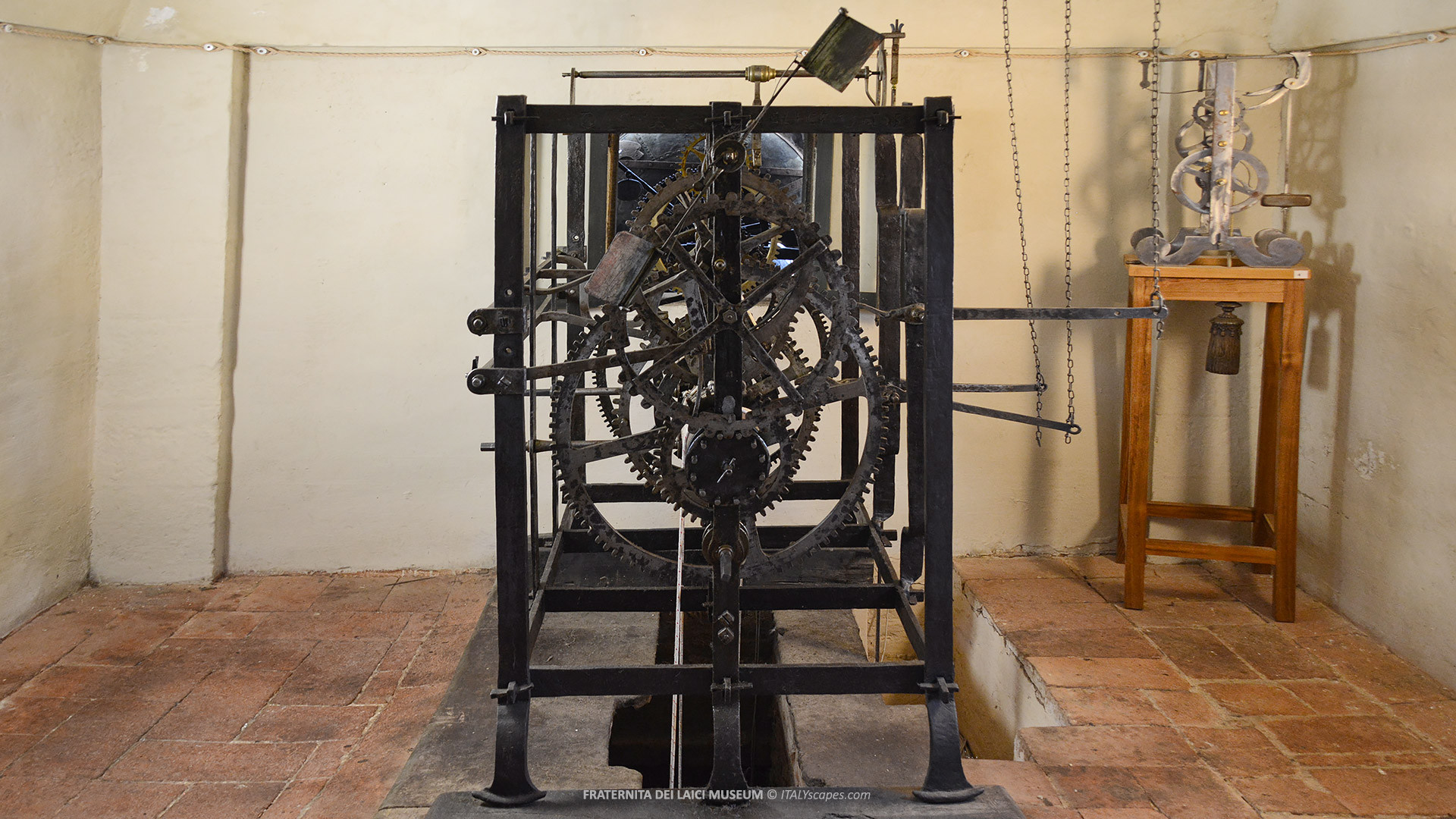
The clock dial occupies a central position beneath the bells. Its placement makes it readable from the square, while the machinery is housed in a dedicated room behind the façade. Visitors entering this room can examine the gears, wheels, ropes and counterweights that operate the system.
The bell gable provides a vertical culmination without overwhelming the older building. Its modest width corresponds with the central portal and sculptural group below, creating a continuous architectural axis from the entrance to the highest bell.
The later extension toward Santa Maria della Pieve follows the scale and main horizontal levels of the earlier palace. Although completed during a separate phase, it visually connects Palazzo della Fraternita dei Laici with the surrounding buildings and helps define the upper side of Piazza Grande.
Interior Spaces
The interior reflects repeated changes in function. Rooms once used for audiences, administrative meetings, charitable operations and storage were later adapted for the library, courtrooms, offices and museum displays. Surviving decorations identify several of these former purposes.
The ground-floor Audience Hall was one of the most important institutional spaces. Here, the rectors received citizens, considered petitions and conducted the Fraternity’s business. Its monumental fresco demonstrated the authority of the organization while representing its relationship with the wider community of Arezzo.
Upper rooms were reorganized during the eighteenth-century library project and subsequently occupied by judicial offices. Following restoration, these spaces became exhibition galleries, administrative rooms and areas used for cultural activities, while maintaining architectural evidence of their previous functions.
The upper route reaches the clock mechanism room and panoramic terrace. From this level, visitors can examine the relationship between the Palazzo della Fraternita dei Laici, the sloping surface of Piazza Grande, Santa Maria della Pieve, the Logge Vasari and the surrounding medieval cityscape.
Art of Palazzo della Fraternita dei Laici
Spinello Aretino and the Entrance Lunette
The earliest major artistic commission for Palazzo della Fraternita dei Laici was the mural painted by Spinello Aretino around 1395-1396. It represented Christ in Pietà between the sorrowful Virgin Mary and Saint John and occupied the lunette directly above the central portal.
The image was exposed to weather and environmental damage for centuries. To protect it, the original mural was detached in 1952 and transferred to the National Museum of Medieval and Modern Art in Arezzo. A modern copy now occupies its former position on the façade.
Bernardo Rossellino’s Sculptures
The central sculptural group was created by Bernardo Rossellino, who had been called to Arezzo in 1433 to complete the upper façade. The work represents the Madonna della Misericordia with the Child, accompanied by the young saints Lorentino and Pergentino.
The Virgin stands beneath a mantle supported by angels, following an iconographic tradition associated with protection and mercy. Lorentino and Pergentino were early Christian martyrs connected with Arezzo and were particularly important within the devotional identity of the Fraternita dei Laici.
The figures of Saint Donatus and Blessed Gregory X occupy separate niches beside the central group. Saint Donatus is the patron saint of Arezzo, while Gregory X died in the city in 1276 and became closely connected with its religious history.
The Audience Hall Fresco
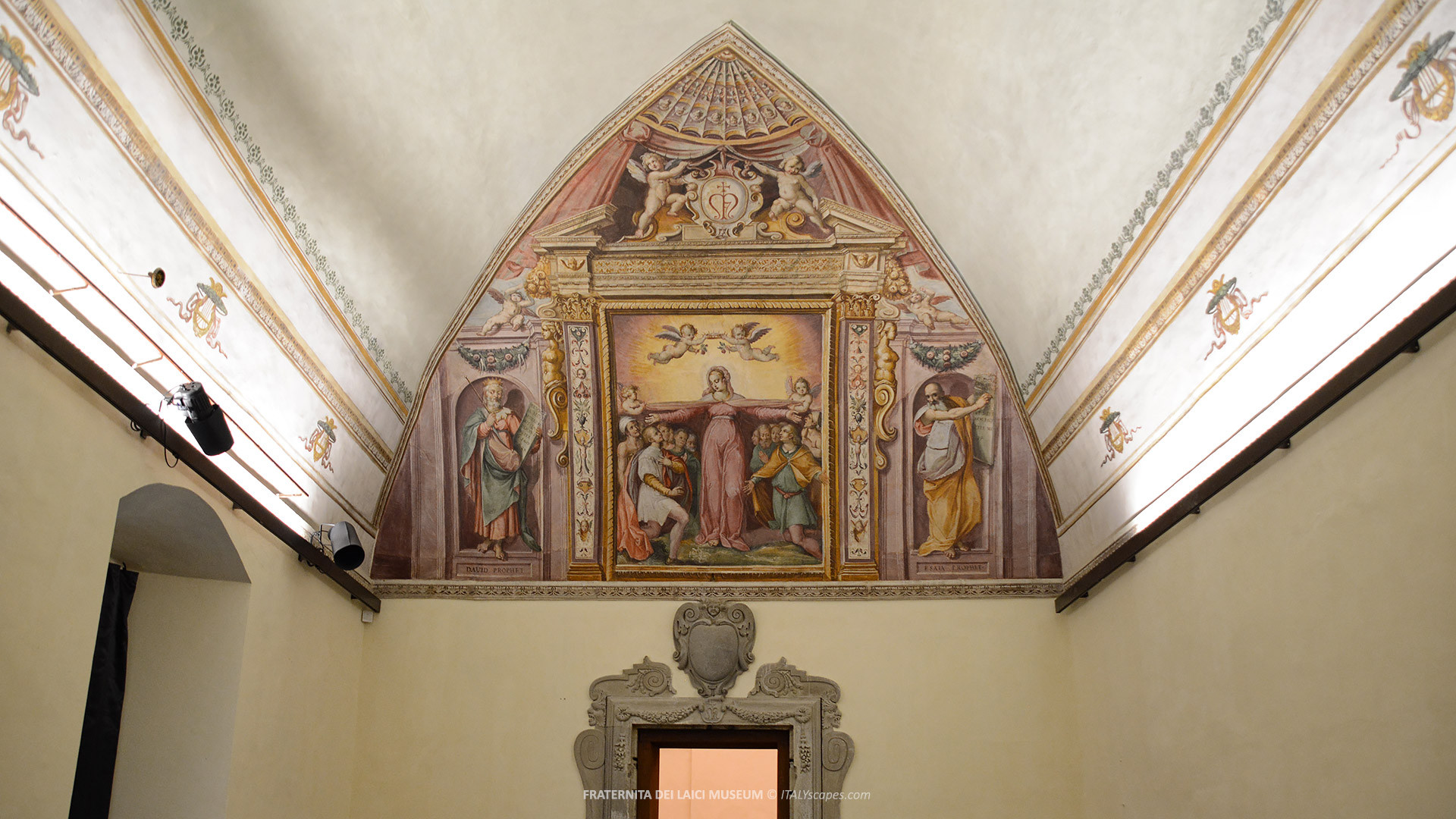
Inside the Palazzo della Fraternita dei Laici, the most important surviving medieval work is the large fresco painted by Parri di Spinello in 1448. Commonly known as the Maestà or Madonna della Misericordia and Saints, it was commissioned for the Audience Hall on the ground floor.
The Virgin appears in a protective role, accompanied by Saint Donatus, Blessed Gregory and representatives of the Fraternity. The image connected divine protection with the rectors responsible for administering the organization and with the citizens whose interests were discussed inside the hall.
Parri di Spinello was the son of Spinello Aretino, the artist responsible for the portal lunette. The presence of works by both painters establishes a direct artistic link between the exterior and interior decorations created for the institution across two generations.
Pallas Athena and Later Decorations
A mural representing Pallas Athena was painted by Angelo Ricci in 1782 during the reorganization of the Fraternity’s library. It occupies a niche near the former entrance to the library and formed part of the decorative program associated with its opening to the public.
Athena was chosen as the goddess of wisdom, intellectual activity, education and the arts. These attributes corresponded with the new cultural functions introduced into Palazzo della Fraternita dei Laici, particularly the public library and the artistic school supported by the institution.
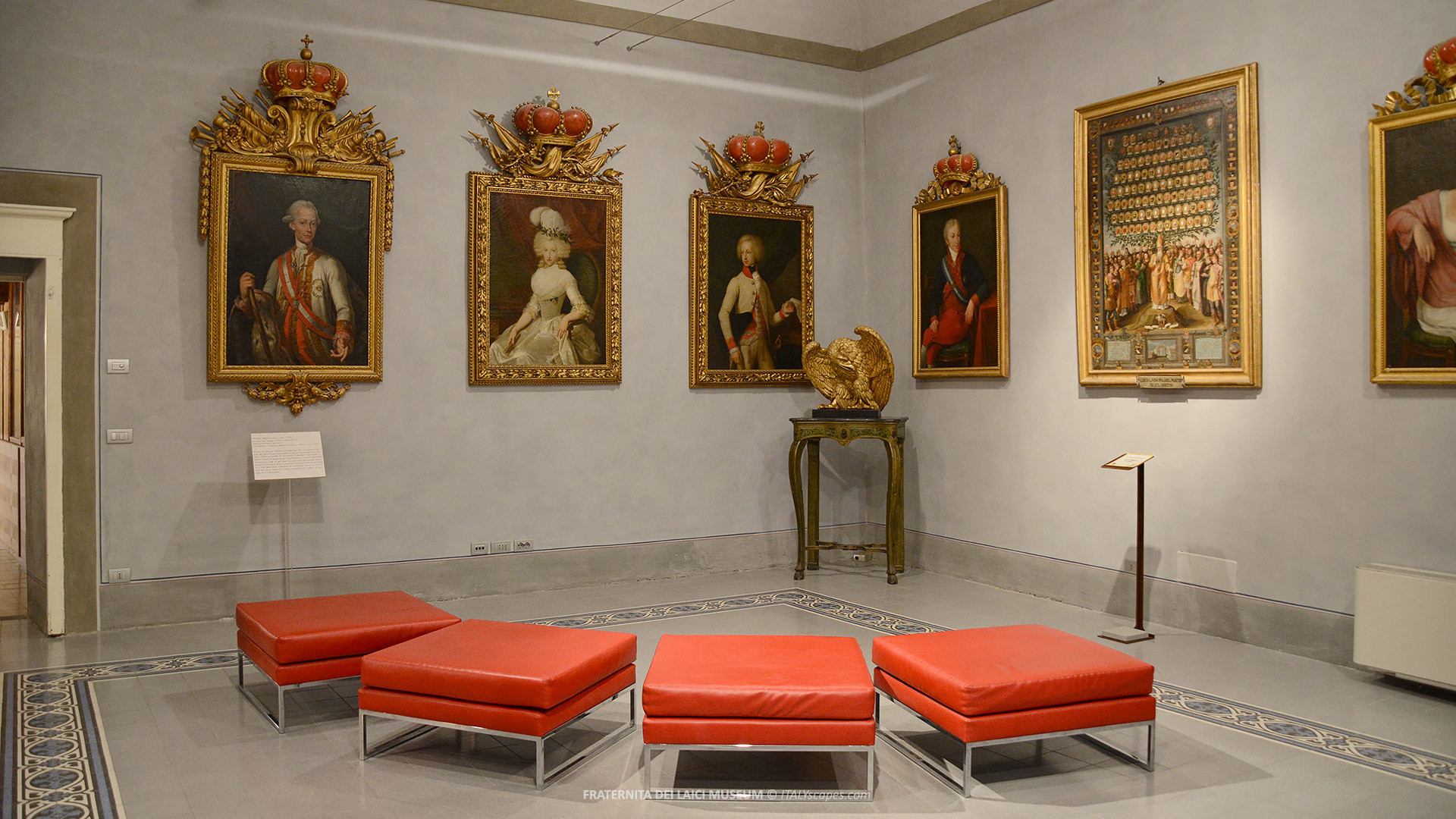
The collections also include portraits of rulers, rectors and benefactors, together with paintings documenting the appearance of Arezzo. A late eighteenth-century view of Piazza Grande by Cristoforo di Donato Conti records the square and its buildings during the period of the Lorraine renovations.
Historical plans and drawings preserve information about projects financed by the Fraternity. Among them is a 1696 representation by Giovan Battista Girelli showing the route of the Vasarian Aqueduct, which transported water from the hills outside Arezzo toward the city and Piazza Grande.
Powered by GetYourGuideFraternita Palace Museum
The Formation of the Collections
The collections of the Fraternita dei Laici developed through donations, testamentary bequests, artistic commissions and archaeological initiatives financed by the institution. They included paintings, sculpture, drawings, printed works, furniture, books, archaeological objects, scientific instruments, minerals and zoological specimens.
The institution’s museum was established during the early nineteenth century, with collections displayed from 1820. Further expansion followed the work of Antonio Fabroni and the acquisition of archaeological, numismatic and natural history material during the following decades.
Until 1935, the museum and library remained closely connected with the cultural patrimony administered by the Fraternity. In that year, substantial parts of the artistic, archaeological, scientific and book collections were transferred to institutions that later became Arezzo’s civic and state museums.
These transfers helped create several of the city’s principal public collections. The Fraternity nevertheless retained a considerable patrimony. Approximately 8,000 works and historical objects remain associated with Palazzo della Fraternita dei Laici, including paintings, sculptures, drawings, prints and antique furnishings.
The museum was re-established and reopened inside the restored palace in 2010. Its displays explain both the artistic heritage of the organization and the wider history of Arezzo, whose public services and cultural development were repeatedly supported by the Fraternita dei Laici.
The Museum Rooms
The traditional museum route includes the Quadreria, or picture gallery, together with the Council Room and the Room of the Primo Rettore. The displayed works range from medieval and Renaissance religious art to portraits, historical views and more recent institutional commissions.
The Council Room reflects the continuing administrative identity of Palazzo della Fraternita dei Laici. Paintings and furnishings coexist with a space intended for institutional meetings, demonstrating that the building is not exclusively a museum but remains connected with the organization that commissioned many of its works.
The Primo Rettore’s Room recalls the traditional title given to the head of the institution. Portraits, documents and furnishings illustrate the governing structure of the Fraternity, historically administered by rectors responsible for its properties, charitable services and cultural initiatives.
The Bartolini Collection
The Bartolini Collection is named after the Arezzo sculptor Ranieri Bartolini, who lived between 1794 and 1856. He left his artistic collection to the city, and it became an important educational resource connected with the Fraternity’s drawing school.
The collection now contains approximately 6,000 objects, including drawings, prints, illustrated books and plaster casts. Its size accounts for a substantial part of the graphic patrimony associated with the museum, although only selected works can be displayed at one time.
Much of the collection is connected with Neoclassicism. It includes studies and graphic works by Pietro Benvenuti, Luigi Sabatelli, Vincenzo Camuccini and other artists active during the late eighteenth and nineteenth centuries.
The Bartolini Collection also preserves earlier drawings. Among the most significant is Giorgio Vasari’s black-chalk study of the head of Hilaritas, prepared around 1546 for the decoration of the Sala dei Cento Giorni in Palazzo della Cancelleria in Rome.
The Astronomical Clock
The astronomical clock is the best-known technical object inside Palazzo della Fraternita dei Laici. Felice di Salvatore Vannucci da Fossato delivered it in 1552, and its surviving machinery represents an exceptional example of sixteenth-century mechanical engineering.
The external dial displays the hours through twelve Roman numerals. An internal circle contains twenty-nine Arabic numerals corresponding with the days of the lunar month, while moving components represent the relationship between the Earth, Moon and Sun.
The Earth occupies the center according to the Aristotelian-Ptolemaic system accepted when the clock was created. The mechanism also indicates the movement of the Sun and the phases and positions of the Moon within the lunar cycle.
Different spheres represent the principal celestial bodies. The Moon is shown through a sphere divided into light and dark halves, enabling its changing phases to be reproduced as the mechanism advances through the calendar.
The clock operates through gears, ropes, pulleys, weights and counterweights rather than an electrical motor. It requires manual intervention to raise the weights and provide the force necessary for the machinery to continue moving.
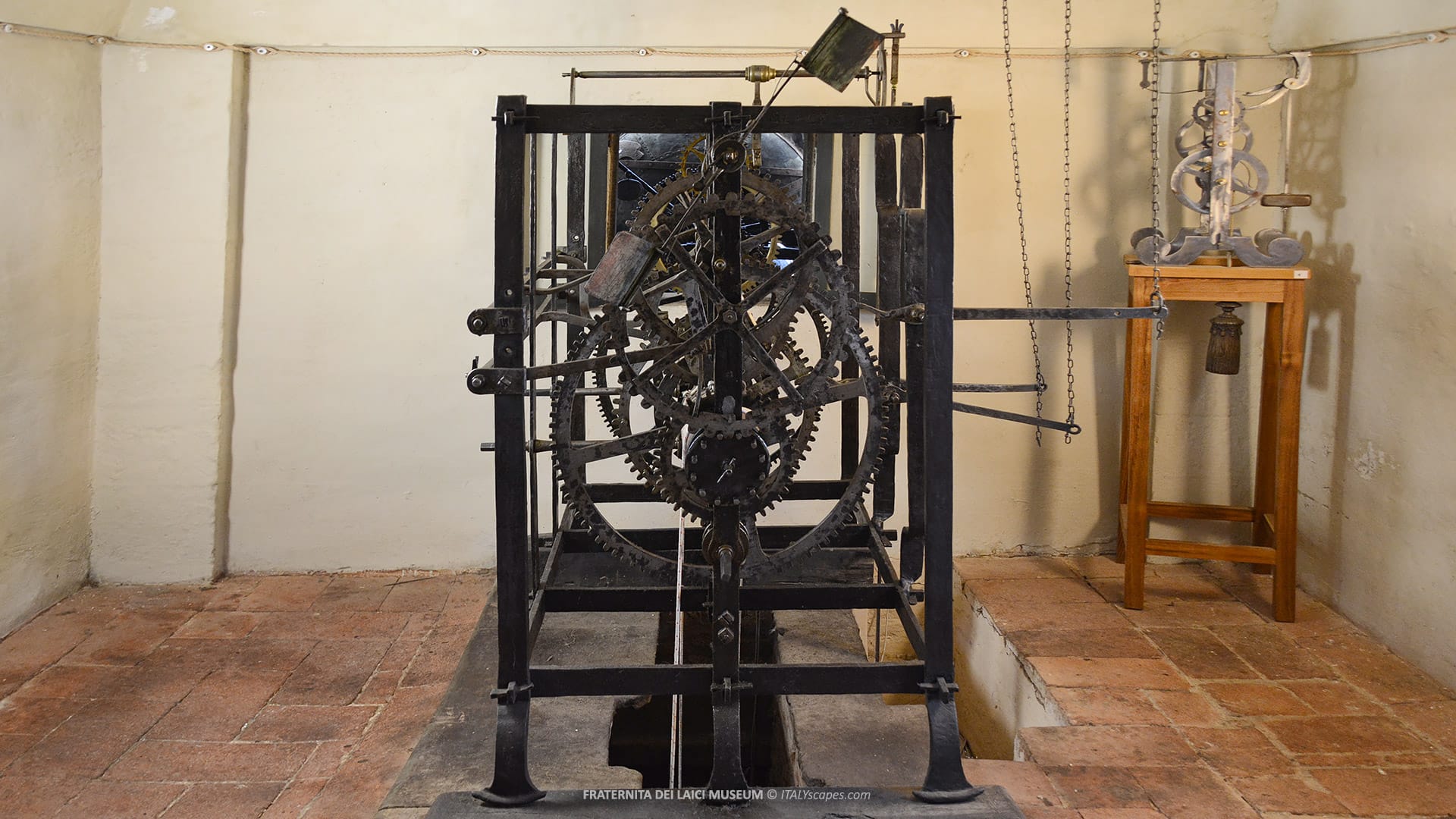
The Astronomical Clock
How to Get to Palazzo della Fraternita dei Laici
Getting to Palazzo della Fraternita dei Laici on foot
Palazzo della Fraternita dei Laici is located approximately 950 meters from Arezzo railway station. The walk usually takes around 12-15 minutes, although the final part follows streets that climb toward Piazza Grande.
From the station, visitors can proceed through Piazza della Repubblica and follow Via Guido Monaco toward the historic center. The route continues through the central pedestrian streets before ascending toward Piazza Grande, where the Palazzo della Fraternita dei Laici stands beside Santa Maria della Pieve and the Logge Vasari.
Getting to Palazzo della Fraternita dei Laici by bus
Urban Line C connects the station area and Piazza Guido Monaco with the upper historic center. The service follows a circular route that includes Viale Buozzi Opp 5 – Prato and Via Ricasoli – Duomo/Municipio.
The closest useful stop is Viale Buozzi Opp 5 – Prato, approximately 250 meters from Palazzo della Fraternita dei Laici. From the stop, visitors can walk toward the upper side of Piazza Grande in about four minutes.
Getting to Palazzo della Fraternita dei Laici by taxi
Taxis are normally available outside Arezzo railway station in Piazza della Repubblica. The journey toward Piazza Grande is short, although the precise route depends on traffic regulations and vehicle restrictions inside the historic center.
Because sections of central Arezzo form a restricted traffic zone, taxis may use authorized access routes or leave passengers at the nearest permitted point. A brief walk may be necessary before reaching the entrance of Palazzo della Fraternita dei Laici.
Frequently Asked Questions about Palazzo della Fraternita dei Laici
Where is Palazzo della Fraternita dei Laici located?
Palazzo della Fraternita dei Laici is located in Piazza Grande, Arezzo’s principal historic square, between the apse of Santa Maria della Pieve and the Logge Vasari.
When was Palazzo della Fraternita dei Laici built?
Construction began in 1375. The Palazzo della Fraternita dei Laici developed through Gothic, Renaissance and later phases, with major contributions from Bernardo Rossellino, Giuliano da Settignano and Giorgio Vasari.
What is the Fraternita dei Laici?
The Fraternita dei Laici is a charitable and cultural institution founded in Arezzo in 1262. It remains active in social assistance, education and cultural heritage management.
What is special about the astronomical clock?
Built in 1552 by Felice da Fossato, the clock displays hours, lunar days, Moon phases and celestial movements according to the Aristotelian-Ptolemaic model.
What can visitors see inside the museum?
Visitors can see paintings, sculptures, portraits, drawings, prints, antique furnishings, the Audience Hall fresco, selected Bartolini Collection works and the astronomical clock mechanism.
How far is the Palazzo della Fraternita dei Laici from Arezzo railway station?
The palace is approximately 950 meters from Arezzo railway station. The uphill walk through the historic center generally requires around 12-15 minutes.
Can visitors access the panoramic terrace?
The museum route normally includes access to the upper part of the palace, where visitors can observe the clock mechanism and enjoy views over Piazza Grande and Arezzo.
Sources:Powered by GetYourGuide -
Photos
-
Map
-
Reviews