


-
About
Table of Contents
Buy tickets & tours:VivaTicketThe Cathedral of Saints Peter and Donatus is the Cathedral of Arezzo, located in Piazza del Duomo, on top of San Pietro Hill. Its elevated position places the church within the historic centre, beside the Bishop’s Palace and close to the Palazzo dei Priori, overlooking much of the surrounding urban landscape.
The Arezzo Cathedral is the principal Catholic place of worship in the city and the episcopal seat of the Diocese of Arezzo-Cortona-Sansepolcro. It is also the largest religious building in the Province of Arezzo, reflecting the political and ecclesiastical importance of the city during the Middle Ages.
The present building was constructed over several centuries, beginning in the late 13th century and continuing through the Renaissance. Later interventions altered its chapels, decoration, staircase, façade, bell tower, and presbytery. The resulting monument combines a predominantly Gothic structure with Renaissance, Baroque, Neoclassical, and modern additions.
The Arezzo Cathedral is dedicated to Saint Peter the Apostle and Saint Donatus, the patron saint of Arezzo. Saint Donatus was an early Christian bishop traditionally associated with the city, and most of his relics are preserved inside the monumental marble shrine behind the cathedral’s high altar.
Among the most important works inside are the stained-glass windows by Guillaume de Marcillat, Piero della Francesca’s fresco Mary Magdalene, the marble tomb of Bishop Guido Tarlati, and the Chapel of the Madonna del Conforto. The church also contains works connected with Giorgio Vasari, Andrea della Robbia, Donatello, Pietro Benvenuti, and Luigi Sabatelli.
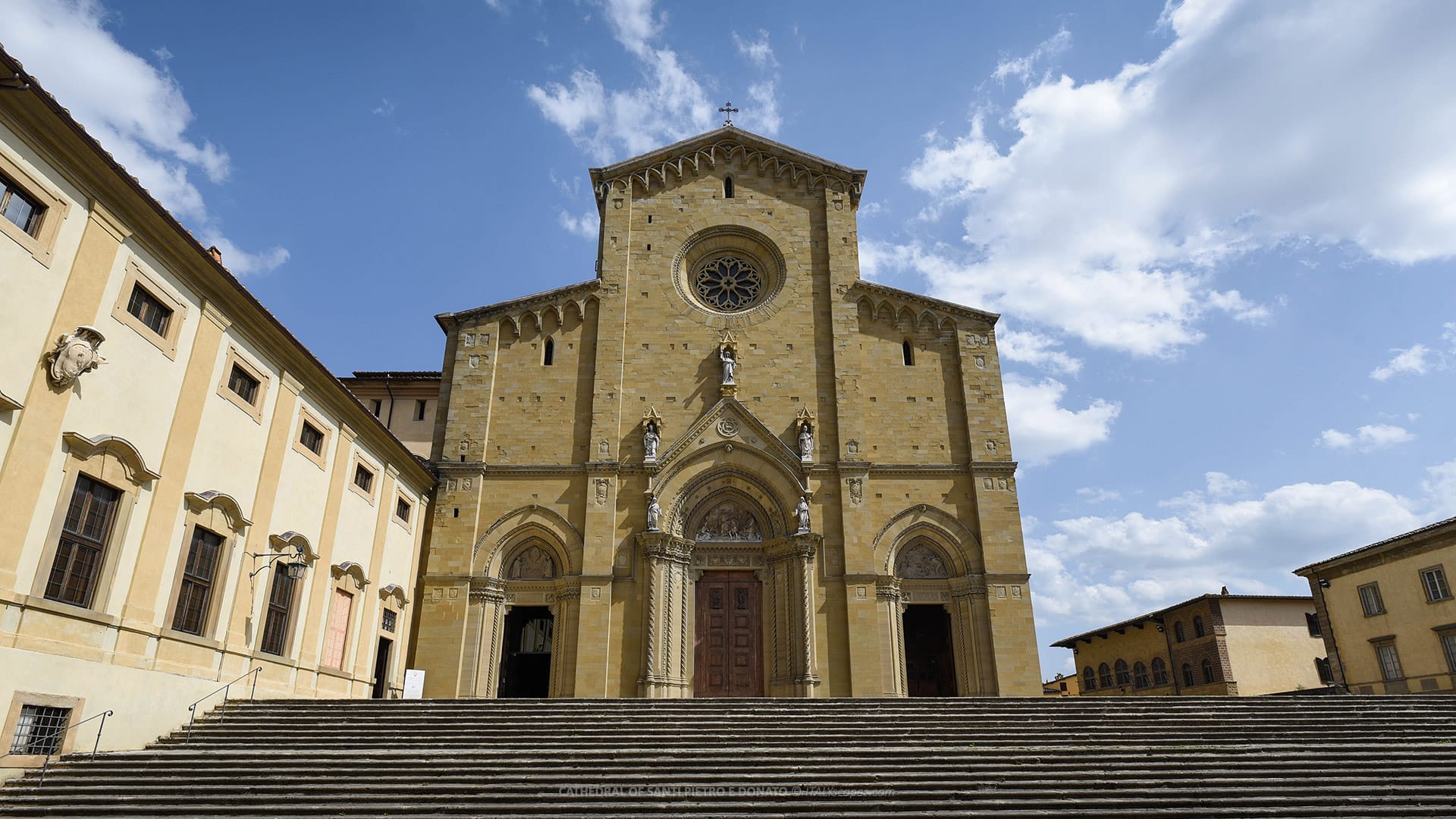
The façade of the Cathedral of Saints Peter and Donatus
Short History of the Cathedral of Saints Peter and Donatus (Arezzo Cathedral)
The Transfer of the Arezzo Cathedral to San Pietro Hill
Before the construction of the present Arezzo Cathedral, the episcopal complex stood outside the city walls at Pionta, a hill located southwest of the medieval centre. The area contained an important religious settlement associated with the early bishops of Arezzo and with the cult of Saint Donatus.
Its exposed position made the complex difficult to defend during periods of military conflict. In 1203, Pope Innocent III ordered Bishop Amedeo to transfer the cathedral, the canons, and the episcopal residence from Pionta to a more secure location inside the city walls.
The Benedictine church of San Pietro Maggiore, situated on the city’s highest hill, became the temporary cathedral. This church occupied approximately the same urban area as the present building, although the medieval structure was later replaced as construction of the new cathedral progressed.
The decision established San Pietro Hill as Arezzo’s permanent ecclesiastical centre. The bishop’s residence, cathedral chapter, and principal civic institutions became concentrated within the fortified upper part of the city, where Piazza del Duomo remains today.
Pope Gregory X and the Foundation of the New Cathedral
A decisive event occurred when Pope Gregory X reached Arezzo between December 19 and 20, 1275, while returning from the Second Council of Lyon. The pope was seriously ill and remained in the city, where he died on January 10, 1276.
Gregory X left a substantial sum toward the construction of a new cathedral. Documentary sources identify the bequest as 30,000 gold florins. His presence also strengthened the religious prestige of Arezzo and its cathedral chapter.
The pope was initially buried in the cathedral. His remains were later placed in a monumental tomb, and his cult developed locally over the following centuries. Gregory X was beatified in 1713, and his relics continue to be preserved in a glass urn inside Arezzo Cathedral.
On November 9, 1277, Bishop Guglielmino degli Ubertini issued the formal decree for constructing a church dedicated to God, the Virgin Mary, and Saint Donatus. This act is generally regarded as the official beginning of the present cathedral building project.
Medieval Construction
Work began from the eastern end, following a method frequently used for large medieval churches. The polygonal apse and the first sections of the nave were therefore constructed before the western façade, allowing liturgical activities to continue while the remainder of the building was still unfinished.
By 1289, the year of the Battle of Campaldino, the apse and the first two bays had been completed. The church had already been consecrated, even though its nave, façade, chapels, and other architectural components remained incomplete.
Bishop Guido Tarlati, who governed the diocese during the early 14th century, supported another important phase of construction. Under his episcopate, the third bay and the elaborate lateral portal on the southern side were built, while several chapels and funerary monuments were added inside.
Construction advanced slowly because of the enormous financial and technical demands of the project. Political instability also affected the work. After Arezzo came under Florentine control in 1384, major construction activity stopped for almost a century.
Powered by GetYourGuideCompletion and Early Modern Transformations
Work resumed in 1471, during a period of greater stability under Florentine rule. The remaining sections of the nave were gradually completed, and by 1511 the cathedral had substantially acquired the overall dimensions and spatial form visible today.
The early 16th century brought an important campaign of artistic decoration. Guillaume de Marcillat created the cathedral’s stained-glass windows and painted parts of its vaults, while Giorgio Vasari later contributed designs for furnishings associated with the choir and organ.
During the early 17th century, the interior was modernized in accordance with the liturgical principles that followed the Council of Trent. The local painter and architect Teofilo Torri directed changes to chapels and altars, adapting the medieval interior to contemporary religious practices.
Additional vault decoration was carried out between 1660 and 1664 by Salvi Castellucci. These paintings extended the earlier decorative program initiated by Marcillat, visually unifying areas constructed or decorated during different historical periods.
The devotion to the Madonna del Conforto led to another major transformation after 1796. A large chapel designed by Giuseppe Del Rosso was built along the left aisle and completed in 1817, introducing a monumental Neoclassical space into the Gothic cathedral.
The Façade and Bell Tower
For centuries, the western end remained without the elaborate stone façade visible today. Earlier representations show a simpler exterior, reflecting the fact that medieval resources had been concentrated primarily on the apse, nave, chapels, portal, and interior decoration.
The present façade was constructed between 1901 and 1914 according to a design by Dante Viviani. Its architectural vocabulary follows the Gothic character of the medieval building, although the entire composition dates from the early 20th century.
The sculptural decoration was created by artists including Giuseppe Cassioli, Enrico Quattrini, and Dante Viviani. The façade was officially inaugurated on August 2, 1914, shortly before Italy entered the First World War.
The present bell tower was completed in 1937 after several earlier solutions had proved unsatisfactory. In 2012, the presbytery received a modern liturgical arrangement by Giuliano Vangi, including a new altar, ambo, and episcopal chair, inaugurated on April 22 of that year.
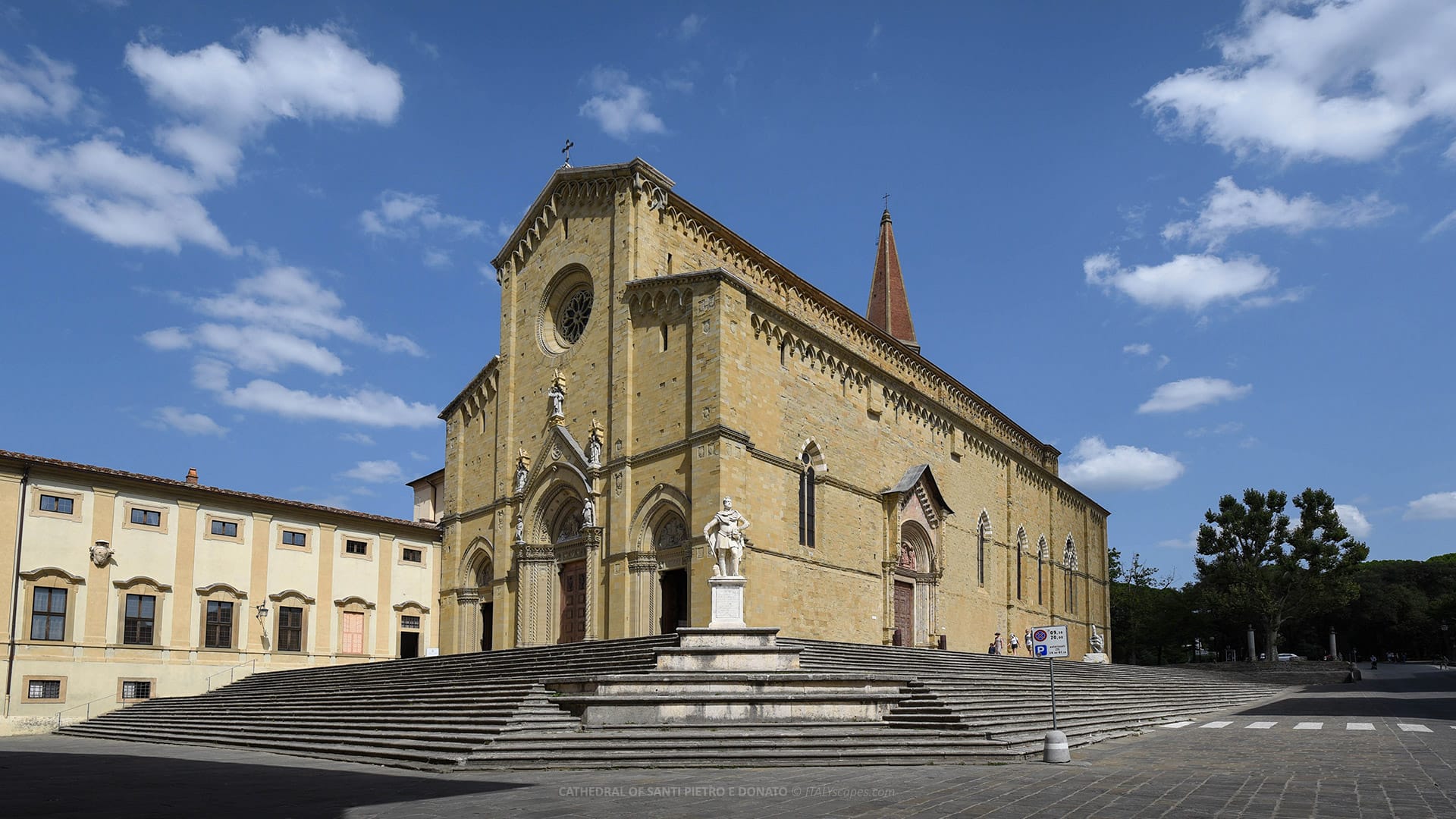
Arezzo Cathedral seen from Piazza del Duomo
Architecture of the Cathedral of Saints Peter and Donatus (Arezzo Cathedral)
Exterior Architecture
Arezzo Cathedral occupies the summit of San Pietro Hill, where the difference in elevation between the church and the lower streets is immediately visible. The building stands above a broad monumental staircase that creates a formal approach from the historic centre.
The staircase and cathedral forecourt were originally constructed between 1525 and 1529 from a design attributed to Guillaume de Marcillat. They were substantially renewed during the 18th century, with further adjustments extending into the early 19th century.
The façade is divided vertically into three sections corresponding to the three internal naves. Three portals occupy the lower level, while pointed arches, pinnacles, sculptural elements, and a large central rose window establish its Neo-Gothic appearance.
Above the main portal are statues and reliefs connected with the cathedral’s dedication and history. The sculptural program includes representations of Christ the Redeemer, Saint Donatus, and Blessed Gregory X, linking the modern façade to the church’s medieval religious identity.
The southern exterior preserves more of the original medieval masonry. A visible line distinguishes the older sandstone construction from the 20th-century façade, making it possible to identify where the modern intervention meets the 14th-century structure.
The Southern Portal
The most important medieval exterior feature is the lateral portal facing Via Ricasoli. Created during the first half of the 14th century, it consists of a rounded arch surmounted by a gable and supported by decorative architectural elements.
Its columns include reused porphyry shafts, demonstrating the medieval practice of incorporating valuable older materials into new buildings. Sculptural details around the entrance present moral and religious subjects, including personifications associated with virtues and vices.
The lunette contains a polychrome composition made with terracotta and cocciopesto. It represents the Virgin nursing the Christ Child between Saint Donatus and Pope Gregory X, accompanied by angels. The group is generally dated to approximately 1325-1327.
The portal was positioned on the side most directly connected with the medieval city. Before the completion of the modern western façade, this entrance played an especially important ceremonial and practical role in access to the Cathedral of Saints Peter and Donatus.
The Bell Tower
The current bell tower is the fourth major solution attempted for the Arezzo Cathedral. Earlier bell structures were removed or abandoned because of concerns involving stability, vibrations, nearby civic buildings, and the delicate stained-glass windows.
One earlier tower was reportedly problematic because its bells disturbed meetings held in the nearby Palazzo dei Priori. Another proposal placed the structure too close to Marcillat’s windows, creating fears that repeated vibrations could damage the Renaissance glass.
A detached tower was subsequently begun, but difficulties caused by unstable ground and groundwater prevented its completion. During the 19th century, Luigi Mercanti designed another version, although construction stopped in 1860 before the planned upper section was finished.
Giuseppe Castellucci later redesigned the summit, adding the upper stages and spire. The hexagonal bell tower was finally completed in 1937 and reaches approximately 76.8 metres, making it one of the most visible elements of Arezzo’s skyline.
Powered by GetYourGuideInterior Plan
The interior is organized into three naves without a projecting transept. Large pillars divide the space into longitudinal sections and support pointed arches, ribbed vaults, and the upper walls containing the cathedral’s stained-glass windows.
The central nave is wider and higher than the lateral aisles, directing attention toward the polygonal apse and high altar. The absence of a transept produces a continuous longitudinal plan rather than the strongly articulated cross-shaped layout found in many other medieval cathedrals.
Stone surfaces, painted vaults, stained glass, chapels, monuments, and wooden furnishings create a layered interior. The principal Gothic structure remains clearly visible, while additions from later centuries document changing liturgical requirements and artistic preferences.
The polygonal apse forms the eastern termination of the building. Its vertical proportions, windows, and relationship with the high altar emphasize the sanctuary, where the relics of Saint Donatus occupy the central position behind the principal altar.
The Chapel of the Madonna del Conforto
The Chapel of the Madonna del Conforto opens from the left aisle but differs architecturally from the medieval body of Arezzo Cathedral. Designed by Giuseppe Del Rosso, it was built between 1796 and 1817 in a monumental Neoclassical style.
Its construction followed the events of February 15, 1796, when a small devotional image of the Virgin became associated with the end of a series of earthquake tremors. The image subsequently became the focus of intense local devotion.
The chapel has a centralized, cross-shaped arrangement covered by a coffered hemispherical dome and lantern. Its proportions, polished architectural surfaces, paintings, sculptures, and glazed terracottas distinguish it from the pointed arches and ribbed vaults of the medieval church.
The new space was designed to accommodate pilgrims and public ceremonies connected with the Madonna del Conforto. The chapel remains one of the cathedral’s principal devotional areas and an important example of late 18th-century religious architecture in Tuscany.
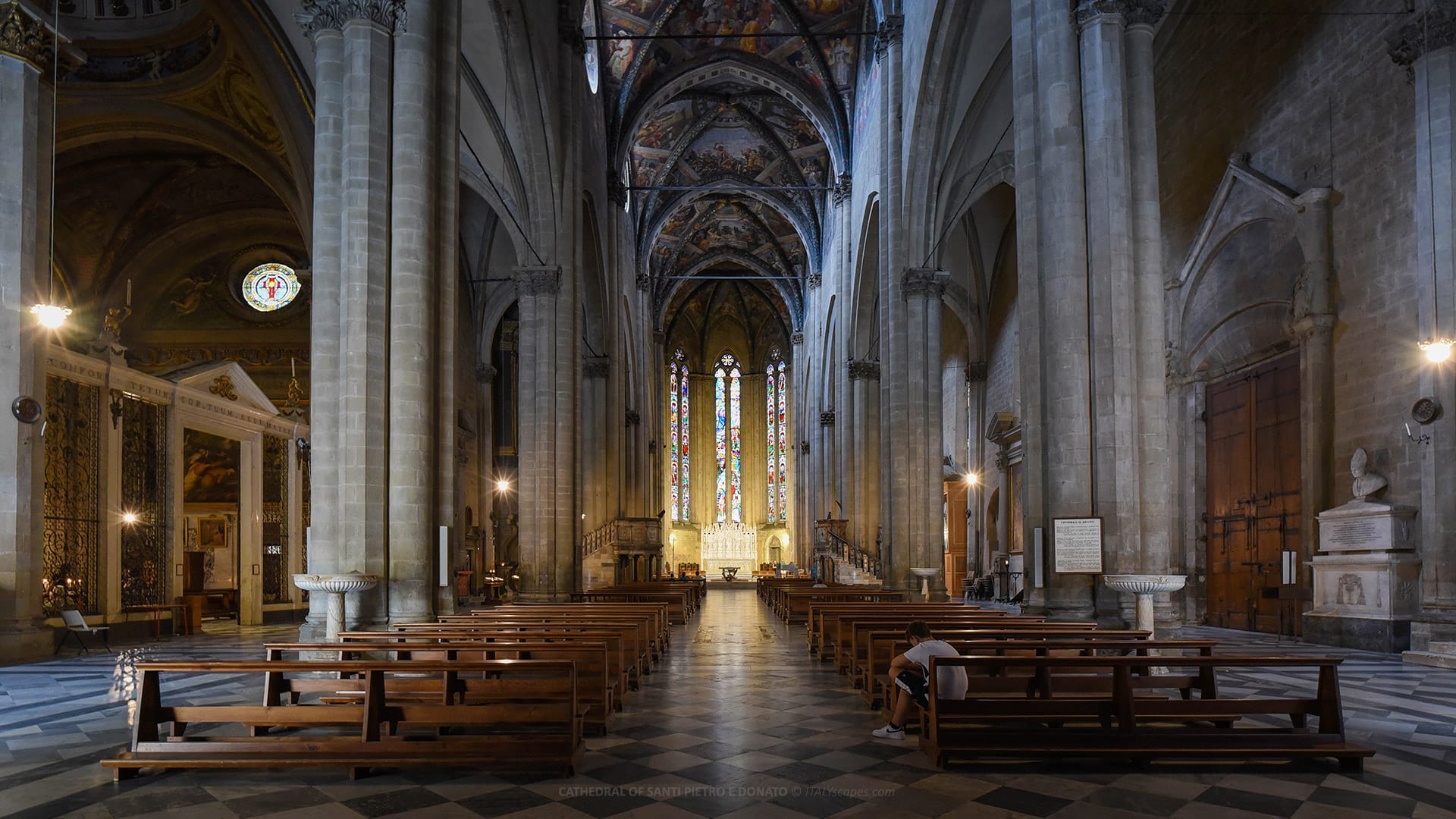
The interior of the Cathedral of Saints Peter and Donatus
Art of the Cathedral of Saints Peter and Donatus (Arezzo Cathedral)
The Stained-Glass Windows of Guillaume de Marcillat
One of the cathedral’s greatest artistic ensembles is the cycle of seven stained-glass windows created by Guillaume de Marcillat. The French-born artist worked in Arezzo during two principal phases, from 1516 to 1517 and from 1522 to 1524.
Marcillat produced glass compositions distinguished by strong modelling, complex architectural settings, monumental figures, and an exceptionally broad range of colours. Rather than relying only on separate coloured pieces, he used painted details to achieve effects approaching those of Renaissance panel painting.
The earliest surviving window, located in the left aisle, represents Saint Sylvester and Saint Lucy with the Allegory of Charity. Completed in 1516, it already demonstrates Marcillat’s ability to organize several figures within a unified vertical composition.
The five windows along the southern aisle depict episodes from the New Testament. Their subjects include The Calling of Saint Matthew, The Baptism of Christ, The Expulsion of the Merchants from the Temple, Christ and the Adulteress, and The Resurrection of Lazarus.
The central façade contains Marcillat’s large rose window, Pentecost, dated 1518. Approximately 3.5 metres in diameter, it presents the apostles gathered around the Virgin Mary beneath the dove of the Holy Spirit.
Together, the seven windows form one of the most significant surviving Renaissance stained-glass cycles in Italy. Their preservation is especially important because stained glass of comparable size and artistic ambition has frequently been lost through structural changes, accidents, warfare, or replacement.
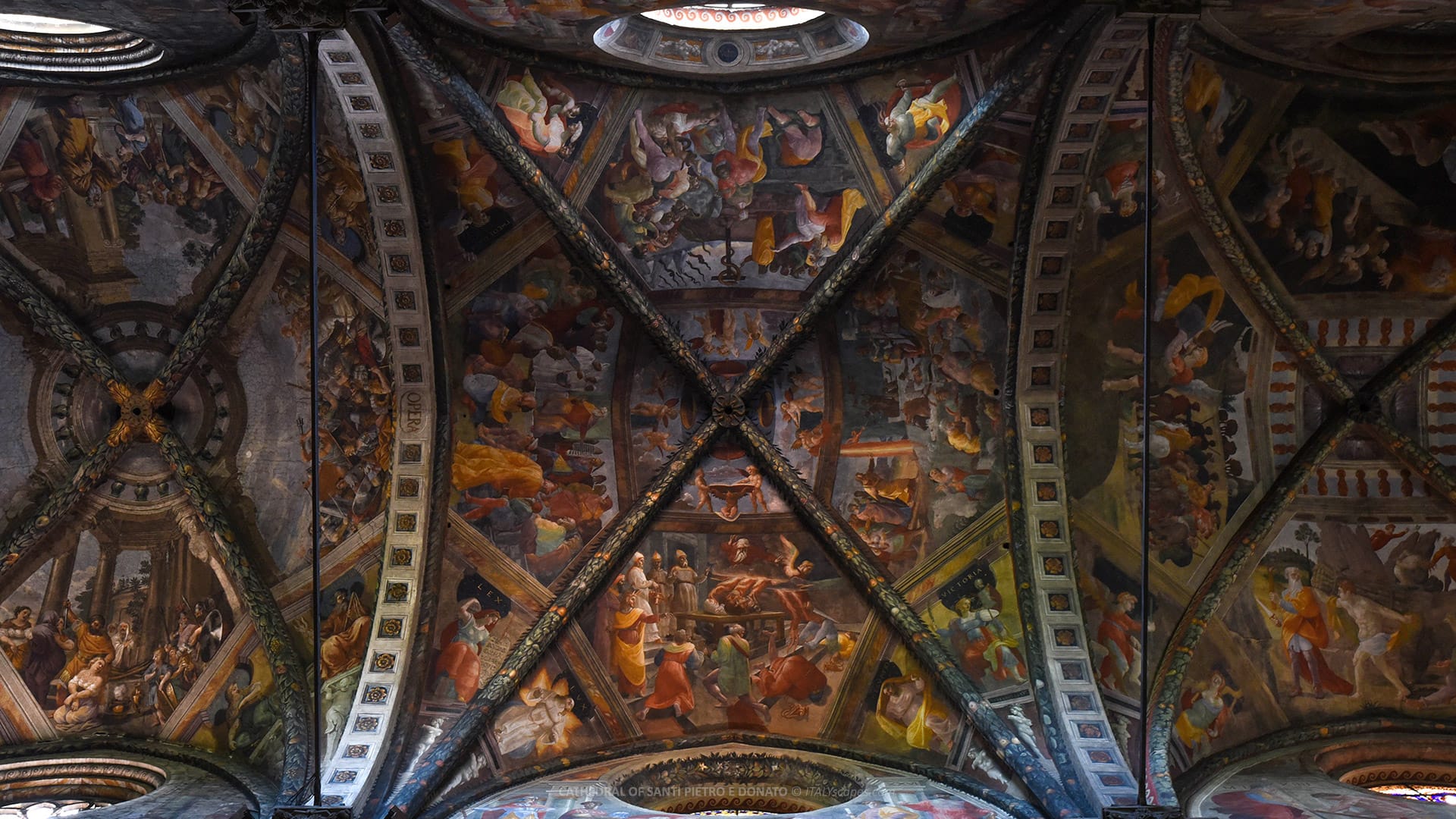
The Painted Vaults
Marcillat also worked as a fresco painter inside the Cathedral of Saints Peter and Donatus. He decorated the vaults of the first three bays of the central nave and the first bay of the left aisle with scenes and figures drawn from biblical history.
The compositions were adapted to the triangular and curved surfaces created by the Gothic ribs. Figures, ornamental details, and narrative scenes were arranged to remain readable from the floor, despite their considerable height above the nave.
The remaining vault decoration was completed during the 17th century by Salvi Castellucci. His work, executed between 1660 and 1664, continued the existing decorative system while reflecting a later approach to colour, movement, and religious narrative.
The combined program transforms the ceiling into an extensive painted surface without concealing the underlying Gothic framework. The ribs continue to organize each section, while the frescoes provide a chronological and visual connection between the Renaissance and Baroque periods.
The High Altar and the Ark of Saint Donatus
The high altar dates from before 1289 and was probably consecrated by Bishop Guglielmino degli Ubertini. Its early date confirms that the sanctuary was already functioning while much of the nave remained under construction.
Behind the altar stands the monumental marble Ark of Saint Donatus. The structure was produced in several phases by different sculptors, explaining variations in figure style, relief carving, architectural detail, and the treatment of its individual components.
The lower portions are connected with Agostino di Giovanni and Agnolo di Ventura. The upper sections were completed during the later 14th century, approximately between 1364 and 1375, by artists including Giovanni di Francesco, Betto di Francesco, and other collaborators.
The marble composition is supported by twelve small pillars and incorporates pointed arches, pinnacles, statues, and narrative reliefs. The sculpted scenes recount episodes from the life and martyrdom of Saint Donatus, integrating his relics with a visual account of his religious significance.
Most of the saint’s relics are preserved within the cathedral shrine. His head, however, is kept in a reliquary bust in the nearby Church of Santa Maria della Pieve, reflecting the historical distribution of important relics between Arezzo’s principal churches.
Piero della Francesca’s Mary Magdalene
On the wall of the left aisle is Piero della Francesca’s fresco Mary Magdalene, one of the best-known individual works in the Cathedral of Saints Peter and Donatus. It was painted around 1459, during the artist’s mature period.
The saint stands beneath a painted architectural arch and holds a container of ointment, her traditional identifying attribute. Her frontal pose, carefully constructed volume, restrained expression, and controlled lighting are characteristic of Piero della Francesca’s approach to sacred figures.
The fresco originally formed part of a wider decorative context that has not survived intact. Its placement against the cathedral wall allows the monumental figure to function almost like a freestanding statue within an illusionistic architectural niche.
The work is especially important because Piero della Francesca was born in nearby Sansepolcro and maintained strong connections with the Arezzo area. His celebrated fresco cycle The Legend of the True Cross is preserved in the city’s Basilica of San Francesco.
The Tomb of Bishop Guido Tarlati
The right aisle contains the monumental cenotaph of Bishop Guido Tarlati, one of the most powerful political and ecclesiastical figures in medieval Arezzo. The monument was produced in 1330 by Agostino di Giovanni and Agnolo di Ventura.
Guido Tarlati served as bishop from 1312 and became the effective ruler of the city. His policies, military campaigns, territorial expansion, and building projects made his episcopate a decisive period in Arezzo’s early 14th-century history.
The monument includes sixteen narrative reliefs presenting important episodes from Tarlati’s life. Rather than concentrating exclusively on religious subjects, the scenes record political, military, ceremonial, and administrative events associated with his public career.
Its elaborate Gothic architecture, sculpted figures, pinnacles, arches, and narrative panels transform the tomb into a detailed statement of personal authority. The monument also provides valuable evidence about medieval clothing, weapons, ceremonies, and urban identity.
Powered by GetYourGuideMedieval Frescoes and Funerary Monuments
Along the right wall survives a fresco attributed to Buonamico Buffalmacco, Madonna and Child Enthroned among Saints, generally dated between 1321 and 1327. It represents one of the cathedral’s most important surviving examples of early 14th-century painting.
The composition preserves the hierarchical organization typical of medieval devotional imagery. The enthroned Virgin and Child occupy the central position, while the surrounding saints establish the sacred and intercessory context of the image.
Frescoes associated with Andrea di Nerio survive from the former Bertoldini Chapel. Dating from approximately 1340-1360, the decoration includes Madonna and Child with Stories of Saints James the Greater and Christopher, although the original chapel arrangement has been altered.
The marble Chapel of Ciuto Tarlati was created in 1334 by Giovanni di Agostino. It incorporates an ancient fluted sarcophagus dating from the 4th century, reused as part of the medieval funerary monument.
The chapel is particularly significant because it is the only substantially surviving medieval chapel among the numerous private chapels that once lined the Arezzo Cathedral. Many others were modified or removed during later campaigns of liturgical reorganization.
The Baptismal Font
The cathedral’s baptismal font has a hexagonal form and is associated with Donatello and his workshop. The relief The Baptism of Christ, produced after 1425, presents Christ in the Jordan River with Saint John the Baptist performing the sacrament.
The composition is organized within a shallow sculptural space, with carefully arranged figures and controlled depth. The relief demonstrates the innovative Renaissance interest in anatomy, perspective, natural movement, and the physical relationship between figures.
Attribution has been discussed because major Renaissance workshops frequently involved assistants executing parts of a master’s design. The font is therefore generally described as a work connected with Donatello and his workshop, rather than assigned without qualification to the sculptor alone.
Its presence documents the importance of baptism within the cathedral’s liturgical functions. The work also connects Arezzo Cathedral with the broader development of early Renaissance sculpture in Florence and central Italy.
Giorgio Vasari and the Cathedral Furnishings
Giorgio Vasari designed the wooden choir in 1554. The furnishing was created for the cathedral clergy and organized the seating within the sanctuary, combining practical liturgical requirements with the carefully proportioned architectural language of the Italian Renaissance.
Vasari was born in Arezzo in 1511 and maintained close connections with the city throughout his career. His involvement in the Arezzo Cathedral formed part of a wider group of local commissions that also included architectural, decorative, and administrative projects.
He also provided the design associated with the cathedral’s stone organ gallery. The structure was carved during the 1530s by Pietro di Bernardino di Subisso and Piero Giannozzo da Settignano and is regarded as an important example of Vasari’s early architectural work.
The historic organ was constructed between 1534 and 1536 by Luca di Bernardino da Cortona. Although modified over time and later reconstructed, it remains connected with the Renaissance reorganization of music, furnishings, and ceremonial space inside the Cathedral of Saints Peter and Donatus.
The Chapel of the Madonna del Conforto
The Chapel of the Madonna del Conforto contains a small devotional image that became associated with the events of February 1796. The image is displayed above the chapel’s altar and remains the focal point of one of Arezzo’s strongest religious traditions.
The chapel’s decorative program was created by several prominent artists. Luigi Catani and Luigi Ademollo painted frescoes between 1799 and 1802, adapting large narrative and allegorical compositions to the dome, pendentives, and surrounding architectural surfaces.
Two monumental paintings occupy important positions within the chapel. Pietro Benvenuti painted Judith Showing the Head of Holofernes in 1804, while Luigi Sabatelli completed Abigail Appeasing David in 1806.
Both canvases represent Old Testament heroines whose actions protected their people. Their subjects were selected for a Marian chapel because Catholic interpretation frequently treated courageous biblical women as symbolic predecessors or theological parallels of the Virgin Mary.
The chapel also contains glazed terracotta works by Andrea della Robbia and his workshop. These pieces were transferred from other religious buildings and installed in the chapel in 1811, rather than being created specifically for its original decorative program.
Among them are The Holy Trinity with Saints Donatus and Bernard and Madonna Enthroned with Saints Donatus, Mary Magdalene, Apollonia, and Bernardino. Their white figures, blue backgrounds, and coloured details are characteristic of Della Robbia glazed terracotta.
The Relics of Blessed Gregory X
The remains of Blessed Gregory X are preserved inside a glass urn in the cathedral. His association with Arezzo resulted from his unexpected illness and death in the city during his return journey from Lyon.
The pope’s original burial and subsequent monuments changed as the cathedral developed. His present display allows visitors to view the relics while maintaining their role within the liturgical and devotional life of the church.
Gregory X was officially beatified in 1713. His memory is closely connected with the establishment of the present Arezzo Cathedral because his financial bequest helped make the late 13th-century construction project possible.
The relics provide a direct historical connection between Arezzo, the medieval papacy, and the Second Council of Lyon. They also explain the representation of Gregory X on the cathedral’s medieval portal and modern façade.
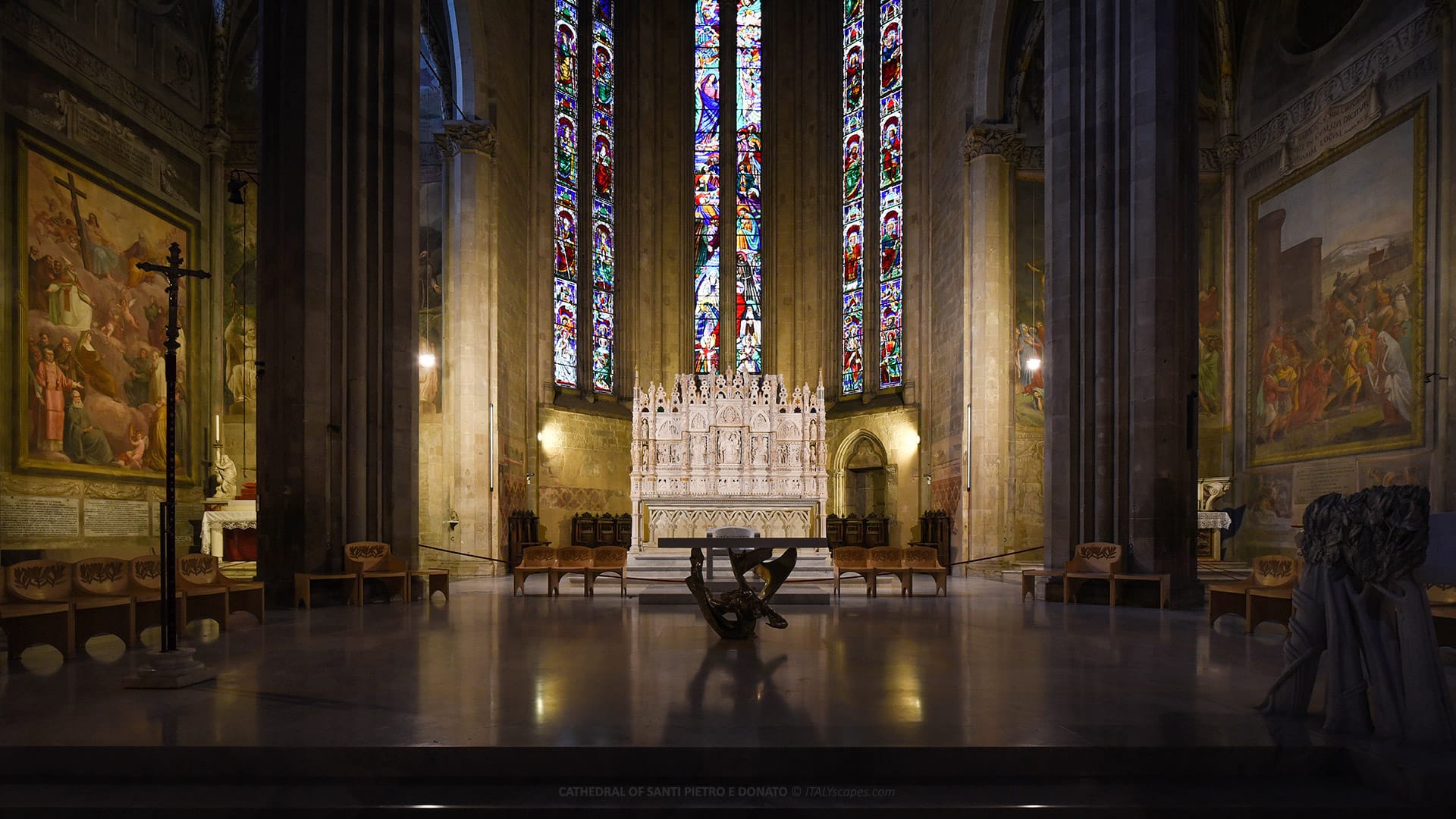
The altar of the Arezzo Cathedral
How to Get to the Cathedral of Saints Peter and Donatus (Arezzo Cathedral)
Getting to the Cathedral of Saints Peter and Donatus on foot
The Cathedral of Saints Peter and Donatus is located approximately 1.2 kilometres from Arezzo railway station. The precise distance varies slightly according to the chosen streets, but the walk generally takes between 15 and 20 minutes.
From the station, cross Piazza della Repubblica and continue along Via Guido Monaco toward Piazza Guido Monaco. Proceed into the historic centre and follow the streets climbing toward Piazza della Libertà and Piazza del Duomo.
The final section is uphill, because the cathedral stands on San Pietro Hill, one of the highest points within the historic centre. The route is paved and passes through central streets, although gradients and stone surfaces may require additional time for visitors with reduced mobility.
Walking is the most practical option for visitors who also want to see Arezzo’s historic centre. The route can be combined with Piazza Grande, Corso Italia, Santa Maria della Pieve, and Piazza della Libertà without requiring major detours.
Getting to the Cathedral of Saints Peter and Donatus by bus
The historic-centre bus service currently operates as Line C. From the station area, passengers can board Line C at a nearby stop such as Via Petrarca 45. The service travels through central Arezzo and reaches the upper part of the historic centre.
The closest stop to Arezzo Cathedral is Via Ricasoli (Duomo/Municipio). It is situated beside the cathedral complex, making it the most convenient option for travellers who prefer to avoid the uphill walk.
Getting to the Cathedral of Saints Peter and Donatus by taxi
A taxi rank is available directly outside Arezzo railway station, in Piazza della Repubblica. From there, the journey to Piazza del Duomo is short, although its exact duration depends on traffic, restricted-access rules, and the route available through the historic centre.
Taxis are particularly useful for passengers carrying luggage or for visitors with limited mobility. The service can reach the area around Via Ricasoli and Piazza della Libertà, close to the cathedral entrance.
Parts of central Arezzo are regulated by a limited-traffic zone, so private vehicles cannot always follow the same route used by authorized taxis. Access may also change temporarily during public events or street closures.
Arezzo’s Radio Taxi service operates through the telephone number 0575 382626. Travellers requiring an accessible vehicle should request it in advance and explain any specific boarding, wheelchair, or luggage requirements when making the reservation.
Frequently Asked Questions about the Cathedral of Saints Peter and Donatus (Arezzo Cathedral)
Where is the Cathedral of Saints Peter and Donatus located?
The Cathedral of Saints Peter and Donatus is located in Piazza del Duomo, on San Pietro Hill in Arezzo’s historic centre, beside the Bishop’s Palace and close to the Palazzo dei Priori.
When was Arezzo Cathedral built?
Construction officially began after the episcopal decree of 1277. The principal medieval and Renaissance building phases continued for centuries, with the basic structure substantially completed in 1511.
Who is Arezzo Cathedral dedicated to?
The Arezzo Cathedral is dedicated to Saint Peter the Apostle and Saint Donatus, an early bishop and patron saint of Arezzo whose relics are preserved behind the high altar.
What is the most famous artwork in Arezzo Cathedral?
One of its best-known works is Piero della Francesca’s Mary Magdalene, painted around 1459 and preserved on the wall of the cathedral’s left aisle.
How far is Arezzo Cathedral from the train station?
The Arezzo Cathedral is approximately 1.2 kilometres from Arezzo. Walking normally takes 15-20 minutes, while Line C buses and taxis provide alternatives for the uphill journey.
Sources:Buy tickets & tours:VivaTicketPowered by GetYourGuide -
Photos
-
Video
Table of Contents
-
Map
-
Reviews


