-
About
Table of Contents
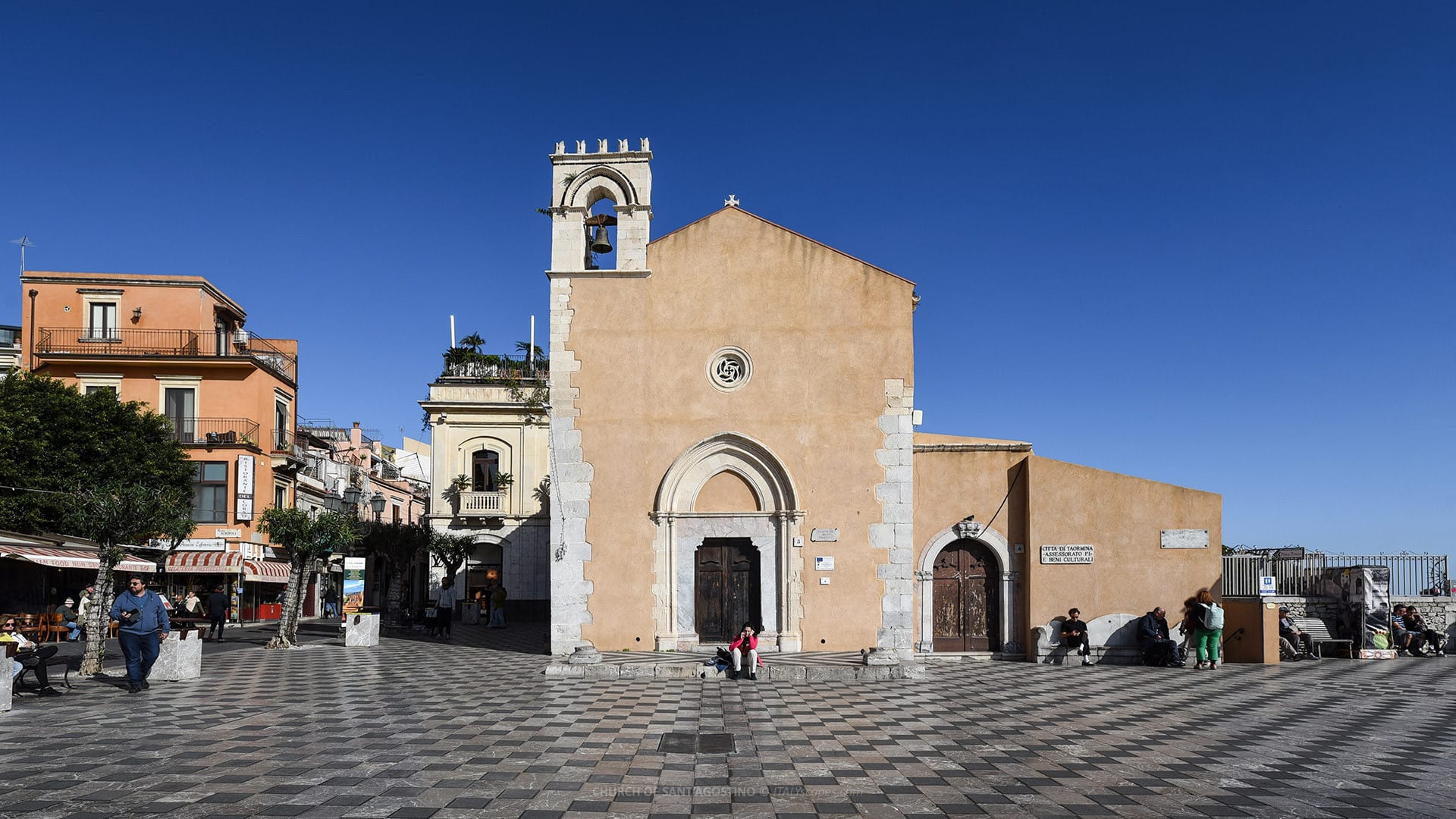
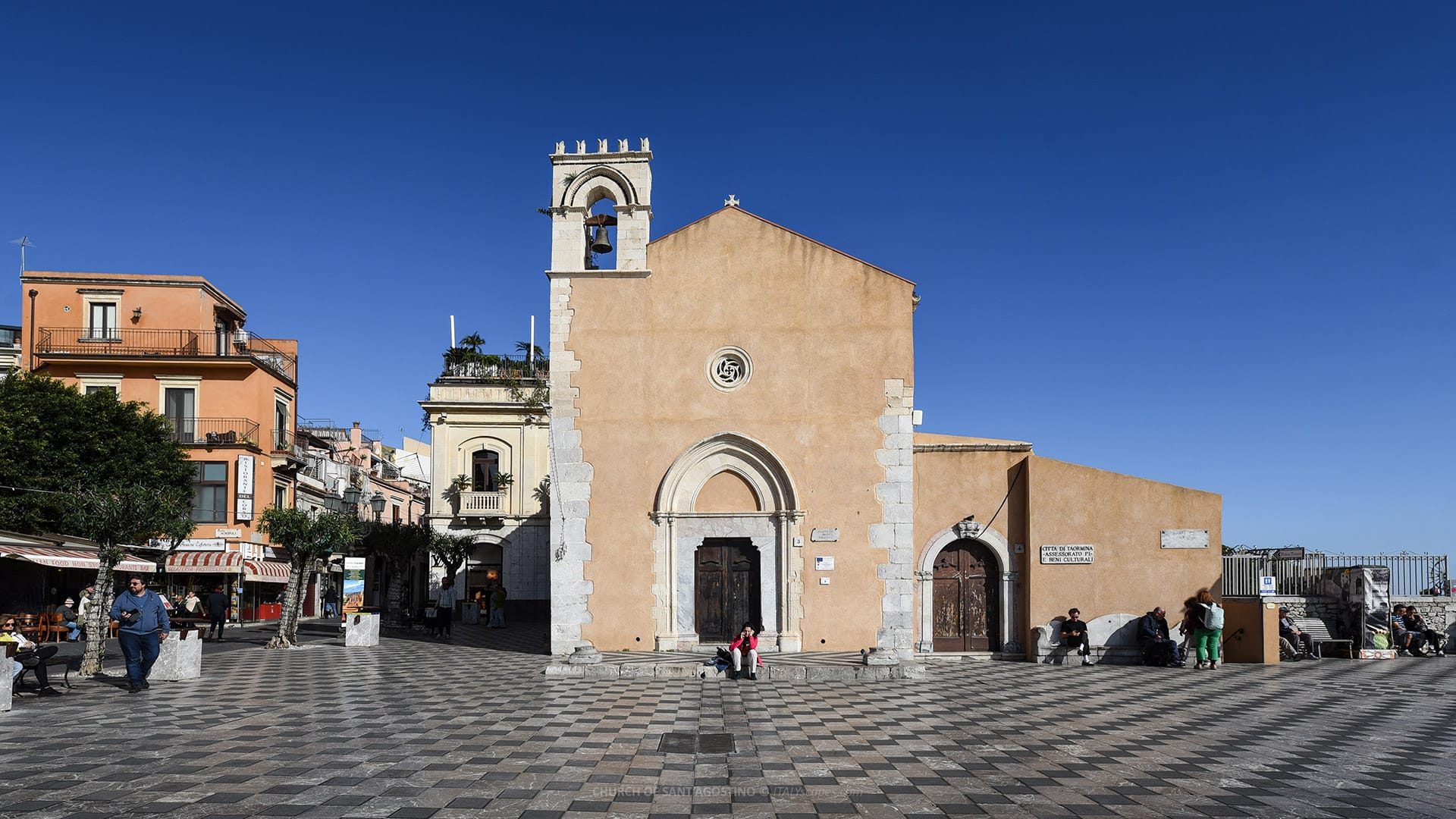
The Church of Sant’Agostino is a former religious building located in the historic center of Taormina, one of the most renowned cultural and tourist destinations in eastern Sicily.
Today deconsecrated, the church stands prominently in Piazza IX Aprile, the town’s main panoramic square, directly facing Torre dell’Orologio, also known as Porta di Mezzo, which historically divided Taormina into two urban districts.
Due to its central location, the Church of Sant’Agostino has always played a significant role in the civic and social life of Taormina. Although it no longer functions as a place of worship, the building remains an important historical landmark and a key component of the town’s architectural heritage.
Over the centuries, the church has undergone numerous transformations, reflecting broader political, religious, and cultural changes that affected Sicily from the late Middle Ages through the modern era.
Today, the former church and its adjacent convent are integrated into Taormina’s Museo Diffuso (Distributed Museum) system and are used as a library, exhibition space, and cultural venue, continuing a long tradition of public use that dates back to the 19th century.
Short History of the Church of Sant’Agostino
The history of the Church of Sant’Agostino begins in the late 15th century.
The earliest structure built on this site was the Church of San Sebastiano, constructed in 1486. This first church was built in the Gothic style, which was still widely used in Sicily during this period, particularly in religious architecture.
Gothic elements were often adapted to local materials and construction techniques, creating a distinctive regional interpretation of the style.
On September 12, 1530, a decisive change occurred in the building’s history. The church was officially entrusted to the Order of Saint Augustine, a mendicant religious order that had been expanding its presence in Sicily since the late Middle Ages.
Following this transfer, the church was rededicated to Saint Augustine, and the Augustinian friars began using both the church and the adjoining convent for religious, educational, and community purposes.
For several centuries, the Augustinian complex represented an important spiritual and cultural center within Taormina.
Like many religious institutions of the time, the convent likely housed not only monks but also a significant collection of manuscripts and printed works, reflecting the Augustinians’ involvement in theological study and intellectual life.
The presence of the order contributed to the shaping of the surrounding urban area, especially Piazza IX Aprile, which gradually became one of the town’s focal points.
A major turning point came in the 19th century, following the political unification of Italy. In 1866, the newly formed Italian state issued a Royal Decree that ordered the suppression of religious orders and congregations.
As a result of this decree, numerous monasteries, convents, and churches across Italy were confiscated by the state. The Church of Sant’Agostino and its convent were among the properties affected.
After the expropriation, the entire complex was transferred to the Municipality of Taormina. The religious functions of the church ceased, and the building was adapted for secular uses.
Initially, the former church and convent were used as an art gallery, reflecting a broader effort to repurpose former ecclesiastical buildings for public cultural activities.
Subsequently, the complex served as an elementary school, demonstrating its continued importance in the social life of the town.
In 1933, the former convent underwent another significant transformation when it was converted into a public library.
The purpose of the library was to preserve and make accessible the book collections that had belonged to several suppressed religious institutions, including the monasteries of Sant’Agostino, San Domenico, and Sant’Antonio of Padua.
Today, the library housed within the Sant’Agostino complex contains over 22,000 volumes, making it one of the most important cultural institutions in Taormina.
Approximately 2,000 of these volumes are dedicated exclusively to Sicily, covering topics such as local history, archaeology, art, and literature.
The collection primarily consists of works on theology, philosophy, and the sciences, reflecting the scholarly interests of the religious orders that originally assembled these books.
A comprehensive restoration campaign was carried out in 1981, aimed at preserving the architectural integrity of the complex while adapting it to modern use.
Since 1985, the former Church of Sant’Agostino has functioned both as a library and as a multipurpose cultural space, hosting art exhibitions, conferences, and events connected to Taormina’s Museo Diffuso.
Architecture of the Church of Sant’Agostino
The architectural appearance of the Church of Sant’Agostino reflects the many transformations it has undergone over the centuries.
While much of the original structure has been altered or lost, several significant elements of the ancient facade are still visible today and offer valuable insight into the building’s past.
From the original facade, only a few components have survived intact. Among these are the small rose window, a typical feature of Gothic architecture, and the tympanum of the main portal.
These elements hint at the stylistic character of the original 15th-century church and its Gothic inspiration, even though the overall facade has been substantially modified.
On the left side of the building stands a small bell-gable, an architectural solution often used in smaller churches or conventual complexes. The bell-gable is surmounted by a semi-pointed arch and finished with battlements, giving it a slightly fortified appearance.
One of its most distinctive features is the elegant decoration created with lava stone inlays, a material commonly used in eastern Sicily due to the proximity of Mount Etna. The use of lava stone not only provided durability but also added a strong local identity to the structure.
On the right side of the church, a portal provides access to the former convent. This passage underscores the close functional relationship between the church and the monastic buildings, which together formed a unified complex during the centuries of Augustinian presence in Taormina.
The interior of the Church of Sant’Agostino is relatively simple but architecturally significant. One of its defining features is the wooden trussed ceiling, which spans the nave and reflects traditional construction techniques used in Sicilian religious buildings.
Along the walls of the interior are four niches, each decorated with false arches and false Corinthian-style columns. These decorative elements create a sense of rhythm and classical order within the space, even though they are not structural.
The use of Corinthian motifs reflects the enduring influence of classical architecture on religious buildings in Sicily, particularly during periods of renovation and reinterpretation.
How to Get to the Church of Sant’Agostino
Reaching the Church of Sant’Agostino is straightforward, especially for visitors exploring Taormina on foot.
The church is located along Corso Umberto, the town’s main thoroughfare, which runs east to west through the historic center. Corso Umberto is a pedestrian street, meaning that vehicular access is restricted.
As a result, the Church of Sant’Agostino can only be reached on foot, which allows visitors to fully appreciate the surrounding architecture and atmosphere of Taormina’s old town.
The church is situated approximately 450 meters from Porta Messina, the principal western entrance to Taormina and the official boundary of the pedestrian zone.
From Porta Messina, visitors can walk along Corso Umberto, passing shops, palaces, and historic buildings, until they reach Piazza IX Aprile.
The Church of Sant’Agostino is immediately visible upon entering the square and stands directly opposite Torre dell’Orologio, making it easy to locate and an integral part of one of Taormina’s most iconic urban spaces.
Sources: -
Photos
-
Map
-
Reviews