


-
About
Table of Contents
Piazza della Repubblica is the main square of Pizzo and one of the most important public spaces in the town. Located in the historic center, it occupies a spectacular panoramic position overlooking the Tyrrhenian Sea, offering visitors one of the most recognizable views in Calabria.
For centuries, Piazza della Repubblica has served as the social and civic center of Pizzo. Residents gather here throughout the day, while tourists use it as a starting point for exploring the town’s historical attractions.
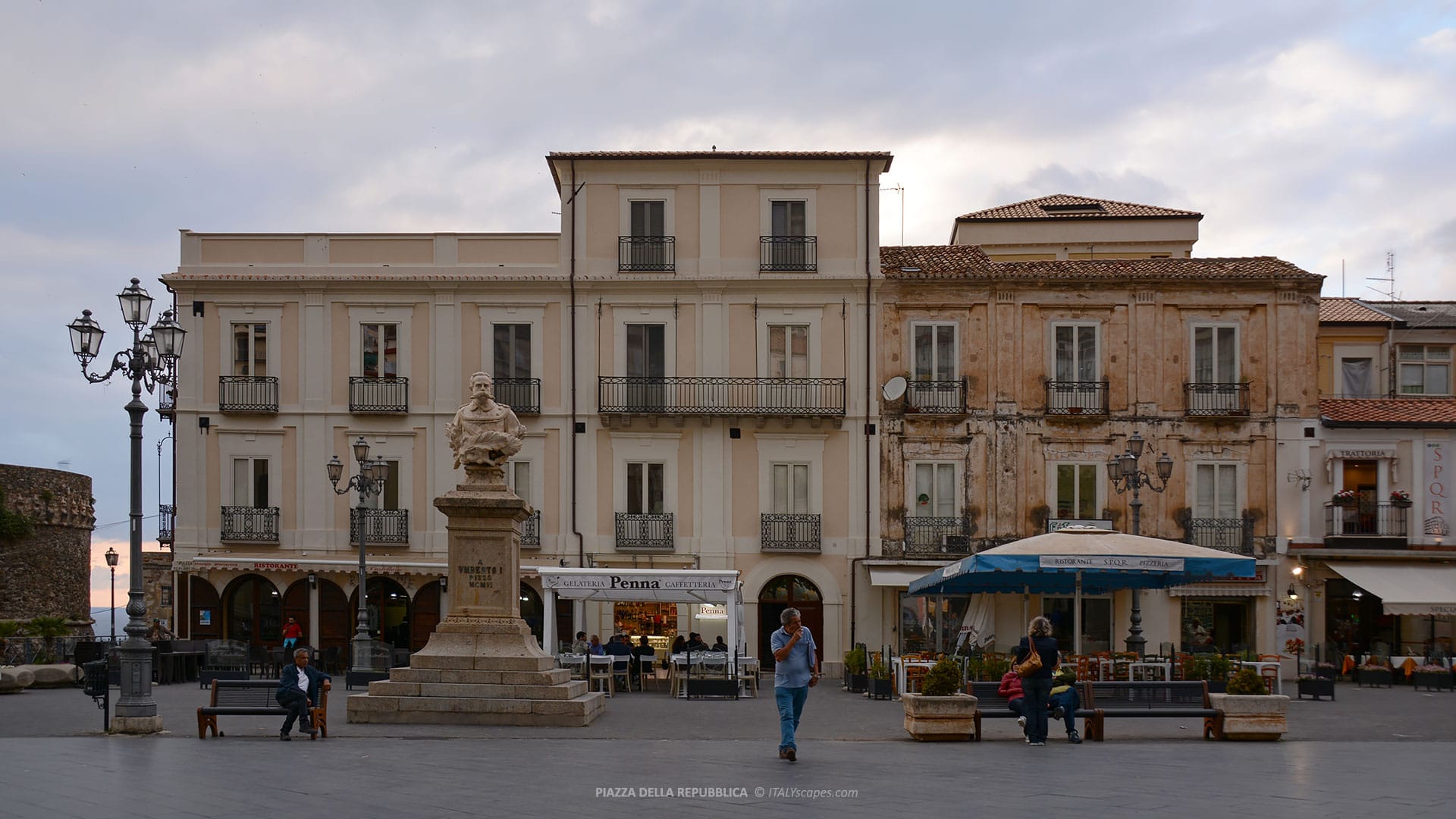
Today, the square is surrounded by cafés, restaurants, gelaterias, historic buildings, monuments, and religious landmarks. It is also one of the best places to experience the atmosphere of Pizzo while enjoying panoramic views of the coastline and the Gulf of Sant’Eufemia.
Piazza della Repubblica is particularly associated with the culinary traditions of the town. Several establishments located around the square serve Tartufo di Pizzo, the famous ice cream dessert that has become one of Calabria’s best-known gastronomic specialties.
Powered by GetYourGuideShort History of Piazza della Repubblica
The history of Piazza della Repubblica is closely linked to the historical development of Pizzo itself. As the town expanded around the rocky promontory overlooking the Tyrrhenian Sea, the square gradually became the principal civic space where commercial, administrative, religious, and social activities took place.
For many years, the square was known as Piazza Umberto I, in honor of King Umberto I of Italy. The dedication reflected the political climate of the period following Italian unification and the establishment of the Kingdom of Italy.
Following the institutional changes that occurred after the Second World War and the birth of the Italian Republic in 1946, the square adopted its current name, Piazza della Repubblica. Despite the change, several elements associated with its former dedication remain visible within the square.

Architecture of Piazza della Repubblica
Piazza della Repubblica presents a remarkable combination of military, religious, civic, and commemorative architecture. The buildings and monuments surrounding the square reflect different periods of the town’s history and contribute to its distinctive appearance.
The square is characterized by its panoramic opening toward the sea, a feature that distinguishes it from many other historic squares in Calabria.
Castello Murat
The most imposing structure overlooking Piazza della Repubblica is Castello Murat, located on the western side of the square. The fortress was originally constructed during the fifteenth century under Aragonese rule as part of a defensive network designed to protect the Calabrian coastline.
Its strategic position allowed the control of maritime routes and offered protection against attacks arriving from the sea. The fortress became one of the most important defensive structures in the region and remains among the best-preserved historical monuments in Pizzo.
The castle is known today as Castello Murat because of its connection with Joachim Murat, King of Naples and brother-in-law of Napoleon Bonaparte. Following the collapse of Napoleon’s empire, Murat attempted to regain his throne by landing in Calabria in October 1815.
His expedition failed shortly after his arrival. Murat was captured by Bourbon authorities and imprisoned inside the fortress overlooking the square. Following a military trial, he was sentenced to death and executed in Pizzo on 13 October 1815.
The execution transformed the fortress into a place of national historical significance. Today, the castle houses exhibitions dedicated to Joachim Murat, the Napoleonic period, and the historical events that shaped southern Italy during the early nineteenth century.
U Spunduni
Near the castle stands one of the most famous viewpoints in Pizzo, known locally as U Spunduni. The name derives from the local dialect and refers to the rocky projection that overlooks the sea below.
The terrace offers extensive views of the Tyrrhenian coastline and the Gulf of Sant’Eufemia. From this elevated position, visitors can observe the coastline stretching toward the north and south, while on clear days the panorama extends far across the sea.
U Spunduni has long served as a favorite meeting place for residents. Its location adjacent to Piazza della Repubblica makes it a natural extension of the square and one of the most photographed spots in the historic center.
Statue of Umberto I
One of the most significant monuments in the square is the statue dedicated to King Umberto I of Italy, to whom the square was originally dedicated.
The monument was created at the beginning of the twentieth century by Francesco Gerace, one of Calabria’s most distinguished sculptors. The work commemorates Umberto I, who reigned as King of Italy from 1878 until his assassination in 1900.
The statue stands on a granite pedestal created by Pietro Marmorato, whose work complements the sculpture and contributes to its monumental character. Together, the statue and pedestal form one of the most recognizable landmarks within the square.
The monument also serves as an important reminder of the square’s former name. Although Piazza Umberto I became Piazza della Repubblica after the establishment of the Italian Republic, the statue remains an integral part of the urban landscape.
Fontana del Commercio
In the southwestern corner of Piazza della Repubblica stands Fontana del Commercio, one of the square’s most distinctive decorative features.
The fountain was built in 1864 using granite obtained from a monument that had been destroyed a few years earlier during the political upheavals associated with the period of Italian unification. The reuse of the material represents an interesting example of nineteenth-century urban adaptation.
Its name, which translates as “Fountain of Commerce”, reflects the historical role played by the square as the commercial center of Pizzo. For generations, residents gathered in the area to conduct business, exchange goods, and participate in everyday economic activities.
Church of the Immaculate Conception
The eastern side of Piazza della Repubblica is dominated by the Church of the Immaculate Conception, one of the most important religious buildings in the historic center.
The church was built in 1630, making it one of the oldest structures directly overlooking the square. Its location creates a visual balance with Castello Murat on the opposite side, linking the religious and civic history of the town.
Over the centuries, the church has undergone various restoration campaigns while maintaining its historical significance. It remains an active place of worship and continues to play an important role in the religious life of the local community.
Inside the church, visitors can admire several artworks of religious importance. The most valuable is the wooden statue of the Immaculate Conception, located on the main altar and highly venerated by the faithful.
How to Get to Piazza della Repubblica
Piazza della Repubblica is located in the historic center of Pizzo, approximately 1.4 kilometers from Pizzo railway station.
Getting to Piazza della Repubblica on foot
The route between the station and the square can be covered on foot in about twenty minutes, following the roads that climb toward the elevated historic center.
Getting to Piazza della Repubblica by taxi or car
Visitors arriving by train will generally find taxis available outside the station. The journey to Piazza della Repubblica takes only a few minutes and provides a convenient option for those carrying luggage or preferring to avoid the uphill walk.
Those arriving by car can use parking areas located near the historic center before continuing on foot toward the square. Due to the historic layout of Pizzo, many streets in the center are narrow and best explored on foot.
Frequently Asked Questions about Piazza della Repubblica
Where is Piazza della Repubblica located?
Piazza della Repubblica is located in the historic center of Pizzo, Calabria, in a panoramic position overlooking the Tyrrhenian Sea and the Gulf of Sant’Eufemia.
What is Piazza della Repubblica famous for?
Piazza della Repubblica is famous for its sea views, lively cafés, historic monuments, Castello Murat, and its connection with Pizzo’s famous tartufo ice cream.
What can you see in Piazza della Repubblica?
Visitors can see Castello Murat, the statue of Umberto I, Fontana del Commercio, nearby churches, historic buildings, cafés, restaurants, and panoramic viewpoints.
What is U Spunduni?
U Spunduni is the famous panoramic viewpoint beside the square, offering beautiful views over the Tyrrhenian coastline, the marina, and the Gulf of Sant’Eufemia.
Is Piazza della Repubblica good for eating tartufo?
Yes, Piazza della Repubblica is one of the best places in Pizzo to taste Tartufo di Pizzo, the town’s famous ice cream dessert.
How do you get to Piazza della Repubblica?
The square is about 1.4 kilometers from Pizzo railway station. Visitors can walk uphill in about 20 minutes, take a taxi, or arrive by car nearby.
Sources:Powered by GetYourGuide -
Photos
-
Map
-
Reviews

