-
About
Table of Contents
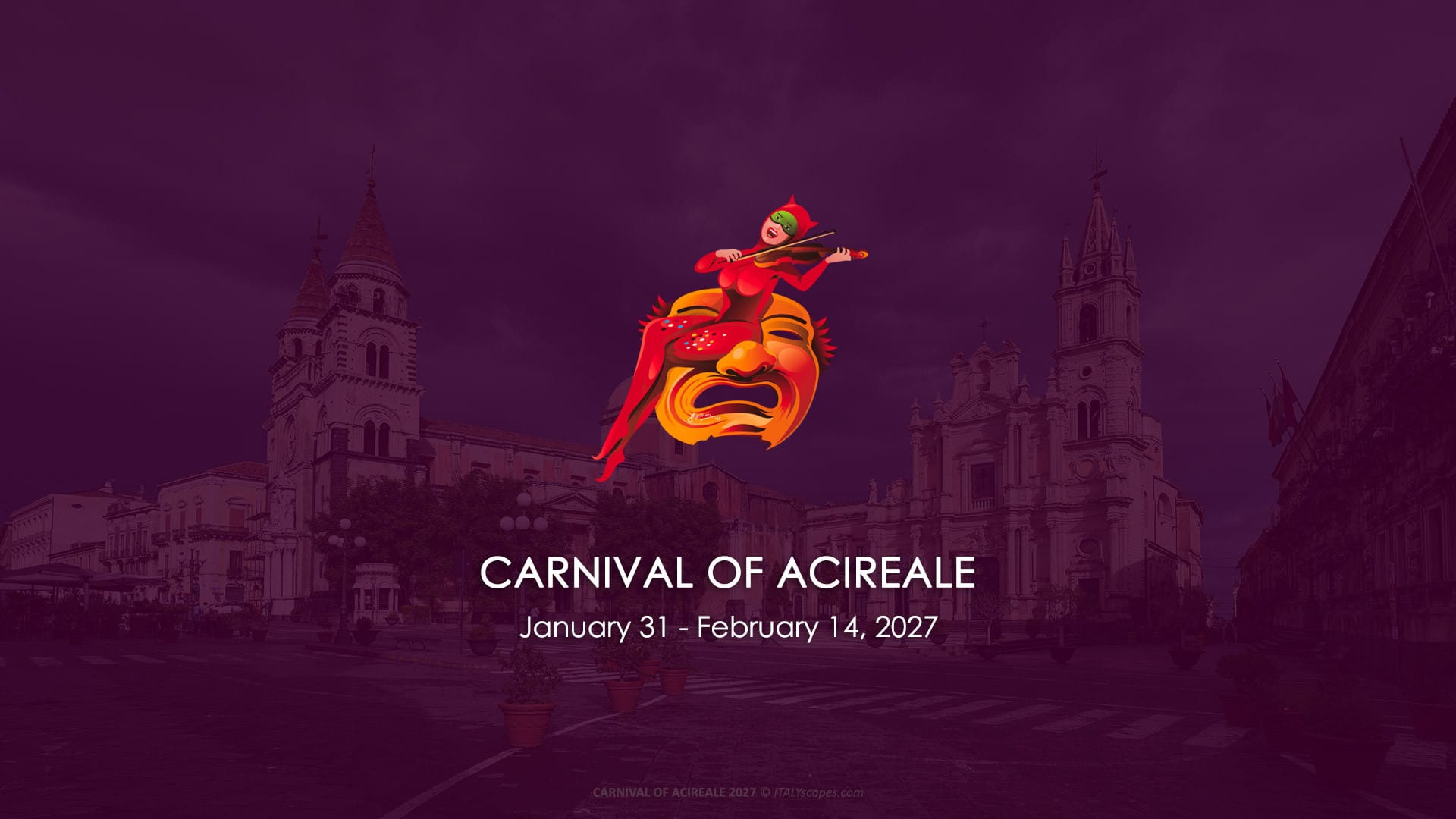
The Carnival of Acireale 2027 will take place in Acireale, Sicily, from Sunday, January 31, to Sunday, February 14, 2027. The celebration transforms the historic centre into a large open-air stage dominated by monumental papier-mâché floats, mechanical figures, satire, music, lights, costumes, and public entertainment.
Acireale’s winter carnival is particularly famous for its allegorical-grotesque floats, enormous creations built by specialised local craftsmen using papier-mâché, painting, mechanical systems, lighting, and sound. Their subjects frequently reinterpret contemporary politics, popular culture, social issues, and public figures through caricature, exaggeration, humour, and carefully constructed visual narratives.
The floats are accompanied by individual masks, costumed groups, performers, music, and other activities spread through the central streets. The combination of moving sculptures and the city’s Sicilian Baroque architecture gives Acireale a visual character substantially different from carnivals based primarily on masks, balls, or static historical processions.
Flower-covered floats also have a long history in Acireale, originating from decorated vehicles introduced during the 20th century. Today, however, the principal flower-float programme belongs to the separate Festa dei Fiori, held in spring, while the winter carnival concentrates primarily on the spectacular allegorical-grotesque papier-mâché creations.
The event is deeply connected with local craftsmanship. Float construction involves sculpture, clay modelling, mould-making, paper application, painting, carpentry, metal structures, electrical systems, mechanical movements, and scenography. The result is a carnival in which artistic and technical production is as important as the crowds, costumes, music, and street entertainment.
When Will the Carnival of Acireale 2027 Take Place?
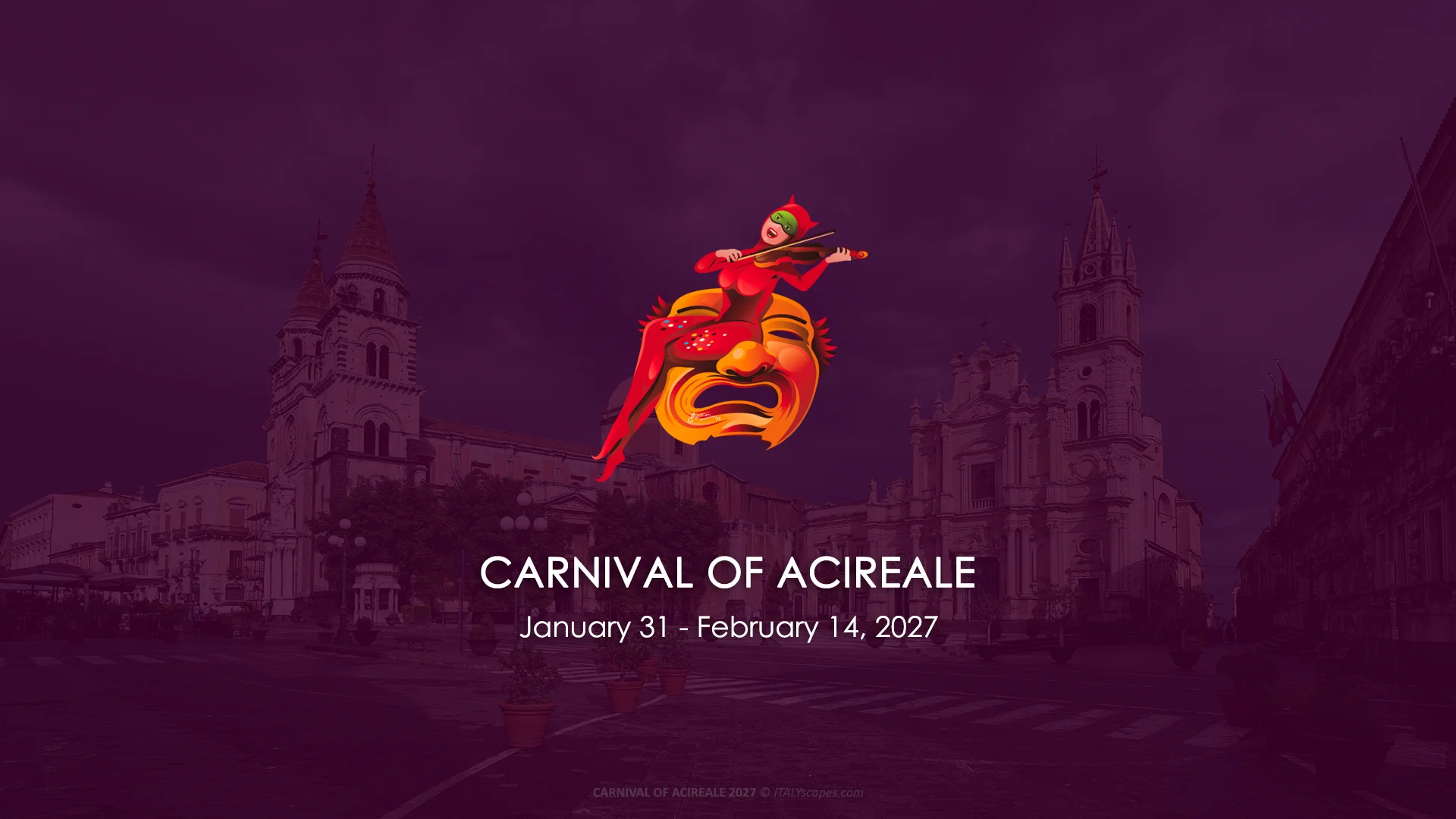
The Carnival of Acireale 2027 is scheduled from January 31 to February 14, 2027. January 31 falls on a Sunday, while February 14 is also a Sunday, giving visitors two full weeks in which the principal celebrations, parades, displays, performances, and related activities can be distributed through the historic centre.
The dates extend beyond the traditional Shrove Tuesday of the Christian Carnival calendar. This reflects the modern organisation of Acireale’s celebration as a major cultural and tourism event, whose programme can occupy several weekends rather than being restricted exclusively to the final days immediately preceding Ash Wednesday.
The most important moments are concentrated around the appearances of the large allegorical floats on the historic circuit. Visitors planning specifically to see the moving papier-mâché constructions should consult the final daily programme before travelling, because parade times and individual activities are organised separately within the overall January 31-February 14 period.
What Is the Schedule of the Carnival of Acireale 2027?
The complete hour-by-hour schedule for the Carnival of Acireale 2027 edition has not yet been published in definitive form. The central structure of the event, however, remains focused on the historic Carnival circuit, where the allegorical-grotesque floats perform for spectators while music, entertainment, exhibitions, and other initiatives occupy the surrounding streets and squares.
The city circuit used by the Carnival was adopted in its present general form during the early 1980s. It passes through Piazza del Duomo, Corso Umberto, Corso Italia, and Corso Savoia, linking several of the most important streets and architectural spaces in central Acireale within one controlled urban route.
Piazza Indirizzo also occupies an important position within this central area, connecting parts of the route and providing another recognisable gathering point during large public events. The Carnival circuit effectively creates a broad loop through the Baroque centre, allowing the floats to move repeatedly past different viewing areas rather than making only one linear passage.
Access to the controlled circuit is organised through monitored entrance points associated with ticket offices. This system allows the organisers to manage large visitor numbers and safety requirements while preserving pedestrian access through streets that were never originally designed to accommodate modern crowds surrounding enormous moving carnival structures.
Where Will the Carnival of Acireale 2027 Take Place?
About Acireale
Acireale lies on the eastern coast of Sicily, within the Metropolitan City of Catania, on elevated terrain overlooking the Ionian Sea. The city stands north of Catania and southeast of Mount Etna, occupying a geographical position where volcanic landscapes, cultivated countryside, coastal cliffs, and Mediterranean settlements meet within a relatively compact area.
The present city developed from the complex historical territory traditionally associated with Aci, whose name is connected with the ancient myth of Acis and Galatea. Over time, settlements in this territory separated into several communities, producing modern place names including Acireale, Aci Castello, Aci Catena, Aci Sant’Antonio, and Aci Trezza.
Acireale’s present architectural identity was strongly shaped by reconstruction following the devastating 1693 earthquake that affected much of southeastern Sicily. Churches, palaces, balconies, façades, and civic spaces were rebuilt or transformed during the following decades, giving the centre the elaborate Baroque appearance that now provides the visual setting for the Carnival of Acireale 2027.
The city stands immediately above La Timpa, a high coastal escarpment formed through geological processes connected with the Etna region. The protected landscape contains vegetation, paths, lava formations, terraces, and routes descending toward seaside settlements such as Santa Maria La Scala, creating a sharp contrast between the urban centre and Ionian coastline.
What Is the Venue of the Carnival of Acireale 2027?
The Carnival of Acireale 2027 will take place throughout the historic centre of Acireale, rather than inside a single arena or festival complex. Streets and squares become part of the event infrastructure, with controlled access points surrounding the route followed by the large allegorical floats and associated Carnival activities.
Piazza del Duomo forms the principal architectural centre of the celebration. The square contains Acireale Cathedral, the Basilica of Saints Peter and Paul, Palazzo di Città, and other historic buildings, creating one of the most recognisable Baroque settings encountered by the Carnival floats as they circulate through the city.
From the central square, the established circuit reaches Corso Umberto, Corso Italia, and Corso Savoia. These streets create a route through commercial and residential sections of the centre while linking important public spaces, allowing the large floats to move, stop, perform, and activate their mechanical elements before different sections of the audience.
The centre is therefore more than a background for the event. Streets, façades, churches, squares, balconies, and the controlled circuit determine how spectators experience each performance. The relationship between monumental contemporary papier-mâché and historic Sicilian architecture remains one of the Carnival’s most distinctive characteristics.

A Short History of the Carnival of Acireale
The First Documentary Evidence
The earliest surviving documentary reference connected with Carnival celebrations in Acireale dates to 1594. A municipal payment ordered by the local authorities in favour of the Capuchin friars referred to festivities held during the Carnival period, providing an important documentary point for tracing the celebration’s long history.
Carnival offered a temporary opportunity to overturn normal social conventions. Satire directed toward powerful figures became an important part of the celebrations, producing early popular characters such as the Abbatazzu, also known as Pueta Minutizzu, whose exaggerated behaviour mocked members of the clergy and local authority.
Around the beginning of the 17th century, Carnival crowds also participated in battles involving oranges and lemons thrown through the streets. The practice became sufficiently dangerous and disorderly that authorities prohibited it in 1612, providing another early indication of both the popularity and unruly character of the local festivities.
Earthquake and Revival
The catastrophic Val di Noto earthquake of 1693 devastated communities across southeastern Sicily and severely damaged Acireale. Carnival celebrations consequently entered a period of interruption while the city confronted destruction, reconstruction, economic difficulties, and the need to restore churches, houses, streets, and civic institutions.
During the 18th century, celebrations gradually returned as Acireale recovered. New popular masks became associated with Carnival, including the Baruni, which satirised aristocratic behaviour, and the Manti, elaborate costumes whose principal function was to preserve the anonymity of the person wearing them.
This renewed Carnival developed within a city being rebuilt in the Baroque style. The transformation was significant because the architectural environment created after the earthquake would eventually become inseparable from the modern event, providing the monumental urban scenery through which floats, masks, performers, and spectators continue to move.
The Cassariata and the Arrival of Papier-Mâché
During the 19th century, one important Carnival spectacle was the cassariata, a parade of elegant carriages belonging to wealthy families. Nobles travelled through the streets in decorated landaus and threw coloured confetti toward the crowds, combining social display with increasingly elaborate forms of public entertainment.
A decisive change arrived in 1880, when the first papier-mâché allegorical floats were constructed in Acireale. Local artisans were already familiar with decorative techniques used for religious and theatrical purposes, providing the technical knowledge required to transform temporary Carnival structures into increasingly ambitious sculptural creations.
Papier-mâché eventually displaced the noble carriages as the main visual attraction. The material was comparatively light and versatile, allowing artisans to create large figures without the weight of solid sculpture. It also provided a surface that could be moulded, painted, exaggerated, dismantled, and reconstructed according to the needs of each new Carnival.
The 20th Century
Institutional organisation became more structured in 1929, when responsibility for Carnival was assumed by the local tourism organisation. This period helped transform the celebration from a primarily spontaneous tradition into a planned public event increasingly connected with promotion, tourism, competitions, and the organised presentation of large artistic works.
Around 1930, decorated vehicles covered with fresh flowers appeared in the Carnival. These early flower cars later evolved into increasingly elaborate floral creations, eventually becoming another important branch of Acireale’s Carnival craftsmanship alongside the better-known allegorical papier-mâché floats.
The Second World War caused another major interruption, but Carnival returned after the conflict. During the 1950s and 1960s, miniature floats known as Lilliput appeared alongside the full-size constructions and flower vehicles, introducing a smaller format that helped younger participants learn techniques associated with the city’s larger artistic workshops.
During the following decades, float construction became increasingly sophisticated. Artisans introduced more complex mechanical systems, stronger internal structures, elaborate painting, amplified music, and coordinated illumination. The allegorical creations developed into mobile theatrical machines, capable of performing sequences of movements instead of functioning merely as decorated parade vehicles.
Satire, Technology, and Modern Float Making
The modern allegorical-grotesque floats preserve Carnival’s old connection with satire. Politicians, celebrities, social trends, technology, international events, environmental issues, and popular culture can all become subjects, interpreted through exaggerated faces, oversized bodies, visual jokes, symbols, and combinations of apparently unrelated characters.
Construction begins months before the parade. Artists prepare concepts and sketches before developing figures through modelling and mould-making. Paper is applied in layers to create lightweight surfaces, while metal frameworks and mechanical systems support the increasingly complicated movements required by contemporary competitive floats.
Painting establishes the visual identity of each construction, but movement is equally important. Eyes may rotate, mouths open, heads turn, arms rise, figures emerge from scenery, and large structures transform while music and lighting coordinate the sequence. Each float effectively functions as a travelling performance rather than a static sculpture.
The skills required are therefore both artistic and technical. Sculptors, painters, mechanics, electricians, designers, builders, and younger apprentices contribute different abilities, while competition between workshops encourages experimentation. This system has made float-making a form of specialised local knowledge passed between generations rather than a temporary decorative activity.
The Modern Carnival
Today, the Carnival includes more than the full-size allegorical floats. Individual masks and miniature floats provide additional competitive and creative formats, allowing younger artists to develop skills before progressing toward larger projects. Exhibitions and associated activities also explain the techniques, history, and visual culture surrounding Carnival construction.
The Carnival’s activities have also expanded beyond the winter event. Acireale now presents different seasonal expressions of its Carnival identity, including the Festa dei Fiori and summer initiatives, allowing floats, craftsmanship, masks, and visual traditions to remain visible at other points during the year.
The official visual identity has also evolved. For 2027, the Carnival uses Lavica, Zagara, and Ionica, characters representing different seasonal aspects of the celebration and its territory. Their imagery connects Mount Etna, flowers, the Ionian coast, the Aci landscape, and the traditional grotesque character of Acireale’s floats.
More than four centuries after the first surviving documentary reference, the event remains grounded in the same fundamental elements: public celebration, satire, disguise, artistic competition, and temporary transformation of the city. Its longevity comes from continuous reinvention, rather than from preserving every historical custom unchanged.

Beyond the Carnival of Acireale 2027
What to Visit in Acireale
Begin with Piazza del Duomo, the architectural heart of Acireale and also one of the principal Carnival spaces. The square contains Acireale Cathedral and the Basilica of Saints Peter and Paul, while Palazzo di Città contributes another richly decorated façade to one of eastern Sicily’s most coherent historic urban settings.
A short walk leads to the Basilica Collegiata di San Sebastiano, one of the city’s most important Baroque monuments. Its elaborate façade is preceded by a sculpted balustrade, while the interior contains extensive fresco decoration by Pietro Paolo Vasta and works by several artists connected with the Acese artistic tradition.
Visitors interested in landscape should explore La Timpa Nature Reserve, the dramatic escarpment descending from Acireale toward the Ionian Sea. Historic paths cross volcanic terrain and Mediterranean vegetation, while routes toward coastal settlements reveal the physical relationship between the elevated city, former lava landscapes, terraced slopes, and shoreline.
Below the city, Santa Maria La Scala provides a contrasting maritime environment with fishing boats, waterfront buildings, rocky coastline, and direct views toward the Ionian Sea. The descent also helps visitors understand how sharply Acireale’s urban plateau rises above the narrow coastal strip immediately to the east.
Acireale also has a strong tradition of Sicilian puppet theatre, linked with the Opera dei Pupi. Visitors interested in local cultural heritage can combine the monumental centre with museums, workshops, Carnival displays, and spaces dedicated to traditions that developed outside the city’s major churches and aristocratic architecture.
What to Eat
Acireale is particularly associated with Sicilian granita, consumed locally well beyond the hottest summer months. Almond and lemon remain classic flavours, while other versions vary with ingredients and season. Granita is traditionally accompanied by a soft brioche with the characteristic rounded top commonly known as the tuppo.
Carnival itself has several fried specialties. Crispelle can be prepared in savoury versions filled with ricotta or anchovies, making them practical street food during festivities. Rice-based sweet crispelle, also known as zeppole di riso, are fried and finished with honey, often accompanied by citrus aromas and cinnamon.
Another Carnival sweet is pignolata, made from small pieces of fried dough assembled together and covered with honey. Various versions exist across Sicily, but honey-coated forms are particularly suitable to the Carnival period, when fried sweets traditionally appear in pastry shops and on family tables throughout the island.
Visitors looking for savoury everyday food can try Sicilian arancini, cartocciate, cipolline, and other bakery or tavola calda preparations commonly found around eastern Sicily. The territory also produces trunzu di Aci, a distinctive local kohlrabi traditionally used in regional cooking and associated particularly with the Acireale area.
Acireale’s position above the Ionian coast also means that fresh fish and seafood are prominent in nearby coastal settlements. Cannoli, almond pastries, artisan gelato, ricotta-filled sweets, and products using Etna lemons provide further options, making local food an easy complement to several hours spent following Carnival events.

Frequently Asked Questions about the Carnival of Acireale 2027
When will the Carnival of Acireale 2027 take place?
The Carnival of Acireale 2027 is scheduled from January 31 to February 14, 2027, covering two weeks of celebrations, parades, displays, entertainment, and activities in the historic centre of Acireale.
Where does the Carnival of Acireale 2027 take place?
The Carnival of Acireale 2027 takes place in Acireale’s historic centre, with the principal circuit passing through Piazza del Duomo and major streets including Corso Umberto, Corso Italia, and Corso Savoia.
What is the Carnival of Acireale famous for?
It is particularly famous for its large allegorical-grotesque papier-mâché floats, which combine sculpture, political and social satire, mechanical movements, painting, lighting, music, and complex theatrical presentation.
Do I need a ticket for the Carnival of Acireale?
Access to controlled parade days can require a ticket, with entry managed through monitored gates around the circuit. Ticket arrangements depend on the specific date and official programme.
Are the floral floats part of the winter Carnival?
Acireale has an important flower-float tradition, but the major modern presentation of the Carri Infiorati belongs to the separate Festa dei Fiori held during the spring.
How old is the Carnival of Acireale?
The earliest surviving documentary reference dates to 1594, when a municipal payment referred to Carnival festivities, making Acireale’s celebration one of Sicily’s long-established Carnival traditions.
What are the floats made from?
The principal allegorical floats use papier-mâché supported by internal structures and mechanical systems. They are sculpted, painted, illuminated, and engineered to perform complex movements during their appearances.
What should I visit in Acireale besides the Carnival?
Major attractions include Piazza del Duomo, Acireale Cathedral, the Basilica of San Sebastiano, La Timpa Nature Reserve, and Santa Maria La Scala on the Ionian coast below the city.
What traditional food should I try during the Carnival?
Good choices include crispelle, pignolata, arancini, cannoli, and Sicilian pastries. Acireale is also particularly famous for granita served with brioche, a local ritual enjoyed throughout much of the year.
-
Photos
-
Video
Table of Contents
-
Map
-
Reviews
31 January 2027
14 February 2027