-
About
Table of Contents
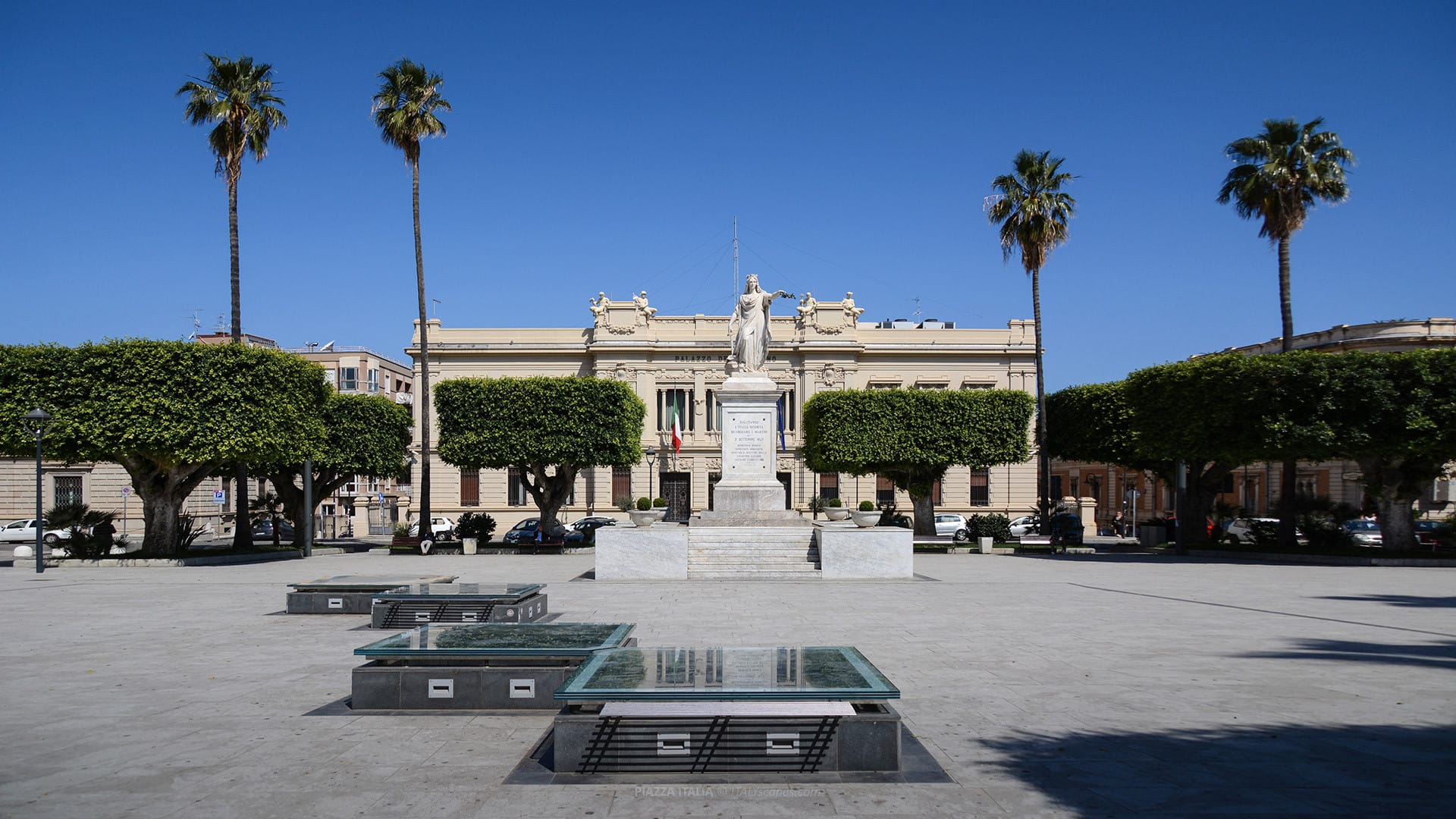
Piazza Italia is one of the most important squares in Reggio Calabria, located in the historic center of the city. Its official name is Piazza Vittorio Emanuele II, but it is commonly known by its popular name because of the Monument to Italy standing at its center.
The square is the political and administrative heart of Reggio Calabria. Around it stand some of the most important institutional buildings of the city, including Palazzo San Giorgio, the seat of the Municipality, and Palazzo Corrado Alvaro, the seat of the Metropolitan City of Reggio Calabria.
Piazza Italia has a square-shaped plan and opens on its southeastern side toward Corso Giuseppe Garibaldi, the main central street of Reggio Calabria. The square follows the urban layout of the historic center and is positioned obliquely in relation to the cardinal points.
This location makes Piazza Italia one of the most central and accessible public spaces in Reggio Calabria. It stands close to major civic, cultural, and commercial points of interest, including Teatro Francesco Cilea, Corso Garibaldi, and other institutional buildings connected to local administration.
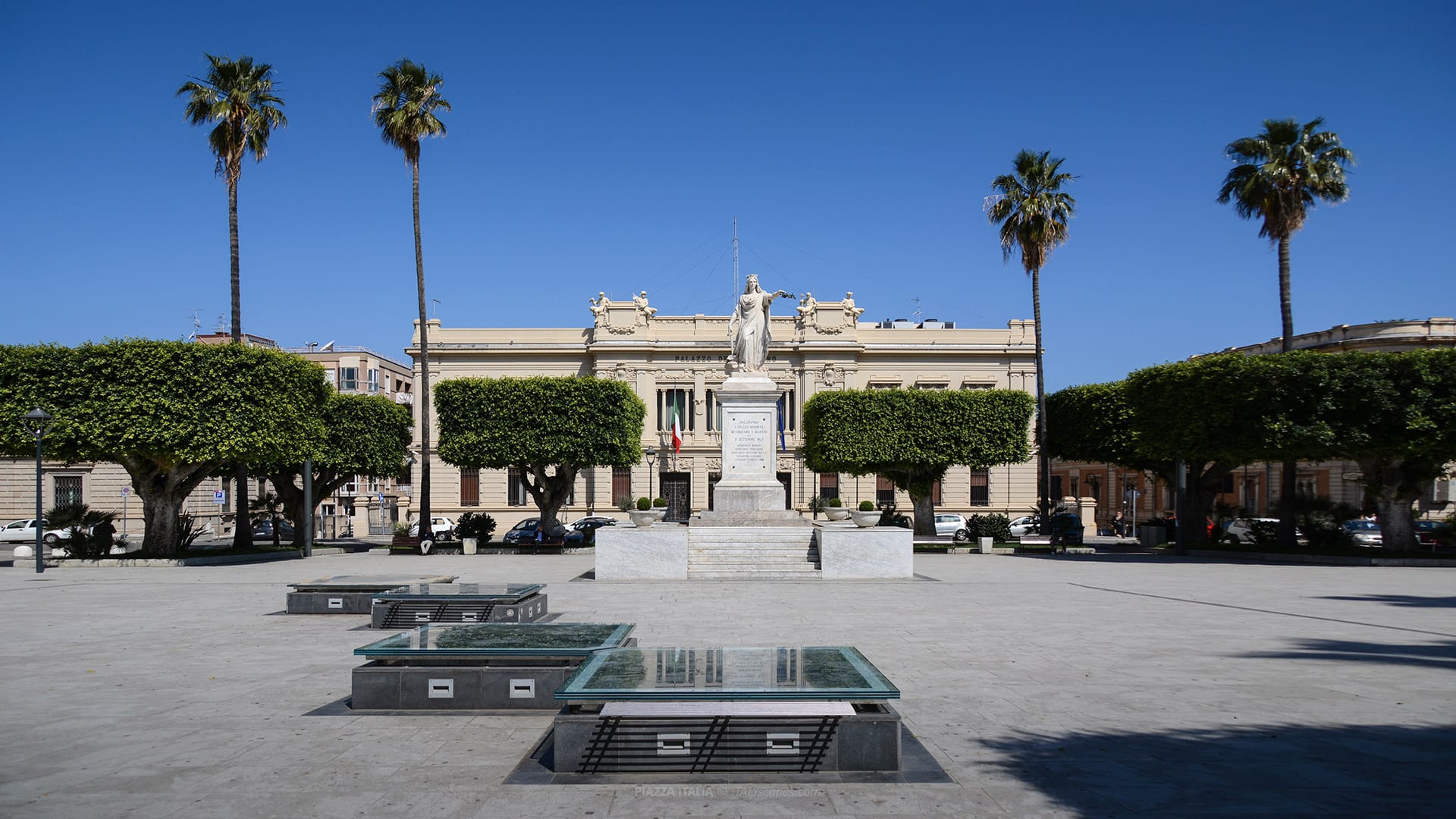
Piazza Italia with the Monument to Italy in the foreground
Short History of Piazza Italia
The Ancient Name – Tocco Piccolo
Before receiving its modern name, Piazza Italia was known as Tocco Piccolo. This name was connected to the historical civic organization of Reggio Calabria, when the city was divided into areas called “tocchi”, each with specific administrative and representative functions.
Tocco Piccolo was historically associated with the election of the representative of noble extraction. Its counterpart was Tocco Grande, today’s Piazza Duomo, linked to representatives of the people and artisan classes. Together, the two spaces reflected the civic structure of old Reggio Calabria.
Names Between 1810 and 1860
During the 19th century, especially between 1810 and 1860, Piazza Italia changed name several times. Some names were official, while others came from popular use.
Among its former names were Piazza della Cattolica, connected to the presence of a church, and a name linked to Joachim Murat, King of Naples. During the Restoration period, the square was also called Piazza dei Gigli, referring to the Bourbon royal symbol.
Bourbon Monuments and Risorgimento Changes
In 1828, a monument dedicated to Ferdinand I, King of the Two Sicilies, was erected in the square. This monument expressed Bourbon dynastic authority in Reggio Calabria before the political changes brought by the Italian unification movement in the mid-19th century.
After the entry of Giuseppe Garibaldi into Reggio Calabria in 1860, the Bourbon statue was demolished. The square was then named after Vittorio Emanuele II, king of the new Italian state, marking the transition from Bourbon rule to the national framework of united Italy.
The Monument to Italy
The popular name Piazza Italia comes from the Monument to Italy, placed at the center of the square. The work was created by Rocco Larussa in 1868 and became the visual and symbolic element that shaped the square’s common name for more than a century.
The statue represents Italia turrita, the turreted personification of Italy. It holds a sword and is shown encouraging its children to break the chains of Rome and Venice, a direct reference to the completion of national unity during the Risorgimento.
The monument also commemorates the martyrs who fell on 2 September 1847, together with others who rebelled against Bourbon rule. This gives the statue a double meaning: it is both a patriotic symbol of Italian unity and a memorial connected to local resistance.
The Post-Earthquake City
Like much of Reggio Calabria, the modern appearance of the square is connected to the reconstruction that followed the 1908 Messina-Reggio earthquake. The surrounding institutional buildings belong largely to the period of urban and architectural rebirth after the disaster.
The post-earthquake reconstruction gave Piazza Italia its present civic character. Around the square, public buildings were rebuilt or redesigned according to early 20th-century architectural languages, including Liberty and Neoclassical elements adapted to the new urban plan.
Archaeology Under the Square
Excavations in the southeastern area of Piazza Italia between 2000 and 2005 revealed a major archaeological sequence. The underground site proves that this area remained central to the city across many historical periods, from ancient Greek phases to the early 19th century.
The archaeological area preserves eleven construction phases within approximately 6 meters of depth. These layers include Greek-Archaic remains, Roman structures, Byzantine and Norman evidence, Angevin buildings, and later traces showing the gradual transformation of the area into a public square.
Architecture of Piazza Italia
General Layout of the Square
Piazza Italia has a regular square plan, framed by important institutional and cultural buildings. Its southeastern side opens toward Corso Giuseppe Garibaldi, while the rest of the square is enclosed by façades that reinforce its formal administrative character.
Palazzo San Giorgio
Palazzo San Giorgio stands on the northeastern side of Piazza Italia and serves as the seat of the Municipality of Reggio Calabria. The present building was reconstructed after the 1908 earthquake and is one of the most important civic buildings in the city.
The palace was rebuilt between 1918 and 1921 and designed by the Palermo architect Ernesto Basile, an important representative of the Liberty style. It was officially inaugurated in 1922 in the presence of King Vittorio Emanuele III.
Palazzo San Giorgio has two above-ground floors and an almost square plan. On the ground floor, the building is divided into two parts connected by a gallery, which links the area of Corso Garibaldi with Via Miraglia.
The façade includes round-arched windows, rusticated frames, pilasters, capitals, coats of arms, friezes, and a broad cornice with balustrade. The main entrance faces Piazza Italia and forms a central projecting element, similar to a tower, topped by a balcony, a clock, and a bell.
Palazzo Corrado Alvaro
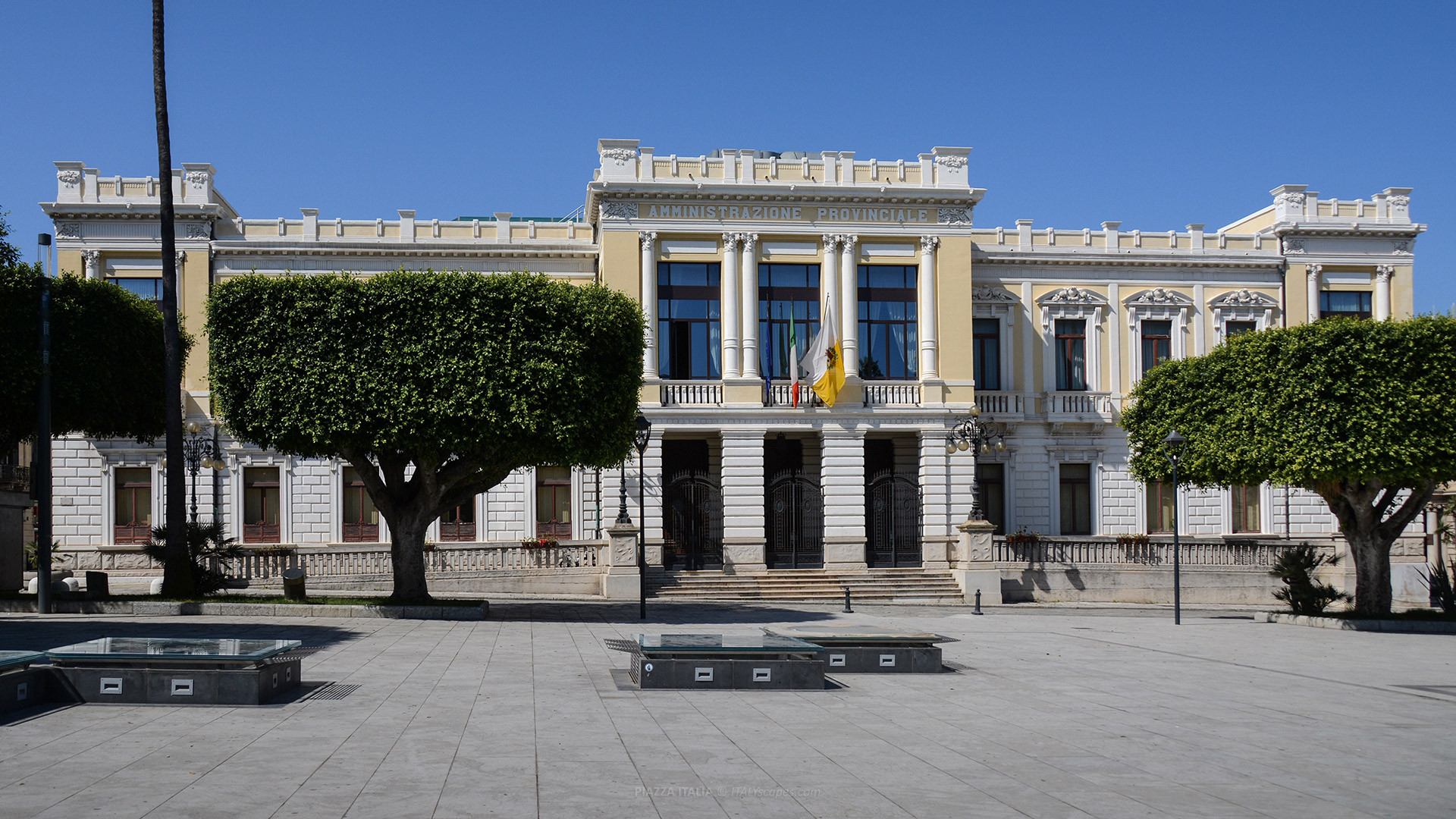
Palazzo Corrado Alvaro, formerly known as Palazzo Foti, stands on the southwestern side of Piazza Italia. It is the seat of the Metropolitan City of Reggio Calabria and occupies the block between the square, Corso Garibaldi, Via Pietro Foti, and Via Miraglia.
The building was designed by Gaetano Spinelli and Camillo Autore and completed in 1920. It replaced the former Palazzo dell’Intendenza, which had been destroyed during the 1908 earthquake, and became one of the main institutional buildings of the reconstructed city.
Palazzo Corrado Alvaro is known for its Umbertine architecture and for the artworks preserved inside. Its monumental staircase includes a Roman-era altar, while the entrance hall contains works by sculptor Francesco Panetta and artist Francesco Jerace.
Palazzo Melissari-Musitano
Palazzo Melissari-Musitano forms one of the architectural fronts of Piazza Italia. It was built between 1912 and 1924 and combines Neoclassical elements with Liberty influences, creating a unified façade despite its two-part construction history.
The right side was built in 1912 as part of a project replacing the old 18th-century Melissari palace destroyed by the 1908 earthquake. The left side, owned by the Musitano family, was built in 1924, continuing the earlier Melissari design.
The ground floor of Palazzo Melissari-Musitano features smooth ashlar and a sequence of round-arched portals. The main doorway is framed by columns with Ionic capitals, which support the corbels of the central balcony on the piano nobile.
Palazzo del Governo and Other Institutional Buildings
The Palazzo del Governo, seat of the Prefecture, stands on the northwestern side of the square. Together with Palazzo San Giorgio, Palazzo Corrado Alvaro, and Palazzo Melissari-Musitano, it helps define Piazza Italia as the institutional center of Reggio Calabria.
Other buildings connected to the square include Palazzo Spanò Bolani to the north, Teatro Francesco Cilea to the east, and the Palazzo del Banco di Napoli to the west. Their proximity strengthens the square’s role as a concentrated civic and cultural area.
Monument and Underground Archaeology
The central monument gives the square its popular name and its patriotic identity. It is not only a decorative element, but also a historical statement connected to the Risorgimento, the memory of the 1847 martyrs, and the symbolic representation of national unity.
Modern Piazza Italia also includes access elements related to the underground archaeological area. After the excavations, the square was reopened with steel and thick-glass skylights, display cases, explanatory panels, and a glass-and-steel access structure leading to the hypogeum.
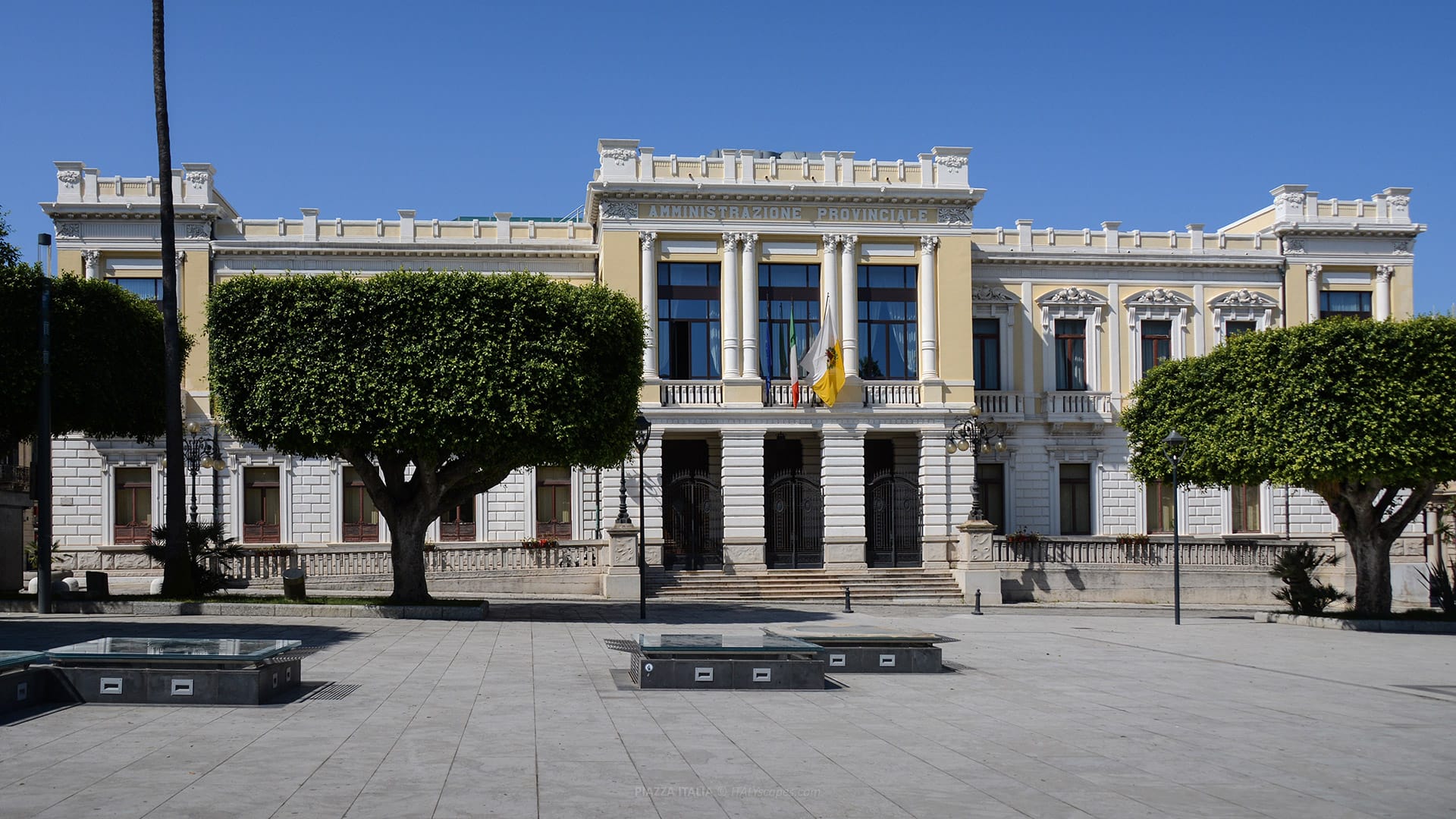
Palazzo Corrado Alvaro
How to Get to Piazza Italia
Getting to Piazza Italia on foot
Piazza Italia is located in the historic center of Reggio Calabria and is easy to reach on foot from the city’s main central streets. It stands directly by Corso Giuseppe Garibaldi, one of the most important pedestrian and commercial axes in the city.
From Reggio Calabria Centrale, the walk to Piazza Italia is approximately 1 kilometer and usually takes around 10 to 15 minutes. The route is practical for travelers arriving by train and heading toward the administrative and cultural center of the city.
Visitors already exploring central Reggio Calabria can easily include Piazza Italia in a walking itinerary. The square is close to Teatro Francesco Cilea, Corso Garibaldi, and the main institutional area, making it a natural stop during a visit to the historic center.
Getting to Piazza Italia by bus
Piazza Italia is served by the urban transport network of Reggio Calabria through stops located in the central area. The closest bus stop is in Corso G. Matteotti 101, approximately 100 meters from the square, and is served by bus lines 6, 7, 11, 12, 14, and 15.
These local bus lines connect the square with other neighborhoods, the station area, and different parts of the city. Because urban bus routes and timetables may change depending on weekday, season, and direction, visitors should check the current ATAM schedule before planning a precise journey.
Getting to Piazza Italia by taxi
A taxi is a convenient option for visitors arriving with luggage, traveling in hot weather, or moving quickly from the railway station, airport, or hotel. From Reggio Calabria Centrale, the distance by road is short, usually around 1 kilometer, depending on the exact route.
The taxi ride from the station area to Piazza Italia generally takes only a few minutes in normal traffic. This is the simplest option for travelers who want to reach the square directly without walking through the center or checking urban bus schedules.
Frequently Asked Questions about Piazza Italia
Where is Piazza Italia located?
Piazza Italia is located in the historic center of Reggio Calabria, beside Corso Giuseppe Garibaldi, surrounded by major institutional, administrative, cultural, and financial buildings.
What is the official name of Piazza Italia?
The official name is Piazza Vittorio Emanuele II. The popular name Piazza Italia comes from the central Monument to Italy, created by Rocco Larussa.
Why is Piazza Italia important?
Piazza Italia is important because it is the political-administrative heart of Reggio Calabria, with the Municipality, Metropolitan City, Prefecture, and other institutions nearby.
What was Piazza Italia called in ancient times?
The square was historically known as Tocco Piccolo, a civic area linked to the old administrative organization of Reggio Calabria and noble representation.
Which buildings face Piazza Italia?
Important buildings include Palazzo San Giorgio, Palazzo Corrado Alvaro, Palazzo del Governo, Palazzo Melissari-Musitano, and nearby Teatro Francesco Cilea.
How far is Piazza Italia from Reggio Calabria Centrale?
Piazza Italia is about 1 kilometer from Reggio di Calabria Centrale. The walk usually takes around 10 to 15 minutes through the city center.
Sources: -
Photos
-
Map
-
Reviews