-
About
Table of Contents
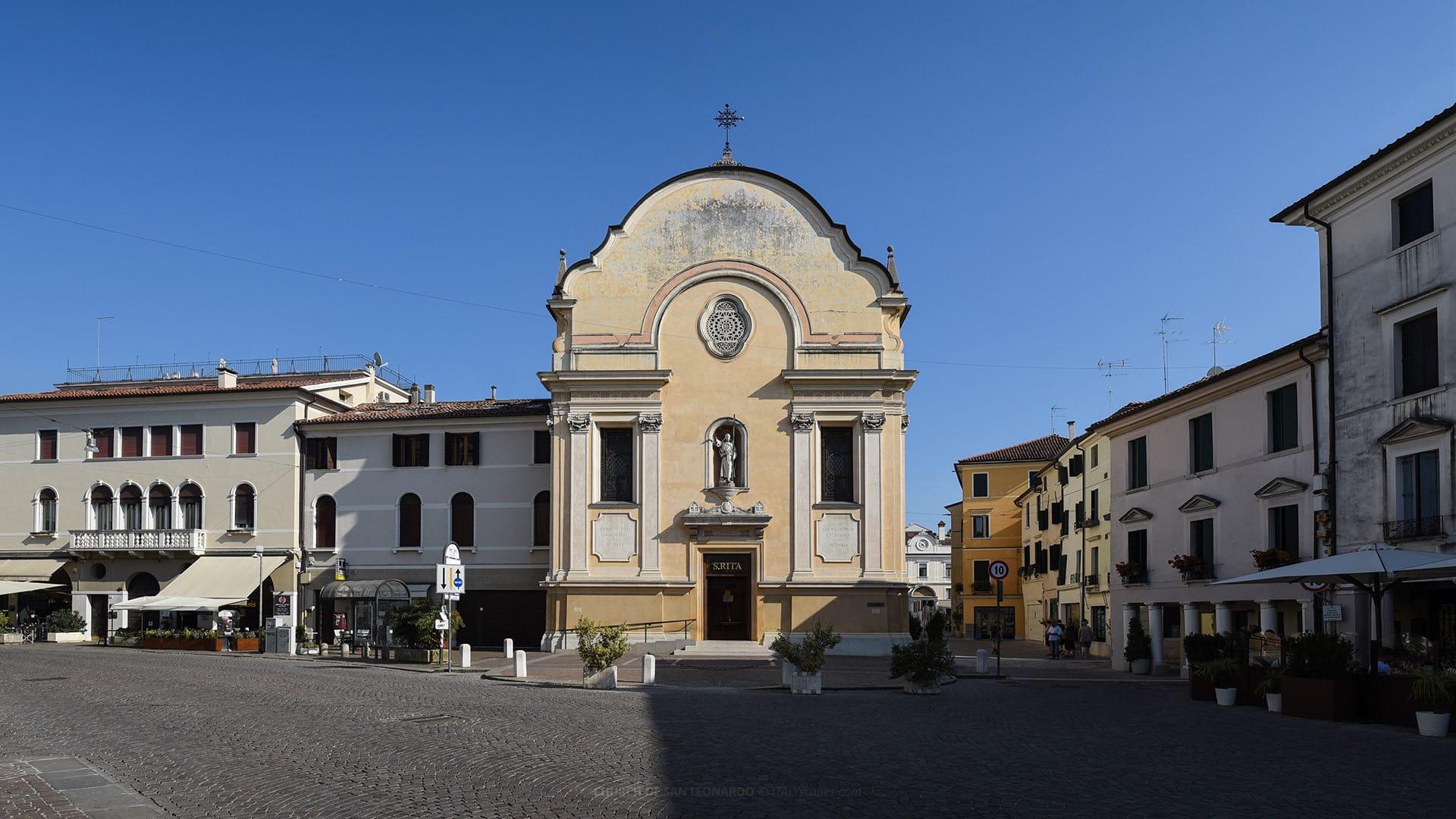
The Church of San Leonardo is a Catholic church in the historic center of Treviso, located in Piazza San Leonardo, between the Quartiere Latino and Piazza dei Signori. It faces the eponymous square, close to Ca’ Spineda, one of the historic palaces connected with the urban identity of central Treviso.
The church is dedicated to Saint Leonard of Noblac, a saint traditionally invoked as a protector of prisoners. In Treviso, however, the church is also closely connected with Saint Rita of Cascia, whose altar is visited by many faithful throughout the year, especially around her feast day.
The origins of San Leonardo go back to the 12th century, but the present building is the result of several later transformations. The most important reconstruction took place in 1657, while the façade visible today was designed in 1930 by architect Luigi Candiani.
Inside, the church has a single nave, a raised presbytery, several devotional altars, paintings by Ludovico Pozzoserrato, a ceiling fresco by Giovan Battista Canal, and a historic pipe organ built by Gaetano Callido in 1787.
Short History of the Church of San Leonardo
Medieval Origins of San Leonardo
The earliest documented history of the Church of San Leonardo is connected with the 12th century. The church is mentioned in a papal bull sent by Pope Lucius III in 1184 to the bishop of Treviso, confirming that the dedication already existed in the medieval period.
In 1330, the church appeared in documents as San Leonardo Abate. At that time, it was connected with an already existing hospital of the same name. It was also listed among the churches dependent on “San Giovanni del Dom”, the institution linked with the present Treviso Cathedral.
Originally, San Leonardo stood outside the first ring of Treviso’s defensive walls. This changed from the 13th century, when the later city walls were built and the area became more integrated into the life of the city. Shops, artisans, and merchants developed around the church.
Reconstruction and Later Transformations
The medieval church did not survive in its original form. The present building is mainly the result of a major reconstruction carried out in 1657, which gave the church its current perimeter. This intervention replaced the earlier structure and reshaped San Leonardo as a post-medieval urban church.
At the beginning of the 19th century, architect Francesco Zambon raised the building and improved the interiors.
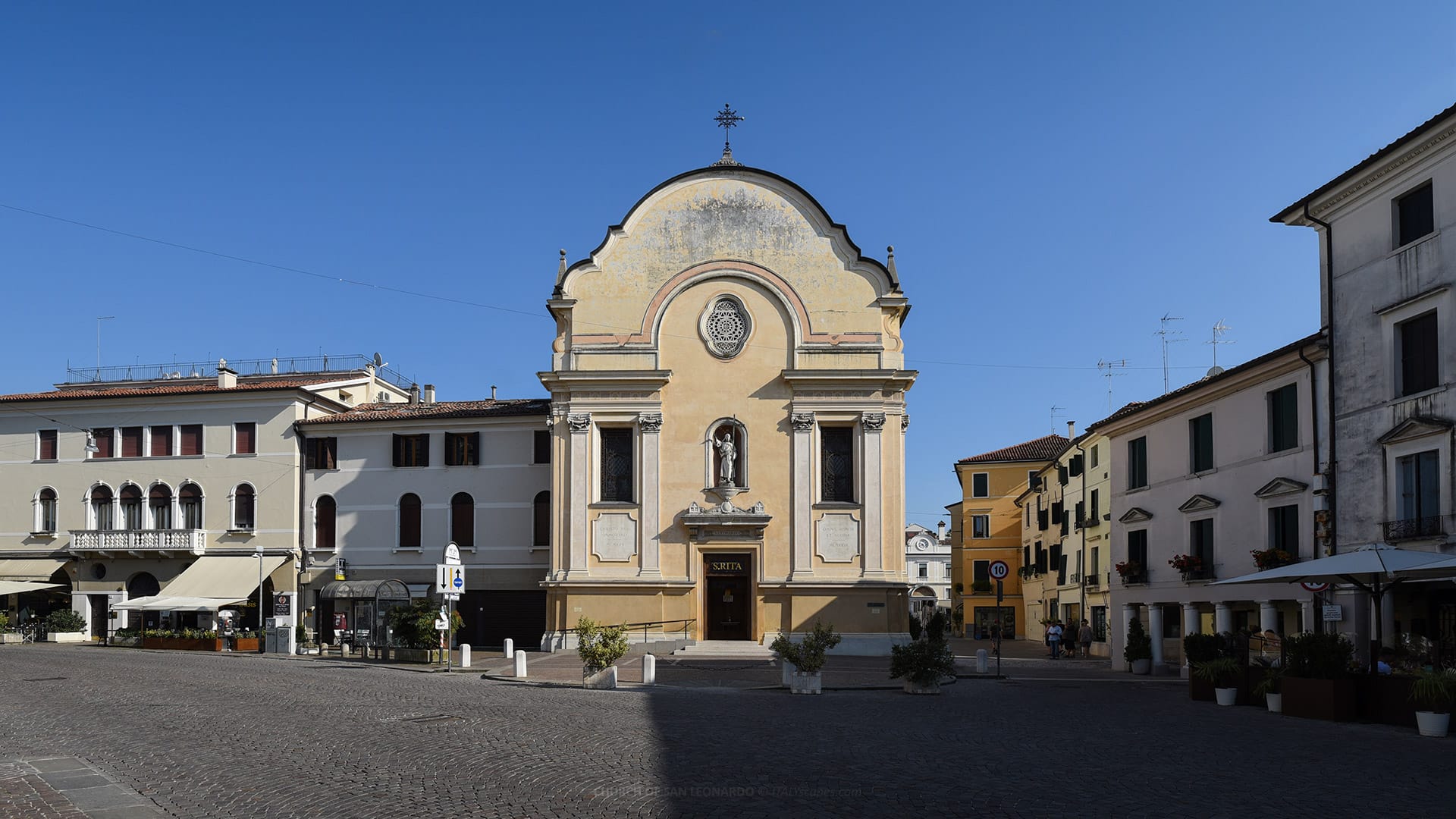
The façade was rebuilt in 1930 by architect Luigi Candiani. This intervention gave the church its present exterior appearance, with an eclectic style, plastered brickwork, classical divisions, and decorative elements. Earlier documentation also records a painted decoration by Gian Maria Lepscky on the tympanum.
Later conservation works helped preserve the building. Documented interventions include roof maintenance in 1987, works on the sacristy in 1990, interior conservation in 2000, and restoration of the external plaster in 2012.
Architecture of the Church of San Leonardo
Plan and Interior Layout
The Church of San Leonardo has a rectangular plan, with the main entrance on the western side and a secondary entrance on the southern side. The interior is organized as a single nave, which directs attention toward the raised presbytery and the high altar.
The presbytery is slightly elevated and partly marked by a stone balustrade. Behind it, a short apsidal niche frames the high altar.
On the counter-façade, above the main entrance, there is a choir loft that holds the historic pipe organ. A spiral staircase provides access to this upper area.
The ceiling is a shallow vault that hides the wooden roof structure above. The roof is supported by wooden trusses and covered externally with traditional terracotta tiles.
Floor, Façade, and Bell Tower
The floor is made of square stone elements set diagonally, with alternating white and red tones. Along the central axis, the path from the entrance to the altar is emphasized by ochre bands and colored geometric inserts, including green and red stone details.
The façade is plastered in yellow and organized by four pilasters with decorated capitals. These vertical elements divide the front into sections and frame the portal, rectangular windows, decorative plaques, and upper openings.
Above the portal, an inscription refers to Saint Leonard. Higher on the façade, a niche contains a sculpture, while a small decorated opening contributes to the upper composition. The façade ends with a shaped upper profile, reflecting the eclectic taste of the early 20th century.
The bell tower is attached to the church and has a square shaft. The belfry is opened by a two-light window on each side. Above it, an octagonal drum and a low roof covered with tiles complete the vertical profile of the church complex.
Art of the Church of San Leonardo
High Altar and Main Paintings
The high altar is attributed to architect Giovanni Miazzi and was enriched in 1768 with bas-reliefs by Giovanni Marchiori. It stands in the apsidal niche and includes a tabernacle, architectural decoration, festoons, putti, and ornamental elements that create a refined focal point.
Behind the high altar is an altarpiece by Ludovico Pozzoserrato, representing Saint Leonard, Saint James the Greater, and Saint Martha. The composition places the titular saint at the center of the church’s visual program and connects the building’s dedication with broader devotional imagery.
Pozzoserrato is also linked with other works inside the church. One painting represents Saint Michael the Archangel defeating Lucifer, while another canvas, associated with the altar of the dead, depicts the Martyrdom of Saint Veneranda.
Another important painting shows Saint Erasmus enthroned with Saint John the Baptist and Saint Sebastian. The work is attributed to Vincenzo Dai Destri.
Devotional Altars and Sacred Images
The altar of the Blessed Virgin of the Snow contains a triptych with the Madonna and Child, Saint Bartholomew, and Saint Prosdocimus. The work is attributed to Cima da Conegliano and his workshop, connecting San Leonardo with an important artistic tradition of the Venetian mainland.
The altar of Saint Anthony of Padua is decorated with a painting by Gian Battista Carrer. Saint Anthony’s presence reflects a widespread Franciscan devotion and complements the other saintly figures represented in the church, including Saint Leonard, Saint Rita, Saint Erasmus, and Saint Veneranda.
The altar dedicated to Saint Rita of Cascia is one of the most visited parts of the church. Saint Rita’s cult is particularly strong among people seeking intercession in difficult situations, and the altar has become an important devotional point inside San Leonardo.
The church also contains a baptismal font near the rear area. Historical references connect some sculptural elements with Lorenzo Bregno, including reliefs later replaced by plaster copies. A statue of Saint Sebastian originally linked with San Leonardo was transferred to Treviso Cathedral.
Ceiling Fresco and Pipe Organ
On the ceiling, visitors can see the fresco Glory of Saint Leonard by Giovan Battista Canal.
The pipe organ is one of the most important historic objects in the church. It was built by Gaetano Callido in 1787 and placed on the choir loft above the entrance. Callido was one of the most important Venetian organ builders of the 18th century.
The instrument has mechanical transmission, one keyboard of 47 notes, and a pedalboard of 18 notes. It was damaged by fire in 1970, when the painted wooden case suffered serious damage, and was later restored. The organ remains part of the church’s liturgical and musical heritage.
How to Get to the Church of San Leonardo
The Church of San Leonardo is located in Piazza San Leonardo, in the historic center of Treviso. It is close to Piazza dei Signori, the Loggia dei Cavalieri, the Quartiere Latino, Ca’ Spineda, and several canals that define the urban image of Treviso.
From Treviso Centrale railway station, the church can be reached on foot, by urban bus, or by taxi. Walking is usually the most practical option, because the distance is short and the route enters the historic center directly through the main streets of central Treviso.
Getting to the Church of San Leonardo on foot
From Treviso Centrale railway station, the walking distance to the Church of San Leonardo is approximately 1.1 kilometers. The walk usually takes around 15 minutes, depending on pace, traffic lights, and short stops along the route through the historic center.
Exit the railway station and follow Via Roma northward. Continue toward Corso del Popolo, one of the main access routes into central Treviso. From there, proceed toward the area of Piazza dei Signori and the Loggia dei Cavalieri.
After reaching the central area, continue toward Piazza San Leonardo. The church stands directly on the square, facing the open urban space.
Getting to the Church of San Leonardo by bus
From Treviso Centrale railway station, the most direct urban bus option is MOM line 7. The route includes the stop Stazione FS – Via Roma and also stops at Piazza San Leonardo, making it the most relevant bus connection for reaching the church from the station.
Line 7 serves the urban route between San Lazzaro, the railway station area, Piazza dei Signori, Piazza San Leonardo, Piazza Matteotti, and Sant’Artemio.
Another possible option is MOM line 1, which connects Stazione FS with Piazza Matteotti. From Piazza Matteotti, the church is only a short walk away through the historic center.
Getting to the Church of San Leonardo by taxi
A taxi from Treviso Centrale railway station to the Church of San Leonardo is the fastest door-to-door option. The driving distance is short, roughly 1.5 to 2 kilometers, depending on the exact route and on traffic restrictions inside the historic center.
Taxi Treviso publishes a minimum daytime fare of 10.00 € for rides from the railway station or historic center between 6:00 and 22:00. The minimum fare for night and holiday rides is 12.00 €, valid between 22:00 and 6:00.
Frequently Asked Questions about the Church of San Leonardo
Where is the Church of San Leonardo located?
The Church of San Leonardo is located in Piazza San Leonardo, in the historic center of Treviso, close to Piazza dei Signori, the Quartiere Latino, Ca’ Spineda, and the city’s canal area.
How old is the Church of San Leonardo?
The church is documented from the 12th century. It was mentioned in a papal bull issued by Pope Lucius III in 1184, confirming its medieval origins.
What are the most important artworks inside the church?
Important artworks include paintings by Ludovico Pozzoserrato, a triptych attributed to Cima da Conegliano and his workshop, and the ceiling fresco Glory of Saint Leonard by Giovan Battista Canal.
How much does it cost to visit the Church of San Leonardo?
Visiting the Church of San Leonardo is generally free, as it is an active Catholic church. There is no standard museum ticket, but donations may be appreciated for maintenance and restoration.
How far is the Church of San Leonardo from Treviso railway station?
The church is about 1.1 kilometers from Treviso Centrale railway station. The walk usually takes around 15 minutes through Via Roma, Corso del Popolo, and the historic center.
Sources: -
Photos
-
Map
-
Reviews