-
About
Table of Contents
The Cathedral of San Pietro Apostolo, also known as Treviso Cathedral, is the main Catholic church of Treviso and the cathedral of the Diocese of Treviso. Dedicated to Saint Peter the Apostle, it stands in Piazza del Duomo, in the historic center, close to Calmaggiore and Piazza dei Signori.
The cathedral is the religious heart of the city, because it contains the bishop’s chair and serves as the mother church of the diocese. Its present appearance is mainly Neoclassical, but the building preserves older medieval, Romanesque, Renaissance, and early Christian elements beneath and around the modern structure.
The most important architectural features include the six-column Ionic pronaos, the broad staircase, the three-nave interior, the seven domes, the raised presbytery, and the ancient crypt. The cathedral complex also includes the adjacent Baptistery of San Giovanni Battista, the canonries, the diocesan museum, and the bell tower.
Inside Treviso Cathedral, the most valuable artistic area is the Malchiostro Chapel, a Renaissance space connected with Broccardo Malchiostro, Titian, Il Pordenone, Paris Bordone, and the Lombardo family. The cathedral’s crypt, with 68 columns, medieval fresco fragments, and the relics of Saint Liberalis, is another essential historical section.

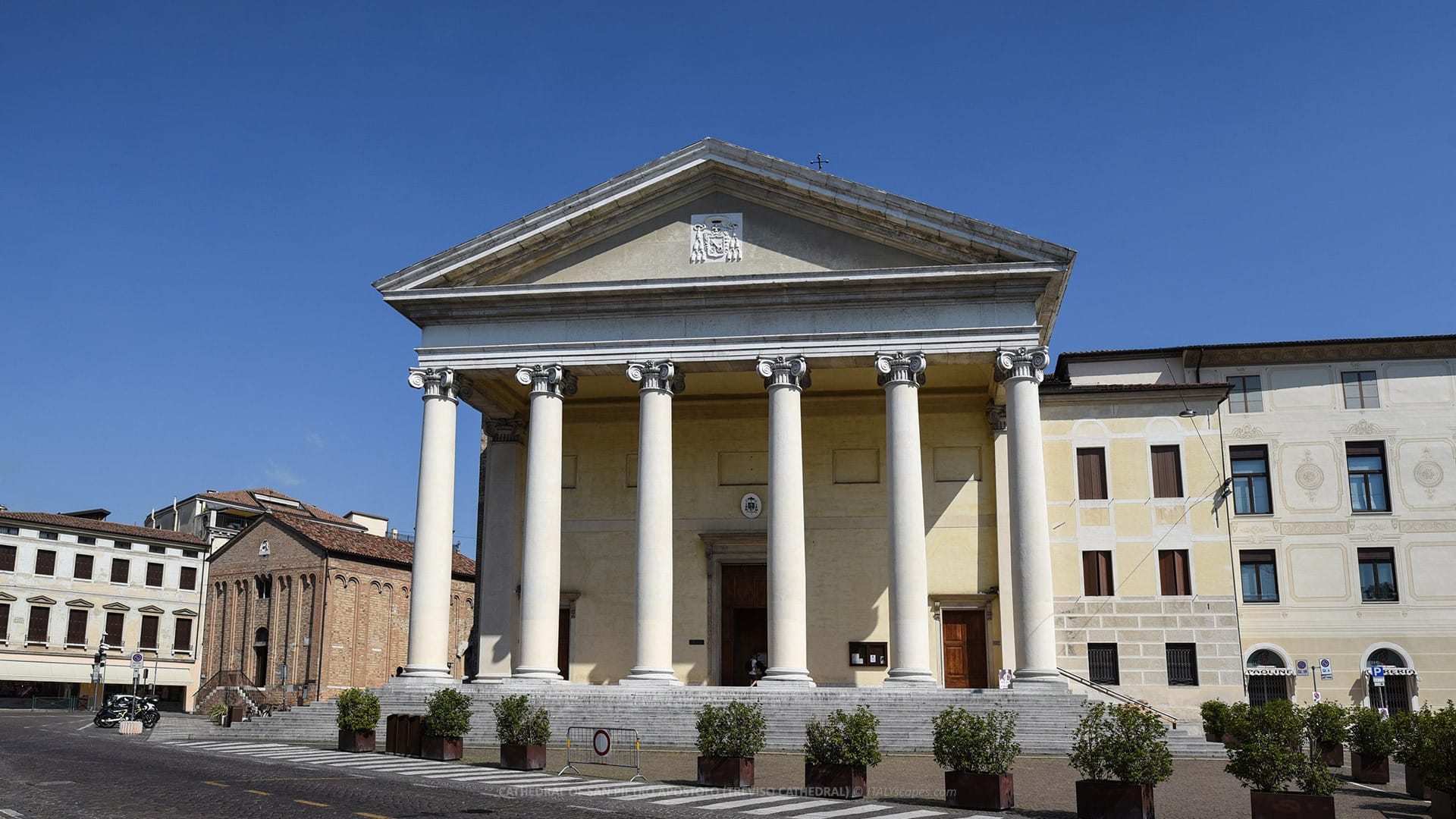
The façade of Treviso Cathedral overlooking Piazza del Duomo
Short History of the Cathedral of San Pietro Apostolo (Treviso Cathedral)
Early Christian Origins
The history of the Cathedral of San Pietro Apostolo begins in the early Christian period, probably between the 5th and 6th centuries. The first cathedral was built after Treviso became an episcopal seat, in a central area of the Roman city of Tarvisium, where older public buildings had previously existed.
The cathedral area was probably occupied in Roman times by important urban structures, including a temple, a theater, and possibly baths. This makes the site one of the most historically layered places in Treviso, where ancient Roman, early Christian, medieval, and modern structures overlap within the same religious complex.
Archaeological investigations carried out in the 20th century revealed ancient remains, including fragments of early Christian mosaic flooring. These discoveries confirm that the cathedral site was already used for Christian worship in the first centuries of the Middle Ages.
The Romanesque Cathedral
Between the 11th and 12th centuries, the early Christian cathedral was replaced or deeply transformed by a Romanesque building. This new cathedral had a basilican plan with three naves, a raised presbytery, a crypt underneath, and a façade with a large rose window and blind mullioned openings.
The Romanesque cathedral also had a porch with column-bearing lions. Two marble lions in red Verona marble survived from this medieval phase and were later placed beside the modern staircase. They are among the clearest visible reminders of the Romanesque cathedral that existed before the Neoclassical rebuilding.
The raised presbytery and the crypt were essential parts of the Romanesque structure. The crypt, still preserved today, was built under the presbytery and divided into irregular naves by many columns. Its survival allows visitors to understand how much of the medieval cathedral remains beneath the later church.
Renaissance Transformations
Between the end of the 15th century and the first decades of the 16th century, the cathedral underwent important Renaissance transformations. The old Romanesque presbytery was modified, and new chapels were added by artists and architects connected with the Lombardo family and the Venetian Renaissance.
Work began in 1481, when the Romanesque presbytery was demolished to create a new Renaissance presbytery. The main chapel, designed with a square plan, an apse, and a hemispherical dome, was dedicated in 1488 to the Immaculate Conception of Mary after a complex building campaign.
The side chapels were completed in the first half of the 16th century. The Chapel of the Blessed Sacrament was built between 1506 and 1513, while the Chapel of the Annunciation, later known as the Malchiostro Chapel, was built between 1518 and 1523.
The Neoclassical Rebuilding
In 1742, because of the poor condition of the old building, the Cathedral Chapter requested a major reconstruction project. A competition was organized, and the project was won by Giordano Riccati, who proposed rebuilding the naves while preserving and harmonizing the Renaissance presbytery area.
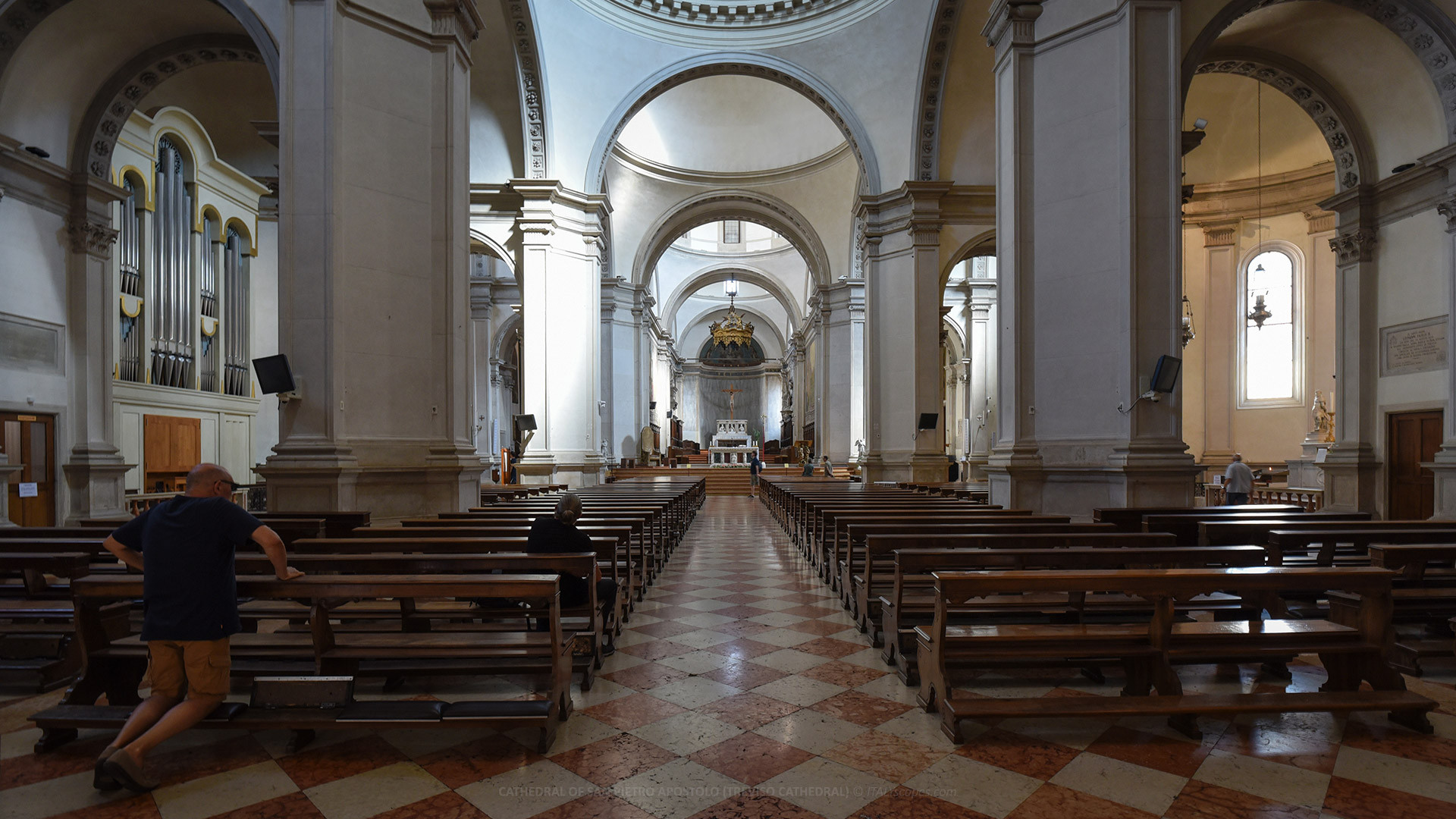
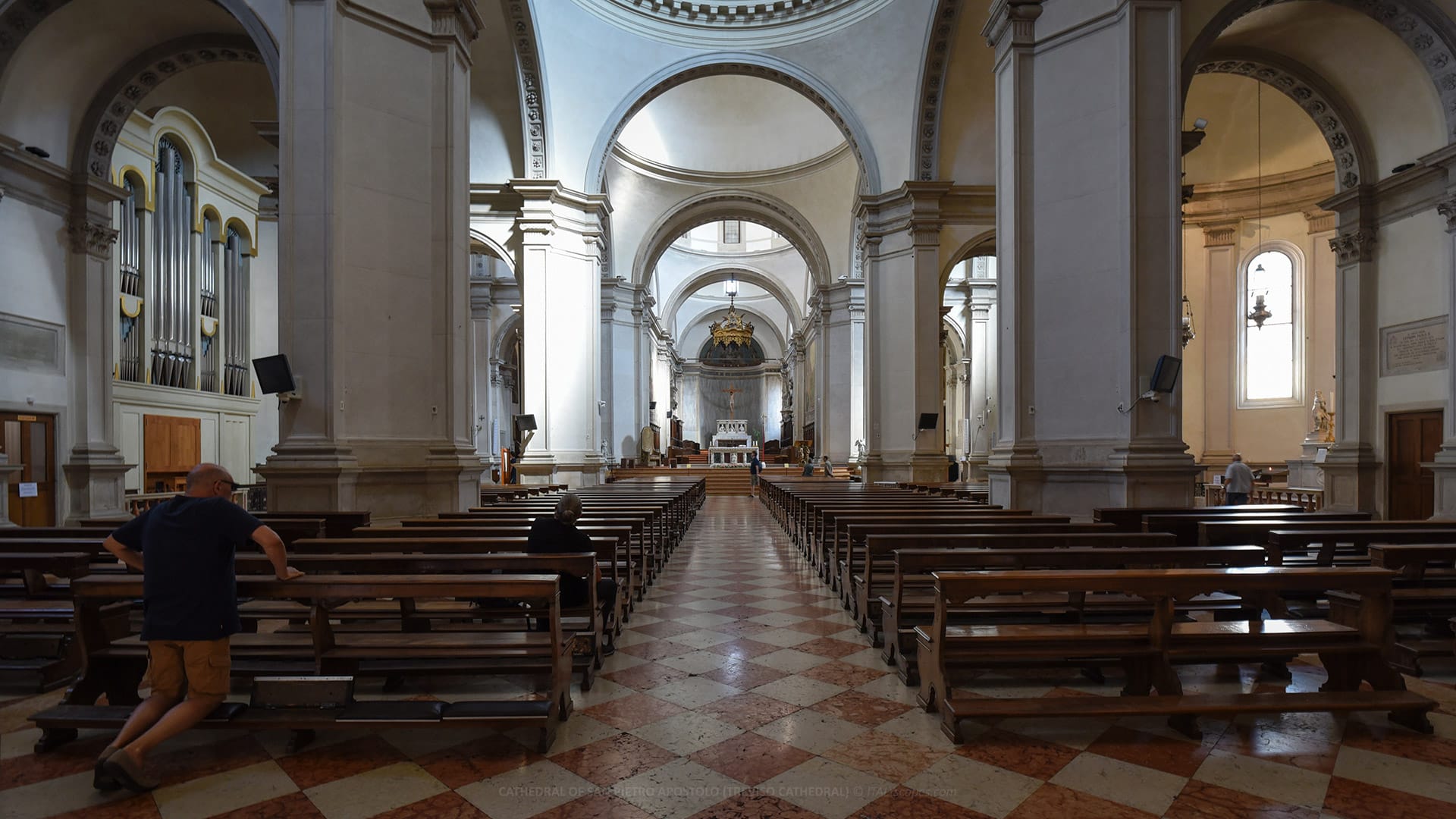
Construction work began in the second half of the 18th century. The old naves were demolished and replaced by a new Neoclassical hall. The rebuilt aula reached about 75 meters in length and 23 meters in width, giving the cathedral its broad and monumental interior space.
The rebuilding was not completed quickly. Work stopped in 1782, and the interior was later completed by Giannantonio Selva around 1790. The long process explains why the cathedral combines earlier Renaissance chapels with an 18th-century Neoclassical nave and a 19th-century façade.
The 19th and 20th Centuries
The present façade was completed between 1836 and 1848 by Francesco Bomben. This intervention gave Treviso Cathedral its current temple-like entrance, with a broad staircase, a triangular pediment, and six Ionic columns.
Further changes were made in the 19th and 20th centuries. The high altar, the choir area, the organs, and the presbytery furnishings were modified several times.
During the 20th century, restoration and structural works continued in different phases. The cathedral was affected by the history of modern Treviso, including wartime damage and later conservation. Today, it remains both a functioning cathedral and a monument that reflects more than fifteen centuries of religious history.
The central nave of the Cathedral of San Pietro Apostolo
Architecture of the Cathedral of San Pietro Apostolo (Treviso Cathedral)
The Neoclassical Façade
The architecture of the cathedral is dominated today by its Neoclassical façade. The entrance is preceded by a wide staircase that raises the building above Piazza del Duomo. At the top of the staircase, a large pronaos with six Ionic columns creates the appearance of an ancient classical temple.
The triangular pediment above the columns contains the coat of arms of the Cathedral Chapter. The façade is sober, symmetrical, and monumental, reflecting 19th-century Neoclassical taste. Its clean lines contrast with the more complex historical structure hidden behind it, where medieval and Renaissance elements survive.
At the sides of the staircase stand two medieval lions carved in red Verona marble. These sculptures belonged to the earlier Romanesque cathedral and were reused in the modern setting.
Domes and Exterior Structure
One of the most distinctive features of the Cathedral of San Pietro Apostolo is its group of seven domes. Five domes cover the central nave, while two others correspond to the chapels in the transept area. From nearby streets, the domes reveal the unusual internal structure of the cathedral.
The domes are especially visible from the area around Calmaggiore and Piazza del Duomo. They give the cathedral a profile different from many churches in Veneto, where bell towers and façades are usually more dominant.
The bell tower stands beside the cathedral complex, near the Baptistery of San Giovanni Battista. It is traditionally considered unfinished. According to local tradition, the tower was not completed to its intended height because Venetian authorities did not want it to compete with the bell tower of Saint Mark’s in Venice.
Interior Plan and Dimensions
The interior has three naves and a wide central space created during the 18th-century reconstruction. The rebuilt aula measures about 75 meters in length and 23 meters in width.
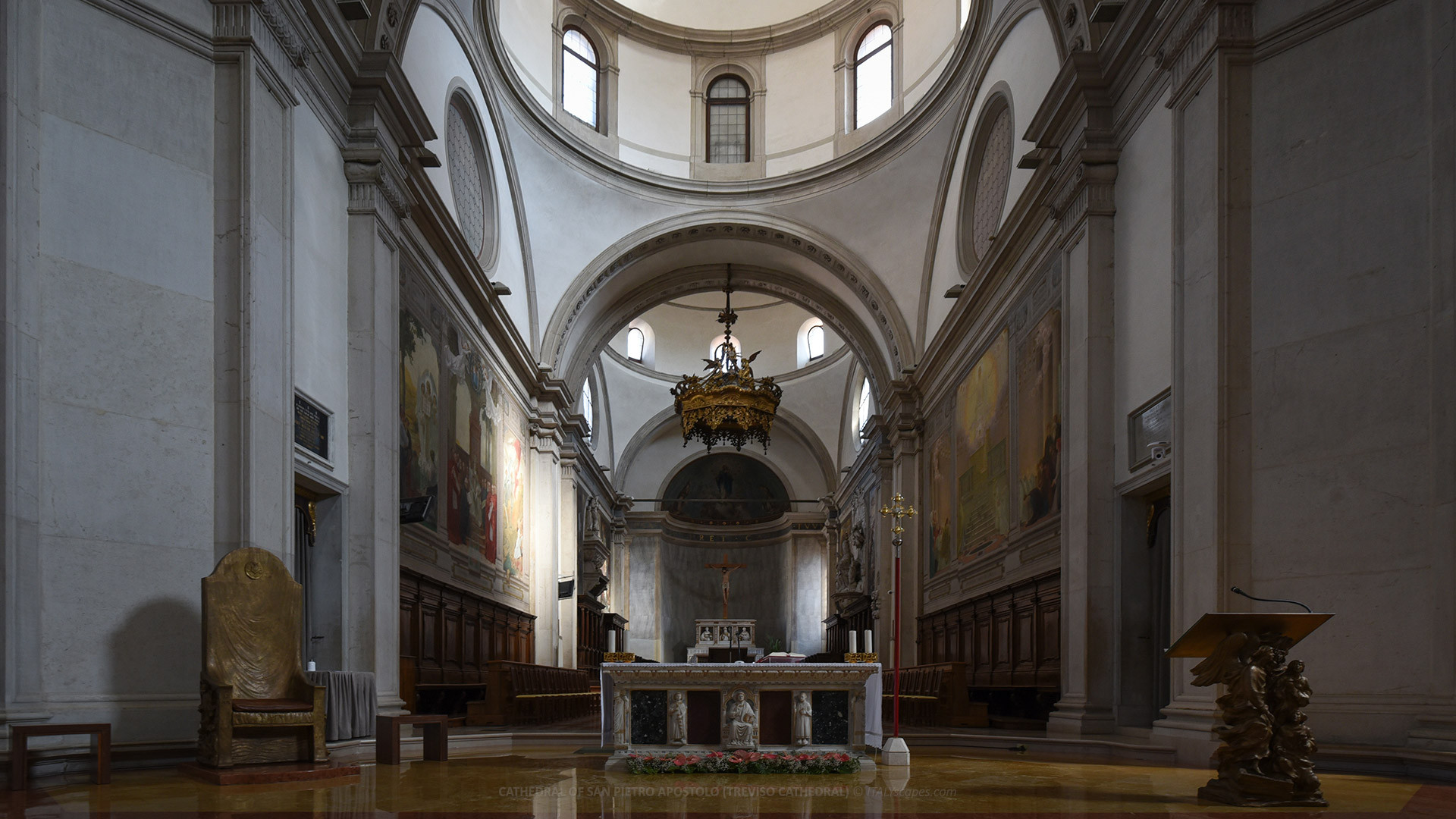
The naves lead toward a raised presbytery, which preserves the older spatial relationship between the upper church and the crypt below. This arrangement comes from the medieval cathedral and was maintained through later transformations.
The Crypt
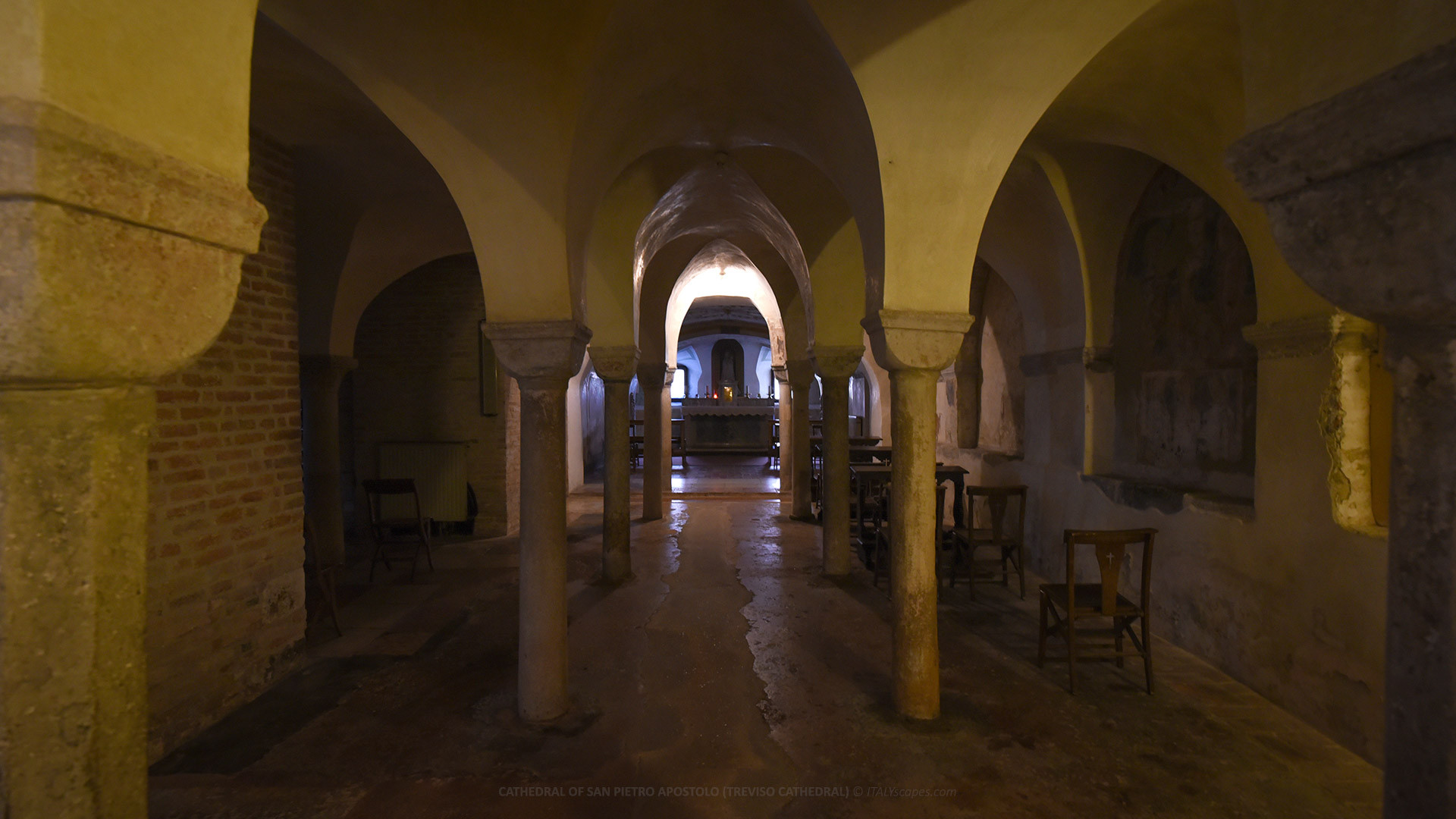
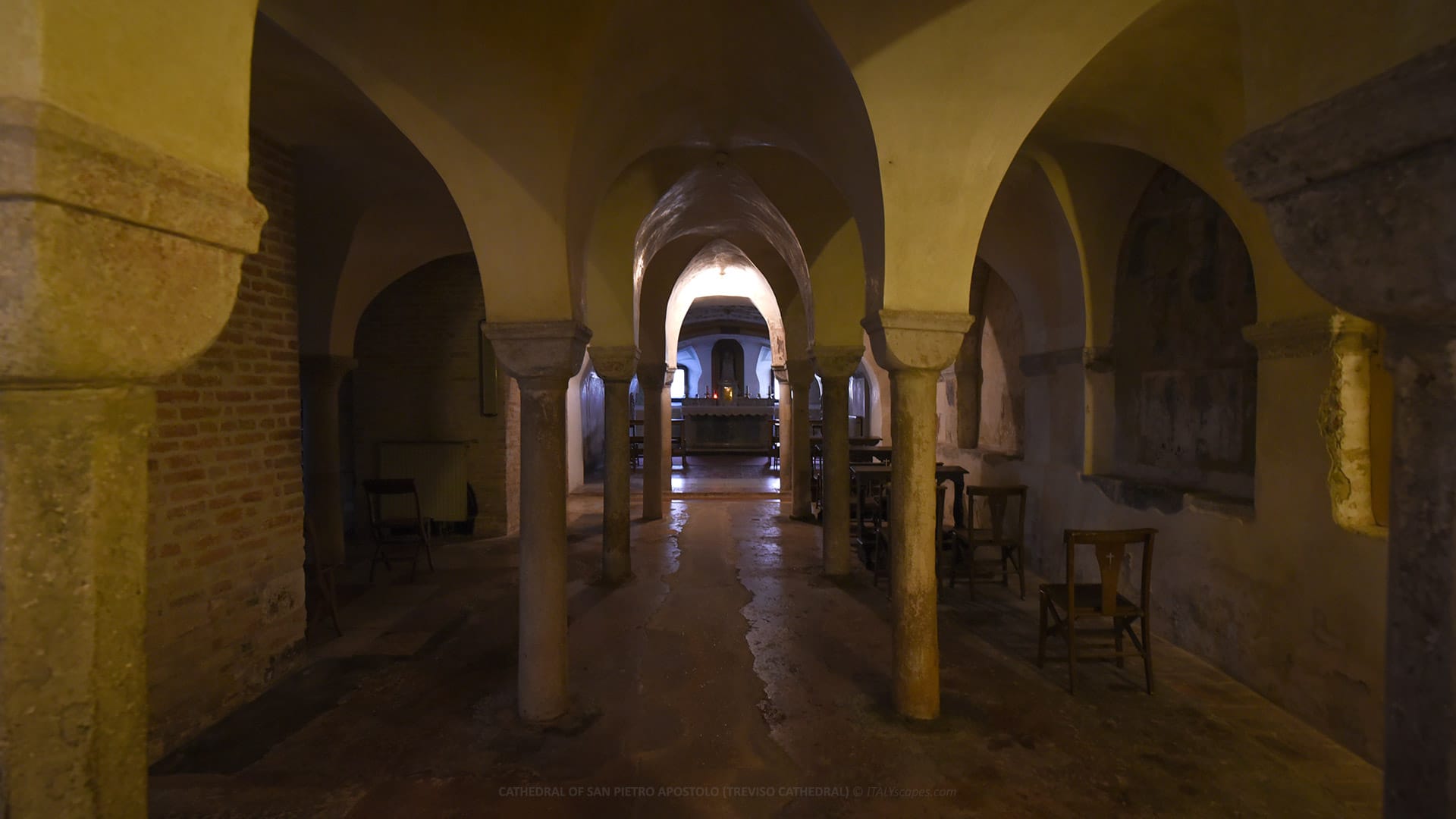
The crypt is the oldest and most important architectural space preserved inside the Treviso Cathedral. Located beneath the presbytery, it is divided into three irregular naves by 68 columns. The columns have different capitals, showing that the space was shaped and reshaped over several historical periods.
The irregular structure of the crypt is part of its historical value. It reflects medieval construction, later modifications, and the adaptation of older elements to new architectural needs. The space preserves a much older atmosphere than the upper church and offers a direct connection with the Romanesque cathedral.
The crypt contains the Ark of Saint Liberalis, the patron saint of Treviso. His relics make the crypt an important devotional space, not only an archaeological or architectural one. The area also preserves fragments of medieval frescoes and a valuable polychrome majolica floor with vegetal motifs.
The Baptistery and Cathedral Complex
The cathedral complex includes the adjacent Church of San Giovanni Battista, used as the baptistery. It stands near the cathedral and belongs to the same religious area. Unlike many early baptisteries with circular or central plans, this building has a rectangular layout with a single nave.
The baptistery was restored several times, especially after the earthquake of 1222, and again in later centuries. Its proximity to Treviso Cathedral shows the historical organization of the episcopal complex, where cathedral, baptistery, bell tower, canonries, and diocesan buildings formed a connected religious center.
The crypt of the Cathedral of San Pietro Apostolo
Art of the Cathedral of San Pietro Apostolo (Treviso Cathedral)
The Malchiostro Chapel
The most important artistic space in the Cathedral of San Pietro Apostolo is the Malchiostro Chapel, also called the Chapel of the Annunciation. It stands near the presbytery and sacristy, on the right side of the church, and was built during the Renaissance between 1518 and 1523.
The chapel was commissioned by Broccardo Malchiostro, secretary of Bishop Bernardo de’ Rossi. It was designed within the cultural atmosphere of early 16th-century Treviso, when Venetian Renaissance art strongly influenced architecture, painting, and sculpture.
The Malchiostro Chapel has a square plan and a dome, following Renaissance ideals of balance and proportion. Its importance comes from the collaboration of major artists, especially Titian and Il Pordenone.
Titian’s Annunciation
Titian’s Annunciation is the most famous artwork inside Treviso Cathedral. Painted around 1520, it was created for the Malchiostro Chapel and remains in its original religious context. The painting shows the Virgin Mary in the foreground, while the angel enters from the background through a dynamic architectural space.
The work is important because Titian changed the traditional composition of the Annunciation. Instead of placing the angel and Virgin in a simple symmetrical arrangement, he used movement, light, architecture, and depth to create a more dramatic scene. Broccardo Malchiostro appears as a small donor figure within the composition.
Il Pordenone’s Frescoes
Il Pordenone decorated the Malchiostro Chapel with an important fresco cycle. His works included scenes such as Adoration of the Magi, The Visitation, and The Dream of Augustus, together with saints, Doctors of the Church, and painted architectural illusions placed around the chapel walls and dome.
These frescoes are significant because they show the energetic style of Il Pordenone, one of the strongest painters active in the Veneto and Friuli areas during the early 16th century. His figures are powerful, dynamic, and monumental, contrasting with the calmer architectural order of the chapel.
Some parts of the fresco cycle were damaged during the bombing of Treviso in 1944. The image of God the Father in the dome was lost, and other sections were affected.
The Vestibule of the Malchiostro Chapel
Before entering the Malchiostro Chapel, visitors pass through a small raised vestibule containing several important works. These include paintings by Paris Bordone, Girolamo da Treviso the Elder, and Domenico Capriolo, which make this area an important Renaissance gallery within the cathedral.
Among the works in the vestibule are the Adoration of the Shepherds and the Altarpiece of Saint Lawrence by Paris Bordone. Another important painting is Madonna del Fiore by Girolamo da Treviso the Elder, dated 1487, which belongs to the earlier Renaissance phase of Treviso’s artistic history.
The vestibule also contains the funerary ark of Bishop Castellano Salomone, dated 1322. This medieval tomb is attributed to a Venetian artist influenced by Tuscan sculpture.
Presbytery and Funerary Monuments
The presbytery of Treviso Cathedral contains important works connected with the Renaissance and later periods. The apse includes the fresco of the Immaculate Conception by Antonio Beni. The area was historically shaped by Pietro Lombardo and his sons, who worked on the Renaissance transformation of the cathedral.
On the left wall of the presbytery area stands the monument of Bishop Giovanni Dacre, also known as Zanetto, dated 1486. Opposite it is the Baroque monument to Pope Alexander VIII Ottoboni, created by Giovanni Bonazza between 1689 and 1693, during the late 17th century.
Chapels and Other Artworks
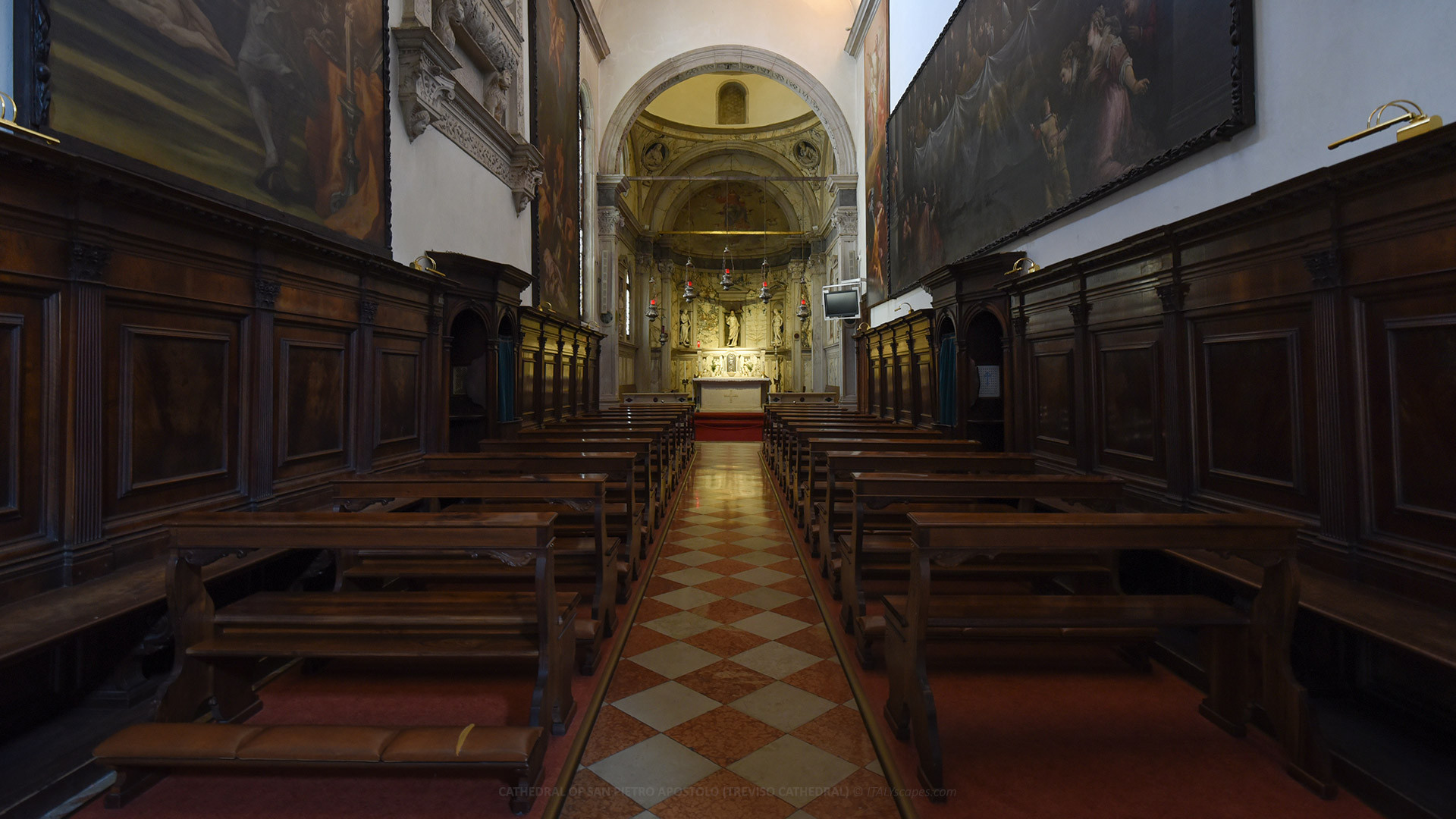
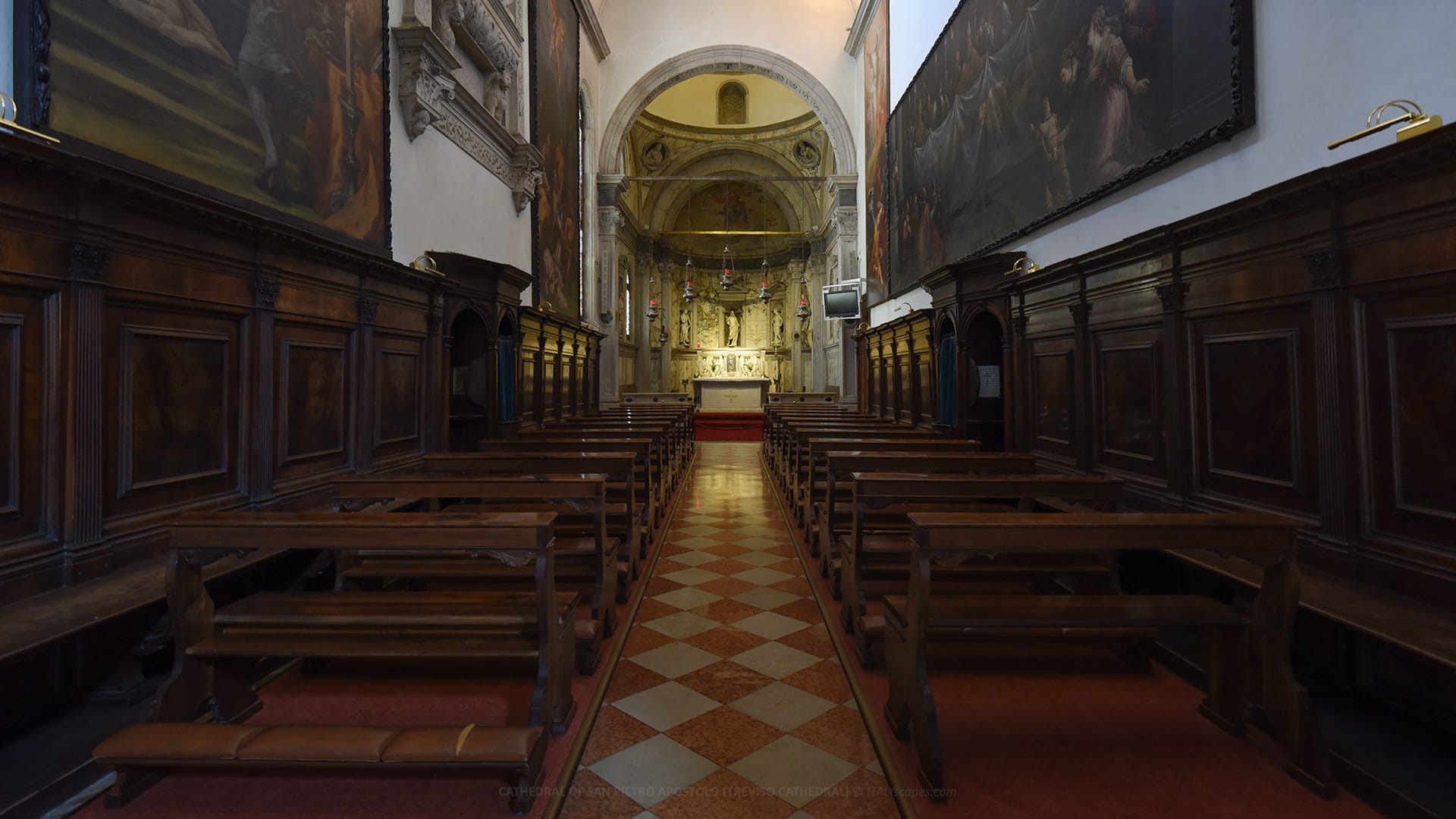
The Chapel of the Blessed Sacrament was built between 1506 and 1513 and contains important Renaissance and funerary elements. It is connected with Bishop Niccolò Franco, who played a role in the civic and religious history of Treviso and was associated with the foundation of the local Monte di Pietà.
The chapel also contains decoration by Pier Maria Pennacchi, including a Pantocrator fresco dated 1511.
In the nave and side chapels, visitors can find additional paintings, sculptures, and reliefs. These include a 1530 altarpiece by Francesco Bissolo, a Madonna and Child by Tommaso Lombardo, and a Visitation relief by Lorenzo Bregno.
The crypt also has artistic importance. Its medieval fresco fragments, varied capitals, relic shrine, and decorated floor make it more than an architectural survival. It is a devotional and artistic space where sculpture, painting, liturgy, and local identity are closely connected.
How to Get to the Cathedral of San Pietro Apostolo (Treviso Cathedral)
The Cathedral of San Pietro Apostolo is located in Piazza del Duomo, in the historic center of Treviso. The cathedral is close to Calmaggiore, the arcaded street that connects Piazza dei Signori with the cathedral area.
From the railway station, the cathedral can be reached on foot, by urban bus, or by taxi. The distance is short, because Treviso Centrale railway station stands just south of the historic center. The route enters the old town through Via Roma and Corso del Popolo.
Getting to the Cathedral of San Pietro Apostolo on foot
From Treviso Centrale railway station, the walking distance to Treviso Cathedral is approximately 1.1-1.3 kilometers. The walk usually takes about 15-18 minutes, depending on pace.
Exit the station and follow Via Roma north toward the city center. Cross the River Sile and continue straight along Corso del Popolo. This street leads into the commercial and historic heart of Treviso, passing toward Piazza Borsa and the streets around Piazza dei Signori.
From the area of Piazza dei Signori, continue along Calmaggiore, one of Treviso’s most characteristic central streets. Walk under the arcades until you reach Piazza del Duomo. The cathedral façade, with its staircase and six Ionic columns, stands at the end of this central route.
Getting to the Cathedral of San Pietro Apostolo by bus
From Treviso Centrale railway station, the most direct urban bus option is MOM line 11, because the route includes Stazione FS and P. Duomo. This makes it the clearest public transport connection between the railway station and the cathedral area.
MOM line 11 follows the route Padernello – Paese – Piazzale Pistoia – Stazione FS – P. Duomo – Piazzale Pistoia – Paese – Padernello. Visitors should board at or near the railway station and get off at Piazza Duomo, which is the closest stop to the cathedral.
Getting to the Cathedral of San Pietro Apostolo by taxi
A taxi from Treviso Centrale railway station to the Cathedral of San Pietro Apostolo is the fastest option, especially for travelers with luggage or limited time. The driving distance is roughly 1.2-1.5 kilometers, depending on traffic restrictions and the exact route used inside the center.
The taxi ride usually takes around 5-10 minutes in normal conditions. Because the cathedral stands in the historic center, the driver may stop directly in Piazza del Duomo or at a nearby permitted point. From there, the cathedral entrance is only a short walk away.
The Chapel of the Blessed Sacrament
Frequently Asked Questions about the Cathedral of San Pietro Apostolo
Where is the Cathedral of San Pietro Apostolo located?
Treviso Cathedral is located in Piazza del Duomo, in the historic center of Treviso. It stands close to Calmaggiore, Piazza dei Signori, and several important streets of the old town.
How old is the Cathedral of San Pietro Apostolo?
The origins of the cathedral go back to the early Christian period, probably between the 5th and 6th centuries. The present building includes medieval, Renaissance, Neoclassical, and modern phases.
How much does it cost to visit Treviso Cathedral?
Entry to the main cathedral is generally free. Visitors should still check current access conditions, because special events, guided visits, exhibitions, or restricted areas may follow different rules.
What is the most important artwork in Treviso Cathedral?
The most important artwork is Titian’s Annunciation in the Malchiostro Chapel. Painted around 1520, it is one of the cathedral’s greatest Renaissance masterpieces and a major attraction in Treviso.
What is the Malchiostro Chapel?
The Malchiostro Chapel is a Renaissance chapel inside Treviso Cathedral. It was built in the early 16th century and decorated with works by Titian and Il Pordenone.
How far is Treviso Cathedral from the railway station?
Treviso Cathedral is about 1.1 to 1.3 kilometers from Treviso Centrale railway station. The walk usually takes around 15 to 18 minutes through the historic center.
Sources: -
Photos
-
Map
-
Reviews