-
About
Table of Contents
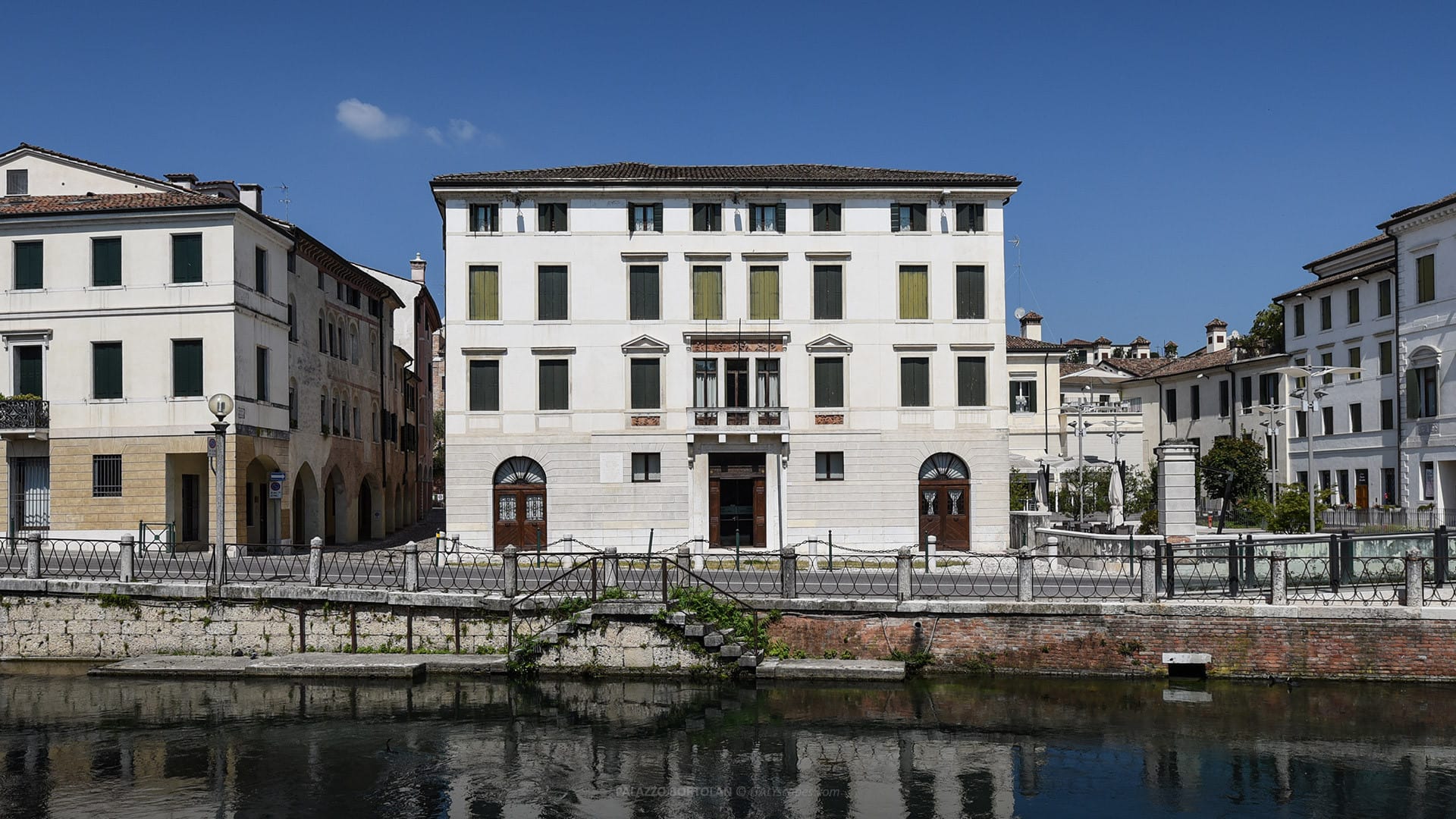
Palazzo Bortolan is one of the most distinctive historic buildings in the center of Treviso, standing between the refined urban fabric of the old town and the river landscape of the Sile. The palace is located in the area of Riviera Garibaldi and Piazza dell’Università.
Also known as Palazzo dell’Umanesimo Latino, the building belongs to the historic complex of San Leonardo, an area closely linked today with Treviso’s university district. Its position makes it part of the Quartiere Latino, one of the most important urban recovery projects carried out in the modern history of the city.
The palace has 16th-century origins, but its present appearance is largely the result of a major Neoclassical transformation completed in the early 19th century.
Today, Palazzo Bortolan is connected with cultural, educational, conference, and hospitality functions. Its upper floors host Le Camere di Palazzo Bortolan, an accommodation structure with seven rooms and a three-room apartment, allowing guests to stay inside a restored historic palace in central Treviso.
Short History of Palazzo Bortolan
Origins and the Bortolan Transformation
The original building dates back to the 16th century, when this part of Treviso was already connected with the Sile River and the nearby religious and civic structures of San Leonardo. The palace later became one of the most visible buildings along this riverfront section of the historic center.
A decisive change came in 1806, when the property was acquired by Giacomo Bortolan, an important local industrialist. Bortolan was the founder of the well-known mechanical foundry in Santa Maria del Rovere, a northern area of Treviso that became connected with manufacturing and industrial activity.
After the acquisition, the old palace was radically transformed between 1807 and 1823. These works gave the building its Neoclassical character, replacing or reshaping much of the earlier appearance. Historical tradition attributes the project itself to Giacomo Bortolan, although the building preserves traces of different phases.
The transformation reflected the architectural taste of the period. The façade became more regular, ordered, and monumental, while the interiors were enriched with artistic decorations.
Public Functions and the Hospital Period
During the period of the Kingdom of Lombardy-Venetia, Palazzo Bortolan acquired an institutional role. The building housed the Office of Public Works, confirming that it was not only a private residence, but also a functional administrative space within the city.
In 1877, the palace was purchased by the local hospital administration. Its rooms and internal organization were adapted to public and administrative needs.
Before the major restoration of the early 2000s, the ground floor of the palace was used by the Hospital Pharmacy, while the upper floors housed the General Administration of the institution. This practical use preserved the building’s role but did not fully protect its artistic and architectural value.
By the 20th century, parts of the building required conservation. In 1935, restoration and modification works affected the façade. During these works, the best-preserved decorative fragments were detached and taken to the Civic Museum of Treviso.
Restoration and the Quartiere Latino
The most important modern intervention took place in 2000-2001, when the palace was restored as part of the wider recovery of the San Leonardo area. The project was promoted by Fondazione Cassamarca and inserted Palazzo Bortolan into the renewed urban context later known as Quartiere Latino.
The restoration was designed by Paolo Portoghesi, one of the most influential Italian architects of the late 20th century.
The recovered palace was equipped with three large rooms suitable for teaching or conferences, several offices, and a prestigious hall for cultural events. On the top floor, a guest area was created.
Architecture and Art of Palazzo Bortolan
Exterior of Palazzo Bortolan
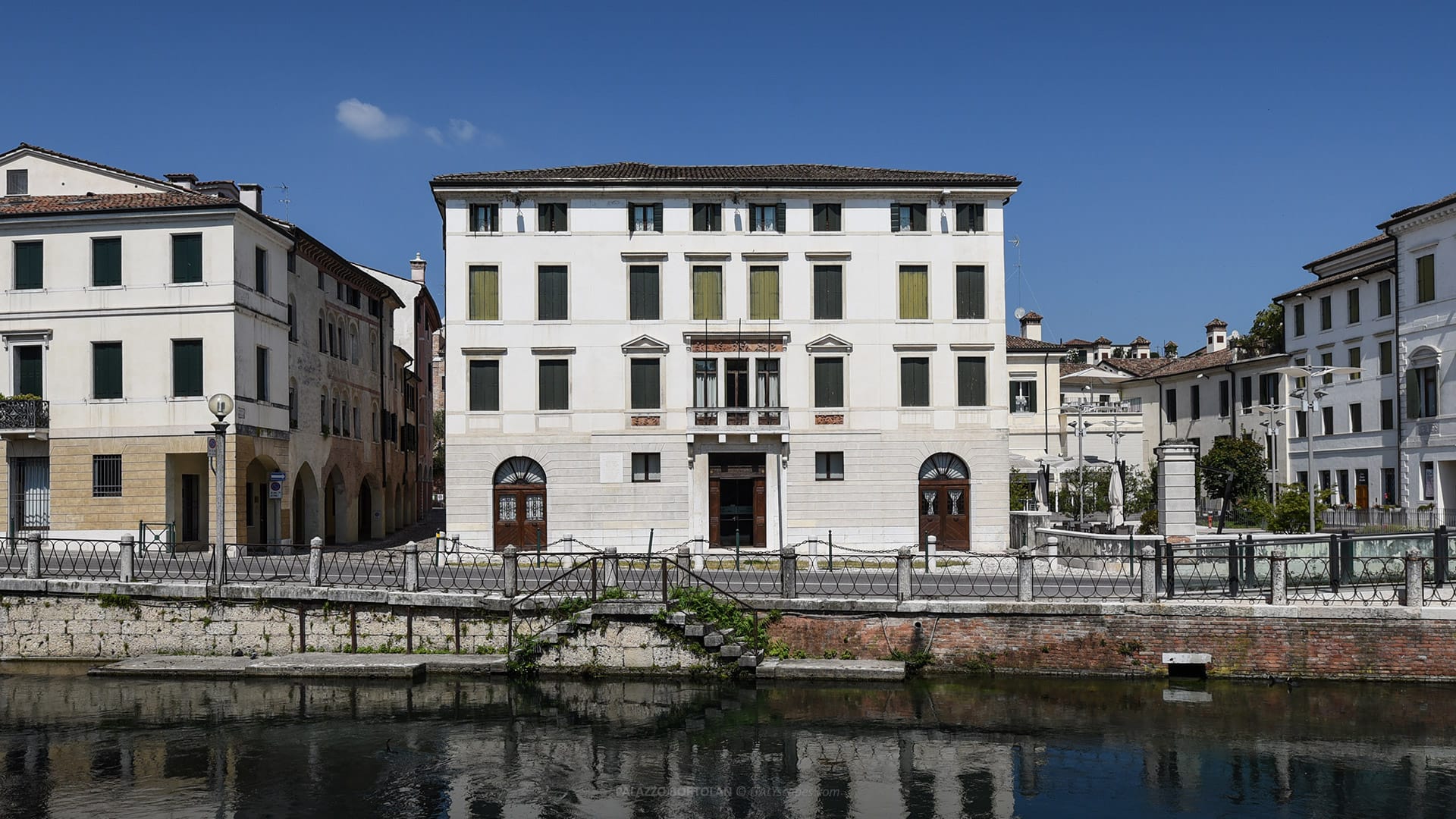
Architecturally, Palazzo Bortolan is a refined example of Neoclassical design in Treviso. Its white façade is regular, symmetrical, and sober, following the classical taste that spread across northern Italy in the late 18th and early 19th centuries.
The façade is one of the most recognizable elements of the palace. It presents balanced proportions, simple wall surfaces, and decorative restraint. The façade is also decorated with terracotta bas-reliefs attributed to Luigi Zandomeneghi.
One of its most important exterior features is the Istrian stone balcony, accessible from a three-light window.
Interior Decorations
Inside, Palazzo Bortolan preserves a more decorative character than its exterior suggests. The rooms contain wooden ceilings, frescoes, stuccoes, paintings, and reliefs, reflecting the taste of the families and institutions that shaped the palace across different historical periods.
One room is enriched by three plaster bas-reliefs created by Marco Casagrande in 1827. These works represent Hector and Andromache, Paolo and Francesca, and Olindo and Sofronia. The palace also preserves frescoes by Giovanni Demin and paintings by Pietro Paoletti.
On the first floor, smaller frescoed rooms include scenes from classical and mythological repertories. The walls show subjects such as the Killing of Caesar and the Farewell of Attilius Regulus, while the ceiling includes Venus, Adonis, and Cupid.
Other decorations above the doors include monochrome battle scenes, such as Amazonomachy, Tauromachy, and Centauromachy.
Modern Elements After the Restoration
The restoration by Paolo Portoghesi did not simply preserve the historic fabric. It also introduced contemporary elements designed to connect the different floors and historical phases of the palace.
The most important of these is the modern monumental staircase known as Albero della Conoscenza. This staircase, whose name means “Tree of Knowledge”, was conceived as a modern architectural connector inside the restored building.
Portoghesi also designed interior elements such as sofas, lamps, and fabrics, later produced by important Italian companies.
Le Camere di Palazzo Bortolan
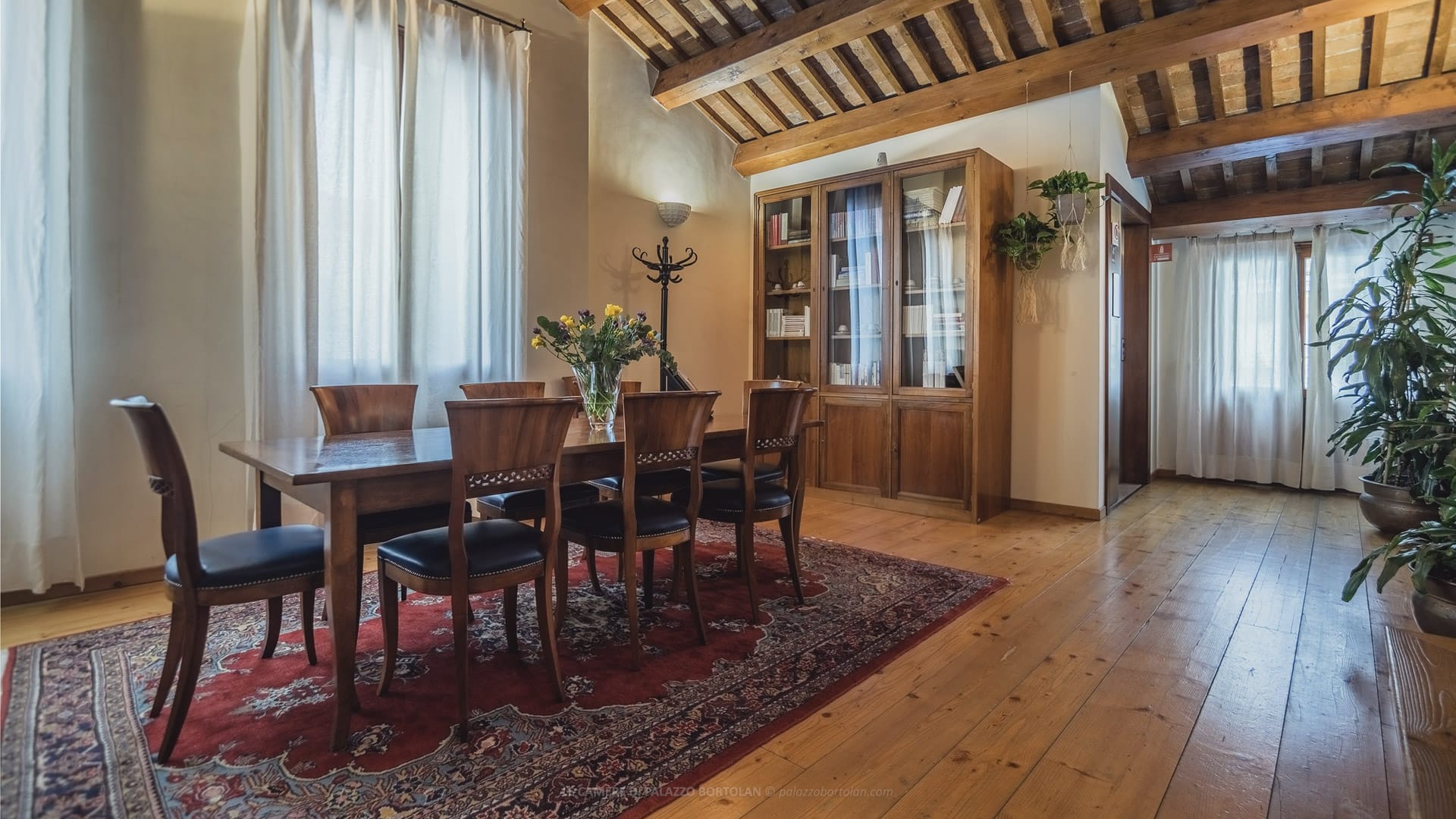
One of the most interesting aspects of Palazzo Bortolan today is the possibility of staying inside the building. Le Camere di Palazzo Bortolan occupies the upper floor of the historic palace and offers accommodation in a setting that preserves frescoes, stuccoes, and historic architectural details.
The structure includes seven spacious rooms and one three-room apartment. The rooms are designed for short stays in Treviso, while the apartment offers a more independent solution for guests who need additional space, a kitchenette, or a more traditional residential arrangement.
The accommodation provides free Wi-Fi in the rooms and common spaces. The building also includes elegant shared areas and access to a panoramic terrace, which can be used for private events, according to the structure’s internal organization and availability.
On the ground floor, the Caffè Letterario operates in the setting of Piazza dell’Università. It serves breakfast for guests and also offers quick lunches, snacks, aperitifs, toast, sandwiches, piadine, and fresh drinks. On request, it can organize refreshments for private occasions.
Le Camere di Palazzo Bortolan
How to Get to Palazzo Bortolan
Palazzo Bortolan is located in central Treviso, between Riviera Garibaldi 13 and Piazza dell’Università 5. The building faces the Sile River and is close to Ponte Dante, Loggia dei Cavalieri, Buranelli Canal, and the main walking routes of the historic center.
Its location is practical for visitors arriving by train, bus, taxi, or from Treviso Airport. Treviso Centrale railway station is close enough to reach on foot, while the city’s compact scale makes Palazzo Bortolan easy to include in a walking itinerary through the old town.
Getting to Palazzo Bortolan on foot
From Treviso Centrale railway station, Palazzo Bortolan is about 750-900 meters away, depending on the chosen route. The walk usually takes around 9 to 12 minutes, making walking the simplest option for visitors arriving with light luggage.
The route from the station crosses the southern part of the historic center and leads toward the Sile River. It offers a quick introduction to Treviso’s canals, bridges, and compact urban layout, especially around Via Roma, the university area, and the riverfront near Riviera Garibaldi.
Getting to Palazzo Bortolan by bus
From Treviso Centrale, the most useful urban bus options are MOM line 1 and, when operating on the relevant route, MOM line 7. Both connect the railway station area with the central route through Piazza Matteotti, which is within walking distance of Palazzo Bortolan.
Line 1 follows the route Ospedale – Stazione FS – Piazza Matteotti – Santa Maria del Rovere – Sant’Artemio – Carità – Catena – Villorba. Line 7 connects the station area with Piazza Matteotti, Sant’Artemio, San Lazzaro, and San Zeno, depending on direction and timetable.
Getting to Palazzo Bortolan by taxi
Taxis are available outside Treviso Centrale railway station. From the station to Palazzo Bortolan, the ride usually takes only a few minutes, depending on traffic and the exact drop-off point near Piazza dell’Università or Riviera Garibaldi.
A taxi is the most practical option for travelers with heavy luggage, limited mobility, or late arrivals. Because Palazzo Bortolan stands inside the historic center, the driver may stop at the most convenient accessible point close to the building rather than directly in front of every entrance.
Frequently Asked Questions about Palazzo Bortolan
Where is Palazzo Bortolan located?
Palazzo Bortolan is located in the historic center of Treviso, between Riviera Garibaldi and Piazza dell’Università, close to the Sile River and the city’s university district.
When was Palazzo Bortolan built?
The building has 16th-century origins, but its current Neoclassical appearance mainly dates from the early 19th century, after major works carried out between 1807 and 1823.
Who restored Palazzo Bortolan?
The modern restoration of Palazzo Bortolan was led by Paolo Portoghesi between 2000 and 2001, as part of the wider recovery project of Treviso’s San Leonardo area.
Can you visit Palazzo Bortolan inside?
Palazzo Bortolan is not a traditional museum. Some interior spaces are used for cultural, conference, educational, and hospitality purposes, while guests can stay inside through Le Camere di Palazzo Bortolan.
How far is Palazzo Bortolan from Treviso Centrale station?
Palazzo Bortolan is about 750-900 meters from Treviso Centrale railway station. The walk usually takes around 9 to 12 minutes, depending on the chosen route.
Sources: -
Photos
-
Map
-
Reviews