-
About
Table of Contents
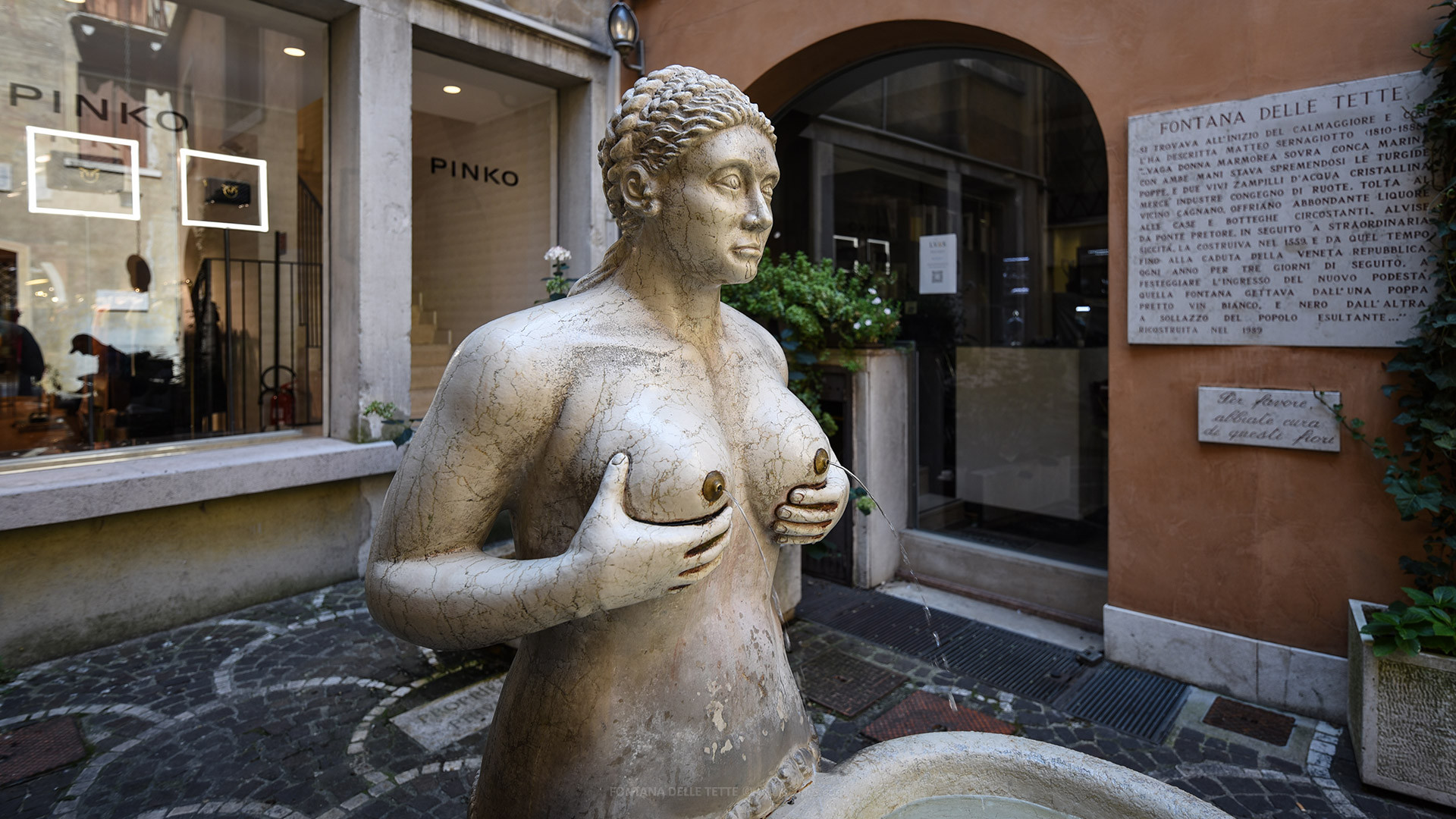
Fontana delle Tette is one of the most unusual public monuments in Treviso. The fountain is located in the historic center, close to Piazza dei Signori, Calmaggiore, and Calle del Podestà, in one of the most visited areas of the city.
The name is usually translated into English as the Fountain of Tits or Fountain of Breasts. The monument depicts a bare-breasted female figure whose breasts release water into a basin. Its appearance is striking, but its historical meaning is linked to civic celebration, Venetian rule, and public ritual.
The fountain visible today in the courtyard of Palazzo Zignoli is not the original sixteenth-century sculpture. It is a 1989 reconstruction of the historic fountain, created to bring back into public view one of Treviso’s best-known civic symbols.
The authentic sculpture is kept under the portico of Palazzo dei Trecento, one of the most important medieval buildings in Treviso.
Short History of Fontana delle Tette
Origins Under Venetian Rule
The history of Fontana delle Tette begins in 1559, when Treviso was under the control of the Republic of Venice. At that time, the city was governed through Venetian institutions, including the office of the podestà, the official who represented Venetian authority in the local administration.
The fountain was commissioned by Alvise Da Ponte, who was podestà of Treviso in the sixteenth century. Its construction followed a severe drought that affected the city and the surrounding countryside, making the monument closely connected to water, civic welfare, and public utility.
Originally, the statue was placed inside the Palazzo Pretorio, in the area of Via Calmaggiore, one of the central streets of Treviso.
The Wine Ritual
The fountain became famous because, during the period of Venetian rule, it did not serve only as an ordinary water fountain. On special civic occasions, especially the arrival or celebration of a new podestà, the fountain was used to distribute wine to the citizens of Treviso.
For three consecutive days, wine flowed from the breasts of the female figure. One breast released white wine, while the other released red wine. Citizens could drink the wine freely, turning the fountain into a public instrument of celebration and civic participation.
This ritual continued until 1797, the year that marked the fall of the Republic of Venice.
Removal, Recovery, and Reconstruction
After the fall of the Republic of Venice in 1797, the fountain lost its original ceremonial role. It was later dismantled, and its memory gradually faded. The surviving sculpture was eventually recovered by Abbot Luigi Bailo, an important figure in the preservation of Treviso’s cultural heritage.
After its recovery, the original fountain was placed in the Museo Casa da Noal. Later, for conservation reasons, the surviving original was moved to a protected display under the portico of Palazzo dei Trecento, where it can be viewed today.
The fountain that visitors usually photograph in the historic center is the 1989 copy. This reconstruction was made by the Peruvian sculptor Miguel Miranda Quinones, with the support of a private initiative.
The copy was placed in the courtyard of Palazzo Zignoli, accessible from the gallery that connects Calmaggiore with Piazzetta della Torre and Calle del Podestà.
Description of Fontana delle Tette
Urban Position
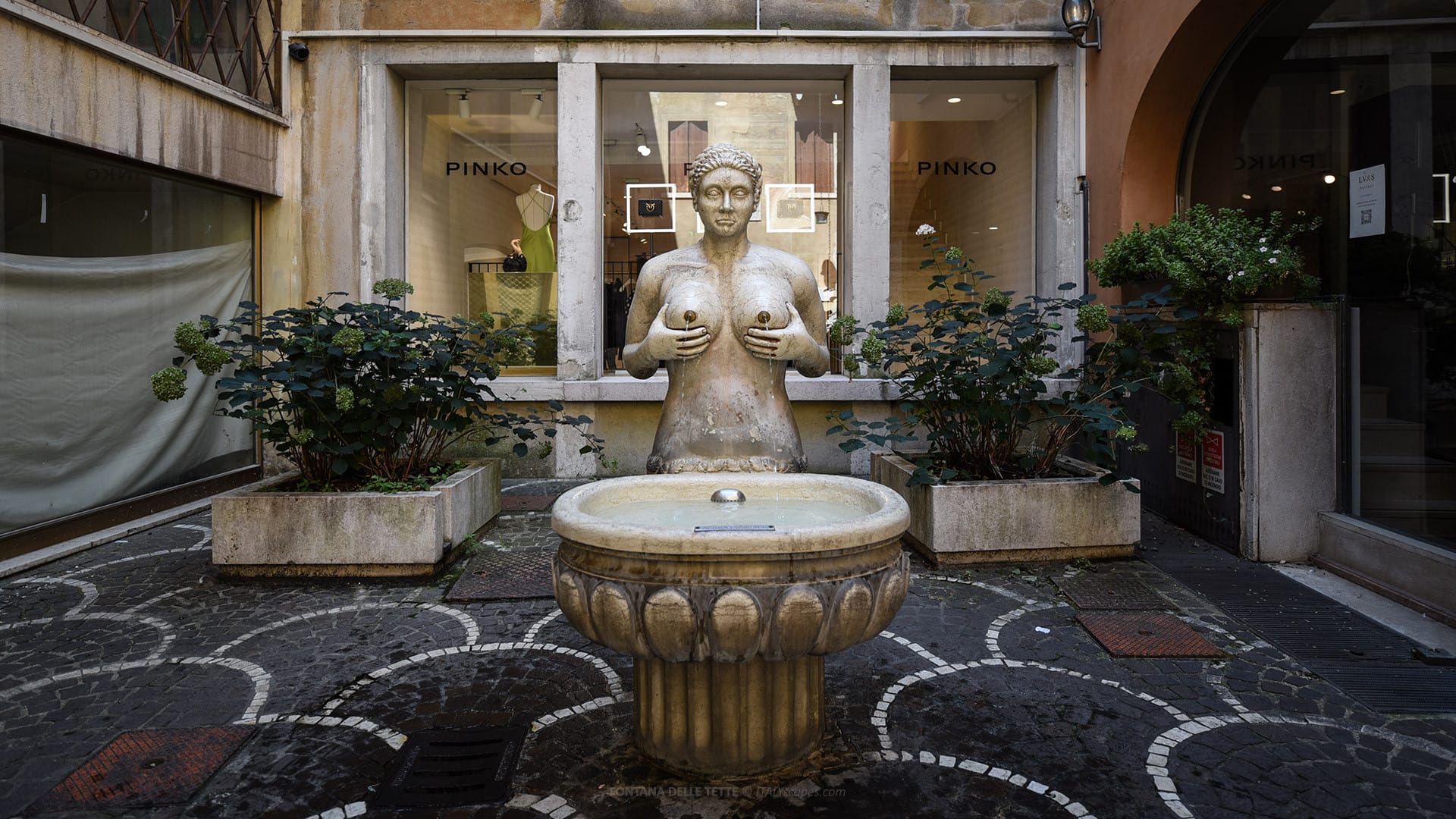
The modern Fontana delle Tette in Palazzo Zignoli is placed in a small courtyard, slightly hidden from the busiest pedestrian routes. This makes the fountain feel like a local discovery, even though it is located only a short walk from Treviso’s central square.
Near the modern copy, a plaque recalls the history of the fountain and refers to the nineteenth-century description by Matteo Sernagiotto, who lived between 1810 and 1888.
The Female Figure
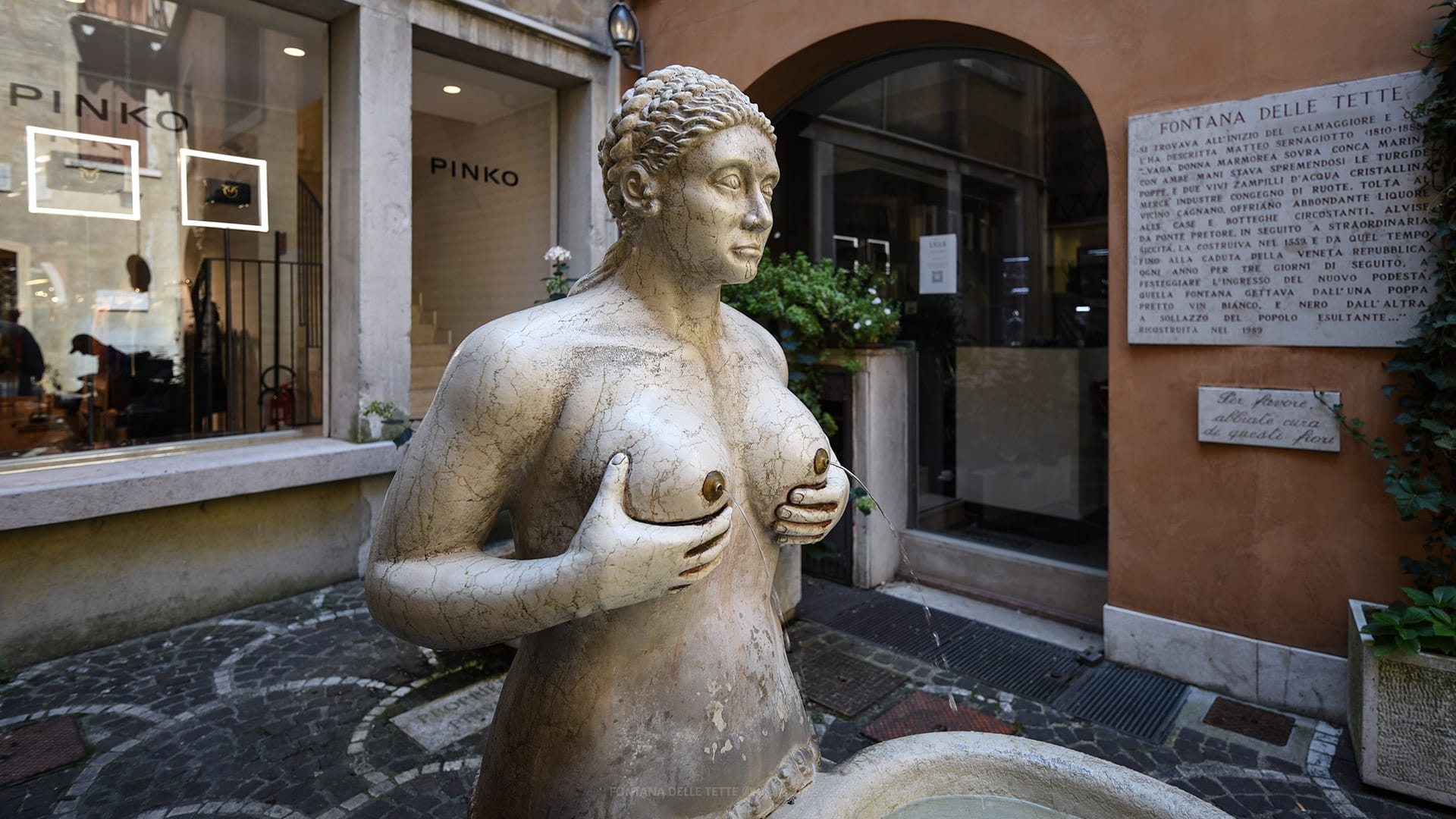
The modern fountain represents a female figure shown from the waist upward. The figure is bare-breasted and holds her breasts with both hands. Water flows from the nipples into the basin below, reproducing the defining visual feature of the historical fountain.
The facial expression is calm and neutral. The sculpture does not rely on dramatic movement or complex decoration. Its visual impact comes from the directness of the gesture and from the unusual way in which the body becomes part of the fountain’s function.
The Original Sculpture
The original Fontana delle Tette was made of Istrian stone, a material widely used in the Venetian world. The surviving original measures approximately 60 centimeters high, 57 centimeters wide, and 35 centimeters deep, confirming that the historic figure was relatively small but highly recognizable.
How to Get to Fontana delle Tette
Fontana delle Tette is located in the historic center of Treviso, in the courtyard of Palazzo Zignoli, near Calle del Podestà. The fountain is very close to Calmaggiore, Treviso’s central pedestrian street, and to Piazza dei Signori, the main square of the old town.
Getting to Fontana delle Tette on foot
Fontana delle Tette is approximately 1 kilometer from Treviso Centrale railway station. The walk usually takes around 12 minutes, depending on pace and the chosen route through the historic center.
From Treviso Centrale, visitors can walk toward the city center, crossing into the old town and continuing toward Piazza dei Signori. From there, it is only a short distance to Calmaggiore, Piazzetta della Torre, and Calle del Podestà.
Walking is the best option for most visitors. Treviso’s center is compact, and the route from the station passes close to canals, porticoes, and historic streets.
Getting to Fontana delle Tette by bus
Treviso’s urban bus service is operated by Mobilità di Marca, commonly known as MOM. Several urban lines connect the railway station with central areas of the city, including routes that pass through or near Piazza Matteotti and other stops close to the historic center.
Among the useful urban routes are Line 1 and Line 7, both of which serve Treviso Stazione FS and central stops. From the nearest central stop, visitors can continue on foot toward Piazza dei Signori, Calmaggiore, and Calle del Podestà.
Getting to Fontana delle Tette by Taxi
Taxis are available outside Treviso Centrale railway station and can take visitors close to the historic center. The journey is short and usually lasts under 10 minutes, depending on traffic and access restrictions in the central pedestrian area.
Because Fontana delle Tette is located in a compact historic zone, taxis may not stop directly beside the courtyard. In most cases, visitors will be dropped near Piazza dei Signori, Calmaggiore, or another accessible point, then continue on foot for a few minutes.
Frequently Asked Questions About Fontana delle Tette
What is Fontana delle Tette?
Fontana delle Tette is a historic fountain in Treviso, showing a female figure whose breasts release water. It recalls a sixteenth-century civic ritual from the Venetian period.
Where is Fontana delle Tette located?
Fontana delle Tette is located in the historic center of Treviso, inside the courtyard of Palazzo Zignoli, near Calmaggiore, Calle del Podestà, and Piazza dei Signori.
Is the fountain visible today the original one?
No. The fountain visible today is a 1989 copy. The original sixteenth-century sculpture is preserved under the portico of Palazzo dei Trecento for protection.
When was the original Fontana delle Tette built?
The original Fontana delle Tette was built in 1559, during the period when Treviso was governed by the Republic of Venice through its local officials.
Did Fontana delle Tette really dispense wine?
Yes. During special civic celebrations, the fountain dispensed red wine from one breast and white wine from the other for three consecutive days.
How far is Fontana delle Tette from Treviso Centrale?
Fontana delle Tette is about 1 kilometer from Treviso Centrale railway station. The walk usually takes around 12 minutes through Treviso’s compact historic center.
Is Fontana delle Tette free to visit?
Yes. Fontana delle Tette can be visited for free. The modern copy is accessible in a central courtyard, while the original can be seen under Palazzo dei Trecento.
Sources: -
Photos
-
Map
-
Reviews