


-
About
Table of Contents
Buy tickets & tours:GetYourGuideThe Cathedral of San Pietro Apostolo, also known as Mantua Cathedral or Duomo di Mantova in Italian, is the principal Catholic church of Mantua. Dedicated to Saint Peter the Apostle, the cathedral serves as the seat of the Bishop of Mantua and the mother church of the diocese.
The Cathedral of San Pietro Apostolo stands on the northern side of Piazza Sordello, the monumental square at the center of medieval Mantua. The square also contains buildings associated with the Gonzaga dynasty, including Palazzo Ducale, while the Basilica of Sant’Andrea, another important religious monument, is located within walking distance.
Mantua Cathedral preserves architectural and artistic elements from several centuries, including a Romanesque bell tower, surviving Gothic structures, a substantially reconstructed Renaissance interior, and an eighteenth-century marble facade. The building’s successive transformations reflect the changing political, religious, and artistic circumstances of Mantua, particularly during the centuries of Gonzaga rule.

The Baroque facade of Mantua Cathedral overlooking Piazza Sordello.
Short History of the Cathedral of San Pietro Apostolo (Mantua Cathedral)
Early Christian Origins and Medieval Reconstruction
The origins of the Cathedral of San Pietro Apostolo date to the Early Christian period, although the precise circumstances of its foundation are not securely documented. Historical traditions associate the area with two early churches dedicated to Saints Peter and Paul, which formed part of the developing Christian community of Mantua.
A major fire destroyed the earlier church in 894, necessitating its reconstruction. The building was subsequently restored in an early Romanesque form. By the late eleventh century, Mantua Cathedral had become an important religious institution, as demonstrated by the burial of Saint Anselm of Lucca there in 1086.
A further rebuilding campaign began in 1132, during the episcopate of Bishop Manfredo. The works produced a substantially reconstructed Romanesque cathedral, completed before 1150. The medieval building included a nave arrangement and a crypt, while portions of its masonry survived subsequent transformations and became incorporated into later construction phases.
The Gonzaga Dynasty and the Gothic Cathedral
An important new chapter began in 1395, when Francesco I Gonzaga ordered the reconstruction and enlargement of the Cathedral of San Pietro Apostolo. The initiative was associated with the birth of his firstborn son and formed part of the architectural development of Mantua under the Gonzaga family.
The project, carried out between 1395 and 1401, involved the Venetian sculptors and architects Jacobello and Pierpaolo dalle Masegne. Their intervention gave Mantua Cathedral an elaborate Gothic appearance, incorporating decorative pinnacles, pointed architectural features, and marble and terracotta elements characteristic of northern Italian construction.
The medieval facade created during this period no longer exists, but its appearance is documented in Domenico Morone’s painting La cacciata dei Bonacolsi, dated 1494 and preserved in Palazzo Ducale. The composition depicts the cathedral with its earlier entrance porch, rose windows, and decorative pinnacles.
The Renovation by Giulio Romano
In 1545, following another fire, Cardinal Ercole Gonzaga commissioned a major reconstruction of the Cathedral of San Pietro Apostolo. The project was entrusted to Giulio Romano, the architect and painter who had previously worked with Raphael in Rome and had become a leading artistic figure at the Gonzaga court.
Giulio Romano retained the existing exterior perimeter and medieval facade but radically reorganized the internal space. His design for Mantua Cathedral drew inspiration from the arrangement of the ancient Saint Peter’s Basilica in Rome, before the construction of the present Vatican basilica transformed the original church.
Giulio Romano died in 1546, shortly after the reconstruction had begun. The project subsequently continued under other architects, particularly Giovan Battista Bertani. The lengthy construction process introduced changes to the original scheme, including modifications to the presbytery, while retaining the classical architectural vocabulary established by Giulio Romano.
The Eighteenth Century and Later Developments
Between 1756 and 1761, the Cathedral of San Pietro Apostolo received a new facade at the initiative of Bishop Antonio Guidi di Bagno. The project was designed by Nicolò Baschiera, a Roman engineer serving in the Austrian army, and the sculptural and construction work involved Giovanni Angelo Finali and Giuseppe Tivani.
During the Napoleonic occupation, Mantua Cathedral suffered the removal of important artworks. Among the paintings taken away was Paolo Veronese’s The Temptations of Saint Anthony, originally commissioned for the cathedral in the sixteenth century and subsequently transferred to France, where it remains in Caen.
The Cathedral of San Pietro Apostolo was officially recognized as an Italian national monument in 1940. During the twentieth century, the building underwent further restoration and liturgical modifications. Pope John Paul II visited Mantua in June 1991, an event associated with additional changes to the cathedral’s liturgical arrangements.
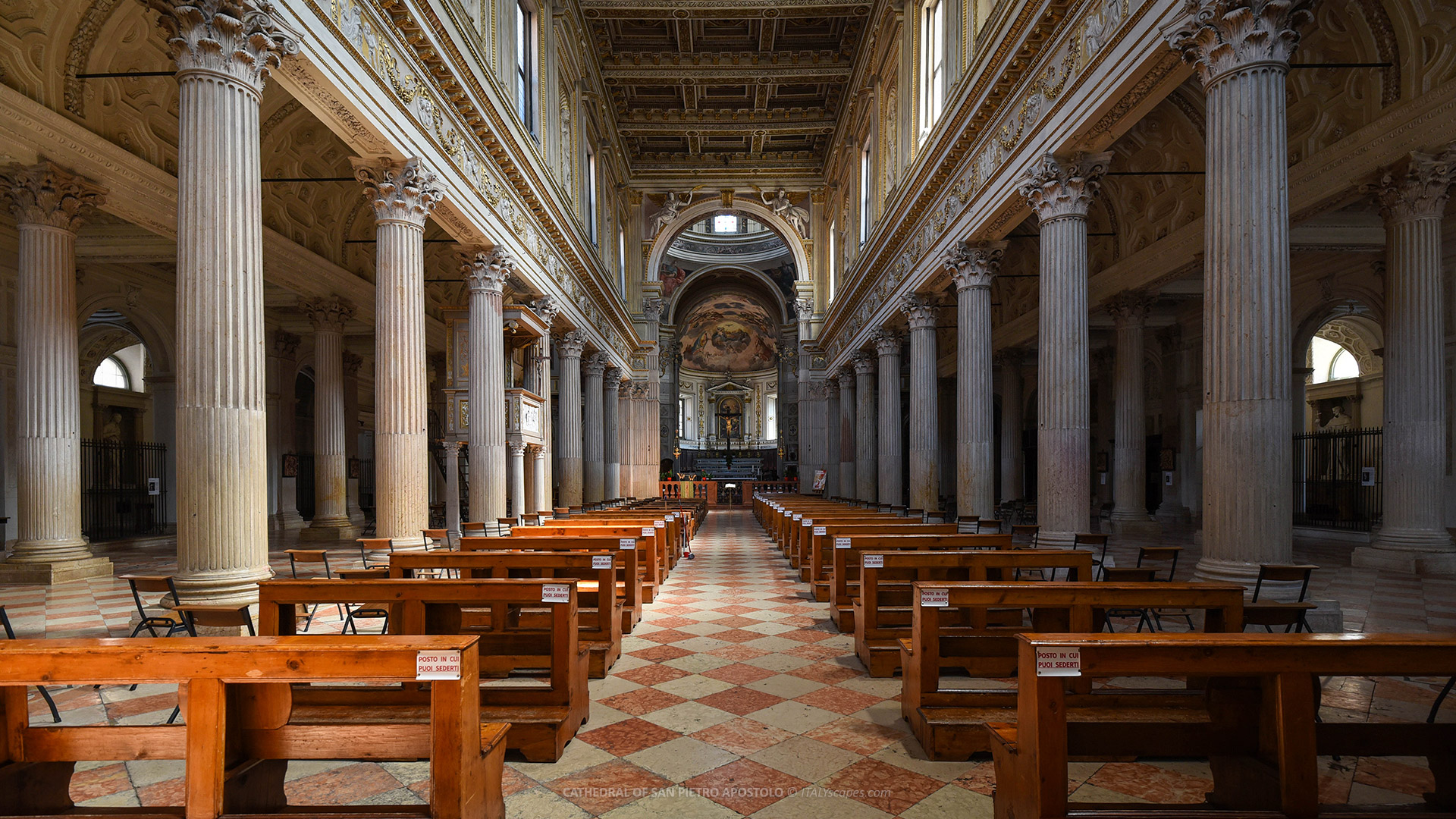
The main nave leading toward the high altar of Mantua Cathedral.
Architecture of the Cathedral of San Pietro Apostolo (Mantua Cathedral)
The Eighteenth-Century Marble Facade
The present facade of the Cathedral of San Pietro Apostolo is constructed of Carrara marble and displays the characteristics of late Baroque architecture. Its composition includes a taller central section and lower lateral portions, establishing a symmetrical elevation that occupies the northern end of Piazza Sordello.
The central section of Mantua Cathedral contains three entrance portals, framed by four pilasters with Corinthian capitals. Above the principal architectural order rises a triangular pediment. The arrangement follows classical principles of symmetry, with decorative moldings defining the individual sections of the facade.
The upper part of the Cathedral of San Pietro Apostolo incorporates sculptures representing important figures of Catholic tradition. The four statues associated with the central pediment depict Pope Celestine I, Saint Peter, Saint Paul, and Saint Anselm, connecting the building’s dedication with the religious history of Mantua.
The lateral portions of Mantua Cathedral contain four additional statues: Saint Speciosa, Saint Aloysius Gonzaga, Saint Giovanni Bono, and Blessed Osanna Andreasi. The facade also includes decorative medallions, episcopal heraldry, and an inscription referring to Empress Maria Theresa of Austria, documenting the political circumstances under which the eighteenth-century project was completed.
The Medieval Bell Tower and Gothic Exterior
The bell tower of the Cathedral of San Pietro Apostolo is an important surviving element of its medieval architectural structure. Built predominantly in the Romanesque tradition, it preserves characteristics associated with the earlier cathedral and differs considerably from the marble architecture of the principal facade.
Along the right side of Mantua Cathedral, visitors can observe surviving architectural elements from the late fourteenth and early fifteenth centuries. These include pointed decorative features, pinnacles, and elaborate masonry associated with the Gothic rebuilding. They provide evidence of the cathedral’s appearance before its later transformations.
An unusual feature of the Cathedral of San Pietro Apostolo is a Roman female head displayed in a niche of the bell tower. The sculpture visible today is a reproduction, while the ancient original is preserved in Mantua’s Museo Diocesano Francesco Gonzaga, the city’s diocesan museum of religious art.
The bell tower of Mantua Cathedral contains a set of seven bells. The largest was cast by Giuseppe Ruffini, an eighteenth-century bell founder. The remaining bells were produced by the Cavadini foundry of Verona during the first half of the nineteenth century, reflecting successive changes to the cathedral’s musical equipment.
The Interior Layout and Five Naves
The interior of the Cathedral of San Pietro Apostolo follows a Latin-cross plan, with a longitudinal body intersected by a transept. The principal space is divided into five naves by four parallel rows of fluted columns with Corinthian capitals, establishing a classical architectural organization.
The arrangement of Mantua Cathedral distinguishes between the central nave, two inner side aisles, and two outer side aisles. The central nave and the outer aisles have flat coffered ceilings, while the two intermediate aisles are covered by barrel vaults, creating different ceiling profiles across the interior.
The outer aisles of the Cathedral of San Pietro Apostolo incorporate rows of altars and devotional spaces. These areas were originally conceived as continuous aisles rather than separate chapels. Subsequent additions of partitions and railings created chapel-like compartments while preserving the underlying architectural organization.
The interior of Mantua Cathedral has a strongly defined longitudinal axis extending from the main entrance toward the presbytery. The repeated columns support the upper architectural structures, while the openings between them maintain visual connections across the five naves. The arrangement reflects the classical basilican model adopted during the sixteenth-century reconstruction.
The Dome, Presbytery, and Chapels
Above the crossing of the Cathedral of San Pietro Apostolo rises a dome supported by an octagonal drum. Unlike domes equipped with an exterior lantern, this structure has no lantern. Its position marks the intersection between the principal nave and the transept, emphasizing the central area of the church.
The presbytery of Mantua Cathedral contains the high altar, constructed using different colored marbles and surmounted by a carved wooden crucifix. The episcopal chair is also situated within this liturgical area, reflecting the cathedral’s function as the principal church of the bishop.
The Chapel of the Blessed Sacrament, connected to the left transept of the Cathedral of San Pietro Apostolo, has an octagonal plan and a segmented dome. Bishop Masseo Vitali commissioned its construction in 1664 from architect Alfonso Moscatelli. Subsequent interventions, including works in the Neoclassical period, contributed to its present appearance.
Another important architectural component of Mantua Cathedral is the adjoining Sanctuary of the Incoronata, constructed during the fifteenth century under Luca Fancelli. Designed as a distinct religious space, it is connected to the cathedral and the monumental sacristy. Its architecture reflects the Renaissance vocabulary associated with contemporary developments in Mantuan building.
The cathedral also contains a baptistery situated within the area of the medieval bell tower. This space is reached from the right side of the church, beyond the third altar. Its location preserves a connection between the earlier architectural structure and one of the essential functions of Catholic worship.
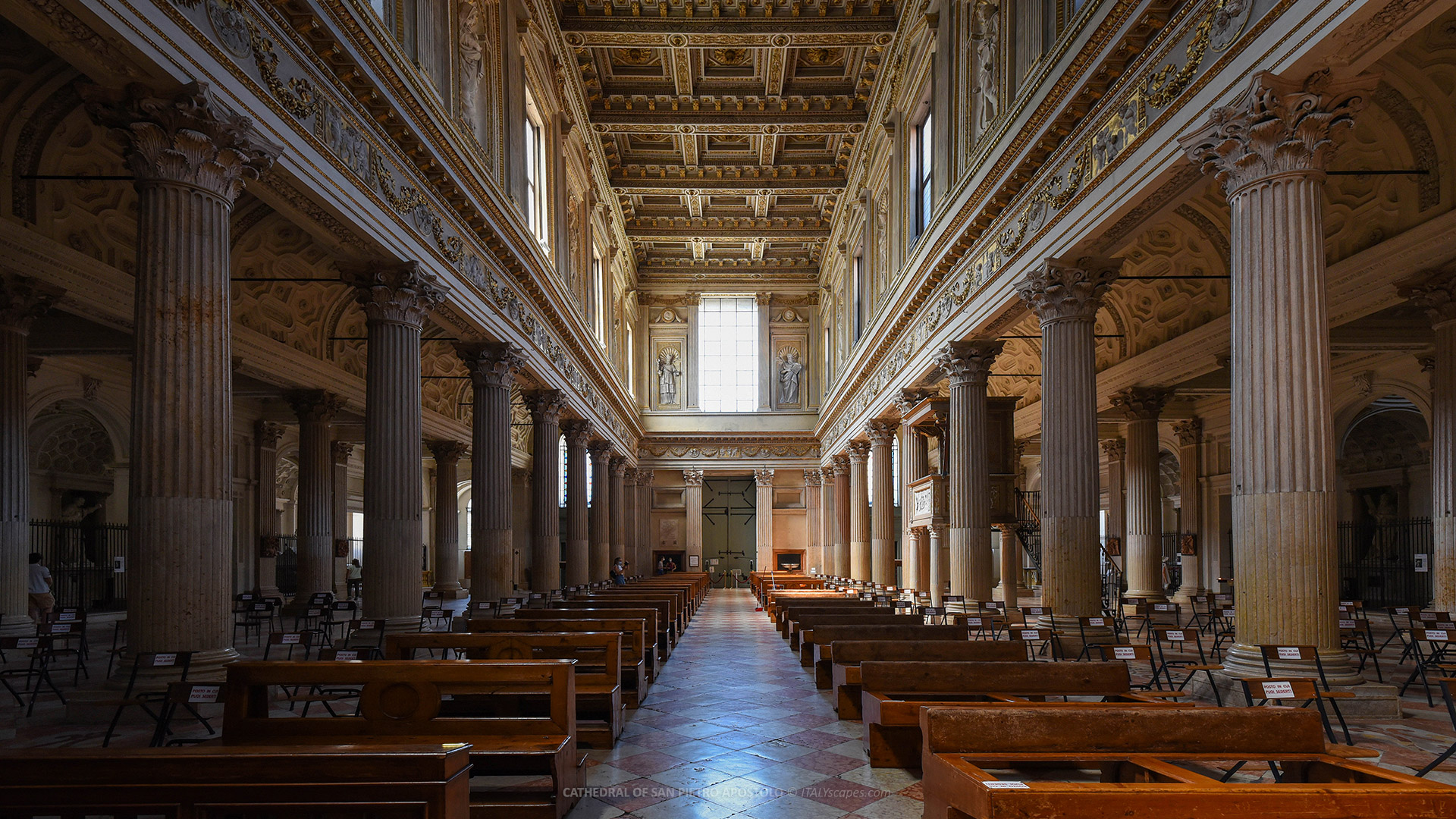
The monumental interior and coffered ceiling of Mantua Cathedral.
Art of the Cathedral of San Pietro Apostolo (Mantua Cathedral)
Early Christian Sculpture and Medieval Paintings
Among the oldest surviving objects in the Cathedral of San Pietro Apostolo is an Early Christian sarcophagus dating from the fourth or fifth century. Located between the first and second chapels on the right side, the monument was reworked during the twelfth century and contains carved religious imagery, including an early representation of the Nativity.
The baptistery of Mantua Cathedral preserves frescoes dating from the beginning of the fourteenth century. These paintings belong to the medieval decorative heritage of the building and predate the extensive transformations of the sixteenth century. Their survival provides an important example of the cathedral’s earlier artistic decoration.
Other sculptural elements inside the Cathedral of San Pietro Apostolo include figures and reliefs representing biblical prophets, sibyls, Moses, and Aaron. These images form part of the religious decorative program developed during the cathedral’s renovation and illustrate the relationship between Old Testament prophecy and Christian teaching.
The monumental sacristy of Mantua Cathedral contains a particularly important cycle of eight Marian scenes, completed in 1482. The paintings decorate the vault and are attributed to an anonymous artist associated with the school of Andrea Mantegna. Their subjects concern episodes from the life of the Virgin Mary.
Altarpieces and Paintings in the Side Aisles
The first altar on the left side of the Cathedral of San Pietro Apostolo is dedicated to Saint Agatha. Its altarpiece, painted by Ippolito Costa in 1552, represents the saint during her martyrdom. The painting belongs to the group of sixteenth-century works produced for the cathedral’s renewed interior.
Other altars along the left aisle of Mantua Cathedral are dedicated to Saint Speciosa, Saint Lucy, and Saint Pius X. The painting representing Saint Speciosa is attributed to Giovan Battista Bertani, while the altarpiece of Saint Lucy was executed by Fermo Ghisoni in 1552. The depiction of Saint Pius X is by Alessandro Dal Prato.
On the right side of the Cathedral of San Pietro Apostolo, the altar dedicated to Saint Eligius, patron of goldsmiths and metalworkers, contains an altarpiece by Giovanni Pietro Possenti, a pupil of Guercino. Another important painting depicts Saint Aloysius Gonzaga, represented by the Mantuan artist Ippolito Andreasi.
Mantua Cathedral also preserves an altarpiece by Giovanni Battista Buratto, representing Saints Francis of Assisi, Clare, and Anthony of Padua. Paintings associated with Franciscan devotion form part of the building’s broader collection of religious art, which includes works created in different periods and transferred from other Mantuan churches.
The Frescoes of the Dome, Apse, and Transepts
The apse of the Cathedral of San Pietro Apostolo contains an extensive fresco by Antonio Maria Viani, representing the Trinity with the Virgin Mary, Saint John, and angels. The composition covers approximately 180 square meters and forms one of the principal pictorial elements of the cathedral’s decorative program.
The dome of Mantua Cathedral contains a painted representation of God the Father surrounded by the nine choirs of angels. The decoration was completed by 1605 and forms part of a larger program covering the crossing and transepts, with paintings devoted to religious subjects and figures from Mantuan history.
An important patron of this decorative campaign was Bishop Francesco Gonzaga, born Annibale Gonzaga, who became Bishop of Mantua in 1593. The paintings associated with his episcopate involved artists including Teodoro Ghisi and Ippolito Andreasi and emphasized subjects connected with the Redemption, the Virgin Mary, and the saints.
The frescoes and religious imagery of the Cathedral of San Pietro Apostolo also address Mantuan traditions associated with the Precious Blood of Christ. These subjects form part of the iconographic program that developed after the Council of Trent, when religious art was used to communicate Catholic doctrine and the importance of the sacraments.
Artworks in the Chapel of the Blessed Sacrament
The Chapel of the Blessed Sacrament contains two important sixteenth-century paintings: Saint Margaret, executed by Domenico Brusasorci in 1552, and Saint Martin Sharing His Cloak with a Poor Man, painted by Paolo Farinati in the same year. The paintings are positioned above the chapel’s confessionals.
The altar of the chapel contains a representation of The Calling of Saints Peter and Andrew, based on a composition invented by Giulio Romano and executed by his pupil Fermo Ghisoni. The version displayed in Mantua Cathedral is a late eighteenth-century copy painted by Felice Campi.
Felice Campi also contributed four paintings representing the Doctors of the Church: Saints Ambrose, Augustine, Jerome, and Gregory the Great. Their images are accompanied by an allegorical representation of Faith in the chapel’s vault, creating a decorative program centered on Catholic teaching and Eucharistic devotion.
The ornamental decoration of the Chapel of the Blessed Sacrament incorporates seven stucco roundels designed as part of a broader program by Paolo Pozzo. Andrea Mones and Leandro Marconi executed decorative elements, while the eighteenth-century altar incorporates gilded reliefs and small columns decorated with lapis lazuli.
The Sanctuary of the Incoronata and the Monumental Sacristy
The Sanctuary of the Incoronata, connected to the Cathedral of San Pietro Apostolo, preserves an ancient fresco of the Madonna and Child. According to religious tradition, Saint Anselm prayed before this image. Its veneration eventually gave rise to the sanctuary originally known as Santa Maria dei Voti.
Devotion to the Marian image increased during the late fifteenth century, particularly after 1477, when miracles were reported through the Virgin’s intercession. In 1640, Maria Gonzaga promoted the solemn coronation of a corresponding movable image of the Virgin as Queen of Mantua, establishing the sanctuary’s present dedication.
The monumental sacristy of Mantua Cathedral also contains a sixteenth-century bronze sculpture of the Madonna and Child by Antonio Begarelli. Other objects include paintings by Fermo Ghisoni and Battista d’Agnolo del Moro, together with an altar featuring a painting by Marc’Antonio Donzelli.
An additional furnishing is a carved cabinet dated 1730, associated with Giovanni Battista Duschi and decorated with an image of the Immaculate Conception. The sacristy also provides access to the chapter rooms, which preserve objects connected with the ecclesiastical administration and clergy of the Cathedral of San Pietro Apostolo.
Funerary Monuments and the Cathedral Organ
One of the most important religious figures associated with Mantua Cathedral is Saint Anselm of Lucca, the city’s principal patron saint. His remains are preserved beneath the high altar, making the cathedral an important place of devotion to the bishop who supported the Gregorian Reform during the Investiture Controversy.
The Cathedral of San Pietro Apostolo also contains the remains of Blessed Osanna Andreasi, a Mantuan Dominican tertiary who died in 1505. Her body rests in the left transept, at an altar dedicated to Saint Dominic, inside a reliquary decorated with silver reliefs representing episodes from her life.
Several members of the Gonzaga family are buried in Mantua Cathedral, including Ludovico III Gonzaga and his wife Barbara of Brandenburg. The monumental sacristy preserves funerary remains associated with Cardinal Ercole Gonzaga and his brother Ferrante Gonzaga, illustrating the dynasty’s longstanding connection with the church.
The pipe organ of the Cathedral of San Pietro Apostolo was constructed in 1915 by Benzi-Franceschini of Crema. Installed in the right transept, it has two manuals of 61 notes each and a pedalboard with 32 notes. The instrument uses an electropneumatic transmission system and underwent modifications in 1940 and during the 1970s.
The organ case of Mantua Cathedral is older than the present instrument. Designed by Giambattista Marconi during the early nineteenth century, it features carved and gilded wood in a Neoclassical style. The visible arrangement of pipes is divided into three principal sections, while the console stands near the presbytery.
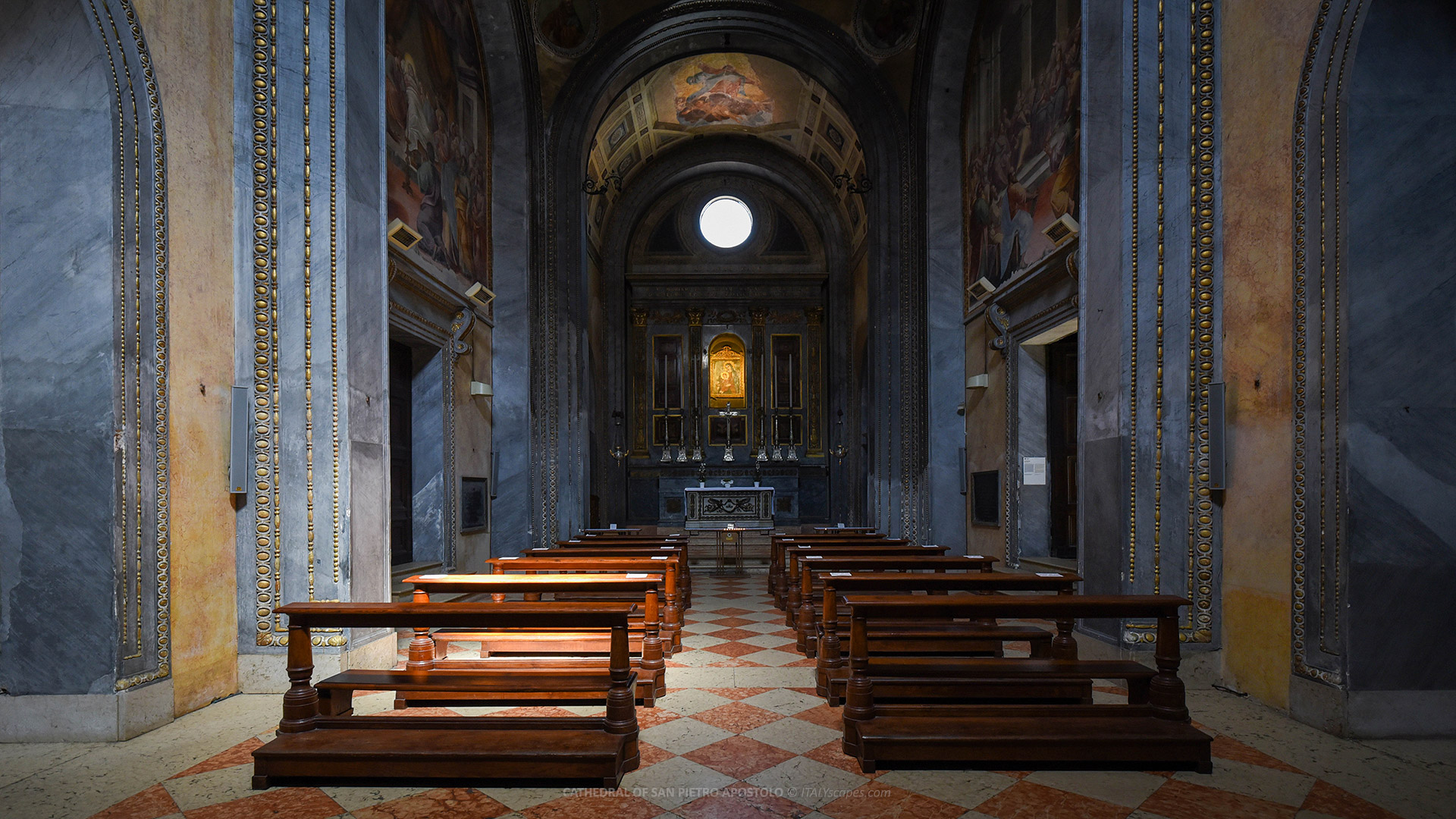
A decorated side chapel inside the Cathedral of San Pietro Apostolo.
How to Get to the Cathedral of San Pietro Apostolo (Mantua Cathedral)
The Cathedral of San Pietro Apostolo is located in Piazza Sordello, approximately 1.2 kilometers from Mantova railway station. Visitors arriving by train can reach the cathedral on foot, by public bus, or by taxi. The journey passes through or around Mantua’s compact historic center.
Getting to the Mantua Cathedral on foot
Walking from Mantova railway station to Mantua Cathedral takes approximately 15-20 minutes, depending on the chosen route. The station is situated in Piazza Don Leoni, west of the historic center. From the main station entrance, visitors should head toward Corso Vittorio Emanuele II.
A practical route to the Cathedral of San Pietro Apostolo continues toward Piazza Marconi and Piazza delle Erbe, passing through the central streets and squares of Mantua. From Piazza delle Erbe, visitors can proceed through Piazza Broletto and the historic Voltone di San Pietro into Piazza Sordello.
The entrance to Mantua Cathedral faces Piazza Sordello, toward the northern end of the square. The walking route crosses areas with different surfaces, including historic stone paving and cobblestones. Most of the journey takes place within the central urban area, where several streets have pedestrian access restrictions.
Getting to the Mantua Cathedral by bus
Visitors arriving at Mantova railway station can use the APAM urban bus network to reach the Cathedral of San Pietro Apostolo. The station area is served by routes 4C, 4S, 4T, and 12, which provide connections toward Piazza Sordello and the surrounding historic center.
The closest bus stop to Mantua Cathedral is Duomo – Piazza Sordello, situated immediately beside the cathedral area. Lines 4C, 4S, 4T, and 12 serve this stop, although the appropriate direction and individual departures should be checked against the current APAM timetable.
Another nearby stop is Palazzo Ducale – Piazza Sordello, located in the same square. From either stop, the Cathedral of San Pietro Apostolo is accessible on foot. APAM urban buses have accessibility equipment and spoken stop announcements, while passengers requiring specific assistance should consult the operator before travelling.
Getting to the Mantua Cathedral by taxi
A taxi rank is located in Piazza Don Leoni, directly outside Mantova railway station. Visitors can take a taxi from this location to the Cathedral of San Pietro Apostolo. The railway station taxi stand can also be contacted at +39 0376 325351.
The taxi journey to Mantua Cathedral is relatively short, with a road distance of approximately 2 kilometers, depending on the route. Passengers should request Piazza Sordello as their destination, preferably the area near the cathedral or Palazzo Ducale, where a taxi rank is located.
Taxis can also be requested through Radiotaxi Mantova, at +39 0376 368844. Parts of Mantua’s historic center are subject to restricted traffic regulations, so the exact drop-off point depends on permitted vehicle access. The final approach to the Cathedral of San Pietro Apostolo may require a short walk.
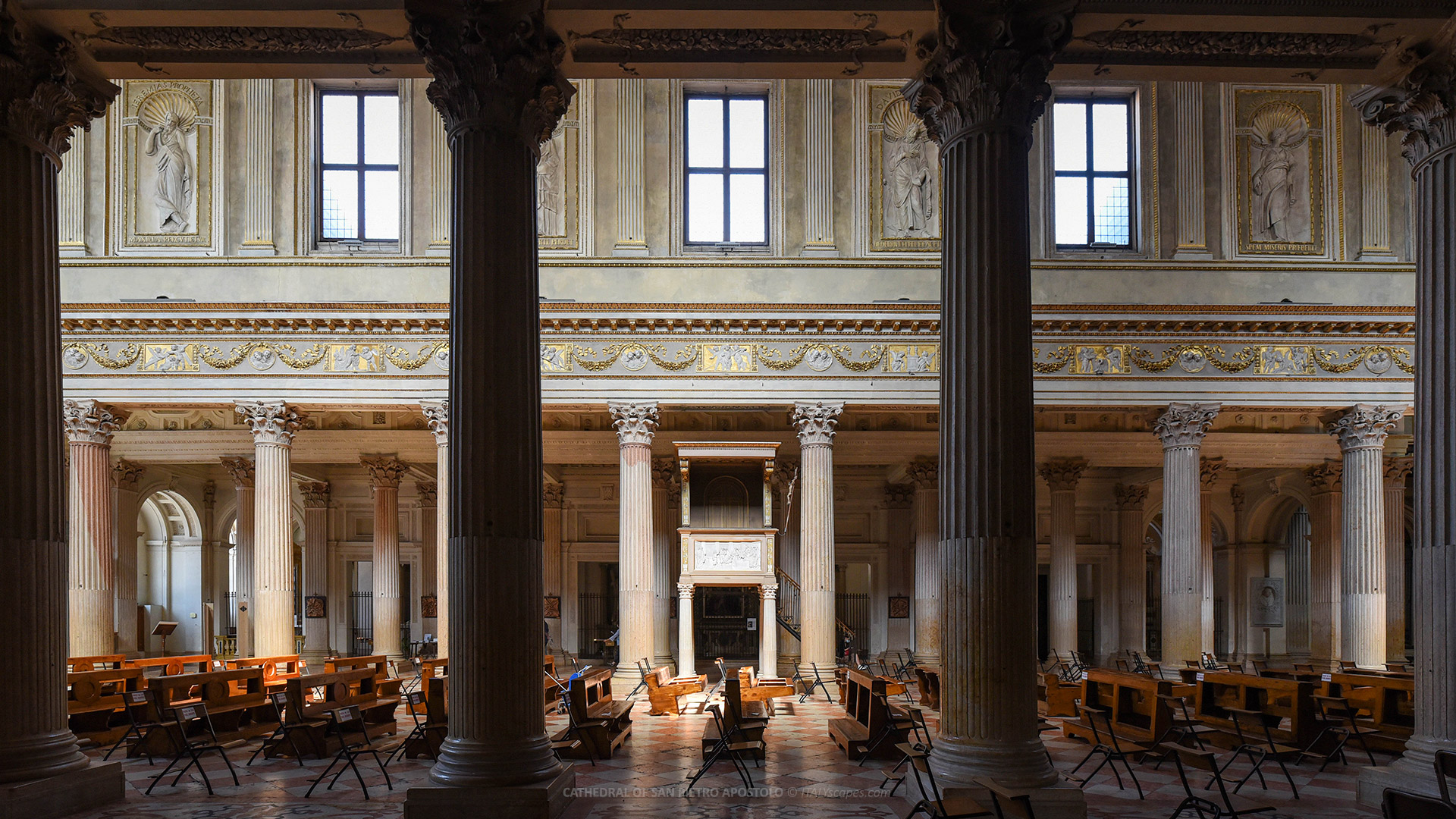
Corinthian columns and decorative details inside Mantua Cathedral.
Frequently Asked Questions about the Cathedral of San Pietro Apostolo (Mantua Cathedral)
Is the Cathedral of San Pietro Apostolo the same as the Basilica of Sant’Andrea?
No. They are separate churches. The Cathedral of San Pietro Apostolo is Mantua’s cathedral, while the Basilica of Sant’Andrea is its co-cathedral. Both are important religious buildings within the diocese.
Is Mantua Cathedral part of a UNESCO World Heritage Site?
Yes. Mantua’s historic center belongs to the UNESCO World Heritage property Mantua and Sabbioneta, inscribed in 2008. The cathedral is part of this protected urban heritage, not a separately inscribed site.
Is the Cathedral of San Pietro Apostolo accessible to wheelchair users?
The main entrance has a gentle access ramp, and the principal nave is level. Visitors using wheelchairs can enter the main worship area and participate in religious services.
Does the Sanctuary of the Incoronata have a separate religious identity?
Yes. Although connected to the Cathedral of San Pietro Apostolo, the Incoronata is a distinct Marian sanctuary dedicated to the Virgin Mary as Queen of Mantua.
Buy tickets & tours:GetYourGuide -
Photos
-
Map
-
Reviews


