-
About
Table of Contents
Porta San Giorgio, also known as Porta Trento, is one of the historic gates of Verona, located along the city’s old defensive walls on the left bank of the Adige River. It stands near Lungadige San Giorgio, close to the Church of San Giorgio in Braida and the northern edge of the historic center.
The gate marked an important access point into Verona from the river’s left bank. Its location was strategic because it controlled a route connected with the northern approaches to the city, including the road toward Tyrol and the hilly defensive area above Verona.
Porta San Giorgio is not only a city gate, but a military structure shaped by several historical periods. Its first phase belongs to the Scaliger fortifications, its Renaissance façade belongs to Venetian Verona, and its inner completion belongs to the Austrian period.
Today, Porta San Giorgio is best understood as part of Verona’s defensive landscape. It can be combined with San Giorgio in Braida, the Adige riverfront, Ponte Pietra, the Roman Theatre area, and the northern hillside routes of Verona.
Short History of Porta San Giorgio
The Scaliger Gate of the 14th Century
The earliest Porta San Giorgio belonged to the defensive program of Cangrande I della Scala, one of the most powerful rulers of medieval Verona. Between 1321 and 1324, he commissioned a fortified wall circuit to protect the city.
The project is associated with the master builder Calzaro, who planned a gate already dedicated to San Giorgio. This medieval entrance was connected with the Scaliger walls and with an attached defensive element known as the Rocchetta.
The Venetian Reconstruction
In the 16th century, Verona was under the control of the Republic of Venice. The city’s walls were strengthened because medieval fortifications were no longer enough against artillery. Porta San Giorgio was rebuilt as part of this larger defensive modernization.
The reconstruction belongs to the period of Doge Andrea Gritti, whose policies supported the strengthening of Venetian mainland cities. Verona was a key fortified city for the Republic of Venice, especially because of its position between the Po Valley, the Alps, and northern routes.
The Renaissance reconstruction was carried out between 1525 and 1526. The project is traditionally attributed to Giovanni Maria Falconetto, a Veronese architect and artist connected with Renaissance architecture in the Veneto.
The Austrian Completion
The city-facing side of Porta San Giorgio remained unfinished for a long time. Work on the internal elevation began in 1835 and was completed in 1840, when Verona was under Austrian rule.
This Austrian phase was directed by the Imperial Royal Office of Fortifications of Verona. The new inner front followed the existing dimensions of the monument but used a stricter military language, suitable for 19th-century defensive architecture.
Architecture of Porta San Giorgio
Renaissance Exterior Façade
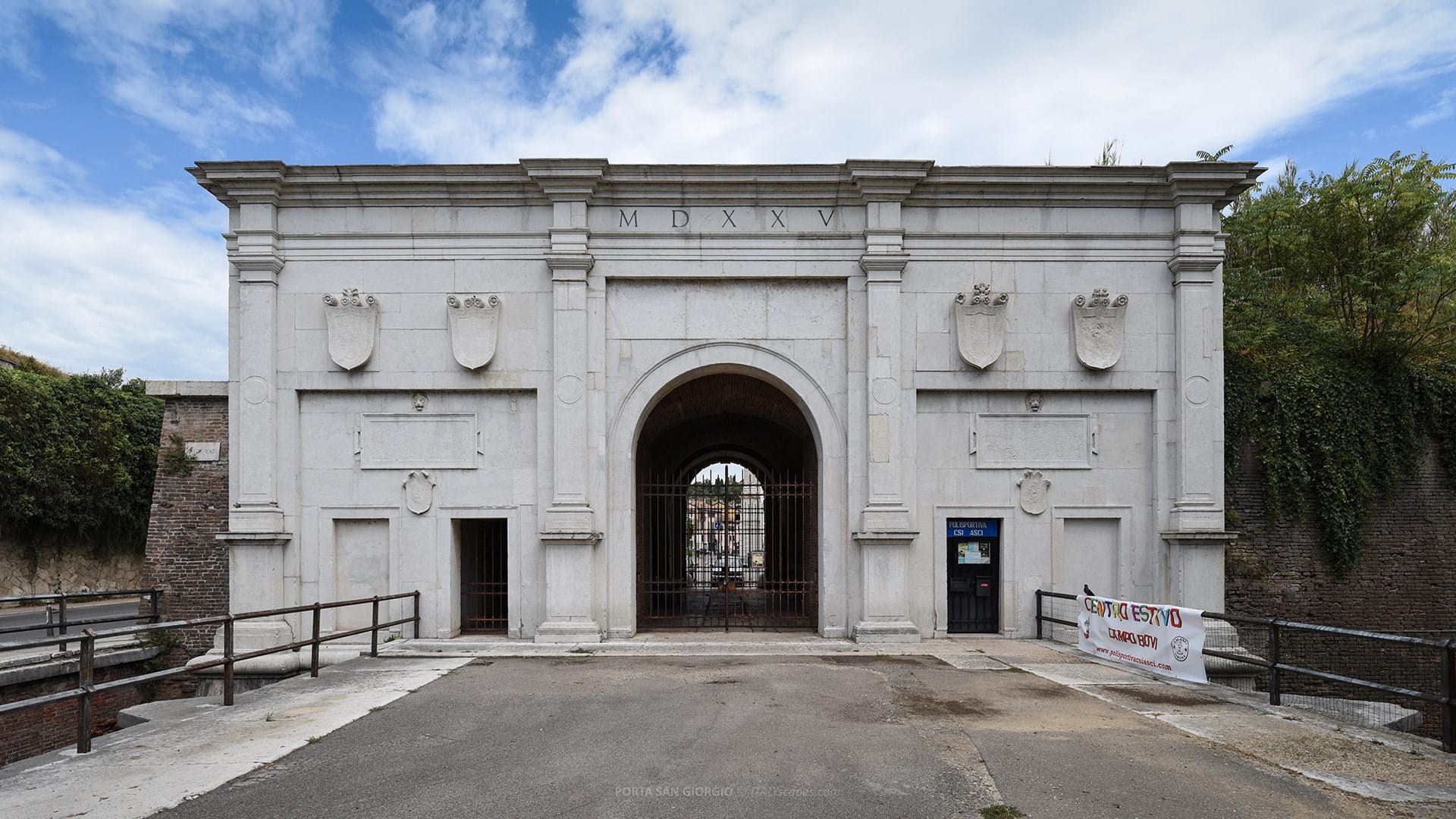
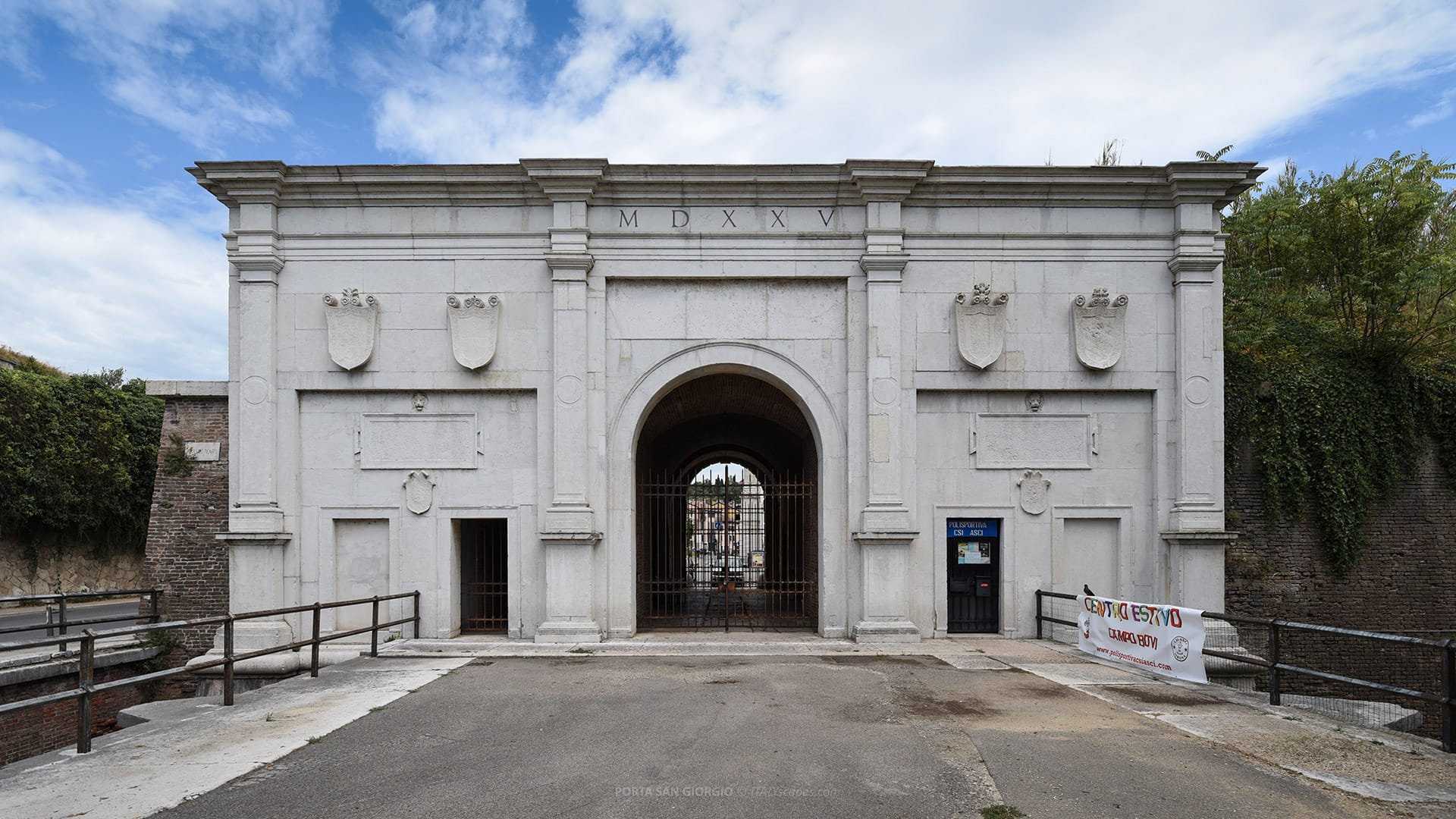
The most important Renaissance element of Porta San Giorgio is the exterior façade facing the countryside. This side is faced with smooth white stone, giving the monument a clean, noble, and controlled appearance.
The façade follows the classical model of a triumphal arch. It includes a larger central opening and side openings arranged in a balanced composition. The design uses the Doric order, a classical architectural language often associated with strength and discipline.
The exterior decoration is restrained. The most visible ornaments are the coats of arms and commemorative plaques of Venetian officials connected with the city’s fortifications. The result is monumental but not overloaded.
The Three-Bay Inner Front
The inner side, completed under Austrian rule, keeps a three-bay composition. On this front, the three large arches are of equal size, creating a more severe and utilitarian appearance.
This city-facing elevation uses rustic tuff facing, which gives it a heavier military character. The difference between the elegant white-stone Renaissance exterior and the stronger Austrian inner front is one of the most interesting architectural features of the gate.
Plan, Passages and Internal Spaces
The plan of Porta San Giorgio is rectangular and asymmetrical. Its organization was based on function, not decorative symmetry. The gate included a central carriage passage, a side pedestrian passage, and rooms for practical military and customs use.
The presence of a military guardroom and a customs guardroom shows that the gate controlled both security and movement. People, goods, and vehicles entering the city could be monitored at this point.
The walls of the carriage and pedestrian passages were equipped with loopholes. These openings allowed defenders to fire from protected positions inside the structure, turning the gate into an active defensive point.
Drawbridges, Moat and Upper Defenses
In the past, Porta San Giorgio had wooden drawbridges. These drawbridges lowered onto a masonry bridge that crossed part of the main moat. This system made the gate easier to defend and harder to force during an attack.
The upper part of the gate also had defensive functions. A terrace held a position for rifle fire, while the roof was designed with a bomb-proof covering, an important feature for a fortified structure exposed to artillery.
How to Get to Porta San Giorgio
Getting to Porta San Giorgio on foot
Porta San Giorgio can be reached on foot from Verona’s historic center. It is especially convenient if you are already visiting the northern part of the city, including Ponte Pietra, Sant’Anastasia, the Cathedral area, or the riverfront.
From Verona Porta Nuova railway station, the walking distance is about 2.7 kilometers. The walk usually takes around 32 minutes, depending on pace, route, pedestrian crossings, and stops along the way.
A practical walking route is to go from Verona Porta Nuova toward Piazza Bra, continue through the historic center, and then head north toward the Adige. The route can be combined with several major monuments, so it works well for sightseeing.
Getting to Porta San Giorgio by bus
Bus travel is a practical option from Verona Porta Nuova if you do not want to walk. Verona’s urban buses are operated by ATV, the local transport company responsible for city and provincial bus services.
A reported direct connection links Stazione FS with Porta S. Giorgio. The journey can take around 7 minutes when using the direct line option listed for this route.
Getting to Porta San Giorgio by taxi
A taxi from Verona Porta Nuova to the San Giorgio in Braida area covers about 3.3 kilometers. In normal traffic, the ride usually takes around 6 minutes, making it the fastest direct option from the station.
Taxi travel is useful if you have luggage, limited time, or limited mobility. It is also practical in hot weather, late evening, or when you want to reach the northern side of the historic center without crossing the city on foot.
Frequently Asked Questions about Porta San Giorgio
Where is Porta San Giorgio located?
Porta San Giorgio is located in Verona, along Lungadige San Giorgio, near the Church of San Giorgio in Braida. It stands on the left bank of the Adige River, close to the northern edge of the historic center.
Why is it called Porta San Giorgio?
The name comes from the nearby Church of San Giorgio in Braida, located just beyond the gate. The gate was already dedicated to San Giorgio during its 14th-century Scaliger phase.
When was Porta San Giorgio first built?
The first gate was built between 1321 and 1324, during the rule of Cangrande I della Scala. It formed part of the Scaliger fortified wall circuit around Verona.
Who designed the Renaissance reconstruction?
The Renaissance reconstruction is traditionally attributed to Giovanni Maria Falconetto, a Veronese architect and artist. The works were carried out between 1525 and 1526, during Venetian rule.
Can visitors enter Porta San Giorgio?
Porta San Giorgio is mainly appreciated from the outside, as a historic gate and part of Verona’s defensive walls. Its exterior, inner front, passages, and relation to San Giorgio in Braida are the main visible features.
How far is Porta San Giorgio from Verona Porta Nuova?
The walking distance from Verona Porta Nuova is about 2.7 kilometers. The walk normally takes around 32 minutes, depending on route, pace, and stops.
Sources: -
Photos
-
Map
-
Reviews