-
About
Table of Contents
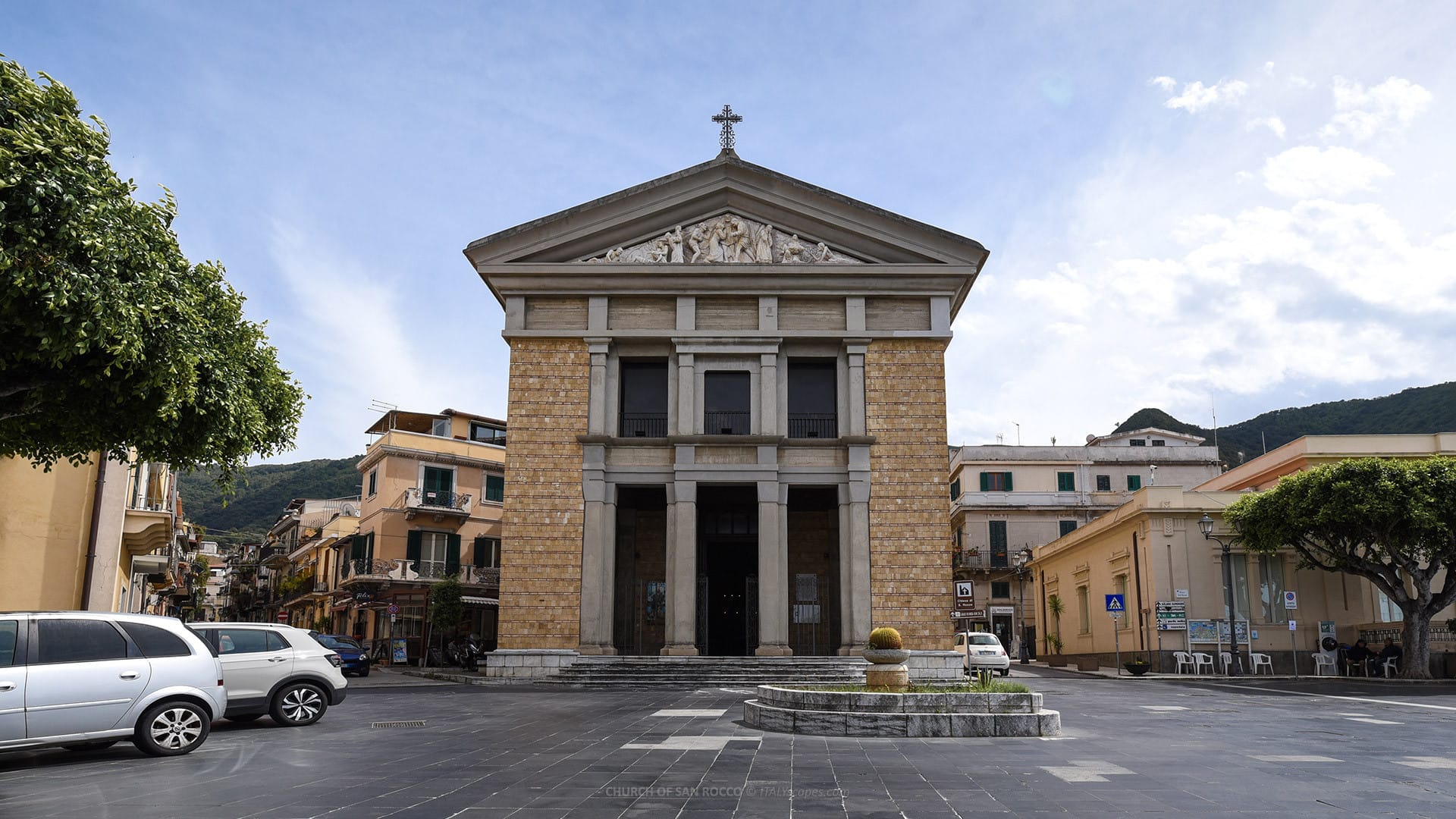
The Church of San Rocco is one of the most important religious landmarks in Scilla, a historic coastal town in southern Calabria. Dedicated to Saint Roch (San Rocco), the patron saint of Scilla, the church stands in Piazza San Rocco, overlooking part of the town.
Although the current building is relatively recent, the history of the church and the devotion to its patron saint date back several centuries and are deeply connected to the identity of the local community.
Powered by GetYourGuideSan Rocco
Saint Roch, known in Italian as San Rocco, is one of the most venerated saints in Europe and has long been associated with protection against plague and contagious diseases.
Born in Montpellier, France, during the 14th century, he dedicated his life to helping the sick and the poor. According to tradition, he travelled through several Italian cities, caring for plague victims and performing miraculous healings.
The iconography of San Rocco is easily recognizable. He is usually depicted as a pilgrim carrying a staff and showing a wound on his leg, a reference to the illness he contracted while assisting plague victims.
A dog often appears beside him, recalling the legend according to which an animal brought him bread every day while he recovered in isolation.
The devotion to San Rocco became widespread throughout Italy during the late Middle Ages. Communities affected by epidemics frequently invoked his protection, and many churches and chapels were dedicated to him.
His feast day, celebrated on August 16, remains one of the most important religious celebrations in numerous Italian towns.
Short History of the Church of San Rocco
The Origins of the Cult of San Rocco in Scilla
The devotion to San Rocco in Scilla is believed to have originated during the 15th century, a period when outbreaks of plague affected many parts of southern Italy.
Local tradition attributes the town’s protection from the epidemic to the intercession of the saint, leading to the rapid spread of his cult among the inhabitants.
At that time, Scilla maintained significant maritime and commercial connections with Venice, one of the principal trading powers of the Mediterranean. Venice was also home to the most important shrine dedicated to San Rocco, where the saint’s relics were preserved.
The relationship between Scilla and Venice played a crucial role in strengthening local devotion. Historical accounts indicate that during the 16th century, a statue of San Rocco was transported from Venice to Scilla.
The arrival of this sacred image further increased the saint’s popularity and contributed to his designation as the town’s patron saint.
Over the centuries, the cult of San Rocco became deeply embedded in local traditions. Religious celebrations dedicated to the saint grew in importance, and his protection was invoked during times of disease, natural disasters, and hardship.
The annual festivities continue to be among the most significant events in Scilla today.
The Construction of the Church
The first church on the site was dedicated to Saint George (San Giorgio), another important figure in the religious history of Scilla.
In 1738, a new church dedicated to San Rocco was built, reflecting the increasing importance of the saint within the local community.
Earthquakes and Reconstruction
Like many historic buildings in Calabria, the Church of San Rocco suffered severe damage during the devastating earthquakes of 1783, a series of powerful seismic events that affected much of southern Italy. The structure required extensive repairs and reconstruction following the disaster.
Another tragic chapter occurred after the catastrophic Messina earthquake of 1908, one of the deadliest earthquakes in European history. The Church of San Rocco was once again heavily damaged, forcing the local community to undertake further rebuilding efforts.
The Modern Church
The current building largely dates from a major reconstruction campaign initiated during the 1970s. The project became necessary due to the deterioration caused not only by time but also by damage sustained during the Second World War.
The rebuilding process involved substantial participation from the local population. Residents contributed resources and support, reflecting the strong bond between the Church of San Rocco and the community.
The reconstruction was completed in August 1990, giving Scilla the church that visitors can admire today.
Architecture of the Church of San Rocco
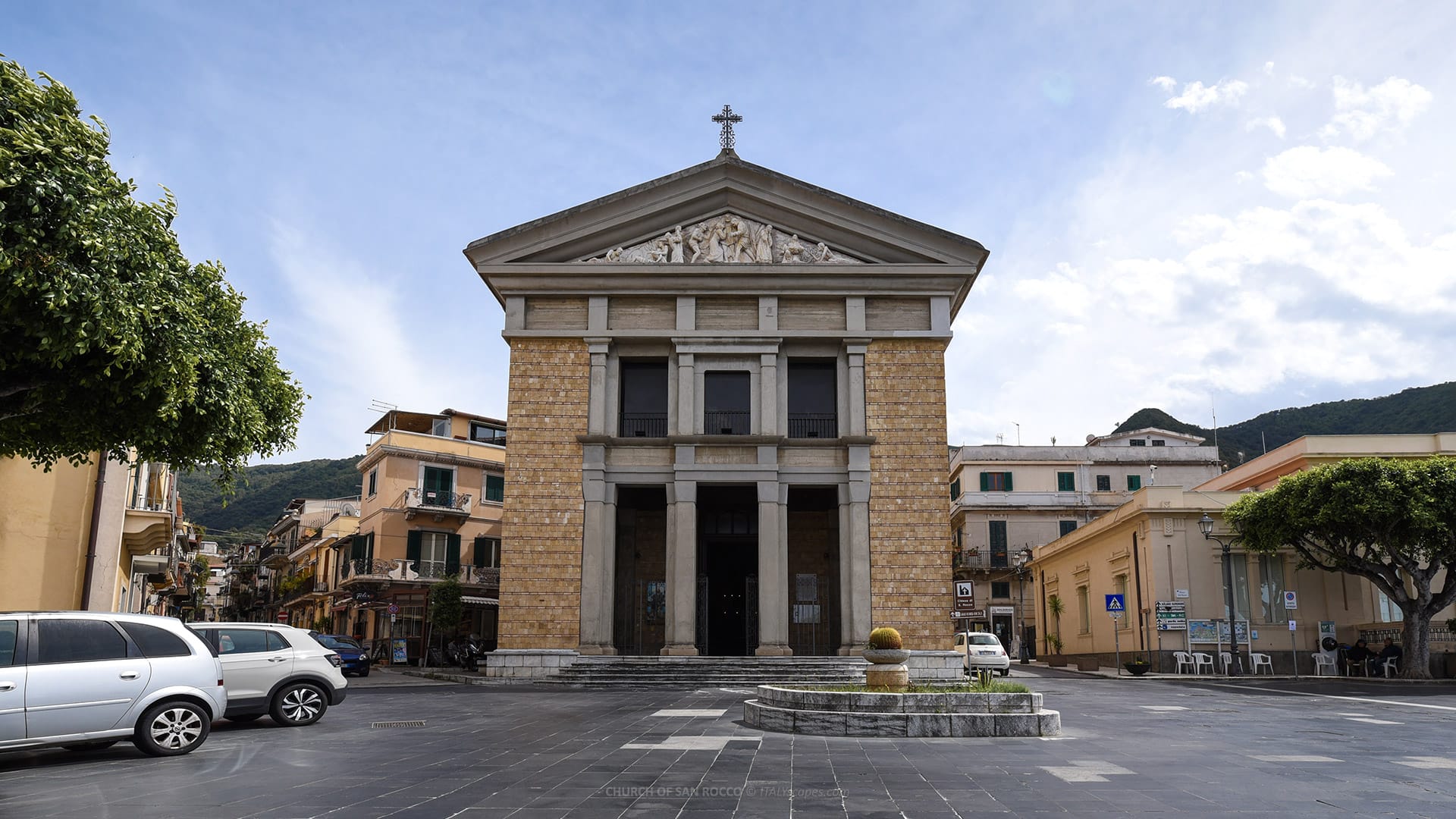
The exterior of the Church of San Rocco presents a harmonious and elegant design inspired by classical architectural forms. The façade is characterized by a symmetrical composition that immediately recalls the appearance of an ancient temple.
At the center of the façade stand two prominent columns, accompanied by two semi-columns positioned along the sides. These architectural elements create a sense of balance and monumentality while emphasizing the importance of the main entrance.
The upper section of the façade is crowned by a triangular tympanum, a feature commonly associated with classical architecture. Particularly noteworthy is the large bas-relief created by sculptor Mario Benedetto in 2003, positioned within the tympanum.
One of the most valuable features of the Church of San Rocco is its monumental wooden entrance door, crafted by Rocco Foca in 1885. The door is divided into eight carved panels, showcasing remarkable craftsmanship and representing an important example of local artistic heritage.
The interior of the church contrasts with the decorative richness of the entrance by offering a spacious and luminous environment. Designed in a Neoclassical style, the Church of San Rocco features a single nave, creating a clear and harmonious layout that directs attention toward the altar.
Large openings allow natural light to enter the building, enhancing the sense of openness and serenity.
Art of the Church of San Rocco
The Church of San Rocco houses several important works of religious art that testify to the long-standing devotion of the local community and enrich the visitor experience.
Immediately inside the entrance, visitors encounter two notable paintings. On the right side is the Miracle of Saint Anthony, while on the left appears Saint Francis of Assisi in Glory.
The most significant artistic and devotional elements are undoubtedly the two statues of San Rocco preserved inside the church. One statue, sculpted in marble, occupies a prominent position near the altar and serves as a permanent focal point for prayer and veneration.
The second statue, carved in wood, plays a central role during the annual celebrations dedicated to the patron saint. This image is traditionally carried through the streets of Scilla during religious processions, allowing the faithful to express their devotion publicly and participate in one of the town’s most cherished traditions.
Near the presbytery, visitors can admire two additional paintings of considerable artistic interest. One depicts Saint Anthony in Veneration of the Child, while the other represents Saint George in Veneration of the Virgin.
These paintings are generally attributed to Antonio Filocamo, a painter associated with the artistic tradition of Calabria and Sicily.
How to Get to the Church of San Rocco
The Church of San Rocco is located in Piazza San Rocco, one of the most important squares in Scilla.
Getting to the Church of San Rocco on foot
For those arriving by train, the church lies approximately 800 meters from Scilla railway station. The walk generally takes around 15 minutes and passes through some of the town’s characteristic streets, offering visitors a pleasant introduction to Scilla’s atmosphere.
Getting to the Church of San Rocco by car
Reaching the church by car is relatively easy. Drivers arriving from the A2 Autostrada del Mediterraneo can exit at Scilla, then follow the signs toward the town center and Piazza San Rocco.
Frequently Asked Questions about the Church of San Rocco
Where is the Church of San Rocco located?
The Church of San Rocco is located in Piazza San Rocco, one of the most important squares in Scilla, overlooking part of the historic town.
Who is the church dedicated to?
The church is dedicated to San Rocco, a 14th-century saint traditionally venerated as a protector of the sick, the poor, and communities affected by epidemics.
When was the Church of San Rocco built?
A new church dedicated to San Rocco was built in 1738, while the current building was completed in August 1990 after major reconstruction works.
Was the church damaged by earthquakes?
Yes, the church was damaged by the earthquakes of 1783 and 1908, both of which caused severe destruction in Calabria and the Strait of Messina area.
What can you see inside the church?
Inside, visitors can see paintings, devotional statues of San Rocco, a luminous single nave, the altar area, and artworks connected with Scilla’s religious tradition.
Sources:Powered by GetYourGuide -
Photos
-
Map
-
Reviews