-
About
Table of Contents
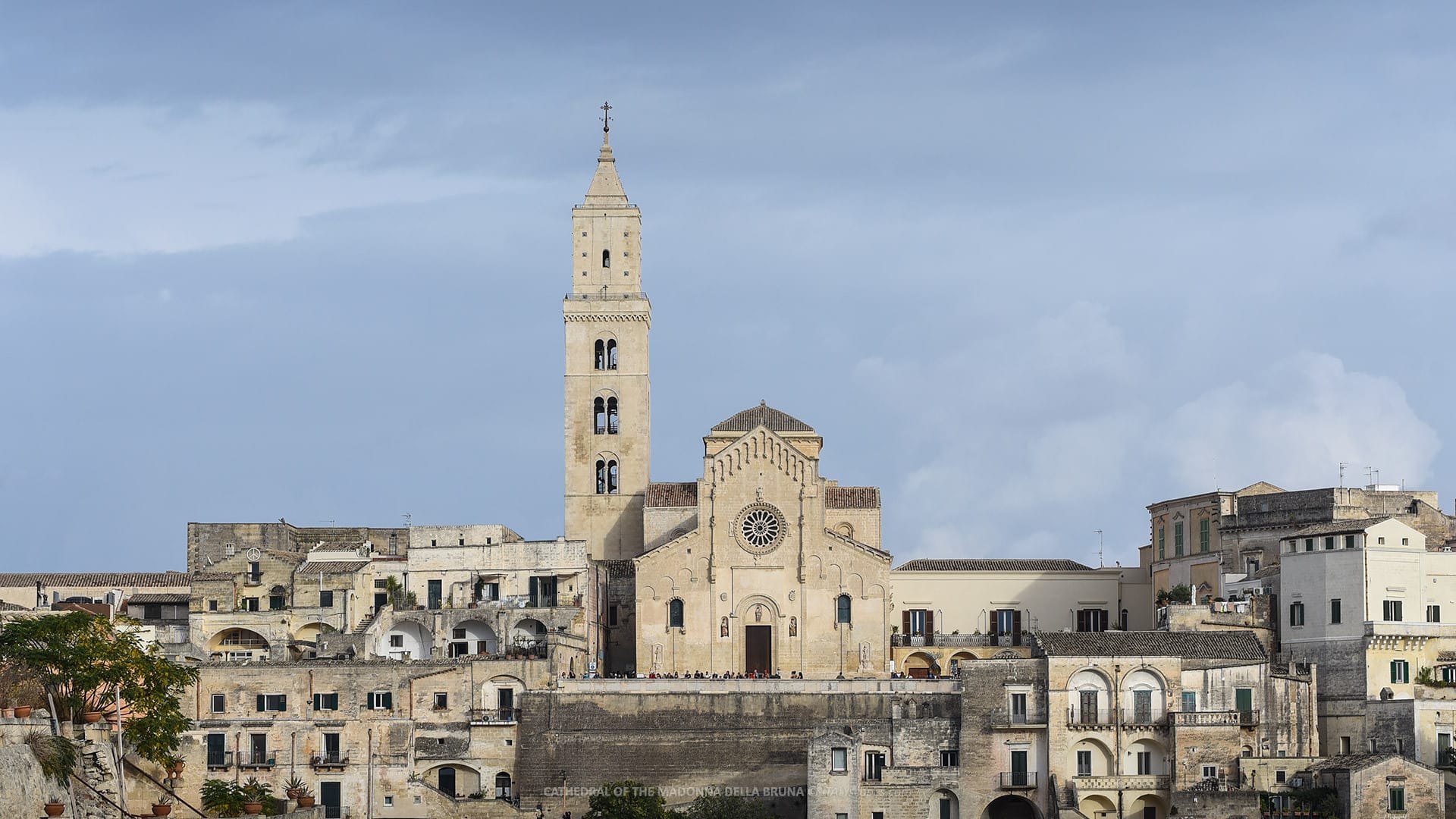
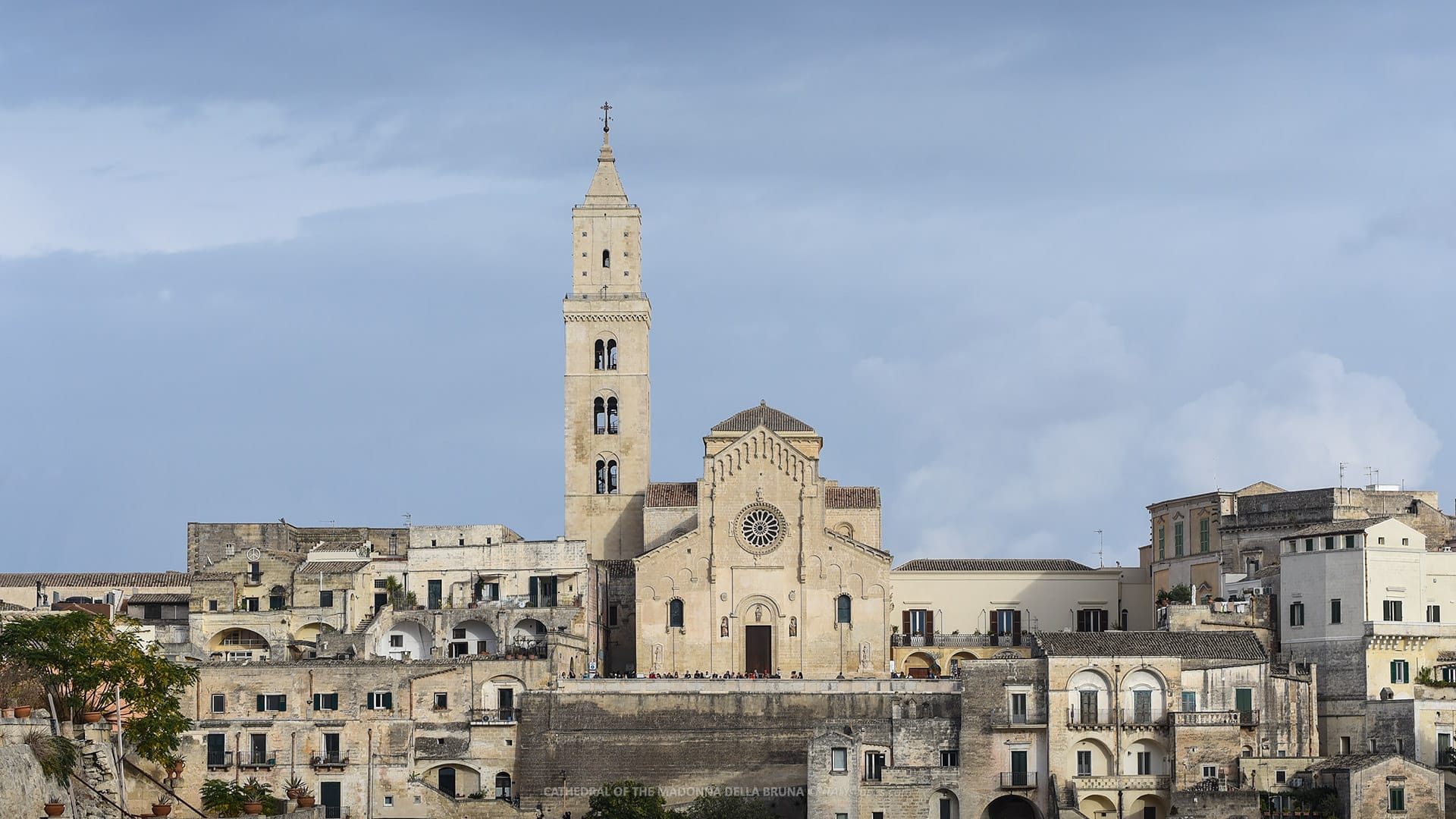
The Cathedral of the Madonna della Bruna and Sant’Eustachio, commonly known as Matera Cathedral, is the cathedral of Matera and one of the most important religious monuments in southern Italy.
The Matera Cathedral is dedicated to the Madonna della Bruna, the Virgin Mary venerated as the patron saint of the city, and to Saint Eustace, an early Christian martyr associated with the medieval Benedictine tradition of the site.
The church stands on the highest point of the historic city, in the area known as La Civita, positioned dramatically between the two ancient districts of Sasso Caveoso and Sasso Barisano.
From this elevated location, the Cathedral of the Madonna della Bruna dominates the urban landscape of Matera, visually and symbolically representing the spiritual center of the city. Its position reflects the medieval concept of sacred hierarchy, where the cathedral rises above the surrounding dwellings carved into the rock.
Short History of the Cathedral of the Madonna della Bruna
The Matera Cathedral was constructed between 1230 and 1270, during a period of intense architectural and urban development in southern Italy.
The building was erected on the remains of an 11th-century Benedictine monastery dedicated to Saint Eustace, confirming the continuity of worship on the site across many centuries.
This Benedictine presence played a crucial role in shaping the early religious life of Matera, especially during the Norman and Swabian periods.
Originally, the Matera Cathedral was dedicated to Santa Maria di Matera, emphasizing the city’s long-standing Marian devotion.
Over time, this dedication evolved, and the church became associated with Santa Maria della Bruna, a title that would later become inseparable from Matera’s religious identity.
The Madonna della Bruna gradually emerged as the principal protector of the city, a role still celebrated today through the famous annual Feast of the Madonna della Bruna held on July 2.
Starting from 1627, the cathedral officially adopted its dual dedication to both the Madonna della Bruna and Saint Eustace.
This change reflects broader liturgical and devotional developments following the Council of Trent, when many churches redefined their dedications and internal arrangements to align with Counter-Reformation ideals.
From the same year, 1627, the interior of the cathedral began to undergo substantial transformations.
Medieval austerity gave way to richer decorative programs, including stuccoes, altars, and ornamental elements, intended to enhance the didactic and emotional impact of the sacred space.
These interventions significantly altered the original Romanesque interior while preserving the external medieval structure.
In 1719, the original wooden roof structure was concealed beneath a false wooden ceiling. During the 19th century, this ceiling was decorated with three large paintings by the Calabrian artist Battista Santoro, depicting episodes connected to Marian devotion.
In 1776, the stucco decorations were enriched with gold leaf, intensifying the Baroque character of the interior and emphasizing the ceremonial function of the cathedral as the city’s principal religious building.
From 2003 onward, the Cathedral of the Madonna della Bruna became the subject of major restoration campaigns aimed at addressing structural and conservation issues.
In 2006, significant consolidation works were carried out, particularly on the medieval wooden trusses and on architectural elements such as cornices that had previously collapsed.
After years of careful restoration, the Matera Cathedral was reopened to worship on March 5, 2016, restoring full access to one of the city’s most important spiritual and cultural landmarks.
Architecture of the Matera Cathedral
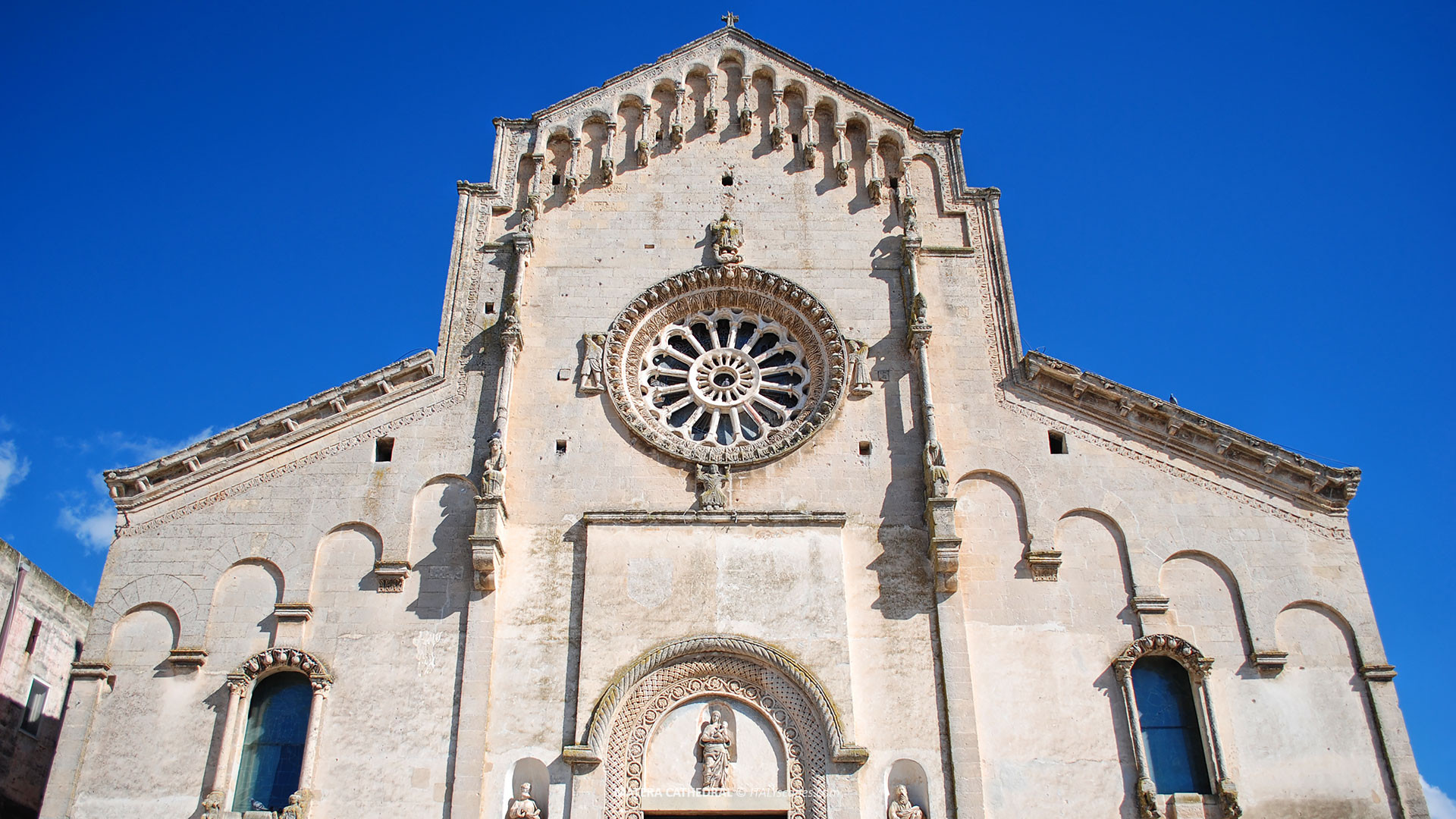
Unlike the interior, which has undergone extensive modifications over the centuries, the exterior of the Matera Cathedral has preserved its original Romanesque-Apulian form almost intact.
The cathedral’s architecture reflects a synthesis of Apulian Romanesque influences and local construction traditions, resulting in a sober yet monumental appearance.
The facade is dominated by a striking rose window with sixteen rays, a symbolic element associated with divine light and cosmic order. Above the rose window stands the figure of the Archangel Michael, reinforcing the protective role of the cathedral over the city below.
At the center of the facade is the main portal, framed by a round arch. Above the portal is a statue of the Madonna della Bruna, affirming her role as patroness of Matera.
Flanking the doorway are the statues of Saint Peter and Saint Paul, the foundational apostles of the Church, whose presence underscores the cathedral’s authority and apostolic continuity.
On the left side of the church rises the imposing bell tower, reaching a height of 52 meters. The tower is articulated into four levels: the first three feature mullioned windows, while the uppermost level has single-light openings.
The structure is crowned by a pyramidal spire, a vertical element that enhances the cathedral’s dominance over the skyline of La Civita.
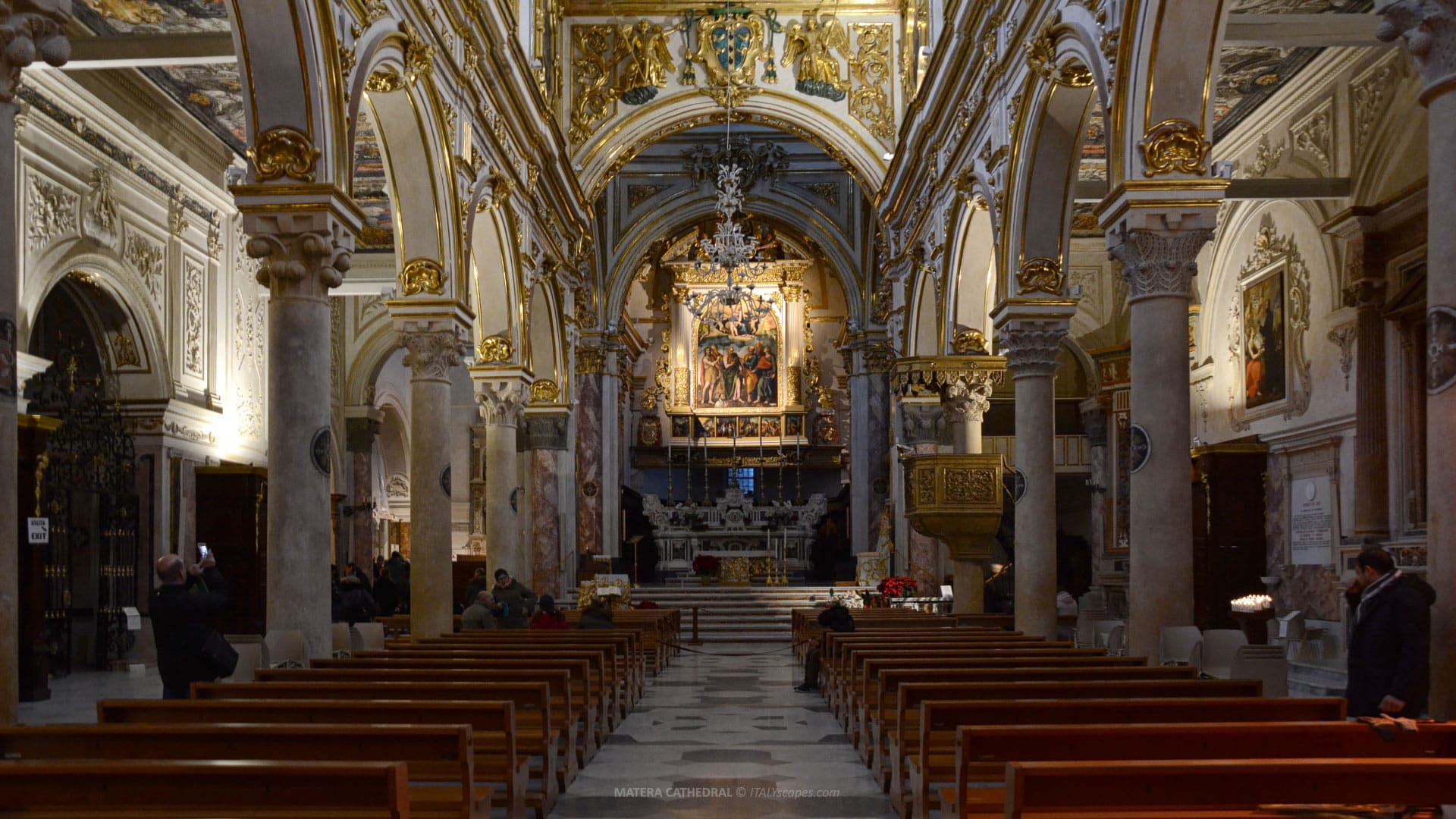
The interior plan follows a Latin cross layout with three naves, the central nave being higher than the lateral ones. The naves are divided by round arches supported by ten columns, each surmounted by carved capitals.
Art of the Cathedral of the Madonna della Bruna
The artistic heritage of the Cathedral of the Madonna della Bruna reflects the complex history of the building, combining medieval foundations with Baroque and later decorative interventions.
While much of the original medieval decoration has been lost or concealed, the cathedral preserves a rich ensemble of artworks that document centuries of devotional practices in Matera.
One of the most significant artistic features of the interior is the Baroque decorative program introduced from the 17th century onward.
Stucco work, ornamental frames, and gilded surfaces were designed to transform the cathedral into a space capable of inspiring devotion through visual splendor.
The extensive use of gold leaf, applied in the 18th century, accentuates architectural lines and altarpieces, creating a luminous atmosphere consistent with Counter-Reformation aesthetics.
The false wooden ceiling, installed in 1719, represents a key artistic element. The ceiling is adorned with three painted panels by Battista Santoro, executed in the 19th century.
Throughout the lateral naves and chapels, visitors encounter a series of side altars, many of which house paintings and sculptural elements from the 17th and 18th centuries.
A highlight of the cathedral is the Chapel of the Annunciation (Cappella dell’Annunziata), located as the penultimate chapel on the left aisle. Dating back to the 16th century, this chapel stands out for its refined architectural and decorative qualities.
The space is characterized by a coffered ceiling and walls articulated with niches, creating a harmonious and intimate setting.
At the center of the chapel’s altar is a sculptural group depicting the Virgin Mary and the Angel Gabriel, capturing the moment of the Annunciation. The figures are flanked by statues of Saint Roch and Saint Catherine of Alexandria, saints particularly venerated for protection and wisdom.
Above the altar, in the lunette, is a Pietà, adding a contemplative dimension that links the mystery of the Incarnation with that of Christ’s Passion.
The chapel exemplifies the transition from Renaissance balance to early Baroque expressiveness, making it one of the most artistically significant spaces within the cathedral.
Matera Cathedral (main nave)
How to Get to the Matera Cathedral
The Matera Cathedral is located approximately 1 kilometer from Matera Centrale railway station. Reaching the cathedral on foot takes about 20 minutes, following a route that leads through the historic areas of the city and gradually ascends toward La Civita.
From the railway station, visitors may also use the Linea Sassi bus service. The bus stops at Piazza San Pietro Barisano, situated about 300 meters from the cathedral, from where a short uphill walk leads to the church.
A bus ticket costs €0.80 when purchased at the ticket office and €1.50 if bought directly on board.
Sources: -
Photos
-
Map
-
Reviews