


-
About
Table of Contents
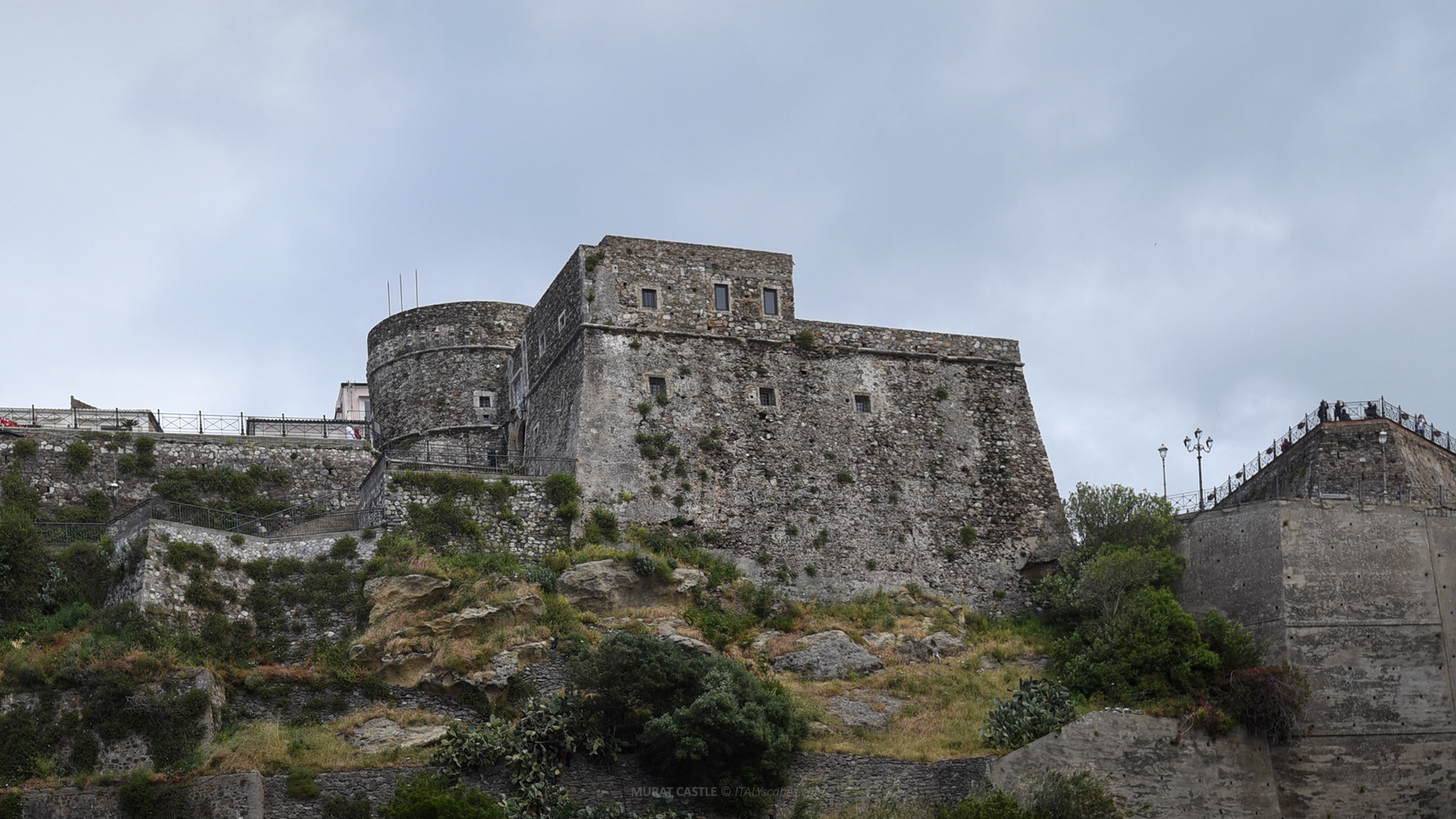
Castello Murat, also known as the Aragonese Castle of Pizzo, is one of the most important historical monuments in Pizzo. The fortress stands on a rocky cliff overlooking the Tyrrhenian Sea, close to the historic center and the marina.
The Murat Castle is closely linked to Joachim Murat, the brother-in-law of Napoleon Bonaparte. Murat was imprisoned here after his failed attempt to regain the Kingdom of Naples in 1815.
Today, Castello Murat functions as a museum dedicated to Joachim Murat and the history of the fortress. Visitors can explore the prison cells, historical rooms, and exhibitions connected to the final days of the former king.
Powered by GetYourGuideJoachim Murat
Joachim Murat was born in 1767 in southern France. He became one of Napoleon Bonaparte’s most important military commanders during the Napoleonic Wars. Murat was famous for his cavalry leadership and for his flamboyant military uniforms.
In 1800, Murat married Caroline Bonaparte, Napoleon’s younger sister. The marriage strengthened his political position inside the French imperial court and increased his influence within the Napoleonic Empire.
King of Naples
In 1808, Napoleon appointed Murat King of Naples. During his reign, Murat introduced administrative reforms, improved parts of the road system, and tried to modernize the kingdom according to French political models.
Although initially loyal to Napoleon, Murat later attempted to protect his own throne by negotiating with Austria. His political position became unstable after Napoleon’s defeat in 1815.
Capture and Execution
In October 1815, Murat landed near Pizzo with a small group of supporters. His goal was to recover the Kingdom of Naples and organize an uprising against the Bourbon monarchy.
The expedition failed almost immediately. Murat was captured by Bourbon forces in Pizzo and imprisoned inside the castle. After a rapid military trial, he was sentenced to death.
On October 13, 1815, Joachim Murat was executed by firing squad inside the castle. According to historical accounts, shortly before his execution, he asked the soldiers to spare his face and aim directly at his heart.
Short History of Castello Murat
Angevin Origins
The oldest section of Castello Murat dates to the late 14th century, during the Angevin domination of southern Italy. The main structure from this period is the Mastia Tower, a massive defensive tower built to protect the coastline.
The tower formed part of a broader coastal defense system created against Saracen and pirate raids. During the Middle Ages, attacks from the sea represented a constant danger for many Calabrian towns.
Aragonese Expansion
During the second half of the 15th century, the fortress was enlarged under the rule of Ferdinand I of Aragon. Construction works started around 1481 and were completed in 1485.
The Aragonese transformed the original Angevin tower into a larger military fortress. They added a rectangular defensive body, additional towers, and observation points facing the marina and the sea routes near Pizzo.
Castello Murat became part of a wider network of Aragonese coastal fortifications in Calabria. Similar defensive structures were developed in cities such as Crotone, Corigliano-Rossano, Cariati, and Reggio Calabria.
Noble Families and State Ownership
In 1505, Ferdinand the Catholic granted the castle to the De Mendoza family. Later, ownership passed to the De Silva family, Dukes of the Infantado, who controlled the fortress for several centuries.
In 1806, the property passed to the state. During the late 19th century, the castle became municipal property after its purchase by the Municipality of Pizzo in 1884.
In 1892, the Italian state officially declared Castello Murat a National Monument. This recognition protected the structure because of its architectural and historical importance.
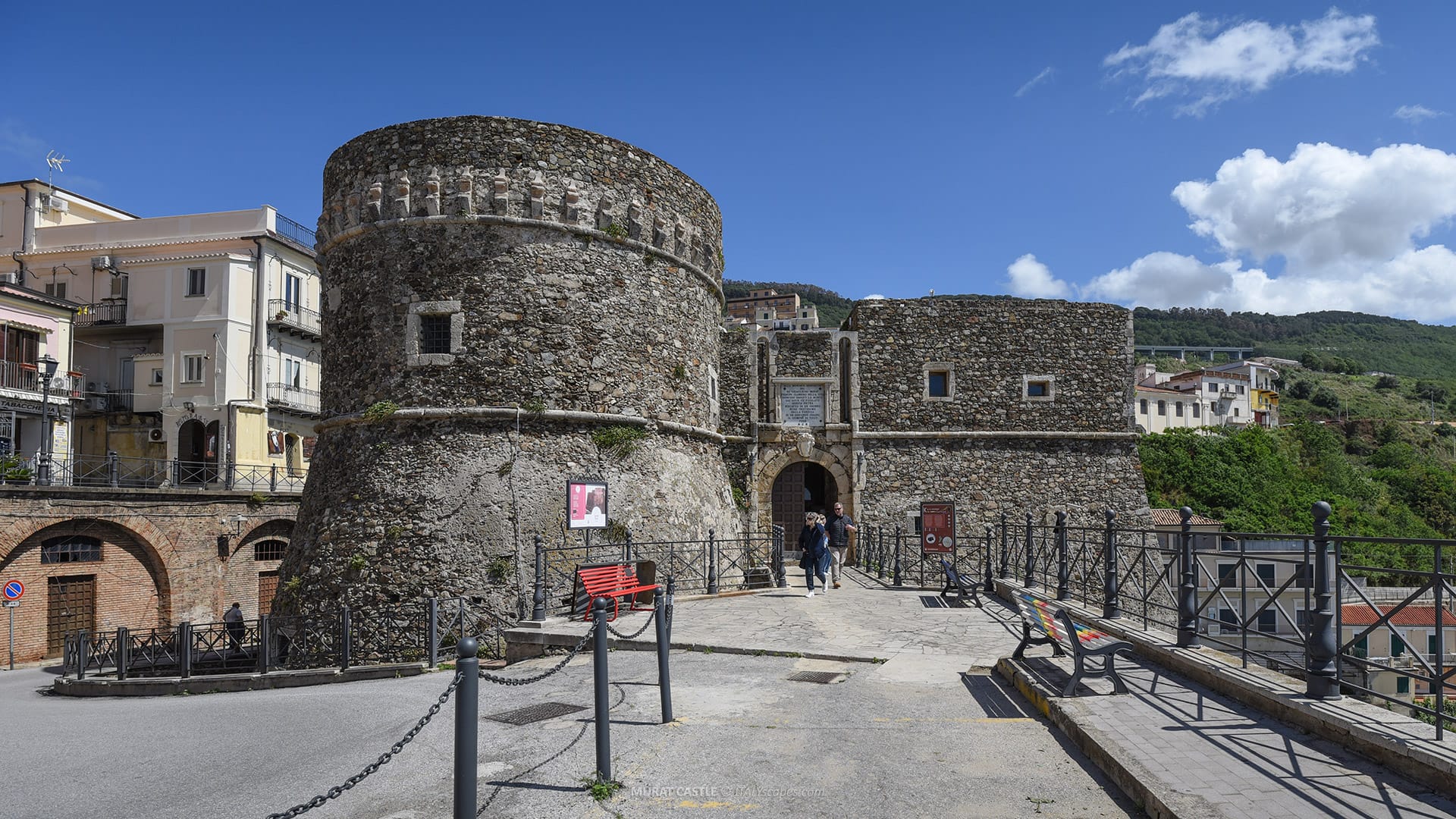
Castello Murat, the main façade
Architecture of Castello Murat
Defensive Structure
Castello Murat has an irregular rectangular layout adapted to the rocky terrain overlooking the sea. Its thick walls and elevated position allowed defenders to monitor maritime traffic and possible attacks.
The Murat Castle includes towers, internal courtyards, defensive walls, and observation points directed toward the Tyrrhenian coast. The structure combines Angevin and Aragonese military architectural elements.
The Mastia Tower
The Mastia Tower (Torre maschia) is the oldest surviving part of the complex. Built during the Angevin period, the tower originally functioned as the main defensive core of the fortress.
Its elevated position offered visibility over the surrounding coastline. The tower also served as a strategic observation point against pirate incursions approaching from the sea.
Position Above the Sea
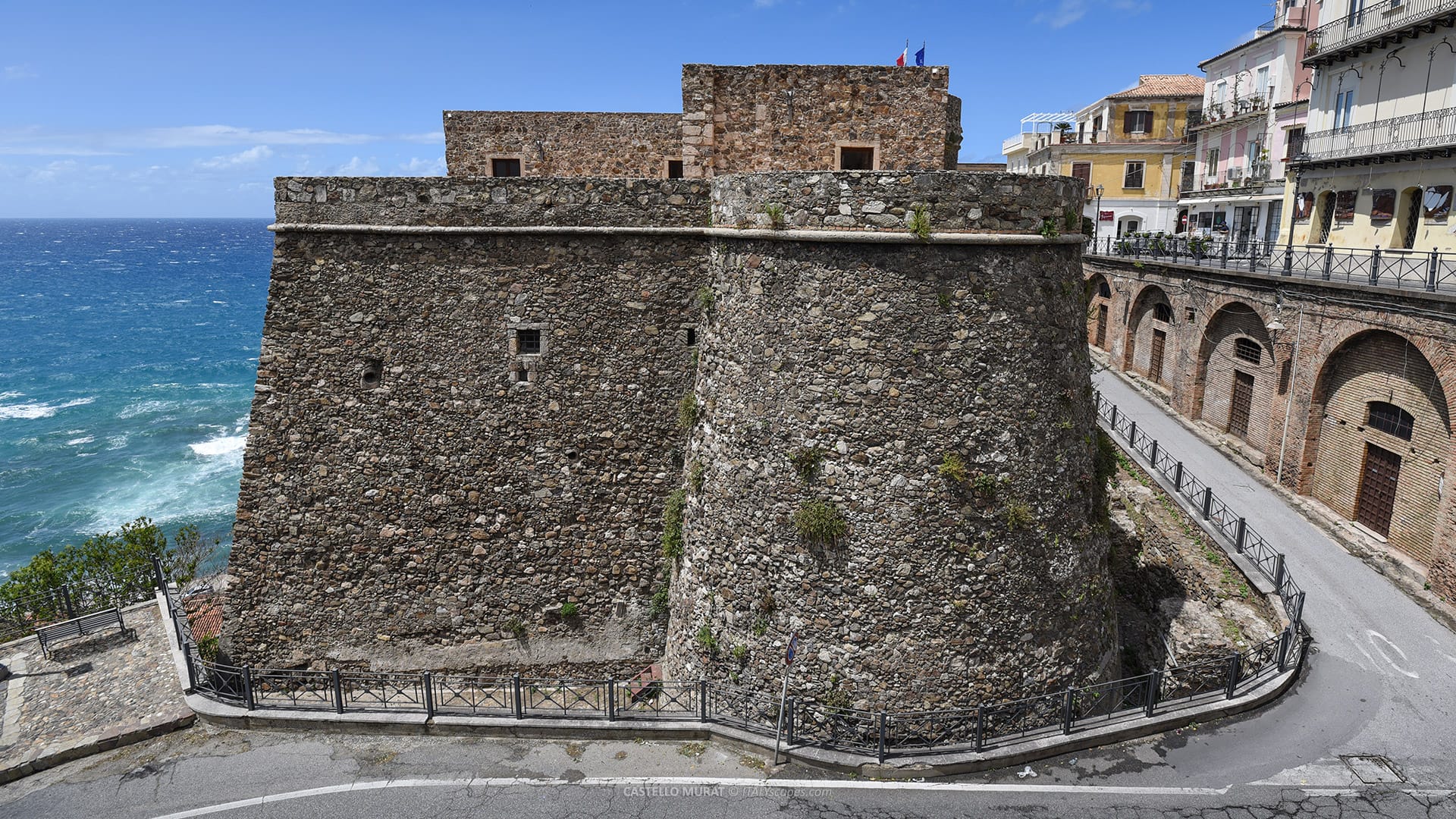
One of the castle’s most distinctive characteristics is its dramatic position above the marina of Pizzo. The Murat Castle rises directly from a rocky cliff facing the Tyrrhenian Sea.
This location gave Castello Murat a strong defensive advantage. It also allowed direct visual control over the coastal routes connecting Calabria with Sicily and other Mediterranean territories.
Cultural Importance
Castello Murat represents one of the main historical attractions in Pizzo and an important symbol of Calabria’s medieval and Napoleonic heritage.
Because of the execution of Joachim Murat, the Murat Castle became internationally associated with the final chapter of the Napoleonic era in Italy.
The monument is also part of the cultural identity of Pizzo. Throughout the year, the Murat Castle attracts visitors interested in military architecture, Italian history, and the political events of the early 19th century.
Murat Museum
The Prison Cells
Today, several rooms inside the castle recreate the imprisonment of Joachim Murat. Visitors can see the underground cell where he was initially held after his capture in Pizzo.
The museum also includes the room where Murat spent his final hours before execution. Historical documents and reproductions describe the atmosphere inside the fortress during the last days of his life.
The Farewell Letter
One of the most important historical elements preserved inside the museum is the memory of Murat’s farewell letter to his wife Caroline and their children.
The letter was written shortly before his execution in October 1815. It remains one of the best-known personal testimonies connected to the final phase of the Napoleonic era in southern Italy.
Historical Exhibitions
The museum contains historical panels, reproductions, portraits, weapons, and documents related to the Napoleonic period and the Kingdom of Naples.
Several rooms use multimedia installations and reconstructed scenes to explain Murat’s arrival in Calabria, his arrest, the military trial, and the execution inside the castle courtyard.
How to Get to Castello Murat
Castello Murat is located in the historic center of Pizzo, in Piazza Musolino, close to the marina and the main panoramic terraces of the town.
Getting to Castello Murat on foot
The castle is approximately 1.4 kilometers from Pizzo railway station. The route can be completed on foot in around 20 minutes.
Getting to Castello Murat by car
The castle is also easily accessible by car through the A2 motorway and the regional road network connecting the Tyrrhenian coast of Calabria.
Frequently Asked Questions about Castello Murat
Where is Castello Murat located?
Castello Murat is located in Pizzo, Calabria, near the historic center and Piazza della Repubblica, on a rocky cliff overlooking the Tyrrhenian Sea.
Why is it called Castello Murat?
The castle is named after Joachim Murat, former King of Naples and Napoleon Bonaparte’s brother-in-law, who was imprisoned and executed here in October 1815.
What is Castello Murat famous for?
Castello Murat is famous for its dramatic sea position, medieval defensive architecture, Murat Museum, prison rooms, and connection to Joachim Murat’s final days.
When was Castello Murat built?
The oldest part dates back to the late 14th century, while the Aragonese expansion began around 1481 and was completed in 1485.
How much does it cost to visit Castello Murat?
The listed ticket price is €5 for a full ticket, €3.50 for a reduced ticket, and free entrance for children under 6 years old.
Sources:Powered by GetYourGuide -
Photos
-
Map
-
Reviews

1 Review on “Murat Castle (Castello Murat)”
Leave a Review

A wonderful historical monument in a gorgeous setting with the bonus of enjoying Pizzo’s scrumptious handmade gelato treat, the tartufo, in one of the many gelato shops.