-
About
Table of Contents
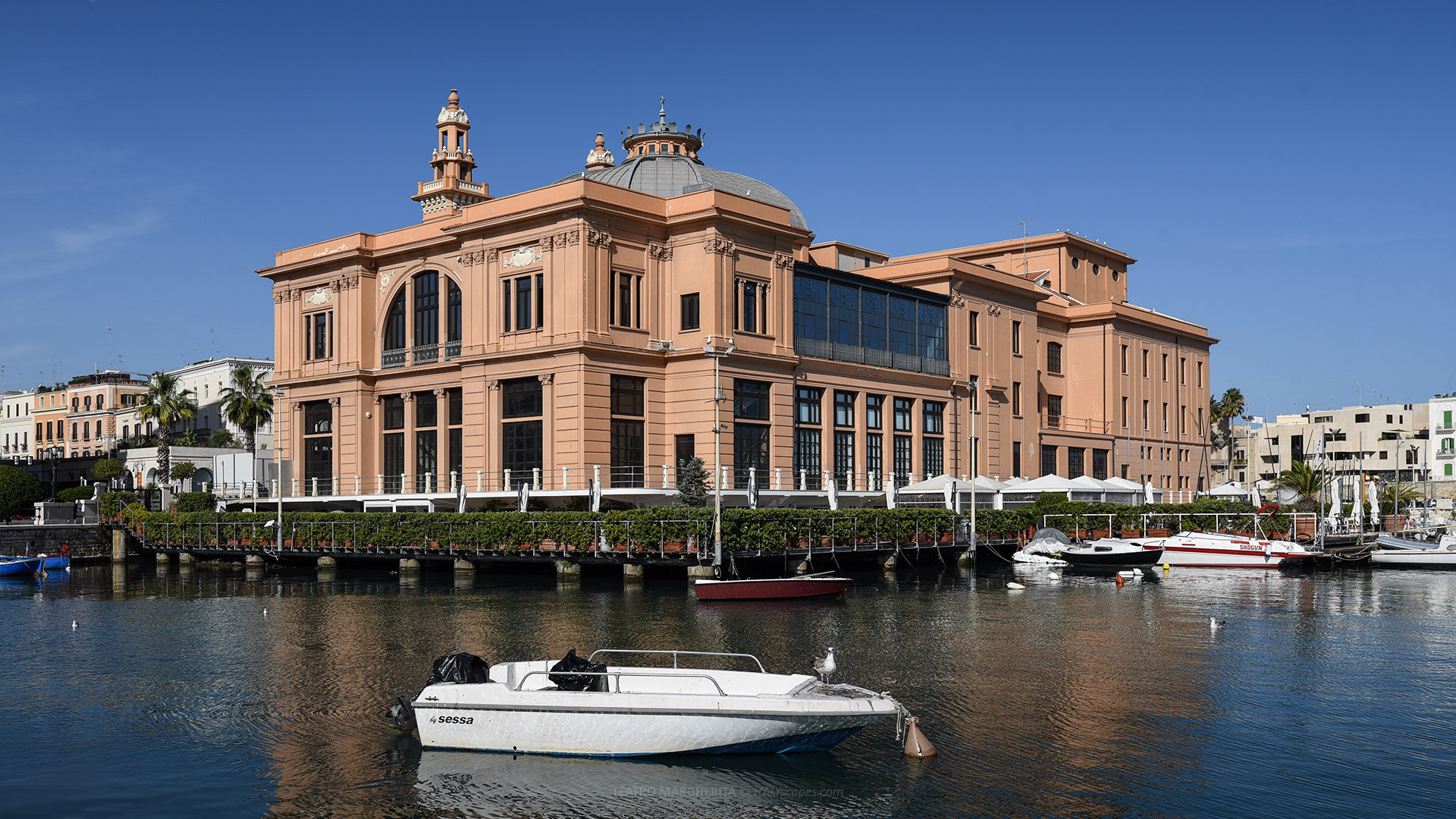
Perched gracefully along the Adriatic coastline of Bari, Teatro Margherita stands as a striking emblem of the city’s cultural past and present.
Once a theatre and cinema, now a revived museum and exhibition space, this elegant Liberty-style building rises from the sea on stilts, offering a unique fusion of architecture, history, and seaside charm.
Its pastel façade, signature towers, and seaside setting make it immediately recognizable; inside, the layout and restored interior speak of ambition, innovation, and resilience.
Visiting Teatro Margherita is more than a stop – it’s a journey through time, from Belle Époque grandeur to contemporary art, floating between land and sea.
Short History of Teatro Margherita
The Beginnings – From Wood to Concrete
The story of Teatro Margherita begins with a predecessor: a wooden theatre named Varietà Margherita, opened on 5 October 1910.
Built on the waterfront, that wooden structure was an early attempt to provide Bari with an entertainment venue distinct from the already established Teatro Petruzzelli.
However, the Varietà Margherita had a tragically short life – just months later, in the early hours of 22 July 1911, it was destroyed by a violent fire that razed the building within an hour. Though the cause was never definitively established, sabotage was not ruled out.
To replace it, the city commissioned a new structure – one ambitious and clever.
Between 1912 and 1914, under architect Francesco De Giglio (with engineering support from Luigi Santarella), the new building was erected directly over the sea on a system of reinforced-concrete stilts (piles).
This clever design exploited the agreement between the municipal authorities and the Petruzzelli family – which forbade any new theaters on municipal land – by building “on the water,” over the maritime zone.
When it opened on 22 August 1914 as the “Kursaal Margherita”, the theatre was among the first buildings in Bari – and among the first in Italy – built in reinforced concrete.
Its lightweight yet robust construction gained recognition across Europe and gave rise to a building technique nicknamed “solaio alla Margherita” (the “Margherita floor slab”).
Years of Grandeur, Decline, and RevivalThroughout the early 20th century, Teatro Margherita served as a versatile performance venue: variety shows, theatre, concerts – becoming a vibrant cultural hub for Bari.
During World War II, the building suffered damage: in 1943 it was occupied by Allied forces, used as a Garrison Theatre and auxiliary club for troops. It also sustained damage from bombings and from the 1945 explosion of the ship Henderson in the harbor.
Post-war, in 1946, it returned to civilian use and was converted into a cinema, a role it maintained until 1979.
After its closure in 1979, Teatro Margherita fell into disuse.
But in 2009, a comprehensive restoration project began. The building’s waterside foundations were consolidated, exterior facades repaired, and the interior refurbished.
By December 2018, the theatre reopened – not as a theatre or cinema, but as a contemporary art museum (often referred to as “Bari Arte Contemporanea”) with exhibitions, cultural events, and renewed public life.
Architecture of Teatro Margherita
A Seaside Masterpiece in Liberty Style
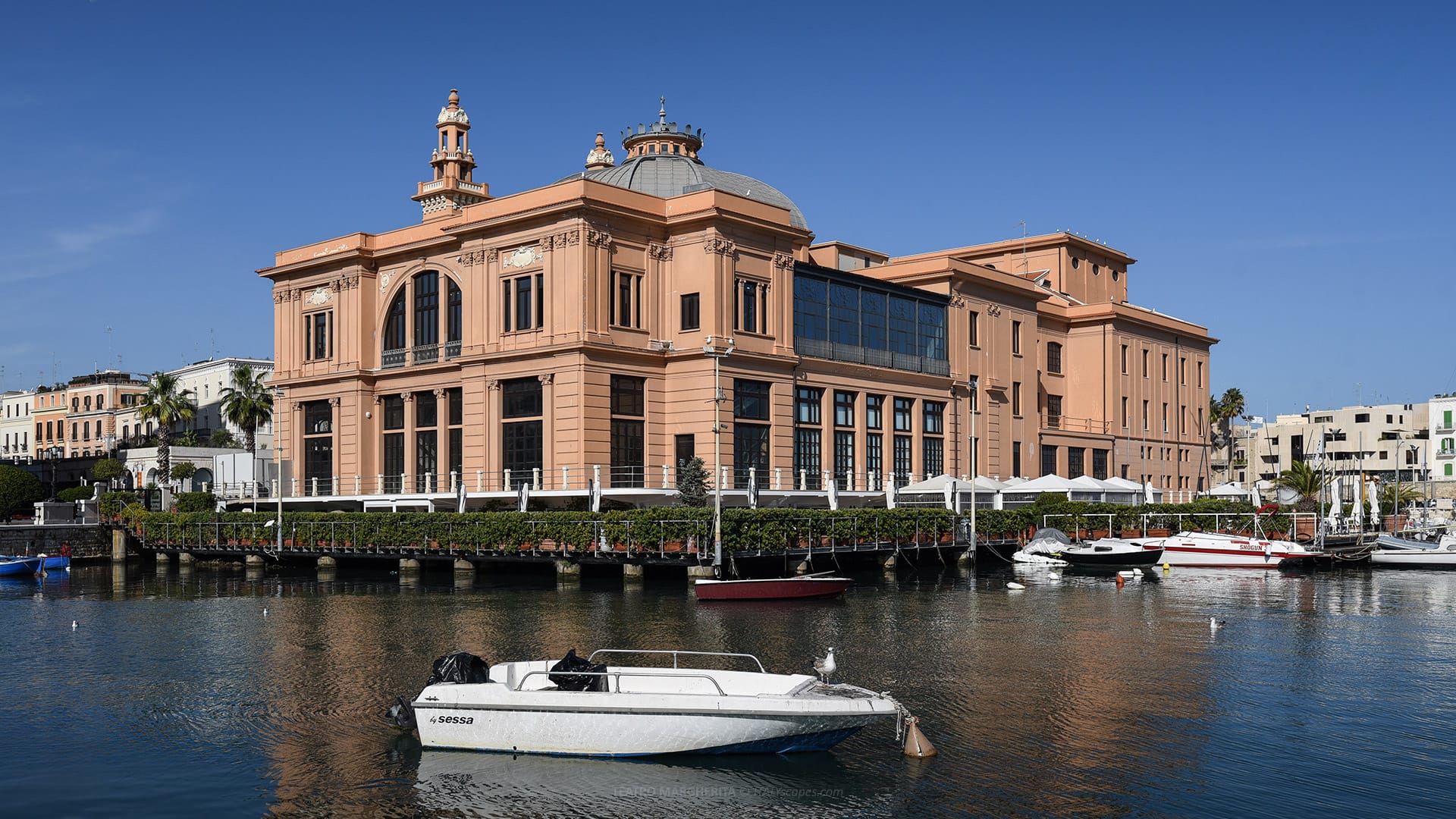
Teatro Margherita is widely celebrated as one of the finest examples of Liberty (Art Nouveau) architecture on the Adriatic coast. Its very construction – on stilts over the sea – already marks it as unique among European theatres.
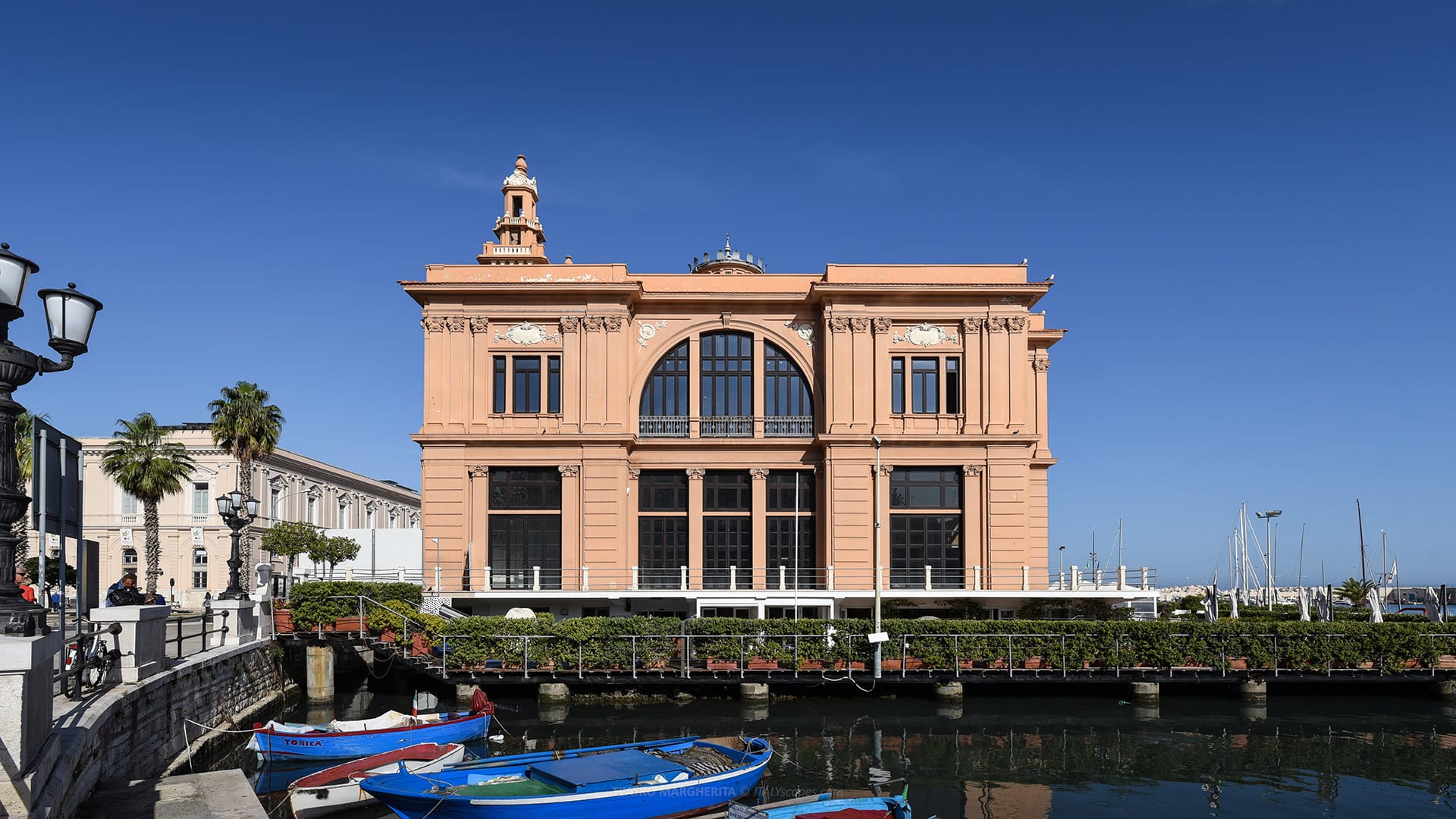
The building presents a rectangular footprint extending seaward, connected to the mainland by a pier.
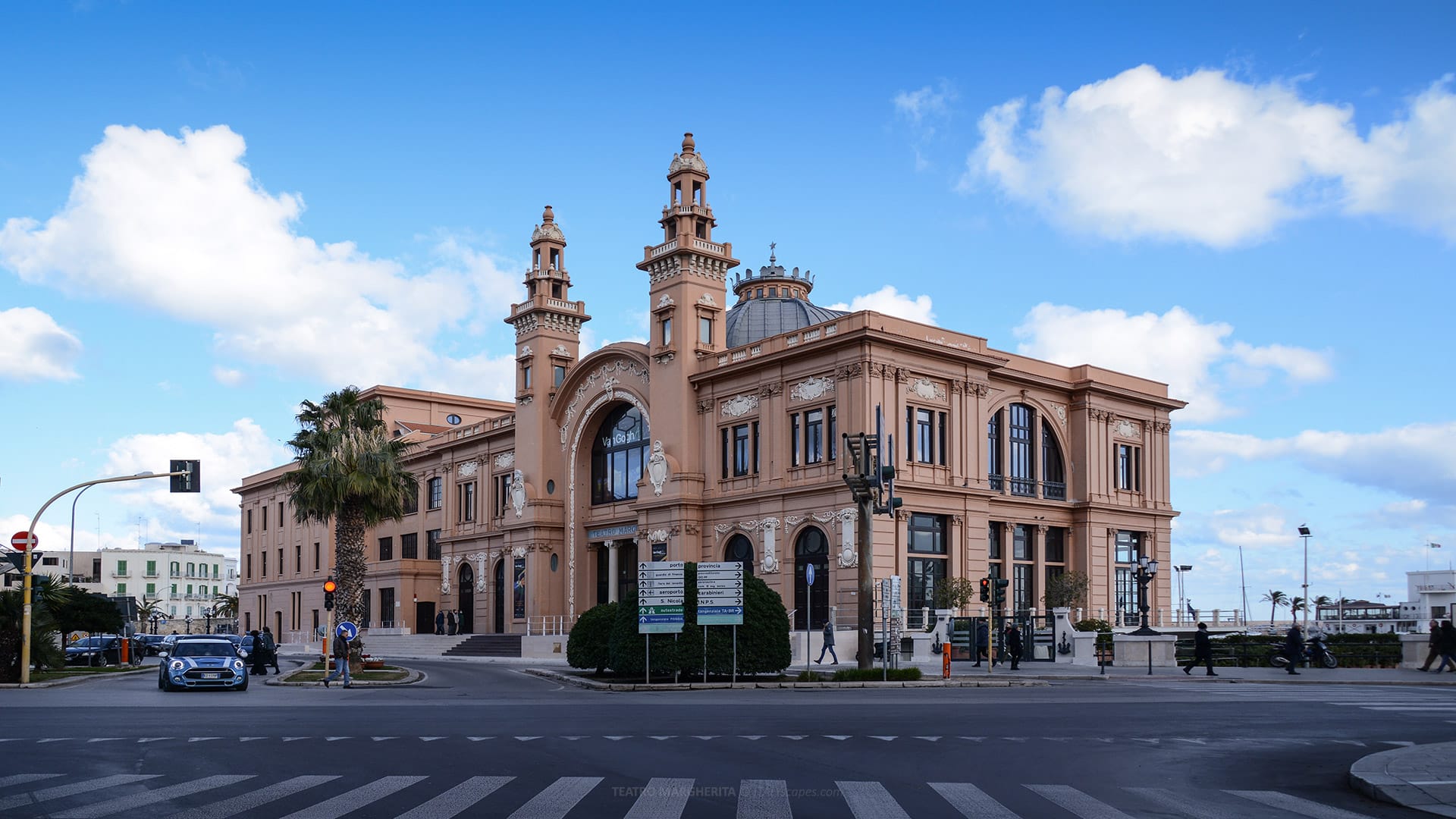
Its façade faces the waterfront promenade (Corso Vittorio Emanuele II / Lungomare), with a grand central arch flanked by two towers topped with pinnacles and decorative finials.
Large arched windows, Corinthian pilasters and ornamental details complete the elegant frontage – a blend of structural ingenuity and aesthetic refinement.
At the time of construction, the theatre boasted a lightweight but resilient floor system: a reinforced-concrete slab with hollow clay tiles (pignatte), which allowed long, open interior spans – perfect for a large auditorium – while minimizing load on the marine piles.
This construction method proved so successful that it became a reference throughout Italy and even beyond.
Interior Layout and AdaptationAlthough Teatro Margherita was originally conceived for theatre and live performance, with a large hall and seating for many spectators, over time – and especially after its complete restoration – the internal spaces have been adapted for modern use as exhibition halls, contemporary art galleries, and event venues.
The project of 2016-2018 reorganized interior circulation, restored decorative details where possible, and introduced scenographic staircases, expanded galleries, a restored dome, and modern amenities – while carefully preserving the historical character.
From the outside, Teatro Margherita still looks like an elegant palace perched above water – and from the ground it remains one of Bari’s most evocative landmarks, blending sea view, architectural elegance, and cultural identity.
How to Get to Teatro Margherita
Getting to Teatro Margherita in Bari is quite straightforward thanks to its central, seafront location. Here are the main ways to reach it:
On Foot: If you are staying in Bari’s historic center or near the seafront, walking to Teatro Margherita is the easiest and most pleasant option.
The theatre is located along the waterfront – Lungomare Imperatore Augusto / Corso Vittorio Emanuele II – just a few minutes’ walk from major city landmarks, the old port and other attractions.
A stroll along the seafront promenade also offers nice views of the Adriatic, fishing boats, and other seaside charm before you arrive at Teatro Margherita’s distinctive towers rising over the water.
By Bus: If you arrive at Bari Centrale railway station and prefer public transport, local buses can take you close to the waterfront. The local bus network – operated by AMTAB – serves the city center and seafront; you should aim for stops near the Lungomare or near Corso Vittorio Emanuele II.
From the bus stop, Teatro Margherita will be a short and pleasant walk: you’ll reach the squared promenade, and soon spot the theatre’s towers, arches and seafront façade.
Because of the theatre’s location – directly on the waterfront – using public transport or walking can often be easier than driving, especially considering restricted or limited parking near the historic center.
By Taxi or Private Transfer: For travelers with luggage or arriving late, a taxi from Bari Centrale station or from the airport is a convenient option.
The ride to Teatro Margherita typically takes around 10-15 minutes depending on traffic, given its seafront position and relative proximity to the city center.
Because the theatre lies on or near the coastline and within the city core, a taxi can drop you very close – often just a few steps away – from the main entrance or the promenade, making it a comfortable choice for first-time visitors or those with limited mobility.
Sources: -
Photos
-
Map
-
Reviews