-
About
Table of Contents
The Cathedral of Santa Maria Annunciata is the main Roman Catholic church of Vicenza and the seat of the Diocese of Vicenza. It stands in Piazza Duomo, in the historic center, and is dedicated to the Annunciation of the Virgin Mary.
The Vicenza Cathedral is important because it preserves many layers of Vicenza’s religious history, from Roman structures and an early Christian worship space to medieval rebuilding, late Gothic architecture, Renaissance interventions, Palladian additions, and post-war reconstruction.
Its archaeological area, chapels, presbytery, and artworks make it one of the key religious monuments in Vicenza.

Vicenza Cathedral seen from Piazza del Duomo
Short History of the Cathedral of Santa Maria Annunciata (Vicenza Cathedral)
Roman and Early Christian Origins
Studies carried out in the 20th century identified an early Christian worship space on the site of the Cathedral of Santa Maria Annunciata. This first Christian nucleus probably reused parts of a Roman building from the 1st century AD, located in an important urban area of ancient Vicetia.
Below the present cathedral, archaeologists found Roman walls, mosaic pavements, heated rooms, and a paved road running about 3 meters below today’s floor level. These remains show that the cathedral stands over a prestigious Roman residential area, later adapted for Christian use.
After the Edict of Constantine in 313, a first public Christian church was probably built here. It was a small rectangular building with an apse, using pre-existing Roman structures.
In the second half of the 5th century, a larger basilica was built on the same site. It had three naves, a semicircular apse, a polychrome mosaic floor, and inscriptions recording donors. This basilica was dedicated to Saint Euphemia and served Vicenza during the Longobard and Carolingian periods.
Medieval Rebuilding and Episcopal Role
Around the early Middle Ages, the church was modified again, probably between the 7th and 8th centuries. Later, in the Carolingian period, it was rebuilt with three naves and three apses, incorporating earlier structures. The massive square base of the bell tower also belongs to this medieval phase.
The first documented mention of the church as episcopal seat dates to 1066. By this time, the building was clearly the episcopal church of Vicenza, and its dedication had shifted toward Santa Maria Annunciata, the Announced Virgin.
In the 10th and 11th centuries, under Bishop Girolamo, the cathedral was transformed into a larger building with five naves and a grand three-apse arrangement. Excavations under the present crypt revealed this earlier layout, which was about 25 meters wide and divided into seven bays.
The earthquake of 1117 damaged the building, but the cathedral remained central to civic and religious life. Documents record public assemblies held in the Duomo in 1164, 1167, and 1189, when the full council of the Comune met there under the presidency of the bishop.
The 13th-Century and Late Gothic Cathedral
The cathedral was badly affected by the sack of Vicenza by the troops of Frederick II in 1236. In the second half of the 13th century, a new cathedral was built. An inscription on the southern doorway records the completion of works in 1290, during the episcopate of Pietro De Saracenis.
Later medieval changes, especially the opening of side chapels, weakened the main walls. By 1430, the structure required major rebuilding. The great late Gothic reconstruction lasted from 1444 to 1467, under bishops Pietro Barbo and Marco Barbo.
During this 15th-century phase, the upper windows of the central nave were opened, the side chapels were reorganized, and the four-part façade was recomposed. The date 1467 and the invocation “Ave Maria” can still be read in the lozenges under the small arches of the second façade register.
The present Gothic façade belongs to this late medieval rebuilding. The large circular opening between the pilasters of the second order was added in 1493, after the main façade arrangement had already been completed.
Renaissance Works and Palladio
The new main chapel and apse were planned in the late 15th century by Lorenzo da Bologna. Work on the apse began in 1482, but the project remained incomplete for decades. In 1540, a temporary roof was built because Vicenza was considered as a possible seat for the council later held in Trento.
Only in 1557 did the Comune obtain the funds needed to complete the apse, thanks to a legacy left by Bishop Zeno. Andrea Palladio then prepared the final design. From 1558 to 1559, the cornice and drum were built, and from 1564 to January 1566, the dome was placed in position.
The north portal of the cathedral is also connected with Palladio. In 1560, the canon Paolo Almerico asked permission to build a door on the northern side at his own expense. The portal was opened in 1565, probably for the entry of Bishop Matteo Priuli.
Paolo Almerico later commissioned Palladio to design the famous Villa Almerico Capra, known as La Rotonda. This connection makes the cathedral’s north portal especially important for understanding Palladio’s work in Vicenza, even though the attribution has been debated by scholars.
War Damage and Modern Restoration
During the First World War, the Cathedral of Santa Maria Annunciata was not seriously damaged. In the Second World War, however, it suffered heavy destruction. The bombing of 14 May 1944, followed by air raids on 4 January 1945 and 18 March 1945, devastated large parts of the building.
The nave was badly damaged, the vaults of the nave and chapels burned, the southern chapels and façade were injured, and many frescoes, paintings, and altars were lost. The northern chapels and the apse were not destroyed, which explains why some historic elements survived the war.
The main post-war reconstruction was carried out between 1946 and 1950, under Bishop Carlo Zinato, with work by Ferdinando Forlati and Giuseppe Chemello. Later restorations began in 1988 and continued until 2001-2002, restoring the presbytery’s decorative system.
In 2009, the liturgical furnishings of the presbytery were redesigned by the sculptor Pino Castagna. This modern intervention belongs to the long sequence of changes that shaped the cathedral, from Roman foundations and medieval rebuilding to Renaissance additions and contemporary restoration.
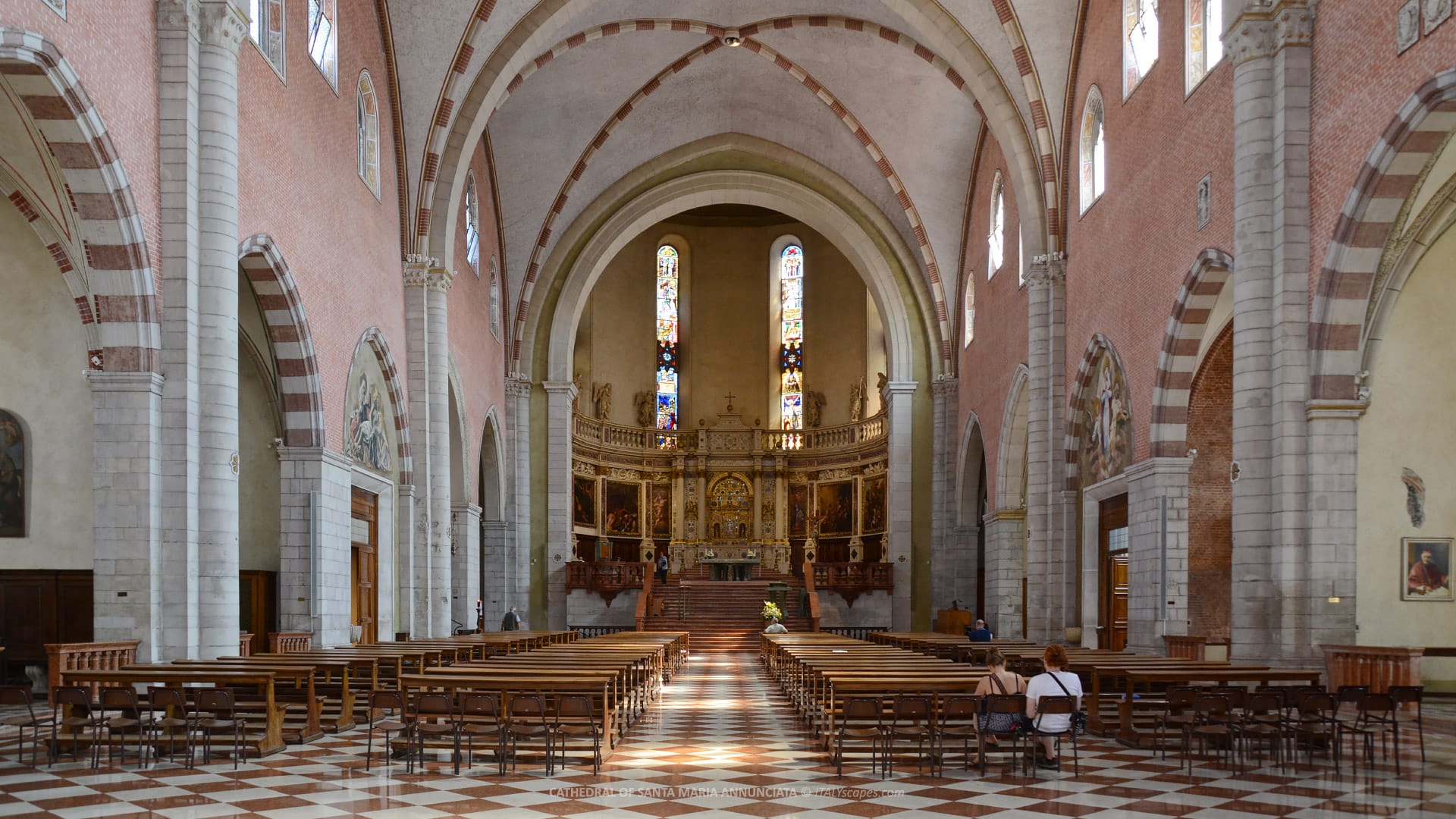
Interior of the Cathedral of Santa Maria Annunciata
Architecture of the Cathedral of Santa Maria Annunciata (Vicenza Cathedral)
Façade and Exterior
The façade of the Cathedral of Santa Maria Annunciata is late Gothic and is traditionally attributed to Domenico da Venezia. It has a bichrome surface and is divided into four horizontal sectors, giving the front a clear architectural structure despite the many phases of construction.
The lower sector has five deep arches, while the second is divided by pilasters and includes the large circular opening added in 1493. The third sector is simpler and smoother, and the upper register is decorated with five statues and two pinnacles added in 1948.
The façade is one of the most recognizable elements of Vicenza Cathedral because it survived the Second World War better than the nave. Its late Gothic appearance contrasts with the Renaissance and Palladian elements at the rear and on the northern side, showing the long chronology of the building.
The cathedral is slightly separated from its bell tower, which stands along the street on the southern side. The tower is not a single-phase structure: its 10th-century base and 12th-century elevation show different materials, techniques, and medieval additions.
North Portal and Palladian Dome
The north portal was built in 1564-1565 and commissioned by Paolo Almerico. It is formed as a small architectural frame with Corinthian pilasters, an entablature with an inscription, a rectangular opening, a curved frieze, and a mascaron between festoons.
The portal uses pietra di Vicenza for the doorway and capitals, while the pilasters are in masonry. Its composition, with an architraved door inserted inside another architraved frame, is linked to Palladian solutions also found in other works associated with the architect.
The apse and dome form the most important Renaissance part of the Cathedral of Santa Maria Annunciata. The apse project began with Lorenzo da Bologna, but the final completion was directed by Andrea Palladio after funding became available in 1557.
Palladio’s work was executed in two stages: the drum and cornice from 1558 to 1559, and the dome from 1564 to January 1566. The lantern has an abstract, almost undecorated form, later echoed in Palladio’s designs for domes in Venice and in his studies of ancient centralized temples.
Interior and Chapels
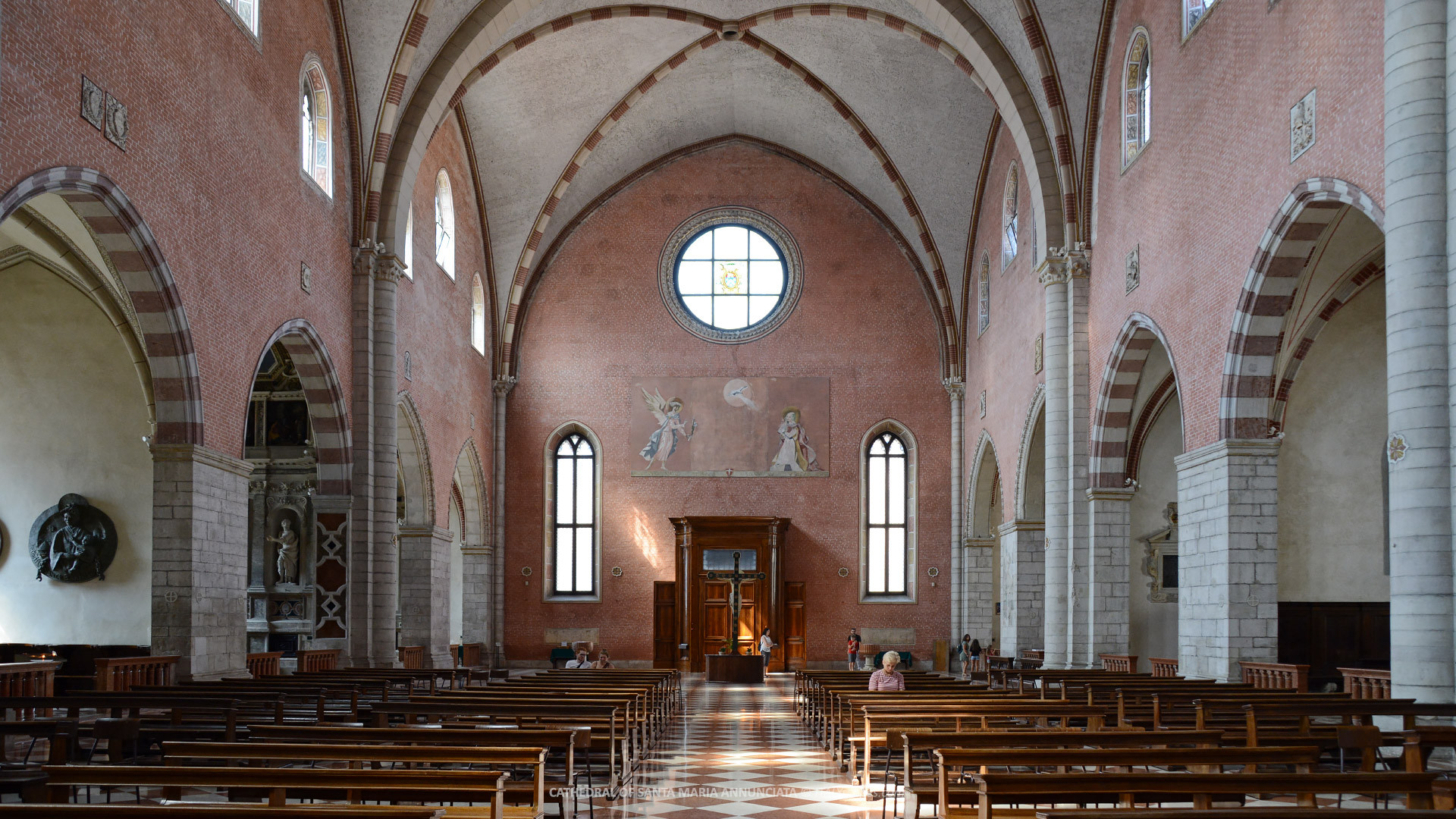
The interior of the cathedral is Gothic in character, with a single nave, cross vaults, and side chapels opening along the walls. The current interior is the result of medieval planning, later transformations, wartime destruction, and post-war reconstruction.
The building measures about 79 meters in length and 18 meters in width. The nave is divided into four bays, and the side walls include fourteen chapels. These chapels were mainly created between the 14th and 15th centuries by noble families of Vicenza.
The chapels on the right side are generally rectangular, while those on the left are larger and often end in polygonal apses.
At the end of the nave stands the raised presbytery, placed above the crypt and connected with the polygonal apse. This elevated arrangement recalls Cistercian Gothic solutions and gives the sanctuary a strong visual separation from the main body of the church.
Presbytery and Archaeological Area
The main altar, known as the Dall’Acqua altar, was commissioned by the jurist Aurelio Dall’Acqua in 1535. It was made by Giovanni da Pedemuro and Girolamo Pittoni, using polychrome marble, and was later moved to the back wall of the apse.
Between 1675 and 1682, the altar was integrated into the monumental Paramento Civran, an architectural screen in stucco and marmorino. This large presbytery decoration frames twelve major canvases and creates one of the most important Baroque ensembles inside the cathedral.
Below the Cathedral of Santa Maria Annunciata extends an archaeological area of about 750 square meters. It contains Roman remains, traces of an early Christian domus ecclesiae, Longobard-Carolingian structures, Romanesque remains, and parts of later medieval phases.
The underground area also preserves a Roman paved road and a Roman milestone with a dedication to Emperor Gratian. The route was reopened to the public on 20 December 2014, after restoration and environmental works carried out between 2000 and 2003.
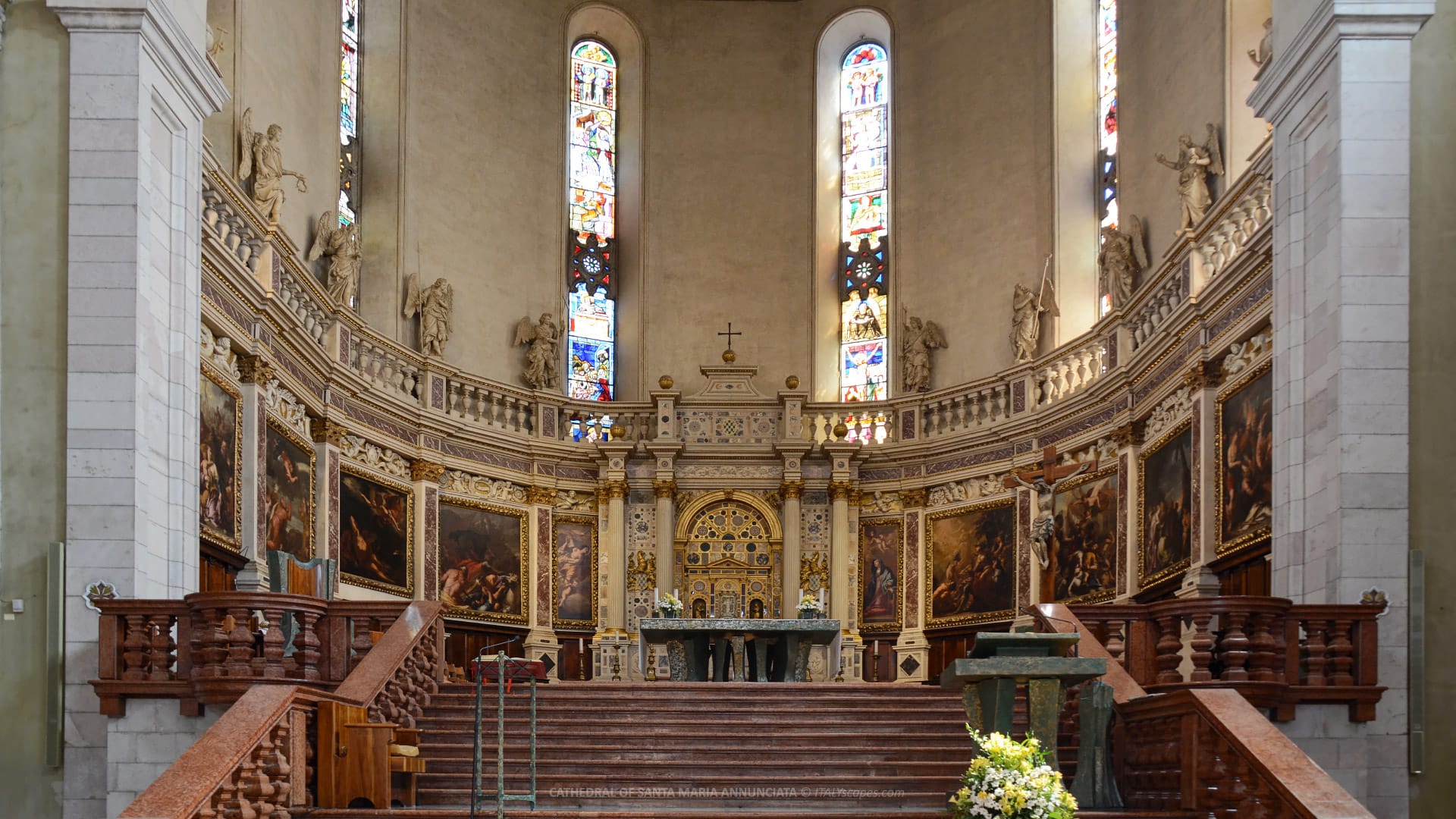
The presbytery of Vicenza Cathedral with the Paramento Civran
Art of the Cathedral of Santa Maria Annunciata (Vicenza Cathedral)
The Presbytery and the Paramento Civran
The most important decorative ensemble in Vicenza Cathedral is the Paramento Civran, located on the wall of the apse around the main altar. It was made between 1675 and 1682 and consists of stucco and marmorino architecture framing large canvases.
The canvases of the Paramento Civran include scenes from the Old Testament, episodes connected with Constantine and the True Cross, and two Annunciation scenes placed beside the altar. The overall theme is the triumph of the Cross and salvation.
Several Venetian painters of the second half of the 17th century contributed to the cycle. Artists connected with it include Antonio Zanchi, Andrea Celesti, Pietro Liberi, Giovanni Antonio Fumiani, and Giovanni Carboncino, representing both post-Caravaggesque naturalism and a brighter Venetian tendency.
The presbytery also contains the modern liturgical furnishings installed in 2009 by Pino Castagna. These works were not intended to erase the historical setting, but to provide a contemporary liturgical arrangement within the restored ancient and Baroque structure.
Artworks in the Left Chapels
The first chapel on the left is the Thiene or Passion Chapel. It contains the funerary monument of Lavinia Thiene, made by Giulio Romano in 1544, and a cenotaph connected with the Thiene family and Saint Gaetano di Thiene.
The second chapel on the left preserves Adoration of the Virgin with Angels, painted by Alessandro Maganza in 1581. The third chapel on the left is dedicated to the Loschi family and includes funerary monuments to Alfonso Loschi and Antonio Loschi.
The fourth chapel on the left contains Madonna and Child with Saints Mary Magdalene and Lucy by Bartolomeo Montagna. The fifth chapel, known as the Chapel of the Incoronata or Gonfalone, was built in 1426 and preserves a 1448 polychrome stone relief of the Coronation of the Virgin.
Artworks in the Right Chapels
The first chapel on the right contains the baptismal font, made by the Sguarise stonecutters after a design by Antonio Bernati. Its cover includes a small 17th-century statue of Saint John the Baptist by Girolamo Albanese.
The second chapel on the right, dedicated to the Fracanzani family, contains a polychrome altar with a painting of Saint Gaetano di Thiene in prayer, attributed to Giulio Carpioni. The chapel reflects family devotion and links between Vicenza and noble lineages.
The third chapel on the right, dedicated to Saints James and Anthony Abbot, preserves the Dormitio Virginis polyptych by Lorenzo Veneziano, dated 1366. This is one of the most important medieval artworks still associated with the cathedral.
The fourth right chapel, dedicated to Saint Jerome, is the oldest chapel and was founded in 1383 by Bishop Giovanni de Surdis. It contains 16th-century funerary monuments to Girolamo and Giovanni Battista Gualdo, with busts by Alessandro Vittoria from 1574.
Later Works, Organ, and Modern Elements
Other works in the right chapels include Adoration of the Magi by Francesco Maffei, a 1744 altarpiece by Giambattista Pittoni, and a 1650 painting by Giulio Carpioni showing the Madonna and Child enthroned between Saint John the Baptist and Saint Anthony of Padua.
The cathedral also contains modern bronze medallions representing Saint Josephine Bakhita and Saint Maria Bertilla Boscardin. These works connect the old cathedral with more recent saints linked to the wider religious history of Vicenza and the Veneto.
The pipe organ is the Mascioni opus 721, built between 1955 and 1956 and now located in the last chapel on the right. It has electro-pneumatic transmission, three 61-note keyboards, a 32-note pedalboard, and 58 stops.
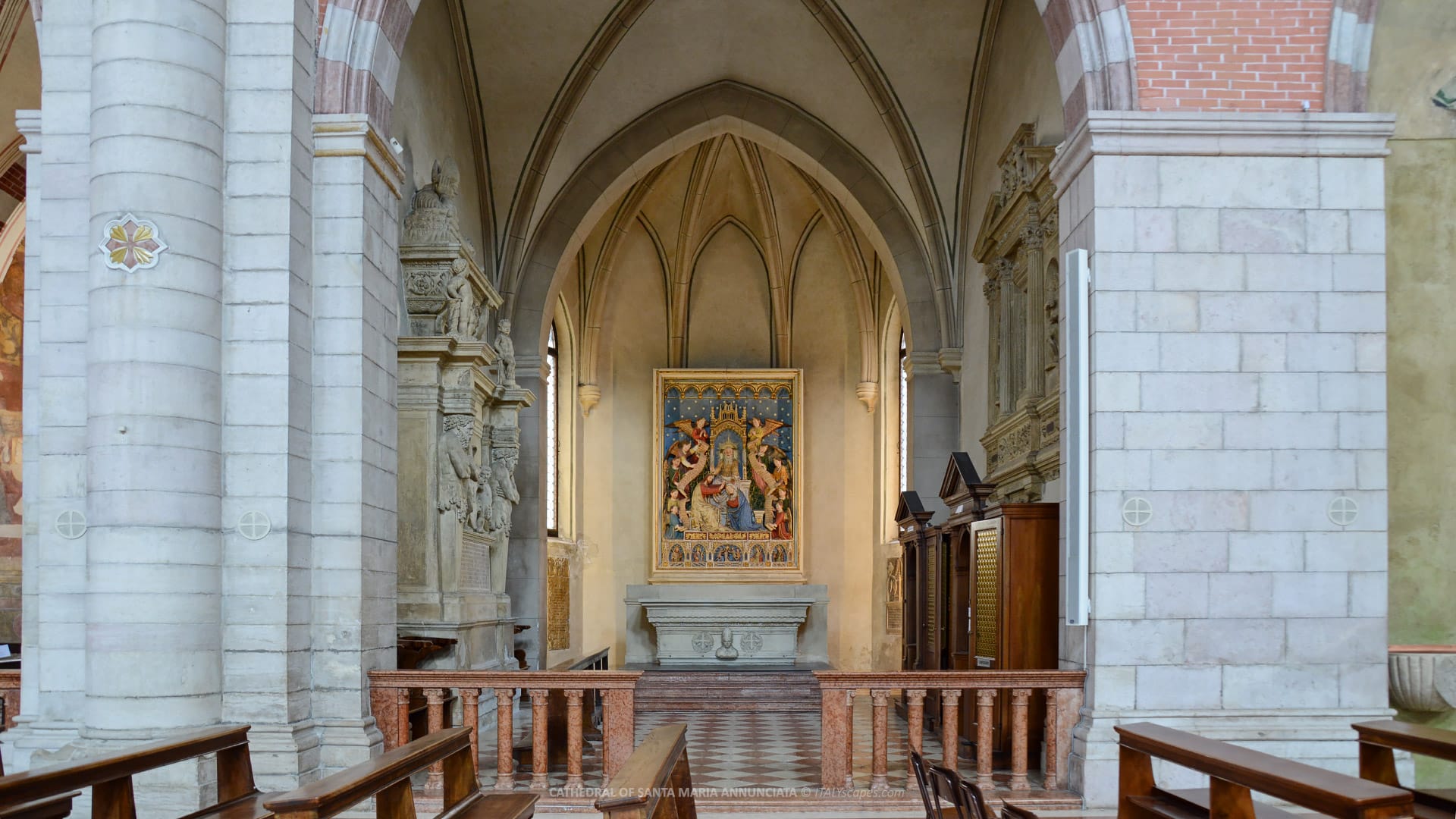
Chapel of the Incoronata or Gonfalone
How to Get to the Cathedral of Santa Maria Annunciata (Vicenza Cathedral)
Getting to the Cathedral of Santa Maria Annunciata on foot
The Cathedral of Santa Maria Annunciata is located in Piazza Duomo, in the historic center of Vicenza. From Vicenza railway station, the walk is about 650-700 meters and usually takes 8-10 minutes, depending on the route and pace.
The route is straightforward: leave the station area, continue toward Viale Roma, enter the historic center near Piazza Castello, and continue toward Piazza Duomo. The cathedral is also within easy walking distance of Corso Palladio, Piazza dei Signori, and the Diocesan Museum.
Getting to the Cathedral of Santa Maria Annunciata by bus
The closest practical bus stops are around Piazza Castello, about 180 meters from the cathedral. Several urban and suburban SVT lines stop in this central area, including main city routes that connect the railway station, the historic center, and outer districts.
Because local routes and timetables can change, visitors should check the current SVT schedule before traveling. From Piazza Castello, the cathedral is only a short walk through the historic center, making the bus useful mainly for visitors arriving from outside the central pedestrian area.
Getting to the Cathedral of Santa Maria Annunciata by taxi
A taxi is useful for visitors with luggage, limited mobility, or little time. Official taxi ranks in Vicenza include Piazzale della Stazione and the Castello rank on Corso Andrea Palladio.
From Vicenza railway station to Piazza Duomo, the ride is short, usually only a few minutes in normal traffic. Because the cathedral stands in the historic center, taxis may stop at the nearest accessible point rather than directly in front of the entrance.
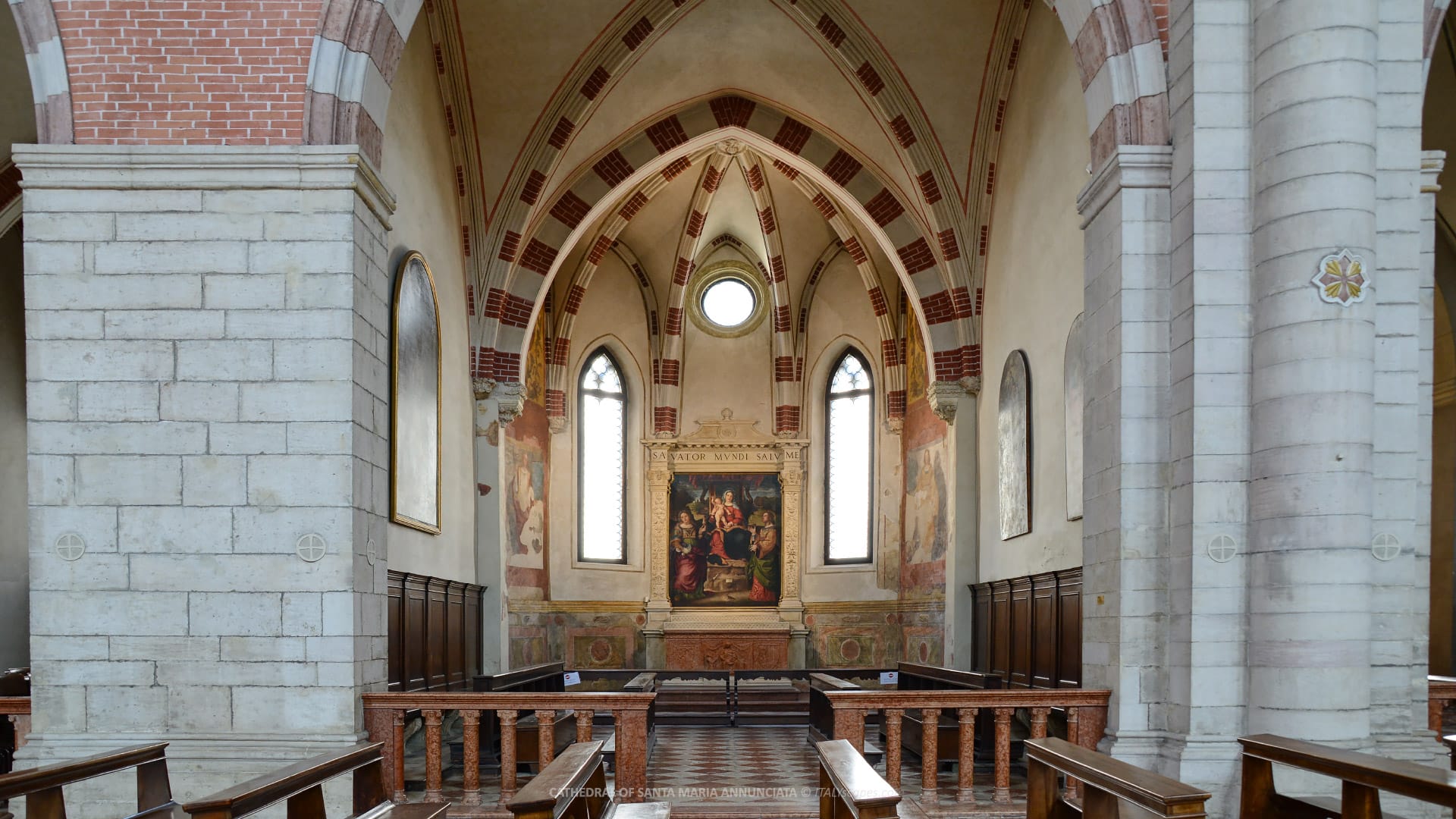
Madonna and Child with Saints Mary Magdalene and Lucy by Bartolomeo Montagna
Frequently Asked Questions about the Cathedral of Santa Maria Annunciata (Vicenza Cathedral)
Where is the Cathedral of Santa Maria Annunciata located?
The Cathedral of Santa Maria Annunciata is located in Piazza Duomo, in the historic center of Vicenza. It stands close to the Diocesan Museum, Corso Palladio, and Piazza dei Signori.
What is the Cathedral of Santa Maria Annunciata dedicated to?
The cathedral is dedicated to the Annunciation of the Virgin Mary. This dedication explains the name Santa Maria Annunciata and the repeated Marian references in the façade and decoration.
Is the cathedral part of the UNESCO World Heritage Site?
The cathedral’s Palladian dome and north portal are included in the UNESCO World Heritage Site connected with Vicenza and the Palladian villas of the Veneto, recognized in 1994.
Who designed the dome of Vicenza Cathedral?
The dome was designed by Andrea Palladio. The drum was built from 1558 to 1559, and the dome itself was placed between 1564 and January 1566.
What are the most important artworks inside Vicenza Cathedral?
Important works include the Paramento Civran, the Dall’Acqua altar, Lorenzo Veneziano’s Dormitio Virginis polyptych, Giulio Romano’s monument to Lavinia Thiene, and paintings by Bartolomeo Montagna, Alessandro Maganza, Giulio Carpioni, Francesco Maffei, and Giambattista Pittoni.
Can visitors see the archaeological area under the cathedral?
Yes, but visits to the underground archaeological area are managed separately. The area covers about 750 square meters and preserves Roman remains, early Christian structures, medieval churches, a Roman road, and a milestone.
Is there an entrance fee to visit the cathedral?
Entry to the church itself is generally free, though visits may be restricted during religious services. The archaeological area and guided visits may require a separate ticket or reservation through the Diocesan Museum.
Sources: -
Photos
-
Map
-
Reviews