


-
About
Table of Contents
The Cathedral of San Martino is the cathedral church of Lucca and the principal place of worship of the Roman Catholic Archdiocese of Lucca. It stands in Piazza San Martino, close to Piazza Antelminelli and the former episcopal complex, within the southeastern part of the city’s walled historical center.
Dedicated to Saint Martin of Tours, the Cathedral of San Martino developed from an early medieval religious building traditionally attributed to Bishop Frediano. Its present appearance records several major building phases, combining a richly decorated Romanesque exterior with a tall, predominantly Gothic interior created through successive medieval and Renaissance interventions.
The Lucca Cathedral is especially important for three reasons: its asymmetrical marble façade, the venerated wooden crucifix known as the Volto Santo di Lucca, and the marble Funerary Monument of Ilaria del Carretto by Jacopo della Quercia. Together, these elements connect architecture, pilgrimage, civic identity, and artistic patronage.
The cathedral also formed part of a wider episcopal and liturgical complex that included the nearby Church of Santi Giovanni e Reparata, its baptistery, ecclesiastical buildings, and spaces now incorporated into the Cathedral Museum and archaeological itinerary. This concentration of monuments preserves evidence from Roman, early Christian, medieval, and later periods.

The façade of the Cathedral of San Martino
Short History of the Cathedral of San Martino (Lucca Cathedral)
From the Early Church to Cathedral Status
The earliest church preceding Lucca Cathedral is traditionally associated with San Frediano, Bishop of Lucca during the 6th century. Documentary evidence for the primitive building is limited, but the area contained several closely grouped religious structures that probably performed different episcopal, baptismal, funerary, and liturgical functions within the early Christian city.
San Martino gradually became more important than the nearby Church of Santi Giovanni e Reparata. By 725, it was already documented as Lucca’s cathedral, confirming that the transfer of the episcopal title had occurred by the first half of the 8th century rather than through a single precisely recorded ceremony.
In 780, Bishop Giovanni I transferred the relics of San Regolo from the declining coastal settlement of Populonia to Lucca. Their arrival required additional space and more prestigious furnishings, encouraging the enlargement of the cathedral and the construction of a crypt suitable for the preservation and veneration of the relics.
Very little remains visibly identifiable from this early medieval church. A small architectural element preserved in the Cathedral Museum is among the few surviving traces.
The Romanesque Reconstruction
Around 1060, Bishop Anselmo da Baggio initiated a complete rebuilding of the cathedral. Anselmo became Pope Alexander II in 1061 but retained the episcopal title of Lucca. The reconstructed church was solemnly consecrated in 1070 in the presence of Matilda of Canossa, one of the period’s most powerful political figures.
The 11th-century Lucca Cathedral was conceived as a large Romanesque basilica, probably with five naves, columns, upper galleries, and timber roofing. Although later rebuilding substantially altered this arrangement, fragments of masonry and evidence associated with the former galleries help historians reconstruct the scale and organization of the cathedral consecrated in 1070.
A new portico was constructed during the first half of the 12th century. The cathedral already had a history of covered entrance structures, with an earlier portico documented in the 9th century, destroyed in 905, and rebuilt in 928. The surviving medieval portico therefore continued a long-established architectural tradition at San Martino.
In 1196, the Opera del Frontespizio was established to finance, organize, and decorate the upper part of the western façade. Guidetto da Como and his collaborators began the elevated galleries and ornamental program in 1204, creating a decisive model for the second phase of Lucca Romanesque, enriched by Pisan and Lombard influences.
Gothic Rebuilding and Later Interventions
From 1233, and more intensively during the following decades, work concentrated on the portals and their sculptural decoration. Guido Bigarelli and his workshop played an important role in this campaign, while Nicola Pisano completed major elements between 1257 and 1260, marking the façade with some of the most advanced sculpture produced in 13th-century Tuscany.
A major rebuilding of the eastern section began in 1308. The apse was extended, and the project gradually moved toward a three-nave church with a transept. Construction resumed in 1320, but limited finances and structural difficulties complicated the work, particularly in the tribunes, supports, and newly vaulted eastern bays.
By 1372, the apse, the outer walls of the transept, and the easternmost bay had been completed. After specialists criticized the insufficient strength of parts already built, the project adopted more substantial octagonal piers, probably influenced by architectural solutions used in Florence at Santa Maria del Fiore.
Construction advanced during the following decades, transforming the Romanesque body into the high interior visible today. Renaissance artists later renewed floors, tombs, screens, organs, stained glass, pulpits, and altars. A systematic reorganization in 1591 introduced ten symmetrical side altars, followed by chapels and decorative work completed during the 16th and 17th centuries.
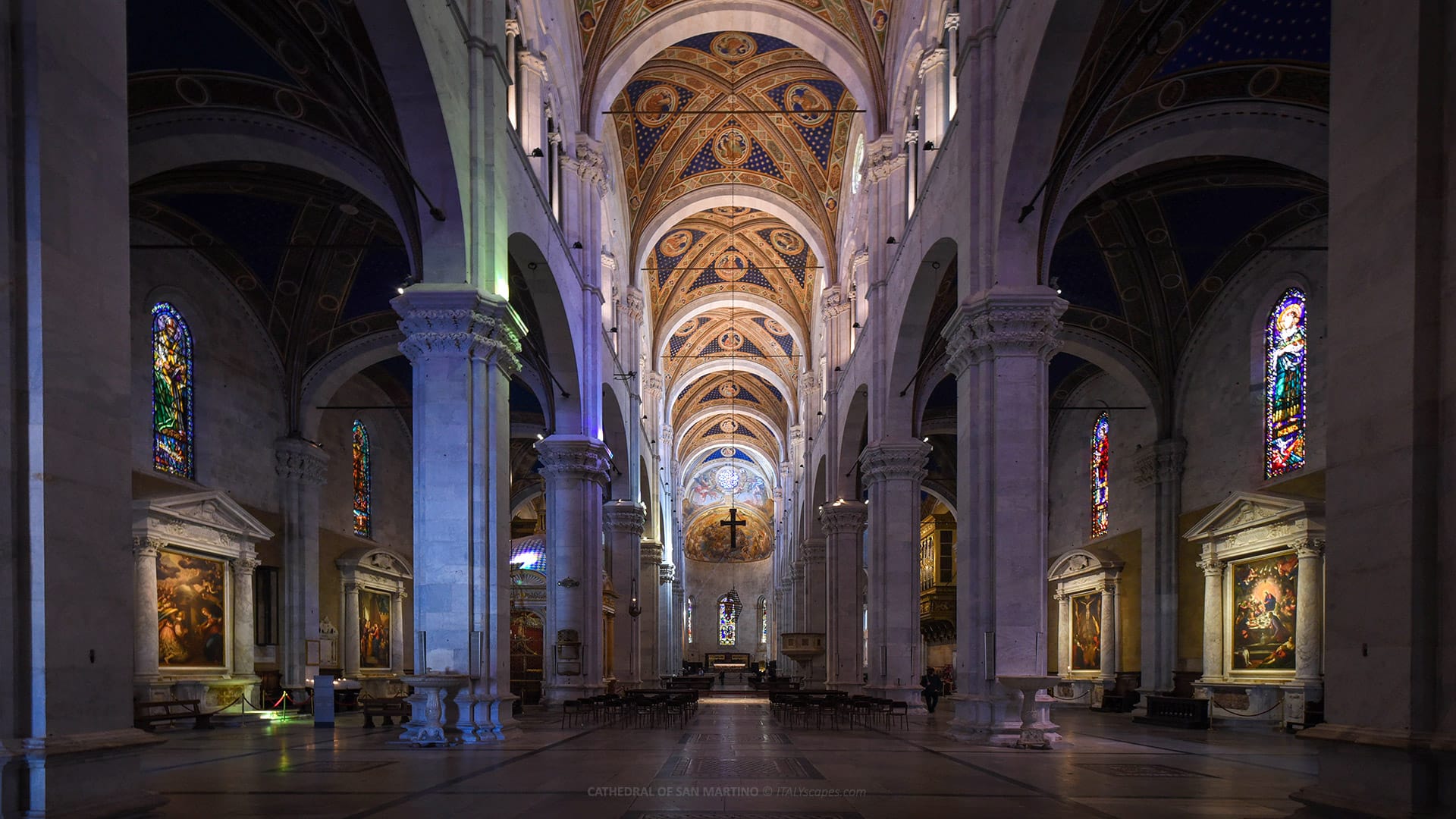
The interior of Lucca Cathedral
Architecture of the Cathedral of San Martino (Lucca Cathedral)
The Asymmetrical Romanesque Façade
At the Cathedral of San Martino, the west façade is one of the finest examples of late Lucca Romanesque architecture. Its lower section forms a deep portico or narthex opened by three broad arches. The right arch is narrower than the others because the existing bell tower occupied part of the available frontage when the portico was designed.
Above the portico rise three levels of open galleries supported by numerous small columns. Their shafts, capitals, arches, and surrounding surfaces display remarkable variety, including geometric ornament, carved figures, and two-colored marble inlays. This deliberate variation prevents the upper façade from becoming a repetitive grid despite its clearly ordered horizontal structure.
A sculptural representation of Saint Martin Sharing His Cloak with a Poor Man appears above the portico. The figure on the exterior is a copy; the original group is preserved inside on the counter-façade. The subject identifies the patron saint through the best-known episode of his charitable life.
The three portals are framed by an extensive decorative program. Reliefs include the Stories of Saint Martin and the Cycle of the Months, while works connected with Nicola Pisano include the Deposition and an architrave depicting the Annunciation, Nativity and Adoration of the Magi.
The Portico and Exterior Details
The portico functioned as more than a monumental entrance. During the Middle Ages, money changers operated beneath it because Lucca attracted merchants and pilgrims traveling along the Via Francigena. A surviving inscription warned exchangers against fraud and placed commercial conduct under the moral protection of the cathedral clergy and Saint Martin.
On a pier beside the bell tower, visitors can see a carved labyrinth accompanied by a Latin inscription referring to Daedalus, Theseus, Ariadne, and the Cretan maze. Its exact interpretation remains debated, but its location on an important pilgrimage route gives the carving a clear connection with movement, difficulty, and guided passage.
The wooden doors were commissioned in 1496 from the workshop of Masseo Civitali. Their carved surfaces belong to the later Renaissance renewal of the cathedral while remaining integrated into the medieval portals. The entrance most frequently used historically also offered a direct axial view toward the chapel containing the Volto Santo di Lucca.
The cathedral measures approximately 84.3 meters in length. The combined width of the naves is about 27.3 meters, while the transept reaches roughly 43.6 meters. These dimensions explain why San Martino dominates its square without possessing the vast scale of the largest Italian cathedral complexes.
Powered by GetYourGuideBell Tower and Building Materials
The bell tower of Lucca Cathedral rises immediately to the right of the façade on a square base. Its vertical elevations open through five levels of progressively more elaborate windows: single openings, biforas, triforas, and two upper stages of quadriforas. The summit is finished with Ghibelline swallowtail battlements.
Built between the 12th and 13th centuries, the tower reaches approximately 60 meters. Its masonry incorporates local materials, including stone from Guamo and limestone from Santa Maria del Giudice, both quarried a few kilometers from Lucca, near the foot of Monte Pisano.
The bell chamber contains seven bells, some dating from the 13th and 14th centuries. After restoration, the tower was opened to visitors, who reach the upper level by climbing 217 steps. The summit provides a 360-degree view across the historical center, the city walls, the Lucca plain, Monte Pisano, and the Pizzorne hills.
The tower’s pre-existence directly determined the irregular arrangement of the façade. Rather than demolishing or concealing the structure, the builders adapted the portico and galleries around it. The result is an architectural composition whose functional asymmetry became one of the cathedral’s most recognizable characteristics.
The Gothic Interior
The interior follows a Latin-cross plan with three naves and a transept. The central nave rises far above the side aisles, producing pronounced verticality. False upper galleries open through Gothic triforas, while ribbed vaults cover the central space and emphasize the long east-west axis toward the presbytery.
Although the spatial impression is strongly Gothic, the design retains rounded arches in many of the principal arcades. Pointed arches appear more selectively, especially in the false galleries and near the eastern end.
The semicircular apse is lit by three large windows and occupied by the presbytery. A high altar made with polychrome marble stands at its center. The transept reaches the height of the central nave and is itself divided into two aisles, but it does not reproduce the upper gallery system.
Much of the marble floor is connected with Matteo Civitali’s Renaissance work. Geometric grids contain panels with plant and abstract motifs, some reusing medieval material. In the central nave, the large polychrome composition Judgment of Solomon, dated 1475, was executed by Antonio di Ghino, probably using a design associated with Matteo Civitali and Baldassarre di Biagio.
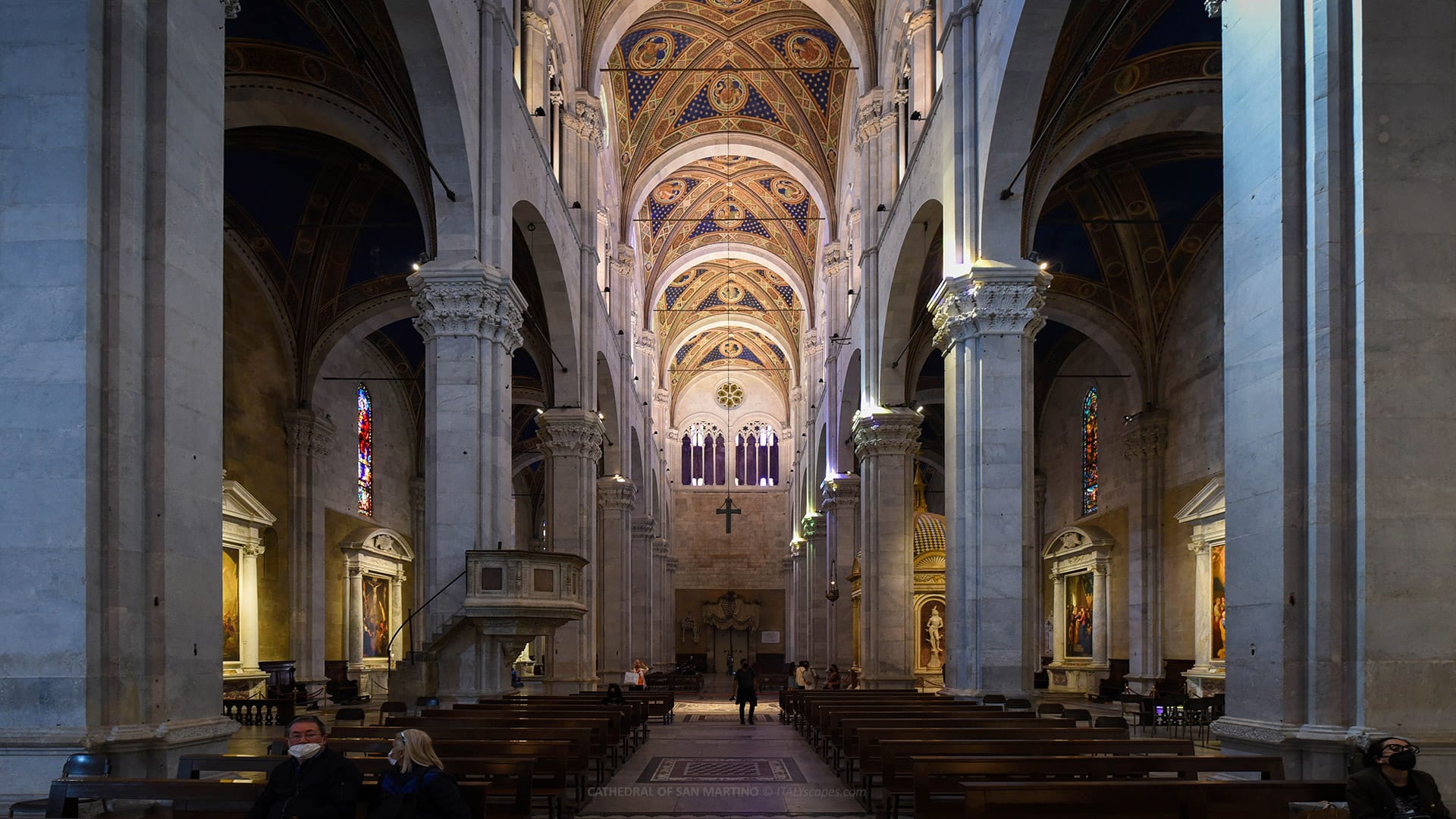
The interior of the Cathedral of San Martino
Art of the Cathedral of San Martino (Lucca Cathedral)
The Volto Santo di Lucca
The most venerated object in the Cathedral of San Martino is the Volto Santo di Lucca, a large wooden crucifix representing the living Christ dressed in a long-sleeved tunic. Scientific examinations announced in 2020 dated the sculpture between the final decades of the 8th century and the beginning of the 9th, making it an exceptionally early surviving wooden image.
According to the medieval legend, Nicodemus carved Christ’s body but did not dare reproduce the face, which was completed through divine intervention. The crucifix was later placed on an unmanned boat, reached the port of Luni, and was brought to Lucca after Bishop Giovanni received a guiding dream.
The legend continues that the image was first placed in San Frediano but miraculously moved toward the cathedral. Whatever the historical origin of the account, the crucifix became a major destination for European pilgrims and appeared on seals and coins, demonstrating its central role in Lucca’s public identity.
The relic is housed in an octagonal marble chapel designed and carved by Matteo Civitali between 1482 and 1484. Eight columns support rounded arches around the enclosure. The chapel stands in the third bay of the left aisle, where its placement makes the crucifix visible within the cathedral’s principal devotional route.
During the celebrations of the Holy Cross, the crucifix is adorned with precious jewels normally preserved in the Cathedral Museum. The annual Luminara di Santa Croce takes place on September 13, when a candlelit procession travels from San Frediano to San Martino before the feast observed on September 14.
The Monument of Ilaria del Carretto
The Funerary Monument of Ilaria del Carretto was commissioned by Paolo Guinigi, ruler of Lucca from 1400 to 1430, after the death of his second wife in 1405. Jacopo della Quercia created the marble ensemble between 1406 and 1410, uniting Gothic elegance with emerging Renaissance naturalism.
Ilaria is represented lying on an elevated base, richly dressed in a long pellanda with a high collar and carefully rendered folds. Her individualized face, elaborate hairstyle, and relaxed pose create the impression of sleep rather than physical decay, while the treatment of fabric reveals the sculptor’s close observation of courtly fashion.
At her feet rests a small dog, traditionally interpreted as a symbol of marital fidelity. The animal is not merely decorative: its raised head and alert posture introduce a subtle living presence beside the still figure. This contrast contributes to the monument’s emotional restraint and visual immediacy.
The base consists of four slabs. The short sides display a branching cross and the combined heraldry of the Guinigi and Del Carretto families. Along the long sides, putti hold garlands in a design derived from ancient Roman sarcophagi, demonstrating Jacopo’s creative use of classical models.
The monument originally stood in the transept near the Guinigi-sponsored altar of San Biagio. After Paolo Guinigi’s fall, its components were partly separated and moved. It never contained Ilaria’s body and was fully reassembled only in the 20th century. Today it is displayed in the Lucca Cathedral sacristy.
Powered by GetYourGuideRenaissance Sculpture and Furnishings
Matteo Civitali’s contribution extends far beyond the chapel of the Holy Face. His work includes holy-water stoups, parts of the marble pavement, funerary monuments, architectural screens, and a suspended pulpit completed in 1498. These commissions gave the cathedral a coherent Renaissance sculptural language rooted in Florentine models and local craftsmanship.
The Tomb of Pietro da Noceto, completed between the late 1460s and 1472, is Civitali’s first signed and dated work. Its arched structure, colored marble panels, reclining figure, heraldic angels, and devotional imagery reinterpret prestigious Florentine tomb types for a patron connected with Pope Nicholas V.
Civitali also created the Tomb of Domenico Bertini and Sveva Risaliti, completed in 1479. Less monumental than the Noceto tomb, it includes a realistic portrait bust and unusual supports shaped as skulls and bones. These details demonstrate the artist’s ability to combine humanist portraiture with funerary symbolism.
The suspended pulpit was commissioned in 1494 by Domenico Bertini. Its semi-hexagonal form recalls the geometry of the chapel of the Holy Face, while its underside presents a concentrated repertory of antique-inspired architectural ornament. The work exemplifies Civitali’s dual role as sculptor and architectural designer.
Paintings and Stained Glass
Domenico Ghirlandaio painted Madonna Enthroned with the Child and Saints in 1479 for a former altar in the right aisle. Now installed in the sacristy, the altarpiece shows the Virgin and Child with Saints Clement, Sebastian, Peter, and Paul in a symmetrical arrangement marked by Florentine Renaissance clarity.
The painting introduced influential compositional and decorative ideas to Lucca, including the rectangular altarpiece format framed with antique-inspired ornament. Ghirlandaio combined rich color, detailed surfaces, and individualized expressions, qualities partly connected with his knowledge of Flemish painting and contemporary Florentine practice.
One of the cathedral’s most important late Renaissance paintings is Tintoretto’s Last Supper, dated 1594 and completed with assistance from his son Domenico Robusti and the workshop. The oblique table creates depth, while dramatic light and active gestures transform the biblical episode into a dynamic Venetian composition.
Fra Bartolomeo’s Madonna of the Sanctuary, signed and dated 1509, depicts the Virgin and Child between Saints John the Baptist and Stephen. Its balanced structure, softened modeling, backlighting, and restrained group of figures made it a powerful model for 16th-century altarpieces in Lucca.
The central apse window bears the signature of Pandolfo di Ugolino and the date 1485. It belongs to the surviving portion of an important late 15th-century stained-glass program. The designs are generally connected with the Lucca artistic environment and possibly with Vincenzo Frediani, working within a culture influenced by Filippino Lippi.
Vincenzo Frediani also painted Stories of the Holy Face on the counter-façade between approximately 1489 and 1495. A damaging restoration in 1960 left the fresco severely compromised, but surviving areas still reveal landscape settings, details from everyday life, and the painter’s narrative interest in the local legend.
The ten side altars created after the reorganization of 1591 preserve paintings by artists from several Italian centers. They include works by Domenico Passignano, Federico Zuccari, Jacopo Ligozzi, Giovan Battista Paggi, and Michele Ridolfi, demonstrating the cathedral’s broad artistic connections during the Counter-Reformation and later periods.
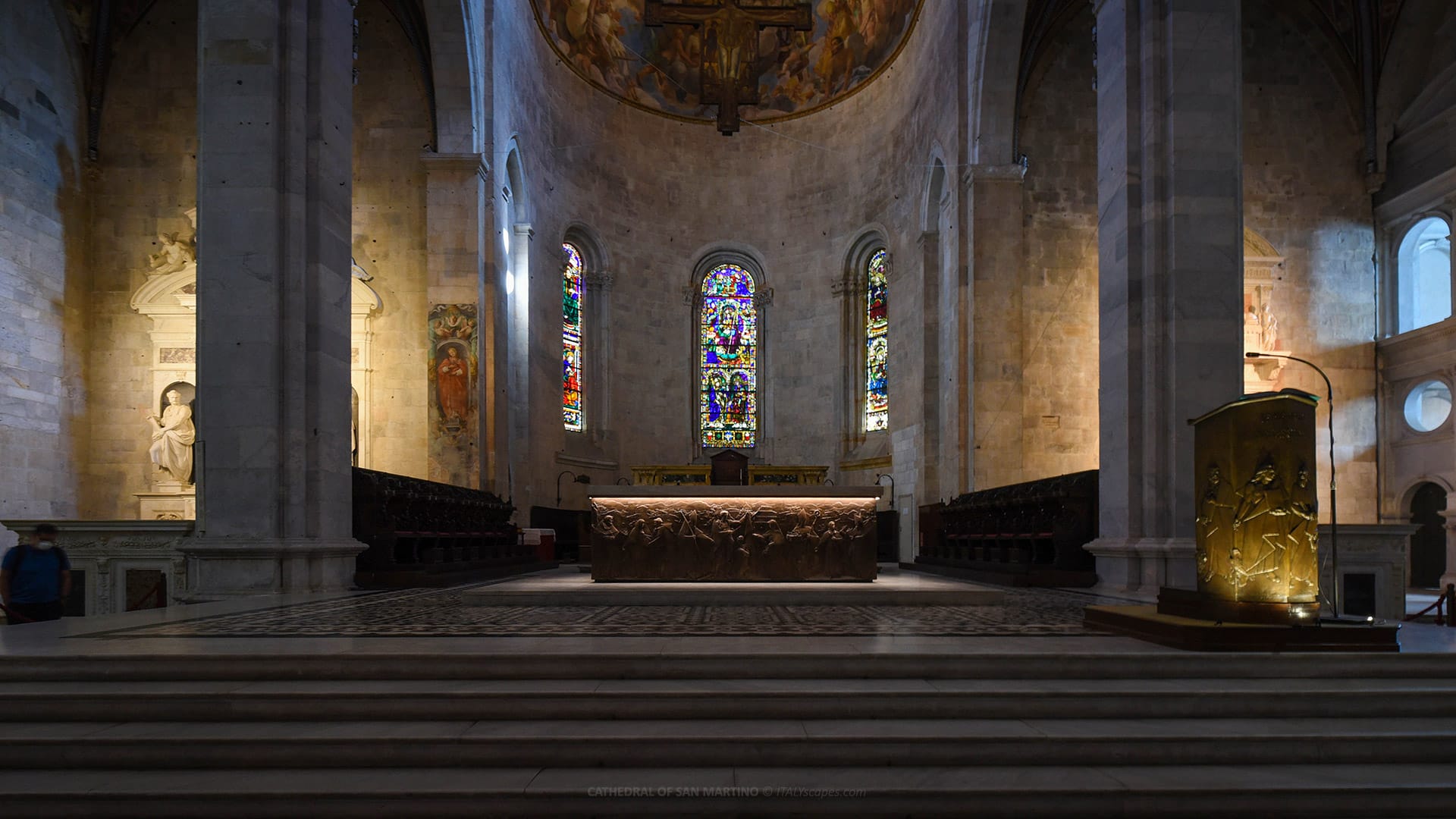
The altar of Lucca Cathedral
How to Get to the Cathedral of San Martino (Lucca Cathedral)
Getting to the Cathedral of San Martino on foot
The Cathedral of San Martino is approximately 700-800 meters from Lucca railway station. The walk normally takes about 9-10 minutes. From the station forecourt, cross toward the city walls and enter the historical center through Porta San Pietro, the most direct southern gateway for pedestrians arriving by train.
Continue toward Piazza San Giovanni, which lies beside the cathedral complex, and then follow the short connection into Piazza San Martino. The route is almost entirely level and passes through the compact walled center. Because the final streets are historic and partly pedestrianized, walking is generally the simplest option for most visitors.
Getting to the Cathedral of San Martino by bus
Urban bus line 2+ connects the railway station area with the eastern part of the historical center. Services call at Stazione FS Lucca or Regina Margherita FS, depending on the direction and current operating pattern, and continue to Della Rosa, the practical stop for reaching the Cathedral of San Martino.
From Della Rosa, the remaining distance is approximately 120 meters, requiring only a short walk through the nearby streets to Piazza San Martino. The bus ride itself is brief, commonly around five or six minutes.
Getting to the Cathedral of San Martino by taxi
Taxis are normally available outside Lucca railway station. The road distance to the cathedral area is under one kilometer, so the journey is very short and is most useful for travelers carrying heavy luggage or visitors whose mobility makes the walk difficult.
Ask for Piazza San Martino or Piazza Antelminelli. Access within Lucca’s restricted historical center can depend on traffic regulations, service permissions, and temporary closures, so the driver may use the nearest authorized stopping point. From there, the cathedral entrance should require only a brief final walk.
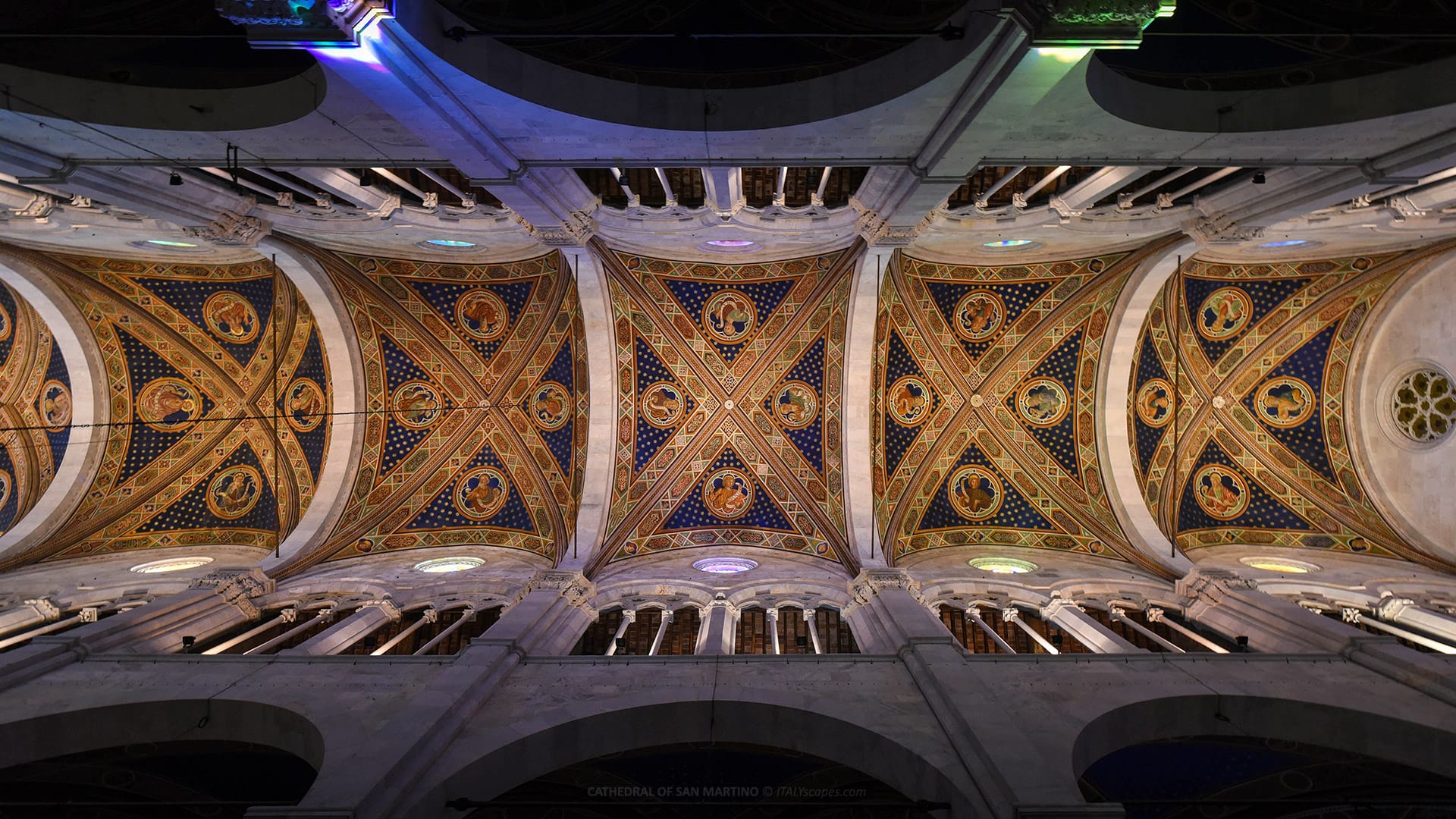
The ceiling of the Cathedral of San Martino
Frequently Asked Questions about the Cathedral of San Martino (Lucca Cathedral)
Where is the Cathedral of San Martino located?
It stands in Piazza San Martino, within Lucca’s walled historical center, beside Piazza Antelminelli and close to the Church of Santi Giovanni e Reparata and the Cathedral Museum.
Who is Lucca Cathedral dedicated to?
Lucca Cathedral is dedicated to Saint Martin of Tours, the 4th-century bishop traditionally represented sharing part of his cloak with a poor man outside the city of Amiens.
When was the Cathedral of San Martino founded?
Tradition attributes the original church to San Frediano in the 6th century. The present monument developed through major Romanesque, Gothic, Renaissance, and later building campaigns.
What is the Volto Santo di Lucca?
The Volto Santo di Lucca is an early medieval wooden crucifix showing Christ in a long tunic. It became Lucca’s principal sacred image and a major pilgrimage destination.
Can visitors climb the cathedral bell tower?
Yes. The bell tower forms part of the cathedral museum itinerary, and visitors can climb 217 steps to obtain panoramic views over Lucca, its walls, surrounding hills, and plain.
How far is the cathedral from Lucca railway station?
The cathedral is approximately 700-800 meters from Lucca railway station. The direct walk through Porta San Pietro normally takes around nine or ten minutes.
Sources:Powered by GetYourGuide -
Photos
-
Map
-
Reviews


